Blake seeks to provide the Golden String which can lead us through the labyrinth of our experience or his own poetry.

Tuesday, November 12, 2013

THE JOURNEY III


British Museum
  For the Sexes: Gates of Paradise
Plate 1
For the Sexes: Gates of Paradise, Plate 3, (E 260) 
"1 I found him beneath a Tree"  

For the Sexes: Gates of Paradise, Plate 19, (E 268)

"Keys 

1    My Eternal Man set in Repose
     The Female from his darkness rose
     And She found me beneath a Tree                     
     A Mandrake & in her Veil hid me
     Serpent Reasonings us entice
     Of Good & Evil: Virtue & Vice"


The undivided man is neither male nor female. He becomes divided when the female is separated by becoming exteriorized. The unified individual is the goal toward which the journey leads as well as the starting point from which it begins. The first of the series of plates in For the Sexes: Gates of Paradise represents the first of the divisions the Eternal Man undergoes which starts him on the return Journey. Higher levels of consciousness develop through the breaking down of the paradigm which is in control of the current level of development. Blake follows the thought pattern which asserts that we behold externally what we need to deal with internally.

The divided man becomes a babe emerging from the earth which represents a darker region of the unconscious. The female assumes care and control of the infant. The outer world becomes more real to the man than the inner world which had been his whole world before he divided.

The first division leads to another. Eve who has split from Adam eats of the Tree of Knowledge of Good and Evil. The knowledge is passed on to Adam and the internal reasoning power becomes dualistic rather the monistic.

The man taken from the earth assumes the garment of mortality; he is hidden in the veil of flesh.

The serpent is said to represent the infinite confined by the finite. The ability to see everything as holy has become the desire to cling to what we call good, and reject what we call evil. Integrating the contraries becomes a major task of continuing on the Journey.

Jerusalem, Plate 30 [34], (E 176)
"What may Man be? who can tell! but what may Woman be?            
To have power over Man from Cradle to corruptible Grave.
There is a Throne in every Man, it is the Throne of God
This Woman has claimd as her own & Man is no more!" 

 Four Zoas, Night IX, Page 133, (E 401)
"And Many Eternal Men sat at the golden feast to see 
The female form now separate They shudderd at the horrible thing
Not born for the sport and amusement of Man but born to drink up all his powers
They wept to see their shadows they said to one another this is Sin  
This is the Generative world" 

 Milton, Plate 3, (E 97)  
"Enraged & stifled without & within: in terror & woe, he threw his
Right Arm to the north, his left Arm to the south, & his Feet  
Stampd the nether Abyss in trembling & howling & dismay
And a seventh Age passed over & a State of dismal woe

Terrified Los stood in the Abyss & his immortal limbs
Grew deadly pale; he became what he beheld: for a red
Round Globe sunk down from his Bosom into the Deep in pangs  
He hoverd over it trembling & weeping. suspended it shook
The nether Abyss in temblings. he wept over it, he cherish'd it
In deadly sickening pain: till separated into a Female pale
As the cloud that brings the snow: all the while from his Back
A blue fluid exuded in Sinews hardening in the Abyss       
Till it separated into a Male Form howling in Jealousy

Within labouring. beholding Without: from Particulars to Generals
Subduing his Spectre, they Builded the Looms of Generation
They Builded Great Golgonooza Times on Times Ages on Ages
First Orc was Born then the Shadowy Female: then All Los's Family
At last Enitharmon brought forth Satan Refusing Form, in vain
The Miller of Eternity made subservient to the Great Harvest
That he may go to his own Place Prince of the Starry Wheels"
 
First Corinthians 11
[11] (Nevertheless, in the Lord woman is not independent of man nor man of woman;
[12] for as woman was made from man, so man is now born of woman. And all things are from God.) 
.

Sunday, November 10, 2013

THE JOURNEY II

British Museum
For The Sexes: THE GATES of PARADISE
Title & Prologue
As a prologue to Blake's second version of The Gates of Paradise he added a passage which incorporates some of his most basic teaching about the condition of man. He tells us that entry into Eternity in which man's divine nature is realized, requires that man engage in Mutual Forgiveness. Unless an individual knows himself to be forgiven and actively forgives the faults in others he aligns himself with the Accuser. Having eaten of the fruit of the knowledge of good and evil, the individual assigns the category good to whatever benefits him, and evil to whatever opposes him. Until he realizes the everything is holy, the Gates will not open for him.


To Blake eating of the fruit of the forbidden tree led to the promulgation of the law which is the instrument of accusation, dividing man into the virtuous and the law-breaker. Mercy, which does not assign guilt, deserves to be placed on Christian altars in the place of commandments through which man may be condemned.

Blake wrote The Gates of Paradise as a guide for entry into Paradise. The prologue serves a reminder that the stages through which man progresses are are not for the purpose of condemnation but should lead to acceptance and forgiveness.

For The Sexes: THE GATES of PARADISE, Prologue, (E259)                      
"Mutual Forgiveness of each Vice
Such are the Gates of Paradise
Against the Accusers chief desire
Who walkd among the Stones of Fire
Jehovahs Finger Wrote the Law 
Then Wept! then rose in Zeal & Awe
And the Dead Corpse from Sinais heat 
Buried beneath his Mercy Seat
O Christians Christians! tell me Why
You rear it on your Altars high"         

Jerusalem, Plate 54, (E 203)
"In Great Eternity, every particular Form gives forth or Emanates
Its own peculiar Light, & the Form is the Divine Vision
And the Light is his Garment This is Jerusalem in every Man
A Tent & Tabernacle of Mutual Forgiveness Male & Female Clothings.
And Jerusalem is called Liberty among the Children of Albion" 

Jerusalem, Plate 92, (E 252)
"Los answerd swift as the shuttle of gold. Sexes must vanish & cease
To be, when Albion arises from his dread repose O lovely Enitharmon:
When all their Crimes, their Punishments their Accusations of Sin: 
All their Jealousies Revenges. Murders. hidings of Cruelty in Deceit
Appear only in the Outward Spheres of Visionary Space and Time.
In the shadows of Possibility by Mutual Forgiveness forevermore
And in the Vision & in the Prophecy, that we may Foresee & Avoid
The terrors of Creation & Redemption & Judgment."

Songs and Ballads, (E 477)
"Let us agree to give up Love
And root up the infernal grove                                 
Then shall we return & see
The worlds of happy Eternity

& Throughout all Eternity 
I forgive you you forgive me
As our dear Redeemer said                                   
This the Wine & this the Bread"
 
Ephesians 4
[31] Let all bitterness and wrath and anger and clamor and slander be put away from you, with all malice,
[32] and be kind to one another, tenderhearted, forgiving one another, as God in Christ forgave you.

Mark 2
[5] And when Jesus saw their faith, he said to the paralytic, "My son, your sins are forgiven."

Mark 11
[25] And whenever you stand praying, forgive, if you have anything against any one; so that your Father also who is in heaven may forgive you your trespasses."

Luke 6
[37] "Judge not, and you will not be judged; condemn not, and you will not be condemned; forgive, and you will be forgiven

.

Friday, November 8, 2013

THE JOURNEY

Wikipedia Commons  
For the Sexes: The Gates of Paradise
Frontispiece
Blake published The Gates of Paradise twice: once For Children, once For The Sexes. The second version provides the same pictures with added statements.

On the Frontispiece is an image of a caterpillar on a leaf above another leaf upon which rests a chrysalis bearing the face of a sleeping infant. Blake has set the stage for two versions of the answer to the question, "What is Man!", which forms the caption for the picture. When he issued the plate for a second time he added: "The Suns Light when he unfolds it/Depends on the Organ that beholds it." Thus he reinforced the idea that there are alternate ways of understanding the nature of man.

The version of the poem, For The Sexes, adds Keys to the gates at the end of the 18 plates. The Key to the Frontispiece is, "The Catterpiller on the Leaf/ Reminds thee of thy Mothers Grief." Being born of woman is Natural birth, birth into the Natural world by the Natural man. The Gates of Paradise proposes to lead the reader through a rebirth which is available to the sleeping infant bound in the chrysalis if he emerges from the Natural to the Spiritual.

Thel, Plate 3, (E 5)
"Then if thou art the food of worms. O virgin of the skies,       
How great thy use. how great thy blessing; every thing that lives,
Lives not alone, nor for itself: fear not and I will call
The weak worm from its lowly bed, and thou shalt hear its voice.
Come forth worm of the silent valley, to thy pensive queen.

The helpless worm arose, and sat upon the Lillys leaf,           
And the bright Cloud saild on, to find his partner in the vale."

Four Zoas, Night IX, Page 133, (E 401)
"And Many Eternal Men sat at the golden feast to see 
The female form now separate They shudderd at the horrible thing
Not born for the sport and amusement of Man but born to drink up all his powers
They wept to see their shadows they said to one another this is Sin
This is the Generative world they rememberd the Days of old

And One of the Eternals spoke All was silent at the feast 

Man is a Worm wearied with joy he seeks the caves of sleep
Among the Flowers of Beulah in his Selfish cold repose
Forsaking Brotherhood & Universal love in selfish clay
Folding the pure wings of his mind seeking the places dark"

Job 7
[17] What is man, that thou dost make so much of him,
and that thou dost set thy mind upon him,

Psalms 8
[4] what is man that thou art mindful of him,
and the son of man that thou dost care for him?

John 19
[5] So Jesus came out, wearing the crown of thorns and the purple robe. Pilate said to them, "Behold the man!" 

.

Wednesday, November 6, 2013

BREATH DIVINE

Blake's image of the Elohim creating Adam is well known. An equally striking image of the creation of mankind is rarely seen. The opportunity to illustrate a new edition of Young's Night Thoughts impelled Blake to paint 537 watercolor images for the book. However only 43 were published before the project was suspended. The complete set of illustrations resides in the British Museum and is available to be viewed online.

The particular image that recently caught my attention shows Jesus in the role of the creator breathing  the Breath of Life into the newly formed body of man still clothed in the red clay from which he was formed. The hands of the creator rest on the head of the new being and on the earth from which he came as they do in the more famous image, however the positions are reversed.

The 'breath of the Almighty', 'Human Hands & Feet & Breath', and 'the Breath Divine', are terms which Blake used to designate the indwelling spirit which gives life to man. Biblical terminology includes 'the breath of life', 'the breath of the Almighty', and 'the Holy Spirit.' 

Milton, Plate 30 [33], (E 129)
"Beulah is evermore Created around Eternity; appearing
To the Inhabitants of Eden, around them on all sides.
But Beulah to its Inhabitants appears within each district       
As the beloved infant in his mothers bosom round incircled
With arms of love & pity & sweet compassion. But to
The Sons of Eden the moony habitations of Beulah,
Are from Great Eternity a mild & pleasant Rest.

And it is thus Created. Lo the Eternal Great Humanity            
To whom be Glory & Dominion Evermore Amen
Walks among all his awful Family seen in every face
As the breath of the Almighty. such are the words of man to man
In the great Wars of Eternity, in fury of Poetic Inspiration,
To build the Universe stupendous: Mental forms Creating"          

Jerusalem, Plate 27, (E 173)
 "The Divine Vision still was seen
Still was the Human Form, Divine
  Weeping in weak & mortal clay
O Jesus still the Form was thine.      

  And thine the Human Face & thine
The Human Hands & Feet & Breath
  Entering thro' the Gates of Birth
And passing thro' the Gates of Death"

Jerusalem, Plate 93, (E 254) 
"Over them the famishd Eagle screams on boney Wings and around   
Them howls the Wolf of famine deep heaves the Ocean black thundering
Around the wormy Garments of Albion: then pausing in deathlike silence

Time was Finished! The Breath Divine Breathed over Albion
Beneath the Furnaces & starry Wheels and in the Immortal Tomb
And England who is Brittannia awoke from Death on Albions bosom 
She awoke pale & cold she fainted seven times on the Body of Albion" 

Jerusalem, Plate 95, (E 254)
"Her voice pierc'd Albions clay cold ear. he moved upon the Rock
The Breath Divine went forth upon the morning hills, Albion mov'd 
Upon the Rock, he opend his eyelids in pain; in pain he mov'd
His stony members, he saw England. Ah! shall the Dead live again

The Breath Divine went forth over the morning hills Albion rose 
In anger: the wrath of God breaking bright flaming on all sides around
His awful limbs: into the Heavens he walked clothed in flames
Loud thundring, with broad flashes of flaming lightning & pillars
Of fire, speaking the Words of Eternity in Human Forms, in direful
Revolutions of Action & Passion, thro the Four Elements on all sides  
Surrounding his awful Members."

Gen.2
[1] Thus the heavens and the earth were finished, and all the host of them.
[2] And on the seventh day God finished his work which he had done, and he rested on the seventh day from all his work which he had done.
[3] So God blessed the seventh day and hallowed it, because on it God rested from all his work which he had done in creation.
[4] These are the generations of the heavens and the earth when they were created. In the day that the LORD God made the earth and the heavens,
[5] when no plant of the field was yet in the earth and no herb of the field had yet sprung up -- for the LORD God had not caused it to rain upon the earth, and there was no man to till the ground;
[6] but a mist went up from the earth and watered the whole face of the ground --
[7] then the LORD God formed man of dust from the ground, and breathed into his nostrils the breath of life; and man became a living being.


Job 32
[8] But it is the spirit in a man,
the breath of the Almighty, that makes him understand.
[9] It is not the old that are wise,
nor the aged that understand what is right.

Job 33
[4] The spirit of God has made me,
and the breath of the Almighty gives me life.

John 20
[21] Jesus said to them again, "Peace be with you. As the Father has sent me, even so I send you."
[22] And when he had said this, he breathed on them, and said to them, "Receive the Holy Spirit..."
.

Monday, November 4, 2013

BLAKE & FUSELI VI

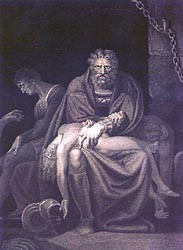
Blake felt compelled to speak out against the criticism in the Monthly Magazine which his friend Fuseli's painting Count Ugolino received. Blake defended Fuseli's rendering of the subject and attacked the publication for undermining the taste of the British public by promoting the style imported from Flanders and Holland.
Wikipedia Count Ugolino
Print of Fuseli's lost painting

Letters, To the Editor of the Monthly Magazine (E 768) SIR, 
 My indignation was exceedingly moved at reading a criticism in Bell's Weekly Messenger (25th May) on the picture of Count Ugolino, by Mr. Fuseli, in the Royal Academy exhibition
 ...
"My criticism on this picture is as follows:

     Mr. Fuseli's Count Ugolino is the father of sons of feeling
and dignity, who would not sit looking in their parent's face in
the moment of his agony, but would rather retire and die in
secret, while they suffer him to indulge his passionate and
innocent grief, his innocent and venerable madness, and insanity,
and fury, and whatever paltry cold hearted critics cannot,
because they dare not, look upon.  Fuseli's Count Ugolino is a
man of wonder and admiration, of resentment against man and
devil, and of humilitation before God; prayer and parental
affection fills the figure from head to foot.  The child in his
arms, whether boy or girl signifies not, (but the critic must be
a fool who has not read Dante, and who does not know a boy from a
girl); I say, the child is as beautifully drawn as it is
coloured--in both, inimitable! and the effect of the whole is
truly sublime, on account of that very colouring which our critic
calls black and heavy.  The German flute colour, which was used
by the Flemings, (they call it burnt bone), has possessed the eye
of certain connoisseurs, that they cannot see appropriate
colouring, and are blind to the gloom of a real terror."

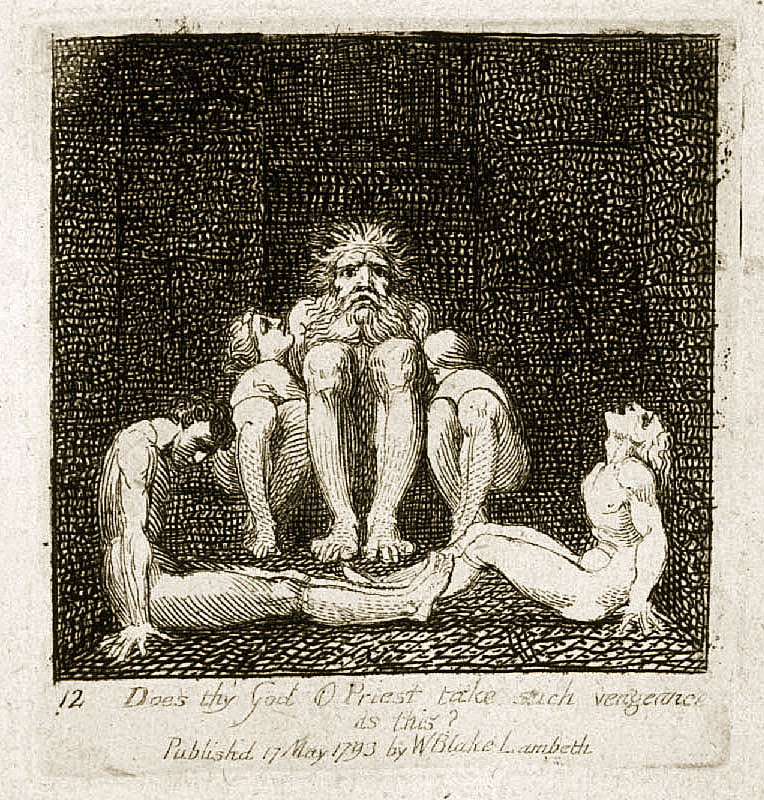
The theme of Ugolino's imprisonment and suffering was common among artists. Milton Klonsky writes in Blake's Dante, "As an instance of papal tyranny, Ugolino's imprisonment and death by starvation became a popular subject for Protestant English artists."  Blake included images of the family who had been sealed in a locked tower sentenced to die of starvation in Marriage of Heaven & Hell, in A Small Book of Designs, and in Gates of Paradise. The caption on the image in Gates of Paradise is, "Does thy God O Priest take such vengeance as this?" When Blake illustrated Dante's Divine Comedy near the end of his life he returned to the tragic incident.

Among the themes Blake alluded to in his images are his opposition to vengeance, the imprisonment of man in his five senses, and the suffering which man brings on himself and his children by violence. 

In his final use of the image Blake adds two motifs not present in the earlier images; angels make there presence known in the cell, and the flames of a fire are seen behind Ugolino's head. The protection by the Divine Providence can be seen in the presence of the angels. The cleansing fire of the furnace preliminary to regeneration has been added as well.  
Wikipedia Commons
Ugolino in Prison
Illustration to Dante's Divine Comedy
.

Sunday, November 3, 2013

BLAKE & WORDSWORTH III

Blake valued Wordsworth's works highly enough to study them carefully and to write comments in two of his books. He found that he could not agree with Wordsworth view that the appreciation of Nature led to spiritual consciousness.
Annotations to Wordsworth's Poems, (E 665)  
Wordsworth on page 44:
" Influence of Natural Objects 
     Incalling forth and strengthening the Imagination 
     in Boyhood and early Youth."

Blake:  
"Natural Objects always did & now do Weaken deaden &
obliterate Imagination in Me  Wordsworth must know that what he
Writes Valuable is Not to be found in Nature Read Michael Angelos
Sonnet vol 2 p. 179"
Wordsworth was quite familiar with the poem from Michelangelo to which Blake referred; he had translated it himself from the Italian to English poetry. Blake finds in the poem affirmation that the spiritual world is primary, that the natural world derives its meaning from the spiritual world and not the reverse. Wordsworth's expressed dependence on the world of nature for inspiration was repugnant to Blake because Nature to him obscured and distorted the visionary experience which he enjoyed.

The Life of William Blake by Alexander Gilchrist provides the poem which Blake cited:
 
Miscellaneous Poems, Michael Angelo
"No mortal object did these eyes behold
When first they met the placid light of thine,
And my Soul felt her destiny divine,
And hope of endless peace in me grew bold:
Heaven-born, the Soul a heavenward course must hold;
Beyond the visible world she soars to seek
(For what delights the sense is false and weak)
Ideal Form, the universal mould.
The wise man, I affirm, can find no rest
In that which perishes: nor will he lend
His heart to aught which doth on time depend.
'Tis sense, unbridled will, and not true love,
That kills the soul: love betters what is best,
Even here below, but more in heaven above."

British Museum

Caption for the picture in the British Museum:
"Adapted by Blake after a figure painted by Michelangelo in the Pauline Chapel in the Vatican, known to Blake through prints. Almost wholly engraved - very few etched lines. The plate is dated 1773, which is the date of the first state (the earliest known print designed and engraved by Blake). Substantially reworked for the second state c1810-20."

From Engravings of William Blake by Archibald Russell on page 53 we read:
"The figure of Joseph is derived from that on the extreme right, in front, of Michelangelo's fresco of the Crucifixion of St. Peter in the Vatican."   

Legend on second version of image:

"JOSEPH of Arimathea among The Rocks of Albion
     Engraved by W Blake 1773 from an old Italian Drawing 
     This is One of the Gothic Artists who Built the Cathedrals
in what we call the Dark Ages    Wandering about in sheep skins &
goat skins of  whom  the World was not worthy   such were the
Christians in all Ages
     Michael Angelo Pinxit 

 [on a proof of the early state of the plate]
     Engraved when I was a beginner at Basires from a drawing by
Salviati after Michael Angelo" 
 
Blake's comment on the final paragraph of the 1818 edition of Wordsworth's Poems gave him the opportunity further to express his thoughts on the contrast between Memory and Imagination, between the Natural Man and the Spiritual Man.
 

Annotations to Wordsworth's Poems, (E 666)  
[Page 375, final paragraph]  
Wordsworth: ". . . if [the Writer] were not
persuaded that the Contents of these Volumes . . . evinced
something of the "Vision and the Faculty divine," . . . he would
not, if a wish could do it, save them from immediate
destruction."

Blake: "It appears to me as if the last Paragraph beginning With "Is
it the result" Was writ by another hand & mind from the rest of
these Prefaces.  Perhaps they are the opinions of Sr G Beaumont a
Landscape Painter [to whom the book was dedicated] 
Imagination is the Divine Vision not of The
World nor of Man nor from Man as he is a Natural Man but only as
he is a Spiritual Man Imagination has nothing to do with Memory" 
 

Saturday, November 2, 2013

BLAKE & WORDSWORTH II

The evidence that William Wordsworth was acquainted with Blake's poetry comes from Diary, Reminiscences, and Correspondence of Henry Crabb Robinson. In an entry from 1812 on page 247 we read:

"May 24th. — A very interesting day. At half-past 
ten joined Wordsworth in Oxford Road ; we then got 
into the fields, and walked to Hampstead. I read to 
him a number of Blake's poems, with some of which he 
was pleased. He regarded Blake as having in him the 
elements of poetry much more than either Byron or 
Scott."
Blake apparently paid more attention to Wordsworth than vice versa. In this passage from Harold Bloom's commentary in Erdman's The Complete Poetry and Prose of William Blake, Bloom comments on the transcript produced by Blake of Wordsworth's Preface and the lines quoted there from "the first Book of the Recluse". Even the punctuation became a means that Blake used to differentiate his thought from Wordsworth's.
On Page 666 Bloom writes:

"Annotations to the Preface to The Excursion, being a portion
of The Recluse, A Poem, by William Wordsworth.  London, 1814

     Blake's transcript and comment (in 1826) on Wordsworth's
Preface and the lines quoted there from "the first Book of the
Recluse" are in Dr Williams's Library, London.
...
He capitalized rather heavily: Wordsworth's "good and evil of our
mortal state" became "Good & Evil of our Mortal State", and Blake
insisted on capitalizing Law Supreme, Earth, Heaven, and "Worlds
To which the Heaven of Heavens is but a Veil", also "darkest Pit"
and "Song"; but he resisted several of Wordsworth's capitals,
turning "prophetic Spirit! that inspir'st / The human Soul of
universal earth" to "Prophetic Spirit that inspirest / The Human
soul of Universal Earth".  Similar reversals of case were:
"illumination,--may my Life" to "Illumination may my life" and
"My Heart . . . thy unfailing love" to "My heart . . . thy
unfailing Love"."  
 Henry Crabb Robinson makes an amusing but revealing remark about Blake on page 303 of his above mentioned book  
British Museum
Illustrations to Young's Night Thoughts
"Sharp became a warm partisan of Joanna Southcott, and endeavoured to make a convert of Blake; but, as Flaxman judiciously observed, such men as Blake are not fond of playing second fiddle. Blake lately told Flaxman that he had had a violent dispute with the angels on some subject, and had driven them away" 


To Blake Poetry was not to be taken lightly. We can imagine him disputing with angels as he wrote: 


Milton, Plate 41 [48], (E 142)
"To cast off the idiot Questioner who is always questioning,
But never capable of answering; who sits with a sly grin
Silent plotting when to question, like a thief in a cave;
Who publishes doubt & calls it knowledge; whose Science is Despair   
Whose pretence to knowledge is Envy, whose whole Science is
To destroy the wisdom of ages to gratify ravenous Envy;
That rages round him like a Wolf day & night without rest
He smiles with condescension; he talks of Benevolence & Virtue
And those who act with Benevolence & Virtue, they murder time on time
These are the destroyers of Jerusalem, these are the murderers
Of Jesus, who deny the Faith & mock at Eternal Life:
Who pretend to Poetry that they may destroy Imagination;
By imitation of Natures Images drawn from Remembrance
These are the Sexual Garments, the Abomination of Desolation
Hiding the Human lineaments as with an Ark & Curtains 
Which Jesus rent: & now shall wholly purge away with Fire
Till Generation is swallowd up in Regeneration." 
.