Blake seeks to provide the Golden String which can lead us through the labyrinth of our experience or his own poetry.

Showing posts with label Vision. Show all posts

Tuesday, May 20, 2025

ROMANTIC POETRY

Victoria and Albert Museum
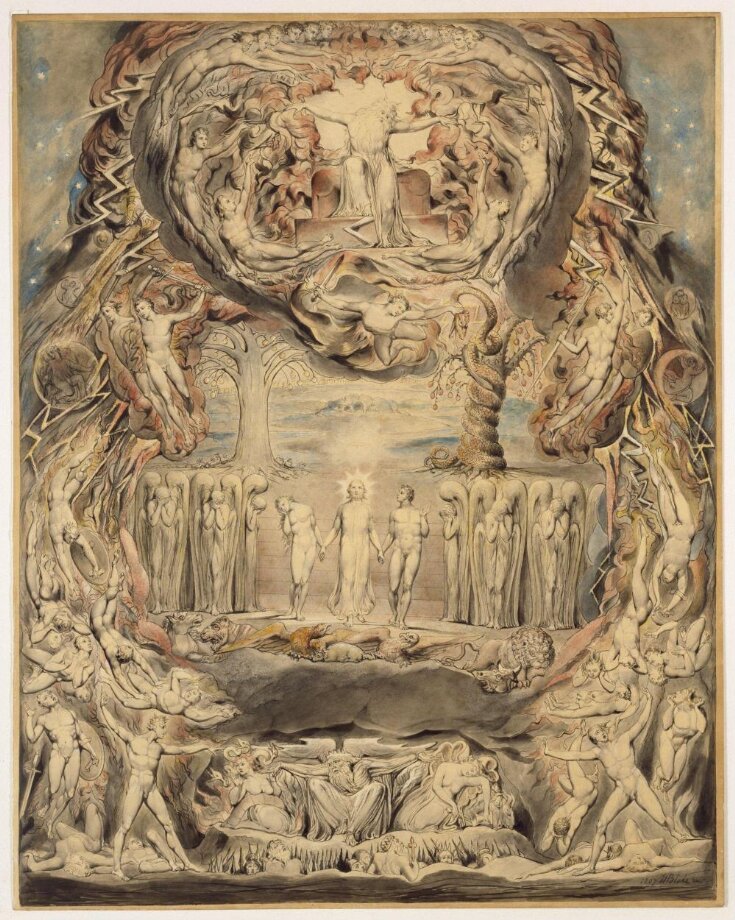
Fall of Man


The Visionary Company, Harold Bloom

Bloom began his book on English Romantic Poetry with a chapter on the background which formed its basis. The historic circumstances during which Romantic Poetry was written influenced the six men who are acknowledged as the major poets of the Romantic period: Blake, Wordsworth, Coleridge, Byron, Shelley and Keats. This was the historic period dominated by the spirit of revolution including the American Revolution, the French Revolution and the Napoleonic wars. 

During the Romantic period England was undergoing a change from a agrarian society to one dominated by an industrial working class. There was concern among our poets for the misery generated by economic and social disruption. However Bloom atributes religious dissent, a common characteric of the six poets, to be a more important aspect which they held in common.  Although each espressed his religious beliefs distinctively, they all were from the protestant nonconformist milieu. Each expressed in his poetry his "autonomous soul seeking its own salvation outside of and beyond the hierarchy of grace." (Page xviii)

Bloom points out that the Romantic interest in Creating and in Imagination are two of its distinguishing characteristics. Creating which had been associated primarily with the activity of God was extended to the activity of man in bringing forth means of expressing truth in poetry. The concept of the Imagination, which was routinely correlated with madness, became a means of trancending the restrictions of self-imposed constraints.

The Romantic period was innovative. It broke away from a time of tradition, orthodoxy, conformity. Its poetry was the expression of new ways of thinking, feeling, relating and believing. The diversity within the group of poets themselves was a clear indication that each perceived the world from the depths of his individual psyche.      

As Bloom states "the Romantic assertion is not just an assertion; it is a metaphysic, a theory of history, and much more important than either of these, it is what all the Romantics - but Blake in particular - called a vision, a way of seeing, and of living a more human life." Page xxiii

Blake's Comments on the Poetry of William Wordsworth

Miscellaneous Prose, (E 698)

[Blake's Autograph in the Album of William Upcott]

"WILLIAM BLAKE one who is very much delighted with being in good Company Born 28 Novr 1757 in London & has died several times since January 16 1826 The above was written & the drawing annexed by the desire of Mr Leigh how far it is an Autograph is a Question I do not think an Artist can write an Autograph especially one who has Studied in the Florentine & Roman Schools as such an one will Consider what he is doing but an Autograph as I understand it, is Writ helter skelter like a hog upon a rope or a Man who walks without Considering whether he shall run against a Post or a House or a Horse or a Man & I am apt to believe that what is done without meaning is very different from that which a Man Does with his Thought & Mind & ought not to be Calld by the Same Name. I consider the Autograph of Mr Cruikshank which very justly stands first in the Book & that Beautiful Specimen of Writing by Mr Comfield & my own; as standing [in] the same Predicament they are in some measure Works of Art & not of Nature or Chance Heaven born the Soul a Heavenward Course must hold For what delights the Sense is False & Weak Beyond the Visible World she soars to Seek Ideal Form, The Universal Mold Michael Angelo. Sonnet as Translated by Mr Wordsworth

Annotations to Wordsworth, PREFACE [PAGE viii] (E 665)

WORDSWORTH: "The powers requisite for the production of
poetry are, first, those of observation and description. . . .
whether the things depicted be actually present to the senses, or
have a place only in the memory. . . . 2dly, Sensibility, . . ."

BLAKE: "One Power alone makes a Poet.-Imagination The Divine Vision" 
Annotations to Wordsworth, PREFACE, Page 43, (E 665) 
WORDSWORTH: To H. C. Six Years Old
BLAKE:  "This is all in the highest degree Imaginative & equal to any
Poet but not Superior   I cannot think that Real Poets have any
competition   None are greatest in the Kingdom of Heaven it is so
in Poetry"  
Annotations to Wordsworth, PREFACE, Page 44, (E 665) 
 "Natural Objects always did & now do Weaken deaden &
obliterate Imagination in Me   Wordsworth must know that what he
Writes Valuable is Not to be found in Nature   Read Michael Angelos
Sonnet vol 2 p. 179 

Michaelangelo

When first they met the placid light of thine,And my Soul felt her destiny divine,And hope of endless peace in me grew bold:Heaven-born, the Soul a heavenward course must hold;Beyond the visible world she soars to seek(For what delights the sense is false and weak)Ideal Form, the universal mould.The wise man, I affirm, can find no restIn that which perishes: nor will he lendHis heart to aught which doth on time depend.'Tis sense, unbridled will, and not true love.That kills the soul: love betters what is best,Even here below, but more in heaven above."

Annotations to Wordsworth's  POEMS, Page 375, (E 666)
"It appears to me as if the last Paragraph beginning With "Is
it the result" Was writ by another hand & mind from the rest of
these Prefaces.  Perhaps they are the opinions of Sr G Beaumont a
Landscape Painter   Imagination is the Divine Vision not of The
World nor of Man nor from Man as he is a Natural Man but only as
he is a Spiritual Man  Imagination has nothing to do with Memory"

Textural Notes (BY David V. Erdman for Pages 659-666) (E 887)

Annotations to Volume 1 of Poems including Lyrical Ballads...By William Wordsworth

"PAGE 375 opinions of . . . a Landscape Painter] The 'Landscape Painter' comes out in Wordsworth's contempt for poetry that 'does not contain a single new image of external nature' or evidence 'that the eye of the Poet had been steadily fixed upon his object' (paragraph 20) as well as in his faulting Macpherson for using imagery inappropriate to the actual 'Morven before his eyes' (p 364). The Preface, from p I on, assumes 'memory' to be the supplier of 'materials' for the production of poetry."

Wednesday, February 12, 2025

FIRST VISION OF LIGHT

 First posted Dec 2020 

Like Blake, Larry was interested in learning all that he could about the wisdom of the ages. In 1977 he had been studying Ouspensky, Gurdjieff, and Nicoll. From there he went on to pursuing C. G. Jung and his interpreters. He came across a little book by W. P. Witcutt titled Blake: A Psychological Study which proposed to use Jungian psychology as a key to understanding Blake. As a result Larry turned to studying Blake because he found his poetry more lucid and and cogent than anything he had been studying.

Larry wrote: 
"My own serious interest in Blake began in 1977 when my wife brought Blake: A Psychological Study by W. P. Witcutt home from the Arlington Public Library. I had been on the point of a commitment to the study of Jung's voluminous writings, which at that time seemed the most creative intellectual work at hand. Witcutt diverted my commitment to Blake, which we have now."

Following his study of Witcutt Larry wrote the following on 5-18-1978.

"Some ideas about Blake's poetry:

It is naming of the selves. Sharing his visions gives great help in understanding, in gaining detachment from the hardening and rigid concrete of opinion, prejudice, passion - the principalities and powers - that work to make us automatisms, zombies, denizens of hell. It offers fresh and new ways of perceiving life - ourselves and others - it detaches us from the old man - this body of death, makes us aware of the spiritual struggle going on - we have been asleep to it - tossed under the waves, the prostrate Albion, the sick king. Blake's vivid imagery may shock us into consciousness so that we may begin to act purposely.  

Blake must have been an imaginative young boy and at some point found thinking very oppressive. Did he go from permissive and indulgent parents to a brutal taskmaster who used 'geometric logic' like Quigg did (in Caine Mutiny). He found reason and feeling horrible and his visions of them seem to center on calamity - the Fall.

He shared his visions in such a way that one might hope to understand him at a deeper, more profound and real level than do most folk including ourselves. Thus if we can achieve this understanding of Blake, we may progress in learning of others including ourselves. Then love may come forth.

The woes of Urizen do indeed move us strangely, perhaps they may evoke the Holy Spirit in a powerful way. Hurrah!

In the Four Zoas, fallen Albion gives the scepter to Urizen who builds a steel trap world, which 'has done so much harm to our imagination's elastic and vital power.' Thus he didn't hate creative thought & law but only the worship of the created good. He hated the reactionaries and identified them with reason which, no doubt, they used as a weapon against visionary liberals."  


Wikipedia Commons
Book of Urizen
Plate 4, Copy G


Visions of Daughters of Albion, Plate 5, (E 48)
"But when the morn arose, her lamentation renewd,
The Daughters of Albion hear her woes, & eccho back her sighs.

O Urizen! Creator of men! Mistaken Demon of heaven:
Thy joys are tears! thy labour vain, to form men to thine image.
How can one joy absorb another? are not different joys           

Holy, eternal, infinite! and each joy is a Love.
...
Does not the eagle scorn the earth & despise the treasures beneath? But the mole knoweth what is there, & the worm shall tell it thee. Does not the worm erect a pillar in the mouldering church yard? Plate 6 And a palace of eternity in the jaws of the hungry grave Over his porch these words are written. Take thy bliss O Man! And sweet shall be thy taste & sweet thy infant joys renew!"
Letters, To Thomas Butts, (E 713)
[First Vision of Light]
     "My Eyes more & more
     Like a Sea without shore
     Continue Expanding
     The Heavens commanding
     Till the jewels of Light
     Heavenly Men beaming bright
     Appeard as One Man
     Who Complacent began
     My limbs to infold
     In his beams of bright gold
     Like dross purgd away
     All my mire & my clay
     Soft consumd in delight
     In his bosom sun bright
     I remaind.  Soft he smild
     And I heard his voice Mild
     Saying This is My Fold
     O thou Ram hornd with gold
     Who awakest from sleep
     On the sides of the Deep
     On the Mountains around
     The roarings resound
     Of the lion & wolf
     The loud sea & deep gulf
     These are guards of My Fold
     O thou Ram hornd with gold
     And the voice faded mild
     I remaind as a Child
     All I ever had known
     Before me bright Shone
     I saw you & your wife
     By the fountains of Life
     Such the Vision to me
     Appeard on the Sea"

Monday, January 6, 2025

MILTON & LARK

New York Public Library
Milton
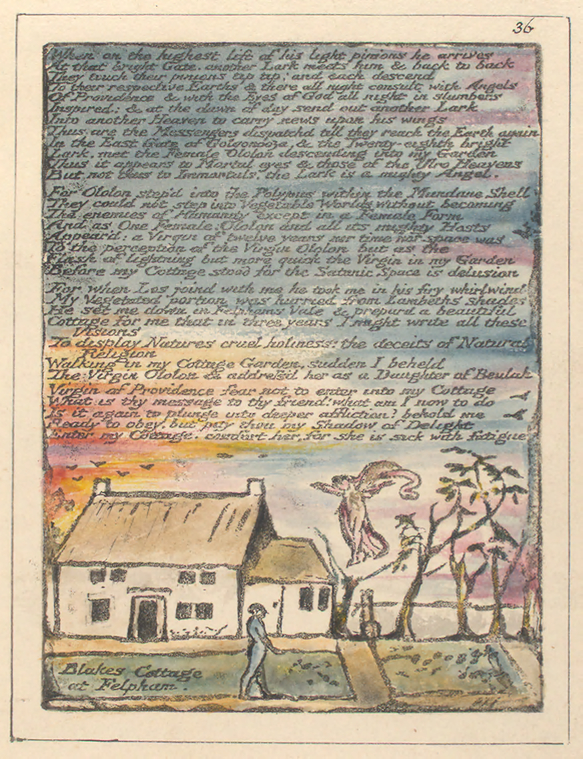
Plate 36

Blake makes a dramatic reversal in his imagery on Plate 31 of Milton. From the laboring of Los, the howling of Orc, the trembling of Enitharmon and the weeping of Beulah, he goes directly to the Nightingale singing the song of spring. With her song she brings a message of hope and joy and love expresed by a chior of birds and a chorus of flowers.

The moment of vision arrives as a flash of lightining delivered by a messenger, or by an angel in the form a lark, arriving after consultation with the Twenty-seven Churches. This moment of vision was what Blake was seeking. He had brought together the wisdom to which he had access, sought the guidance of providence, and listened for a message in response. Blake perceived that by renovating his own psyche, Milton would become restored to completeness. Together he and Milton could forgive each other, themselves and God for any errors that had led to suffering. 

Milton, Plate 31 [34],(E 130)
"Corporeal Strife      
In Los's Halls continual labouring in the Furnaces of Golgonooza
Orc howls on the Atlantic: Enitharmon trembles: All Beulah weeps

Thou hearest the Nightingale begin the Song of Spring;
The Lark sitting upon his earthy bed: just as the morn
Appears; listens silent; then springing from the waving Corn-field! loud
He leads the Choir of Day! trill, trill, trill, trill,
Mounting upon the wings of light into the Great Expanse:
Reecchoing against the lovely blue & shining heavenly Shell:
His little throat labours with inspiration; every feather
On throat & breast & wings vibrates with the effluence Divine    
All Nature listens silent to him & the awful Sun
Stands still upon the Mountain looking on this little Bird
With eyes of soft humility, & wonder love & awe.
Then loud from their green covert all the Birds begin their Song
The Thrush, the Linnet & the Goldfinch, Robin & the Wren         
Awake the Sun from his sweet reverie upon the Mountain:
The Nightingale again assays his song, & thro the day,
And thro the night warbles luxuriant; every Bird of Song
Attending his loud harmony with admiration & love.
This is a Vision of the lamentation of Beulah over Ololon!       

Thou percievest the Flowers put forth their precious Odours!
And none can tell how from so small a center comes such sweets
Forgetting that within that Center Eternity expands
Its ever during doors, that Og & Anak fiercely guard[.]
First eer the morning breaks joy opens in the flowery bosoms     
Joy even to tears, which the Sun rising dries; first the Wild Thyme
And Meadow-sweet downy & soft waving among the reeds.
Light springing on the air lead the sweet Dance: they wake
The Honeysuckle sleeping on the Oak: the flaunting beauty
Revels along upon the wind; the White-thorn lovely May           
Opens her many lovely eyes: listening the Rose still sleeps 
None dare to wake her. soon she bursts her crimson curtaind bed
And comes forth in the majesty of beauty; every Flower:
The Pink, the Jessamine, the Wall-flower, the Carnation
The Jonquil, the mild Lilly opes her heavens! every Tree,        
And Flower & Herb soon fill the air with an innumerable Dance
Yet all in order sweet & lovely, Men are sick with Love! 

Such is a Vision of the lamentation of Beulah over Ololon" 

Milton, Plate 35 [39], (E 135)

"O how the Starry Eight rejoic'd to see Ololon descended!
And now that a wide road was open to Eternity,                   

By Ololons descent thro Beulah to Los & Enitharmon,

For mighty were the multitudes of Ololon, vast the extent
Of their great sway, reaching from Ulro to Eternity

Surrounding the Mundane Shell outside in its Caverns
And through Beulah. and all silent forbore to contend            
With Ololon for they saw the Lord in the Clouds of Ololon

There is a Moment in each Day that Satan cannot find
Nor can his Watch Fiends find it, but the Industrious find
This Moment & it multiply. & when it once is found
It renovates every Moment of the Day if rightly placed.        
In this Moment Ololon descended to Los & Enitharmon
Unseen beyond the Mundane Shell Southward in Miltons track

Just in this Moment when the morning odours rise abroad
And first from the Wild Thyme, stands a Fountain in a rock
Of crystal flowing into two Streams, one flows thro Golgonooza   

And thro Beulah to Eden beneath Los's western Wall
The other flows thro the Aerial Void & all the Churches
Meeting again in Golgonooza beyond Satans Seat

The Wild Thyme is Los's Messenger to Eden, a mighty Demon
Terrible deadly & poisonous his presence in Ulro dark            
Therefore he appears only a small Root creeping in grass
Covering over the Rock of Odours his bright purple mantle
Beside the Fount above the Larks nest in Golgonooza
Luvah slept here in death & here is Luvahs empty Tomb
Ololon sat beside this Fountain on the Rock of Odours.           

Just at the place to where the Lark mounts, is a Crystal Gate
It is the enterance of the First Heaven named Luther: for
The Lark is Los's Messenger thro the Twenty-seven Churches
That the Seven Eyes of God who walk even to Satans Seat
Thro all the Twenty-seven Heavens may not slumber nor sleep      

But the Larks Nest is at the Gate of Los, at the eastern
Gate of wide Golgonooza & the Lark is Los's Messenger
PLATE 36 [40], (E 136)
When on the highest lift of his light pinions he arrives
At that bright Gate, another Lark meets him & back to back
They touch their pinions tip tip: and each descend
To their respective Earths & there all night consult with Angels
Of Providence & with the Eyes of God all night in slumbers       
Inspired: & at the dawn of day send out another Lark
Into another Heaven to carry news upon his wings
Thus are the Messengers dispatchd till they reach the Earth again
In the East Gate of Golgonooza, & the Twenty-eighth bright
Lark. met the Female Ololon descending into my Garden            
Thus it appears to Mortal eyes & those of the Ulro Heavens
But not thus to Immortals, the Lark is a mighty, Angel.

For Ololon step'd into the Polypus within the Mundane Shell
They could not step into Vegetable Worlds without becoming
The enemies of Humanity except in a Female Form          
And as One Female, Ololon and all its mighty Hosts
Appear'd: a Virgin of twelve years nor time nor space was
To the perception of the Virgin Ololon but as the
Flash of lightning but more  quick the Virgin in my Garden
Before my Cottage stood for the Satanic Space is delusion"   

Milton, Plate 21 [23], (E 115)
"I saw in the nether
Regions of the Imagination; also all men on Earth,
And all in Heaven, saw in the nether regions of the Imagination
In Ulro beneath Beulah, the vast breach of Miltons descent.
But I knew not that it was Milton, for man cannot know
What passes in his members till periods of Space & Time
Reveal the secrets of Eternity: for more extensive
Than any other earthly things, are Mans earthly lineaments.
And all this Vegetable World appeard on my left Foot,
As a bright sandal formd immortal of precious stones & gold:
I stooped down & bound it on to walk forward thro' Eternity.


Thursday, September 5, 2024

BLAKE & DREAMS 3

  Katharine of Aragon was the first wife of Henry VIII of England. He attempted to have the marriage annuled in order to marry Anne Boleyn. When the Pope refused to grant an annulment, a schism developed between England and the Catholic Church. Catherine died at Kimbolton Castle on 7 January 1536.

Fitzwilliam Museum
Queen Katharine Drean
circa 1783 to 1790

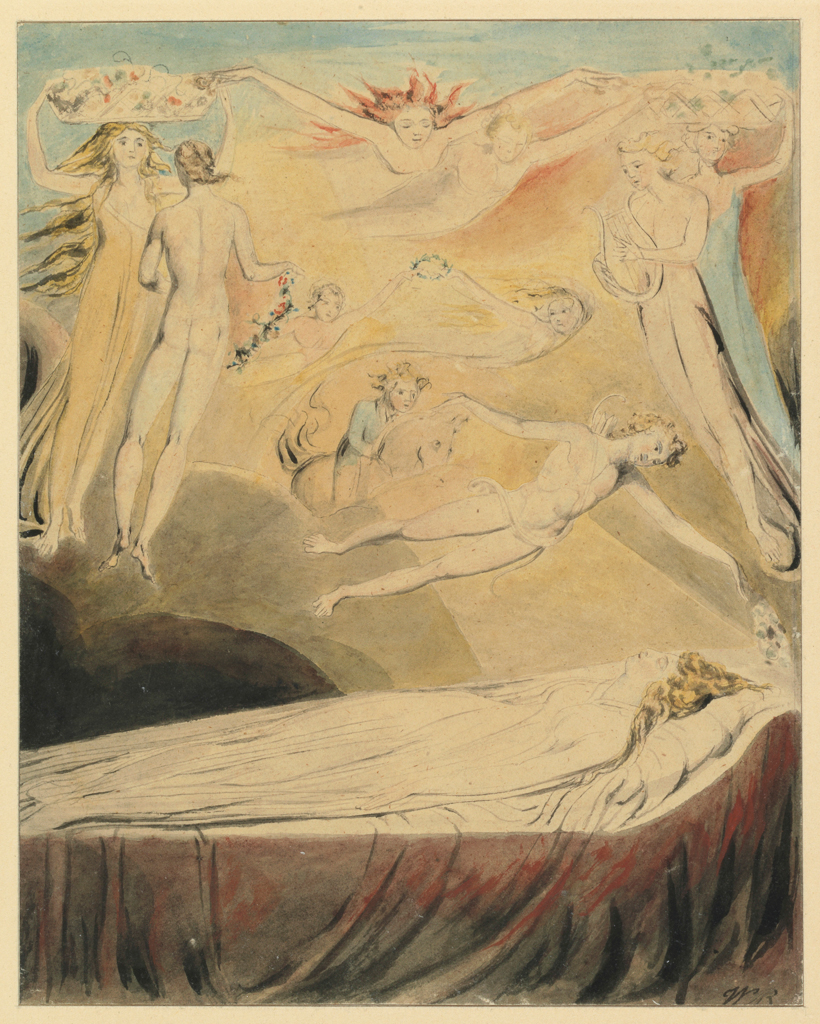
Blake's picture titled Queen Katharine's Dream is an illustration to lines from William Shakespeare's play Henry VII. Blake choose to illustrate lines from the play which echo his own feelings. As Katharine of Aragon the first wife of Henry lies on her deathbed she reports a dream which she had of the glorious world which awaited her.

Henry VIII , Scene IV
"KATHARINE
No? Saw you not, even now, a blessed troop
Invite me to a banquet; whose bright faces
Cast thousand beams upon me, like the sun?
They promised me eternal happiness;
And brought me garlands, Griffith, which I feel
I am not worthy yet to wear: I shall, assuredly.
GRIFFITH
I am most joyful, madam, such good dreams
Possess your fancy."

Blake painted illustrations for this scene at least three times. A earliest image of the scene resides in the Fitzwilliam Museum, Cambridge and is dated between 1783 and 1790. Look for motifs from Visions of the Daughters of Albion, Blake's lithograph of Enoch, and Plate 33 (37) of Jerusalem in this painting. Shown here are the later images.

British Museum, London (dated 1809).................
National Gallery, Washington
                                                                              (dated 1825)


Wednesday, June 5, 2024

SEEING


Yale Center for British Art
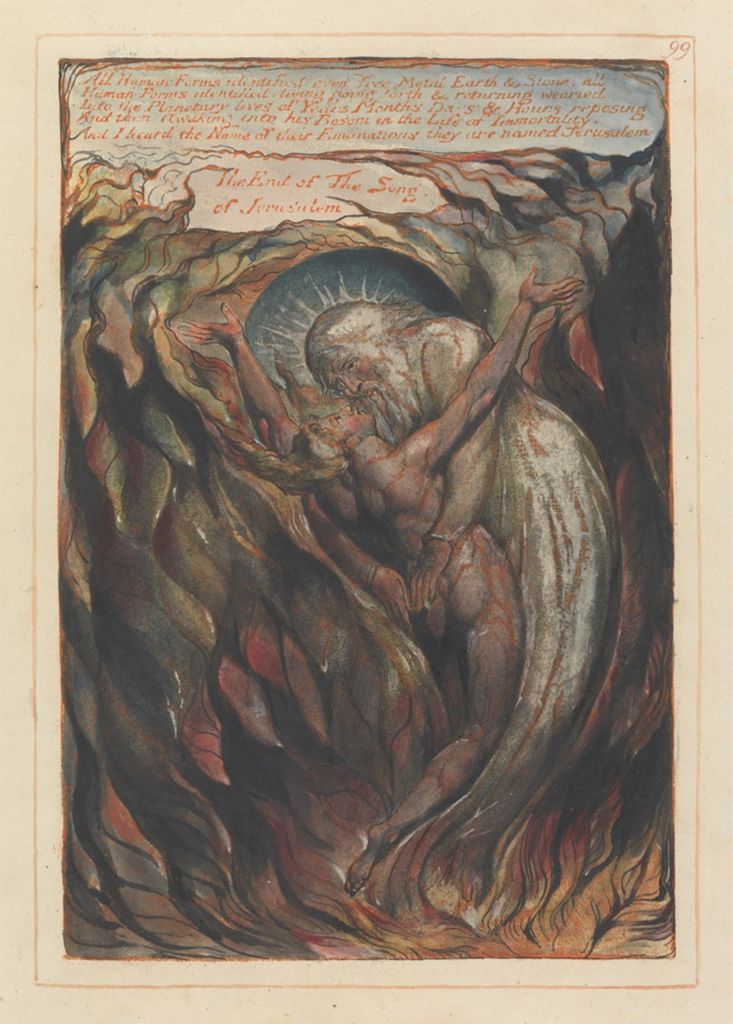
Jerusalem
Plate 99

If as McGilchrist proposes the right hemisphere of the brain is designed and suited to be the master and the left hemisphere its emissary, we can look for evidence to support that postulate. McGilchrist notes that the act of seeing which may seem straightforward to the left hemisphere, is doing much more when processed by the right hemisphere. The left brain may be seeing solely with the eye whereas the right brain is using the act of seeing to go beyond the surface of an object to the substance and meaning it incorporates.

Iain McGilchrist on  Page 359-60 of The Master and His Emissary makes these statements about the act of seeing which takes place in the right hemisphere

"Every object, clearly seen, opens up a new organ or perception in us." (Goethe)

...for us to truly experience something to enter into and alter us, and there must be something in us which specifically responds to it as unique.

Understanding, then, is not a discursive explanatory process, but a moment of connection, in which we see through our experience - an apercu  or insight. ... each act of seeing, in the sense of allowing something to 'presence' for us, is in itself necessarily an act of understanding."

To Blake the act of perception is not static or solitary. Time and Space are altered as are the organs which perceive them. If we are capable of living in Eternity, if we have developed our spiritual senses sufficiently, we are not opaque to one another but share the one life which includes all.

Jerusalem, Plate 98, (E 258)

"every Word & Every Character
Was Human according to the Expansion or Contraction, the Translucence or
Opakeness of Nervous fibres such was the variation of Time & Space
Which vary according as the Organs of Perception vary & they walked
To & fro in Eternity as One Man reflecting each in each & clearly seen
And seeing: according to fitness & order. And I heard Jehovah speak" 
Letters, To Flaxman, (E 707)
"Now my lot in the Heavens is this; Milton lovd me in childhood & shewd me his face
Ezra came with Isaiah the Prophet, but Shakespeare in riper years gave me his hand
Paracelsus & Behmen appeard to me. terrors appeard in the Heavens above
And in Hell beneath & a mighty & awful change threatend the Earth
The American War began   All its dark horrors passed before my face
Across the Atlantic to France.  Then the French Revolution commencd in thick clouds
And My Angels have told me. that seeing such visions I could not subsist on the Earth
Terrific from his Holy Place & saw the Words of the Mutual Covenant Divine"
We find in the Bible the same implication that the eye is an organ which is capable of furnishing the body with light if it is used in one way and the opposite if used differently: light if looked 'thro' or darkness if it is looked 'with.'

First Corinthians 13

[12] For now we see through a glass, darkly; but then face to face: now I know in part; but then shall I know even as also I am known.

Matthew 6
[22] The light of the body is the eye: if therefore thine eye be single, thy whole body shall be full of light.
[23] But if thine eye be evil, thy whole body shall be full of darkness. If therefore the light that is in thee be darkness, how great is that darkness!
Luke 11

[34] The light of the body is the eye: therefore when thine eye is single, thy whole body also is full of light; but when thine eye is evil, thy body also is full of darkness.
[35] Take heed therefore that the light which is in thee be not darkness.
[36] If thy whole body therefore be full of light, having no part dark, the whole shall be full of light, as when the bright shining of a candle doth give thee light.

Commenting on the above verses John A Sanford in The Kingdom Within states: 
"If our eye, our spiritual insight, is dark, and we are accordingly acting out of ignorance of ourselves, our whole inner life will be dark for we will in fact be possessed by everything in ourselves of which we are unconscious."  Page 147


Auguries of Innocence, (E 492)
"Every Night & every Morn
Some to Misery are Born 
Every Morn & every Night
Some are Born to sweet delight
Some are Born to Endless Night
We are led to Believe a Lie 
When we see not Thro the Eye         

Which was Born in a Night to perish in a Night
When the Soul Slept in Beams of Light
God Appears & God is Light
To those poor Souls who dwell in Night 
But does a Human Form Display
To those who Dwell in Realms of day"
Vision of Last Judgment, (E 565)
"People flatter themselves   I will not Flatter them   Error is
Created Truth is Eternal   Error or Creation will be Burned Up &
then & not till then Truth or Eternity will appear   It is Burnt up
the Moment Men cease to behold it  I assert for My self that I do
not behold the Outward Creation & that to me it is hindrance &
not Action it is as the Dirt upon my feet No part of Me.  What it
will be Questiond When the Sun rises  do  you  not  see  a  round 
Disk of fire somewhat like a Guinea   O no no I see an Innumerable
company of the Heavenly host crying Holy Holy Holy is the Lord
God Almighty  I question not my Corporeal or Vegetative Eye any
more than I would Question a Window concerning a Sight I look
thro it & not with it."  
Letters, To Rev Dr Trusler, (E 702)
"Mirth is
better than Fun & Happiness is better than Mirth--I feel that a
Man may be happy in This World.  And I know that This World Is a
World of Imagination & Vision  I see Every thing I paint In This
World, but Every body does not see alike.  To the Eyes of a Miser
a Guinea is more beautiful than the Sun & a bag worn with the use
of Money has more beautiful proportions than a Vine filled with
Grapes. The tree which moves some to tears of joy is in the Eyes
of others only a Green thing that stands in the way.  Some See
Nature all Ridicule & Deformity & by these I shall not regulate
my proportions, & Some Scarce see Nature at all  But to the Eyes
of the Man of Imagination Nature is Imagination itself.  As a man
is So he Sees.  As the Eye is formed such are its Powers  You
certainly Mistake when you say that the Visions of Fancy are not
be found in This World.  To Me This World is all One continued
Vision of Fancy or Imagination & I feel Flatterd when I am told
So." 

Thursday, August 24, 2023

BLAKE & PLATO

BLAKE & PLATO

First posted 2011

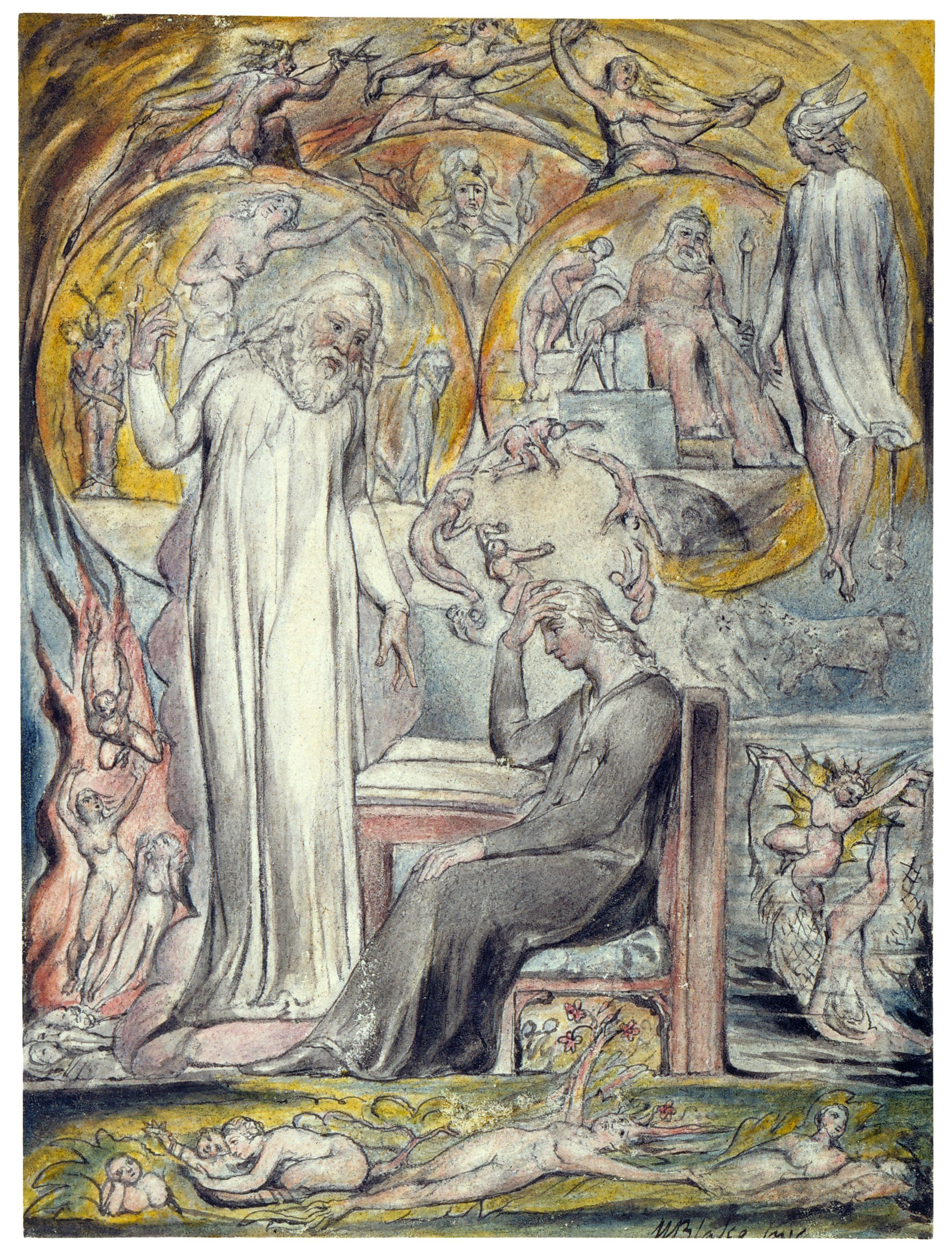
Commentary on Blake's six illustrations to Milton's Il Penseroso is found in Bette Charlene Werner's book Blake's vision of the poetry of Milton: illustrations to six poems. Blake 'invented', (he signed images WBlake inv), the third illustration The Spirit of Plato as a means of presenting a number of Plato's ideas as Milton contemplated them.

Il Penseroso

"Or let my lamp, at midnight hour,
Be seen in some high lonely tower,
Where I may oft outwatch the Bear,
With thrice great Hermes, or unsphere
The spirit of Plato, to unfold
What worlds or what vast regions hold
The immortal mind that hath forsook
Her mansion in this fleshly nook;
And of those demons that are found
In fire, air, flood, or underground,"
(lines 85-95)

In the picture we see how Plato divided the soul between the three worlds of Venus, Jupiter, Mars - senses, reason and energy. The Great Bear is the constellation around which the constellations revolve; it never sets - symbolizing an ever circling round.

Blake added a few lines of descriptive material to each of his illustrations to Il Penseroso.
Blake's description: "The Spirit of Plato unfolds his Worlds to Milton in Contemplation. The three destinies sit on the Circles of Plato's Heavens weaving their Thread of Mortal Life; these Heavens are Venus Jupiter and Mars. Hermes flies before as attending on the Heaven of Jupiter, the Great Bear is seen in the Sky beneath Hermes & The Spirits of Fire, Air, Water & Earth Surround Milton's Chair."

In this the third illustration to Il Penseroso illustrating lines 85-95 of Milton's poem, Blake goes to pains to include the import of the lines of the poem but adds details to indicate the ideas of Plato to which he objected.

Damon enumerates the points at which Plato's thought differed from Blake's:
"Thus it is that although Plato banished poets from his Republic, made God a geometrician, preached morality, was a fatalist when he accepted the Three Fates, debased love to homosexuality, admitted war to his ideal state, and considered Art an imitation of Nature (hence second rate), Blake was indebted to him." Blake knew that there was much to be admired in Plato's thought although he said that "What Jesus came to remove was the Heathen or Platonic Philosophy, which blinds the eye to Imagination, The real Man." (E 664 ). Blake portrays the Greek learned and wise among the saved in the Last Judgment.

The prominence in the illustration of Hermes perhaps in his role of as the guide for souls in the underworld, may be Blake's assertion that both Plato and Milton are still in need of guidance in matters of the soul. None of the Platonic images contemplated by Milton seems to show the positive outcome for Man's plight for which Blake is working.

Blake's ambivalence to Plato and Greek thought can be seen in these 2 short passages:

Songs and Ballads,(E 479)
"Twas the Greeks love of war
Turnd Love into a Boy
And Woman into a Statue of Stone
And away fled every joy"

Letter to Trusler, (E 702)
"The wisest of the Ancients considerd what is not
too Explicit as the fittest for Instruction because it rouzes the
faculties to act. I name Moses Solomon Esop Homer Plato"


Wednesday, June 7, 2023

JAMES JOYCE

Princeton University Library
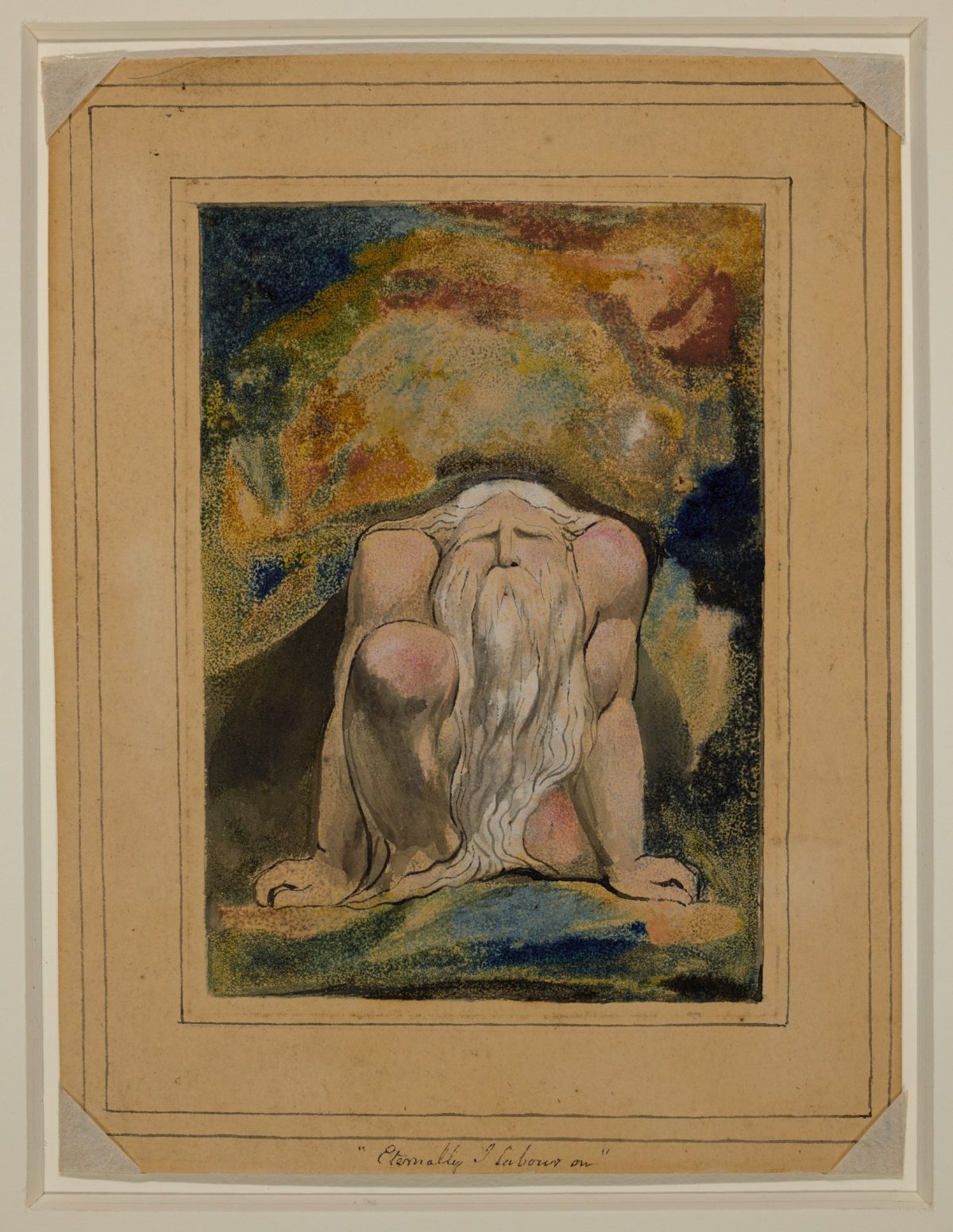
Book of Urizen
Plate 4
"Eternally I Labor On"

To my surprise I learned that James Joyce had his imagination stimulated by the poetic imagery of William Blake. An exhibition at the Tate Gallery had this quote by Joyce attached to the introduction.  

Tate Exhibition

“Blake sang of the ideal world, of the truth of the intellect, and of the divinity of the imagination. … The only writer to have written songs for children with the soul of a child … he holds, in my view, a unique position because he unites intellectual sharpness with mystic sentiment.” Joyce

A lecture on William Blake, in Italian, was given March 1912 at the Università Popolare Triestina by James Joyce. The twenty page manuscript is in the Yale University Library. 

The following passages are translations from Joyce's Lecture:

"It is a sad irony to think that this poet of childish innocence, the only writer who has written songs for children with the soul of a child, and who has illuminated the phenomenon of gestation with a light so tender and mystical in his [218] strange poem The Chrystal Cabinet, was destined never to see the sight of a real human child at his fireside. To him who had such great pity for everything that lives and suffers and rejoices in the illusions of the vegetable world, for the fly, the hare, the little chimney sweep, the robin, even for the flea, was denied any other fatherhood than the spiritual fatherhood, intensely natural though it is, that still lives in the lines of Proverbs: [11]

'He who mocks the Infant’s Faith
Shall be mock’d in Age & Death.
He who shall teach the Child to Doubt
The rotting Grave shall ne’er get out.
He who respects the Infant’s faith
Triumphs over Hell & Death.'"

***********

"One must be, in the first place, well-disposed to mysticism, and in the second place, endowed with the patience of a saint in order to get an idea of what Paracelsus and Behmen mean by their cosmic exposition of the involution and evolution of mercury, salt, sulphur, body, soul and spirit. Blake naturally belongs to another category, that of the artists, and in this category he occupies, in my opinion, a unique position, because he unites keenness of intellect with mystical feeling. This first quality is almost completely lacking in mystical art. St. John of the Cross, for example, one of the few idealist artists worthy to stand with Blake, never reveals either an innate sense of form or a coordinating force of the intellect in his book The Dark Night of the Soul, that cries and faints with such an ecstatic passion." 

*************

"Michelangelo’s influence is felt in all of Blake’s work, and especially in some passages of prose collected in the fragments, in which he always insists on the importance of the pure, clean line that evokes and creates the figure on the background of the uncreated void."

*************

"Armed with this two-edged sword, the art of Michelangelo and the revelations of Swedenborg, Blake killed the dragon of experience and natural wisdom, and, by minimizing space and time and denying the existence of memory and the senses, he tried to paint his works on the void of the divine bosom."

*************

"The mental process by which Blake arrives at the threshold of the infinite is a similar process. Flying from the infinitely small to the infinitely large, from a drop of blood to the universe of stars, his soul is consumed by the rapidity of flight, and finds itself renewed and winged and immortal on the edge of the dark ocean of God. And although he based his art on such idealist premises, convinced that eternity was in love with the products of time, the sons of God with the sons of […]" 

Milton, Plate 24 [26], (E 121)

"Los is by mortals nam'd Time Enitharmon is nam'd Space
But they depict him bald & aged who is in eternal youth
All powerful and his locks flourish like the brows of morning    
He is the Spirit of Prophecy the ever apparent Elias
Time is the mercy of Eternity; without Times swiftness
Which is the swiftest of all things: all were eternal torment:
All the Gods of the Kingdoms of Earth labour in Los's Halls.
Every one is a fallen Son of the Spirit of Prophecy             
He is the Fourth Zoa, that stood arou[n]d the Throne Divine."
The kinship which Joyce felt for Blake is evident in these few words:

"That language was the same in which tonight I try, by your leave, in so far as I can, to recall his spirit from the twilight of the universal mind, to detain it for a minute and question it. He began to study Italian in order to read the Divina Commedia in the original and to illustrate Dante’s vision with mystical drawings," Joyce 

TRACING BLAKE'S VISIONARY PROCESS IN JOYCE'S
A PORTRAIT OF THE ARTIST AS A YOUNG MAN
By HYE-YOUNG KIM  


Sunday, October 9, 2022

JACOB'S LADDER

British Museum
Jacob's Ladder

Genesis 28

[10] And Jacob went out from Beer-sheba, and went toward Haran.
[11] And he lighted upon a certain place, and tarried there all night, because the sun was set; and he took of the stones of that place, and put them for his pillows, and lay down in that place to sleep.
[12] And he dreamed, and behold a ladder set up on the earth, and the top of it reached to heaven: and behold the angels of God ascending and descending on it.
[13] And, behold, the LORD stood above it, and said, I am the LORD God of Abraham thy father, and the God of Isaac: the land whereon thou liest, to thee will I give it, and to thy seed;
[14] And thy seed shall be as the dust of the earth, and thou shalt spread abroad to the west, and to the east, and to the north, and to the south: and in thee and in thy seed shall all the families of the earth be blessed.
[15] And, behold, I am with thee, and will keep thee in all places whither thou goest, and will bring thee again into this land; for I will not leave thee, until I have done that which I have spoken to thee of.
[16] And Jacob awaked out of his sleep, and he said, Surely the LORD is in this place; and I knew it not.
[17] And he was afraid, and said, How dreadful is this place! this is none other but the house of God, and this is the gate of heaven.
[18] And Jacob rose up early in the morning, and took the stone that he had put for his pillows, and set it up for a pillar, and poured oil upon the top of it.
[19] And he called the name of that place Bethel: but the name of that city was called Luz at the first.

As Jacob sleeps and dreams, resting his head upon a stone, he watches angels spiraling toward heaven on a staircase. But the traffic on the stair goes in both directions. Jacob is being transported to heaven, and heaven is descending into his brain. By Jacob listening and responding the place where he lies becomes a gate to heaven.  

Milton, Plate 28 [30], (E 126)

"And every Hour has a bright golden Gate carved with skill.
And every Day & Night, has Walls of brass & Gates of adamant,
Shining like precious stones & ornamented with appropriate signs:"

Jerusalem, Plate 34 [38],(E 181)
"There is in Albion a Gate of precious stones and gold            
Seen only by Emanations, by vegetations viewless,
Bending across the road of Oxford Street; it from Hyde Park
To Tyburns deathful shades, admits the wandering souls
Of multitudes who die from Earth: this Gate cannot be found
PLATE 35 [39]
By Satans Watch-fiends tho' they search numbering every grain
Of sand on Earth every night, they never find this Gate.
It is the Gate of Los. Withoutside is the Mill, intricate, dreadful" 
Listen as Ian McGilchrist responds to Blake's image of Jacob's Ladder. 

Descriptive Catalogue, (E 543)

"All these things are written in Eden.  
The artist is an inhabitant of that happy country, and if 
every thing goes on as it has begun, the world of vegetation 
and generation may expect to be opened again to Heaven, 
through Eden, as it was in the beginning.
Vision of Last Judgment, (E 556) 
"Moses & Abraham are not here meant but the States Signified by
those Names the Individuals being representatives or Visions of
those States as they were reveald to Mortal Man in the Series of
Divine Revelations. as they are written in the Bible these
various States I have seen in my Imagination when distant they
appear as One Man but as you approach they appear
Multitudes of Nations.  Abraham hovers above his posterity which
appear as Multitudes of Children ascending from the Earth
surrounded by Stars as it was said As the Stars of Heaven for
Multitude   Jacob & his Twelve Sons hover beneath
the feet of Abraham & recieve their children from the Earth" 
Vision of Last Judgment, (E 561)
"The Cloud that opens rolling apart before the throne &
before the New Heaven & the New Earth is Composed of Various
Groupes of Figures particularly the Four Living Creatures
mentiond in Revelations as Surrounding the Throne these I suppose
to have the chief agency in removing the 
old heavens & the old Earth to make way for the New Heaven & the
New Earth to descend from the throne of God & of the Lamb.
Vision of Last Judgment, (E 561)
"Around the Throne Heaven is opend & the Nature of
Eternal Things Displayd All Springing from the Divine Humanity
All beams from him Because as he himself has said All
dwells in him He is the Bread & the Wine he is the Water of
Life" 
Vision of Last Judgment, (E 566) 
"I assert for My self that I do
not behold the Outward Creation & that to me it is hindrance &
not Action it is as the Dirt upon my feet No part of Me. What it
will be Questiond When the Sun rises  do  you  not  see  a  round 
Disk of fire somewhat like a Guinea O no no I see an Innumerable
company of the Heavenly host crying Holy Holy Holy is the Lord
God Almighty I question not my Corporeal or Vegetative Eye any
more than I would Question a Window concerning a Sight I look
thro it & not with it."  

Letters, To Butts, (E 724) 
"The Thing I
have most at Heart! more than life or all that seems to make life
comfortable without.  Is the Interest of True Religion & Science
& whenever any thing appears to affect that Interest. (Especially
if I myself omit any duty to my Station as a
Soldier of Christ) It gives me the greatest of torments, I am not
ashamed afraid or averse to tell You what Ought to be Told.  That
I am under the direction of Messengers from Heaven Daily &
Nightly but the nature of such things is not as some suppose.
without trouble or care." 
Letters, To Hayley, (E 740)
"love & gratitude the two
angels who stand at heavens gate  ever open  ever inviting guests
to the marriage   O foolish Philosophy! Gratitude is Heaven
itself there could be no heaven without Gratitude" 
 

Thursday, October 6, 2022

BURNING BUSH

Victoria & Albert Museum
Moses and the Burning Bush

The shepherd Moses has led his flock out of the desert to Horab the mountain of God. In Blake's picture Moses turns his face to his right side. He holds a scroll in his right hand. Beside his right side is a ram. His attention is focused on the bush which burns and is not consumed. The right side of the picture is bright while the left side of the picture is darkened by an overhanging tree of the type which Blake used to represent error. Blake saw two sides to Moses.

Moses listens as the voice of God addresses him from the burning bush calling him by name. Moses is receptive to God's call and responds, "Here am I." 

The voice of God tells Moses that he is to go to the Pharaoh in order to deliver his people "out of the hand of the Egyptians, and to bring them up out of that land unto a good land." Moses continues the conversation with God. His reluctance is overcome when God assures him that he will be with him.

Exodus 3:12
And he said, Certainly I will be with thee; and this shall be a token unto thee, that I have sent thee: When thou hast brought forth the people out of Egypt, ye shall serve God upon this mountain.

Although Blake considered Moses a great prophet and an instrument of God, in Blake's estimation Moses entered into error on two accounts. First in promulgating the ten commands which intended to impose standards of morality. Blake says "Moses beheld upon Mount Sinai forms of dark delusion (Song of Los, E 67). In Blake's opinion Jesus who was "all virtue,and acted from impulse, not from rules", violated in spirit every one of the ten Commandments. It was not the failure to follow the Law that offended Blake but the attempt to uniformly impose an absolute morality which perverted the "fiery joy" of life "to ten commands"(America, E 54). 

Marriage of Heaven and Hell, Plate 22, (E 43) 
"if Jesus Christ is the
greatest man, you ought to love him in the greatest degree; now
hear how he has given his sanction to the law of ten
commandments: did he not mock at the sabbath, and so mock the
sabbaths God? murder those who were murderd because of him? turn
away the law from the woman taken in adultery? steal the labor of
others to support him? bear false witness when he omitted making
a defence before Pilate? covet when he pray'd for his disciples,
and when he bid them shake off the dust of their feet against
such as refused to lodge them? I tell you, no virtue can exist
without breaking these ten commandments: Jesus was all virtue,
and acted from impulse: not from rules."

The second great error of Moses was massacring the nations who occupied Canaan before the Israelites arrived. "God never makes one man murder another nor one nation...To Extirpate a nation by means of another nation is as wicked as to destroy an individual. (Annotations to Watson, E 641) 

Exodus 3
[1] Now Moses kept the flock of Jethro his father in law, the priest of Midian: and he led the flock to the backside of the desert, and came to the mountain of God, even to Horeb.
[2] And the angel of the LORD appeared unto him in a flame of fire out of the midst of a bush: and he looked, and, behold, the bush burned with fire, and the bush was not consumed.
[3] And Moses said, I will now turn aside, and see this great sight, why the bush is not burnt.
[4] And when the LORD saw that he turned aside to see, God called unto him out of the midst of the bush, and said, Moses, Moses. And he said, Here am I.
[5] And he said, Draw not nigh hither: put off thy shoes from off thy feet, for the place whereon thou standest is holy ground.
[6] Moreover he said, I am the God of thy father, the God of Abraham, the God of Isaac, and the God of Jacob. And Moses hid his face; for he was afraid to look upon God.
[7] And the LORD said, I have surely seen the affliction of my people which are in Egypt, and have heard their cry by reason of their taskmasters; for I know their sorrows;
[8] And I am come down to deliver them out of the hand of the Egyptians, and to bring them up out of that land unto a good land and a large, unto a land flowing with milk and honey; unto the place of the Canaanites, and the Hittites, and the Amorites, and the Perizzites, and the Hivites, and the Jebusites.
[9] Now therefore, behold, the cry of the children of Israel is come unto me: and I have also seen the oppression wherewith the Egyptians oppress them.
[10] Come now therefore, and I will send thee unto Pharaoh, that thou mayest bring forth my people the children of Israel out of Egypt.
[11] And Moses said unto God, Who am I, that I should go unto Pharaoh, and that I should bring forth the children of Israel out of Egypt?
[12] And he said, Certainly I will be with thee; and this shall be a token unto thee, that I have sent thee: When thou hast brought forth the people out of Egypt, ye shall serve God upon this mountain.
[13] And Moses said unto God, Behold, when I come unto the children of Israel, and shall say unto them, The God of your fathers hath sent me unto you; and they shall say to me, What is his name? what shall I say unto them?
[14] And God said unto Moses, I AM THAT I AM: and he said, Thus shalt thou say unto the children of Israel, I AM hath sent me unto you.
[15] And God said moreover unto Moses, Thus shalt thou say unto the children of Israel, The LORD God of your fathers, the God of Abraham, the God of Isaac, and the God of Jacob, hath sent me unto you: this is my name for ever, and this is my memorial unto all generations. 
 
Letters, To Trusler, (E 702)
"The wisest of the Ancients considerd what is not too Explicit as the fittest for Instruction because it rouzes the faculties to act. I name Moses Solomon Esop Homer Plato"
Annotations to Watson, (E 617) 
"Of what consequence is it whether Moses wrote the Pentateuch
or no.  If Paine trifles in some of his objections it is folly to
confute him so seriously in them & leave his more material ones
unanswered  Public Records as If Public Records were True 
     *Impossible for the facts are such as none but the actor
could tell, if it is True Moses & none but he could write it
unless we allow it to be Poetry & that poetry inspired 
     [P 16] If historical facts can be written by inspiration
Miltons Paradise Lost is as true as Genesis. or Exodus. but the
Evidence is nothing for how can he who writes what he has neither
seen nor heard of. be an Evidence of The Truth of his history"
Annotations to Watson,(E 618) 
"I cannot concieve the Divinity of the <books in the> Bible
to consist either in who they were written by or at what time or
in the historical evidence which may be all false in the eyes of
one man & true in the eyes of another but in the Sentiments &
Examples which whether true or Parabolic are Equally useful as
Examples given to us of the perverseness of some & its consequent
evil & the honesty of others & its consequent good  This sense of
the Bible is equally true to all & equally plain to all. none can
doubt the impression which he recieves from a book of Examples. 
If he is good he will abhor wickedness in David or Abraham if he
is wicked he will make their wickedness an excuse for his & so he
would do by any other book."
Thanks to A Blake Dictionary by S. Foster Damon, page 286.