Blake seeks to provide the Golden String which can lead us through the labyrinth of our experience or his own poetry.

Showing posts with label Church. Show all posts

Thursday, April 10, 2025

CATHEDRALS


British Museum
Jerusalem 
Copy A, Frontispiece
Los entering Gothic door


From A Blake Dictionary by S. Foster Damon

Blake choose the cities which he used to represent Cathedral Cities because they had associations which could carry symbolic meaning. They could be used to represent attempts to embody spiritual characteristics which could protect Albion from making destructive decisions.

The first mentioned, Selsey, no longer existed but had been destroyed by flooding caused by the encroaching ocean. Her neighbor Chichester became the seat of her bishop, and the location of the courtroom where Blake himself was acquitted of treason in 1804. Damon associated the next mentioned, Winchester, with William Hayley who was instramental in Blake's move to Felpham. Richard Warner of Bath was cited by Damon for his courageous anti-war sermon. Damon continued through Blake's list of churchs mentioning prominent men who were associated with them including John Milton for Ely of Cambridgeshire. Milton, a graduate of Cambridge, fit the title of "Scribe of Los, whose pen no other hand Dare touch!"

Jerusalem, Plate 36 [40],(E 182)
"And these the Twenty-four in whom the Divine Family    
Appear'd; and they were One in Him. A Human Vision!
Human Divine, Jesus the Saviour, blessed for ever and ever.

Selsey, true friend! who afterwards submitted to be devourd
By the waves of Despair, whose Emanation rose above
The flood, and was nam'd Chichester, lovely mild & gentle! Lo!   
Her lambs bleat to the sea-fowls cry, lamenting still for Albion.

Submitting to be call'd the son of Los the terrible vision:
Winchester stood devoting himself for Albion: his tents
Outspread with abundant riches, and his Emanations
Submitting to be call'd Enitharmons daughters, and be born     
In vegetable mould: created by the Hammer and Loom
In Bowlahoola & Allamanda where the Dead wail night & day.

(I call them by their English names: English, the rough basement.
Los built the stubborn structure of the Language, acting against
Albions melancholy, who must else have been a Dumb despair.)   

Gloucester and Exeter and Salisbury and Bristol: and benevolent"
Jerusalem, Plate 41 [46], (E 188)
"Bath, mild Physician of Eternity, mysterious power
Whose springs are unsearchable & knowledg infinite.
Hereford, ancient Guardian of Wales, whose hands
Builded the mountain palaces of Eden, stupendous works!
Lincoln, Durham & Carlisle, Councellors of Los.            
And Ely, Scribe of Los, whose pen no other hand
Dare touch! Oxford, immortal Bard! with eloquence
Divine, he wept over Albion: speaking the words of God
In mild perswasion: bringing leaves of the Tree of Life.

Thou art in Error Albion, the Land of Ulro:               
One Error not remov'd, will destroy a human Soul
Repose in Beulahs night, till the Error is remov'd
Reason not on both sides. Repose upon our bosoms
Till the Plow of Jehovah, and the Harrow of Shaddai
Have passed over the Dead, to awake the Dead to Judgment.     
But Albion turn'd away refusing comfort.

Oxford trembled while he spoke, then fainted in the arms
Of Norwich, Peterboro, Rochester, Chester awful, Worcester,
Litchfield, Saint Davids, Landaff, Asaph, Bangor, Sodor,
Bowing their heads devoted: and the Furnaces of Los         
Began to rage, thundering loud the storms began to roar
Upon the Furnaces, and loud the Furnaces rebellow beneath

And these the Four in whom the twenty-four appear'd four-fold:
Verulam, London, York, Edinburgh, mourning one towards another"
Milton, Plate 36 [40], (E 137)
"My Vegetated portion was hurried from Lambeths shades
He set me down in Felphams Vale & prepard a beautiful
Cottage for me that in three years I might write all these Visions
To display Natures cruel holiness: the deceits of Natural Religion"
Jerusalem, Plate 34 [38], (E 180)
"Thus speaking; the Divine Family follow Albion:
I see them in the Vision of God upon my pleasant valleys.

I behold London; a Human awful wonder of God!
He says: Return, Albion, return! I give myself for thee:         
My Streets are my, Ideas of Imagination.
Awake Albion, awake! and let us awake up together.
My Houses are Thoughts: my Inhabitants; Affections,
The children of my thoughts, walking within my blood-vessels,
Shut from my nervous form which sleeps upon the verge of Beulah  
In dreams of darkness, while my vegetating blood in veiny pipes,
Rolls dreadful thro' the Furnaces of Los, and the Mills of Satan.
For Albions sake, and for Jerusalem thy Emanation
I give myself, and these my brethren give themselves for Albion.

So spoke London, immortal Guardian! I heard in Lambeths shades:  
In Felpham I heard and saw the Visions of Albion
I write in South Molton Street, what I both see and hear
In regions of Humanity, in Londons opening streets.

I see thee awful Parent Land in light, behold I see!
Verulam! Canterbury! venerable parent of men,                    
Generous immortal Guardian golden clad! for Cities
Are Men, fathers of multitudes, and Rivers & Mount[a]ins
Are also Men; every thing is Human, mighty! sublime!
In every bosom a Universe expands, as wings
Let down at will around, and call'd the Universal Tent.          
York, crown'd with loving kindness. Edinburgh, cloth'd
With fortitude as with a garment of immortal texture
Woven in looms of Eden, in spiritual deaths of mighty men" 
Jerusalem, Plate 96, (E 256)
"Do I sleep amidst danger to Friends! O my Cities & Counties
Do you sleep! rouze up! rouze up. Eternal Death is abroad

So Albion spoke & threw himself into the Furnaces of affliction 
All was a Vision, all a Dream: the Furnaces became
Fountains of Living Waters Howing from the Humanity Divine
And all the Cities of Albion rose from their Slumbers, and All
The Sons & Daughters of Albion on soft clouds Waking from Sleep
Soon all around remote the Heavens burnt with flaming fires    
And Urizen & Luvah & Tharmas & Urthona arose into
Albions Bosom: Then Albion stood before Jesus in the Clouds
Of Heaven Fourfold among the Visions of God in Eternity
Plate 97
Awake! Awake Jerusalem! O lovely Emanation of Albion
Awake and overspread all Nations as in Ancient Time
For lo! the Night of Death is past and the Eternal Day
Appears upon our Hills: Awake Jerusalem, and come away

So spake the Vision of Albion & in him so spake in my hearing   
The Universal Father. Then Albion stretchd his hand into Infinitude."   

Blake's twenty-eight Cathedral Cities
1 Chichester - "lovely mild & gentle"

2 Winchester - "devoting himself for Albion"
3 Gloucester
4 Exeter
5 Salisbury
6 Bristol
7 Bath - "best and worst in Heaven and Hell"
8 Hereford, "ancient Guardian of Wales"
9 Lincoln
10 Durham
11 Carlisle
12 Ely - "Scribe of Los, whose pen no other hand Dare touch!"
13 Oxford - "trembled while he spoke, then fainted in the arms"
14 Norwich
15 Peterboro
16 Rochester
17 Chester
18 Worcester
19 Litchfield 
20 Saint Davids 
21 Landaff
22 Asaph
23 Bangor 
24 Sodor, "Bowing their heads devoted"
25 Edinburgh 
26 Verulam (Canterbury) 
27 London 
28 York 


Saturday, April 5, 2025

FRIENDS OF ALBION

A Blake Dictionary
S Foster Damon
Cathedral Cities

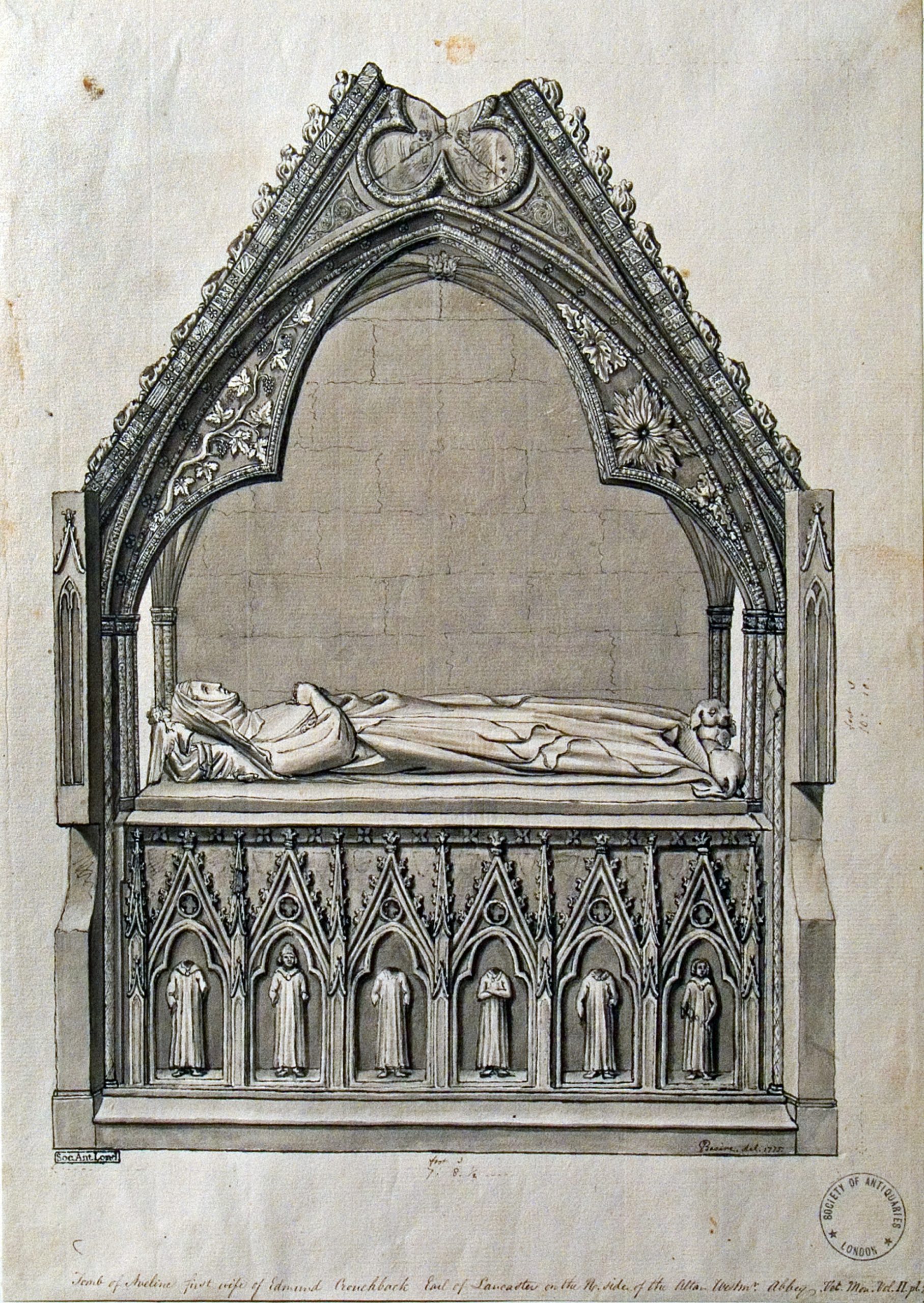
William Blake’s drawings of Westminster Abbey
                            Countess Aveline tomb

In Jerusalem Blake intoduced the 28 catherdal cities when Albion had turned away from the Divine Vision. Albion was the symbol Blake used to represent Britain, his beloved homeland which was enduring multiple threats including war and famine. Within Britain were her Cathedral Cities, remnats of her past attempts at providing spiritual sustenance to sustain her when threats arose. Each City was associated with individuals and events from current or past history.

Jerusalem, Plate 35 [39], (E 181)
"Los was the friend of Albion who most lov'd him. In Cambridgeshire
His eternal station, he is the twenty-eighth, & is four-fold.
Seeing Albion had turn'd his back against the Divine Vision,
Los said to Albion, Whither fleest thou? Albion reply'd.         

I die! I go to Eternal Death! the shades of death
Hover within me & beneath, and spreading themselves outside
Like rocky clouds, build me a gloomy monument of woe:
Will none accompany me in my death? or be a Ransom for me
In that dark Valley? I have girded round my cloke, and on my feet

Bound these black shoes of death, & on my hands, death's iron gloves:
God hath forsaken me, & my friends are become a burden
A weariness to me, & the human footstep is a terror to me.

Los answerd, troubled: and his soul was rent in twain:
Must the Wise die for an Atonement? does Mercy endure Atonement? 
No! It is Moral Severity, & destroys Mercy in its Victim.
So speaking, not yet infected with the Error & Illusion,

Jerusalem, Plate 36 [40], (E 181)
"Los shudder'd at beholding Albion, for his disease
Arose upon him pale and ghastly: and he call'd around
The Friends of Albion: trembling at the sight of Eternal Death
The four appear'd with their Emanations in fiery
Chariots: black their fires roll beholding Albions house of Eternity               
Damp couch the flames beneath and silent, sick, stand shuddering
Before the Porch of sixteen pillars: weeping every one
Descended and fell down upon their knees round Albions knees,
Swearing the Oath of God! with awful voice of thunders round
Upon the hills & valleys, and the cloudy Oath roll'd far and wide

Albion is sick! said every Valley, every mournful Hill 

And every River: our brother Albion is sick to death." 

Jerusalem, Plate 44 [30], (E 193)

"And Los prayed and said. O Divine Saviour arise
Upon the Mountains of Albion as in ancient time. Behold!
The Cities of Albion seek thy face, London groans in pain
From Hill to Hill & the Thames laments along the Valleys
The little Villages of Middlesex & Surrey hunger & thirst        
The Twenty-eight Cities of Albion stretch their hands to thee:
Because of the Opressors of Albion in every City & Village:
They mock at the Labourers limbs!"
From Larry's post Church 8:
"Bear in mind that 27 is a super sinister number; Frye described it as "the cube of thee, the supreme aggravation of three". A happier constellation of 28 (a composite of the complete numbers four and seven) occurs in Jerusalem where England's cathedral cities are called the Friends of Albion. With this image Blake  recognized that in spite of all its sins the church had exercised a beneficent influence upon the course of history. Blake habitually picked one of these cities to be represented an important historical personage.

       For example Ely, the cathedral city of Cambridgeshire, stands for Milton, the greatest man produced by Cambridge. Verulam, an ancient name for Canterbury, represents Francis Bacon , one of Blake's chief devils. Professor Erdman informed us that Bath represents Rev. Richard Warner, a courageous minister who preached against war in 1804, when to do such a thing bordered on sedition. Blake's admiration for Warner led to the prominence which he gave Bath in the second chapter of Jerusalem."
 

Friday, March 28, 2025

Blake's Church II

  First posted June 2011

British Museum
Songs of Innocence and of Experience
Copy A, Plate 39

While the Church Fathers congregated in Rome, Gnosticism had its center in Alexandria, a marketplace of competing religious and philosophical ideas. There in the third century a man named Plotinus gave birth to Neo-platonism, an amalgam of the best of Greek thought with the ethical teachings of Christ. Extremely eclectic, drawing on currents of thought from Rome to India, Plotinus's teachings became the religion of some of the later Roman Emperors. Blake read widely and drew on Gnosticism and Neo-platonism.


During the fourth century the religion of Neo-platonism disappeared as a rival of the Church. However it deeply influenced the shape of Christian theology, most notably through the mind of St. Augustine. Augustine in his spiritual journey passed through a Neo-platonic stage, which left its mark upon his Christian life and writing. Augustine occupies an anomalous position in the history of the Church: he is both a Church Father of impeccable reputation and the spiritual forebear of many theologians whose Neo-platonic bent put them on the fringe of orthodoxy:

Erigena, Duns Scotus, William of Ockham, Meister Eckhart are a few of these Neo-platonic Christians. Some of these thinkers succeeded in remaining within the umbrella of the authorized tradition; some were partially or totally cast out. Among them they preserved to theology a breadth and a poetic dimension that burst open the priestly cocoon with the 15th Century Renaissance and the 16th Century Reformation.

Blake had definite gnostic leanings:
"To understand what is being said in such poems as "THE GARDEN OF LOVE" and "The Little Vagabond" one must consider the poet's religious, or shall I say spiritual, position. William Blake considered himself to be a monistic Gnostic. He believed what saved a person's soul was not faith but knowledge. Faith, he felt, was a term that was abused by those who thought spending every Sunday in a church would grant them eternal salvation regardless of what actions they might exhibit outside the walls of the church. Church ceremonies were also dry, emotionless and meaningless, according to Blake."

Blake expressed many times that the church was a spiritual obstacle.

His "The Little Vagabond" portrays the "loveless morality of the churches" (Raine 148). The church, the clerics of the church and the church ceremony altogether is cold and distant. "Dear Mother, dear Mother, the Church is cold" ("The Little Vagabond ln i) is the opening line of the poem. It is obvious that the young child is distraught with his church because it is not quenching his spiritual thirst. However, he offers a remedy:

"But if at the Church they would give us some Ale,
And a pleasant fire our souls to regale,
We'd sing and we'd pray all the live-long day,
Nor ever once wish from the Church to stray."

"These lines plainly, but clearly, express Blake's religious stance. The church is a cold place that has kept a distance between its members and itself. Therefore, the meanings of the gospels have been delivered in a way that has no meaning or effectiveness. The word of God has been marginalized when it should in fact be communicated in a kind loving manner. The preacher is God and the members of the church are God as well. Instead, the preacher is a merciless intruder that is penetrating the word into the congregation's heads not alloying thought, but perpetuating cold disciplined faith. This poem is used by Blake as a way to communicate his belief that the church was suffering from cold militant preaching rather than warm intoxicating love."

Monday, March 24, 2025

Blake's Christianity

 First posted  April  2014

A Blakean View of Christianity

The immediate followers of Jesus were accused of turning the world upside down. They followed him in challenging all forms of worldly power including death. One can make a good case for the idea that the Christian by definition challenges the powers of the world; that's certainly the meaning of 'radical Christian'.

Blake perceived the legacy that Jesus left behind in two ways. On one hand the church as the mystical body of Christ consists of those who continually challenge the authority or powers of the world. On the other hand the Church as an institution becomes one of the powers of the world. The tension between these two principles probably exists within the breast of anyone seriously interested in Christ.
       
In the second century Ignatius of Antioch eloquently embodied that tension with his life. Ignatius died a martyr to the secular power of the Roman Empire. Before that happened, he had spent much of his time as an eccleiastical authority rooting out dissenters, whom he called heretics; he did this in the course of establishing the institutional authority of what became the Roman Church.
       
With Constantine these two streams of authority came together. In 312 A.D. the new emperor declared himself a Christian and assumed control of the Church. He exercised that control through the simple device of naming his most trusted servant as bishop. The Church became an arm of the political power of the empire.

From that day to this the Church has been primarily one of the powers of the world. The power of the Church has been expressed through ecclesiastical hierarchies and creeds, both imposed upon the rank and file by various coercive techniques essentially identical with those of other worldly powers. This means that the spiritual reality of Christ vis-a-vis the Church is only actualized through the same sort of dissent that Jesus made in the beginning.

These conclusions of course may be debated, but they represent the basic and lifelong viewpoint underlying the radical protest which was Blake's art.


The Early Church

 
After the departure of Christ converts to the new faith gathered together in small groups awaiting the bodily return of Christ, which they expected momentarily. Paul and the other missionaries organized these brotherhoods throughout the Roman world. Paul's letters usually contain two sections: poetic images created to encourage their faith as they awaited the return of Christ at the end of the age and practical advice for the Christians' life together.

He wrote for example to the Colossians that they were "buried with him in baptism [and] risen with him through the faith". No one could interpret that as a statement of material fact, but rather as a powerful poetic identification of the faithful with Christ. In spite of Paul's encouragement the years went by disappointing their hopes for the second coming and requiring adjustment to changed expectations.

Two classes of leaders arose, whom we may call priests and poets. The priests dedicated their efforts to preserving the heritage of the apostles. They clearly spelled out the facts and implications of the faith which they had received from the first generation of believers. They claimed the authority of their forebears, and they required uniformity of belief and obedience as a condition of membership in the Church. Paul's practical advice to struggling congregations became the rules of order; his poetic images became dogma. The priests imposed their order and dogma upon the majority of their followers and cast out the others. The priests go by the name of the Church Fathers, and the institution which they organized became the orthodox Church.

The other class of leaders we have called the poets. The earliest Christian poets largely manifested themselves in a movement called Gnosticism. While the Church Fathers transformed doctrine into dogma, these Christian Gnostic poets moved in the opposite direction. Instead of focusing on the letter they listened to the Spirit, and they heard a wide variety of things. They believed in "letting a thousand flowers bloom". Many of them enjoyed Greek or oriental learning, which they combined with Christian thought, much to the dismay of the priests.

What did the Church Fathers find so threatening about the Gnostics? First of all it was a matter of temperament; priests and poets are temperamentally at opposite poles; it has always been so. The priestly enterprise requires a conforming flock; poets simply don't conform. The Gnostic poets came up with all sorts of radical ideas which severely threatened the emerging orthodoxy.
       
They became the first of a long line of non-conforming Christians, a line that comes straight down to William Blake. Obviously a movement like Christian Gnosticism, creative as it may have been, didn't make for order. The Church Fathers were much better organized, and they successfully cast out the Gnostics, naming them heretics. Bowing to their conforming zeal the Christian Gnostics went underground but emerged periodically offering a radical alternative to the established way. 

The Bogomils, the Albigenses, the Waldensians and many other groups through the ages experienced a grace that freed them both from the law and from much concern about this world. The priestly party, who usually controlled the sword, assisted thousands of them in their exit from this world. The Church through the centuries combined a rigidly orthodox view of Christian theology with a bloodthirsty reaction toward their theological opponents.
       
Blake, like many other thoughtful people, discounted the orthodox theology on the basis of the bloodthirsty spirit, which he perceived as an obvious contradiction to the spirit of Christ. "Though I speak with the tongues of men and of angels and have not love". The Church had done that, and Blake knew it. He therefore listened to the tongues of other men and other angels. 

Jerusalem, Plate 52, (E 201)
"The Glory of Christianity is, To
Conquer by Forgiveness.  All the Destruction therefore, in
Christian Europe has arisen from Deism, which is Natural Religion.                                                   
  I saw a Monk of Charlemaine             
Arise before my sight 
  I talkd with the Grey Monk as we stood  
In beams of infernal light

  Gibbon arose with a lash of steel       
And Voltaire with a wracking wheel
  The Schools in clouds of learning rolld 
Arose with War in iron & gold.

  Thou lazy Monk they sound afar          
In vain condemning glorious War           
  And in your Cell you shall ever dwell   
Rise War & bind him in his Cell.

  The blood. red ran from the Grey Monks side
His hands & feet were wounded wide
  His body bent, his arms & knees          
Like to the roots of ancient trees

  When Satan first the black bow bent
And the Moral Law from the Gospel rent
  He forgd the Law into a Sword
And spilld the blood of mercys Lord.
     
  Titus! Constantine!  Charlemaine!  
O Voltaire! Rousseau! Gibbon! Vain
  Your Grecian Mocks & Roman Sword   
Against this image of his Lord!

  For a Tear is an Intellectual thing; 
And a Sigh is the Sword of an Angel King
  And the bitter groan of a Martyrs woe      
Is an Arrow from the Almighties Bow!"

Friday, March 21, 2025

WITCUTT 8

Earlier posts on READING WITCUTT were posted Dec 2020.

Also  concerning Witcutt Intuitive Introvert .

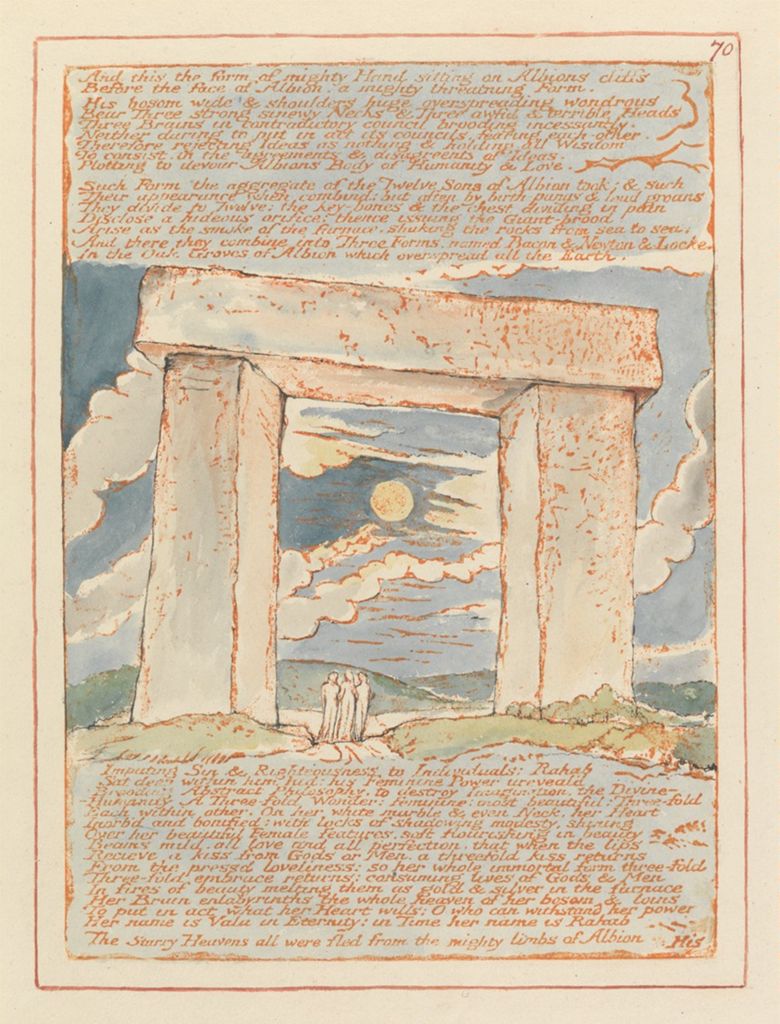
Jerusalem, Plate 70, (E 224)
"And this the form of mighty Hand sitting on Albions cliffs
Before the face of Albion, a mighty threatning Form.

His bosom wide & shoulders huge overspreading wondrous
Bear Three strong sinewy Necks & Three awful & terrible Heads
Three Brains in contradictory council brooding incessantly.      
Neither daring to put in act its councils, fearing each-other,
Therefore rejecting Ideas as nothing & holding all Wisdom
To consist. in the agreements & disagree[me]nts of Ideas.
Plotting to devour Albions Body of Humanity & Love.

Such Form the aggregate of the Twelve Sons of Albion took; & such
Their appearance when combind: but often by birth-pangs & loud groans
They divide to Twelve: the key-bones & the chest dividing in pain
Disclose a hideous orifice; thence issuing the Giant-brood
Arise as the smoke of the furnace, shaking the rocks from sea to sea.
And there they combine into Three Forms, named Bacon & Newton & Locke,
In the Oak Groves of Albion which overspread all the Earth.

Imputing Sin & Righteousness to Individuals; Rahab
Sat deep within him hid: his Feminine Power unreveal'd
Brooding Abstract Philosophy. to destroy Imagination, the Divine-
-Humanity A Three-fold Wonder: feminine: most beautiful: Three-fold
Each within other. On her white marble & even Neck, her Heart
Inorb'd and bonified: with locks of shadowing modesty, shining
Over her beautiful Female features, soft flourishing in beauty
Beams mild, all love and all perfection, that when the lips
Recieve a kiss from Gods or Men, a threefold kiss returns    
From the pressd loveliness: so her whole immortal form three-fold
Three-fold embrace returns: consuming lives of Gods & Men
In fires of beauty melting them as gold & silver in the furnace
Her Brain enlabyrinths the whole heaven of her bosom & loins
To put in act what her Heart wills; O who can withstand her power
Her name is Vala in Eternity: in Time her name is Rahab

The Starry Heavens all were fled from the mighty limbs of Albion"
Blake: A Psychological Strdy, W. P. Witcutt:
Page 116
"[T]he first thing that stikes and orthodox Christian, or one brought up in the shadow of orthodox Christiaity, as we all are, was blake's rejection of the Moral Law, which seems strangely inconsistent in one who, at least in later life, claimed with vehemence to be a Christian. What did he mean by it?...The answer seems to be that what he complains about is 'abstract good and evil,'  a law applied to each individual without pityor consideration of extenuating circumstances. 'One law for the lion and ox is oppression.' He saw this Law, thinking always in pictures, as in the illustration to Jerusalem -  a great Druid pylon or Menhir with a red sun shining through it amid dark clouds, while three blue-cloaked figures stand conversing underneath, 'imputing sin and righteousness to individuals.'

He seems to have desired what the Jesuits called causistry and the old English law 'equity,' that each act should be judged on its own merits and not according to a rigid abstract code. That is presumably how God judges, but fallible men must have a term of reference, even when the circumstances are taken into account. Blake's thought ran always to extremes.
...
It was only to be expected that Blake would revolt with violence against a system which worshiped the God of Nature and left out the Son altogether. This was Deism...Blake hated it. It kept the part of Christianity which he most disliked - the Moral Law - and omitted the saving personality of Christ and the forgiveness of sins." 
 
Jerusalem, Plate 52, (E 202)
"When Satan first the black bow bent
And the Moral Law from the Gospel rent
  He forgd the Law into a Sword
And spilld the blood of mercys Lord."

     
William Purcell Witcutt timeline

1908 born Anglican
1928 studied law
1930's converted Cathocism 
1930's 7 year seminary education
1949 Return to Anglican faith
1972 Died

TIME MAGAZINE article, JULY 4 1955

To Rome and Return

"The Rev. William Purcell Witcutt's mouth clicked shut like a snap lock when British reporters tried to interview him six years ago on his reasons for quitting the Roman Catholic Church and rejoining the Church of England. This week the lock opened smoothly with U.S. publication of Anglican Witcutt's Return to Reality (Macmillan; $1.65)—a well-written attack upon Roman Catholic doctrine.

In 1928 Witcutt, son of a Staffordshire merchant tailor, was studying law at Birmingham University when the attraction of G.K. Chesterton's anti-industrial theory of "Distributism" led him to Rome. Distributists took one look at the misery of the workingman and concluded that large-scale industry should be abolished in favor of a social-industrial structure more like that of the Middle Ages.

Since the leading Distributists seemed to be Catholics, Witcutt began to study the Roman Catholic system of thought. "It at once attracted me," he writes. "Here was an intellectual scheme moulded and shaped, it seemed, to include every detail. One had only to make an act of faith and one was settled, intellectually, for life. No more questions need be asked."

'Seven-Year Grind.' -  Anglican Witcutt became a Roman Catholic, and resolved to study for the priesthood. He persuaded Catholic authorities to waive their rule requiring converts to spend two years in the church before entering the seminary, and within a month of his reception into the church, plunged into a seven-year seminary grind at Oscott.

"It was," writes Father Witcutt, "a seven years' intensive training in how to think . . . We studied every branch of philosophy and theology. Logic was our master and the syllogism our instrument." He was entranced by the church's scholastic system of theology, "glittering and shapely as a machine." Scholastic theology's two fundamentals, says Witcutt, are the Abstract Idea (the essence of every object is comprehensible only to the mind, which is immaterial, spiritual and immortal) and the Beatific Vision ("the plunge of the soul into the Divine").

'Searching Look.' - Armed with his newfound theology, Father Witcutt was sent to a slum parish in Birmingham. For a while all went well. Then in a lecture on the Reformation .to the Catholic Evidence Guild he bore down too heavily on the corruption of the medieval Catholic clergy. "I was summoned to interview the Vicar-General, who told me, with a searching look, that I was being transferred to 'the farthest outpost of the diocese.' "

As a parish priest in the villages of Staffordshire and Warwickshire, Father Witcutt drew nearer and nearer to the God that seemed to lie just behind the veil of nature and farther and farther away from the Abstract Idea and the Beatific Vision. He found that "The God of Scholasticism was unworshipable. Nor do Roman Catholics worship Him. They cannot. They worship the Sacred Heart, the Virgin, and the Saints . . . To me Roman Catholicism seemed one of two things: either a set of dry philosophical formulae or else a range of plaster-cast statues . . . What I wanted was no vision of the intellect, but resurrection. It was the doctrine of bodily resurrection which held me by an unbreakable bond to the Christian religion, as it had held St. Paul."


“Spiritual Iron Curtain.” - Roman Catholicism, says Father Witcutt, conflicts with philosophy (“It does not allow for any advance in philosophy made since the 13th century”), with physical science (“by insisting upon the now indefensible Aristotelian doctrine” that qualities, such as color, are objective instead of being in our senses) and with history. Back in the Anglican fold, he holds that the Bishop of Rome became pre-eminent in the church only because the Mohammedans “over whelmed the Patriarchs of Alexandria, Antioch, and Jerusalem, isolated him of Constantinople, and left only the Patri arch of Rome in his former authority.”

For the last six years Father Witcutt has been a high-church Anglican curate in London’s run-down suburb of East Ham. The freedom of the Church of England is a relief to him. “More and more the Latin liturgy had become an annoyance to me,” he writes, and “I had grown to detest the spiritual Iron Curtain which divides Roman Catholics from their fellow countrymen … I am sorry to say that the Roman Catholic, and particularly the priest, despises the Church of England. He does not consider its clergy to be true priests, and he despises it for its lack of congregations and its empty pews.”

Of these empty pews optimistic Anglican Witcutt notes that the unchurched English are “not bitter anticlericals and atheists, as they would be in a Continental country. They are members of the Church who are at present asleep, and one day someone’s voice will wake them.”


Friday, May 17, 2024

Radical Christianity

  Previously posted Nov 2019

Fitzwilliam Museum
Europe
Copy K, Plate14

British Museum commentary for this plate:
"Copy D, plate 13; above, a papal figure with bat's wings sitting on an ornate throne, floating on a cloud, with an open book on his knees; below on each side a winged gowned female figure holding a sceptre; the sceptres pointing downwards and meeting above the text at the bottom of the plate, as though they were an upside-down pair of compasses; 5 lines of verse beginning "Albions Angel rose...". 1794 Europe,"


Europe, Plate 11 [13], (E 64)
"Albions Angel rose upon the Stone of Night.
He saw Urizen on the Atlantic;
And his brazen Book,
That Kings & Priests had copied on Earth
Expanded from North to South."


The immediate followers of Jesus were accused of turning 
the world upside down. They followed him in challenging all 
forms of worldly power including death. One can make a 
good case for the idea that the Christian by definition 
challenges the powers of the world; that's certainly the 
meaning of 'radical Christian'.

Blake perceived the legacy that Jesus left behind in two 
ways. On one hand the church as the mystical body of 
Christ consists of those who continually challenge the 
authority or powers of the world. On the other hand the 
Church as an institution becomes one of the powers of 
the world. The tension between these two principles 
probably exists within the breast of anyone seriously 
interested in Christ.

In the second century Ignatius of Antioch eloquently 
embodied that tension with his life. Ignatius died a martyr 
to the secular power of the Roman Empire. Before 
that happened, he had spent much of his time as an 
ecclesiastical authority rooting out dissenters, whom he 
called heretics; he did this in the course of establishing 
the institutional authority of what became the Roman 
Church.

With Constantine these two streams of authority came 
together. In 312 A.D. the new emperor declared himself 
a Christian and assumed control of the Church. He 
exercised that control through the simple device of naming 
his most trusted servant as bishop. The Church became 
an arm of the political power of the empire.

From that day to this the Church has been primarily one 
of the powers of the world. The power of the Church has 
been expressed through ecclesiastical hierarchies and 
creeds, both imposed upon the rank and file by various 
coercive techniques essentially identical with those of 
other worldly powers. This means that the spiritual reality 
of Christ vis-a-vis the Church is only actualized through 
the same sort of dissent that Jesus made in the beginning.

These conclusions of course may be debated, but they 
represent the basic and lifelong viewpoint underlying the 
radical protest which was Blake's art.

Jerusalem, Plate 52, (E 201)
"many believed what they saw, and
Prophecied of Jesus.
  Man must & will have Some Religion; if he has not the Religion
of Jesus, he will have the Religion of Satan, & will erect the
Synagogue of Satan. calling the Prince of this World, God; and
destroying all who do not worship Satan under the Name of God. 
Will any one say: Where are those who worship Satan under the
Name of God! Where are they? Listen! Every Religion that Preaches
Vengeance for Sins the Religion of the Enemy & Avenger; and not
the Forgiver of Sin, and their God is Satan, Named by the Divine
Name   Your Religion O Deists: Deism, is the Worship of the God
of this World by the means of what you call Natural Religion and
Natural Philosophy, and of Natural Morality or
Self-Righteousness, the Selfish Virtues of the Natural Heart. 
This was the Religion of the Pharisees who murderd Jesus.  Deism
is the same & ends in the same."

Monday, November 27, 2023

Church 8

Fitzwilliam Museum
Songs of Innocence and of Experience
Plate 45,Copy AA

What he Said

        In 'Songs of Experience' Blake expressed some biting truths about the  place of the church in the lives of ordinary people:

"A little black thing among the snow,
Crying "'weep! 'weep!" in notes of woe!
"Where are thy father & mother? Say?"
They are both gone up to the church to
pray. Because I was happy upon the heath,
And smil'd among the winter's snow,
They clothed me in the clothes of death,
And taught me to sing the notes of woe.
And because I am happy & dance & sing,
They think they have done me no injury,
And are gone to praise God & his Priest & King,
Who make up a heaven of our misery."    

(The Chimney Sweeper from Songs of Experience, Song 37, (E 22))     

 Surely the church has become more human since Blake's day, when it could condone the employment of five year olds as chimney sweepers and in fact their legal sale by their parents for such a purpose. Even more bald in its
ecclesiastical implications is The Little Vagabond, which sounds very much like a Ranter's song:

  "Dear Mother, dear Mother, the Church is cold,
 But the Ale-house is healthy & pleasant & warm;
 Besides I can tell where I am used well,
Such usage in heaven will never do well.
 But if at the Church they would give us some Ale,
And a pleasant fire our souls to regale,
We'd sing and we'd pray all the live-long day,
Nor ever once wish from the Church to stray.
Then the Parson might preach, & drink, & sing,
And we'd be as happy as birds in the spring;
And modest dame Lurch, who is always at Church,
Would not have bandy children, nor fasting, nor birch.
And God, like a father rejoicing to see
His children as pleasant and happy as he,
Would have no more quarrel with the Devil or the Barrel,
But kiss him, & give him both drink and apparel."
      (The Little Vagabond, Song 45, (E 26) )

       In Europe, written about the same time, Blake recounts the degradation of the church with the cult of chivalry and the Queen of Heaven:

"Now comes the night of Enitharmon's joy!
Who shall I call? Who shall I send,
That Woman, lovely Woman, may have dominion?
Arise, O Rintrah, thee I call! & Palambron, thee!
Go! tell the Human race that Woman's love is Sin;
That an Eternal life awaits the worms of sixty winters
In an allegorical abode where existence hath never come.
Forbid all Joy, & from her childhood shall the little female
Spread nets in every secret path."
      (Europe 5:1ff, (E 62) )

       Enitharmon's grammar in the second line indicates her essential falsity,
assuming the place of the true God (See Isaiah 6 ). But after 1800 Blake
rehabilitates Enitharmon, and Rahab becomes his symbol of the false church;
she continually afflicts Jerusalem and finally crucifies Jesus (See 4Z and J).
Blake used the word 'church' in some rather unconventional ways. In Milton,
Plate 37 and later in 'Jerusalem' Plate 76 he divided human history into 27
Churches, made up of three groups. The first corresponds to the nine
antediluvian patriarchs (Adam to Lamech) taken from Genesis 5. The second
group includes the patriarchs from Noah to Terah, the father of Abraham. For
the third series Blake chose seven famous religious leaders from Abraham to
Luther; each of these represents for Blake a certain type or phase of religious
history:

       The first two groups were druidic (devoted to cultic murder), but Abraham
began to curtail human sacrifice when he chose a ram instead of Issac (See
Genesis 22 ). Moses brought the Law; Solomon represents Wisdom. Paul
represents the early Christian Church. Constantine marks its embrace by the
highest satanic power. Charlemayne founded the Holy Roman Empire, and
Luther brings us to the modern age. All of these except Paul resorted to war;
therefore Blake referred to these Churches as "Religion hid in war".

       Blake felt that he had described a natural progression going nowhere for
"where Luther ends, Adam begins again in Eternal Circle", but this "Eternal
Circle" is interrupted by Jesus, who, "breaking thro' the Central zones of Death & Hell,/ Opens Eternity in Time & Space, triumphant in Mercy". There in its most concentrated form is Blake's 6000 year history of the church.

       Bear in mind that 27 is a super sinister number; Frye described it as "the
cube of thee, the supreme aggravation of three". A happier constellation of 28 (a composite of the complete numbers four and seven) occurs in Jerusalem where England's cathedral cities are called the Friends of Albion. With this image Blake  recognized that in spite of all its sins the church had exercised a beneficent influence upon the course of history. Blake habitually picked one of these cities to represent an important historical personage.

       For example Ely, the cathedral city of Cambridgeshire, stands for Milton, the greatest man produced by Cambridge. Verulam, an ancient name for
Canterbury, represents Francis Bacon , one of Blake's chief devils. Professor
Erdman informed us that Bath represents Rev. Richard Warner, a courageous
minister who preached against war in 1804, when to do such a thing bordered
on sedition. Blake's admiration for Warner led to the prominence which he gave Bath in the second chapter of Jerusalem.

      Aside from these prophetic and poetic excursions the Blakean doctrine of
the church found in the myth is roughly as follows: The Church is Beulah. The
majority of the population exist beneath it, spiritually asleep, living what Blake
called Eternal Death without even a murmur of discontent. Their eyes are closed to the spirit. They are seeds that do not generate. The hungry generally take refuge in a church and surrender their spiritual destiny into the keeping of a priest or a priestly community.

    A few still suffer hunger and eventually may come out into the sunlight .
That chosen few are, like Blake, compelled to live in a state of tension with the
church that belongs to the world. The best of them continually court martyrdom and may be honored posthumously if at all. But of such is the kingdom of heaven, where like Blake they cast off the enslavement of other men's systems and create their own.

       (Nels Ferre, who may or may not have known Blake, wrote a short parable
that describes the Blakean doctrine of the church as well or better than Frye did. It appears in the beginning of a small book entitled The Sun and the Umbrella. The image of the church as an umbrella keeping us from the full force of the Sun is compelling and quite Blakean.

(See also Religion and War)