Blake seeks to provide the Golden String which can lead us through the labyrinth of our experience or his own poetry.

Friday, August 21, 2026

Death

 First posted March 2019

Wikipedia Commons 
Illustrations to The Grave
Designed by Blake engraved by Schiavonetti

This is an extract from Chapter Two of Ram Horn'd With Gold by Larry Clayton. 

If its visions of love express the quality of a culture, so also does the face which it presents to death. Our society expends enormous sums on the professional removal of all evidence of death from our consciousness, even in the teeth of the stark reality. Ernest Becker, in The Denial of Death, showed the ubiquity of this impulse in American culture. His title, a poetic term, can just as easily mean one thing as the other. Like all symbols of value we encounter good denials of death and bad ones.
      
The poetry of Walt Whitman expresses one of the best. Like our poet Whitman was so sure of Eternity that the end of natural life had no terrors for him. He gained first hand experience with death as a hospital volunteer during the Civil War. Exceptionally memorable is his address to a dying soldier, "I don't commiserate, I congratulate you". Here is the exact opposite of the forms of denial most often exercised by the mortician, who simply does all he can to encourage us not to think about it.

In one of his earliest writings Blake explored the meaning of death to an ordinary young man and his loved ones. The Couch of Death (Erdman 441) voices the common fears of humanity but moves to the faithful reality that Blake possessed throughout his days, ending "and the youth breathes out his soul with joy into eternity".
Couch of Death 
"...Sorrow linked them together,
leaning on one another's necks alternately--like lilies, dropping
tears in each other's bosom, they stood by the bed like reeds
bending over a lake, when the evening drops trickle down.  His
voice was low as the whisperings of the woods when the wind is
asleep, and the visions of Heaven unfold their visitation. 
Parting is hard, and death is terrible; I seem to walk through a
deep valley, far from the light of day, alone and comfortless!
The damps of death fall thick upon me! Horrors stare me in the
face! I look behind, there is no returning; Death follows after
me; I walk in regions of Death, where no tree is; without a
lantern to direct my steps, without a staff to support me."
Blake's idealism found expression in the simple inversion of death, an idea that goes back as far as Heraclitus, who speaking of the Eternals said, "we live their death, and we die their life". The thought comes down to us through Euripides, Plato, and many others as late as Thomas Wolfe.
Most often when Blake speaks of "Death Eternal" he expresses the viewpoint of the Eternals; they meant by the term "this mortal life". Three times in Plate 14 of Milton the poet in Heaven, having heard the "Bard's Song" about Satan and recognizing Satan as his own Self-hood, says, "I go to Eternal Death!". He clearly means to return to this world, reenacting the kenosis (self emptying) of Christ.

Otherwise Blake used the word 'death' more straightforwardly than he had used 'love' and in two general senses. In fairly common parlance death is the opposite of the creative. Speaking of the Law in 'Jerusalem' the Divine Voice says:
"No individual can keep these Laws, for they are death To every energy of man and forbid the springs of life."

If you read Paul's epistles, you will discover that he used 'death' in the same ways. For example "And you hath he quickened, who were dead in trespasses and sins" (Ephesians 2:1). Paul is always reminding the Christian that he participates in the death and resurrection of Christ.

Secondly, Blake used 'death' in its most proper sense as the end of mortal life, but whenever he touched this subject, he always denied the materialistic viewpoint that death is the end. A clear example comes in Gates of Paradise, a short synoptic and pictorial description of Blake's myth of life:
" But when once I did descry The Immortal Man that cannot Die, Thro' evening shades I haste away To close the Labours of my Day."

Though he lived intensely, the love of the Ideal and his life long visions of Eternity led Blake to yearn for the Beyond and to depreciate material existence. Like the apostle Paul he had a "desire to depart, and to be with Christ; which is far better". Blake made a deliberate attempt through the aid of the doctrine of correspondences to live each moment of earthly life in the eternal realm, "to see a World in a Grain of Sand". Or expressed negatively:
"I assert for My Self that I do not behold the outward Creation & that to me it is hindrance & not Action; it is as the Dirt upon my feet, No part of Me."

And as stated in CHAPTER ONE he died with a song of praise on his lips. His life and all his art provide a convincing testimony for the reality of the Beyond. It was really Death that was "Dirt upon his feet".

Finally Blake used 'death' in the uniquely Christian context of self giving. At the end of 'Jerusalem' Jesus explains to Albion the meaning of his own death and its significance as a universal form of relationship:
      "...Fear not Albion: unless I die thou canst not live;
But if I die I shall arise again & thou with me.
This is Friendship & Brotherhood: without it Man is Not. ...
....Wouldest thou love one who never died
For thee, or ever die for one who had not died for thee?
And if God dieth not for Man & giveth not himself
Eternally for Man, Man could not exist; for Man is Love
As God is Love; every kindness to another is a little Death 
In the Divine Image, nor can Man exist but by Brotherhood.
*************************************

     These explorations of 'love' and 'death' may help the reader to grasp some of the poetic meanings attached to Blake's other terms of value, words like heaven and hell, good and evil, truth and error. Always watch for irony, for the other point of view, the reverse side of the coin. In such ways Blake continually provokes the intellect. He delights the person who enjoys an intellectual challenge--and frustrates others. He intimated as much in a letter to Dr. Trusler, who likely belonged to the second category:
" But you ought to know that What is Grand is necessarily
obscure to Weak men. That which can be made Explicit to
the Idiot is not worth my care. The wisest of the Ancients
consider'd what is not too Explicit as the fittest for
Instruction, because it rouzes the faculties to act. I
name Moses, Solomon, Esop, Homer, Plato."

Thursday, August 13, 2026

ANCIENT MODELS

 First posted March 2015

 Blake's attitude toward Greek and Roman literature and culture was ambivalent. Kathleen Raine tells us in Blake and Antiquity:

"The first evidence of Blake's reading of Porphyry appears in the Book of Thel, written in 1787, thirty -two years before he painted the Arlington Tempera... But once Blake had set his soul to study in a learned school, with Thomas Taylor and the Platonic philosophers, he quickly became master of a coherent symbolic system which he handled with ever-increasing scope and freedom.
 

Not only did neo-Platonism give him a vocabulary and grammar of symbolic terms; it placed him in the mainstream of European poetic and pictorial symbolism. From his reading of Porphyry and Plotinus he came to recognize in the works of poets already known to him the same symbols, endlessly recreated and re-clothed in beautiful forms. Thus he was able to extend his field of allusion and to introduce themes and images taken from many sources, without destroying the unity of his symbolic structure." (Page 17)
Illustrations to Pilgrim's Progress
Christian and Hopeful Escape Giant Despair

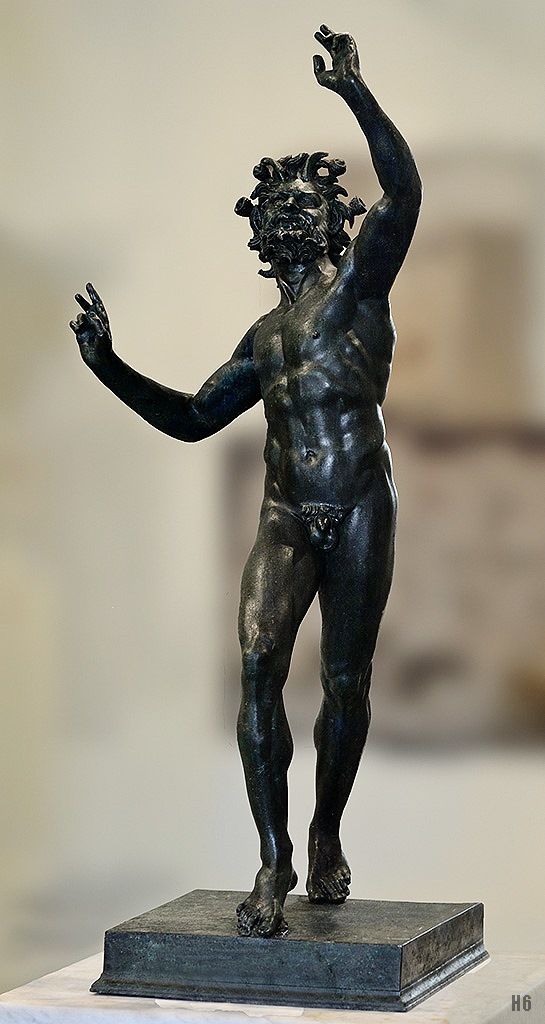
In 1809, describing his large painting of the Ancient Britons which was included his Exhibition at his brother's shop, Blake indicates that his three principle figures are recreations of characters portrayed by the ancients. Although the painting to which Blake referred is lost, we can see how Blake portrayed ApolloHercules and the Dancing Fawn by looking at images from antiquity. He referred back to portrayals of Greek gods with which he was familiar and later he projected forward when illustrating authors whom he admired.
 

Blake sees the characters who people myths as archetypal. His aim is to represent the same archetypal truth which the masters of antiquity displayed. When he places images from the pictorial vocabulary of Greece in his illustrations to Milton's Ode on the Morning of Christ's Nativity, illustrations to Bunyan's Pilgrim's Progress or to Shakespeare's Midsummer Night's Dream, he connects his reader/viewer to a more complete context. However Blake's attitudes to the values demonstrated by the Greek gods and heroes changed over time: his Dancing Fawn (as Puck) doesn't resemble the Ugly Man he described in his Catalogue; his Hercules (as the Giant Despair) is not the Strong Man of his earlier description.

Descriptive Catalogue, (E 544)
 "His opinions, who does not see spiritual agency, is
not worth any man's reading; he who rejects a fact because it is
improbable, must reject all History and retain doubts only.
  It has been said to the Artist, take the Apollo for the
model of your beautiful Man and the Hercules for your strong Man,
and the Dancing Fawn for your Ugly Man.  Now he comes to his
trial.  He knows that what he does is not inferior to the
grandest Antiques.  Superior they cannot be, for human power
cannot go beyond either what he does, or what they have done, it
is the gift of God, it is inspiration and vision.  He had
resolved to emulate those precious remains of antiquity,
he has done so and the result you behold; his ideas of strength
and beauty have not been greatly different.  Poetry as it exists
now on earth, in the various remains of ancient authors, Music as
it exists in old tunes or melodies, Painting and Sculpture as it
exists in the remains of Antiquity and in the works of more
modern genius, is Inspiration, and cannot be surpassed; it is
perfect and eternal.  Milton, Shakspeare, Michael Angelo, Rafael,
the finest specimens of Ancient Sculpture and Painting, and
Architecture, Gothic, Grecian, Hindoo and Egyptian, are the
extent of the human mind.  The human mind cannot go beyond the
gift of God, the Holy Ghost.  To suppose that Art can go beyond
the finest specimens of Art that are now in the world, is not
knowing what Art is; it is being blind to the gifts of the
spirit.
  It will be necessary for the Painter to say
something concerning his ideas of Beauty, Strength and Ugliness.
  The Beauty that is annexed and appended to folly, is a
lamentable accident and error of the mortal and perishing life;
it does but seldom happen; but with this unnatural mixture the
sublime Artist can have nothing to do; it is fit for the
burlesque.  The Beauty proper for sublime art, is lineaments, or
forms and features that are capable of being the receptacles of
intellect; accordingly the Painter has given in his beautiful
man, his own idea of intellectual Beauty.  The face and limbs
that deviates or alters least, from infancy to old age, is the
face and limbs of greatest Beauty and perfection.
  The Ugly likewise, when accompanied and annexed to
imbecility and disease, is a subject for burlesque and not for
historical grandeur; the Artist has imagined his Ugly man; one 
approaching to the
beast in features and form, his forehead small, without frontals; 
his jaws large; his nose high on the ridge, and narrow; his chest 
and the stamina of his make, comparatively little, and his joints 
and his extremities large; his eyes with scarce any whites, 
narrow and cunning, and every thing tending toward what is truly 
Ugly; the incapability of intellect.
  The Artist has considered his strong Man as a receptacle of
Wisdom, a sublime energizer; his features and limbs do not
spindle out into length, without strength, nor are they too large
and unwieldy for his brain and bosom.  Strength consists in
accumulation of power to the principal seat, and from thence a
regular gradation and subordination; strength is compactness, not
extent nor bulk.
  The strong Man acts from conscious superiority, and marches
on in fearless dependance on the divine decrees, raging with the
inspirations of a prophetic mind.  The Beautiful Man acts
from duty, and anxious solicitude for the fates of those for whom
he combats.  The Ugly Man acts from love of carnage, and delight
in the savage barbarities of war, rushing with sportive 
precipitation into the very teeth of the affrighted enemy.
  The Roman Soldiers rolled together in a heap before them:
"Like the rolling thing before the whirlwind;" each shew a
different character, and a different expression of fear, or
revenge, or envy, or blank horror, or amazement, or devout wonder
and unresisting awe.
  The dead and the dying, Britons naked, mingled with armed
Romans, strew the field beneath.  Among these, the last of the
Bards who were capable of attending warlike deeds, is seen
falling, outstretched among the dead and the dying; singing to
his harp in the pains of death."

Thursday, August 6, 2026

WOODLAND ENCOUNTER

Previously posted June 2020

Harry Ransom Center
The University of Texas at Austin
Woodland Encounter
Since I am always searching for things I have not seen before, I come across unexpected things in unexpected places. Such is this image from the University of Texas Harry Ransom Center. Images of the drawings of Blake are less available on the internet than are images from the Illuminated Books, Watercolors or Temperas. Perhaps this is because they are more likely to be held by individual collectors than by universities or museums. 

A watercolor wash drawing such as this, has a sense of immediacy not felt in a more finished painting or engraving. It seems to come to us directly from Blake's vision through his pencil and brush. The name that is attached to this picture, Woodland Encounter, did not likely come from Blake, but it suggests the significant features of the drawing. It takes place in the woods where confrontations with the other begin. We see the male as active offering direction, the female as receptive signaling acceptance. There is a prayerful attitude in the countenance of both figures as if they may be joined in spirit. 

If we look at this image from a psychological perspective, we can see an acknowledgment of the contrary states within the individual. We can see the figures as aspects on the psyche instead of a picture of a man and a woman. Blake sought to unite the contrary states. He did not see the marriage of heaven and hell as a failure but as a successful reconciliation of divisions which result from the inability to accept what is unlike one's self-image. To the extent we can accept that law (or wrath) and grace (or pity) are both necessary components of our own nature, we can begin to acknowledge that in society there will be expressions of law and grace constantly resurfacing in apparent opposition to each other.  Blake never tired of presenting the contraries in new guises. In the passage from The Marriage of Heaven and Hell Blake tells us that contraries: "Attraction and Repulsion, Reason and Energy, Love and Hate, are necessary to Human existence." Not necessary in the sense of being permanent but in the sense of being essential, as is time itself, if there is to be "progress" or movement toward wholeness.
 
Marriage of Heaven and Hell, Plate 3, (E 34) 
 " As a new heaven is begun, and it is now thirty-three years
since its advent: the Eternal Hell revives. And lo! Swedenborg is
the Angel sitting at the tomb; his writings are the linen clothes
folded up. Now is the dominion of Edom, & the return of Adam into
Paradise; see Isaiah XXXIV & XXXV Chap:
  Without Contraries is no progression.  Attraction and
Repulsion, Reason and Energy, Love and Hate, are necessary to
Human existence.
  From these contraries spring what the religious call Good &
Evil. Good is the passive that obeys Reason[.] Evil is the active
springing from Energy.
  Good is Heaven. Evil is Hell."

Isaiah 34
[12] They shall call the nobles thereof to the kingdom, but none shall be there, and all her princes shall be nothing.
[13] And thorns shall come up in her palaces, nettles and brambles in the fortresses thereof: and it shall be an habitation of dragons, and a court for owls.
[14] The wild beasts of the desert shall also meet with the wild beasts of the island, and the satyr shall cry to his fellow; the screech owl also shall rest there, and find for herself a place of rest.
[15] There shall the great owl make her nest, and lay, and hatch, and gather under her shadow: there shall the vultures also be gathered, every one with her mate.
[16] Seek ye out of the book of the LORD, and read: no one of these shall fail, none shall want her mate: for my mouth it hath commanded, and his spirit it hath gathered them.
[17] And he hath cast the lot for them, and his hand hath divided it unto them by line: they shall possess it for ever, from generation to generation shall they dwell therein.

Isaiah 35
[1The wilderness and the solitary place shall be glad for them; and the desert shall rejoice, and blossom as the rose.
[2] It shall blossom abundantly, and rejoice even with joy and singing: the glory of Lebanon shall be given unto it, the excellency of Carmel and Sharon, they shall see the glory of the LORD, and the excellency of our God.
[3] Strengthen ye the weak hands, and confirm the feeble knees.
[4] Say to them that are of a fearful heart, Be strong, fear not: behold, your God will come with vengeance, even God with a recompence; he will come and save you.
[5] Then the eyes of the blind shall be opened, and the ears of the deaf shall be unstopped.
[6] Then shall the lame man leap as an hart, and the tongue of the dumb sing: for in the wilderness shall waters break out, and streams in the desert.
[7] And the parched ground shall become a pool, and the thirsty land springs of water: in the habitation of dragons, where each lay, shall be grass with reeds and rushes.
[8] And an highway shall be there, and a way, and it shall be called The way of holiness; the unclean shall not pass over it; but it shall be for those: the wayfaring men, though fools, shall not err therein.
[9] No lion shall be there, nor any ravenous beast shall go up thereon, it shall not be found there; but the redeemed shall walk there:
[10] And the ransomed of the LORD shall return, and come to Zion with songs and everlasting joy upon their heads: they shall obtain joy and gladness, and sorrow and sighing shall flee away.

4 comments:

Ian V Mulder said...

It's a most attractive drawing, I don't generally like his representations of the human formm, but this one is more realistic. The woman finished in detail, the man sketched lightly. I've no idea what Blake intended, but form an impression that this simple man of the woods finds himself confronted by an apparition, in the form of a beautiful woman who's more real to him in this moment than his own mundane life. Yet less physical!

ellie Clayton said...

Thanks for seeing the image with different eyes. Perhaps the definition of a successful work of art is that it brings forth the inner truth which the conscious mind is prepared to receive.

If one can see the woman as more real but less physical, one has bridged the gap between the two worlds.

I am glad that you act as my bridge to the other side of the big pond. ellie

Susan J. said...

wow. Ellie. this image really captured me, and I loved your commentary. I guess I've told you about my sure-seemed-to-be-real experience of Jesus at the edge of a forest clearing, beckoning to me & saying "follow me" -- I love what you wrote about the essential necessity of opposites... thanks so much!!! oh - and the allusion to male and female as essential parts of each individual human seems quite timely as well -- THANK YOU, dear friend!

-- Susan J

ellie Clayton said...

Larry and I used to remark on how we 'played tapes', retelling the same memories. However I don't remember your 'tape' about Jesus beckoning to you from the edge of the forest clearing. I would like to hear it played repeatedly.

I know I repeat myself in my posts but then aren't there only a few things that need to be said. All we can hope is to state the old truth in fresh ways.

I'm glad I found WOODLAND ENCOUNTER for many reasons including that we meet in the woods for worship since the meeting house is closed.

Have a Blessed Day, ellie


The Selfhood

First posted  Jan 2010

 Be ye therefore perfect. (Matthew 5:48)

Matthew 5
[29] And if thy right eye offend thee, pluck it out, and cast it from thee: for it is profitable for thee that one of thy members should perish, and not that thy whole body should be cast into hell.
[30] And if thy right hand offend thee, cut if off, and cast it from thee: for it is profitable for thee that one of thy members should perish, and not that thy whole body should be cast into hell.

...
[42] Give to him that asketh thee, and from him that would borrow of thee turn not thou away.
[43] Ye have heard that it hath been said, Thou shalt love thy neighbour, and hate thine enemy.
[44] But I say unto you, Love your enemies, bless them that curse you, do good to them that hate you, and pray for them which despitefully use you, and persecute you;
[45] That ye may be the children of your Father which is in heaven: for he maketh his sun to rise on the evil and on the good, and sendeth rain on the just and on the unjust.
[46] For if ye love them which love you, what reward have ye? do not even the publicans the same?
[47] And if ye salute your brethren only, what do ye more than others? do not even the publicans so?
[48] Be ye therefore perfect, even as your Father which is in heaven is perfect.


In the Preface to The Great Divorce 
C. S. Lewis wrote:
"if we accept Heaven we shall not be able to retain even the smallest and most intimate souvenirs of Hell." We may have to give up our right hand or our right eye.

Egocentricity, Self-centeredness, Narcissism, Selfishness, Contempt for the 'neighbor', etc. etc! These are some of the attributes that Blake grouped together into the image of "The Selfhood". Blake saw these and other similar traits within himself; he saw them in others, and he saw them in the world.

For twenty years he fought injustice, greed, chicanery, deceit, exploitation; in all those things he was very much of a negative thinker. But at some point he turned: he was forgiven; he turned positive although he understood all too well that he, we, the world must annihilate the Selfhood in order to reach Eternity.

Blake also used the term 'Spectre'; it too was to be annihilated.
In the poem, Milton, we hear from the mouth of 'Milton' speaking to his Spectre:
"Such are the .......Laws of Eternity, that each shall mutually
Annihilate himself for others' good, as I for thee. . . .

In Self annihilation all that is not of God alone,
To put off Self and all I have, ever & ever . . ." (Milton, Plate 39; Erdman 139)

And "The Negation is the Spectre, the Reasoning Power in Man:
This is a false Body, an Incrustation over my Immortal
Spirit, a Selfhood which must be put off & annihilated alway. " (Milton, Plate 40; Erdman 142)
Wikipedia Commons
Jerusalem
Plate 8


Saturday, August 1, 2026

ZOAS AS ARCHETYPES

First posted May 2011

Blake uses the Zoas as a means of presenting the aspects of the psyche which he sees internally and recognizes as the structure of the human mind. Early in Blake's life he recognized that there were internal divisions within himself. Reason, desire, imagination and sensation each tried to claim the uppermost position in the allocation of his time and resources. Blake personified these abstractions as the 'Four Mighty Ones in Every Man.'

The beginning of the Four Zoas brings to our attention the four mighty ones who do battle:

Four Zoas, Night I, Page 3, (E 300)
"The Song of the Aged Mother which shook the heavens with wrath
Hearing the march of long resounding strong heroic Verse
Marshalld in order for the day of Intellectual Battle

Four Mighty Ones are in every Man;"

Later Blake identifies the Four Zoas and their positions in the Eternal World.

Four Zoas, Night VII, Page 74, (E 351)
"But in Eternal times the Seat of Urizen is in the South
Urthona in the North Luvah in East Tharmas in West"

Laurens van der Post, in Jung and the Story of Our Time, speaking of Jung's observation that the conflict between the conscious and unconscious forces in the mind led to mental illness notes that :

"The trouble started only when the part of the human personality which was conscious behaved as if it were the whole of the man. There was nothing this unconscious world abhorred more than one-sidedness. When one extreme of spirit attempted a monopoly for itself another extreme sooner of later rose titanic in the unconscious to overthrow it. That is why the history of man was so much a swing from one opposite of spirit into another as Heraclitus had observed millenniums before." (Page 209)

The trouble starts in Blake's myth when the positions of the Zoas are altered by the deal between Urizen and Luvah. The harmonious balance is ruined.

Milton, PLATE 19 [21], (E 112)
"Four Universes round the Mundane Egg remain Chaotic
One to the North, named Urthona: One to the South, named Urizen:
One to the East, named Luvah: One to the West, named Tharmas
They are the Four Zoa's that stood around the Throne Divine!
But when Luvah assum'd the World of Urizen to the South:
And Albion was slain upon his mountains, & in his tent;
All fell towards the Center in dire ruin, sinking down.
And in the South remains a burning fire; in the East a void.
In the West, a world of raging waters; in the North a solid,
Unfathomable! without end. But in the midst of these,
Is built eternally the Universe of Los and Enitharmon:
Towards which Milton went, but Urizen oppos'd his path."

Van der Post writes of the collective unconscious and archetypes of Jung as the patterns of the mind which organize its form and put to use the psyche's energy.

"He [Jung] revealed how in this collective unconscious of the individual man were infinite resources of energy, organized in definite patterns. Each of these patterns had at its disposal its own form of energy and somewhere located, as it were, in the center, between the unconscious and the conscious, there was a master pattern to which all the others subscribed and all their other energies could be joined in one transcendental orbit. He called these patterns, first of all, 'primordial images,' ... but later changed to 'archetypes,' an idea rediscovered from Saint Augustine, and before him from Hermes Trimegistus, who proclaimed in the Poimandres, 'You have seen in your mind the archetypal image!'" (Page 209)

In Jerusalem we learn the Zoas have lost their original abilities and exemplify the opposite characteristics:

Jerusalem, Plate 38, (E184)
"They [the Four Zoas] saw their Wheels rising up poisonous against Albion
Urizen, cold & scientific: Luvah, pitying & weeping
Tharmas, indolent & sullen: Urthona, doubting & despairing
Victims to one another & dreadfully plotting against each other
To prevent Albion walking about in the Four Complexions."

Jerusalem, Plate 49, (E 199)
"Because the Evil is Created into a State. that Men
May be deliverd time after time evermore. Amen.
Learn therefore O Sisters to distinguish the Eternal Human
That walks about among the stones of fire in bliss & woe
Alternate! from those States or Worlds in which the Spirit travels:
This is the only means to Forgiveness of Enemies"


Blake and Jung both sought consciousness of the internal dynamics of the psyche, awareness of the forces seeking expression or dominance, and recognition of 'the Eternal Human That walks about among the stones of fire in bliss & woe.'


Frontispiece to Bürger's "Leonora" (London, 1796)
Designed by Blake, Engraved by Perry


Van der Post explains Jung's concept of wholeness:

"Wholeness was the ultimate of man's conscious and unconscious seeking; indeed consciousness was so important because it was the chosen instrument of the unconscious seeking the abolition of partialities in a harmony of differences that is wholeness." (Page 219)