Blake seeks to provide the Golden String which can lead us through the labyrinth of our experience or his own poetry.

Showing posts with label Good and Evil. Show all posts

Thursday, June 30, 2022

GREAT SIN


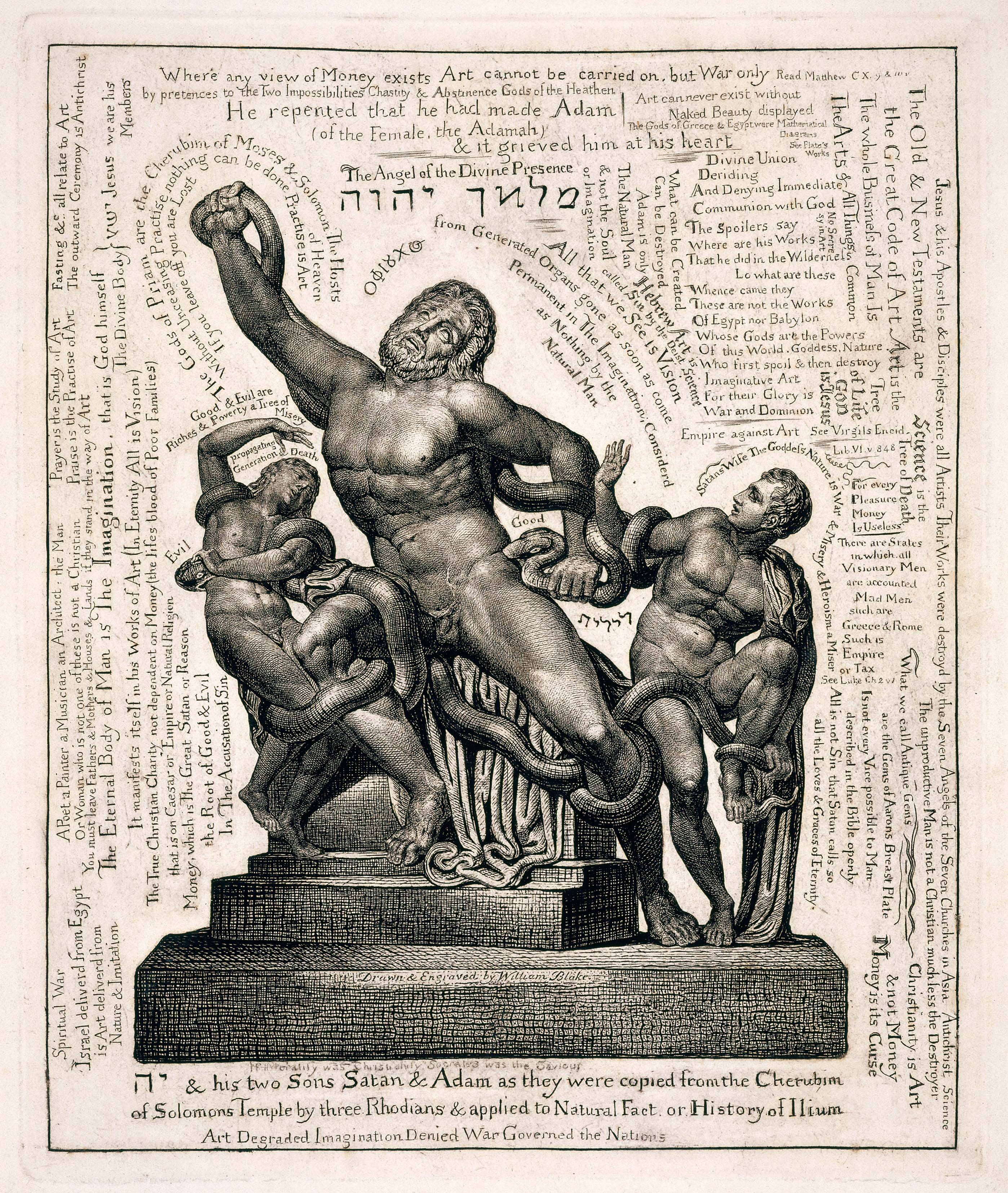
Laocoon
Jehovah & his two Sons Satan & Adam
 

William Blake was a man who interested Henry Crabb Robinson who made a hobby of interviewing the people who interested him. Robinson was not daunted by the fact that Blake spoke of subjects which were beyond his comprehension. We are indebted to Robinson for recording his first hand conversations with Blake, something which was done by no one else.

Henry Crabb Robinson, Reminiscences, Page 26

"It is one of the subtle remarks of Hume, on certain religious speculations, that the tendency of them is to make men indifferent to whatever takes place, by destroying all ideas of good and evil. I took occasion to apply this remark to something Blake had said. 'If so,' I said, 'there is no use in discipline or education, - no difference between good and evil.' He hastily broke in upon me: 'There is no use in education . I hold it to be wrong. It is the great sin. It is eating of the tree of the knowledge of good and evil. This was the fault of Plato. He knew of nothing but the virtues and vices, and good and evil. There is nothing in all that. Everything is good in God's eyes.' On my putting the obvious question, 'Is there nothing absolutely evil in what men do ?' — 'I am no judge of that. Perhaps not in God's eyes.'

He sometimes spoke as if he denied altogether the existence of evil, and as if we had nothing to do with right and wrong ; it being sufficient to consider all things as alike the work of God. Yet at other times he spoke of there being error in heaven. I asked about the moral character of Dante, in writing his 'Vision,' — was he pure ? -- ' Pure,' said Blake, 'do you think there is any purity in God's eyes? The angels in heaven are no more so than we. 'He chargeth his angels with folly.'' He afterwards represented the Supreme Being as liable to error. 'Did he not repent him that he had made Nineveh?' It is easier to repeat the personal remarks of Blake than these metaphysical speculations, so nearly allied to the most opposite systems of philosophy. Of himself, he said he acted by command. The Spirit said to him, 'Blake, be an artist, and nothing else.' In this there is felicity. His eye glistened while he spoke of the joy of devoting himself solely to divine art. 'Art is inspiration. When Michael Angelo, or Raphael, or Mr. Flaxman, does any of his fine things, he does them in the Spirit.' Blake said: 'I should be sorry if I had any earthly fame, for whatever natural glory a man has is so much taken from his spiritual glory. I wish to do nothing for profit. I wish to live for art. I want nothing whatever. I am quite happy.'

Among the unintelligible things he expressed was his distinction between the natural world and the spiritual. The natural world must be consumed. Incidentally, Swedenborg was referred to. Blake said: 'He was a divine teacher. He has done much good, and will do much. He has corrected many an error.'"

In Fearful Symmetry, Northrop Frey clarifies Blake's objection to Plato's objective in education. 

 "The fact that in the world of vision or art we see what we want to see implies that it is a world of fulfilled desire and unbounded freedom. The rejection of art from Plato's Republic is an essential part of a vision of the human soul which puts desire in bondage to reason, a vision of a universe turning on a spindle of necessity, and an assumption that a form is an idea rather than an image...Imagination is energy incorporated in form...imagination creates reality, and as desire is a part of imagination, the world we desire is more real than the world we passively accept." (Page 26,27)

Marriage of Heaven and Hell, Plate 4, (E 34)

'2. Energy is the only life and is from the Body and Reason is the bound or outward circumference of Energy. 
3. Energy is Eternal Delight'

Laocoon, (E 273)

"Good & Evil are

Riches & Poverty a Tree of Misery 
propagating Generation & Death 
The whole Business of Man Is The Arts & All Things Common

Christianity is Art & not Money 
Money is its Curse

The Old & New Testaments are the Great Code of Art

Jesus & his Apostles & Disciples were all Artists
Adam is only The Natural Man & not the Soul or Imagination

The Eternal Body of Man is The IMAGINATION.
          God himself  |
that is                |<Hebrew>[Yeshua] JESUS We are his Members
        The Divine Body|

It manifests itself in his Works of Art (In Eternity All is Vision)
All that we See is VISION from Generated Organs gone as soon as come
Permanent in The Imagination; considered as Nothing by the NATURAL MAN 
All is not Sin that Satan calls so    all the Loves & Graces of Eternity." 
Jerusalem, Plate 9, (E 152)
"And this is the manner of the Sons of Albion in their strength
They take the Two Contraries which are calld Qualities, with which
Every Substance is clothed, they name them Good & Evil
From them they make an Abstract, which is a Negation             
Not only of the Substance from which it is derived
A murderer of its own Body: but also a murderer
Of every Divine Member: it is the Reasoning Power
An Abstract objecting power, that Negatives every thing
This is the Spectre of Man: the Holy Reasoning Power             
And in its Holiness is closed the Abomination of Desolation"
Jerusalem, Plate 74, (E 230)
"the Daughters of Albion ran around admiring
His awful beauty: with Moral Virtue the fair deciever; offspring 
Of Good & Evil," 

Jerusalem, Plate 98, (E 258)

"Where is the Covenant of Priam, the Moral Virtues of the Heathen
Where is the Tree of Good & Evil that rooted beneath the cruel heel
Of Albions Spectre the Patriarch Druid! where are all his Human Sacrifices" 
On Homers Poetry, (E 269) 
"It is the same with the Moral of a whole Poem as with the Moral Goodness
of its parts Unity & Morality, are secondary considerations &
belong to Philosophy & not to Poetry, to Exception & not to Rule,
to Accident & not to Substance. the Ancients calld it eating of
the tree of good & evil." 
Everlasting Gospel, (E 521)
"Good & Evil are no more     
Sinais trumpets cease to roar
Cease finger of God to Write
The Heavens are not clean in thy Sight
Thou art Good & thou Alone     
Nor may the sinner cast one stone
To be Good only is to be
A Devil or else a Pharisee" 
Vision of Last Judgment,(E 554) 
"The Last Judgment when all those are Cast away who trouble
Religion with Questions concerning Good & Evil or Eating of the
Tree of those Knowledges or Reasonings which hinder the Vision of
God turning all into a Consuming fire <When> Imaginative Art &
Science & all Intellectual Gifts all the Gifts of the Holy Ghost
are [despisd] lookd upon as of no use & only Contention
remains to Man then the Last Judgment begins & its Vision is seen
by the [Imaginative Eye] of Every one according to the
situation he holds" 
Vision of Last Judgment, (E 620)
"Here they are no longer talking of what is Good &
Evil or of what is Right or Wrong & puzzling themselves in Satans
[Maze] Labyrinth But are Conversing with Eternal
Realities as they Exist in the Human Imagination   We are in a
World of Generation & death & this world we must cast off if we
would be Painters [P 91] Such as Rafa[e]l Mich Angelo & the
Ancient Sculptors. if we do not cast off this world we shall be
only Venetian Painters who will be cast off & Lost from Art"  

Vision of Last Judgment, (E 565)

" Angels are happier than Men <&
Devils> because they are not always Prying after Good & Evil in
One Another & eating the Tree of Knowledge for Satans
Gratification"
Annotations to Swedenborg, (E 604)
"Good & Evil are here both Good & the two contraries Married" 
Annotations to Bacon, (E 621)
"Self Evident Truth is one Thing and Truth the result of Reasoning is another Thing    Rational Truth is not the Truth of Christ but of Pilate  It is the Tree of the Knowledge of Good & Evil" 


Thursday, October 7, 2021

LARGE COLOR PRINTS 7

First posted Feb 2014

 Daniel 4
[29] At the end of twelve months he was walking on the roof of the royal palace of Babylon,
[30] and the king said, "Is not this great Babylon, which I have built by my mighty power as a royal residence and for the glory of my majesty?"
[31] While the words were still in the king's mouth, there fell a voice from heaven, "O King Nebuchadnez'zar, to you it is spoken: The kingdom has departed from you,
[32] and you shall be driven from among men, and your dwelling shall be with the beasts of the field; and you shall be made to eat grass like an ox; and seven times shall pass over you, until you have learned that the Most High rules the kingdom of men and gives it to whom he will."
[33] Immediately the word was fulfilled upon Nebuchadnez'zar. He was driven from among men, and ate grass like an ox, and his body was wet with the dew of heaven till his hair grew as long as eagles' feathers, and his nails were like birds' claws.
[34] At the end of the days I, Nebuchadnez'zar, lifted my eyes to heaven, and my reason returned to me, and I blessed the Most High, and praised and honored him who lives for ever; for his dominion is an everlasting dominion, and his kingdom endures from generation to generation;

Nebuchadnezzar stood at the pinnacle of success and power as the ruler of an empire. He attributed to his own strength and wisdom all that belonged to him. But he was unaware of things in his life to which he had not given attention. There were unclaimed aspects of his psyche which needed to be acknowledged. When we read the quote from the Book of Daniel we realize that when his conscious mind laid claim to all of his achievements, another part of his mind, his unconscious, drove him into a dark and terrifying place. That surface patina of ego-consciousness was overwhelmed by the behavior of a beast of the field. His condition became that of one suffering from what we now call mental illness.

Wikipedia Commons
Large Color Prints
Nebuchadnezzar

Blake's image of Nebuchadnezzar shows him deprived of human characteristics. In the sequence of the Large Color Prints which we have been following this represents a further descent from man's state in Eden. He had lost the ability to perceive the Divine Image and therefore appears as less than human. Blake used the term Ulro for the level of existence at which all memory of Eternity had been eradicated.  

Notice in the passage from Daniel that after seven times passed over Nebuchadnezzar three things happened: he lifted his eyes to heaven, his reason returned, and he blessed the Most High. Lifting his eyes to heaven is recognition of God as the source of all things. His reason returns when he has learned to process and put into order the content of both the conscious and unconscious levels of his mind. He reorders his life since he now knows what comes from himself and what comes from God and he is grateful.

Four Zoas, Night IX, Page 135, (E 403)
"Attempting to be more than Man We become less said Luvah
As he arose from the bright feast drunk with the wine of ages
His crown of thorns fell from his head he hung his living Lyre
Behind the seat of the Eternal Man & took his way
Sounding the Song of Los descending to the Vineyards bright      
His sons arising from the feast with golden baskets follow
A fiery train as when the Sun sings in the ripe vineyards
Then Luvah stood before the wine press all his fiery sons
Brought up the loaded Waggons with shoutings ramping tygers play
In the jingling traces furious lions sound the song of joy       
To the golden wheels circling upon the pavement of heaven & all
The Villages of Luvah ring the golden tiles of the villages
Reply to violins & tabors to the pipe flute lyre & cymbal
Then fell the Legions of Mystery in maddning confusion
Down Down thro the immense with outcry fury & despair            
Into the wine presses of Luvah howling fell the Clusters
Of human families thro the deep. the wine presses were filld
The blood of life flowd plentiful Odors of life arose
All round the heavenly arches & the Odors rose singing this song
Page 136 
O terrible wine presses of Luvah O caverns of the Grave
How lovely the delights of those risen again from death
O trembling joy excess of joy is like Excess of grief

So sang the Human Odors round the wine presses of Luvah"


When man associates the contents of his conscious mind with good, and of the unconscious mind with evil he is in danger of an eruption of his buried or shadow side. The rejected content may surface as uncontrolled outbursts, moods of depression, or feelings of worthlessness. But when he retrieves from his shadow side discarded remnants from a totality which needs both darkness and light to define its outlines, he may indeed feel he is 'risen again from death.'
 
The following quote is from Meeting the Shadow, The Hidden Power of the Dark Side of Human Nature by Connie Zweig and Jeremiah Abrams:

"British Jungian analyst and astrologer Liz Greene points to the paradoxical nature of the shadow as both the container of darkness and the beacon pointing toward the light: “It is the suffering, crippled side of the personality which is both the dark shadow that won't change and also the redeemer that transforms one's life and alters one's values. The redeemer can get hidden treasure or win the princess or slay the dragon because he's marked in some way –he's abnormal. The shadow is both the awful thing that needs redemption, and suffering redeemer who can provide it."


Sunday, October 3, 2021

LARGE COLOR PRINTS 4

First posted Feb 2014

Genesis 2
[9] And out of the ground the LORD God made to grow every tree that is pleasant to the sight and good for food, the tree of life also in the midst of the garden, and the tree of the knowledge of good and evil.
[16] And the LORD God commanded the man, saying, "You may freely eat of every tree of the garden;
[17] but of the tree of the knowledge of good and evil you shall not eat, for in the day that you eat of it you shall die." 
 
The drama which took place in the Garden of Eden revolved around the tree which bore the fruit which if eaten would provide knowledge of Good & Evil. Without that knowledge nothing was of greater or lesser value. Thinking as Blake did that man could return to Eden at any time, this knowledge of Good & Evil became a pivotal point for him. 
 
As Blake worked it out, man, as a consequence of dualistic thinking, named an opposed characteristics to each entity he identified. Then he compounded his error by declaring one of the pair good and the other evil. Himself and what he preferred, he identified with the good, and the other object, person, idea or word he identified with evil. From this description it is apparent that good and evil are arbitrary. 
 
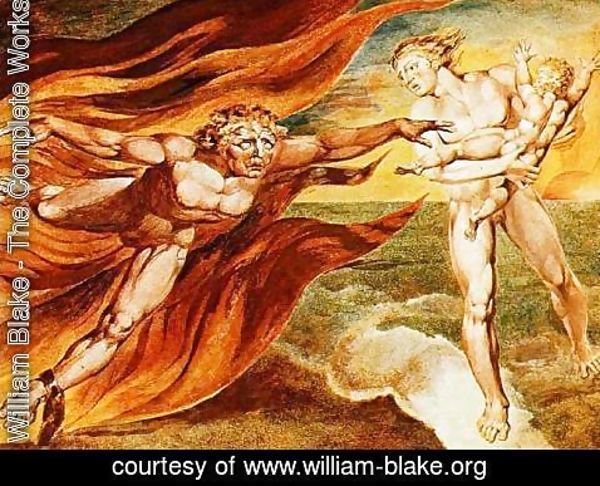
In the two previous posts on the Large Color Prints, the Fall of man was seen as the consequence of division: man dividing from God, then man dividing from woman. In the Good & Evil Angels Struggling for Possession of a Child we see that the process of division has come to permeate everything. And that the divisions lead to contentions between two sides seeking dominance. To Blake the dualistic thinking which leads to the labels of good and evil is the root of the whole process of accusation, condemnation and vengeance. Brotherhood cannot come until the other is not seen as evil. 
williamblake.org 
The Good and Evil Angels Struggling for Possession of a Child


In the Editors' Notes for this picture in the Blake Archive we read:
"The color print may also indicate the fall into the errors of the good/evil, body/soul, energy/reason dualities. The child may thus represent humanity caught between these contending oppositions."

A Vision of The Last Judgment, (E 554)
                   For the Year 1810
        Additions to Blakes Catalogue of Pictures &c

     "The Last Judgment when all those are Cast away who trouble
Religion with Questions concerning Good & Evil or Eating of the
Tree of those Knowledges or Reasonings which hinder the Vision of
God turning all into a Consuming fire  Imaginative Art &
Science & all Intellectual Gifts all the Gifts of the Holy Ghost
are [despisd] lookd upon as of no use & only Contention
remains to Man then the Last Judgment begins & its Vision is seen
by the [Imaginative Eye] of Every one according to the
situation he holds"

A Vision of The Last Judgment, (E 562)
"Here they are no longer talking of what is Good &
Evil or of what is Right or Wrong & puzzling themselves in Satans
[Maze] Labyrinth But are Conversing with Eternal
Realities as they Exist in the Human Imagination   We are in a
World of Generation & death & this world we must cast off" 

A Vision of The Last Judgment, (E 563)
 "By this it will be seen that I do not consider either the Just
or the Wicked to be in a Supreme State but to be every one of
them States of the Sleep which the Soul may fall into in its
Deadly Dreams of Good & Evil when it leaves Paradise
[with]  the Serpent" 

A Vision of The Last Judgment, (E 564)
"Nothing is displeasing to God but Unbelief & Eating of the Tree
of Knowledge of Good & Evil 
 Men are admitted into Heaven not because they have
 governd their Passions or have No Passions but because
they have Cultivated their Understandings.  The Treasures of
Heaven are not Negations of Passion but Realities of Intellect
from which All the Passions Emanate  in their Eternal
Glory   The Fool shall not enter into Heaven let him be ever so
Holy.  Holiness is not The Price of Enterance into Heaven Those
who are cast out Are All Those who having no Passions of their
own because No Intellect.  Have spent their lives in Curbing &
Governing other Peoples by the Various arts of Poverty & Cruelty
of all kinds"
 

Saturday, January 30, 2021

ONENESS

Wikipedia Commons
Jerusalem
Frontispiece

This paragraph is from an earlier post by Larry:

"Good and Evil are a polarity, and a contrary of the pristine oneness of the original Garden. We may see it as the first contrary, from which all others sprang. We live in a dualistic world, and people in general can only see things in black and white (like infants do). To perceive things as a spectrum, such as 'Good, less good, still less good,' etc. is a step away from the fatal tree, but still a long way from the primeval oneness from which we came and to which we are destined to return."


The Tree of Knowledge of Good and Evil is central to the understanding of the relationship of God and his creation. According to the book of Genesis eating of the fruit this tree is forbidden to man. A common way of looking a this prohibition is that it was a test of man's obedience to the commands of God. The premise upon which this interpretation is based is belief an authoritarian God who demands worship and submission. An alternative understanding of the eating of the fruit of the knowledge of good and evil is that creation depended upon the promulgation of contraries which originated with the awareness of the first two - Good and Evil (the preferred and the rejected.) 

If we can see Knowledge of Good and Evil as the contrary of the Knowledge of the Unity of God and Man, creation depended upon the eating of the fruit of the knowledge of good and evil, since the creation would only progress through further divisions into contraries. 

The act of Creation by God is the beginning of the division of the primordial unity. When man and woman eat of the fruit of the Tree of Knowledge of Good and Evil, the process of creation passes into the hands of Humanity who is given the responsibility of becoming God's image in the milieu the time and space. The process of dividing continues until mankind comprehends that life is drawing him back to the center which is the light on men.

John 1
[1] In the beginning was the Word, and the Word was with God, and the Word was God.
[2] The same was in the beginning with God.
[3] All things were made by him; and without him was not any thing made that was made.
[4] In him was life; and the life was the light of men.
[5] And the light shineth in darkness; and the darkness comprehended it not.

Genesis 2
[15] And the LORD God took the man, and put him into the garden of Eden to dress it and to keep it.
[16] And the LORD God commanded the man, saying, Of every tree of the garden thou mayest freely eat:
[17] But of the tree of the knowledge of good and evil, thou shalt not eat of it: for in the day that thou eatest thereof thou shalt surely die.

A Vision of Last Judgment, (E 554)
                    "For the Year 1810
        Additions to Blakes Catalogue of Pictures &c

     The Last Judgment when all those are Cast away who trouble
Religion with Questions concerning Good & Evil or Eating of the
Tree of those Knowledges or Reasonings which hinder the Vision of
God turning all into a Consuming fire <When> Imaginative Art &
Science & all Intellectual Gifts all the Gifts of the Holy Ghost
are [despisd] lookd upon as of no use & only Contention
remains to Man then the Last Judgment begins & its Vision is seen
by the [Imaginative Eye] of Every one according to the
situation he holds"

Vision of Last Judgment, (E 563)  
"Allegories are things that Relate to Moral Virtues Moral Virtues do not Exist they are Allegories & dissimulations <But Time & Space are Real Beings a Male & a Female Time is a Man Space is a Woman & her Masculine Portion is Death> [PAGE 86] The Combats of Good & Evil <is Eating of the Tree of Knowledge The Combats of Truth & Error is Eating of the Tree of Life> [& of Truth & Error which are the same thing] <these> are not only Universal but Particular. Each are Personified There is not an Error but it has a Man for its [Actor] Agent that is it is a Man.. There is not a Truth but it has also a Man <Good & Evil are Qualities in Every Man whether <a> Good or Evil Man> These are Enemies & destroy one another by every Means in their power both of deceit & of open Violence The Deist & the Christian are but the Results of these Opposing Natures Many are Deists who would in certain Circumstances have been Christians" Vision of Last Judgment, (E 564) "Christ comes as he came at first to deliver those who were bound under the Knave not to deliver the Knave He Comes to Deliver Man the [Forgiven] <Accused &> not Satan the Accuser we do not find any where that Satan is Accused of Sin he is only accused of Unbelief & thereby drawing Man into Sin that he may accuse him. Such is the Last Judgment a Deliverance from Satans Accusation Satan thinks that Sin is displeasing to God he ought to know that Nothing is displeasing to God but Unbelief & Eating of the Tree of Knowledge of Good & Evil [PAGE 87] Men are admitted into Heaven not because they have <curbed &> governd their Passions or have No Passions but because they have Cultivated their Understandings. The Treasures of Heaven are not Negations of Passion but Realities of Intellect from which All the Passions Emanate <Uncurbed> in their Eternal Glory The Fool shall not enter into Heaven let him be ever so Holy. Holiness is not The Price of Enterance into Heaven Those who are cast out Are All Those who having no Passions of their own because No Intellect. Have spent their lives in Curbing & Governing other Peoples by the Various arts of Poverty & Cruelty of all kinds"

Tuesday, November 17, 2020

SATAN & DEISM

Wikipedia Commons
Jerusalem
Plate 26

Part of what Blake meant by Satan can be understood in the light of what he said about Deism. When the philosophers of the enlightenment discarded orthodox Christianity they created a structure to hold their own religion, Blake called it Deism. Also Blake referred to it as the Synagogue of Satan because the traditional God of the Jews and the Christians was replaced by the God of This World, whom Blake recognized as Satan. Some of the characteristics are named in this passage.

The Deists:

1.) Taught that man is righteous by nature,

2.) Preached vengeance for sins of others,

3.) Caused war

4.) Did not practice forgiveness

Satan, to Blake, is known by his works and his works are seen in his followers. The follower of Satan is the self-righteous person who seeks to punish those who don't measure up to his standards, who accuses others and exonerates himself for the same offenses, who considers forgiving others a sign of weakness, and who would rather see the suffering of war than the blessings of peace.

Introduction to Chapter 3 of Jerusalem, To the Deists

Jerusalem, Plate 52, (E 200)
 "You O Deists profess yourselves the Enemies of Christianity:
and you are so: you are also the Enemies of the Human Race & of
Universal Nature. Man is born a Spectre or Satan & is altogether
an Evil, & requires a New Selfhood continually & must continually
be changed into his direct Contrary.  But your Greek Philosophy
(which is a remnant of Druidism) teaches that Man is Righteous in
his Vegetated Spectre: an Opinion of fatal & accursed consequence
to Man, as the Ancients saw plainly by Revelation to the intire
abrogation of                  
Experimental Theory. and many believed what they saw, and
Prophecied of Jesus.
  Man must & will have Some Religion; if he has not the Religion
of Jesus, he will have the Religion of Satan, & will erect the
Synagogue of Satan. calling the Prince of this World, God; and
destroying all who do not worship Satan under the Name of God. 
Will any one say: Where are those who worship Satan under the
Name of God! Where are they? Listen! Every Religion that Preaches
Vengeance for Sins the Religion of the Enemy & Avenger; and not
the Forgiver of Sin, and their God is Satan, Named by the Divine
Name   Your Religion O Deists: Deism, is the Worship of the God
of this World by the means of what you call Natural Religion and
Natural Philosophy, and of Natural Morality or
Self-Righteousness, the Selfish Virtues of the Natural Heart. 
This was the Religion of the Pharisees who murderd Jesus.  Deism
is the same & ends in the same.

 Voltaire Rousseau Gibbon Hume. charge the Spiritually Religious
with Hypocrisy! but how a Monk or a Methodist either, can be a
Hypocrite: I cannot concieve.  We are Men of like passions with
others & pretend not to be holier than others: therefore, when a
Religious Man falls into Sin, he ought not to be calld a
Hypocrite: this title is more properly to be given to a Player
who falls into Sin; whose profession is Virtue & Morality & the
making Men Self-Righteous.  Foote in calling Whitefield,
Hypocrite: was himself one: for Whitefield pretended not to be
holier than others: but confessed his Sins before all the World;
Voltaire! Rousseau! You cannot escape my charge that you are
Pharisees & Hypocrites, for you are constantly talking of the
Virtues of the Human Heart, and particularly of your own, that
you may accuse others & especially the Religious, whose errors,
you by this display of pretended Virtue, chiefly design to
expose.  Rousseau thought Men Good by Nature; he found them Evil
& found no friend.  Friendship cannot exist without Forgiveness
of Sins continually.  The Book written by Rousseau calld his
Confessions is an apology & cloke for his sin & not a confession.
  But you also charge the poor Monks & Religious with being the
causes of War: while you acquit & flatter the Alexanders &
Caesars, the Lewis's & Fredericks: who alone are its causes & its
actors.  But the Religion of Jesus, Forgiveness of Sin, can never
be the cause of a War nor of a single Martyrdom.
  Those who Martyr others or who cause War are Deists, but never
can be Forgivers of Sin.  The Glory of Christianity is, To
Conquer by Forgiveness.  All the Destruction therefore, in
Christian Europe has arisen from Deism, which is Natural
Religion."             


In William Blake's Jerusalem, Minna Doskow, explains why Blake used the philosophers of the Enlightenment to represent the forces which bound man to materialism:

"The error of the Deists begins, Blake tells us, by teaching 'that Man is Righteous in his Vegetated Spectre.' We have only to look at Rousseau's praise of natural man or the writings of Locke and Hume, praised by Voltaire, which glorify man as a natural creature of sense and reason to find the truth of Blake's statement. For Locke man is simply the sum of his sense impressions and his reflections on them. Similarly for Hume man is 'nothing but a bundle or collection of different perceptions which succeed each other with inconceivable rapidity and are in perpetual flux and movement.' Here is Blake's 'Vegetated Spectre' or merely natural man whom the Daughters of Albion circumscribe, bind, and sacrifice to their own ends - the Deistic conception of man bound by purely physical nature. Through their theories of sensation Locke and his followers have 'bound Englishmen to dead nature and imprisoned them in the cavern of their material bodies,' a process which together with its consequences, is summarized in the dedication and explored in the chapter." (Page 34) 


Sunday, September 20, 2020

CLOTHING ADAM & EVE

 Wikipedia Commons
The Angel of the Divine Presence Clothing Adam and Eve with Coats of Skins 
1803 

Blake read the Bible as a vehicle for the purpose of conveying spiritual truth. He created poetry and images for the same purpose. Above is an image for expanding our perception of the relationship of Eden to Generation, Innocence to Experience, the Spiritual Body to the Natural body. The mind can be trained to see not with the eye but thru the eye.

First we see a benevolent old man leading a young man and a young woman through a gate. From the title of the picture we realize that the old man is an Angel and the young couple are Adam and Eve. The Gate provides a passageway between states of existence: from perfect union with the Divine into a state of consciousness in which the Human is distinct from the Divine. The Angel provides Adam and Eve with coats of skins which were unnecessary in Eden - their spiritual bodies in Eden were unconcealed and unprotected. The skins are physical bodies which are mercifully supplied to mediate between the spiritual and physical reality.

Humanity is sent through the gate leading from Eden but he is not deprived of the Spiritual Body which was his in Eden. As a mercy this portion remains his true being, which though buried is alive. In the Physical Body humanity would experience both Evil and Good that he might learn to know the difference and choose the path to the wholeness of the Divine.

Genesis 3
[17] And unto Adam he said, Because thou hast hearkened unto the voice of thy wife, and hast eaten of the tree, of which I commanded thee, saying, Thou shalt not eat of it: cursed is the ground for thy sake; in sorrow shalt thou eat of it all the days of thy life;
[18] Thorns also and thistles shall it bring forth to thee; and thou shalt eat the herb of the field;
[19] In the sweat of thy face shalt thou eat bread, till thou return unto the ground; for out of it wast thou taken: for dust thou art, and unto dust shalt thou return.
[20] And Adam called his wife's name Eve; because she was the mother of all living.
[21] Unto Adam also and to his wife did the LORD God make coats of skins, and clothed them.
[22] And the LORD God said, Behold, the man is become as one of us, to know good and evil: and now, lest he put forth his hand, and take also of the tree of life, and eat, and live for ever:
[23] Therefore the LORD God sent him forth from the garden of Eden, to till the ground from whence he was taken.

Isaiah 63
[8] For he said, Surely they are my people, children that will not lie: so he was their Saviour.
[9] In all their affliction he was afflicted, and the angel of his presence saved them: in his love and in his pity he redeemed them; and he bare them, and carried them all the days of old.

Vision of Last Judgment (E 563) 
"Many suppose that before  the
Creation All was Solitude & Chaos    This is the most pernicious
Idea that can enter the Mind as it takes away all sublimity from
the Bible & Limits All Existence to Creation & to Chaos   To the
Time & Space fixed by the Corporeal Vegetative Eye & leaves the
Man who entertains such an Idea the habitation of Unbelieving
Demons     Eternity Exists and All things in Eternity Independent of
Creation which was an act of Mercy"   
Letters, To Butts, (E 724)
"you are so kind as to Enquire for I never
obtrude such things on others unless questiond & then I never
disguise the truth--But if we fear to do the dictates of our
Angels & tremble at the Tasks set before us. if we refuse to do
Spiritual Acts. because of Natural Fears or Natural Desires!  Who
can describe the dismal torments of such a state!--I too well
remember the Threats I heard!--If you who are organized by Divine
Providence for Spiritual communion.  Refuse & bury your Talent in
the Earth even tho you should want Natural Bread. Sorrow &
Desperation
pursues you thro life! & after death shame & confusion of face to
eternity--Every one in Eternity will leave you aghast at the Man
who was crownd with glory & honour by his brethren & betrayd
their cause to their enemies."

Everlasting Gospel, (E 521)
"To be Good only is to be
A Devil or else a Pharisee              
Thou Angel of the Presence Divine
That didst create this Body of Mine   
Wherefore has thou writ these Laws
And Created Hells dark jaws
My Presence I will take from thee
A Cold Leper thou shalt be"

Songs and Ballads, (E 491)
Auguries of Innocence,
"It is right it should be so Man was made for Joy & Woe And when this we rightly know Thro the World we safely go Joy & Woe are woven fine A Clothing for the soul divine"

Four Zoas, Night VIII, Page 104, (E 378) "Los said to Enitbarmon Pitying I saw Pitying the Lamb of God Descended thro Jerusalems gates To put off Mystery time after time & as a Man Is born on Earth so was he born of Fair Jerusalem In mysterys woven mantle & in the Robes of Luvah He stood in fair Jerusalem to awake up into Eden The fallen Man but first to Give his vegetated body To be cut off & separated that the Spiritual body may be Reveald Annotations to Berkley, (E 663) "They also considerd God as abstracted or distinct from the Imaginative World but Jesus as also Abraham & David considerd God as a Man in the Spiritual or Imaginative Vision Jesus considerd Imagination to be the Real Man & says I will not leave you Orphanned and I will manifest myself to you he says also the Spiritual Body or Angel as little Children always behold the Face of the Heavenly Father" Annotations to Berkley, (E 664) "The Natural Body is an Obstruction to the Soul or Spiritual Body" Songs of Innocence and of Experience, To Tirzah, Plate 52, (E 30) "Didst close my Tongue in senseless clay And me to Mortal Life betray: The Death of Jesus set me free, Then what have I to do with thee?" [text on illustration:] It is Raised a Spiritual Body"
Paradise Lost
John Milton

[Eve to Adam]

"Wearied I fell asleep: but now lead on;
In mee is no delay; with thee to goe, [ 615 ]
Is to stay here; without thee here to stay,
Is to go hence unwilling; thou to mee
Art all things under Heav'n, all places thou,
Who for my wilful crime art banisht hence.
This further consolation yet secure [ 620 ]
I carry hence; though all by mee is lost,
Such favour I unworthie am voutsaft, 
By Mee the Promis'd Seed shall all restore.
So spake our Mother Eve, and Adam heard
Well pleas'd, but answer'd not; for now too nigh 
...
The World was all before them, where to choose
Thir place of rest, and Providence thir guide:
They hand in hand with wandring steps and slow,
Through Eden took thir solitarie way.

THE END"
 
.

Thursday, September 10, 2020

CYCLE - FALL

Library of Congress

Book of Urizen

Copy G, Plate 14


The simplest cycle that is discernible in Blake is that of Fall, Return and Judgment. Man falls from the idyllic state of innocence, passes through experience and reaches a transformative event where all that can be annihilated is annihilated. This cycle is presented in multiple ways using various names, and outlining innumerable details to emphasize its importance. In fact everything that Blake writes or pictures may be placed into this cycle.


Milton O Percival titled his book which he called 'a work of interpretation', William Blake's Circle of Destiny. My next three post will be directed at following these three stages of development by connecting with earlier posts. Quotes from Percival will be the guide to interpreting the process.  


William Blake's Circle of Destiny by Milton O Percival, Page 168:


"[Albion] has found the pace of Eden, where energy is free and active, too swift for his lagging spirit. He has come to prefer repose to activity and the restraint of a delusive 'good' to liberty. Beulah is in general, the world of the passive emotions - quiet, tender, given over to outward emotions and dreamy institutions. Into Beulah doubt and denial do not come, because love and pity are (until the fall) adequate to the situation.

...Albion had come to look on the security, the lessened energy, and the emotional serenity of which Beulah is the symbol, as the good life. The fall is a Narcissistic thing. Albion has fallen in love with his own passive self as it is manifested in the relaxation of Beulah. Proud of the pity and love in Beulah, he accepts Vala as Good. Evil is but a step away." 


FALL - CREATION


ON ANOTHERS SORROW

LAMB & LION

BLAKE'S LUCIFER

THE JOURNEY XIX (Satan)


.

Monday, June 24, 2019

TWO WHEELS

Blake postulated two wheels turning in opposite directions - one in the direction of evil the other of good. We cannot deny an awareness of forces which are active in our world which embody evil or wickedness. We are aware simultaneously of the forces of goodness which are everywhere apparent. The dilemma of those who value all that is meant by good, is how can the strength of evil forces not be overwhelming when opposed by peacefulness, gentleness, and receptiveness. Jesus and Blake were not willing to be silent and allow the powerful to run roughshod over the little ones who were powerless; nor were they willing to advocate the use violence to oppose violence. Jesus suffered the punishment of crucifixion for exemplifying and preaching his opposition to the forces of the power of Rome and entrenched religion.

When we look at deplorable conditions everywhere we may succumb to despair, or, on the contrary, we may rejoice in the improvements which have taken place through the efforts and sacrifice of many individuals devoted to living out the goodness in their own hearts and spirits. The third alternative is to attempt to alter the consciousness of those who by their lethargy allow the movement counter to the direction of good to continue. The wheel moving in the direction of evil may be slowed by what people like Jesus and Blake did; they spoke out in clear unequivocal language against cruelty and hate which act as the fuel to sustain the movement of the wheel moving against the current of creation.

Four Zoas, Night 1, Page 3, (E 300)  
[4 lines of Greek text; Ephesians 6: 12
Translated]
"For we wrestle not against flesh and blood, but
against principalities, against powers, against the rulers of the
darkness of this world, against spiritual wickedness in high
places. (King James version)"
Ephesians 6
[12] For we wrestle not against flesh and blood, but against principalities, against powers, against the rulers of the darkness of this world, against spiritual wickedness in high places.
[13] Wherefore take unto you the whole armour of God, that ye may be able to withstand in the evil day, and having done all, to stand.
[14] Stand therefore, having your loins girt about with truth, and having on the breastplate of righteousness;
[15] And your feet shod with the preparation of the gospel of peace;
[16] Above all, taking the shield of faith, wherewith ye shall be able to quench all the fiery darts of the wicked.
[17] And take the helmet of salvation, and the sword of the Spirit, which is the word of God:
[18] Praying always with all prayer and supplication in the Spirit, and watching thereunto with all perseverance and supplication for all saints;

British Museum
Illustrations to Young's Night Thoughts 
Jerusalem, Plate 77, (E 232)
 "I stood among my valleys of the south
And saw a flame of fire, even as a Wheel
Of fire surrounding all the heavens: it went
From west to east against the current of
Creation and devourd all things in its loud                      
Fury & thundering course round heaven & earth
By it the Sun was rolld into an orb:
By it the Moon faded into a globe,
Travelling thro the night: for from its dire
And restless fury, Man himself shrunk up           
Into a little root a fathom long.
And I asked a Watcher & a Holy-One
Its Name? he answerd. It is the Wheel of Religion
I wept & said. Is this the law of Jesus
This terrible devouring sword turning every way    
He answerd; Jesus died because he strove
Against the current of this Wheel: its Name
Is Caiaphas, the dark Preacher of Death
Of sin, of sorrow, & of punishment;
Opposing Nature! It is Natural Religion            
But Jesus is the bright Preacher of Life
Creating Nature from this fiery Law,
By self-denial & forgiveness of Sin." 
Genesis 50
[18] And his brethren also went and fell down before his face; and they said, Behold, we be thy servants.
[19] And Joseph said unto them, Fear not: for am I in the place of God?
[20] But as for you, ye thought evil against me; but God meant it unto good, to bring to pass, as it is this day, to save much people alive.
[21] Now therefore fear ye not: I will nourish you, and your little ones. And he comforted them, and spake kindly unto them.
[22] And Joseph dwelt in Egypt, he, and his father's house: and Joseph lived an hundred and ten years.


Matthew 5
[39] But I say unto you, That ye resist not evil: but whosoever shall smite thee on thy right cheek, turn to him the other also. First Peter 8
[8] Finally, be ye all of one mind, having compassion one of another, love as brethren, be pitiful, be courteous:
[9] Not rendering evil for evil, or railing for railing: but contrariwise blessing; knowing that ye are thereunto called, that ye should inherit a blessing.
[10] For he that will love life, and see good days, let him refrain his tongue from evil, and his lips that they speak no guile:
[11] Let him eschew evil, and do good; let him seek peace, and ensue it.
[12] For the eyes of the Lord are over the righteous, and his ears are open unto their prayers: but the face of the Lord is against them that do evil.
[13] And who is he that will harm you, if ye be followers of that which is good?

Romans 12
[21] Be not overcome of evil, but overcome evil with good.

.

Sunday, July 22, 2018

Blake's Good & Evil

First posted Feb 2011.

Blake was very conversant with what the Bible has to say about Good and Evil:

Gen 1:31 "God saw all that he had made, and it was very good. And there was evening, and there was morning—the sixth day." It seems that everything was very good; there's no polarity here.;


But in Gen 2:8-9 we come to a complication:
"
And the LORD God planted a garden eastward in Eden; and there he put the man whom he had formed.
And out of the ground made the LORD God to grow every tree that is pleasant to the sight, and good for food; the tree of life also in the midst of the garden, and the tree of knowledge of good and evil."

This seems to infer that Good and Evil came into existence as a consequence of the (biblical) Fall. In the pristine Garden before Adam and Eve's fatal mistake Evil had not entered the picture. (Some Bible scholars have concluded that the 'fatal mistake' was a culpa felix (Augustine, Aquinas, Ambrose). However it's generally understood as the cause of all unhappiness in our poor World. Imagine how it would be if the 'fatal mistake' had not occurred. Would we be more like the animals? or the angels?

With The Marriage of Heaven and Hell Blake put an entirely new slant on the subject. (The cavalier way Blake used the biblical Fall here illustrates the use Blake put to the Bible in general: like any other document everything was grist for his mill.) Speaking ironically he described Good as being sheeplike, and Evil as being active and creative. He described conventional people as the Elect, and active, creative people as Reprobate (btw he included Jesus among the Reprobates- following Isaiah 53:12).

The Elect were the angels in MHH; the Reprobates were the devils.

But Blake didn't stick to these definitions; MHH was the work of an angry young man. The mature Blake returned to more conventional meanings for 'angel' and 'devil'.

Returning to the Tree of the Knowledge of Good and Evil we may read in Blake's Songs of Innocence and of Experience:

British Museum
Illustrations to Young's Night Thoughts
"SONGS 47
The Human Abstract.

Pity would be no more,
If we did not make somebody Poor:
And Mercy no more could be,
If all were as happy as we;

And mutual fear brings peace;
Till the selfish loves increase.
Then Cruelty knits a snare,
And spreads his baits with care.


He sits down with holy fears,
And waters the ground with tears:
Then Humility takes its root
Underneath his foot.

Soon spreads the dismal shade
Of Mystery over his head;
And the Catterpiller and Fly,
Feed on the Mystery.

And it bears the fruit of Deceit,
Ruddy and sweet to eat;
And the Raven his nest has made
In its thickest shade.

The Gods of the earth and sea,
Sought thro' Nature to find this Tree
But their search was all in vain:
There grows one in the Human Brain"
(Erdman p. 27)

We may see here the origin of the Tree of Mystery, which in Blake corresponds to the Tree of the Knowledge of Good and Evil; Blake has tried to explain the meaning of the Tree he had read about in Genesis. 

Four Zoas, Night VII ,Page 81, (E 365)
"Of all his wandering Experiments in the horrible Abyss
He knew that weakness stretches out in breadth & length he knew
That wisdom reaches high & deep & therefore he made Orc
In Serpent form compelld stretch out & up the mysterious tree
He sufferd him to Climb that he might draw all human forms    
Into submission to his will nor knew the dread result

Los sat in showers of Urizen watching cold Enitharmon   
His broodings rush down to his feet producing Eggs that hatching
Burst forth upon the winds above the tree of Mystery
Enitharmon lay on his knees. Urizen tracd his Verses   
In the dark deep the dark tree grew. her shadow was drawn down
Down to the roots it wept over Orc. the Shadow of Enitharmon

Los saw her stretchd the image of death upon his witherd valleys
Her Shadow went forth & returnd Now she was pale as Snow
When the mountains & hills are coverd over & the paths of Men shut up  
But when her spirit returnd as ruddy as a morning when
The ripe fruit blushes into joy in heavens eternal halls  
Sorrow shot thro him from his feet it shot up to his head
Like a cold night that nips the root & shatters off the leaves 
Silent he stood oer Enitharmon watching her pale face   
He spoke not he was Silent till he felt the cold disease
Then Los mournd on the dismal wind in his jealous lamentation"
Good and Evil are a polarity, and a contrary of the pristine oneness of the original Garden. 
We may see it as the first contrary, from which all others sprang.  We live in a dualistic 
world, and people in general can only see things in black and white 
(like infants do).  To perceive things as a spectrum, such as 'Good, 
less good, still less good,' etc. is a step away from the fatal tree, 
but still a long way from the primeval oneness from which we came and to
which we are destined to return.
.

Tuesday, April 19, 2016

IMAGES OF CHRIST 7

British Museum 
Illustrations to Young's Night Thoughts
Hell for Blake was not a place of eternal punishment but a state from which man may escape through perceiving and accepting truth. It is up to man to make a heaven of hell by implementing love and forgiveness when a situation seems to call for hate and vengeance. The act of annihilation does not destroy evil but replaces it with good.
 

In the picture Jesus does not point a finger, but offers a hand; he does not lock the suffering man out, but offers him a key which will let him in.
 

Redeeming the contraries known as Good & Evil is accomplished by Annihilation, subjecting them to the light of truth which reveals all. Truth shows that they work together to, as light and shadow do, provide dimension to space.
 

There is, however, the Negation which is incompatible with the unified psyche. It prevents the reconciliation of the Contraries by blocking expressions of love and forgiveness which are necessary for Annihilation. The Contraries are to be reconciled; the Negation to be destroyed.
 

Hebrews 12
[27] And this word, Yet once more, signifieth the removing of those things that are shaken, as of things that are made, that those things which cannot be shaken may remain.
[28] Wherefore we receiving a kingdom which cannot be moved, let us have grace, whereby we may serve God acceptably with reverence and godly fear:
[29] For our God is a consuming fire.

Ephesians 6
[10] Finally, my brethren, be strong in the Lord, and in the power of his might.
[11] Put on the whole armour of God, that ye may be able to stand against the wiles of the devil.
[12] For we wrestle not against flesh and blood, but against principalities, against powers, against the rulers of the darkness of this world, against spiritual wickedness in high places.
[13] Wherefore take unto you the whole armour of God, that ye may be able to withstand in the evil day, and having done all, to stand.


Songs of Innocence & of Experience, SONGS 32, (E 19) 
"The CLOD & the PEBBLE

Love seeketh not Itself to please,
Nor for itself hath any care;
But for another gives its ease,
And builds a Heaven in Hells despair."

Milton, Plate 14 [15], (E 108)
"I will go down to self annihilation and eternal death,
Lest the Last Judgment come & find me unannihilate
And I be siez'd & giv'n into the hands of my own Selfhood
The Lamb of God is seen thro' mists & shadows, hov'ring          
Over the sepulchers in clouds of Jehovah & winds of Elohim
A disk of blood, distant; & heav'ns & earth's roll dark between
What do I here before the Judgment? without my Emanation?
With the daughters of memory, & not with the daughters of inspiration[?]
I in my Selfhood am that Satan: I am that Evil One!              
He is my Spectre! in my obedience to loose him from my Hells
To claim the Hells, my Furnaces, I go to Eternal Death."

Milton, Plate 32 [35], (E 132)
"And thou O Milton art a State about to be Created
Called Eternal Annihilation that none but the Living shall
Dare to enter: & they shall enter triumphant over Death
And Hell & the Grave! States that are not, but ah! Seem to be.

Judge then of thy Own Self: thy Eternal Lineaments explore       
What is Eternal & what Changeable? & what Annihilable!" 
Milton, Plate 38 [43], (E 139)
[Milton speaks]
"Mine is to teach Men to despise death & to go on            
In fearless majesty annihilating Self, laughing to scorn
Thy Laws & terrors, shaking down thy Synagogues as webs
I come to discover before Heavn & Hell the Self righteousness
In all its Hypocritic turpitude, opening to every eye
These wonders of Satans holiness shewing to the Earth     
The Idol Virtues of the Natural Heart, & Satans Seat
Explore in all its Selfish Natural Virtue & put off
In Self annihilation all that is not of God alone:
To put off Self & all I have ever & ever Amen

Satan heard! Coming in a cloud, with trumpets & flaming fire     

Saying I am God the judge of all, the living & the dead
Fall therefore down & worship me. submit thy supreme
Dictate, to my eternal Will & to my dictate bow"

Milton, Plate 40 [46], (E 142) 
"There is a Negation, & there is a Contrary
The Negation must be destroyd to redeem the Contraries
The Negation is the Spectre; the Reasoning Power in Man
This is a false Body: an Incrustation over my Immortal           
Spirit; a Selfhood, which must be put off & annihilated alway
To cleanse the Face of my Spirit by Self-examination."

Jerusalem, Plate 12, (E 155)
"I saw the finger of God go forth                
Upon my Furnaces, from within the Wheels of Albions Sons:
Fixing their Systems, permanent: by mathematic power
Giving a body to Falshood that it may be cast off for ever.
With Demonstrative Science piercing Apollyon with his own bow!
God is within, & without! he is even in the depths of Hell!      

Such were the lamentations of the Labourers in the Furnaces!" 
Jerusalem, Plate 10, (E 152)
"They take the Two Contraries which are calld Qualities, with which
Every Substance is clothed, they name them Good & Evil
From them they make an Abstract, which is a Negation             
Not only of the Substance from which it is derived
A murderer of its own Body: but also a murderer
Of every Divine Member: it is the Reasoning Power
An Abstract objecting power, that Negatives every thing
This is the Spectre of Man: the Holy Reasoning Power             
And in its Holiness is closed the Abomination of Desolation

Therefore Los stands in London building Golgonooza"

Jerusalem, Plate 17, (E 162)
"Negations are not Contraries: Contraries mutually Exist:
But Negations Exist Not: Exceptions & Objections & Unbeliefs
Exist not: nor shall they ever be Organized for ever & ever:     
If thou separate from me, thou art a Negation: a meer
Reasoning & Derogation from Me, an Objecting & cruel Spite
And Malice & Envy: but my Emanation, Alas! will become
My Contrary: O thou Negation, I will continually compell
Thee to be invisible to any but whom I please, & when            
And where & how I please, and never! never! shalt thou be Organized
But as a distorted & reversed Reflexion in the Darkness"


Blake's formulation of the the concepts of the Contraries and the Negation may be seen as his commentary on the 7th and 8th chapter of Romans. Blake and Paul sought to bring everything under the dominion of the Divine but they saw that there was a resistance which prevented man from entering the kingdom which is prepared for him. To Paul this was the Law of Sin & Death which acted as a barrier between accepting Christ as the Spirit Within, and seeking to be righteous before the Law. The Law as an abstraction will not allow infractions to be forgiven. This abstraction is Blake's Negation: the unwillingness to allow the Contraries to mutually exist.

The Contraries are to examined, evaluated, judged and assimilated; but Negations which will not let this process proceed are to be destroyed in the consuming fires.

Romans 7
[8] But sin, taking occasion by the commandment, wrought in me all manner of concupiscence. For without the law sin was dead.
[9] For I was alive without the law once: but when the commandment came, sin revived, and I died.
[10] And the commandment, which was ordained to life, I found to be unto death.
[11] For sin, taking occasion by the commandment, deceived me, and by it slew me.
[12] Wherefore the law is holy, and the commandment holy, and just, and good.
[13] Was then that which is good made death unto me? God forbid. But sin, that it might appear sin, working death in me by that which is good; that sin by the commandment might become exceeding sinful.
[14] For we know that the law is spiritual: but I am carnal, sold under sin.
[15] For that which I do I allow not: for what I would, that do I not; but what I hate, that do I.
[16] If then I do that which I would not, I consent unto the law that it is good.
[17] Now then it is no more I that do it, but sin that dwelleth in me.
[18] For I know that in me (that is, in my flesh,) dwelleth no good thing: for to will is present with me; but how to perform that which is good I find not.
[19] For the good that I would I do not: but the evil which I would not, that I do.
[20] Now if I do that I would not, it is no more I that do it, but sin that dwelleth in me.
[21] I find then a law, that, when I would do good, evil is present with me.
[22] For I delight in the law of God after the inward man:
[23] But I see another law in my members, warring against the law of my mind, and bringing me into captivity to the law of sin which is in my members.
[24] O wretched man that I am! who shall deliver me from the body of this death?
[25] I thank God through Jesus Christ our Lord. So then with the mind I myself serve the law of God; but with the flesh the law of sin.

Romans 8
[1] There is therefore now no condemnation to them which are in Christ Jesus, who walk not after the flesh, but after the Spirit.
[2] For the law of the Spirit of life in Christ Jesus hath made me free from the law of sin and death.
[3] For what the law could not do, in that it was weak through the flesh, God sending his own Son in the likeness of sinful flesh, and for sin, condemned sin in the flesh:
[4] That the righteousness of the law might be fulfilled in us, who walk not after the flesh, but after the Spirit.
[5] For they that are after the flesh do mind the things of the flesh; but they that are after the Spirit the things of the Spirit.
[6] For to be carnally minded is death; but to be spiritually minded is life and peace.
[7] Because the carnal mind is enmity against God: for it is not subject to the law of God, neither indeed can be.
[8] So then they that are in the flesh cannot please God.
[9] But ye are not in the flesh, but in the Spirit, if so be that the Spirit of God dwell in you. Now if any man have not the Spirit of Christ, he is none of his.
[10] And if Christ be in you, the body is dead because of sin; but the Spirit is life because of righteousness.
[11] But if the Spirit of him that raised up Jesus from the dead dwell in you, he that raised up Christ from the dead shall also quicken your mortal bodies by his Spirit that dwelleth in you.
[12] Therefore, brethren, we are debtors, not to the flesh, to live after the flesh.
[13] For if ye live after the flesh, ye shall die: but if ye through the Spirit do mortify the deeds of the body, ye shall live.
[14] For as many as are led by the Spirit of God, they are the sons of God.
[15] For ye have not received the spirit of bondage again to fear; but ye have received the Spirit of adoption, whereby we cry, Abba, Father.
[16] The Spirit itself beareth witness with our spirit, that we are the children of God: 
.