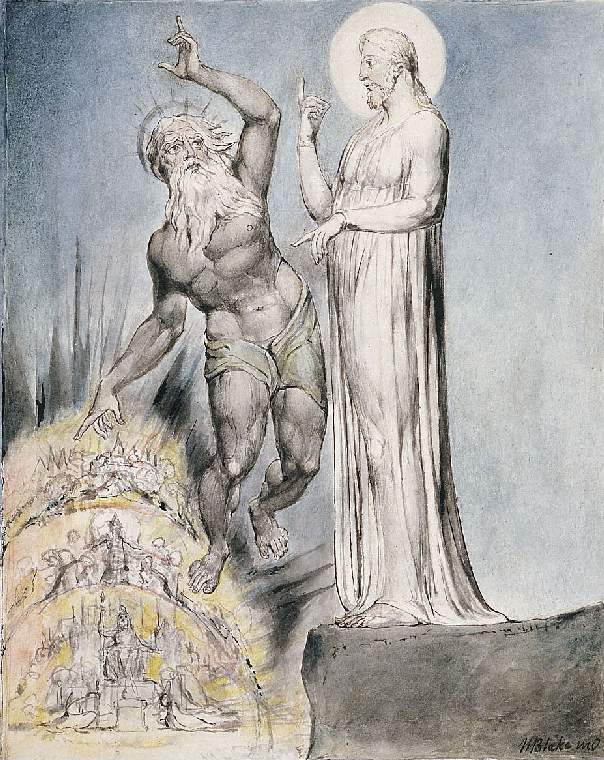
Blake seeks to provide the Golden String which can lead us through the labyrinth of our experience or his own poetry.

Saturday, October 10, 2026

WITNESS TO THE LIGHT

 First posted April 2022 

Milton, Plate 10 [11], (E 104)

"Every thing in Eternity shines by its own Internal light: but thou
Darkenest every Internal light with the arrows of thy quiver
Bound up in the horns of jealousy to a deadly fading Moon
And Ocalythron binds the Sun into a Jealous Globe
That every thing is fixd Opake without Internal light         

So Los lamented over Satan, who triumphant divided the Nations"

Jerusalem, PLATE 54, (E 203)
"In Great Eternity, every particular Form gives forth or Emanates
Its own peculiar Light, & the Form is the Divine Vision
And the Light is his Garment This is Jerusalem in every Man
A Tent & Tabernacle of Mutual Forgiveness Male & Female Clothings.
And Jerusalem is called Liberty among the Children of Albion" 

Four Zoas, Night V, Page 61,  (E 341)
"His eyes the lights of his large soul contract or else expand
Contracted they behold the secrets of the infinite mountains
The veins of gold & silver & the hidden things of Vala          
Whatever grows from its pure bud or breathes a fragrant soul
Expanded they behold the terrors of the Sun & Moon
The Elemental Planets & the orbs of eccentric fire"

Letters, To Hayley, (E 756)
"Suddenly,
on the day after visiting the Truchsessian Gallery of pictures, I
was again enlightened with the light I enjoyed in my youth, and
which has for exactly twenty years been closed from me as by a
door and by window-shutters.  Consequently I can, with
confidence, promise you ocular demonstration of my altered state
on the plates I am now engraving after Romney, whose spiritual
aid has not a little conduced to my restoration to the light of
Art.

A clear account of seeing not an objective thing but the intrinsic reality which underlies surface appearance is found in Robert Pirsig's novel Lila. Pirsig named the philosophy of Phaedrus Dynamic Quality. The exterior static constructs of the left brain fail to provide the flexible perspective which recognizes goodness as it appears in all its aspects.

Robert Pirsig's second novel: read Lila as pdf 

Passage from the end of chapter 26:

"Once when Phaedrus was standing in one of the galleries of the Boston Museum of Fine Arts, he saw on one wall a huge painting of the Buddha and nearby were some paintings of Christian saints. He noticed again something he had thought about before. Although the Buddhists and Christians had no historic contact with one another they both painted halos. The halos weren't the same size. The Buddhists painted great big ones, sometimes surrounding the person's whole body, while the Christian ones were smaller and in back of the person's head or over it. It seemed to mean the two religions weren't copying one another or they would have made the halos the same size. But they were both painting something they were seeing separately, which implied that that 'something' they were  painting had a real, independent existence.

Then as Phaedrus was thinking this he noticed one painting in the corner and thought, There. What the others are just painting symbolically he is actually showing. They're seeing it second-hand. He's seeing it first hand.

It was a painting of Christ with no halo at all. But the clouds in the sky behind his head were slightly lighter near his head than farther away. And the sky near his head was lighter too. That was all. But that was the real illumination, no objective thing at all, just a shift in intensity of light. Phaedru stepped up to the canvas to read the name-plate at the bottom. It was El Greco again.

Our culture immunizes us against giving much importance to all this because the light has no 'objective' reality. That means it's just some 'subjective' and therefore unreal phenomenon. In a Metaphysics of Quality, however, this light is important because it often appears associated with undefined auspiciousness, that is, with Dynamic Quality. It signals a Dynamic intrusion upon a static situation. When there is a letting go of static patterns the light occurs. It is often accompanied by a feeling of relaxation because static patterns have been jarred loose. He thought it was probably the light that infants see when their world is still fresh and whole, before consciousness differentiates it into patterns; a light into which everything fades at death. Accounts of people who have had a 'near death experience' have referred to this 'white light' as something very beautiful and compelling from which they didn't want to return. The light would occur during the breakup of the static patterns of the person's intellect as it returned into the pure Dynamic Quality from which it had emerged in infancy.

During Phaedrus' time of insanity when he had wandered freely outside the limits of cultural reality, this light had been a valued companion, pointing out things to him that he would otherwise have missed, appearing at an event his rational thought had indicated was unimportant, but which he would later discover had been more important than he had known. Other times it had occurred at events he could not figure out the importance of, but which had left him wondering.

He saw it once on a small kitten. After that for a long time the kitten followed him wherever he went and he wondered if the kitten saw it too.

He had seen it once around a tiger in a zoo. The tiger had suddenly looked at him with what seemed like surprise and had come over to the bars for a closer look. Then the illumination began to appear around the tiger's face. That was all. Afterward, that experience associated itself with William Blake's 'Tiger! Tiger! burning bright.'

The eyes had blazed with what seemed to be inner light."


Matthew 17 
[1] And after six days Jesus taketh Peter, James, and John his brother, and bringeth them up into an high mountain apart,
[2] And was transfigured before them: and his face did shine as the sun, and his raiment was white as the light. 
[3] And, behold, there appeared unto them Moses and Elias talking with him. 

Luke 11
[33] No man, when he hath lighted a candle, putteth it in a secret place, neither under a bushel, but on a candlestick, that they which come in may see the light.
[34] The light of the body is the eye: therefore when thine eye is single, thy whole body also is full of light; but when thine eye is evil, thy body also is full of darkness.
[35] Take heed therefore that the light which is in thee be not darkness.
[36] If thy whole body therefore be full of light, having no part dark, the whole shall be full of light, as when the bright shining of a candle doth give thee light.

John 5
[33] Ye sent unto John, and he bare witness unto the truth.
[34] But I receive not testimony from man: but these things I say, that ye might be saved.
[35] He was a burning and a shining light: and ye were willing for a season to rejoice in his light.
[36] But I have greater witness than that of John: for the works which the Father hath given me to finish, the same works that I do, bear witness of me, that the Father hath sent me.

Acts 26
[12] Whereupon as I went to Damascus with authority and commission from the chief priests,
[13] At midday, O king, I saw in the way a light from heaven, above the brightness of the sun, shining round about me and them which journeyed with me.
[14] And when we were all fallen to the earth, I heard a voice speaking unto me, and saying in the Hebrew tongue, Saul, Saul, why persecutest thou me? it is hard for thee to kick against the pricks. 
[15] And I said, Who art thou, Lord? And he said, I am Jesus whom thou persecutest.

John 8
[12] Then spake Jesus again unto them, saying, I am the light of the world: he that followeth me shall not walk in darkness, but shall have the light of life.
 
John 1
[4] In him was life; and the life was the light of men.
[5] And the light shineth in darkness; and the darkness comprehended it not.
[6] There was a man sent from God, whose name was John.
[7] The same came for a witness, to bear witness of the Light, that all men through him might believe.
[8] He was not that Light, but was sent to bear witness of that Light.
[9] That was the true Light, which lighteth every man that cometh into the world.

John 20
[11] But Mary stood without at the sepulchre weeping: and as she wept, she stooped down, and looked into the sepulchre,
[12] And seeth two angels in white sitting, the one at the head, and the other at the feet, where the body of Jesus had lain.
[13] And they say unto her, Woman, why weepest thou? She saith unto them, Because they have taken away my Lord, and I know not where they have laid him.                                                                                                                          

Friday, October 9, 2026

BURNING BRIGHT

 First posted April 2018

Wikimedia Commons
Songs of Innocence and of Experience
Copy Z, Plate 45
The Little Vagabond

Larry and I have written very little about Blake's Tyger although it is Blake's best known and perhaps most provocative poem. It may also contain his most influential thought and message. In Robert Persig's Lila we find an instance of the content of The Tyger not being referenced directly, but by association entering the consciousness of a larger dimension.   

Like Blake, Persig in his book was attempting to provide an opening to a consciousness beyond the habitual frame in which we ordinarily operate. Pirsig's reference to Blake's Tyger in association with perceptions of exterior light in unexpected situations, is a portent of receiving the inner transforming light.

If we reflect on the methods by which we receive light we may focus first on the light from distant objects which we receive through our physical eyes. Second might be the enlightenment which we experience in our minds when we break into new insight about a person, object, situation or idea. Third is consciousness of the light itself when it spreads its illumination in some unusual or intense fashion. Pirsig wrote of experiencing the light as it radiated from an object or person or event of peculiar significance. Blake's experience in the Truchsessian Gallery enhanced his ability to see more clearly in the external world because his inner light was intensified. Pirsig used the the internal generation of light by Blake's Tyger as symbolic of transformation taking place in the psyche.    

Lila by Robert Pirsig, Page 339:

"During Phaedrus' time of insanity when he wandered freely outside the limits of cultural reality, this light had been a valued companion, pointing out things to him that he would otherwise have missed, appearing at an event his rational thought had indicated was unimportant, but which he later discovered had been more important than he had known. Often it had occurred at events he could not figure out the importance of, but had left him wondering.

He saw it once on a small kitten. After that for a long time the kitten followed him wherever he went and he wondered if the kitten saw it too.

He had seen it once around a tiger at the zoo. The tiger had suddenly looked at him with what seemed like surprise and had come over to the bars for a closer look. The the illumination began to appear around the tiger's face. That was all. Afterward, that experience associated itself with William Blake's 'Tiger! Tiger! burning bright.'

The eyes had blazed with what seemed to be inner light."

Letters, To Hayley, (E 756)
"Suddenly,
on the day after visiting the Truchsessian Gallery of pictures, I
was again enlightened with the light I enjoyed in my youth, and
which has for exactly twenty years been closed from me as by a
door and by window-shutters."

Milton, Plate 1, (E 95)
  "And did the Countenance Divine,             
     Shine forth upon our clouded hills?"

Milton, Plate 5, (E 98)
"And this is the manner of the Daughters of Albion in their beauty
Every one is threefold in Head & Heart & Reins, & every one
Has three Gates into the Three Heavens of Beulah which shine
Translucent in their Foreheads & their Bosoms & their Loins
Surrounded with fires unapproachable: but whom they please
They take up into their Heavens in  intoxicating  delight" 

Milton, Plate 10, (E 104)
"Every thing in Eternity shines by its own Internal light: but thou
Darkenest every Internal light with the arrows of thy quiver
Bound up in the borns of jealousy to a deadly fading Moon
And Ocalythron binds the Sun into a Jealous Globe
That every thing is fixd Opake without Internal light"  

Jerusalem, Plate 19, (E 164)
"Where once he sat he weary walks in misery and pain:
His Giant beauty and perfection fallen into dust:
Till from within his witherd breast grown narrow with his woes:
The corn is turn'd to thistles & the apples into poison:         
The birds of song to murderous crows, his joys to bitter groans!
The voices of children in his tents, to cries of helpless infants!
And self-exiled from the face of light & shine of morning,
In the dark world a narrow house! he wanders up and down,
Seeking for rest and finding none! and hidden far within,        
His Eon weeping in the cold and desolated Earth.

All his Affections now appear withoutside:   

So Los lamented over Satan, who triumphant divided the Nations"

Four Zoas, Night VII, Page 81, (E 357)
"Thy roses that expanded in the face of glowing morn
Page 82 
Hid in a little silken veil scarce breathe & faintly shine
Thy lilies that gave light what time the morning looked forth
Hid in the Vales faintly lament & no one hears their voice"

Songs and Ballads, (E 477)
"Mock on Mock on Voltaire Rousseau
Mock on Mock on! tis all in vain!
You throw the sand against the wind
And the wind blows it back again

And every sand becomes a Gem                          
Reflected in the beams divine
Blown back they blind the mocking Eye 
But still in Israels paths they shine

The Atoms of Democritus
And Newtons Particles of light          
Are sands upon the Red sea shore
Where Israels tents do shine so bright"

Songs and Ballads, From Notebook, (E 480)
"My Designs unchangd remain      
Time may rage but rage in vain
For above Times troubled Fountains
On the Great Atlantic Mountains
In my Golden House on high
There they Shine Eternally"     

Auguries of Innocence, (E 492)
"Every Night & every Morn
Some to Misery are Born 
Every Morn & every Night
Some are Born to sweet delight
Some are Born to Endless Night
We are led to Believe a Lie 
When we see not Thro the Eye 
Which was Born in a Night to perish in a Night
When the Soul Slept in Beams of Light
God Appears & God is Light
To those poor Souls who dwell in Night 
But does a Human Form Display
To those who Dwell in Realms of day"

Songs of Innocence and of Experience, Plate 42, (E 24)
"The Tyger.                         

Tyger Tyger, burning bright,
In the forests of the night;
What immortal hand or eye,
Could frame thy fearful symmetry?

In what distant deeps or skies.       
Burnt the fire of thine eyes?           
On what wings dare he aspire?     
What the hand, dare sieze the fire?

And what shoulder, & what art,
Could twist the sinews of thy heart?
And when thy heart began to beat,
What dread hand? & what dread feet?
 
What the hammer? what the chain, 
In what furnace was thy brain?
What the anvil? what dread grasp,       
Dare its deadly terrors clasp!               

When the stars threw down their spears   
And water'd heaven with their tears:
Did he smile his work to see?          
Did he who made the Lamb make thee? 

Tyger Tyger burning bright,
In the forests of the night:                        
What immortal hand or eye,                     
Dare frame thy fearful symmetry?"  

Matthew 17
[1] And after six days Jesus taketh Peter, James, and John his brother, and bringeth them up into an high mountain apart,
[2] And was transfigured before them: and his face did shine as the sun, and his raiment was white as the light.
[3] And, behold, there appeared unto them Moses and Elias talking with him.
[4] Then answered Peter, and said unto Jesus, Lord, it is good for us to be here: if thou wilt, let us make here three tabernacles; one for thee, and one for Moses, and one for Elias.
[5] While he yet spake, behold, a bright cloud overshadowed them: and behold a voice out of the cloud, which said, This is my beloved Son, in whom I am well pleased; hear ye him.
[6] And when the disciples heard it, they fell on their face, and were sore afraid.
[7] And Jesus came and touched them, and said, Arise, and be not afraid.
[8] And when they had lifted up their eyes, they saw no man, save Jesus only.


Monday, October 5, 2026

Heaven and Hell

 Posted March 2019 

Wikimedia Commons
Original in Fitzwilliam Museum
Illustrations to Paradise Regained 
Satan tempts Christ with the Kingdoms of the Earth
This is an extract from Chapter Four (FAITH) of Ram Horn'd With Gold by Larry Clayton.

Heaven and Hell

       Who among us shall dwell with everlasting burnings? (Isaiah 33:14)
   
 No one knows of the Beyond. Still men throughout history have seen visions of it. These visions have informed their faith and galvanized them to the words and deeds by which they have lived. Look now at Blake's visions of Heaven and Hell:

       For Isaiah (and Blake) 'everlasting burnings' had connotations opposite to those of conventional thinking.Indeed throughout the Bible fire symbolizes God more often than the Devil: "our God is a consuming fire". Note also the burning bush seen by Moses and the forks of flame at Pentecost. In Eden every bush burns and flaming tongues fill the air; Blake referred to them as burning arrows of thought.

       Blake's eternity, both here and hereafter, is characterized by two intense activities, War and Hunting (Milton: Plate 35:2), "the Two Fountains of the River of Life". Both are intellectual in nature and aimed at growth into Truth. In this world they have been prostituted into "corporeal war" and the killing of the innocent. War and Hunting of course exhaust the eternals, so periodic rest is provided in what might be called Lower Heaven; Blake called it Beulah:
    "There is from Great Eternity a mild & pleasant rest Nam'd Beulah, a soft Moony Universe, feminine, lovely, Pure, mild & Gentle, given in Mercy to those who sleep, Eternally created by the Lamb of God around, On all sides, within & without the Universal Man."
           4Z (Night 1 5:29-31)
       Blake tells us relatively little about Eden, but in his larger poems he had a lot to say about Beulah. He described it as a sort of way station between Eden and Ulro, which we might roughly translate as this vale of tears. Two way traffic passes through Beulah. Those who reach it from Ulro are in good shape and headed for something better. Those coming from the other direction are also okay for the moment but in deadly peril if they go farther.

       We could also call Ulro "this world". In a sense "this world" is as close to the conventional hell as Blake got. In Blake as in the Bible, especially in Paul, "this world" has a technical meaning. It does not mean the present stage of life as opposed to a heavenly (or hellish) existence beyond physical death. Basically "this world" means a level of consciousness that sees only the material, which Blake called the corporeal. Ulro is the state in which "Reality was forgot, and the Vanities of Time and Space only Remembered and called Reality" (Vision of the Last Judgment; Erdman 555; his comments on an astounding canvas; it concerns Revelation 20:11-15).

       Ulro, Blake's hell, denotes a form of blindness or sleep, from which one may awaken:
    "Of the Sleep of Ulro! and of the passage through Eternal Death! and of the awaking to Eternal Life..." (Jerusalem Chapter One)
       This is his theme, Blake tells us. Students of the New Testament know that sleep and waking are thoroughly biblical figures for the spiritual realities which concerned Blake here. He envisioned Eternal Death as the fallenness of "this world" through which we pass before "awaking to Eternal Life". Blake thus saw hell as man's fallen state before the coming of Jesus to awaken us and set us free.

       The biblical writers as they are generally understood had not adequately grasped the fullness of Jesus' power to rescue mankind totally from the darkness which Blake called Eternal Death. They wrote most of the New Testament in a time of persecution. In their effort to stiffen the spine of the believer in the face of that persecution they retreated into a degree of thralldom to the Old Testament God of Wrath, in the spirit of Jonathan Edwards' sermon,"Sinners in the Hands of an Angry God".

       One can readily understand why the worldly ecclesiastics who followed Peter and Paul picked up on the angry God. All too often he became their primary weapon; the image of hell is the ultimate form of coercion. Blake made no such mistake, probably because of the ten years which he had spent confronting and subduing that "shadow from his wearied intellect", years of suffering, but it turned to glory.
"Albion walkd on the steps of fire before his Halls
And Vala walkd with him in dreams of soft deluding slumber.
He looked up & saw the Prince of Light with splendor faded       
Then Albion ascended mourning into the porches of his Palace
Above him rose a Shadow from his wearied intellect:
Of living gold, pure, perfect, holy: in white linen pure he hoverd
A sweet entrancing self-delusion a watry vision of Albion
Soft exulting in existence; all the Man absorbing!"
(Jerusalem, Plate 43 [29], Erdman 191)  
       In those years he laid to rest the Punisher who has afflicted the minds of believers through the centuries, but he retained the creative possibility which represents the best of the Christian faith. The rationalists and deists had thrown out both and confined us to Ulro, which today threatens to engulf mankind. The reader must decide for himself whose hell is most real--the place of unending punishment or the sleep from which man may awaken.