skip to main |
skip to sidebar
Blake has produced a powerful image of God communicating in the form of the tablets of the law, with man in the form of Moses. Moses is bowed in humility below the feet of God occupying a separate enclosed space where he is protected from the full impact of God's presence. The account of Moses receiving the law is repeated several times in the Bible with details which emphasize various aspects. The accounts may focus on the tablets of the law themselves, but just as important is the experience of Moses in encountering God through the images of fire, cloud, symbolic periods of time, thunderings, lightnings and the noise of the trumpet. Blake incorporates many of these symbols in his picture plus many faces of humans or angels surrounding the events.
Exodus 20
[18] And all the people saw the thunderings, and the lightnings, and the noise of the trumpet, and the mountain smoking: and when the people saw it, they removed, and stood afar off.
[19] And they said unto Moses, Speak thou with us, and we will hear: but let not God speak with us, lest we die.
[20] And Moses said unto the people, Fear not: for God is come to prove you, and that his fear may be before your faces, that ye sin not.
[21] And the people stood afar off, and Moses drew near unto the thick darkness where God was.
[22] And the LORD said unto Moses, Thus thou shalt say unto the children of Israel, Ye have seen that I have talked with you from heaven.
Exodus 24
[12] And the LORD said unto Moses, Come up to me into the mount, and be there: and I will give thee tables of stone, and a law, and commandments which I have written; that thou mayest teach them.
[13] And Moses rose up, and his minister Joshua: and Moses went up into the mount of God.
[14] And he said unto the elders, Tarry ye here for us, until we come again unto you: and, behold, Aaron and Hur are with you: if any man have any matters to do, let him come unto them.
[15] And Moses went up into the mount, and a cloud covered the mount.
[16] And the glory of the LORD abode upon mount Sinai, and the cloud covered it six days: and the seventh day he called unto Moses out of the midst of the cloud.
[17] And the sight of the glory of the LORD was like devouring fire on the top of the mount in the eyes of the children of Israel.
[18] And Moses went into the midst of the cloud, and gat him up into the mount: and Moses was in the mount forty days and forty nights. Exodus 32
[15] And Moses turned, and went down from the mount, and the two tables of the testimony were in his hand: the tables were written on both their sides; on the one side and on the other were they written.
[16] And the tables were the work of God, and the writing was the writing of God, graven upon the tables.
 God Writing upon the Tables of the Covenant
National Galleries of Scotland
It is not the person Moses or the written law which Blake held in high regard, it is the fact that God works in and through men. Blake saw that Moses encountered God on the mountaintop and came away with an image of God which would further the psychological and spiritual development of man.
Marriage of Heaven & Hell, Plate 23, (E 43)
"if Jesus Christ is the
greatest man, you ought to love him in the greatest degree; now
hear how he has given his sanction to the law of ten
commandments: did he not mock at the sabbath, and so mock the
sabbaths God? murder those who were murderd because of him? turn
away the law from the woman taken in adultery? steal the labor of
others to support him? bear false witness when he omitted making
a defence before Pilate? covet when he pray'd for his disciples,
and when he bid them shake off the dust of their feet against
such as refused to lodge them? I tell you, no virtue can exist
without breaking these ten commandments: Jesus was all virtue,
and acted from impulse: not from rules."
Vision of the Last Judgment, (E 556)
"beneath the falling figure of Cain is Moses casting his tables of
stone into the Deeps. it ought to be understood that the Persons
Moses & Abraham are not here meant but the States Signified by
those Names the Individuals being representatives or Visions of
those States as they were reveald to Mortal Man in the Series of
Divine Revelations. as they are written in the Bible these
various States I have seen in my Imagination when distant they
appear as One Man but as you approach they appear
Multitudes of Nations."
Jerusalem, Plate 73, (E 228)
"And all the Kings & Nobles of the Earth & all their Glories
These are Created by Rahab & Tirzah in Ulro: but around
These, to preserve them from Eternal Death Los Creates
Adam Noah Abraham Moses Samuel David Ezekiel
Dissipating the rocky forms of Death, by his thunderous Hammer
As the Pilgrim passes while the Country permanent remains
So Men pass on: but States remain permanent for ever"
.
Exodus
Chapter1
[13] And the Egyptians made the children of Israel to serve with rigour:
[14] And they made their lives bitter with hard bondage, in morter, and in brick, and in all manner of service in the field: all their service, wherein they made them serve, was with rigour.
[15] And the king of Egypt spake to the Hebrew midwives, of which the name of the one was Shiphrah, and the name of the other Puah:
[16] And he said, When ye do the office of a midwife to the Hebrew women, and see them upon the stools; if it be a son, then ye shall kill him: but if it be a daughter, then she shall live.
Chapter 2
[1] And there went a man of the house of Levi, and took to wife a daughter of Levi.
[2] And the woman conceived, and bare a son: and when she saw him that he was a goodly child, she hid him three months.
[3] And when she could not longer hide him, she took for him an ark of bulrushes, and daubed it with slime and with pitch, and put the child therein; and she laid it in the flags by the river's brink.
[4] And his sister stood afar off, to wit what would be done to him.
The infant set afloat on the Nile or the Hiding of Moses in the Tate Collection is not available for publication but here is a link to it.
Blake's picture of the infant Moses set afloat on the Nile calls our attention first to the fact that the scene took place in Egypt, the land to which the Israelites voluntarily moved to escape famine in their homeland. When their benefactor was no longer in power they became slave labor for the Egyptians. To control increase in the Israelite population the Pharaoh ordered that the male infants be killed. In order to avoid having her son killed, Moses' mother hid him in a floating basket on the edge of the Nile. In this scene the mother is leaving the infant to an unknown fate. The child is rescued by a daughter of Pharaoh and grows up in an Egyptian household.
The anxiety of the mother and father is evident in the picture. Realistically, they feared that the child would not survive. However the fears of the parents were not realized. The role that Moses played in the history of his people is well known. He secured their release from slavery, led them through the wilderness, presented them with a covenant from God and received the commandments from God which were to define and shape the people of Israel.
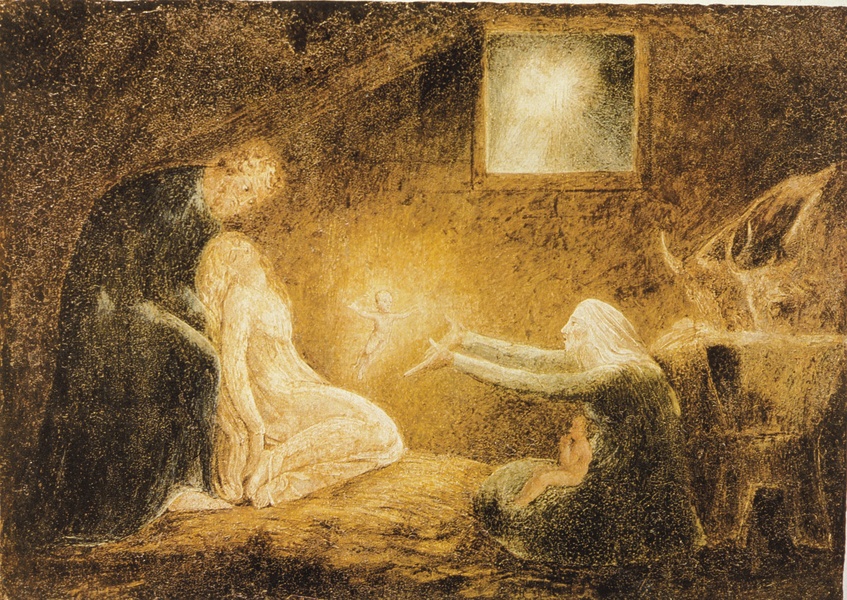
Images which Blake created of the infant Jesus and his parents closely resemble Moses and his parents. Blake was emphasizing that the role of Jesus in the New Testament and of Moses in the Old Testament are parallel. Both had their lives threatened by the authorities as infants, both emerged from the land of Egypt to introduce new teachings to their people. Both offered freedom to enslaved people: those enslaved in Egypt, and those enslaved to the 'law of sin and death'.
Notice the similarity in this illustration to Milton's On the Morning of Christ's Nativity.
This tempera painting of the nativity which Blake produced for Thomas Butts is available on wikipedia. The original is in the Philadelphia Museum of Art.

The culmination of the spiritual development which was traced through the events of the Old Testament and hinged on the character of Moses, came to fruition in Jesus. Blake in his characteristic way ties together disparate events: in this case through visual rather than verbal images.
Hiding of Moses
Image from
Songs of ExperienceIntroduction Northrup Frye, in Fearful Symmetry, develops his own metaphor for reading Blake's poetry on Page 143.
"As far as the poetic effect of Blake's mythology goes, it cannot of course be denied that when a character is presented as an individual or a god and his relationship to an archetype is left to take care of itself, an advantage in vividness is often gained. Blake was, it is obvious, so conscious of the shape of his central myth that his characters become almost diagrammatic. The heroism of Orc or the ululuation of Ololon do not impress us as human realities, like Achillies or Cassandra, but as intellectual ideographs. It all depends on weather the reader has a taste for this kind of metaphysical poetry or not, on whether he is willing to read so uncompromising an address to the intellectual powers. It is not necessary to assume that qualities of poetry which are certainly not in Blake are qualities which Blake tried and failed to produce. One looks at a poet for what is there, and what is there in Blake is a dialectic, an anatomy of poetry, a rigorously unified vision of the essential forms of the creative mind, piercing through its features to its articulate bones. The figure is perhaps not one that he would have approved: his own is:
I give you the end of a golden string,
Only wind it into a ball:
It will lead you in at Heavens gate,
Built in Jerusalems wall."
Jerusalem, Plate 77, (E 231)
It might be said that Blake that in these passages offered additional metaphors for reading his poetry.
Jerusalem, Plate 88, (E 246)
"When in Eternity Man converses with Man they enter
Into each others Bosom (which are Universes of delight)
In mutual interchange. and first their Emanations meet
Surrounded by their Children. if they embrace & comingle
The Human Four-fold Forms mingle also in thunders of Intellect"
Vision of the Last Judgment, (E 560)
" If the Spectator could Enter into these Images in his
Imagination approaching them on the Fiery Chariot of his
Contemplative Thought if he could Enter into Noahs Rainbow or
into his bosom or could make a Friend & Companion of one of these
Images of wonder which always intreats him to leave mortal things
as he must know then would he arise from his Grave then would he
meet the Lord in the Air & then he would be happy General
Knowledge is Remote Knowledge it is in Particulars that Wisdom
consists & Happiness too."
.
The only way I know to get any grasp of this picture is by reading George MacDonald's Lillith which you can do online at this site. MacDonald takes one into a cavern where the dead sleep until they are healed and awake to the reality Blake calls Eternity. Like Blake, MacDonald was interested in revealing the world which is real and spiritual to those who perceive only the false and material. Both men created myths which reveal truth which cannot be contained in the forms of logic and rationality.
Descent into Death
British Museum In the image which appears as the frontispiece of Jerusalem is shown Los entering a door leading down into a dark space which he must explore to restore Albion to wholeness. The present image could be an elaboration on Blake's image for Robert Blair's The Grave which is named The Soul exploring the recesses of the Grave.
Notice that Blake portrays the individual in multiple statuses simultaneously. The individual in a natural body is exploring or observing; as spiritual body or soul, the individual also illumines and guides; the individuals who has entered death are in repose within the various caverns.
The shifting meanings of death, the grave, sleep, awakening and annihilation are seen in this passage from Milton. The image of descending into the recesses of the grave, and poetry from Milton complement one another and shed light for understanding both.
Milton, Plate 14 [15], (E 108)
"Then Milton rose up from the heavens of Albion ardorous!
The whole Assembly wept prophetic, seeing in Miltons face
And in his lineaments divine the shades of Death & Ulro
He took off the robe of the promise, & ungirded himself from the
oath of God
And Milton said, I go to Eternal Death! The Nations still
Follow after the detestable Gods of Priam; in pomp
Of warlike selfhood, contradicting and blaspheming.
When will the Resurrection come; to deliver the sleeping body
From corruptibility: O when Lord Jesus wilt thou come?
Tarry no longer; for my soul lies at the gates of death.
I will arise and look forth for the morning of the grave.
I will go down to the sepulcher to see if morning breaks!
I will go down to self annihilation and eternal death,
Lest the Last Judgment come & find me unannihilate
And I be siez'd & giv'n into the hands of my own Selfhood
The Lamb of God is seen thro' mists & shadows, hov'ring
Over the sepulchers in clouds of Jehovah & winds of Elohim
A disk of blood, distant; & heav'ns & earth's roll dark between
What do I here before the Judgment? without my Emanation?
With the daughters of memory, & not with the daughters of
inspiration[?]
I in my Selfhood am that Satan: I am that Evil One!
He is my Spectre! in my obedience to loose him from my Hells
To claim the Hells, my Furnaces, I go to Eternal Death."
Another post.
.
Young's 'Night Thoughts'
Night VIII, page 23
The British Museum 
The quote from Young which Blake was illustrating:
'When, through Death's Straits Earth's subtil Serpents creep,
Which wiggle into Wealth, or climb Renown,
As crooked Satan the Forbidden Tree,
They leave their party-coloured Robe behind,'
Four Zoas, Night VIII, PAGE 107 [115], (E 380)
"And this is the manner in which Satan became the Tempter
There is a State namd Satan learn distinct to know O Rahab
The Difference between States & Individuals of those States
The State namd Satan never can be redeemd in all Eternity
But when Luvah in Orc became a Serpent he des[c]ended into
That State calld Satan"
.
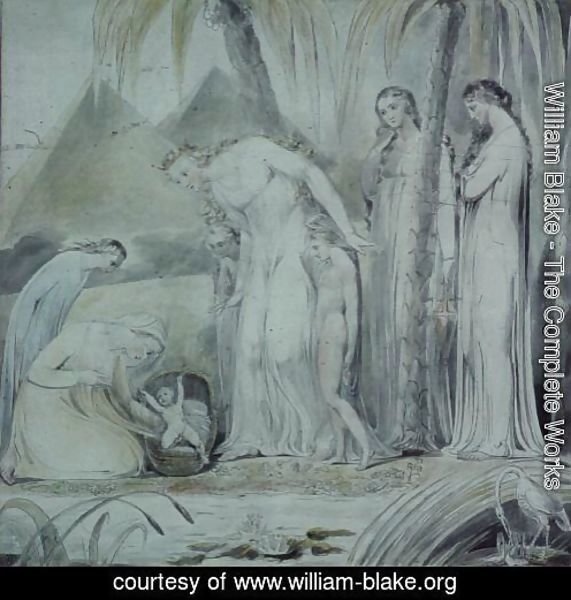
The Compassion of Pharoah's Daughter
The Finding of Moses
from Victoria & Albert Museum
courtesy of www.william-blake.org
Songs & Ballads, (E 491)
"Auguries of Innocence
The Babe is more than swadling Bands
Throughout all these Human Lands
Tools were made & Born were hands
Every Farmer Understands
Every Tear from Every Eye
Becomes a Babe in Eternity
This is caught by Females bright
And returnd to its own delight"
Exod.2
[1] And there went a man of the house of Levi, and took to wife a daughter of Levi.
[2] And the woman conceived, and bare a son: and when she saw him that he was a goodly child, she hid him three months.
[3] And when she could not longer hide him, she took for him an ark of bulrushes, and daubed it with slime and with pitch, and put the child therein; and she laid it in the flags by the river's brink.
[4] And his sister stood afar off, to wit what would be done to him.
[5] And the daughter of Pharaoh came down to wash herself at the river; and her maidens walked along by the river's side; and when she saw the ark among the flags, she sent her maid to fetch it.
6] And when she had opened it, she saw the child: and, behold, the babe wept. And she had compassion on him, and said, This is one of the Hebrews' children.
[7] Then said his sister to Pharaoh's daughter, Shall I go and call to thee a nurse of the Hebrew women, that she may nurse the child for thee?
[8] And Pharaoh's daughter said to her, Go. And the maid went and called the child's mother.
[9] And Pharaoh's daughter said unto her, Take this child away, and nurse it for me, and I will give thee thy wages. And the woman took the child, and nursed it.
[10] And the child grew, and she brought him unto Pharaoh's daughter, and he became her son. And she called his name Moses: and she said, Because I drew him out of the water.
In the light of Blake's system of thought the babe in the picture of the finding of Moses means more than a simple illustration of an event. The appearance of the babe signals a transition to altered circumstances. The babe Moses became a seminal figure in the development of the culture of the Israelites. The sojourn and slavery on the Israelites in Egypt was brought to an end through the instrument of Moses. But the child was to absorb much from the culture of Egypt by being raised by the daughter of Pharoah.
Blake's poem The Mental Traveller can be seen to be related to the situation which Moses exemplified. He was taken in by the Egyptian culture, grew strong, overcame the ties which held him, and led his people to a new freedom. Blake sees the transformations which must occur in individual and societies in the symbol of the birth of the vigorous, insistent babe.
Songs & Ballads, (E 483)
"The Mental Traveller
I traveld thro' a Land of Men
A Land of Men & Women too
And heard & saw such dreadful things
As cold Earth wanderers never knew
For there the Babe is born in joy
That was begotten in dire woe
Just as we Reap in joy the fruit
Which we in bitter tears did sow
And if the Babe is born a Boy
He's given to a Woman Old
Who nails him down upon a rock
Catches his Shrieks in Cups of gold"
.
 God Writing upon the Tables of the Covenant