Blake seeks to provide the Golden String which can lead us through the labyrinth of our experience or his own poetry.

Monday, July 2, 2012

GATE OF LOS II

"Design for Dedication to the Queen"  
Blair's The Grave
Minna Doskow's commentary titled William Blake's Jerusalem provides an enlightening description of the Gate of Los on page 84.  Her statements add to the earlier post Gate of Los.

"...for Los is the connection between time and eternity, the crucial door of change through which states may be exchanged and vision altered. Even fallen Albion possesses such a connection, since 'There is in Albion a Gate of Precious stones and gold/ seen only by Emanations, by vegetations viewless' (34: 55-56) This too is the Gate of Los. All natural creations have gates to eternity within them and vice versa, for all natural creation is potentially eternal. Functioning very much like the vortex in Milton, the gate of Los entered one way, from eternity allows eternal Urthona to become Los, the twenty-eight unfallen cities created by Hammer and Loom in order to save Albion, or Albion to go to death. Entered the other way, however, from time, it finally enables Albion or the reader to awaken and enter Life. It is invisible to 'vegetations,' for they have no awakened imaginative potential, and equally to Satan's Watchfiends' (35:1) no matter how carefully they search, for Satan is fall without limit or possibility of salvation, containing no basis for imagination to work upon. Although Satan's watchfiends are very thorough in their search for Los's gate, 'Numbering every grain/Of sand on Earth every night' (35:1-2), their scientific and analytic methods that Jerusalem warned Albion about earlier (22:20-22) are exclusively material and therefore ineffective."

Jerusalem, Plate 22, (E 167)
"Then spoke Jerusalem O Albion! my Father Albion
Why wilt thou number every little fibre of my Soul               
Spreading them out before the Sun like stalks of flax to dry?
The Infant Joy is beautiful, but its anatomy
Horrible ghast & deadly! nought shalt thou find in it
But dark despair & everlasting brooding melancholy!"
 
Jerusalem, Plate 35 [39], (E 181)
"By Satans Watch-fiends tho' they search numbering every grain
Of sand on Earth every night, they never find this Gate.
It is the Gate of Los."

Jerusalem, Plate 37 [41], (E 183)
"There is a Grain of Sand in Lambeth that Satan cannot find     
Nor can his Watch Fiends find it: tis translucent & has many Angles
But he who finds it will find Oothoons palace, for within
Opening into Beulah every angle is a lovely heaven
But should the Watch Fiends find it, they would call it Sin
And lay its Heavens & their inhabitants in blood of punishment  
Here Jerusalem & Vala were hid in soft slumberous repose
Hid from the terrible East, shut up in the South & West." 
 
Milton, Plate 25 [27] (E 123)
"While Los calld his Sons around him to the Harvest & the Vintage.

Thou seest the Constellations in the deep & wondrous Night
They rise in order and continue their immortal courses
Upon the mountains & in vales with harp & heavenly song
With flute & clarion; with cups & measures filld with foaming wine.
Glittring the streams reflect the Vision of beatitude,           
And the calm Ocean joys beneath & smooths his awful waves!
Plate 26 [28]
These are the Sons of Los, & these the Labourers of the Vintage
Thou seest the gorgeous clothed Flies that dance & sport in summer
Upon the sunny brooks & meadows: every one the dance
Knows in its intricate mazes of delight artful to weave:
Each one to sound his instruments of music in the dance,      
To touch each other & recede; to cross & change & return
These are the Children of Los; thou seest the Trees on mountains
The wind blows heavy, loud they thunder thro' the darksom sky
Uttering prophecies & speaking instructive words to the sons
Of men: These are the Sons of Los! These the Visions of Eternity 

But we see only as it were the hem of their garments
When with our vegetable eyes we view these wond'rous Visions

There are Two Gates thro which all Souls descend. One Southward
From Dover Cliff to Lizard Point. the other toward the North
Caithness & rocky Durness, Pentland & John Groats House.         

The Souls descending to the Body, wail on the right hand
Of Los; & those deliverd from the Body, on the left hand
For Los against the east his force continually bends
Along the Valleys of Middlesex from Hounslow to Blackheath
Lest those Three Heavens of Beulah should the Creation destroy   
And lest they should descend before the north & south Gates
Groaning with pity, he among the wailing Souls laments."
. 

Saturday, June 30, 2012

BODY & SOUL

Marriage of Heaven & Hell, Plate 8,  (E 37)
"Every thing possible to be believ'd is an image of truth."

Blake's work was creating images. His Imagination was his connection with the Infinite. What he received through his senses from the outer world was processed by his mind as images. He received as data: material objects, events, relationships, individuals. But the reality of each thing he knew to be in his mind. Until his mind, through his imagination, created an image from the data, it was not true.  

Jerusalem, Plate 4, (E 147)

"I rest not from my great task!
To open the Eternal Worlds, to open the immortal
Eyes Of Man inwards into the Worlds of Thought: into Eternity
Ever expanding in the Bosom of God. the Human Imagination"

From the raw data which he gathered with an eclectic appetite he created a multitude of images to feed the minds of his readers with ideas and open their imaginations to the 'Perception of the Infinite'.


British Museum
Study for Blair's The Grave
In my last post Los confronted Urizen in his furnace of the brain. Here Blake takes a different tack: he acknowledges that none can pass through the fires of Los which rage in the bottoms of his cave. We might express this idea in psychological terms as: none can reach the source of imagination by digging directly into the unconscious. Blake provides an alternative route: through descending ' To Bowlahoola & Allamanda & to Entuthon Benython.'  This is to say that by living in our bodies with the structures which comprise our organs we can make our way through the trackless forests into Eternity.   


Milton, Plate 37 [41], (E 138)
"but the Fires of Los, rage
In the remotest bottoms of the Caves, that none can pass
Into Eternity that way, but all descend to Los
To Bowlahoola & Allamanda & to Entuthon Benython
"

Kay and Roger Easson's book
Milton: A Poem by William Blake yields further guidance on understanding Blake's terminology and his complex concepts:

"Los is called Time, and we learn in Milton that his hammers are the beating heart, the bellows of his forge are the lungs, and his furnaces are the stomach. For Blake, then, time is a function of pulsation, the rhythmic pounding of the heart, the rhythmic surge of air in the lungs, and the rhythm of digestion in the stomach and intestines. The sensation of the passage of time is inherent in the pulse which pervades the tissues of the body. Los is the poet/ prophet who perceives the rhythms in life, witnesses to the truth that "Time is the mercy of Eternity; without Times swiftness / Which is the swiftest of all things: all were eternal torment." Page 144

 
Milton, Plate (E 120)
Arise O Sons give all your strength against Eternal Death
Lest we are vegetated, for Cathedrons Looms weave only Death     
A Web of Death: & were it not for Bowlahoola & Allamanda
No Human Form but only a Fibrous Vegetation
A Polypus of soft affections without Thought or Vision
Must tremble in the Heavens & Earths thro all the Ulro space[.]
Throw all the Vegetated Mortals into Bowlahoola                  
But as to this Elected Form who is returnd again
He is the Signal that the Last Vintage now approaches
Nor Vegetation may go on till all the Earth is reapd

So Los spoke. Furious they descended to Bowlahoola & Allamanda
Indignant. unconvincd by Los's arguments & thun[d]ers rolling    
They saw that wrath now swayd and now pity absorbd him
As it was, so it remaind & no hope of an end.

Bowlahoola is namd Law. by mortals, Tharmas founded it:
Because of Satan, before Luban in the City of Golgonooza.
But Golgonooza is namd Art & Manufacture by mortal men.          

In Bowlahoola Los's Anvils stand & his Furnaces rage;
Thundering the Hammers beat & the Bellows blow loud
Living self moving mourning lamenting & howling incessantly
Bowlahoola thro all its porches feels tho' too fast founded
Its pillars & porticoes to tremble at the force                  

Of mortal or immortal arm: and softly lilling flutes
Accordant with the horrid labours make sweet melody-

The Bellows are the Animal Lungs: the hammers the Animal Heart
The Furnaces the Stomach for digestion. terrible their fury
Thousands & thousands labour. thousands play on instruments      
Stringed or fluted to ameliorate the sorrows of slavery
Loud sport the dancers in the dance of death, rejoicing in carnage
The hard dentant Hammers are lulld by the flutes['] lula lula
The bellowing Furnaces['] blare by the long sounding clarion
The double drum drowns howls & groans, the shrill fife. shrieks & cries:     
The crooked horn mellows the hoarse raving serpent, terrible, but harmonious
Bowlahoola is the Stomach in every individual man."

Bowlahoola includes the stomach but also includes the whole digestive and respiratory systems which provide the energy for the operation of the body. The Eassons tell us that 'Allamada involves communication, learning, and the exchange of ideas - the continual ideas of mental harvest.' As a system of the body, 'Allamada is the nervous system.' Damon calls Entuthon Benython 'the physical frame of the generated man' but Frye sees in Entuthon Benython, a pathless forest outside of Golgonooza.

The Body & Soul are a unity, understanding the Body is tatamount to understanding the Soul.

Marriage of Heaven & Hell, Plate 4, (E 34)
"But the following Contraries to these are True
  1 Man has no Body distinct from his Soul
for that calld Body is a portion of Soul discernd 
by the five Senses. the chief inlets of Soul in this 
age
  2. Energy is the only life and is from the Body
and Reason is the bound or outward circumference 
of Energy.
  3 Energy is Eternal Delight"
. 

Thursday, June 28, 2012

CONFRONTATION

Library of Congress
Book of Urizen
Copy G, Plate 4
Courtesy of Wikimedia Commons
The struggle between Los and the Spectre is set forth in the following passage. Blake sees the false reasoning represented by the Spectre as an aspect of his mind and a controlling power in the world. Blake portrays Los engaging the Spectre in direct confrontation. Damon (Page 381) tells us that: 'anything in which reason and heart are separated' has its own Spectre.' The divisions which first took place in Urizen and which we read about in the Book of Urizen, were repeated in Los.

Los proposed to cast the Spectre into the furnace and use the false reasoning to break itself down. Los himself had become 'cruel' and a 'horror' in the struggle to resolve internal conflicts and to make his way in the fallen, unforgiving world.

The Spectre is not inclined to gently cooperate with Los but he makes a pretence at obedience. Los changes the perspective of the Spectre from within to without. He shows the Spectre 'the tortures of the victims' which had spread 'Across all Europe & Asia' as a result of the unfortunate internal reasoning which controlled the psyche. The Spectre sees that it is Los, not himself who is meant to be in charge of the sorting, sifting, melting and hammering that take place in the furnace of the brain, but he will not concede.

But the nature of the Spectre has been revealed: he is Los' 'Pride & Self-righteousness'. Los knows the nature of the enemy; he is no longer fighting the unknown darkness.

In the Book of Urizen it was Los who created Time and Space so that Urizen might have a dwelling place; now Los threatens the false reasoning with being consigned to a different place which he will create for him. Unless the Spectre cooperates in reshaping himself he will lose his place in the outer created world of Time and Space and in the inner furnaces of the brain. In the isolation of Hell he will dwell.

The text has been divided into sections for easier commenting.
Jerusalem, Plate 8, (E 151)
"Be attentive! be obedient! Lo the Furnaces are ready to recieve thee.
I will break thee into shivers! & melt thee in the furnaces of death;       
I will cast thee into forms of abhorrence & torment if thou
Desist not from thine own will, & obey  not my stern command!
I am closd up from my children: my Emanation is dividing
And thou my Spectre art divided against me. But mark

I will compell thee to assist me in my terrible labours. To beat 
These hypocritic Selfhoods on the Anvils of bitter Death
I am inspired: I act not for myself: for Albions sake
I now am what I am: a horror and an astonishment
Shuddring the heavens to look upon me: Behold what cruelties
Are practised in Babel & Shinar, & have approachd to Zions Hill  

While Los spoke, the terrible Spectre fell shuddring before him
Watching his time with glowing eyes to leap upon his prey
Los opend the Furnaces in fear. the Spectre saw to Babel & Shinar
Across all Europe & Asia. he saw the tortures of the Victims.

He saw now from the ou[t]side what he before saw & felt from within
He saw that Los was the sole, uncontrolld Lord of the Furnaces
Groaning he kneeld before Los's iron-shod feet on London Stone,
Hungring & thirsting for Los's life yet pretending obedience.
While Los pursud his speech in threatnings loud & fierce.

Thou art my Pride & Self-righteousness: I have found thee out:   
Thou art reveald before me in all thy magnitude & power
Thy Uncircumcised pretences to Chastity must be cut in sunder!
Thy holy wrath & deep deceit cannot avail against me
Nor shalt thou ever assume the triple-form of Albions Spectre

For I am one of the living: dare not to mock my inspired fury 
If thou wast cast forth from my life! if I was dead upon the mountains
Thou mightest be pitied & lovd: but now I am living; unless
Thou abstain ravening I will create an eternal Hell for thee.
Take thou this Hammer & in patience heave the thundering Bellows
Take thou these Tongs: strike thou alternate with me: labour obedient" 
. 

Tuesday, June 26, 2012

DIVIDING

Pierre Berger wrote William Blake: Poet and Mystic in French. It was translated into English by Daniel Henry Conner. The book is made available by Google. Since it is out of copyright, Google offers a text version from which passages can be copied and pasted. Thus I can provide you with a long passage of Berger's incredibly perceptive insights.

This post follows BEGINNING OF SEPARATION. From William Blake: Poet and Mystic, Page 104-7:
  
"Thus Urizen passed through changes; and each change was no longer eternal, but fixed a period, and was existent in Time. Now, Urizen himself, like the Eternals, is nothing but an aggregate of myriads of elemental essences, alive only in the general knowledge of his unity. These elements might combine in a different order, might divide and separate themselves from him after the example he has given them. And these are the changes that Time, by his division, would bind or fix—the rivets of brass and iron. In like wise, as we read in Genesis, God divided the light from the darkness, and the evening and the morning were the first day. But the story in Genesis is only a symbol, signifying to Blake that Urizen tore himself apart from Eternity, and that Time began. It is partly on account of this symbol that, later on, he calls Urizen the Prince of Light, and that the name Los is also the name of the sun—an anagram of " Sol."

From this moment in the story follow the seven days of creation, as symbolised in the majestic Bible narrative, and in the even more majestic evolution of the earth and of life which geological knowledge is beginning to reveal to us. What really came to pass in the invisible world was the progressive creation of Urizen. He developed, age by age, like some monstrous animal in the throes of a painful gestation and a delivery wrapped in darkness and confusion. At first, there was nothing but a dark globe of invisible flame, the fire of life, sometimes spherical, because he is wrapped in self-concentration; at other times becoming heart-shaped, because the pulse of life beats in him, and at others again like great loins, ready to bring forth the universe.

[Urizen, Plate 5, (E 73)]
Like a black globe
Viewed by sons of Eternity; standing
On the shore of the infinite ocean,
Like a human heart struggling and beating,
The vast world of Urizen appeared.

Thus, in a dreamless night, this spirit, who is also a world, remained an unshapen mass of flesh or clay, until in time, with the help of Los, definite forms began to appear in him.
Library of Congress
Book of Urizen
Copy G
Plate 10

[Urizen, Plate 10, (E 75)]
Restless turn'd the immortal inchain'd,
Heaving dolorous, anguish'd, unbearable,
Till a roof shaggy wild inclos'd
In an orb his fountain of thought.
In a horrible dreamful slumber,
Like the linked infernal chain,
A vast Spine writh'd in torment
Upon the winds; shooting pain'd
Ribs, like a bending cavern,
And bones of solidness, froze,
Over all his nerves of joy.
And a first Age passed over,
And a state of dismal woe.

And straightway Blake draws, on the opposite page, a globe of light in the midst of darkness, and in this globe a monstrous skeleton, bent and crouching like the embryo in its envelope; its elbows touching its knees, one bony hand clasping its eyeless skull, in an attitude of misery, terror and immense despair. Thus age succeeds age, and in horror and suffering, the flesh and muscles, the eyes, nose and tongue, all take shape. At last, Urizen stands upright, flings his arms out to north and south, and with his feet stamps the nether abyss, trembling, howling, in despair. He feels that he has lost eternity, and consequently is miserable and furious. But all in vain. From henceforth Urizen will live by his own vitality; and the world which he has created, the universe which he constitutes, will continue to develop itself.

But other lives also are created at the same time, and always in consequence of the first creation. The separation of Urizen has divided Eternity. From henceforth, the Eternals are in one place, and Urizen's universe in another. The Infinite has become finite. Space comes into existence at the same moment with Time.

[Urizen, Plate5, (E 73)]
Sund'ring, dark'ning, thund'ring,
Rent away with a terrible crash,
Eternity rolld wide apart,
Mountainous all round,
Departing, departing, departing,
Leaving ruinous fragments of life,
Hanging, frowning cliffs, and all between
An ocean of voidness unfathomable.
 
And whilst Los, the mighty smith, forged his rivets of iron and brass, creating Time and its divisions, he by that act enclosed Urizen, not in Time only, but also in Space, separating him from the Infinite. Urizen's senses also, his nose, ears, eyes and tongue, as they came into being, felt that they were limited, and could no longer perceive Eternity and the Infinite. With these same senses began the feeling of visible space with its dimensions and its limitations. Thus Los was the personification of both Time and Space, the two new and inevitable consequences of the creation of the new universe.

Now it is the fate of those who separate themselves from others to feel fresh divisions within their own beings. Los, in separating Urizen from Eternity, became himself conscious of an individual existence. He was an "Ego," as Urizen was. He could no longer be one with Eternity, nor return to his former state. He, who was at once Time and Space, was for ever separated from the Eternal-Infinite, confined within the same limits as those in which he had bound Urizen. Further, the two elements of which he was composed must themselves soon divide, Space becoming an entity distinct from Time. As Urizen broke away from Eternity, so would Enitharmon break away from Los."
.

Sunday, June 24, 2012

FRIEND HAYLEY

Library of Congress
Rosenwald Collection
Hayley's Ballads
Sketch for Eagle
William Blake and William Hayley were both in need of friendship when Blake left the city of London to live in the country near Felpham and work with Hayley. The two discovered that there were multiple disagreements between them. Blake left Felpham three years later no richer in worldly goods than when he had arrived. He had, however, gained experience for which he was grateful. The mental and spiritual work which occupied him at Felpham became known only in Milton and Jerusalem which were products of his struggles.

When he had gained some distance from Hayley, Blake recognised that Hayley too needed support and encouragement; that he was a victim of the same system whose oppression Blake felt. In their close association Blake had not felt that Hayley could be a spiritual friend to him, but on reflection he sought of draw Hayley to him by sharing his spiritual labours.


Letters, Dec 11 1805, (E 766)
"To William Hayley Esqre, Felpham
...
I speak of Spiritual Things.  Not of
Natural. of Things known only to Myself & to Spirits Good &
Evil. but Not Known to Men on Earth.  It is the passage thro
these Three Years that has brought me into my Present State. & I
know that if I had not been with You I must have
Perish'd--Those Dangers are now Passed & I can see them beneath
my feet It will not be long before I shall be able to present the
full history of my Spiritual Sufferings to the Dwellers upon
Earth. & of the Spiritual Victories obtaind for me by my
Friends--Excuse this Effusion of the Spirit from One who cares
little for this World which passes away. whose Happiness is
Secure in Jesus our Lord. & who looks for Suffering till the time
of complete Deliverance. In the mean While.  I am kept Happy as I
used to be. because I throw Myself & all that I have on our
Saviours Divine Providence. O What Wonders are the Children of
Men! Would to God that they would Consider it That they would
Consider their Spiritual Life Regardless of that faint Shadow
Calld Natural Life. & that they would Promote Each others
Spiritual Labours. Each according to its Rank & that they would
know that. Recieving a Prophet As a Prophet is a Duty which If
omitted is more Severely Avenged than Every Sin & Wickedness
beside It is the Greatest of Crimes to Depress True Art & Science
I know that those who are dead from the Earth & who mockd &
Despised the Meekness of True Art (and such, I find, have been
the situations of our Beautiful Affectionate Ballads).  I know
that such Mockers are Most Severely Punishd in Eternity I know it
for I see it & dare not help.--The Mocker of Art is the Mocker of
Jesus.  Let us go on Dear Sir following his Cross let us take it
up daily Persisting in Spiritual Labours & the Use of that Talent
which it is Death to Bury. & of that Spirit to which we are
called--"

Hazard Adams, in William Blake on His Poetry and Painting: A Study of a Descriptive Catalogue Other Prose Writings and Jerusalem, sees that we, like Blake, need to forgive Hayley:
"He complimented Hayley on his ballads, which had little popular success and indeed, had been mocked, but he knew that mockers of art are 'Most Severely punished in Eternity', for the mockers of art are the mockers of Jesus. Hayley has mainly been a figure of fun for scholars and critics, but he may be forgiven his bad poetry for his help and friendship to Blake when Blake badly needed it." Page 89
.

Friday, June 22, 2012

BLAKE'S HORSE

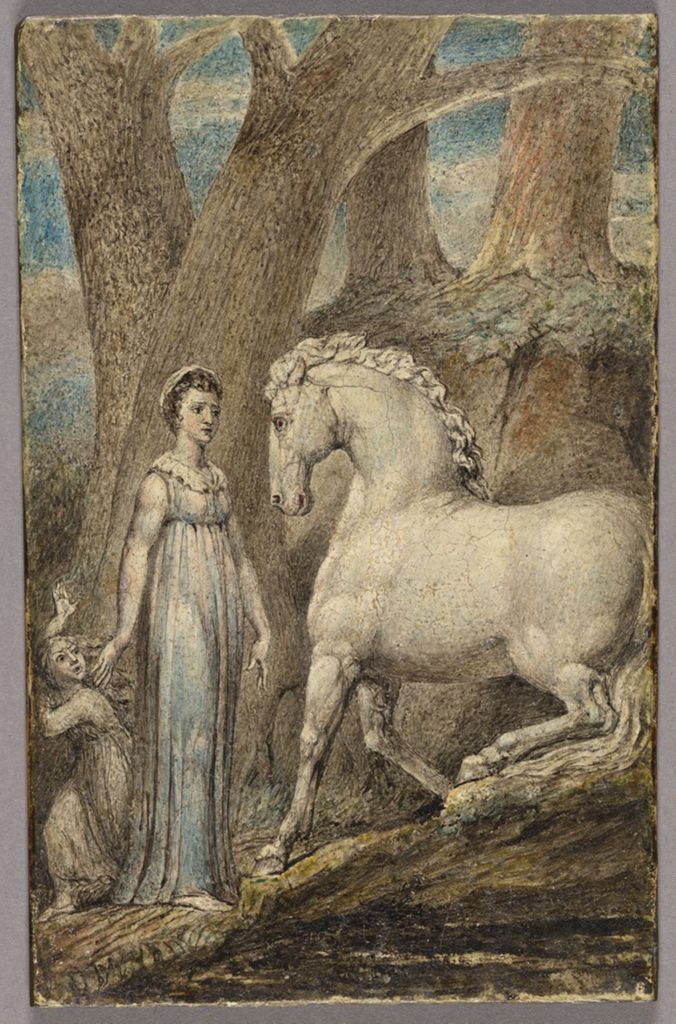
An image which Blake created for Hayley's Ballads was later reused for a small (4 3/16 x 2 1/2 inches) tempera painting on a copper engraving plate. The picture is now in the Mellon Collection of the Yale Center for British Art. 

In
The Human Form Divine, Patrick Noon comments:

Center for British Art
Yale University
The Horse
c 1805


"Another tempera that Mr. Mellon acquired at this time [1961], The Horse, is decidedly not an easel painting and probably was not intended for Butts but is indisputably the gem of the painting collection. Identical in size to the small engraved illustration for Hayley's Ballads (1805) that it reproduces, it might be one of the 'little high finished Pictures the size the engravings are to be' mentioned by Blake in a letter to Hayley of March 1805. If so, it is the only surviving example, but the many similarities between The Horse and the intricately rendered and richly textured large color prints of 1805, irrespective of their different media, certainly justify this supposition." Page 9


Letters,  22 March 1805, (E 763)
"The Subjects I cannot do better than those
already chosen, as they are the most eminent among Animals Viz
The Lion. The Eagle.  The Horse.  The Dog.  Of the Dog Species
the Two Ballads are so preeminent & my Designs for them please me
so well that I have chosen that Design in our Last Number of the
Dog & Crocodile. & that of the Dog defending his  Master
from the Vultures of these five I am
making little high finishd Pictures the Size the Engravings are
to be."
Blake incorporates in his design images which make it less an illustration for Hayley's ballad than a group of symbols for us to consider. The horse dominates in its size, its position and its energy. The woman as a static figure counters the intensity of the horse with her own gaze. The female child balances the energy of the horse with her own energy. The setting includes trees, a hillside and water in the foreground. The horse may represent the passion of Blake's own creative or sexual impulse; the woman may represent the control required to fashion his emotion and imagination into his works of poetry and painting; the child may represent his artistic creations still in need of protection as they are released to the outer world. 
Thel, Plate 3, (E 4)
"O virgin know'st thou not. our steeds drink of the golden springs
Where Luvah doth renew his horses"
Marriage of Heaven & Hell, Plate 25, (E 45)  
"19. Where the son of fire in his eastern cloud, while the
morning plumes her golden breast,
20. Spurning the clouds written with curses, stamps the stony
law to dust, loosing the eternal horses from the dens of night,
crying

  Empire is no more! and now the lion & wolf shall cease."

Visions of Daughters of Albion, Plate 14,(E 66)
"Sotha & Thiralatha, secret dwellers of dreamful caves,
Arise and please the horrent fiend with your melodious songs.
Still all your thunders golden hoofd, & bind your horses black.
Orc! smile upon my children!
Smile son of my afflictions.                                     
Arise O Orc and give our mountains joy of thy red light."

Milton, Plate 12 [13], (E 105)
"The Horses of Palamabron call'd for rest and pleasant death:
I [Leutha] sprang out of the breast of Satan, over the Harrow beaming     
In all my beauty! that I might unloose the flaming steeds
As Elynittria use'd to do; but too well those living creatures
Knew that I was not Elynittria, and they brake the traces
But me, the servants of the Harrow saw not: but as a bow
Of varying colours on the hills; terribly rag'd the horses." 


Wednesday, June 20, 2012

HAYLEY'S BALLADS

During William Blake's sojourn in Felpham under the patronage of William Hayley he undertook illustrating a series of Hayley's ballads on 'anecdotes relating to animals.' Hayley intended that one ballad be issued each month with three illustrations from Blake, for a total of fifteen ballads. Hayley wished the series to be 'considered as vehicles contrived to exhibit the diversified talents of my Friend for original design, and delicate engraving.' The project was terminated after Blake returned to London. The bookseller involved in the distribution considered it a money losing project and advised it be discontinued. Included among the published Numbers are:  The Elephant, The Eagle, The Lion, and The Dog.


Designs to a Series of Ballads Written by William Hayley
Frontispiece
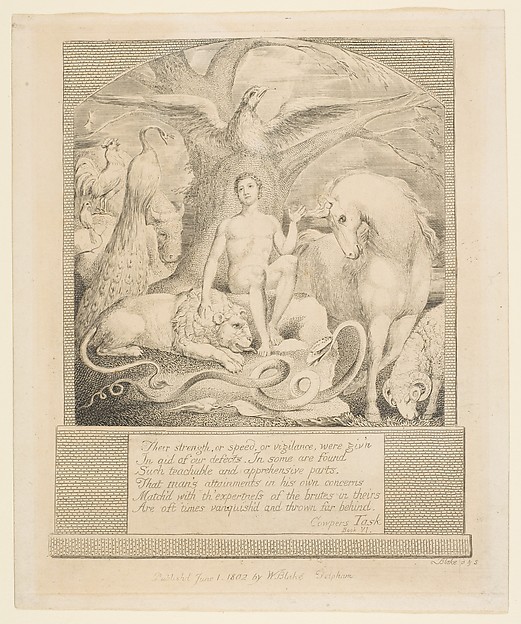
"Adam and the Animals"

Metropolitan Museum of Art
Blake's engraving is mentioned by Hayley in a letter of 16th May 1802: -"He (Blake) is at the moment by my side, representing on copper an Adam of his own, surrounded by animals, - frontispiece to the projected ballads."

Information about this project is from:
The Engravings of William Blake by Archibald G. B. Russell, Published 1912.

Legend on the page:
" Their strength, or speed, or vigilance, were giv'n
In aid of our defects. In some are found
Such teachable and apprehensive parts, 
Match'd with th'expertness of the brutes in theirs
Are oft times vanquished and thrown far behind."

Cowper's "Task," Book VI.

Publish'd June 1 1802, by W. Blake, Felpham


Look for mentions of these and other animals in Blake's poetry.
Songs of Innocence, (E 15)
"SONGS 23
Little Girl
Sweet and small,
Cock does crow
So do you.
Merry voice
Infant noise
Merrily Merrily to welcome in the Year"

Marriage of Heaven & Hell, Plate 9,(E 37)
"When thou seest an Eagle, thou seest a portion of Genius. lift up thy head!" 

Jerusalem, Plate 98, (E 258)
"...And I heard Jehovah speak 
Terrific from his Holy Place & saw the Words of the Mutual Covenant Divine
On Chariots of gold & jewels with Living Creatures starry & flaming
With every Colour, Lion, Tyger, Horse, Elephant, Eagle Dove, Fly, Worm,
And the all wondrous Serpent clothed in gems & rich array Humanize
In the Forgiveness of Sins according to the Covenant of Jehovah."

Four Zoas, Page 128, (E 398) 
"So spoke the Sinless Soul & laid her head on the downy fleece 
Of a curld Ram who stretchd himself in sleep beside his mistress
And soft sleep fell upon her eyelids in the silent noon of day"

Vision of Last Judgment, (E 565)
"The Horse never Envies the Peacock nor the Sheep the Goat
but they Envy a Rival in Life & Existence whose ways & means
exceed their own let him be of what Class of Animals he will a
Dog will envy a Cat who is pamperd at the expense of his comfort"
.