Blake seeks to provide the Golden String which can lead us through the labyrinth of our experience or his own poetry.

Friday, May 30, 2014

PALAMABRON'S TASK

The controversy of the Bard's Song in Milton originates with the desire of Satan to exchange his task at the mill for Palamabron's task at the harrow. Blake uses three sons of Los - Palamabron, Rintrah and Satan - to demonstrate three aspects of the prophetic character.
 
Northrop Frye, in Fearful Symmetry, provides this insight into the youngest son Satan:
"Satan, on the other hand, is the prince of this world: he is the spirit of inertia which incarnates itself in compromise. The worshipers of Satan accept established religions, philosophies, and social conditions because they are established; they observe all the commandments of the law from their youth upwards, and their days are long and peaceful in the lands they possess. They, therefore, are 'The Elect from before the foundation of the World,' and their worldly prosperity is a sign of their inward grace." (Page 333)

Wikipedia Commons
Milton
Copy D, Plate 18
So Satan's task is to create the structure of the conventional mechanics which will keep the system operating. In the Freudian psyche this function is performed by the ego; in Jungian psychology it is performed by the function Reason. In much of Blake's mythology Urizen is the agency of attempting to provide this framework.

Palamabron whose role is to hold the prophetic vision has pity for the flock he tries to nurture. His work is to teach, to encourage and to bind up the wounds of the downtrodden. Frye states: "...the business of the visionary [is] to proclaim the Word of God to a society under the domination of Satan: and that the visionary's social position is typically that of an isolated voice crying in the wilderness against the injustice and hypocrisy of the society from which he has sprung." (Page 336) 

In the Bard's Song we have a blatant attempt of Satan to trade the task of providing a structure in which the imagination may reside, for the agency which feeds the imagination: vision. In the Bard's Song it is Palamabron who is the visionary torn between the desire to communicate his vision and the demands of society to conform to the ordinary regulations of his culture. Palamabron agrees to allow Satan to open himself to receiving and transmitting visions from Eternity, but Satan has no faculty for accessing the intuitive. Likewise Palamabron lacks the organizational skills to keep society's machinery working.
Milton, Plate 4, (E 98)
"Satan was going to reply, but Los roll'd his loud thunders.   

Anger me not! thou canst not drive the Harrow in pitys paths.
Thy Work is Eternal Death, with Mills & Ovens & Cauldrons.
Trouble me no more. thou canst not have Eternal Life

So Los spoke! Satan trembling obeyd weeping along the way."

Milton, Plate 7, (E 100)
"The first, The Elect from before the foundation of the World:  
The second, The Redeem'd. The Third, The Reprobate & form'd
To destruction from the mothers womb: follow with me my plow!

Of the first class was Satan: with incomparable mildness;
His primitive tyrannical attempts on Los: with most endearing love    
He soft intreated Los to give to him Palamabrons station;
For Palamabron returnd with labour wearied every evening
Palamabron oft refus'd; and as often Satan offer'd
His service till by repeated offers and repeated intreaties
Los gave to him the Harrow of the Almighty; alas blamable      
Palamabron. fear'd to be angry lest Satan should accuse him of
Ingratitude, & Los believe the accusation thro Satans extreme
Mildness. Satan labour'd all day. it was a thousand years
In the evening returning terrified overlabourd & astonish'd
Embrac'd soft with a brothers tears Palamabron, who also wept  

Mark well my words! they are of your eternal salvation

Next morning Palamabron rose: the horses of the Harrow
Were maddend with tormenting fury, & the servants of the Harrow
The Gnomes, accus'd Satan, with indignation fury and fire.
Then Palamabron reddening like the Moon in an eclipse,        
Spoke saying, You know Satans mildness and his self-imposition,
Seeming a brother, being a tyrant, even thinking himself a brother
While he is murdering the just; prophetic I behold

His future course thro' darkness and despair to eternal death
But we must not be tyrants also! he hath assum'd my place      
For one whole day, under pretence of pity and love to me:
My horses hath he maddend! and my fellow servants injur'd:
How should he[,] he[,] know the duties of another? O foolish forbearance 
Would I had told Los, all my heart! but patience O my friends.
All may be well: silent remain, while I call Los and Satan."   

Luke 10
[30] And Jesus answering said, A certain man went down from Jerusalem to Jericho, and fell among thieves, which stripped him of his raiment, and wounded him, and departed, leaving him half dead.
[31] And by chance there came down a certain priest that way: and when he saw him, he passed by on the other side.
[32] And likewise a Levite, when he was at the place, came and looked on him, and passed by on the other side.
[33] But a certain Samaritan, as he journeyed, came where he was: and when he saw him, he had compassion on him,
[34] And went to him, and bound up his wounds, pouring in oil and wine, and set him on his own beast, and brought him to an inn, and took care of him.

.

Wednesday, May 28, 2014

SATAN'S TASK

In the threefold world in which we live, there are three mental states which Blake calls the three Classes of Men. The state of Rintrah whose instrument is the plow, of Palamabron whose instrument is the harrow, and of Satan whose instrument is the mill. The three states are designed to move man through the passage of life to the great harvest in which everything which was dispersed is reassembled according to the great design. 

In their commentary in Milton: A Poem by William Blake, Kay Parkhurst Easson and Roger R. Easson write of the effort Blake made to correct the error Milton made in constructing his character Satan in Paradise lost:

"The first thematic division is the Bard's Song. The Bard shows Milton his error, recognition of which is the first step Milton must take on his journey. Since Milton's error is especially evident within the first division of Paradise Lost, where sin is created from Satan's revolt and subsequent fall from Heaven, the Bard revises Milton's narrative. He transforms sin into error. As the Bard tells it, Satan's error is a misunderstanding of his role in the divine plan. In the divine plan Satan is the agent of fragmentation and death; he is the miller of Eternity, and his mills regulate and make distinct the duration of human life, separating birth from death, youth from age, body from soul. He is therefore 'made subservient to the Great Harvest,' which is Blake's paradoxical metaphor for the continual cultivation of living form within the duration of human life. Satan, however, thinks he can improve on the plan; he thinks he can assume Palamabron's task, the wielding of the Harrow of the Almighty. The Harrow, 'a scheme of Human conduct invisible & incomprehensible' to mortals, also connotes death. This death is a death of the selfhood - part of the spiritual journey - not the death of the body - the result of vengeance as depicted in Paradise Lost. The Harrow represents death as mercy; death as the eternal prerequisite for spiritual growth. When Satan takes over the Harrow, he threatens to replace love and mercy with his false pity and 'officious brotherhood.' Satan, thereby, threatens the destruction of the harvest. He disrupts the eternal labors - the planting and plowing of the fields and the milling of the crops - those labors of mental cultivation which lead to the perception of the infinite in everything, and the corresponding creation of prophecy."  (Page 163)
Milton, Plate 25 [27], 122
 "The Elect is one Class: You
Shall bind them separate: they cannot Believe in Eternal Life
Except by Miracle & a New Birth. The other two Classes;
The Reprobate who never cease to Believe, and the Redeemd,       
Who live in doubts & fears perpetually tormented by the Elect
These you shall bind in a twin-bundle for the Consummation--
But the Elect must be saved [from] fires of Eternal Death,
To be formed into the Churches of Beulah that they destroy not the Earth" 
British Museum
Jerusalem
Plate 70, Copy A
 
 Milton, Plate 6, (E 100) 
"And the Three Classes of Men regulated by Los's hammer. 

Plate 7 
The first, The Elect from before the foundation of the World: 
The second, The Redeem'd. The Third, The Reprobate & form'd 
To destruction from the mothers womb: follow with me my plow! 
Of the first class was Satan: with incomparable mildness; 
His primitive tyrannical attempts on Los: with most endearing love 
He soft intreated Los to give to him Palamabrons station;"

 Milton, Plate 3, (E 97)     
"They Builded Great Golgonooza Times on Times Ages on Ages
First Orc was Born then the Shadowy Female: then All Los's Family
At last Enitharmon brought forth Satan Refusing Form, in vain
The Miller of Eternity made subservient to the Great Harvest
That he may go to his own Place Prince of the Starry Wheels
Plate 4                      
Beneath the Plow of Rintrah & the harrow of the Almighty
In the hands of Palamabron. Where the Starry Mills of Satan
Are built beneath the Earth & Waters of the Mundane Shell
Here the Three Classes of Men take their Sexual texture Woven
The Sexual is Threefold: the Human is Fourfold     

If you account it Wisdom when you are angry to be silent, and
Not to shew it: I do not account that Wisdom but Folly.
Every Mans Wisdom is peculiar to his own Individ[u]ality
O Satan my youngest born, art thou not Prince of the Starry Hosts
And of the Wheels of Heaven, to turn the Mills day & night?  
Art thou not Newtons Pantocrator weaving the Woof of Locke
To Mortals thy Mills seem every thing & the Harrow of Shaddai
A scheme of Human conduct invisible & incomprehensible
Get to thy Labours at the Mills & leave me to my wrath,"

Monday, May 26, 2014

BLAKE & ENVY

British Museum
Illustrations to Young's Night Thoughts
Envy is like an infection not easily contained. A person not confident of his own abilities may envy one who receives more praise or respect. He reacts by attempting to denigrate the other in the eyes of his peers or superiors. Resentments may develop in the person who is envied. Envy prevents men from being woven into one fabric of brotherhood and love.

The source of envy is claiming for oneself what is a gift from God. If a person is able to recognize that whatever abilities he has do not belong to him but to the God who made him, he will be humble and grateful. If one knows himself as a member of the one body which is God manifest in the world, he will see his gifts and those of others as meant to serve the whole. God's love is distributed to all in equal measure, but each man's abilities differ according to the needs of the one body.
 
It was of concern to Blake that men competed for recognition and honor. It disturbed him that men might depreciate the work of others with greater gifts to increase their earnings or there renown. To Blake envy was a blight which degraded the development of wisdom, joy and brotherhood which would benefit all.
   
1ST Corinthians 2
[10] God has revealed to us through the Spirit. For the Spirit searches everything, even the depths of God.
[11] For what person knows a man's thoughts except the spirit of the man which is in him? So also no one comprehends the thoughts of God except the Spirit of God.
[12] Now we have received not the spirit of the world, but the Spirit which is from God, that we might understand the gifts bestowed on us by God.
[13] And we impart this in words not taught by human wisdom but taught by the Spirit, interpreting spiritual truths to those who possess the Spirit.
[14] The unspiritual man does not receive the gifts of the Spirit of God, for they are folly to him, and he is not able to understand them because they are spiritually discerned.
[15] The spiritual man judges all things, but is himself to be judged by no one.

 
Marriage of Heaven & Hell, Plate 21, (E 43)
                   "A Memorable Fancy

  Once I saw a Devil in a flame of fire. who arose before an
Angel that sat on a cloud. and the Devil utterd these words.
  The worship of God is.  Honouring his gifts in other men
each according to his genius. and loving the [PL 23] greatest men
best, those who envy or calumniate great men hate God, for there
is no other God.
  The Angel hearing this became almost blue but mastering
himself he grew yellow, & at last white pink & smiling, and then
replied,
  Thou Idolater, is not God One? & is not he visible in Jesus
Christ? and has not Jesus Christ given his sanction to the law of
ten commandments and are not all other men fools, sinners, &
nothings?
 The Devil answer'd; bray a fool in a morter with wheat. yet
shall not his folly be beaten out of him:"

Milton, Plate 41 [48], (E 142)  
"To cast off the idiot Questioner who is always questioning,
But never capable of answering; who sits with a sly grin
Silent plotting when to question, like a thief in a cave;
Who publishes doubt & calls it knowledge; whose Science is Despair   
Whose pretence to knowledge is Envy, whose whole Science is
To destroy the wisdom of ages to gratify ravenous Envy;
That rages round him like a Wolf day & night without rest"

Jerusalem, Plate 17, (E 162)
"If thou separate from me, thou art a Negation: a meer
Reasoning & Derogation from Me, an Objecting & cruel Spite
And Malice & Envy: but my Emanation, Alas! will become
My Contrary: O thou Negation, I will continually compell
Thee to be invisible to any but whom I please, & when            
And where & how I please, and never! never! shalt thou be Organized"

Jerusalem, Plate 86, (E 245)
"She separated stood before him a lovely Female weeping
Even Enitharmon separated outside, & his Loins closed
And heal'd after the separation: his pains he soon forgot:
Lured by her beauty outside of himself in shadowy grief.      
Two Wills they had; Two Intellects: & not as in times of old.

Silent they wanderd hand in hand like two Infants wandring
From Enion in the desarts, terrified at each others beauty
Envying each other yet desiring, in all devouring Love,"

Letters, (E 706)
[To] Mr [George] Cumberland, Bishopsgate,
Windsor Great Park

13 Hercules  Buildings, Lambeth, 2 July 1800
 I have been too little among
friends which I fear they will not Excuse & I know not how to
[gi] apologize for.  Poor Fuseli sore from the lash of
Envious tongues praises you & dispraises with the same breath he
is not naturally good natured but he is artificially very ill
natured yet even from him I learn the Estimation you are held in
among artists & connoisseurs."

Letters, (E 733)
[To] Mr Butts, Gr Marlborough St, London
Felpham August 16. 1803

   "Give me your advice in my perilous adventure. burn what I
have peevishly written about any friend.  I have been very much
degraded & injuriously treated. but if it all arise from my own
fault I ought to blame myself

     O why was I born with a different face  
     Why was I not born like the rest of my race
     When I look each one starts! when I speak I offend
     Then I'm silent & passive & lose every Friend

     Then my verse I dishonour. My pictures despise
     My person degrade & my temper chastise
     And the pen is my terror. the pencil my shame
     All my Talents I bury, and Dead is my Fame

     I am either too low or too highly prizd
     When Elate I am Envy'd, When Meek I'm despisd 

     This is but too just a Picture of my Present state I pray
God to keep you & all men from it & to deliver me in his own good
time."
 
Songs & Ballads, The Pickering Manuscript, (E 487)
  "Mary                       

Sweet Mary the first time she ever was there
Came into the Ball room among the Fair
The young Men & Maidens around her throng
And these are the words upon every tongue

An Angel is here from the heavenly Climes
Or again does return the Golden times   
Her eyes outshine every brilliant ray
She opens her lips tis the Month of May

Mary moves in soft beauty & conscious delight
To augment with sweet smiles all the joys of the Night  
Nor once blushes to own to the rest of the Fair
That sweet Love & Beauty are worthy our care

In the Morning the Villagers rose with delight
And repeated with pleasure the joys of the night
And Mary arose among Friends to be free      
But no Friend from henceforward thou Mary shalt see

Some said she was proud some calld her a whore
And some when she passed by shut to the door
A damp cold came oer her her blushes all fled
Her lillies & roses are blighted & shed       

O why was I born with a different Face
Why was I not born like this Envious Race 
Why did Heaven adorn me with bountiful hand
And then set me down in an envious Land

To be weak as a Lamb & smooth as a Dove     
And not to raise Envy is calld Christian Love
But if you raise Envy your Merits to blame
For planting such spite in the weak & the tame

I will humble my Beauty I will not dress fine
I will keep from the Ball & my Eyes shall not shine   
And if any Girls Lover forsakes her for me
I'll refuse him my hand & from Envy be free 

She went out in Morning attird plain & neat
Proud Marys gone Mad said the Child in the Street
She went out in Morning in plain neat attire  
And came home in Evening bespatterd with mire

She trembled & wept sitting on the Bed side
She forgot it was Night & she trembled & cried
She forgot it was Night she forgot it was Morn
Her soft Memory imprinted with Faces of Scorn   

With Faces of Scorn & with Eyes of disdain
Like foul Fiends inhabiting Marys mild Brain
She remembers no Face like the Human Divine
All Faces have Envy sweet Mary but thine

And thine is a Face of sweet Love in Despair   
And thine is a Face of mild sorrow & care
And thine is a Face of wild terror & fear
That shall never be quiet till laid on its bier"
Romans 12
[3] For by the grace given to me I bid every one among you not to think of himself more highly than he ought to think, but to think with sober judgment, each according to the measure of faith which God has assigned him.
[4] For as in one body we have many members, and all the members do not have the same function,
[5] so we, though many, are one body in Christ, and individually members one of another.
[6] Having gifts that differ according to the grace given to us, let us use them: if prophecy, in proportion to our faith;
[7] if service, in our serving; he who teaches, in his teaching;
[8] he who exhorts, in his exhortation; he who contributes, in liberality; he who gives aid, with zeal; he who does acts of mercy, with cheerfulness.
[9] Let love be genuine; hate what is evil, hold fast to what is good;
[10] love one another with brotherly affection; outdo one another in showing honor.
.

Sunday, May 25, 2014

BLAKE'S SUBLIME


The word sublime, has many meanings both specialized and generalized. Blake uses the term in a variety of ways and enhances the meaning by the usage he puts it to.

Here are a few of the definitions:
>to cause to pass directly from the solid to the vapor state
>to elevate or exalt especially in dignity or honor
>to convert into something of higher worth
>tending to inspire awe or terror.

A related word with a related meaning is subliminal: taking place below the threshold of sensory perception or outside the range of conscious awareness.

Roger R. Easson in his chapter of Blake's Sublime Allegory explains sublime in the context of its chemical or alchemical meaning:


"Blake defines sublime allegory, in the famous Butts letter of 6 July 1803, as 'Allegory addressed to the Intellectual powers, while it is altogether hidden from the Corporeal understanding...' (Letters, p. 69 [27]). Discussing the same idea of poetry, Blake puts it more chemically: 'What is it sets Homer, Virgil & Milton in so high a rank of art? Why is the Bible more entertaining than any other book? Is it not because they are addressed to the Imagination, which is Spiritual Sensation, & but mediately to the Understanding or reason?...Consider what Lord Bacon says: 'Sense sends over to Imagination before Reason have Judged, & Reason send over to Imagination before the Decree can be acted'' (Letters, p. 30 [5]). In chemistry the verb 'sublime' means that a substance may pass from solid to gas without passing into the intermediate liquid state. So too is Blake using the word. Sublime allegory is poetry that speaks to the intellectual powers without penetrating the intermediate stage of the corporeal understanding. It is poetry that is, quite literally, beyond reason. Consequently, it is best suited for dethroning reason within the reader who does not understand that the dominance of reason in his own mind prevents his entering the life of eternity."

Letter 27, [To Thomas Butts] (E 729)
Felpham July 6. 1803
"...Thus I hope that all our three years trouble Ends in
Good Luck at last & shall be forgot by my affections & only
rememberd by my Understanding to be a Memento in time to come &
to speak to future generations by a Sublime Allegory which is now
perfectly completed into a Grand Poem[.] I may praise it since I
dare not pretend to be any other than the Secretary the Authors
are in Eternity I consider it as the Grandest Poem that This
World Contains. Allegory addressd to the Intellectual powers
while it is altogether hidden from the Corporeal Understanding is
My Definition of the Most Sublime Poetry."

More quotes of Blake's use of Sublime:

MHH, Plate 7, (E 35)
"The most sublime act is to set another before you."

MHH, Plate 10, (E 37)
"The head Sublime, the heart Pathos, the genitals Beauty, the
hands & feet Proportion."

Descriptive Catalogue, Page 42, (E 543)
"The Strong man represents the human sublime. The Beautiful
man represents the human pathetic, which was in the wars of Eden
divided into male and female. The Ugly man represents the human
reason."

Four Zoas, Page 5, (E 302)
"Tharmas groand among his Clouds
Weeping, then bending from his Clouds he stoopd his innocent head
And stretching out his holy hand in the vast Deep sublime
Turnd round the circle of Destiny with tears & bitter sighs"

Four Zoas, PAGE 98 [90], (E 370)
"Then I can sigh forth on the winds of Golgonooza piteous forms
That vanish again into my bosom but if thou my Los
Wilt in sweet moderated fury. fabricate forms sublime
Such as the piteous spectres may assimilate themselves into
They shall be ransoms for our Souls that we may live

So Enitharmon spoke & Los his hands divine inspired began
To modulate his fires studious the loud roaring flames"

Descriptive Catalogue, Page 2, (E 531)
"The Greek Muses are daughters of Mnemosyne, or Memory, and not of
Inspiration or Imagination, therefore not authors of such sublime
conceptions."

Jerusalem, Plate 1,(E 144)
"There is a Void, outside of Existence, which if enterd into
Englobes itself & becomes a Womb, such was Albions Couch
A pleasant Shadow of Repose calld Albions lovely Land

His Sublime & Pathos become Two Rocks fixd in the Earth
His Reason his Spectrous Power, covers them above

Jerusalem his Emanation is a Stone laying beneath"

Jerusalem, Plate 34, (E 180)
"I see thee awful Parent Land in light, behold I see!
Verulam! Canterbury! venerable parent of men,
Generous immortal Guardian golden clad! for Cities
Are Men, fathers of multitudes, and Rivers & Mount[a]ins
Are also Men; every thing is Human, mighty! sublime!
In every bosom a Universe expands, as wings
Let down at will around, and call'd the Universal Tent."

To locate all 58 mentions of sublime, go to the blog sidebar, page down to LINKS TO ONLINE BLAKE, click on Concordance to Complete Works.

These are characteristics which you may note as being associated with sublime in Blake:
TRANSFORMATIVE,
BELOW LEVEL OF THE CONSCIOUS,
ASSOCIATED WITH HUMAN IMAGINATION,
PARTAKING OF IDENTITY,
ELEVATED OR AWE-INSPIRING 

.
.

Saturday, May 24, 2014

SONG OF LIBERTY

In Peter Ackroyd's book, Blake: A Biography, he writes of the political situation which existed in Britain during the productive years that Blake lived at Lambeth.
 
"Habeas Corpus had been suspended in the spring of 1794 but now two acts were passed against 'treasonable and seditious Practices' as well as 'Seditious Meetings and Assemblies'. These laws, flawed and uncertain though they were in execution, effectively marked the end of organized radicalism in London. In the spring of 1797 Blake dined with his publisher, Joseph Johnson, in the company of Fuseli among others; in the following year Johnson was arrested for selling a seditious pamphlet attacking an anti-radical track entitled An Apology for the Bible, and was sentenced to six month's imprisonment in the King's Bench Prison near Blake's house in Lambeth. In the same year Blake furiously annotated a similar tract but added, at the beginning, "To defend the in this year 1797 would cost a man his life. The Beast and the Whore rule without controls...I have been commanded from Hell not to print this as it is what our enemies wish'. It was not printed but, more to the point, there is no evidence that he ever again attached himself to any formal or informal political cause." (Page 181)

 
Wikipedia commons Book of Urizen
Plate 20, Copy A
Although Blake was drawn into the political world of his day with the threats, limitations and turmoil of a revolutionary age, his attention was focused on the inner man. His desire was always that the individual achieve the liberty of knowing he belonged to God's family.


There was no further need for Blake to write a radical political document since in 1792 he had engraved his Song of Liberty which he appended to Marriage of Heaven & Hell. His whole idea of revolution as a prelude to rebirth is expressed in this song. Orc the new born terror confronts the starry king, who as an image embodies Urizen, King George and Moses. The world is reborn as holy without the need of empires, priests or laws. The release of the eternal horses signals the return to Eden.
  
Marriage of Heaven & Hell, Plate 25, (E 44)
 " A Song of Liberty

1.  The Eternal Female groand! it was heard over all the Earth:
2.  Albions coast is sick silent; the American meadows faint!
3  Shadows of Prophecy shiver along by the lakes and the rivers
and mutter across the ocean! France rend down thy dungeon;  
4.  Golden Spain burst the barriers of old Rome;
5.  Cast thy keys O Rome into the deep down falling, even to
eternity down falling, 
6.  And weep!                                
7.  In her trembling hands she took the new, born terror howling;
8.  On those infinite mountains of light now barr'd out by the
atlantic sea, the new born fire stood before the starry king! 
9.  Flag'd with grey brow'd snows and thunderous visages the
jealous wings wav'd over the deep.
10. The speary hand burned aloft, unbuckled was the shield,
forth went the hand of jealousy among the flaming hair, and 
[PL 26] hurl'd the new born wonder thro' the starry night.
11. The fire, the fire, is falling!
12. Look up! look up! O citizen of London. enlarge thy
countenance; O Jew, leave counting gold! return to thy oil and
wine; O African! black African! (go. winged thought widen his
forehead.) 
13. The fiery limbs, the flaming hair, shot like the sinking sun
into the western sea.
14. Wak'd from his eternal sleep, the hoary, element roaring
fled away:
15. Down rushd beating his wings in vain the jealous king: his
grey brow'd councellors, thunderous warriors, curl'd veterans,
among helms, and shields, and chariots horses, elephants:
banners, castles, slings and rocks,
16. Falling, rushing, ruining! buried in the ruins, on Urthona's
dens.
17. All night beneath the ruins, then their sullen flames faded
emerge round the gloomy king,
18. With thunder and fire: leading his starry hosts thro' the
waste wilderness [PL 27] he promulgates his ten commands,
glancing his beamy eyelids over the deep in dark dismay,
19. Where the son of fire in his eastern cloud, while the
morning plumes her golden breast,
20. Spurning the clouds written with curses, stamps the stony
law to dust, loosing the eternal horses from the dens of night,
crying

  Empire is no more! and now the lion & wolf shall cease.

          Chorus

  Let the Priests of the Raven of dawn, no longer in deadly
black, with hoarse note curse the sons of joy.  Nor his accepted
brethren whom, tyrant, he calls free; lay the bound or build the
roof.  Nor pale religious letchery call that virginity, that
wishes but acts not!
  For every thing that lives is Holy"

Thursday, May 22, 2014

STRONG & WEAK

British Museum
America, Preludium
Plate 3, Copy H
Orc is variously described as energy, revolution or the American colonies. He is an archetypal principle that initiates cataclysmic change in the status quo. Society must contain Orc or be in perpetual turmoil. Blake sees Urizen as a primary mechanism for containing Orc. Blake is torn between the desire for change to occur, and the realization that change must be moderated to avoid disaster. 

Blake welcomed the American Revolution but considered it to be incomplete. His hope was that the turmoil in France would result in the release of the energy of the masses in constructive ways. The letting of blood and the perpetuation of tyranny dissuaded him of that expectation.

To Blake it was Orc who was strong; and Urizen who was weak. Yet it was the Urizenic principle of control which supplanted Orc's energetic desire for liberty. This was one of the dilemmas which Blake has us struggle with in Marriage of Heaven & Hell and in America.
 America, Plate 16, (E 57)
"Over the hills, the vales, the cities, rage the red flames fierce;
The Heavens melted from north to south; and Urizen who sat
Above all heavens in thunders wrap'd, emerg'd his leprous head
From out his holy shrine, his tears in deluge piteous
Falling into the deep sublime! flag'd with grey-brow'd snows     
And thunderous visages, his jealous wings wav'd over the deep;
Weeping in dismal howling woe he dark descended howling
Around the smitten bands, clothed in tears & trembling shudd'ring cold.
His stored snows he poured forth, and his icy magazines
He open'd on the deep, and on the Atlantic sea white shiv'ring.  
Leprous his limbs, all over white, and hoary was his visage.
Weeping in dismal howlings before the stern Americans
Hiding the Demon red with clouds &  cold mists from the earth;
Till Angels & weak men twelve years should govern o'er the strong:
And then their end should come, when France reciev'd the Demons light.

Stiff shudderings shook the heav'nly thrones! France Spain & Italy,
In terror view'd the bands of Albion, and the ancient Guardians
Fainting upon the elements, smitten with their own plagues
They slow advance to shut the five gates of their law-built heaven
Filled with blasting fancies and with mildews of despair         
With fierce disease and lust, unable to stem the fires of Orc;
But the five gates were consum'd, & their bolts and hinges melted
And the fierce flames burnt round the heavens, & round the abodes of men
                        FINIS "

Marriage of Heaven & Hell, Plate 5 (E 34)
  "Those who restrain desire, do so because theirs is weak enough
to be restrained; and the restrainer or reason usurps its place &
governs the unwilling.
  And being restraind it by degrees becomes passive till it is
only the shadow of desire." 
Marriage of Heaven & Hell, Plate 16, (E 40)
   "The Giants who formed this world into its sensual existence
and  now seem to live in it in chains; are in truth. the causes
of its life & the sources of all activity, but the chains are,
the cunning of weak  and tame minds. which have power to resist
energy. according to the proverb, the weak in courage is strong
in cunning.
   Thus one portion of being, is the Prolific. the other, the
Devouring:  to the devourer it seems as if the producer was in
his chains, but it is not so, he only takes portions of existence
and fancies that the whole.
   But the Prolific would cease to be Prolific unless the
Devourer as a sea recieved the excess of his delights.
   Some will say, Is not God alone the Prolific? I answer, God
only   Acts & Is, in existing beings or Men." 
 Marriage of Heaven & Hell, Plate 19, (E 42)
"in it were a [PL 20] number of monkeys,
baboons, & all of that species chaind by the middle, grinning and
snatching at one another, but witheld by the shortness of their
chains: however I saw that they sometimes grew numerous, and then
the weak were caught by the strong and with a grinning aspect,
first coupled with & then devourd, by plucking off first one limb
and then another till the body was left a helpless trunk. this
after grinning & kissing it with seeming fondness they devourd
too; and here & there I saw one savourily picking the flesh off
of his own tail; as the stench terribly annoyd us both we went
into the mill, & I in my hand brought the skeleton of a body,
which in the mill was Aristotles Analytics.
  So the Angel said: thy phantasy has imposed upon me & thou
oughtest to be ashamed.
  I answerd: we impose on one another, & it is but lost time
to converse with you whose works are only Analytics."

Tuesday, May 20, 2014

CANCELLED PLATE

The year (1793) in which Blake issued America had been active politically. In France Louis XIV had been guillotined and a reign of terror had ensued. Britain had gone to war with France and for much of the next twenty years would be under threat of invasion by France. Blake had given up the idea of having his pamphlet The French Revolution published by Joseph Johnson. He turned to another means of commenting on revolution through prophecy and pictures in his illuminated book named America.
 
The insecurity he felt about expressing himself regarding the political situation is stated in his notebook where he recorded personal thoughts and ideas which would eventually work their way into his art:


Miscellaneous Prose, Memoranda from the Notebook, (E 694)
     "I say I shant live five years
     And if I live one it will be a
     Wonder    June 1793"

Before he issued the eighteen plates of America in the fall of 1793 he cancelled three plates to eliminate explicit mentions of King George III or other statements or images which may be construed as seditious. It seems that Blake found that he could avoid opening himself to the possibility of censorship by leaving unsaid thoughts that the reader may understand without explicit reference.
 
Blake's methods are explained by David V. Erdman in Visionary Forms Dramatic:
"The action of the poem-picture is larger and more complex than would be indicated by the pictures or the words taken separately, for these point not at each other (as in the usual picture book) but beyond themselves. The artifact only opens the sensory doors to the mental theater.
In other words, the text is not there to help us follow the pictures, nor the pictures to help us visualize the text; both lead us to an imaginative leap in the dark, a leap beyond the dark and the fire - from perception to Intellectual Vision, a last judgment in which fools perish."
(Page 92) 

America, Plate b, (E 58)
[Canceled Plates]
"Reveal the dragon thro' the human; coursing swift as fire
To the close hall of counsel, where his Angel form renews.

In a sweet vale shelter'd with cedars, that eternal stretch
Their unmov'd branches, stood the hall; built when the moon forth,
In that dread night when Urizen call'd the stars round his feet; 
Then burst the center from its orb, and found a place beneath;
And Earth conglob'd, in narrow room, roll'd round its sulphur Sun.

To this deep valley situated by the flowing Thames;
Where George the third holds council. & his Lords & Commons meet:
Shut out from mortal sight the Angel came; the vale was dark     
With clouds of smoke from the Atlantic, that in volumes roll'd
Between the mountains, dismal visions mope around the house.

On chairs of iron, canopied with mystic ornaments,
Of life by magic power condens'd; infernal forms art-bound
The council sat; all rose before the aged apparition;            
His snowy beard that streams like lambent flames down his wide breast
Wetting with tears, & his white garments cast a wintry light.

Then as arm'd clouds arise terrific round the northern drum;
The world is silent at the flapping of the folding banners;
So still terrors rent the house: as when the solemn globe        
Launch'd to the unknown shore, while Sotha held the northern helm,
Till to that void it came & fell; so the dark house was rent,
The valley mov'd beneath; its shining pillars split in twain,
And its roofs crack across down falling on th'Angelic seats."
America, Plate 4, (E 53)
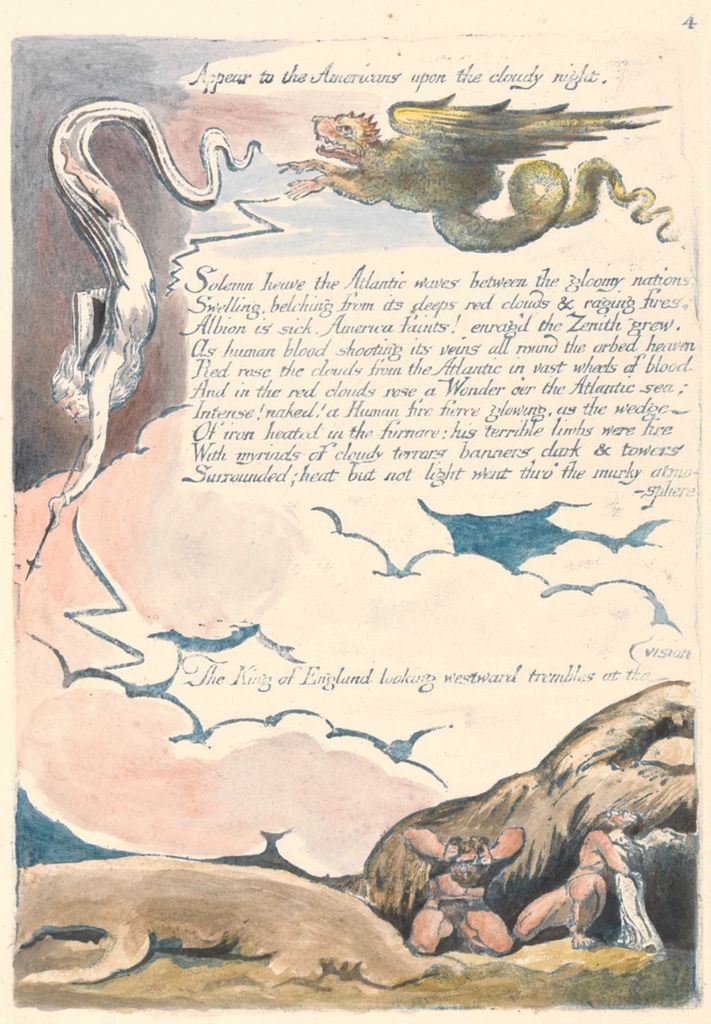
"Appear to the Americans upon the cloudy night.

Solemn heave the Atlantic waves between the gloomy nations,
Swelling, belching from its deeps red clouds & raging Fires!
Albion is sick. America faints! enrag'd the Zenith grew.
As human blood shooting its veins all round the orbed heaven     
Red rose the clouds from the Atlantic in vast wheels of blood
And in the red clouds rose a Wonder  o'er the Atlantic sea;
Intense! naked! a Human fire fierce glowing, as the wedge
Of iron heated in the furnace; his terrible limbs were fire
With myriads of cloudy terrors banners dark & towers             
Surrounded; heat but not light went thro' the murky atmosphere

The King of England looking westward trembles at the vision" 
Yale Center for British Art
America
Plate 6 [4], Copy M