Blake seeks to provide the Golden String which can lead us through the labyrinth of our experience or his own poetry.

Friday, March 6, 2015

FLAXMAN, GRAY & BLAKE

Blake's Watercolours for the Poems of Thomas Gray
Item 89
"To him the mighty mother did unveil her awful face"

"Around the Springs of Gray my wild root weaves
Traveller repose & Dream among my leaves,"

--WILL. BLAKE


John Flaxman was a friend of Blake from his student days. He was a fellow artist and associated with the Swedenborg Church in which Blake briefly participated. There was sometimes tension in the relationship between the fiery Blake and the restrained Flaxman but their relationship was sustained. Blake appreciated the help his friend gave him emotionally and professionally.

This section from a letter Blake wrote to Flaxman in 1800 shows that Blake understood the debt he owed to Flaxman who became quite successful and influential in his time.

Letters, Mr Flaxman, Buckingham Street, Fitzroy Square, (E 707)
"To My Dearest Friend John Flaxman
these lines

I bless thee O Father of Heaven & Earth that ever I saw Flaxmans face
Angels stand round my Spirit in Heaven. the blessed of Heaven are my friends upon Earth
When Flaxman was taken to Italy. Fuseli was giv'n to me for a season
And now Flaxman hath given me Hayley his friend to be mine such my lot upon Earth
Now my lot in the Heavens is this; Milton lovd me in childhood & shewd me his face
Ezra came with Isaiah the Prophet, but Shakespeare in riper years gave me his hand
Paracelsus & Behmen appeard to me. terrors appeard in the Heavens above
And in Hell beneath & a mighty & awful change threatend the Earth
The American War began All its dark horrors passed before my face
Across the Atlantic to France. Then the French Revolution commencd in thick clouds
And My Angels have told me. that seeing such visions I could not subsist on the Earth
But by my conjunction with Flaxman who knows to forgive Nervous Fear
I remain for Ever Yours
WILLIAM BLAKE"

Owing to the close social connection between the Blakes and the Flaxmans, we have one of Blake's unique productions. To please his wife Ann, John Flaxman commissioned William Blake to produce a set of watercolor illustrations of the poems of Thomas Gray which were favorites of Ann. For the sum of 10 guineas Blake produced 116 watercolors and this poem of his own which he attached to the end.

[With Blake's Illustrations to Gray's Poems]
Pickering Manuscript, (E 482)
"To Mrs Ann Flaxman
A little flower grew in a lonely Vale
Its form was lovely but its colors pale
One standing in the Porches of the Sun
When his Meridian Glories were begun
Leaped from the steps of fire & on the grass
Alighted where this little flower was
With hands divine he moved the gentle sod
And took the Flower up in its native Clod
Then planting it upon a Mountains brow
'Tis your own fault if you don't flourish now
- William Blake"

The watercolors which were bound into a book remained in the Flaxman family and in private hands until in1966 they were purchased by Paul Melon (for the Yale Center for British Art) and a expensive facsimile book was issued. You can now purchase a copy of the Dover reprint of Blake's Watercolours for the Poems of Thomas Gray for $24.95 or for less if you wait for a sale. All 116 color illustrations are included in a
9 1/8 x 11 5/8 inch format.
.

Wednesday, March 4, 2015

RHYTHM OF LIFE

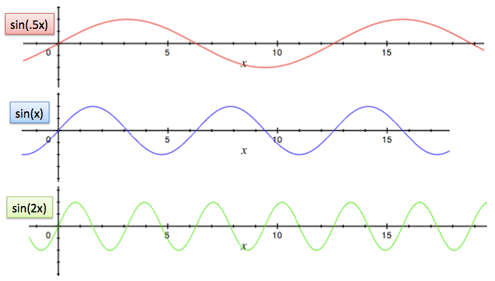
Life is a gift for the individual to put to use for his own benefit and for the benefit of mankind. If we were to plot life over time it would be more of a sine curve than a straight line. We experience a rhythm in life of assent and descent. There are events which which draw us into the pits and events which allow us to soar. The highs and lows are equally necessary to learn the Eternal lessons from temporal experience.
 
Blake writes of learning experiences by which his characters thread their way through difficulties and delights. His point is to make his reader ever more capable of living in the Eternal dimension by learning to discard the impediments which he accumulates in the temporal world. By failing to see the direction he is headed because of the ups and downs of natural existence, man may lose sight of the Divine Guidance. Blake's advice is change one's perspective:
"To see a World in a Grain of Sand
And a Heaven in a Wild Flower
Hold Infinity in the palm of your hand
And Eternity in an hour" (Auguries of Innocence)
 
Marriage of Heaven & Hell, Plate 5, (E 35)
"In seed time learn, in harvest teach, in winter enjoy."

Jerusalem, Plate 56, (E 206)
"O daughters of despair!
Rock the Cradle, and in mild melodies tell me where found
What you have enwoven with so much tears & care? so much
Tender artifice: to laugh: to weep: to learn: to know;
Remember! recollect what dark befel in wintry days               

O it was lost for ever! and we found it not: it came
And wept at our wintry Door: Look! look! behold! Gwendolen
Is become a Clod of Clay! Merlin is a Worm of the Valley!

Then Los uttered with Hammer & Anvil"

Europe, Plate iii, (E 60)
"Then tell me, what is the material world, and is it dead?
He laughing answer'd: I will write a book on leaves of flowers,
If you will feed me on love-thoughts, & give me now and then    
A cup of sparkling poetic fancies; so when I am tipsie,
I'll sing to you to this soft lute; and shew you all alive
The world, when every particle of dust breathes forth its joy.

Milton, Plate 25 [27], (E 122)
"Go forth Reapers with rejoicing. you sowed in tears
But the time of your refreshing cometh, only a little moment     
Still abstain from pleasure & rest, in the labours of eternity
And you shall Reap the whole Earth, from Pole to Pole! from Sea to Sea
Begining at Jerusalems Inner Court, Lambeth ruin'd and given
To the detestable Gods of Priam, to Apollo: and at the Asylum
Given to Hercules, who labour in Tirzahs Looms for bread    
Who set Pleasure against Duty: who Create Olympic crowns
To make Learning a burden & the Work of the Holy Spirit: Strife.
T[o] Thor & cruel Odin who first reard the Polar Caves 
Lambeth mourns calling Jerusalem. she weeps & looks abroad
For the Lords coming, that Jerusalem may overspread all Nations  
Crave not for the mortal & perishing delights, but leave them
To the weak, and pity the weak as your infant care; Break not
Forth in your wrath lest you also are vegetated by Tirzah
Wait till the Judgement is past, till the Creation is consumed
And then rush forward with me into the glorious spiritual    
Vegetation; the Supper of the Lamb & his Bride; and the
Awaking of Albion our friend and ancient companion.

So Los spoke. But lightnings of discontent broke on all sides round"

Jerusalem, Plate 49, (E 199)
"Remove from Albion, far remove these terrible surfaces.          
They are beginning to form Heavens & Hells in immense
Circles: the Hells for food to the Heavens: food of torment,
Food of despair: they drink the condemnd Soul & rejoice
In cruel holiness, in their Heavens of Chastity & Uncircumcision
Yet they are blameless & Iniquity must be imputed only           
To the State they are enterd into that they may be deliverd:
Satan is the State of Death, & not a Human existence:
But Luvah is named Satan, because he has enterd that State.
A World where Man is by Nature the enemy of Man
Because the Evil is Created into a State. that Men               
May be deliverd time after time evermore. Amen.
Learn therefore O Sisters to distinguish the Eternal Human
That walks about among the stones of fire in bliss & woe
Alternate! from those States or Worlds in which the Spirit travels:
This is the only means to Forgiveness of Enemies[.]              
Therefore remove from Albion these terrible Surfaces
And let wild seas & rocks close up Jerusalem away from
Plate 50
The Atlantic Mountains where Giants dwelt in Intellect;
Now given to stony Druids, and Allegoric Generation
To the Twelve Gods of Asia, the Spectres of those who Sleep:
Sway'd by a Providence oppos'd to the Divine Lord Jesus:
A murderous Providence! A Creation that groans, living on Death." 

Descriptive Catalogue, Page 52, (E 546)
"they possess
themselves of the bodies of mortal men, and shut the doors of
mind and of thought, by placing Learning above Inspiration, O
Artist! you may disbelieve all this, but it shall be at your own
peril." 
______________________________________________________
Luke 3
[2] ... the word of God came unto John the son of Zacharias in the wilderness.
[3] And he came into all the country about Jordan, preaching the baptism of repentance for the remission of sins;
[4] As it is written in the book of the words of Esaias the prophet, saying, The voice of one crying in the wilderness, Prepare ye the way of the Lord, make his paths straight.
[5] Every valley shall be filled, and every mountain and hill shall be brought low; and the crooked shall be made straight, and the rough ways shall be made smooth;
[6] And all flesh shall see the salvation of God.


Romans 5
[3] ...we glory in tribulations also: knowing that tribulation worketh patience;
[4] And patience, experience; and experience, hope
:
[5] And hope maketh not ashamed; because the love of God is shed abroad in our hearts by the Holy Ghost which is given unto us. 

.

Monday, March 2, 2015

LIFE AS METAPHOR

British Museum
Illustrations to Young's Night Thoughts 
Few people who read Blake would deny that he is attempting to make his reader change the way he perceives his world. Our minds have been trained to see separate entities which are clearly differentiated. We have learned that things are either one thing or another. We measure and define, explain and rationalize. 


But what if words were pointers to ideas which were too big to be contained in words. What if each word opened the mind to ever expanding vistas of movement and activity. What if there were gates through which you could pass to enter unknown worlds. What if the world to which imagination can take us were all around us and inside us as well. What if we traveled through images of reality in a body which belongs to Eternity. Such a world would be the environs in which William Blake lived.

Blake's life can be thought of as a metaphor which he was using to describe the world which senses cannot access. He lived the joy and woe which permeates his poetic and visual images. He lived the death and the resurrection, and the journey of experience which connects the two. It was not enough to him to portray the Eternal, Infinite, Invisible world, he wanted to give access to that world to the brotherhood of man.

You are given the opportunity of viewing your own life as metaphor. You can become conscious that what we call reality is a mask which covers an "an immense world of delight, clos'd by your senses five". Your imagination will be expanded as was Blake's by exercising your "immortal Eyes ... inward into the Worlds of Thought".
Jerusalem, Plate 5, (E 147)
"Trembling I sit day and night, my friends are astonish'd at me.
Yet they forgive my wanderings, I rest not from my great task!
To open the Eternal Worlds, to open the immortal Eyes
Of Man inwards into the Worlds of Thought: into Eternity
Ever expanding in the Bosom of God. the Human Imagination        
O Saviour pour upon me thy Spirit of meekness & love:
Annihilate the Selfhood in me, be thou all my life!"
Four Zoas, Night VIII, Page 114, (E 385)
"he [Man] rises to the Sun
And to the Planets of the Night & to the stars that gild
The Zodiac & the stars that sullen stand to north & south
He touches the remotest pole & in the Center weeps
That Man should Labour & sorrow & learn & forget & return
To the dark valley whence he came to begin his labours anew
In pain he sighs in pain he labours in his universe
Screaming in birds over the deep & howling in the Wolf
Over the slain & moaning in the cattle & in the winds
And weeping over Orc & Urizen in clouds & flaming fires  
And in the cries of birth & in the groans of death his voice 
Is heard throughout the Universe whereever a grass grows
Or a leaf buds   The Eternal Man is seen is heard   is felt
And all his Sorrows till he reassumes his ancient bliss

Such are the words of Ahania & Enion. Los hears & weeps  
And Los & Enitharmon took the Body of the Lamb 
Down from the Cross & placd it in a Sepulcher which Los had hewn
For himself in the Rock of Eternity trembling & in despair 
Jerusalem wept over the Sepulcher two thousand Years"
Songs of Innocence & of Experience, Plate 9, (E 9)
"And we are put on earth a little space, 
we may learn to bear the beams of love,
...
SONGS 10  
For when our souls have learn'd the heat to bear
The cloud will vanish we shall hear his voice.
Saying: come out from the grove my love & care,
And round my golden tent like lambs rejoice."

.

Saturday, February 28, 2015

THE INVENTOR

Satiric Verses and Epigrams, (E 514)
"Rafael Sublime Majestic Graceful Wise
His Executive Power must I despise  
Rubens Low Vulgar Stupid Ignorant
His power of Execution I must grant"

Metropolitan Museum of Art
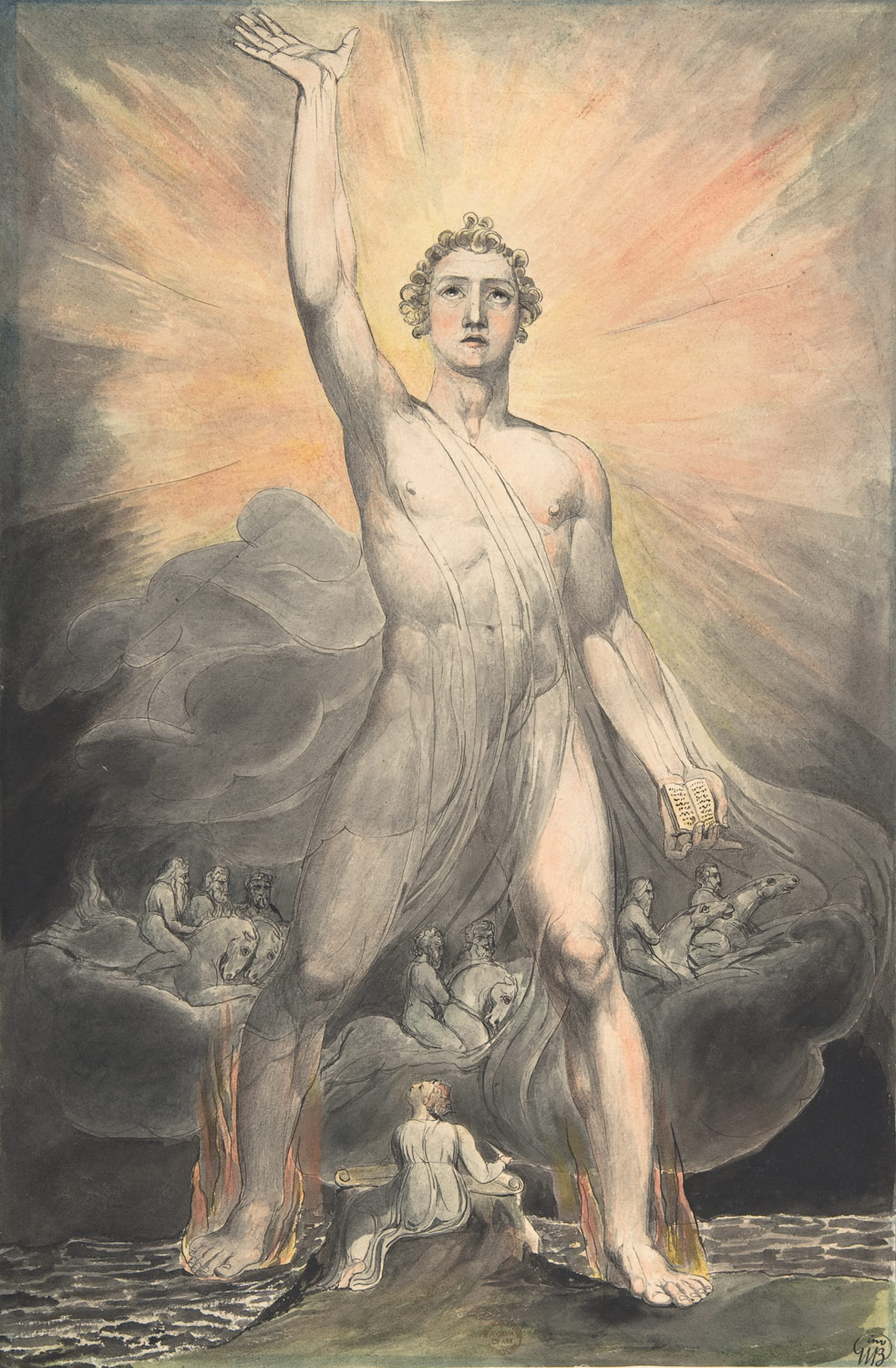
Angel of Revelation
1805
Signature bottom right
In his early career Blake was fond of signing his work 'WB inv'. He recognized that the original conception of the work of art provided the essential foundation upon which the final product was built. Blake worked in various media including drawing, watercoloring, tempera, engraving, poetry and prose. Each depended on an 'Original Invention': an idea or mental image which existed only in his fertile imagination.

Blake's ability to invent was recognized by his contemporaries, but they sometimes denied his ability to execute which depended upon different skills. Blake would not concede that his ability to execute was any less than his ability to invent. 

Blake's training was as a reproductive engraver whose skill is faithfully reproducing images which have been conceived by others for printing in published form. Since his goal was to execute his own inventions, not just the inventions of others, he developed a broad set of skills encompassing disciplines which spanned visual and verbal communication. Engraving in the conventional practice became his vocation; his imaginative creations became his art which he considered to be the 'whole business of man.'
 
Blake's ability to execute was dependent on a two pronged method of learning: study of his predecessors and experimentation. He found in Michelangelo the finest ability to conceive and execute so he set him up as a model in art, as he did Milton in poetry. His experimentation led him into novel methods of printing, painting and writing. Learning through experiments was another facet of his inventiveness; gaining mastery of his new methods allowed him to execute his images in an individualistic manner. If his aim had been to follow current trends and appeal to popular tastes he would have applied different strategies.

Invention and Execution became for Blake two of his contraries; two opposed but equally true expressions of the unity of his art. His work was in consolidating the inner dimension - the invention, with the outer expression - the execution. If they were not perfectly balanced, the work of art would be spoiled by failing to communicate Eternal truth.

Public Address, Page 60, (E 576)
 "No Man Can
Improve An Original Invention. [Since Hogarths time we have
had very few Efforts of Originality] but   
Drawn with a firm hand at once [with all its Spots & Blemishes which are beauties & not faults] like Fuseli & Michael Angelo Shakespeare & Milton>"
 Public Address, PAGE 62, (E 576) 
     "I have heard many People say Give me the Ideas.  It is no
matter what Words you put them into & others say Give me the
Design it is no matter for the Execution.  These People know
Nothing Of Art.  Ideas cannot be Given
but in their minutely Appropriate Words nor Can a Design be made
without its minutely Appropriate Execution ... He who copies does
not Execute he only Imitates what is already Executed Execution
is only the result of Invention" 
Public Address, Page 24, (E 582)
     "I know my Execution is not like Any Body Else I do not
intend it should be so 
...I defy any Man to Cut
Cleaner Strokes than I do or rougher when I please & assert that
he who thinks he can Engrave or Paint either without being a
Master of Drawing is a Fool  Painting is Drawing
on Canvas & Engraving is Drawing on Copper & nothing Else
[Drawing is Execution & nothing Else] & he who Draws best must be
the best Artist [&] to this I subscribe" 
 Annotations to Reynolds, P iii, (E 637)
     "Invention depends Altogether upon Execution or
Organization. as that is right or wrong so is the Invention
perfect or imperfect.  Whoever is set to Undermine the Execution
of Art is set to Destroy Art   Michael Angelos Art Depends on
Michael Angelos Execution Altogether" 
 Annotations to Reynolds, p 126, (E 654) 
    "Can any Man be such a fool as to believe that Rafael &
Michael Angelo were Incapable of the meer Language of Art & That
Such Idiots as Rubens. Correggio & Titian Knew how to Execute
what they could not Think or Invent" 
 Descriptive Catalogue, (E 528)
 "If Italy is enriched and
made great by RAPHAEL, if MICHAEL ANGELO is its supreme glory, if
Art is the glory of a Nation, if Genius and Inspiration are the
great Origin and Bond of Society, the distinction my Works have
obtained from those who best understand such things, calls for my
Exhibition as the greatest of Duties to my Country." 
Descriptive Catalogue, (E 547)
"...when the Artist took his pencil, to execute his
ideas, his power of imagination weakened so much, and darkened,
that memory of nature and of Pictures of the various
Schools possessed his mind, instead of appropriate execution,
resulting from the inventions; like walking in another man's
style, or speaking or looking in another man's style and manner,
unappropriate and repugnant to your own individual character;
tormenting the true Artist, till he leaves the Florentine, and
adopts the Venetian practice, or does as Mr. B. has done, has the
courage to suffer poverty and disgrace, till he ultimately
conquers."
. 

Thursday, February 26, 2015

NO NATURAL RELIGION

We saw in a previous post that Blake thought Natural Religion an "Impossible absurdity." Something which calls itself religion and limits perception to sensing and reasoning, has misunderstood the meaning of the concept of religion. Without God religion is absurd. In one of Blake's earliest engraved poems he presents his argument that man sees only himself, not God, if he relies of his senses and his reasoning to provide him with a religion.
There is no Natural Religion, (E 2) 
THERE is NO NATURAL RELIGION
The Author & Printer W Blake
The Argument
Man has no notion of moral
fitness but from Education.
Naturally he is only a nat-
ural organ subject to Sense.
I
 Man cannot naturally Per-
cieve, but through his natural
or bodily organs
As a natural man all data from the exterior world comes through the senses.

II  
Man by his reason-
ing power. can only 
compare & judge of 
what he has already 
perciev'd.
Man's reason can only process what it has received.

III  
From a perception of 
only 3 senses or 3 ele-
ments none could de-
duce a fourth or fifth
Each sense is limited to its own ability to receive data.

IV  
None could have other 
than natural or organic 
thoughts if he had none 
but organic perceptions
Sense perceptions provide only material which can be processed mechanically.

V
Mans desires are 
limited by his percept
ions. none can de
-sire what he has not 
perciev'd
Without the ability to perceive extra-sensory data man is cut off from desire for more.

VI  
The desires & percepti-
ons of man untaught by
any thing but organs of
sense, must be limited 
to objects of sense.
Without desire or additional means of perceptions, man is trapped in a state of 'single vision.'

THERE is NO NATURAL RELIGION [b]
I  
Mans percepti-
ons are not bound-
ed by organs of
perception. he per-
cieves more than
sense (tho' ever 
so acute) can 
discover.
Man's senses provide limited information. However man has the ability to perceive more than the narrow range which his eyes, ears, nose, mouth and skin can sense.

II
Reason or the ra-
tio of all we have
already known. is
not the same that 
it shall be when
we know more. 
If we were to depend on reason alone we would not be able to go beyond the limit that reason is able to discern.

[III lacking]
IV  
The bounded is 
loathed by its pos-
sessor.  The same
dull round even
of a univer[s]e would
soon become a
mill with complica-
ted wheels.
Input from outside of a limited system prevents it from becoming a continual repetition of the same events.

V
If the many be-
come the same as
the few, when pos-
sess'd, More! More!
is the cry of a mista
-ken soul, less than
All cannot satisfy 
Man.
Continually treading the same ground cannot satisfy man no matter how often it is repeated.

VI  
If any could de-
sire what he is in-
capable of pos-
sessing, despair must
be his eternal 
lot.
The desire for more than man can access through his senses and reasoning power would lead to a dead end if he were incapable of perceiving more.

VII 
The desire of 
Man being Infi-
nite the possession 
is Infinite & him-
self Infinite
If man is capable of desiring more than his limited faculties provide, he opens himself to achieving a perception of the Infinite through perceiving the Infinite within himself.

Conclusion,   
If it were not for the
Poetic or Prophetic
character. the Philo-
sophic & Experimen-
tal would soon be
at the ratio of all
things & stand still, 
unable to do other 
than repeat the same 
dull round over a-
gain
There is a level of perception which is beyond that which is reached by sensing and reasoning. Poetry and Prophecy are expressions which allow man to reach outside of the static repetition of natural patterns.

Application.
He who sees the In-
finite in all things
sees God.  He who 
sees the Ratio only
sees himself only.
Unless an individual develops the ability to go beyond depending on his own sense perception and reasoning power, he is trapped within himself. Seeing more than the surface - into the depths - will open the way to seeing the Infinite in all things and God.

***
Wikimedia Commons There is No Natural Religion
Plate 6
The presence of God within man provides him with the ability to recognize that Presence. Through that recognition he develops the ability to see as God sees - the Infinite in all things. We are in the process of becoming with God. The whole of creation is an expression of God. As creation recognizes God, God becomes as we are and we as he is. God has chosen to be articulated through his creation. As creation strives to respond to the God which is embodied in it, Man and God become One. 


John 17
[20] Neither pray I for these alone, but for them also which shall believe on me through their word;
[21] That they all may be one; as thou, Father, art in me, and I in thee, that they also may be one in us: that the world may believe that thou hast sent me.
[22] And the glory which thou gavest me I have given them; that they may be one, even as we are one:
[23] I in them, and thou in me, that they may be made perfect in one; and that the world may know that thou hast sent me, and hast loved them, as thou hast loved me.

Romans 12
[2] And be not conformed to this world: but be ye transformed by the renewing of your mind, that ye may prove what is that good, and acceptable, and perfect, will of God.

Colossians 1
[15] He is the image of the invisible God, the first-born of all creation;
[16] for in him all things were created, in heaven and on earth, visible and invisible, whether thrones or dominions or principalities or authorities -- all things were created through him and for him.
[17] He is before all things, and in him all things hold together.
[18] He is the head of the body, the church; he is the beginning, the first-born from the dead, that in everything he might be pre-eminent.
[19] For in him all the fulness of God was pleased to dwell,
[20] and through him to reconcile to himself all things, whether on earth or in heaven, making peace by the blood of his cross. 

.

Tuesday, February 24, 2015

BLAKE & NATURAL RELIGION

Without a perception of the infinite Deism became associated with Natural Religion through which the workings of nature replace the workings of God. Man became dependent on nature to provide an object of worship and a system of ethics. Newtonian science became the primary tool to understand reality. The outer material world absorbed his attention and commanded loyalty. In as much as man finds all of his enjoyment in material pleasures and his ethics are directed by the desire for accumulating material goods, he is an adherent of Natural Religion.

These activities which dominate our contemporary culture may be manifestations of our devotion to Natural Religion:
preoccupation with appearance of one's body,
acquisitiveness,
desire to exploit the resources of nature,
egocentricity,  
fear of dying,
willingness to exploit the weak for the benefit of the strong.

 
Yale Center for British Art  
Jerusalem
Copy E, Plate 25

On Plate 25 of Jerusalem we see Albion, the Universal Man, being tortured by Rahab, Vala and Tirzah, three aspects of Natural Religion. All three are manifestations in the fallen world of Eternal realities which have been debased. Rahab as Moral Virture imputes sin or righteousness to individuals rather than to the states through they pass. Vala spreads her veil to prevent man from perceiving the Eternal through the world in which he lives. Tirzah provides man with a physical body to lure him from consciousness of his spiritual body.

Blake saw the danger of replacing revealed religion with the worship of the material world, and spoke out with great force against Natural Religion.

Four Zoas, Night VIII, Page 115, (E 386)
"The Synagogue of Satan therefore uniting against Mystery
Satan divided against Satan resolvd in open Sanhedrim
To burn Mystery with fire & form another from her ashes 
For God put it into their heart to fulfill all his will

The Ashes of Mystery began to animate they calld it Deism
And Natural Religion as of old so now anew began
Babylon again in Infancy Calld Natural Religion"
Jerusalem, Plate 90, (E 250)
"So Los spoke. And the Giants of Albion terrified & ashamed  
With Los's thunderous Words, began to build trembling rocking Stones
For his Words roll in thunders & lightnings among the Temples   
Terrified rocking to & fro upon the earth, & sometimes
Resting in a Circle in Maiden or in Strathness or Dura.
Plotting to devour Albion & Los the friend of Albion
Denying in private: mocking God & Eternal Life: & in Public
Collusion, calling themselves Deists, Worshipping the Maternal  
Humanity; calling it Nature, and Natural Religion 
But still the thunder of Los peals loud & thus the thunder's cry 

These beautiful Witchcrafts of Albion, are gratifyd by Cruelty" 
Milton, Plate 40 [46], (E 141)
"Before Ololon Milton stood & percievd the Eternal Form
Of that mild Vision; wondrous were their acts by me unknown
Except remotely; and I heard Ololon say to Milton

I see thee strive upon the Brooks of Arnon. there a dread
And awful Man I see, oercoverd with the mantle of years.   
I behold Los & Urizen. I behold Orc & Tharmas;
The Four Zoa's of Albion & thy Spirit with them striving
In Self annihilation giving thy life to thy enemies
Are those who contemn Religion & seek to annihilate it
Become in their Femin[in]e portions the causes & promoters       
Of these Religions, how is this thing? this Newtonian Phantasm
This Voltaire & Rousseau: this Hume & Gibbon & Bolingbroke
This Natural Religion! this impossible absurdity
Is Ololon the cause of this? O where shall I hide my face
These tears fall for the little-ones: the Children of Jerusalem  
Lest they be annihilated in thy annihilation.

No sooner she had spoke but Rahab Babylon appeard
Eastward upon the Paved work across Europe & Asia
Glorious as the midday Sun in Satans bosom glowing:
A Female hidden in a Male, Religion hidden in War  

Namd Moral Virtue; cruel two-fold Monster shining bright
A Dragon red & hidden Harlot which John in Patmos saw
...
But turning toward Ololon in terrible majesty Milton
Replied. Obey thou the Words of the Inspired Man
All that can be annihilated must be annihilated   

That the Children of Jerusalem may be saved from slavery"

If we are inclined to think that it is science that upholds the notion that the world is matter only, we should note what Max Planck had to say:
"As a man who has devoted his whole life to the most clear headed science, to the study of matter, I can tell you as a result of my research about atoms this much: There is no matter as such. All matter originates and exists only by virtue of a force which brings the particle of an atom to vibration and holds this most minute solar system of the atom together. We must assume behind this force the existence of a conscious and intelligent Mind. This Mind is the matrix of all matter."
Max Planck, Das Wesen der Materie, 1944 

.

Sunday, February 22, 2015

BLAKE & DEISM

In Blake's day Deism was on the rise. Although Deism is not an organized religion, its influence was replacing religion especially among the educated populace. Since its tenents were diametrically opposed to the religion of Jesus to which Blake ascribed, he spoke out against it. The third chapter of Jerusalem is addressed to the Deists whose error Blake wanted to expose and correct.
Yale Center for British Art
 Jerusalem, Plate 75
"And Rahab Babylon the Great hath destroyed Jerusalem"

The popular attraction of Deism was that it appealed to reason and postulated a God who did not interfere in the operation of the world. The transitions that the culture was undergoing from an agrarian to an industrialized economy, and from an authoritarian to an egalitarian political structure, were supported by the philosophies promulgated by Deists. Although there was not a uniform belief system among Deists, they undermined the belief among the masses that God could be turned to for guidance and assistance.

Blake saw that man was in danger of losing the spiritual foundations on which a society of brotherhood, community and faith could be sustained. Blake's desire was that man should awake to the possibilities within himself to reflect the benevolence, mercy, forgiveness and imagination of God. Man to Blake was Human because God was in Man and Man was in God. To him, a God who did not involve himself with man was no God at all; a society without a connection to the Divine would crumble into chaos.


Jerusalem, Plate 52, (E 200)                                                                
"                                                     |The Spiritual States of
                                                      |the Soul are all Eternal  
Rahab is an   |   To the Deists.      |Distinguish between the 
Eternal State |                               |Man, & his present State  
         
  He never can be a Friend to the Human Race who is the Preacher
of Natural Morality or Natural Religion. he is a flatterer who
means to betray, to perpetuate Tyrant Pride & the Laws of that
Babylon which he foresees shall shortly be destroyed, with the
Spiritual and not the Natural Sword: He is in the State named
Rahab: which State must be put off before he can be the Friend of
Man.
  You O Deists profess yourselves the Enemies of Christianity:
and you are so: you are also the Enemies of the Human Race & of
Universal Nature.  Man is born a Spectre or Satan & is altogether
an Evil, & requires a New Selfhood continually & must continually
be changed into his direct Contrary.  But your Greek Philosophy
(which is a remnant of Druidism) teaches that Man is Righteous in
his Vegetated Spectre: an Opinion of fatal & accursed consequence
to Man, as the Ancients saw plainly by Revelation to the intire
abrogation of                  
Experimental Theory. and many believed what they saw, and
Prophecied of Jesus.
  Man must & will have Some Religion; if he has not the Religion
of Jesus, he will have the Religion of Satan, & will erect the
Synagogue of Satan. calling the Prince of this World, God; and
destroying all who do not worship Satan under the Name of God. 
Will any one say: Where are those who worship Satan under the
Name of God! Where are they? Listen! Every Religion that Preaches
Vengeance for Sins the Religion of the Enemy & Avenger; and not
the Forgiver of Sin, and their God is Satan, Named by the Divine
Name   Your Religion O Deists: Deism, is the Worship of the God
of this World by the means of what you call Natural Religion and
Natural Philosophy, and of Natural Morality or
Self-Righteousness, the Selfish Virtues of the Natural Heart. 
This was the Religion of the Pharisees who murderd Jesus.  Deism
is the same & ends in the same.
  Voltaire Rousseau Gibbon Hume. charge the Spiritually Religious
with Hypocrisy! but how a Monk or a Methodist either, can be a
Hypocrite: I cannot concieve.  We are Men of like passions with
others & pretend not to be holier than others: therefore, when a
Religious Man falls into Sin, he ought not to be calld a
Hypocrite: this title is more properly to be given to a Player
who falls into Sin; whose profession is Virtue & Morality & the
making Men Self-Righteous.  Foote in calling Whitefield,
Hypocrite: was himself one: for Whitefield pretended not to be
holier than others: but confessed his Sins before all the World;
Voltaire! Rousseau! You cannot escape my charge that you are
Pharisees & Hypocrites, for you are constantly talking of the
Virtues of the Human Heart, and particularly of your own, that
you may accuse others & especially the Religious, whose errors,
you by this display of pretended Virtue, chiefly design to
expose.  Rousseau thought Men Good by Nature; he found them Evil
& found no friend.  Friendship cannot exist without Forgiveness
of Sins continually.  The Book written by Rousseau calld his
Confessions is an apology & cloke for his sin & not a confession.
  But you also charge the poor Monks & Religious with being the
causes of War: while you acquit & flatter the Alexanders &
Caesars, the Lewis's & Fredericks: who alone are its causes & its
actors.  But the Religion of Jesus, Forgiveness of Sin, can never
be the cause of a War nor of a single Martyrdom.
  Those who Martyr others or who cause War are Deists, but never
can be Forgivers of Sin.  The Glory of Christianity is, To
Conquer by Forgiveness.  All the Destruction therefore, in
Christian Europe has arisen from Deism, which is Natural
Religion."                        

Jerusalem, Plate 74, (E 229)
"The Four Zoa's clouded rage; Urizen stood by Albion
With Rintrah and Palamabron and Theotormon and Bromion
These Four are Verulam & London & York & Edinburgh
And the Four Zoa's are Urizen & Luvah & Tharmas & Urthona
In opposition deadly, and their Wheels in poisonous              
And deadly stupor turn'd against each other loud & fierce
Entering into the Reasoning Power, forsaking Imagination
They became Spectres; & their Human Bodies were reposed
In Beulah, by the Daughters of Beulah with tears & lamentations

The Spectre is the Reasoning Power in Man; & when separated      
From Imagination, and closing itself as in steel, in a Ratio
Of the Things of Memory. It thence frames Laws & Moralities
To destroy Imagination! the Divine Body, by Martyrdoms & Wars

Teach me O Holy Spirit the Testimony of Jesus! let me
Comprehend wonderous things out of the Divine Law                
I behold Babylon in the opening Street of London, I behold
Jerusalem in ruins wandering about from house to house
This I behold the shudderings of death attend my steps
...
I see a Feminine Form arise from the Four terrible Zoas
Beautiful but terrible struggling to take a form of beauty
Rooted in Shechem: this is Dinah, the youthful form of Erin
The Wound I see in South Molton Street & Stratford place  
Whence Joseph & Benjamin rolld apart away from the Nations
In vain they rolld apart; they are fixd into the Land of Cabul
Plate 75
And Rahab Babylon the Great hath destroyed Jerusalem"

.