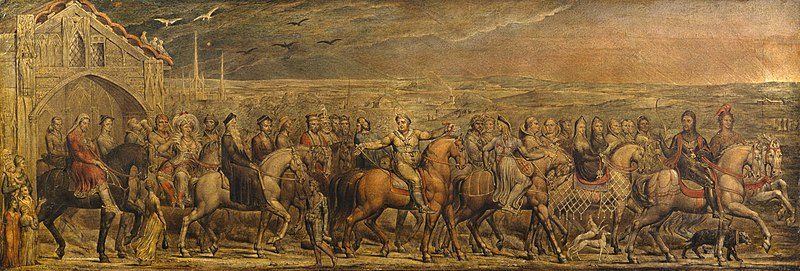
Blake seeks to provide the Golden String which can lead us through the labyrinth of our experience or his own poetry.

Friday, January 13, 2012

CANTERBURY PILGRIMS IV

British Museum
Section of Canterbury Pilgrims engraving used as a frontispiece for prospectus


In Blake: A Biography, Peter Ackroyd helps us to understand what Blake had learned through enduring the difficulties of earning a living through art in the milieu of early nineteenth century London. Ackroyd shows also what Blake wanted to teach his contemporaries about the trade-offs of adopting industrialised models. Quotes from Ackroyd:

"He understood how 'taste' was created and in his own oblique manner connected 'Advertizments in Newspapers' with 'Gentlemen Critics' and 'English Connoisseurs' as well as with 'Picture traders' and 'Picture dealers; here he is attacking what was essentially a middle-class genteel interest in art, propagated by the newspapers and art dealers, a fashionable taste known for its liberality and correctness but one quite unable to understand or appreciate the work of a visionary such as Blake." p 292

"He realised that, if the division between invention and execution is made, an 'Idea' or 'Design' can simply be produced on an assembly line. Art is then turned into a 'Good for Nothing Commodity' manufactured by 'Ignorant Journeymen' for a society of equally ignorant consumers." p 293

"His public address to English engravers was, in essence, not new. John Lanseer had attacked the commercialisation of engraving (and in particular Boydell) in a series of public lectures, while artists such as William Sharp and Benjamin West had criticised the beginnings of what we would now term 'mass' production. But none of them had taken their analysis as far, or as deep, as Blake. It is another example of his clairvoyant understanding of his age that he is able to draw the connection between art, industrial economics and what would become the 'consumer societies' of modern civilisation in an analysis that was not otherwise formulated until the present century. It is as if his own sense of helplessness and despair had broken him open, and he could speak clearly about the world that had come close to destroying him; it was not madness at all, but a peculiar kind of lucidity which springs from those who have nothing left to lose. But he realized well what this encroaching industrial society was about to forfeit - all imitative techniques and mechanical perceptions 'turn that which is Soul & Life into a Mill or Machine' (E 575)...All this time Blake continued his work on his engraving of Chaucer's pilgrims, redolent of a more spiritual state of England and executed by him in a style that imitated the great 'Gothic' masters of the sixteenth century." p 294

Descriptive Catalogue,PAGE 21, (E 536)
"The Plowman is simplicity itself, with wisdom and strength
for its stamina. Chaucer has divided the ancient character of
Hercules between his Miller and his Plowman. Benevolence is the
plowman's great characteristic, he is thin with excessive labour,
and not with old age, as some have supposed.

'He would thresh and thereto dike and delve
For Christe's sake, for every poore wight,
Withouten hire, if it lay in his might.'

Visions of these eternal principles or characters of human
life appear to poets, in all ages; the Grecian gods were the
ancient Cherubim of Phoenicia; but the Greeks, and since them the
Moderns, have neglected to subdue the gods of Priam. These Gods
are visions of the eternal attributes, or divine names, which,
when erected into gods, become destructive to humanity.
They ought to be the servants, and not the masters of man, or of
society. They ought to be made to sacrifice to Man, and not man
compelled to sacrifice to them; for when separated from man or
humanity, who is Jesus the Saviour, the vine of eternity, they
are thieves and rebels, they are destroyers.
"
________________________________________________________________

More Resources for studying Blake's Canterbury Pilgrims

The painting itself belongs to the Glasgow Museum Pollock House. It was exhibited at the Tate Gallery in 2009 at which time they provided this press release. An illustrated biography of Blake by the Tate is available online. The section, Poverty & Paranoia, concerns the period when Blake worked on Canterbury Pilgrims.

Two copies of the print are in the British Museum. Learn more about Chaucer's Canterbury Tales at wikipedia.
The ideal way to view the print is at the Morgan Library website. You can zoom into the image for detail including identification of each character at the bottom of print.

An article titled Interpreting Blake's Canterbury Pilgrims by Warren Stevenson is available at http://digitalcommons.colby.edu/.

Hazard Adams has written a book named William Blake on his poetry and painting: a study of a descriptive catalogue.
.

Wednesday, January 11, 2012

CANTERBURY PILGRIMS III

Preliminary Drawing for Chaucer's Canterbury Pilgrims
British Museum

Blake produced his painting and his engraving of Chaucer's Canterbury Pilgrims at a time when he was hard pressed by the changes taking place in the technical and economic facets of producing art. The prospects of profit motivated artists to compete for business, use short-cuts to mass produce, pander to popular taste, and use underhanded business practices.

Blake felt he had been cheated by the publisher/bookseller Cromek in the work he had done for the edition of Blair's The Grave which Cromek issued. He was deprived of the much need income from engraving his own designs for the book although he felt he had been promised the commission by Cromek. Subsequently Blake conceived of a large cabinet picture of the Canterbury Pilgrims which he would then engrave for sale to the public. Blake recalled mentioning the project to Cromek who then engaged Blake's friend Stothard to do the very same thing. With the backing of the publisher/bookseller Stothard's picture earned considerable money while Blake's did not.

Blake felt betrayed by Cromek and by Stothard who had been his friend since student days. Blake's anger is apparent in his Descriptive Catalogue, in the Chaucer Prospectuses, and in the Public Address which was never published or delivered. Tied in with Blake's resentment of Cormek and Stothard and his hostility toward them was his understanding of the changes in the role of art which were taking place because of the adoption of practices associated with the Industrial Revolution.

Public Address, (E 572)
PAGE 51
"In this Plate Mr B has resumed the style with which he set
out in life of which Heath & Stothard were the awkward imitators
at that time it is the style of Alb Durers Histries & the old
Engravers which cannot be imitated by any one who does not
understand Drawing & which according to Heath & Stothard Flaxman
& even Romney. Spoils an Engraver for Each of these Men have
repeatedly asserted this Absurdity to me in condemnation [P 52]
of my Work & approbation of Heaths lame imitation Stothard being
such a fool as to suppose that his blundering blurs can be made
out & delineated by any Engraver who knows how to cut dots &
lozenges equally well with those little prints which I engraved
after him five & twenty Years ago & by which he got his
reputation as a Draughtsman"

Public Address, (E 574)
PAGE 58
"In this manner the English Public have been imposed upon for
many Years under the impression that Engraving & Painting are
somewhat Else besides Drawing[.] Painting is Drawing on Canvas &
Engraving is Drawing on Copper & Nothing Else & he who pretends
to be either Painter or Engraver without being a Master of
Drawing is an Impostor. We may be Clever as Pugilists but as
Artists we are & have long been the Contempt of the Continent
Gravelot once said to My Master Basire
[you] English may be very clever in [your]
own opinions but [you] do not draw [the] draw

Resentment for Personal Injuries has had some share in this
Public Address But Love to My Art & Zeal for my Country a much
Greater."

Public Address, (E 576)
PAGE 62
"I have heard many People say Give me the Ideas. It is no
matter what Words you put them into & others say Give me the
Design it is no matter for the Execution. These People know
Nothing Of Art. Ideas cannot be Given
but in their minutely Appropriate Words nor Can a Design be made
without its minutely Appropriate Execution[.] The unorganized
Blots & Blurs of Rubens & Titian are not Art nor can their Method
ever express Ideas or Imaginations any more than Popes
Metaphysical jargon of Rhyming[.] Unappropriate Execution is the
Most nauseous affectation & foppery He who copies does
not Execute he only Imitates what is already Executed Execution
is only the result of Invention"

Blake turned inward following the episode involving the painting and engraving of Canterbury Pilgrims. The way which he had reacted to the failure and disappointment of his project was not congruent with his self image as one who knew that the Eternal world was reality, and that what happened in the natural world was transient states. It took Blake a long time to process the experience of rejection from those he depended upon and from the public to whom he appealed. The Public Address was a first step in which his anger exploded, but it was followed by the writing of Milton and Jerusalem in which he explored the dynamics of the presence of evil in the external and internal worlds.

Carl Jung experienced a similar psychological death when he broke with Freud. The experience was followed by a long period of introspection during which Jung explored the dark recesses of his unconscious and formulated his understanding of the dynamics of the psyche.
.

Monday, January 9, 2012

CANTERBURY PILGRIMS II

From Wikimedia Commons
"Chaucer's Canterbury Pilgrims. Copper engraving by William Blake, with additions in watercolour by the artist Third state, 1810–20. In the collection of the Morgan Library"Blake's painting of Chaucer's Canterbury Pilgrims which measured three feet by one foot was followed by his engraving of the same design. During the year which Blake worked on this large, intricately detailed engraving he wrote two or three prospectuses which were printed commercially for prospective buyers. The copper plate for the Chaucer engraving and a copy of the print can now be found in the Yale University Art Gallery.

Chaucer Prospectus, Second, Composite Draft, (E 568)
"BLAKE'S CHAUCER

An Original Engraving by [William Blake] from
his Fresco Painting of [Chaucers Canterbury Pilgrims]
[Mr B having from early Youth cultivated the two Arts
Painting & Engraving & during a Period of Forty Years never
suspended his Labours on Copper for a single Day Submits with
Confidence to Public Patronage & requests the attention of the
Amateur in a Large Stroke Engraving] 3 feet 1 inch long
by one foot high
[Containing Thirty original high finishd whole Length,
Portraits on Horseback Of Chaucers Characters, where every
Character & every Expression, every Lineament of Head Hand &
Foot. every particular of Dress or Costume. where every Horse is
appropriate to his Rider & the Scene or Landscape with its
Villages Cottages Churches & the Inn in Southwark is minutely
labourd not by the hands of Journeymen but by the Original Artist
himself even to the Stuffs & Embroidery of the Garments. the hair
upon the Horses the Leaves upon the Trees. & the Stones & Gravel
upon the road; the Great Strength of Colouring & depth of work
peculiar to Mr B's Prints will be here found accompanied by a
Precision not to be seen but in the work of an Original
Artist]"

The arts like all of life in Blake's time were affected by the Industrial Revolution. Mechanisation led to new styles and tools for engraving which were less labor intensive. The use of mass production techniques removed the artist from more tedious aspects of the production. Believing as Blake did in Art as a product of the Imagination, he chose to distance himself from less than 'human' means of manufacture of art.

Michael Bedard comments on the the alternatives faced by the traditional artist as the machine age gained ground in his book William Blake: The Gates of Paradise:
Page 128
"Blake's lament was the lament of an artist and craftsman who see industry and machine methods destroying both art and craft in the interest of business and profit. His plea for the integrity of the individual artist who unites idea and execution in his work. 'Michelangelo's art depends on Michelangelo's execution altogether,' he wrote. Once the two are separated, design becomes a matter of a production line, and art is no more than a commodity."

Page 140
"In rejecting the ways of the world of commerce and the spread of machine methods into the world of art, Blake embraced the Illuminated Book with renewed passion. While industrial production prided itself on the the ability to make an endless stream of Identical copies, in Illuminated Printing each copy was unique. While industry prided itself on speed and efficiency, Blake's mode of production was deliberately slow and inefficient. While industrial production was grounded on the division of labor and the distinction between those who worked with their heads and those who worked with their hands, Blake's was an artisan's spirit. He took pride in the work of his hands and relentlessly pursued the unity of head and hands in the work of art."

Blake chose to make his engraving in the traditional way he had been taught as an apprentice with Basire. He studied Chaucer using the translation from middle English. He determined the style of clothing worn in the period. He painted types of horses which he felt were appropriate to each rider. Every detail of his engraving was determined by what he could learn about the 15th century which he was representing, and the information which Chaucer had included in his poem.

In creating his engraving for the Canterbury Tales Blake deliberately rejected the influences of the Industrial Age and embraced the ways of the artisan who brought all of his own skills to an artistry which was correct, honest and conveyed the author's intent.
.

Saturday, January 7, 2012

CANTERBURY PILGRIMS

Wikipedia Commons
Canterbury Pilgrims 
When Blake painted his illustration for Chaucer's Canterbury Tales for his Exhibition of 1809 he included a detailed description of the painting in his Catalogue. He lists the pilgrims in the procession as Chaucer had described them. Notice too that he points out the time of day and the starting point of the pilgrimage. He remarks that he has attempted to portray features of the landscape as they would have appeared in Chaucer's time, some 400 years before Blake's own time. In spite of the lapse of time Blake feels that 'the characters themselves for ever remain unaltered' and delineate 'the classes of men.' 

Descriptive Catalogue, (E 532)
"NUMBER III.
Sir Jeffery Chaucer and the nine and twenty Pilgrims on
their journey to Canterbury.

THE time chosen is early morning, before sunrise, when the jolly
company are just quitting the Tabarde Inn. The Knight and Squire
with the Squire's Yeoman lead the Procession, next follow the
youthful Abbess, her nun and three priests; her greyhounds attend
her.

'Of small hounds had she that she fed
'With roast flesh, milk and wastel bread.'

Next follow the Friar and Monk; then the Tapiser, the Pardoner,
and the Somner and Manciple. After these "Our Host," who occupies
the center of the cavalcade; directs them to the Knight
as the person who would be likely to commence their task of each
telling a tale in their order. After the Host follow the
Shipman, the Haberdasher, the Dyer, the Franklin, the Physician,
the Plowman, the Lawyer, the poor Parson, the Merchant, the Wife
of Bath, the Miller, the Cook, the Oxford Scholar, Chaucer
himself, and the Reeve comes as Chaucer has described:

'And ever he rode hinderest of the rout.'

These last are issuing from the gateway of the Inn; the Cook and
the Wife of Bath are both taking their morning's draught of
comfort. Spectators stand at the gateway of the Inn, and are
composed of an old Man, a Woman and Children.
The Landscape is an eastward view of the country, from the
Tabarde Inn, in Southwark, as it may be supposed to have
appeared in Chaucer's time; interspersed with cottages and
villages; the first beams of the Sun are seen above the horizon;
some buildings and spires indicate the situation of the great
City; the Inn is a gothic building, which Thynne in his Glossary
says was the lodging of the Abbot of Hyde, by Winchester. On
the Inn is inscribed its title, and a proper advantage is taken
of this circumstance to describe the subject of the Picture.
The words written over the gateway of the Inn, are as follow:
"The Tabarde Inn, by Henry Baillie, the lodgynge-house for
Pilgrims, who journey to Saint Thomas's Shrine at Canterbury."
The characters of Chaucer's Pilgrims are the characters
which compose all ages and nations: as one age falls, another
rises, different to mortal sight, but to immortals only the same;
for we see the same characters repeated again and again, in
animals, vegetables, minerals, and in men; nothing new occurs in
identical existence; Accident ever varies, Substance can
never suffer change nor decay.
Of Chaucer's characters, as described in his Canterbury
Tales, some of the names or titles are altered by time, but the
characters themselves for ever remain unaltered, and
consequently they are the
physiognomies or lineaments of universal human life, beyond which
Nature never steps. Names alter, things never alter. I have
known multitudes of those who would have been monks in the age of
monkery, who in this deistical age are deists. As Newton
numbered the stars, and as Linneus numbered the plants, so
Chaucer numbered the classes of men."

There were many reasons that Blake put a lot of time and energy into his painting of the Canterbury Pilgrims, some of which we will explore in later posts. First we see it only as a careful rendition of a Gothic text.
.

Thursday, January 5, 2012

READING BLAKE

From Jerusalem, Plate 64
Used on cover of The Complete Poetry & Prose of William Blake

The resources on the internet have made studying Blake easier. When Larry began reading Blake in the 1980's he was dependant on books for his sources. His 'bible' was Geoffrey Keynes' Blake: Complete Writings first published by the Oxford University Press in 1966 (a revision of his 1925 work). The authoritative text for the works of Blake is now David V Erdman's The Complete Poetry & Prose of William Blake published in 1965 and revised in 1988. We are not completely dependant on printed copy now because of access to electronic text. Erdman's text is available to download from the internet as a text file named eE. If you download the file to your computer you will have a searchable copy of all that Blake wrote.

Blake's text is also available through the Blake Digital Text Project of the University of Georgia. Access to individual books and writings is facilitated by the use of an index. Page and line numbers are provided in this format. Search of the complete text is available through the concordance.

In his acknowledgement of the generosity of David Erdman making available his edition of Blake's works, Nelson Hilton, the editor of the digital project, quotes the second paragraph from Blake's 1796 letter to George Cumberland.

Letters, (E 700)

"Lambeth 23 Decembr 1796 a Merry Christmas
Dear Cumberland
I have lately had some pricks of conscience on account of
not acknowledging your friendship to me [before]
immediately on the reciet of your. beautiful book. I have
likewise had by me all the summer 6 Plates which you desired me
to get made for you. they have laid on my shelf. without speaking
to tell me whose they were or that they were [there] at
all & it was some time (when I found them) before I could divine
whence they came or whither they were bound or whether they were
to lie there to eternity. I have now sent them to you to be
transmuted, thou real Alchymist!
Go on Go on. such works as yours Nature & Providence the
Eternal Parents demand from their children how few produce them
in such perfection how Nature smiles on them. how Providence
rewards them. How all your Brethren say, The sound of his harp
& his flute heard from his secret forest chears us to the labours
of life. & we plow & reap forgetting our labour
Let us see you sometimes as well as sometimes hear from you
& let us often See your Works
Compliments to Mr Cumberland & Family
Yours in head & heart
WILL BLAKE"

It is not Blake's writings or pictures that so many labor to present; it is the truth incorporated in his words and images which point to the perennial realities of eternity expressed in time.

Tuesday, January 3, 2012

GOING FORTH

Image from Blake's Watercolours for
the Poems of Thomas Gray
View in Blake Archive


One of the final poetic images of Jerusalem is that of the bow and the arrows. The activity of being sent into the Eternal dimension can be seen in the bow with its 'murmuring' string. 'Arrows of Love, Are the Children of this Bow: a Bow of Mercy & Loving-kindness' sent forth as a continuation of the activity of the bow which propels them.

Blake's Visionary Forms Dramatic edited by David V Erdman and John E Grant, includes an article by Edward J Rose. On Page 460 in a note Rose states:

"The 'Arrows of Intellect' that the fourfold bowstring 'breathes with ardour' are the armaments that he employs in the intellectual battles that are waged in the 'Mental Fight' of visionary art. Visionary arrows penetrate the opacity of man and 'Open the hidden Heart in Wars of mutual Benevolence, Wars of Love'".

On these three plates of Jerusalem, Blake develops his multifaceted image to propel his reader into a visionary experience of being a 'murmuring bow-string' and a 'flaming arrow'.

Jerusalem , Plate 95, (E 254)
"Her voice pierc'd Albions clay cold ear. he moved upon the Rock
The Breath Divine went forth upon the morning hills, Albion mov'd
Upon the Rock, he opend his eyelids in pain; in pain he mov'd
His stony members, he saw England. Ah! shall the Dead live again

The Breath Divine went forth over the morning hills Albion rose
In anger: the wrath of God breaking bright flaming on all sides around
His awful limbs: into the Heavens he walked clothed in flames
Loud thundring, with broad flashes of flaming lightning & pillars
Of fire, speaking the Words of Eternity in Human Forms, in direful
Revolutions of Action & Passion, thro the Four Elements on all sides
Surrounding his awful Members. Thou seest the Sun in heavy clouds
Struggling to rise above the Mountains. in his burning hand
He takes his Bow, then chooses out his arrows of flaming gold
Murmuring the Bowstring breathes with ardor! clouds roll around the
Horns of the wide Bow, loud sounding winds sport on the mountain brows
Compelling Urizen to his Furrow; & Tharmas to his Sheepfold;
And Luvah to his Loom: Urthona he beheld mighty labouring at
His Anvil, in the Great Spectre Los unwearied labouring & weeping
...
PLATE 97
Awake! Awake Jerusalem! O lovely Emanation of Albion
Awake and overspread all Nations as in Ancient Time
For lo! the Night of Death is past and the Eternal Day
Appears upon our Hills: Awake Jerusalem, and come away

So spake the Vision of Albion & in him so spake in my hearing
The Universal Father. Then Albion stretchd his hand into Infinitude.
And took his Bow. Fourfold the Vision for bright beaming Urizen
Layd his hand on the South & took a breathing Bow of carved Gold
Luvah his hand stretch'd to the East & bore a Silver Bow bright shining
Tharmas Westward a Bow of Brass pure flaming richly wrought
Urthona Northward in thick storms a Bow of Iron terrible thundering.

And the Bow is a Male & Female & the Quiver of the Arrows of Love,
Are the Children of this Bow: a Bow of Mercy & Loving-kindness: laying
Open the hidden Heart in Wars of mutual Benevolence Wars of Love
And the Hand of Man grasps firm between the Male & Female Loves
And he Clothed himself in Bow & Arrows in awful state Fourfold
In the midst of his Twenty-eight Cities each with his Bow breathing
PLATE 98
Then each an Arrow flaming from his Quiver fitted carefully
They drew fourfold the unreprovable String, bending thro the wide Heavens
The horned Bow Fourfold, loud sounding flew the flaming Arrow fourfold

Murmuring the Bow-string breathes with ardor. Clouds roll round the horns
Of the wide Bow, loud sounding Winds sport on the Mountains brows:
The Druid Spectre was Annihilate loud thundring rejoicing terrific vanishing"
.

Sunday, January 1, 2012

BLAKE & SOURCES

Marriage of Heaven & Hell
Wikipedia Commons
Plate 21
Library of Congress
Rosenwald Collection

Blake was hungry to assimilate ideas into his ever expanding system of thought as Peter Ackroyd tells us in Blake, A Biography:

"In his eclectic assumption of Taylor's Neoplatonism, in fact, we can observe the movement of Blake's mind; he picked up separate ideas, or fragments of knowledge, as he needed them. He was a synthesiser and a systematiser, like so many of his generation, but it was his own synthesis designed to establish his own system of belief. He was likely to adopt an idea he designed or read in a periodical or pamphlet with the same frequency that he borrowed notions from Swedenborg or Paracelsus. He was, above everything else, an artist and not an orthodox 'thinker': he was attracted to images or phrases as a means of interpretation, and never espoused a complete or coherently organised body of knowledge." (Page 90)

Blake's comments on Swedenborg in Marriage of Heaven & Hell point out the breadth of influences upon him and the critical evaluations he made of his sources.

Marriage of Heaven & Hell, Plate 21, (E 42)
"I have always found that Angels have the vanity to speak of
themselves as the only wise; this they do with a confident
insolence sprouting from systematic reasoning:
Thus Swedenborg boasts that what he writes is new; tho' it
is only the Contents or Index of already publish'd books
A man carried a monkey about for a shew, & because he was a
little wiser than the monkey, grew vain, and conciev'd himself as much
wiser than seven men. It is so with Swedenborg; he shews the
folly of churches & exposes hypocrites, till he imagines that all
are religious. & himself the single
PLATE 22
One on earth that ever broke a net.
Now hear a plain fact: Swedenborg has not written one new
truth: Now hear another: he has written all the old falshoods.
And now hear the reason. He conversed with Angels who are
all religious, & conversed not with Devils who all hate religion,
for he was incapable thro' his conceited notions.
Thus Swedenborgs writings are a recapitulation of all
superficial opinions, and an analysis of the more sublime, but no further.
Have now another plain fact: Any man of mechanical talents
may from the writings of Paracelsus or Jacob Behmen, produce ten
thousand volumes of equal value with Swedenborg's.
and from those of Dante or Shakespear, an infinite number.
But when he has done this, let him not say that he knows
better than his master, for he only holds a candle in sunshine."
.