Blake seeks to provide the Golden String which can lead us through the labyrinth of our experience or his own poetry.

Friday, February 10, 2012

VISUAL SYMBOLS


National Gallery
Washington DC
Courtesy of Wikimedia Commons
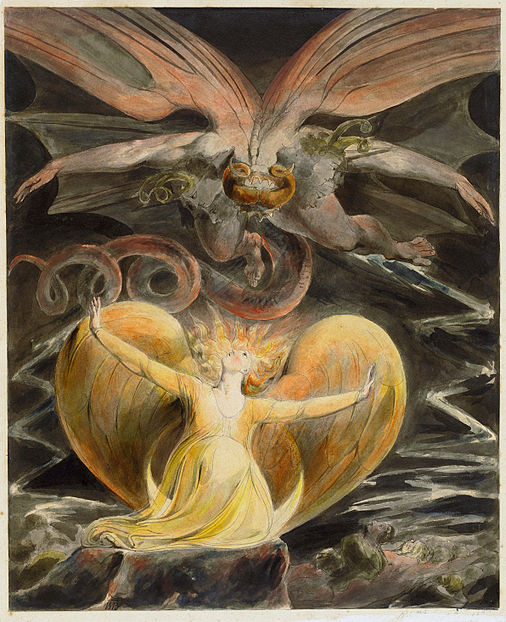
The Great Red Dragon and the Woman clothed with the Sun

Rev.12

[1] And there appeared a great wonder in heaven; a woman clothed with the sun, and the moon under her feet, and upon her head a crown of twelve stars:
[2] And she being with child cried, travailing in birth, and pained to be delivered.
[3] And there appeared another wonder in heaven; and behold a great red dragon, having seven heads and ten horns, and seven crowns upon his heads.
[4] And his tail drew the third part of the stars of heaven, and did cast them to the earth: and the dragon stood before the woman which was ready to be delivered, for to devour her child as soon as it was born.
[5] And she brought forth a man child, who was to rule all nations with a rod of iron: and her child was caught up unto God, and to his throne.
[6] And the woman fled into the wilderness, where she hath a place prepared of God, that they should feed her there a thousand two hundred and threescore days.
[7] And there was war in heaven: Michael and his angels fought against the dragon; and the dragon fought and his angels,
[8] And prevailed not; neither was their place found any more in heaven.
[9] And the great dragon was cast out, that old serpent, called the Devil, and Satan, which deceiveth the whole world: he was cast out into the earth, and his angels were cast out with him.

In studying Blake one is led to give increasing attention to the multitude of symbols which he uses. The visual images which delight us with overall impressions and information, contain as well, clues to more subtle meaning through symbolic gestures. Janet A. Warner, in Blake's Visionary Forms Dramatic, edited by Erdman and Grant, wrote a chapter on Blake's use of gesture. We see repetitions of various postures and positions of the body in the images. Warner helps us to recognise how the gestures contribute to consolidating the symbolic language.

On page 187 Warner uses one image to demonstrate that details contribute to the overall themes conveyed in Blake's work:

"One design which uses many of the symbols which I have been discussing is the water color The Great Red Dragon and the Woman Clothed with the Sun. The hovering figure is here taken to its ultimate Satanic form, encompassing bat wings, serpent tail, and outstretched arms with downturned hands. According to Revelation the dragon is 'that old serpent, called the Devil, and Satan, which deceiveth the whole world.' The woman clothed in the sun and given the wings of an eagle represents the good in nature (she sits on the crescent moon) that the dragon is trying to vanquish; Blake indicates this also by her outstretched arms, her upturned hands, and her position on a stone in the sea, rather reminiscent of Urizen in America 8. The natural world of moon, stone and sea are her province, as they are his. Blake tells us how he reads the passage in Revelation, however, by the way the positions of the woman and the dragon reflect each other: these are two aspects of the same psyche, as powerful an image of the demonic and regenerative impulses of fallen man as he ever painted.

The symbolic gesture of outstretched arms, then, can be associated consistently with the main themes of Blake's work: the essential divinity of man, his capacity for regeneration, his error in turning the divine creativity into mental tyranny or selfhood. The importance of the four attitudes which repeatedly represent these ideas in Blake's art may remind us of his exclamation, 'What kind of Intellects must he have who sees only the Colours of things & not the Form of Things' [E 578]. The out stretched arms motif, perhaps the most evident of several of Blake's repeated visual images, should not, then, be ignored or dismissed as a technical weakness; it is as powerful as any verbal symbol, and essential to that union of sight and sound, that reintegration of the senses which Blake strove to achieve in all his work."

Public Address, PAGE 66, (E 578)
"The English Artist may be assured that he is doing an injury
& injustice to his Country while he studies & imitates the
Effects of Nature. England will never rival Italy while we
servilely copy. what the Wise Italians Rafael & Michael Angelo
scorned nay abhorred as Vasari tells us

Call that the Public Voice which is their Error
Like as a Monkey peeping in a Mirror
Admires all his colours brown & warm
And never once percieves his ugly form

What kind of Intellects must he have who sees only the Colours of
things & not the Forms of Things


PAGE 71
A jockey that is any thing of a jockey will never buy a
Horse by the Colour & a Man who has got any brains will never buy
a Picture by the Colour
When I tell any Truth it is Not for the sake of Convincing
those who do not know it but for the sake of defending those who
Do

PAGE 76
No Man of Sense ever supposes that Copying from Nature is
the Art of Painting if the Art is no more than this it is no
better than any others Manual Labour any body may do it & the
fool often will do it best as it is a work of no Mind"

Blake drew from his imagination using a vocabulary acquired through practice to express intellectual ideas. The form was primary but in spite of Blake's de-emphasis of its importance, the color was an additional facet of his symbolism.
.

Wednesday, February 8, 2012

CANAAN AS SYMBOL

British Museum
Book of Urizen
Copy D, Plate 24
 Northrop Frye on Milton and Blake , Edited by Angela Esterhammer contains a chapter Notes for a Commentary on Milton. Frye sees a structure of symbolism in Blake's Milton as based on the four levels of vision known as Fourfold Vision and consisting of Eden, Beulah, Generation and Ulro. In each of the levels Frye finds seven metaphors which delineate characteristics: the divine world, the spiritual world, the human world, the animal world, the vegetable world, the mineral world, and the chaotic world. As an example of Frye's analysis he sees the vegetable world at the level of Generation developed by Blake in the symbol of the garden; not the garden as in Eden but an unrealised promise in which man is separated from the Divine Image:

"The Garden of the ordinary world is symbolized by Blake as 'Canaan,' i.e., the land possessed by a people who have given up the real Promised Land and settled down under the Mosaic law and the Levitical priesthood. Canaan of course includes eighteenth-century Europe, its counterpart in the next cycle...We are told that the Israelites were frightened away from the Promised Land by 'giants' or 'ghosts' ('Rephaim,' M 31.57), and hence in Canaan would still have been under the domain of the same giants ... Of these giants who in the aggregate make up the Covering Cherub, the most important are Og, Sihon, and Anak. They are politically the tyrants of Canaan, such as William Pitt and Napoleon, intellectually the ideas derived from a world under the stars (M 41.50), and psychologically the moral censors who keep us from using our imaginations (M 22.35)." (Page 255)

Here are the passages in Milton which Frye cites:

Milton, PLATE 29 [31], (E 128)
"The Three Heavens of Ulro, where Tirzah & her Sisters
Weave the black Woof of Death upon Entuthon Benython
In the Vale of Surrey where Horeb terminates in Rephaim"

Milton, PLATE 37 [41], (E 138)
"For the Chaotic Voids outside of the Stars are measured by
The Stars, which are the boundaries of Kingdoms, Provinces
And Empires of Chaos invisible to the Vegetable Man
The Kingdom of Og. is in Orion: Sihon is in Ophiucus
Og has Twenty-seven Districts; Sihons Districts Twenty-one
From Star to Star, Mountains & Valleys, terrible dimension
Stretchd out, compose the Mundane Shell, a mighty Incrustation
Of Forty-eight deformed Human Wonders of the Almighty"

Milton, PLATE 20 [22], (E 114)
"Hence thou art cloth'd with human beauty O thou mortal man.
Seek not thy heavenly father then beyond the skies:
There Chaos dwells & ancient Night & Og & Anak old:
For every human heart has gates of brass & bars of adamant,
Which few dare unbar because dread Og & Anak guard the gates
Terrific! and each mortal brain is walld and moated round
Within: and Og & Anak watch here; here is the Seat
Of Satan in its Webs; for in brain and heart and loins
Gates open behind Satans Seat to the City of Golgonooza
Which is the spiritual fourfold London, in the loins of Albion"
.

Monday, February 6, 2012

JERUSALEM & HAND

Damon, A Blake Dictionary, (Page 172):
"When Hand and his brothers separate from Albion's bosom, and from each other, he becomes the Reasoning Spectre (J 36:23), and thus is the source of the whole materialistic system of society."

On the contrary Jerusalem is in every individual the ability to connect with God as well as Man.

British Museum
Hand & Jerusalem
Sketch for Plate 26 of Jerusalem


Jerusalem, Plate 53, (E 203)
"For the protection of the Twelve Emanations of Albions Sons
The Mystic Union of the Emanation in the Lord; Because
Man divided from his Emanation is a dark Spectre
His Emanation is an ever-weeping melancholy Shadow
But she is made receptive of Generation thro' mercy"

Jerusalem, PLATE 15, (E 158)
"And Hand & Hyle rooted into Jerusalem by a fibre
Of strong revenge & Skofeld Vegetated by Reubens Gate

In every Nation of the Earth till the Twelve Sons of Albion
Enrooted into every Nation: a mighty Polypus growing
From Albion over the whole Earth: such is my awful Vision.

I see the Four-fold Man. The Humanity in deadly sleep
And its fallen Emanation. The Spectre & its cruel Shadow.
I see the Past, Present & Future, existing all at once
Before me; O Divine Spirit sustain me on thy wings!"

Jerusalem, PLATE 18, (E 162)
"From every-one of the Four Regions of Human Majesty,
There is an Outside spread Without, & an Outside spread Within
Beyond the Outline of Identity both ways, which meet in One:
An orbed Void of doubt, despair, hunger, & thirst & sorrow.
Here the Twelve Sons of Albion, join'd in dark Assembly,

Jealous of Jerusalems children, asham'd of her little-ones
(For Vala produc'd the Bodies. Jerusalem gave the Souls)
Became as Three Immense Wheels, turning upon one-another
Into Non-Entity, and their thunders hoarse appall the Dead
To murder their own Souls, to build a Kingdom among the Dead

Cast! Cast ye Jerusalem forth! The Shadow of delusions!
The Harlot daughter! Mother of pity and dishonourable forgiveness
Our Father Albions sin and shame! But father now no more!
Nor sons! nor hateful peace & love, nor soft complacencies
With transgressors meeting in brotherhood around the table,
Or in the porch or garden. No more the sinful delights
Of age and youth and boy and girl and animal and herb,
And river and mountain, and city & village, and house & family.
Beneath the Oak & Palm, beneath the Vine and Fig-tree.
In self-denial!--But War and deadly contention, Between
Father and Son, and light and love! All bold asperities
Of Haters met in deadly strife, rending the house & garden
The unforgiving porches, the tables of enmity, and beds
And chambers of trembling & suspition, hatreds of age & youth
And boy & girl, & animal & herb, & river & mountain
And city & village, and house & family. That the Perfect,
May live in glory, redeem'd by Sacrifice of the Lamb
And of his children, before sinful Jerusalem. To build
Babylon the City of Vala, the Goddess Virgin-Mother.
She is our Mother! Nature! Jerusalem is our Harlot-Sister
Return'd with Children of pollution, to defile our House,
With Sin and Shame. Cast! Cast her into the Potters field.
Her little-ones, She must slay upon our Altars: and her aged
Parents must be carried into captivity, to redeem her Soul
To be for a Shame & a Curse, and to be our Slaves for ever

So cry Hand & Hyle the eldest of the fathers of Albions
Little-ones; to destroy the Divine Saviour; the Friend of
Sinners,"

Jerusalem, Plate 80, (E237)
"He ran in tender nerves across Europe to Jerusalems Shade,
To weave Jerusalem a Body repugnant to the Lamb."

Jerusalem, Plate 83, (E 242)
[spoken by Los]
"Place the Tribes of Llewellyn in America for a hiding place!
Till sweet Jerusalem emanates again into Eternity
The night falls thick: I go upon my watch: be attentive:
The Sons of Albion go forth; I follow from my Furnaces:
That they return no more: that a place be prepard on Euphrates
Listen to your Watchmans voice: sleep not before the Furnaces
Eternal Death stands at the door. O God pity our labours.
...
but Hand is fled
Away: & mighty Hyle: & after them Jerusalem is gone: Awake"

From Erdman, The Illuminated Blake, (Page 305):
"He [Hand] is walking (like Los in Plate 1) into the wind, perhaps leading Jerusalem into Hades (as Orpheus was leading Euridyce out)."

Other posts on this image. One more.
.

Saturday, February 4, 2012

COLLAPSE

British Museum
Illustration to Young's Night Thoughts

Jared Diamond's book Collapse attempts to alert the public to the choices made by societies which cause them to collapse. He
primarily identifies issues involving environmental changes which effect the continuation of the conditions which sustain the society.

Page 23, Plan of the Book
"Chapter 14 asks the perplexing question arising from every past society that has ended up by destroying itself, and that will perplex future earthlings if we too end up destroying ourselves: how could a society fail to have seen the dangers that seem so clear in retrospect? Can we say that their end was the inhabitants' own fault, or instead that they were the tragic victims of insoluble problems? How much past environmental damage was unintentional and imperceptible, and how much was perversely wrought by people acting in full awareness of the consequences?"

Blake was interested in the same issues as Diamond but from another perspective. Blake saw the fall of Man from the original garden in Eden as the cause of the symptoms of society expressed in war, tyranny, poverty and oppression. Blake's concern was more with the inner circumstance which led to collapse rather than the outer ones. But Blake's analysis of the mental patterns which would need changing if a just, equitable and sustainable society could emerge are not far from Diamond's understanding of causes of collapse.

Blake's observations of destructive patterns of thought:
1) Being wedded to a rigid paradigm which was opposed to change,

2) Continuing in the same erroneous behavior even when the results were unproductive,

3) Failing to use the imagination to seek resolutions beyond the present options,

4) Neglecting to recognise that brotherhood or cooperation could change outcomes,

5) Inability to perceive the Divine Vision through which mankind could become one body,

6) Looking for outward solutions when inner turmoil was the root of problems,

7) Clinging to the vengefulness of the Selfhood when forgiveness offered a new beginning.

Jerusalem, Plate 36 [40], (E 181)
"Upon the hills & valleys, and the cloudy Oath roll'd far and wide

Albion is sick! said every Valley, every mournful Hill
And every River: our brother Albion is sick to death.
He hath leagued himself with robbers! he hath studied the arts
Of unbelief! Envy hovers over him! his Friends are his abhorrence!
Those who give their lives for him are despised!
Those who devour his soul, are taken into his bosom!
To destroy his Emanation is their intention:
Arise! awake O Friends of the Giant Albion
They have perswaded him of horrible falshoods!
They have sown errors over all his fruitful fields!

The Twenty-four heard! they came trembling on watry chariots.
Borne by the Living Creatures of the third procession
Of Human Majesty, the Living Creatures wept aloud as they
Went along Albions roads, till they arriv'd at Albions House."

Thursday, February 2, 2012

LEVIATHAN & BEHEMOTH

Blake's Illustrations to the Book of Job
Butts Set 1805
From Wikipedia Commons


Northrop Frye gives an explanation of the roles played by Leviathan and Behemoth in the chapter Blake's Reading of the Book of Job in Northrop Frye on Milton and Blake, edited by Angela Esterhammer. On Plate 15 Job is shown the monstrous forms of Leviathan and Behemoth. Frey's key to extricating oneself from the control of these forces is a change of perspective. Accepting the view of the world from within these monsters distorts vision. Seeing them for what they are is achieved by distancing oneself and looking from outside the system at the sources of destruction.

Page 377
... "The next step is to realize that Satan is the enemy of God, that his rule is not inevitable but is to be fought by God's creative power, and that this creative power exists nowhere at present except in man's creative power. At that point we pass into plate 15, where there are only two levels, God and Job united on top, and below them the cycle of nature inhabited by Behemoth and Leviathan.

"These monsters are identical with Satan, except that, being Satan revealed instead of Satan mysterious and disguised as God, they represent, not so much the natural miseries of drought and famine and pestilence, as the social and political miseries symbolized mainly, in the Bible, by Egypt and Babylon, and in the Book of Job itself by the Sabean Raiders. Ezekiel (chapter 29) identifies the Leviathan with the Pharaoh of Egypt, and Daniel (chapter 4) tells how Nebuchadnezzar of Babylon turned into Behemoth, the subject of several Blake pictures. The political aspect of the monsters is brought out in the phrases emphasized by Blake on Plate 15: Behemoth is 'chief of the ways of God' and Leviathan is 'King over all the Children of Pride' [Job 40:19, 41:34]. As the power in man that makes for tyranny rather than civilization, they can be, if not destroyed, at least brought under some measure of control, like the Blatant Beast in Spencer. At the same time the root of tyranny, for Blake, is still natural religion, the establishing of the order of nature, whether theistically or atheistically regarded, as the circumference of human effort (the original meaning of 'Urizen'). Hence we are all born inside the belly of Leviathan, the world of stars and indefinite places, but those who can see Leviathan for what he is have been placed outside him, like Jonah, and like Job in plate 15. After Job has attained this enlightenment, the prophecy of Jesus is fulfilled and Satan falls from heaven (pl. 16)."


Marriage of Heaven & Hell, Plate 17, (E 41)
"So I remaind with him sitting in the twisted [PL 18] root of
an oak. he was suspended in a fungus which hung with the head
downward into the deep:
By degrees we beheld the infinite Abyss, fiery as the smoke
of a burning city; beneath us at an immense distance was the sun,
black but shining[;] round it were fiery tracks on which revolv'd
vast spiders, crawling after their prey; which flew or rather
swum in the infinite deep, in the most terrific shapes of animals
sprung from corruption. & the air was full of them, & seemd
composed of them; these are Devils. and are called Powers of the
air, I now asked my companion which was my eternal lot? he said,
between the black & white spiders
But now, from between the black & white spiders a cloud and
fire burst and rolled thro the deep blackning all beneath, so
that the nether deep grew black as a sea & rolled with a terrible
noise: beneath us was nothing now to be seen but a black tempest,
till looking east between the clouds & the waves, we saw a
cataract of blood mixed with fire and not many stones throw from
us appeard and sunk again the scaly fold of a monstrous serpent.
at last to the east, distant about three degrees appeard a fiery
crest above the waves slowly it reared like a ridge of golden
rocks till we discoverd two globes of crimson fire. from which
the sea fled away in clouds of smoke, and now we saw, it was the
head of Leviathan. his forehead was divided into streaks of green
& purple like those on a tygers forehead: soon we saw his mouth &
red gills hang just above the raging foam tinging the black deep
with beams of blood, advancing toward [PL 19] us with all the
fury of a spiritual existence.
My friend the Angel climb'd up from his station into the mill;
I remain'd alone, & then this appearance was no more, but I found
myself sitting on a pleasant bank beside a river by moon light
hearing a harper who sung to the harp. & his theme was, The man
who never alters his opinion is like standing water, & breeds
reptiles of the mind."
.

Tuesday, January 31, 2012

QUEEN KATHARINE'S DREAM

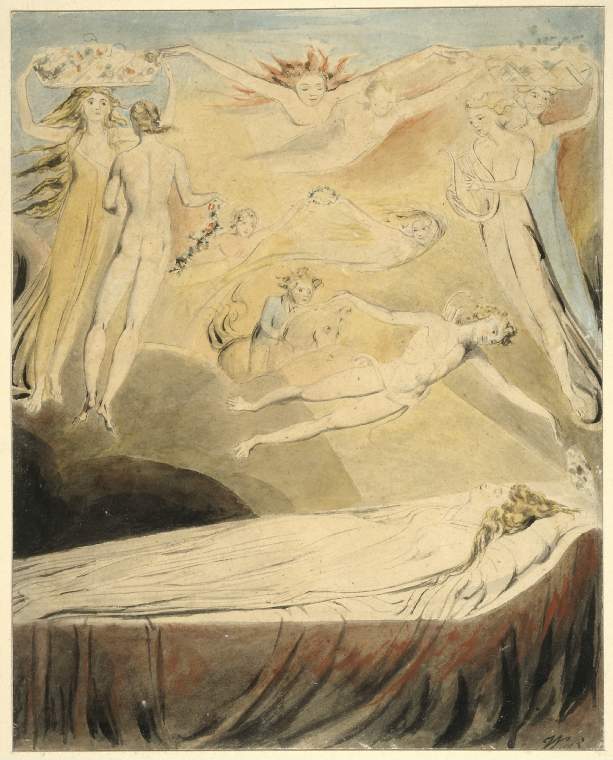
Blake's picture titled Queen Katharine's Dream is an illustration to lines from William Shakespeare's play Henry VII. Blake choose to illustrate lines from the play which echo his own feelings. As Katharine of Aragon the first wife of Henry lies on her deathbed she reports a dream which she had of the glorious world which awaited her.

Henry VIII , Scene IV
"KATHARINE
No? Saw you not, even now, a blessed troop
Invite me to a banquet; whose bright faces
Cast thousand beams upon me, like the sun?
They promised me eternal happiness;
And brought me garlands, Griffith, which I feel
I am not worthy yet to wear: I shall, assuredly.
GRIFFITH
I am most joyful, madam, such good dreams
Possess your fancy."

Blake painted illustrations for this scene at least three times. A earliest image of the scene resides in the Fitzwilliam Museum, Cambridge and is dated between 1783 and 1790. Look for motifs from Visions of the Daughters of Albion, Blake's lithograph of Enoch, and Plate 33 (37) of Jerusalem in this painting. Shown here are the later images.

British Museum, London (dated 1809)..........
National Gallery, Washington (dated 1825)


.

Sunday, January 29, 2012

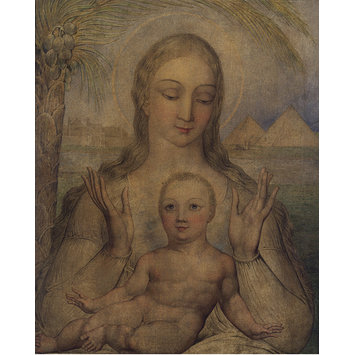
MARY'S SONG


Victoria & Albert Museum, London
Virgin & Child in Egypt
1810


The gospel of Luke records the song Mary sang when her cousin Elizabeth recognised that the Lords's promise of salvation was to be fulfilled through the child Mary was to bear.


Luke 1
[41] And it came to pass, that, when Elisabeth heard the salutation of Mary, the babe leaped in her womb; and Elisabeth was filled with the Holy Ghost:
[42] And she spake out with a loud voice, and said, Blessed art thou among women, and blessed is the fruit of thy womb.
[43] And whence is this to me, that the mother of my Lord should come to me?
[44] For, lo, as soon as the voice of thy salutation sounded in mine ears, the babe leaped in my womb for joy.
[45] And blessed is she that believed: for there shall be a performance of those things which were told her from the Lord.
[46] And Mary said, My soul doth magnify the Lord,
[47] And my spirit hath rejoiced in God my Saviour.
[48] For he hath regarded the low estate of his handmaiden: for, behold, from henceforth all generations shall call me blessed.
[49] For he that is mighty hath done to me great things; and holy is his name.
[50] And his mercy is on them that fear him from generation to generation.
[51] He hath shewed strength with his arm; he hath scattered the proud in the imagination of their hearts.
[52] He hath put down the mighty from their seats, and exalted them of low degree.
[53] He hath filled the hungry with good things; and the rich he hath sent empty away.
[54] He hath holpen his servant Israel, in remembrance of his mercy;
[55] As he spake to our fathers, to Abraham, and to his seed for ever.

In Jerusalem Blake similarly has Mary burst into song but the occasion is the realisation that she is forgiven by God and by Joseph. Blake chooses to have Mary represent the sinner who calls upon God to forgive because it is his nature to forgive.

Jerusalem, Plate 61, (E 212)
"But Jehovahs Salvation
Is without Money & without Price, in the Continual Forgiveness of Sins
In the Perpetual Mutual Sacrifice in Great Eternity! for behold!
There is none that liveth & Sinneth not!"

To Blake to be forgiven was more worthy than to be pure. His Jesus was borne by a Mother who knew that she was not to be glorified. She was made pure through God's mercy. She knew that she could make no claim of virtue. Through mercy she became acquainted with the Divine Humanity, the God of Pity, compassion, and forgiveness.

Jerusalem, Plate 61, (E 212)
"And this is the Covenant
Of Jehovah: If you Forgive one-another, so shall Jehovah Forgive You:
That He Himself may Dwell among You. Fear not then to take
To thee Mary thy Wife, for she is with Child by the Holy Ghost

Then Mary burst forth into a Song! she flowed like a River of
Many Streams in the arms of Joseph & gave forth her tears of joy
Like many waters, and Emanating into gardens & palaces upon
Euphrates & to forests & floods & animals wild & tame from
Gihon to Hiddekel, & to corn fields & villages & inhabitants
Upon Pison & Arnon & Jordan. And I heard the voice among
The Reapers Saying, Am I Jerusalem the lost Adulteress? or am I
Babylon come up to Jerusalem? And another voice answerd Saying

Does the voice of my Lord call me again? am I pure thro his Mercy
And Pity. Am I become lovely as a Virgin in his sight who am
Indeed a Harlot drunken with the Sacrifice of Idols does he
Call her pure as he did in the days of her Infancy when She
Was cast out to the loathing of her person. The Chaldean took
Me from my Cradle. The Amalekite stole me away upon his Camels
Before I had ever beheld with love the Face of Jehovah; or known
That there was a God of Mercy: O Mercy O Divine Humanity!
O Forgiveness & Pity & Compassion! If I were Pure I should never
Have known Thee; If I were Unpolluted I should never have
Glorified thy Holiness, or rejoiced in thy great Salvation.

Mary leaned her side against Jerusalem, Jerusalem recieved
The Infant into her hands in the Visions of Jehovah. Times passed on
Jerusalem fainted over the Cross & Sepulcher She heard the voice
Wilt thou make Rome thy Patriarch Druid & the Kings of Europe his
Horsemen? Man in the Resurrection changes his Sexual Garments at will
Every Harlot was once a Virgin: every Criminal an Infant Love!"

.