Blake seeks to provide the Golden String which can lead us through the labyrinth of our experience or his own poetry.

Monday, April 15, 2013

STONE & FIRE

Wikimedia
Original in Morgan Library & Museum
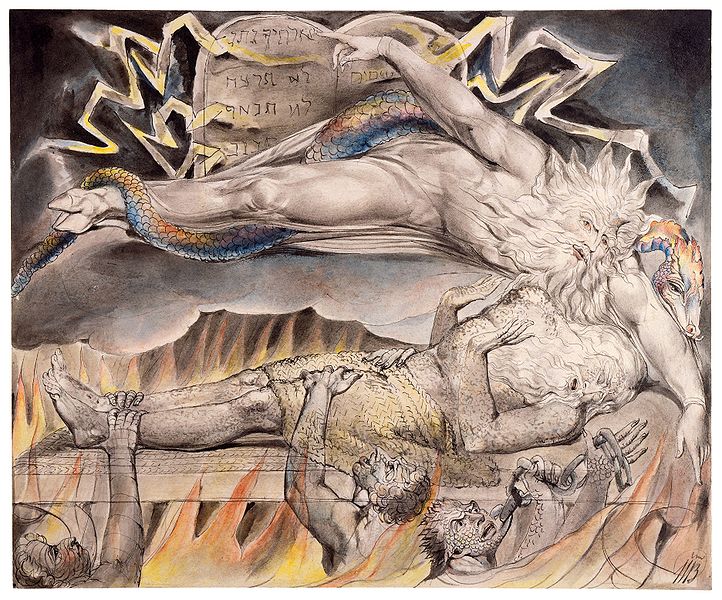
Illustrations of the Book of Job
Job's Evil Dreams
Butts Set, Plate 11
 Two sides of man's psyche can be seen in the images stone and fire. Throughout Blake's poetry and visual images we see these symbols recurring but they are never pinned down or defined in concrete terms. To define them in concrete terms would be to make them into 'stones' and remove the possibility that they become 'fire.'

The level of truth which can be put into laws or doctrine or scientific definitions is well represented by stone. It is hard and inflexible; it is not amenable to change. Fire, on the contrary, ever changing itself, is the agent of change. Fire, as a level of truth, is active not passive, responsive not rejecting, forgiving not condemning. In Biblical terms stone is the Old Testament, fire the New testament; stone the priest, fire the prophet; stone the law, fire the gospel; stone is matter, fire is spirit. Becoming receptive to higher levels of spiritual development involves moving from the truth which is  known, to the spirit which is unknowable. Stone is codified truth; fire is experienced truth. The process of developing spiritual consciousness involves both stone and fire because spirit once achieved must produce new truth which becomes stone before it can again become transforming fire. 
   

Jerusalem, Plate 49, (E 199)
"They are beginning to form Heavens & Hells in immense
Circles: the Hells for food to the Heavens: food of torment,
Food of despair: they drink the condemnd Soul & rejoice
In cruel holiness, in their Heavens of Chastity & Uncircumcision
Yet they are blameless & Iniquity must be imputed only           
To the State they are enterd into that they may be deliverd:
Satan is the State of Death, & not a Human existence:
But Luvah is named Satan, because he has enterd that State.
A World where Man is by Nature the enemy of Man
Because the Evil is Created into a State. that Men               
May be deliverd time after time evermore. Amen.
Learn therefore O Sisters to distinguish the Eternal Human
That walks about among the stones of fire in bliss & woe
Alternate! from those States or Worlds in which the Spirit travels:
This is the only means to Forgiveness of Enemies"

Marriage of Heaven & Hell, Plate 21 and 24, (E 43) 
" I tell you, no virtue can exist
without breaking these ten commandments: Jesus was all virtue,
and acted from impulse: not from rules.
  When he had so spoken: I beheld the Angel who stretched out
his arms embracing the flame of fire & he was consumed and arose
as Elijah."

Vision of Last Judgment, (E 559)
"By the side of Seth is Elijah he comprehends all the
Prophetic Characters he is seen on his fiery Chariot bowing
before the throne of the Saviour." 

Acting from the level of stone leads to division; embracing the the flame leads to reconciliation of the contraries.

Saturday, April 13, 2013

FLEXIBLE SENSES

Yale Center for British Art
Book of Urizen
Copy C, Plate 12
When man is enclosed in a material body he loses the fluctuating sensation he enjoyed in Eternity and acquires characteristics of solidity and inflexibility. The restraints and limitations which we endure in our physical bodies will fall away when we reenter our spiritual bodies. We will once again experience time and space as fluid movements which respond to our ability to perceive without restriction. Our senses will no longer be narrow chinks in our caverned skull but panoramic receptors of infinite worlds of delight.   


Urizen, Plate 3, (E 71)
1. Earth was not: nor globes of attraction
The will of the Immortal expanded
Or contracted his all flexible senses.
Death was not, but eternal life sprung
Europe, Plate 1, (E 60)
"Preludium

The nameless shadowy female rose from out the breast of Orc:
Her snaky hair brandishing in the winds of Enitharmon,
And thus her voice arose.
...
Plate 2
Unwilling I look up to heaven! unwilling count the stars!
Sitting in fathomless abyss of my immortal shrine.
I sieze their burning power
And bring forth howling terrors, all devouring fiery kings.

Devouring & devoured roaming on dark and desolate mountains      
In forests of eternal death, shrieking in hollow trees.
Ah mother Enitharmon!
Stamp not with solid form this vig'rous progeny of fires.

I bring forth from my teeming bosom myriads of flames.
And thou dost stamp them with a signet, then they roam abroad    
And leave me void as death:
Ah! I am drown'd in shady woe, and visionary joy."

Urizen, Plate 4, (E 71)    
"4: From the depths of dark solitude. From
The eternal abode in my holiness,
Hidden set apart in my stern counsels
Reserv'd for the days of futurity,
I have sought for a joy without pain,                   

For a solid without fluctuation
Why will you die O Eternals?
Why live in unquenchable burnings?"

Four Zoas, Night V, Page 57, (E 338)
"Infected Mad he dancd on his mountains high & dark as heaven
Now fixd into one stedfast bulk his features stonify
From his mouth curses & from his eyes sparks of blighting
Beside the anvil cold he dancd with the hammer of Urthona
Terrific pale. Enitharmon stretchd on the dreary Earth   
Felt her immortal limbs freeze stiffning pale inflexible
His feet shrink withring from the deep shrinking & withering 
And Enitharmon shrunk up all their fibres withring beneath
As plants witherd by winter leaves & stems & roots decaying
Melt into thin air while the seed drivn by the furious wind      
Rests on the distant Mountains top. So Los & Enitharmon
Shrunk into fixed space stood trembling on a Rocky cliff
Yet mighty bulk & majesty & beauty remaind but unexpansive
As far as highest Zenith from the lowest Nadir. so far shrunk 
Los from the furnaces a Space immense & left the cold           
Prince of Light bound in chains of intellect among the furnaces
But all the furnaces were out & the bellows had ceast to blow"

Wednesday, April 10, 2013

WAR IN HEAVEN

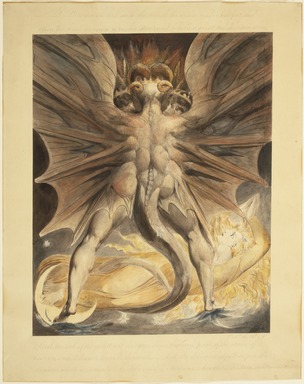
John of Patmos and William Blake were both visionary poets. Their minds were open to visionary messages from the Divine Inspiration. They communicated through describing the visual images they received translated into intellectual forms which their audience may understand. The forces which would build God's Kingdom and those which would destroy it waged battles in the minds of the two men. The great red dragon, and the woman clothed with the sun, were antagonsits whose contrasting images could demonstrate the nature of the opposed forces.Brooklyn Museum
The Great Red Dragon and 
 the Woman Clothed with the Sun
 
From the description in the Brooklyn Museum web page:
"Inscriptions: Inscribed above the image: 'A Woman clothed with the sun, & the moon under her feet, and/upon her head a crown of twelve stars; and behold a great red dragon also.' Inscribed below the image at right: 'Revns:ch:12th: v 4th:' Inscribed below the image: 'And the tail of the great red dragon drew the third part of the stars of/heaven, and did cast them to the earth. And the dragon stood before the/woman which was ready to be delivered for to devour her child as soon as it was born.'"


Revelation 12
[1] And there appeared a great wonder in heaven; a woman clothed with the sun, and the moon under her feet, and upon her head a crown of twelve stars:
[2] And she being with child cried, travailing in birth, and pained to be delivered.
[3] And there appeared another wonder in heaven; and behold a great red dragon, having seven heads and ten horns, and seven crowns upon his heads.
[4] And his tail drew the third part of the stars of heaven, and did cast them to the earth: and the dragon stood before the woman which was ready to be delivered, for to devour her child as soon as it was born.
[5] And she brought forth a man child, who was to rule all nations with a rod of iron: and her child was caught up unto God, and to his throne.
[6] And the woman fled into the wilderness, where she hath a place prepared of God, that they should feed her there a thousand two hundred and threescore days.
[7] And there was war in heaven: Michael and his angels fought against the dragon; and the dragon fought and his angels,
[8] And prevailed not; neither was their place found any more in heaven.
[9] And the great dragon was cast out, that old serpent, called the Devil, and Satan, which deceiveth the whole world: he was cast out into the earth, and his angels were cast out with him.
[10] And I heard a loud voice saying in heaven, Now is come salvation, and strength, and the kingdom of our God, and the power of his Christ: for the accuser of our brethren is cast down, which accused them before our God day and night.
[11] And they overcame him by the blood of the Lamb, and by the word of their testimony; and they loved not their lives unto the death.
[12] Therefore rejoice, ye heavens, and ye that dwell in them. Woe to the inhabiters of the earth and of the sea! for the devil is come down unto you, having great wrath, because he knoweth that he hath but a short time.
[13] And when the dragon saw that he was cast unto the earth, he persecuted the woman which brought forth the man child.
[14] And to the woman were given two wings of a great eagle, that she might fly into the wilderness, into her place, where she is nourished for a time, and times, and half a time, from the face of the serpent.
[15] And the serpent cast out of his mouth water as a flood after the woman, that he might cause her to be carried away of the flood.
[16] And the earth helped the woman, and the earth opened her mouth, and swallowed up the flood which the dragon cast out of his mouth.
[17] And the dragon was wroth with the woman, and went to make war with the remnant of her seed, which keep the commandments of God, and have the testimony of Jesus Christ.

Milton, Plate 39 [44],(E 141)
"So Milton
Labourd in Chasms of the Mundane Shell, tho here before
My Cottage midst the Starry Seven, where the Virgin Ololon
Stood trembling in the Porch: loud Satan thunderd on the stormy Sea
Circling Albions Cliffs in which the Four-fold World resides     
Tho seen in fallacy outside: a fallacy of Satans Churches
PLATE 40 [46]
Before Ololon Milton stood & percievd the Eternal Form
Of that mild Vision; wondrous were their acts by me unknown
Except remotely; and I heard Ololon say to Milton
I see thee strive upon the Brooks of Arnon. there a dread
And awful Man I see, oercoverd with the mantle of years.   
I behold Los & Urizen. I behold Orc & Tharmas;
The Four Zoa's of Albion & thy Spirit with them striving
In Self annihilation giving thy life to thy enemies
Are those who contemn Religion & seek to annihilate it
Become in their Femin[in]e portions the causes & promoters       
Of these Religions, how is this thing? this Newtonian Phantasm
This Voltaire & Rousseau: this Hume & Gibbon & Bolingbroke
This Natural Religion! this impossible absurdity
Is Ololon the cause of this? O where shall I hide my face
These tears fall for the little-ones: the Children of Jerusalem  
Lest they be annihilated in thy annihilation.

No sooner she had spoke but Rahab Babylon appeard
Eastward upon the Paved work across Europe & Asia
Glorious as the midday Sun in Satans bosom glowing:
A Female hidden in a Male, Religion hidden in War               
Namd Moral Virtue; cruel two-fold Monster shining bright
A Dragon red & hidden Harlot which John in Patmos saw

And all beneath the Nations innumerable of Ulro
Appeard, the Seven Kingdoms of Canaan & Five Baalim
Of Philistea. into Twelve divided, calld after the Names      
Of Israel: as they are in Eden. Mountain. River & Plain
City & sandy Desart intermingled beyond mortal ken

But turning toward Ololon in terrible majesty Milton
Replied. Obey thou the Words of the Inspired Man
All that can be annihilated must be annihilated" 
Urizen remembers his own fall.
. 

Sunday, April 7, 2013

CLOVEN FICTION

Alfred Ames in reviewing Fearful Symmetry in 1947 soon after its publication comments:
"The typical poet, Frye believes, as he becomes wiser becomes less lyrical and more didactic, progressively rejecting the “cloven fictions” that delight and instruction are separable objectives, and that subject and object of experience are discrete entities."

Blake speaks of 'cloven fiction' as a shorthand for the false dichotomy which we create between things, people or ideas of equal value by calling them opposites. By using the term 'contrary' himself, Blake recognizes that what seems to be unlike may be equally true. The problem to Blake arises when our first parents eat of the Tree of Knowledge of Good and Evil.

Vision of Last Judgment, (E 564)
"Satan thinks that Sin is displeasing to God he ought to know that
Nothing is displeasing to God but Unbelief & Eating of the Tree
of Knowledge of Good & Evil"  
The knowledge they gained introduced a dualistic viewpoint which began to categorize everything they encountered as either good or evil. As Northrop Frey explains the situation:
"The same distinction between a contrary and a negation occurs in Blake's theory of ideas. All real thing have qualities in them, and qualities have opposites.This is particularly true of moral qualities, as every virtue has its corresponding vice. All 'good' men by any standards  may be 'bad' by other standards, just as an egg that is bad to eat may be good to throw at someone. But the believer in the cloven fiction prefers to identify a real thing with one of its qualities, because things become easier to generalize about when classified into qualities. Now as things are good or bad according to circumstances, the cloven fiction leads to absolutizing of circumstance. The deader a thing is, the more obedient it is to circumstances, and the more alive it is the less predictable it becomes. Hence the believer in the cloven fiction finds it much easier  to understand the behavior of dead things, the objects of exact science under the laws of 'mathematic form.' And in studying human activity he again finds it easiest to understand what is most automatic. So insensibly he tends to call 'the passive that obeys Reason' good, and the active springing from Energy' bad." (Page 189)

On Homers Poetry, (E 269)
"It is the same with the Moral of a whole Poem as with the Moral
Goodness of its parts Unity & Morality, are secondary considerations &
belong to Philosophy & not to Poetry, to Exception & not to Rule,
to Accident & not to Substance. the Ancients calld it eating of
the tree of good & evil." 
Vision of Last Judgment, (E 554)
    "The Last Judgment when all those are Cast away who trouble
Religion with Questions concerning Good & Evil or Eating of the
Tree of those Knowledges or Reasonings which hinder the Vision of
God turning all into a Consuming fire" 

Vision of Last Judgment, (E 563)
"By this it will be seen that I do not consider either the Just
or the Wicked to be in a Supreme State but to be every one of
them States of the Sleep which the Soul may fall into in its
Deadly Dreams of Good & Evil when it leaves Paradise
following the Serpent
The term 'Cloven Fiction' comes from this verse in the Keys to The Gates of Paradise
For Children: The Gates of Paradise 
Fire
Copy D, Page 7
For the Sexes: The Gates of Paradise, (E 268)
"Keys of The Gates

5    Blind in Fire with shield & spear 
     Two Horn'd Reasoning Cloven Fiction 
     In Doubt which is Self contradiction
     A dark Hermaphrodite We stood             
     Rational Truth Root of Evil & Good
     Round me flew the Flaming Sword
     Round her snowy Whirlwinds roard
     Freezing her Veil the Mundane Shell"


Friday, April 5, 2013

IDIOT QUESTIONER

Library of Congress
Europe
Plate 3, Copy E
This picture from Europe seems a perfect illustration for the following passage from Milton.
 
Milton, PLATE 41 [48], (E 142)  "To cast off the idiot Questioner who is always questioning,  But never capable of answering; who sits with a sly grin  Silent plotting when to question, like a thief in a cave;  Who publishes doubt & calls it knowledge; whose Science is Despair  Whose pretence to knowledge is Envy, whose whole Science is  To destroy the wisdom of ages to gratify ravenous Envy;  That rages round him like a Wolf day & night without rest" 

The traveller setting forth expecting a safe and productive journey is not alone. He is observed by a sinister figure who will impede his travels in whatever way possible. Blake's thesis is that the hostile figure is not hidden a cave but is within our own minds. When we begin to see reality not as the creation of our own mental imaging but as the exterior world, a spit has occurred. The first separation is seen as the Emanation, the second as the Spectre. The first as the emotions having an independent existence. The second as reason forgoing the role of supporting the producer of images (the imagination) for the sake of producing a world that he alone will structure and control.

Milton, Plate 32 [35], (E 131)
"I have turned my back upon these Heavens builded on cruelty
My Spectre still wandering thro' them follows my Emanation
He hunts her footsteps thro' the snow & the wintry hail & rain   
The idiot Reasoner laughs at the Man of Imagination
And from laughter proceeds to murder by undervaluing calumny"

The Spectre is Blake's chief formulation for the opposition to Art & Science, the work of the imagination. In these two quotes Blake impolitely refers to him as an 'Idiot Questioner' or an 'idiot Reasoner.' Blake knew his Spectre well for he often felt pursued by him. Blake is not reluctant to let us see the anger he feels toward his Specter. 
Songs and Ballads, (E 475)                                             
"My Spectre around me night & day
Like a Wild beast guards my way
My Emanation far within   
Weeps incessantly for my Sin 
                                  
A Fathomless & boundless deep     
There we wander there we weep
On the hungry craving wind
My Spectre follows thee behind" 
 Read more in these two posts by Larry based on the whole poem from which the first two verses are printed. 
.

Wednesday, April 3, 2013

ART & SCIENCE


Library of Congress
 Songs of Innocence & of Experience
Plate 9
In his chapter in Blake's Visionary Forms Dramatic W. J. T. Mitchell is presenting his study of Blake's Composite Art: his welding into a single art-form the the arts of poetry and painting. On page 72 he speaks of the role imagination played in Blake's activity:
"But Imagination is not simply a product for Blake, a fixed body of well-defined forms; it is the process by which any symbolic form comes into being. When Blake says he 'copies imagination', he means he renders faithfully the activity of the mind as it alters the objects of perception: both the finished product and the process by which it comes into being are 'imagination.'"

When Blake links Art & Science his aim is to speak of the mental pursuits necessary for building the spiritual dimension in the familiar world in which we live. The Imagination takes intellectual form as Art, physical form as Science. But neither Art nor Science is primarily a product; both are processes through which Imagination, the activity of Eternity, becomes manifest in time and space. Art & Science both exist for the display of 'Naked Beauty'; to make visible through 'forms and features' the lineaments which reveal the underlying Eternal existence.

Jerusalem, Plate 32 [36],(E 179)
"Art & Science cannot exist but by Naked Beauty displayd"

Descriptive Catalogue, (E 544)
"The Beauty proper for sublime art, is lineaments, or
forms and features that are capable of being the receptacles of
intellect;" 

Jerusalem, Plate 77, (E 231)
"Is God a Spirit who must be worshipped in
Spirit & in Truth and are not the Gifts of the Spirit Every-thing
to Man? O ye Religious discountenance every one among
you who shall pretend to despise Art & Science! I call upon you
in the Name of Jesus! What is the Life of Man but Art & Science?
is it Meat & Drink? is not the Body more than Raiment? What is
Mortality but the things relating to the Body, which Dies? What
is Immortality but the things relating to the Spirit, which Lives
Eternally! What is the joy of Heaven but Improvement in the
things of the Spirit? What are the Pains of Hell but Ignorance,
Bodily Lust, Idleness & devastation of the things of the
Spirit[?] 
 Answer this to yourselves, & expel from among you those who
pretend to despise the labours of Art & Science, which alone are
the labours of the Gospel: Is not this plain & manifest to the
thought? Can you think at all & not pronounce heartily! That to
Labour in Knowledge. is to Build up Jerusalem: and to Despise
Knowledge, is to Despise Jerusalem & her Builders. 
  And remember: He who despises & mocks a Mental Gift in another;
calling it pride & selfishness & sin; mocks Jesus the giver of
every Mental Gift, which always appear to the ignorance-loving
Hypocrite, as Sins. but that which is a Sin in the sight of cruel
Man, is not so in the sight of our kind God. 
  Let every Christian as much as in him lies engage himself
openly & publicly before all the World in some Mental pursuit for
the Building up of Jerusalem" 
 
Jerusalem, Plate 52, (E 202)
 "For a Tear is an Intellectual thing;
And a Sigh is the Sword of an Angel King
  And the bitter groan of a Martyrs woe
Is an Arrow from the Almighties Bow!"

Going from the sublime to the mundane, this is the oversimplified understanding of Blake's use of Art & Science as products and process of imagination:
art = mental pursuits = inspired thoughts = poetry and painting,
science = physical pursuits = inspired acts = religion, law and medicine.

.

Monday, April 1, 2013

BODY & SOUL

British Museum
Lithograph, 1807
Genesis 5
[21] And Enoch lived sixty and five years, and begat Methuselah:
[22] And Enoch walked with God after he begat Methuselah three hundred years, and begat sons and daughters:
[23] And all the days of Enoch were three hundred sixty and five years:
[24] And Enoch walked with God: and he was not; for God took him.

Hebrews 11
[5] By faith Enoch was translated that he should not see death; and was not found, because God had translated him: for before his translation he had this testimony, that he pleased God.
[6] But without faith it is impossible to please him: for he that cometh to God must believe that he is, and that he is a rewarder of them that diligently seek him.

Milton, PLATE 27 [29], (E 124)
"But in Eternity the Four Arts: Poetry, Painting, Music, And 

Architecture which is Science: are the Four Faces of Man."

In Blake's lithograph of the Old Testament patriarch named Enoch he presents the Four Arts: Poetry, Painting, Music, And Architecture which are in Eternity the Four Faces of Man. We are familiar with the Four Faces of Man as the Four Zoas. The Art of Urthona is poetry, of Tharmas is painting, of Luvah is music, and of Urizen is architecture. Blake pictures music, painting and poetry plying their arts as they stand and sit on the foundation of architecture. The three are portrayed in human form but the fourth as an inanimate object. In the previous post we saw that architecture had become manifest as science in the material world and was expressed as Religion, Law, and Physic & Surgery.

Blake names Poetry Painting & Music as the 'three powers in man of conversing with paradise' not swept away by by the flood. Exercising these powers facilitate communicating with eternity.

Vision of the Last Judgment, (E 559)
"The Persons who ascend to Meet the Lord coming in the Clouds
with power & great Glory. are representations of those States
described in the Bible under the Names of the Fathers before &
after the Flood Noah is seen in the Midst of these Canopied by a
Rainbow. on his right hand Shem & on his Left Japhet these three
Persons represent Poetry Painting & Music the three Powers <in
Man> of conversing with Paradise which the flood did not Sweep
away" 
Moving to the central  image of the picture we see a man who holds a book in which is written the name Enoch in Hebrew. Enoch was unique in the Old Testament for having been translated to God's presence without experiencing death. Blake's teaching was that of experiencing Eternity is an ever present possibility through annihilating the Selfhood. The image of Enoch reinforces the idea that within man are the powers of transcending confinement in an existence that is limited to the material.

The face of this figure of Enoch is indistinguishable from Blake's portrayals of Job, Jehovah, and Urizen. He holds a book which Blake associates with the priestly religion rather than a scroll which he associates with the prophetic. His left foot is exposed offering the possibility of an entry point for either the divine or the demonic. So he is a symbol for reconciling contraries.

In the Marriage of Heaven & Hell Blake asserts that man has no body distinct from his soul. This statement is an indication that the incarnation is not the exception but the rule: that the body and soul are inseparable. The picture centered around Enoch can be seen as an image of the body and soul as the appear from various  viewpoints. The soul is expressed through the body, and the body is expressed through the soul.

Marriage of Heaven & Hell, Plate 4, (E 34)
                 "The voice of the Devil
  All Bibles or sacred codes. have been the causes of the
following Errors.
  1. That Man has two real existing principles Viz: a Body & a
Soul.
  2. That Energy. calld Evil. is alone from the Body. & that
Reason. calld Good. is alone from the Soul.
  3. That God will torment Man in Eternity for following his
Energies.
  But the following Contraries to these are True
  1 Man has no Body distinct from his Soul for that calld Body is
a portion of Soul discernd by the five Senses. the chief inlets
of Soul in this age
  2. Energy is the only life and is from the Body and Reason is
the bound or outward circumference of Energy.
  3 Energy is Eternal Delight"