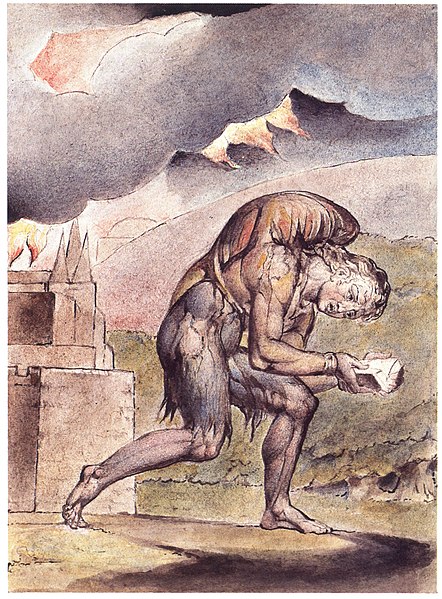
Blake seeks to provide the Golden String which can lead us through the labyrinth of our experience or his own poetry.

Thursday, January 22, 2015

VISIONARY PERSPECTIVE

Wikimedia
Illustrations to Bunyan's Pilgrim's Progress

Christian Reading His Book
Don't go to Greda Norvig's book Dark Figures in the Desired Country looking for light reading. If you are willing to be challenged by her intellect, her vocabulary and her psychological perceptions, you will be rewarded with insights that are as astounding as they are nourishing. In this passage she is using Blake's engraving techniques to present the relationship of what 'is' and 'what seems to be.' 
 
Quoting from page 59 of Norvig's book on Blake's Illustrations to The Pilgrims Progress:

 
"But life as it is here and now can be known to be 'infinite and holy' as soon as distinctions between body and soul, medium and message, 'sensual enjoyment' and spiritual understanding, are recognized as expendable. Achieving such a visionary perspective is clearly not a matter of wresting a precept from an image. On the contrary, Blake's whole effort spent on encouraging trust in the immanent wisdom of observable form. For him, things are literally 'metaphors' of vision, designed to 'carry over' the imaginal archetypes they embody or express. One's attitude toward things, as toward the process of embodiment or ensouling, may need correction; but the problem is perceptual not ontological. So the 'infernal method' of etching on copper is intended to exemplify and to involve the participant in a process of sudden apprehension of surface truth, an apprehension that carries  the certitude of revelation and no need of 'corporeal' explication. Just the reverse of Bunyan's formal strategy of recession, it reflects a coming-forth procedure. Every encounter with Blake's acid-forged forms is meant as a mutual epiphany, a friendship through the eye on the plane of appearance, between the deep structures of the spectator's psyche and the content displayed. The pun on the word apparent, in the phrase 'melting apparent surfaces away,' tells the story. For Blake real surfaces were made apparent (visible) by the elimination of apparent (seeming) surfaces. But the images of truth do not hide as ideas behind a false appearance in his conception, nor do they exist in contradiction to 'apparent surfaces.' Rather, Blake makes his vision of the infinite lift out of the everyday by emphatically affirming their concrete substantiality. Through the 'infernal method,' his printed language of forms - visual and verbal combined - a spiritual body is literally raised. There is a concept of redemption here, both of the spirit and of the body, both of the form and of the inward meaning - the 'infernal state' - of the form."

Jerusalem, Plate 32 [36], (E 179)
 "Art & Science cannot exist but by Naked Beauty displayd

Then those in Great Eternity who contemplate on Death            
Said thus. What seems to Be: Is: To those to whom
It seems to Be, & is productive of the most dreadful
Consequences to those to whom it seems to Be: even of
Torments, Despair, Eternal Death; but the Divine Mercy
Steps beyond and Redeems Man in the Body of Jesus Amen           
And Length Bredth Highth again Obey the Divine Vision Hallelujah"

Marriage of Heaven & Hell, Plate 14, (E 39)
   "The ancient tradition that the world will be consumed in fire
at the  end of six thousand years is true. as I have heard from
Hell.
   For the cherub with his flaming sword is hereby commanded to 
leave his guard at the tree of life, and when he does, the whole 
creation will be consumed, and appear infinite. and holy whereas
it now  appears finite & corrupt.
   This will come to pass by an improvement of sensual enjoyment.
   But first the notion that man has a body distinct from his
soul, is to  be expunged; this I shall do, by printing in the
infernal method, by corrosives, which in Hell are salutary and
medicinal, melting apparent surfaces away, and displaying the
infinite which was hid.
   If the doors of perception were cleansed every thing would
appear  to man as it is: infinite.
   For man has closed himself up, till he sees all things thro'
narrow chinks of his cavern.
Plate 15
                            A Memorable Fancy

   I was in a Printing house in Hell & saw the method in which
knowledge is transmitted from generation to generation.
   In the first chamber was a Dragon-Man, clearing away the
rubbish from a caves mouth; within, a number of Dragons were
hollowing the  cave, 
   In the second chamber was a Viper folding round the rock & the 
cave, and others adorning it with gold silver and precious
stones.
   In the third chamber was an Eagle with wings and feathers of air, 
he caused the inside of the cave to be infinite, around were
numbers  of Eagle like men, who built palaces in the immense
cliffs.
   In the fourth chamber were Lions of flaming fire raging around
&  melting the metals into living fluids.
   In the fifth chamber were Unnam'd forms, which cast the metals 
into the expanse.
   There they were reciev'd by Men who occupied the sixth
chamber,  and took the forms of books & were arranged in
libraries."

Post on Printing House.
. 

Monday, January 19, 2015

HUMAN FORM

British Museum
Illustrations to Young's Night Thoughts
Harold Bloom, who wrote Blake's Apocalypse, uses his deep acquaintance with the Old Testament to reveal something or what Blake was trying to communicate in his conclusion of Auguries of Innocence. Bloom connects the Human Form which is Blake's term for the indwelling spirit with the lesson Jonah was taught about the lost souls of Ninivah whom God would reclaim.

 
"In the passage that ends Blake's Auguries [of Innocence] the bodily eye is identified with the shadowing gourd [Book of Jonah], born in the night of our fall to perish in the night of our destruction. Blake's irony is at its subtlest as he plays at the equivocal beams of light that blind us in our wilful darkness. The eye of our corporeal existence, a narrow opening in our material cavern, was born when our soul slept in the heavenly light. If our soul had kept awake in the light, we would not have fallen, and would now have an eye to see with, and not through, if we are to see our own relation to what we were. But like Jonah we are poor souls dwelling within the mental cavern or whale's belly of the night, the dark forest in which the Bard of Experience saw his Tyger.

 
As God taught Jonah the humane view of apocalypse, so now Blake seeks to teach it to himself. God appears as a light shining into our darkness if we insist upon dwelling in the darkness. But if we see through the eye, the we are auguries of a second Innocence, and dwell in the clear realms of day, where the Tygers of Wrath are anything but fearful, and where God displays the form of the human."
(Page 303)


Everlasting Gospel, (E 520)
"This Lifes dim Windows of the Soul
Distorts the Heavens from Pole to Pole
And leads you to Believe a Lie
When you see with not thro the Eye   
That was born in a night to perish in a night
When the Soul slept in the beams of Light."

Auguries of Innocence, (E 492)
"Every Night & every Morn
Some to Misery are Born 
Every Morn & every Night
Some are Born to sweet delight
Some are Born to Endless Night
We are led to Believe a Lie 
When we see not Thro the Eye  
Which was Born in a Night to perish in a Night
When the Soul Slept in Beams of Light
God Appears & God is Light
To those poor Souls who dwell in Night 
But does a Human Form Display
To those who Dwell in Realms of day"

Songs of Innocence & of Experience, (E 12)
Song 18, The Divine Image 
"For Mercy has a human heart
Pity, a human face:
And Love, the human form divine,
And Peace, the human dress."

Jerusalem, Plate 27, (E 173)
"He witherd up the Human Form,
By laws of sacrifice for sin:
  Till it became a Mortal Worm:    
But O! translucent all within.

  The Divine Vision still was seen
Still was the Human Form, Divine
  Weeping in weak & mortal clay
O Jesus still the Form was thine.      

  And thine the Human Face & thine
The Human Hands & Feet & Breath
  Entering thro' the Gates of Birth
And passing thro' the Gates of Death"

Jonah 4
[6] And the LORD God prepared a gourd, and made it to come up over Jonah, that it might be a shadow over his head, to deliver him from his grief. So Jonah was exceeding glad of the gourd.
[7] But God prepared a worm when the morning rose the next day, and it smote the gourd that it withered.
[9] And God said to Jonah, Doest thou well to be angry for the gourd ? And he said, I do well to be angry, even unto death.
[10] Then said the LORD, Thou hast had pity on the gourd, for the which thou hast not laboured, neither madest it grow; which came up in a night, and perished in a night:

[11] And should not I spare Nineveh, that great city, wherein are more than sixscore thousand persons that cannot discern between their right hand and their left hand; and also much cattle?
.
.
 

Saturday, January 17, 2015

FIERY JOY


British Museum
Small Book of Designs
As Urizen functions as the setter of limits, the promulgator of laws to regulate behavior, Orc is symbolic of the energy which Urizen seeks to control. In one account of the Fall, Urizen and Luvah plot together and then turn against each other in distrust. Both become reduced as their eternal qualities are diminished when they enter the physical world. Luvah's name in the world of generation is Orc. His is the energy striving to be released without thought of restraint. Blake's Orc is a character who will be admired or feared, sought or despised, welcomed or rejected.  His fiery unpredictability makes him the perfect foil for Urizen's cold rationality.


America, Plate 7, (E 54)    
"Lover of wild rebellion, and transgresser of Gods Law; 
Why dost thou come to Angels eyes in this terrific form?
Plate, 8
The terror answerd: I am Orc, wreath'd round the accursed tree:
The times are ended; shadows pass the morning gins to break;
The fiery joy, that Urizen perverted to ten commands,
What night he led the starry hosts thro' the wide wilderness:
That stony law I stamp to dust: and scatter religion abroad      
To the four winds as a torn book, & none shall gather the leaves;
But they shall rot on desart sands, & consume in bottomless deeps;
To make the desarts blossom, & the deeps shrink to their fountains,
And to renew the fiery joy, and burst the stony roof.
That pale religious letchery, seeking Virginity,                 
May find it in a harlot, and in coarse-clad honesty
The undefil'd tho' ravish'd in her cradle night and morn:
For every thing that lives is holy, life delights in life;
Because the soul of sweet delight can never be defil'd.
Fires inwrap the earthly globe, yet man is not consumd;      
Amidst the lustful fires he walks: his feet become like brass,
His knees and thighs like silver, & his breast and head like gold."

John Middleton Murry, on Page 92 of William Blake, reveals the essential function of Orc:
"In the final lines of America we are brought back to the event of which the whole prophecy is symbolic: the consuming of the whole Creation by the cleansing of the doors of perception, so that instead of finite and corrupt, it appears infinite and holy. For the five gates  of the law-built heaven, which the Guardians seek to bar, are the five senses. These gates are consumed, as the doors of perception are cleansed: the consuming and the cleansing are the same act. This is accomplished, in Blake's revolutionary legend, by the flames of Orc- by those 'corroding fires' with which the mighty Devil wrote on the sides of the abyss of the five senses the words of liberation:    

"How do you know but ev'ry Bird that cuts the airy way,
   Is an immense world of delight, clos'd by your senses five?""
Marriage of Heaven & Hell, Plate 5
. 

Thursday, January 15, 2015

THE GARDEN

The Blakes had a garden at their home in Lambeth. They are said to have sat in their garden under an arbor reading Paradise Lost. The grape vine in their garden is said to have been left untrimmed to give it complete liberty to grow as it would. We know something of the Blake's garden at Felpham also, since he ejected an unwelcome Dragoon from his garden.  This act led to unfortunate consequences since Blake was accused by the Dragoon of damning the King, indicted and tried for sedition. Blake had risked losing his own garden by removing the soldier. Blake, though acquitted, returned to London in reduced circumstances, and never again had a significant garden.
 
In Genesis the garden is the image of the ideal state of existence in which man and woman walked and conversed with God. The garden was lost to Adam and Eve when they fractured their connection with God through disobedience.

 
Genesis 2
[15] And the LORD God took the man, and put him into the garden of Eden to dress it and to keep it.

Genesis 3
[24] So he drove out the man; and he placed at the east of the garden of Eden Cherubims, and a flaming sword which turned every way, to keep the way of the tree of life.

 
Library of Congress Milton
Plate 47, Copy D
In Milton, Blake has much of the action take place in his garden at Felpham. Ololon, the Emanation of Milton, descends to Blake's garden in Felpham seeking Milton. It is on the path in Blake's garden that Milton encounters the Starry Seven. Blake himself is struck in terror as he is given a vision of the Immortal Four. Blake returns to his mortal state in his garden beside his cottage with his wife anxiously looking after him.

 
Blake's two characters, Milton and Blake, have both experienced Judgement in the garden having been convinced of the Error in whose grip they had been enthralled.

 
Perhaps you have been reminded of the experience of Jesus in the Garden of Gethsemane.

 Milton, Plate 36 [40], (E 136)
 "Thus are the Messengers dispatchd till they reach the Earth again
In the East Gate of Golgonooza, & the Twenty-eighth bright
Lark. met the Female Ololon descending into my Garden            
Thus it appears to Mortal eyes & those of the Ulro Heavens
But not thus to Immortals, the Lark is a mighty, Angel.
For Ololon step'd into the Polypus within the Mundane Shell
They could not step into Vegetable Worlds without becoming
The enemies of Humanity except in a Female Form          
And as One Female, Ololon and all its mighty Hosts
Appear'd: a Virgin of twelve years nor time nor space was
To the perception of the Virgin Ololon but as the
Flash of lightning but more  quick the Virgin in my Garden
Before my Cottage stood for the Satanic Space is delusion        

For when Los joind with me he took me in his firy whirlwind
My Vegetated portion was hurried from Lambeths shades
He set me down in Felphams Vale & prepard a beautiful
Cottage for me that in three years I might write all these Visions
To display Natures cruel holiness: the deceits of Natural Religion[.]   
Walking in my Cottage Garden, sudden I beheld
The Virgin Ololon & address'd her as a Daughter of Beulah[:]

Virgin of Providence fear not to enter into my Cottage
What is thy message to thy friend: What am I now to do
Is it again to plunge into deeper affliction? behold me          
Ready to obey, but pity thou my Shadow of Delight
Enter my Cottage, comfort her, for she is sick with fatigue"
Plate 37 [41]
The Virgin answerd. Knowest thou of Milton who descended
Driven from Eternity; him I seek! terrified at my Act
In Great Eternity which thou  knowest!  I come him to seek"

Milton, Plate 39 [44], (E 140)
"Suddenly around Milton on my Path, the Starry Seven
Burnd terrible! my Path became a solid fire, as bright
As the clear Sun & Milton silent came down on my Path.           
And there went forth from the Starry limbs of the Seven: Forms
Human; with Trumpets innumerable, sounding articulate
As the Seven spake; and they stood in a mighty Column of Fire
Surrounding Felphams Vale, reaching to the Mundane Shell, Saying

Awake Albion awake! reclaim thy Reasoning Spectre. Subdue        

Him to the Divine Mercy, Cast him down into the Lake
Of Los, that ever burneth with fire, ever & ever Amen!
Let the Four Zoa's awake from Slumbers of Six Thousand Years

Then loud the Furnaces of Los were heard! & seen as Seven heavens
Stretching from south to north over the mountains of Albion"

Milton, Plate 42 [49], (E 143)
"And I beheld the Twenty-four Cities of Albion
Arise upon their Thrones to Judge the Nations of the Earth
And the Immortal Four in whom the Twenty-four appear Four-fold
Arose around Albions body: Jesus wept & walked forth
From Felphams Vale clothed in Clouds of blood, to enter into     
Albions Bosom, the bosom of death & the Four surrounded him
In the Column of Fire in Felphams Vale; then to their mouths the Four
Applied their Four Trumpets & them sounded to the Four winds

Terror struck in the Vale I stood at that immortal sound
My bones trembled. I fell outstretchd upon the path              
A moment, & my Soul returnd into its mortal state
To Resurrection & Judgment in the Vegetable Body
And my sweet Shadow of Delight stood trembling by my side

Immediately the Lark mounted with a loud trill from Felphams Vale
And the Wild Thyme from Wimbletons green & impurpled Hills   

And Los & Enitharmon rose over the Hills of Surrey"
. 

Tuesday, January 13, 2015

FOUR MIGHTY ONES

Yale Center for British ArtBook of Urizen
Copy A, Plate 4

1794
In 1794 and 1795 Blake was printing copies of the Book of Urizen with two images in which we see his Four Zoas whom he was later to develop into the Four Mighty Ones. The were present to Blake in embryonic form before they came to dominate his thinking and writing. The beginning of the Four Zoas gives further definition of the nature of man's psyche. The unity of the Four Mighty ones is associated with the unity in Eden of the Father, the Son and all in whom He lives. The Brotherhood of Eden exists because of the Son taking on the Human Form. Blake repeats in Greek the phrase "He dwelt among us."


Four Zoas, Night I, Page 3, (E 300) "The Song of the Aged Mother which shook the heavens with wrath Hearing the march of long resounding strong heroic Verse Marshalld in order for the day of Intellectual Battle Four Mighty Ones are in every Man; a Perfect Unity          John XVII c. 21 & 22 & 23 v  

[John 17 
[21] That they all may be one; as thou, Father, art in me, and I in thee, that they also may be one in us: that the world may believe that thou hast sent me. 
[22] And the glory which thou gavest me I have given them; that they may be one, even as we are one: 
[23] I in them, and thou in me, that they may be made perfect in one; and that the world may know that thou hast sent me, and hast loved them, as thou hast loved me.]
Cannot Exist. but from the Universal Brotherhood of Eden        John I c. 14. v  

[John 1 
[14] And the Word was made flesh, and dwelt among us, (and we beheld his glory, the glory as of the only begotten of the Father,) full of grace and truth.]
The Universal Man. To Whom be Glory Evermore Amen      >Greek [kai eskanosen en [h]amen]<

John 1 
14 KAI hO LOGOS SARDTZ EGENETO KAI ESKANOSEN hAMIN, KAI ETHEASAMETHA TAN DODTZAN AUTOU,
And the Word became flesh and pitched a tent with us, and we gazed upon his glory, 

Transliteration of Blake phrase:
"and dwelt among us"  

[What] are the Natures of those Living Creatures the Heavenly Father only 
[Knoweth] no Individual [Knoweth nor] Can know in all Eternity" 
.

Sunday, January 11, 2015

LOS VS SPECTRE 2

Wikimedia Commons
Illustrations to Poems of Thomas Gray
Reuniting the broken psyche is not a clean-cut, simple process. Urthona had been torn into pieces who could not agree on who could control the real man. Los and the Spectre had reached a point at which they could call each other brother but they were still more aware of the other's faults than his virtues. In part of this statement in the Four Zoas, it is not clear which brother is claiming to be the real self and which is accused of being the embodiment of the negating, destroying characteristics they each would choose to reject. Apparently Los, although unable to accept the Spectre's claims intellectually, began to experience an opening to reconciliation with his Spectre through seeing his own defenses reflected in those of his Spectre. The avenue to healing the psyche involved seeing the errors in oneself as well as the virtues in the enemy. 

 
John Middleton Murry in his biographical commentary William Blake, gives this explanation on Page 164:
 
"But the psychological meaning is, that by being reconciled to the Spectre within himself, by recognizing and receiving Urizen as a part of his own self, Los-Blake attains a new understanding, a new synthesis (as we might call it today). Not of course an intellectual synthesis; but a real and decisive act of new spiritual understanding, involving a revolution of the whole man, - an act of Self-annihilation which is  Imagination. Blake understands that Urizen is not a separate, demonic power, from whose dominion Blake alone is free; he is Blake himself, a necessary element of Blake's being. Hence Los's task 'to destroy the body he created'. He was to destroy the figure of Urizen as he had formerly created him; he has, by the same compulsion to destroy the figure of Los as he had formerly created him. For the Los of the past is essentially the enemy and opposite of the former Urizen. He belongs to the same order of spiritual blindness; as Blake puts it simply, in looking on Urizen with the eyes of separateness and hatred and contempt, Los 'became what he beheld.' Thus, while the Spectre describes himself as having been 'a ravening, hungering & thirsting cruel lust & murder' in 'old times' when Los subdued him (which is story told in The First Book of Urizen) Los reciprocates by discovering in his former self fury and cruelty and 'the soul of dark revenge'."

Four Zoas, Night VII, Page 95, (E 367) 
"Los embracd the Spectre first as a brother
Then as another Self; astonishd humanizing & in tears    
In Self abasement Giving up his Domineering lust 
Thou never canst embrace sweet Enitharmon terrible Demon. Till
Thou art united with thy Spectre Consummating by pains & labours
That mortal body & by Self annihilation back returning 
To Life Eternal be assurd I am thy real Self  
Tho thus divided from thee & the Slave of Every passion
Of thy fierce Soul Unbar the Gates of Memory look upon me 
Not as another but as thy real Self I am thy Spectre
Thou didst subdue me in old times by thy Immortal Strength 
When I was a ravning hungring & thirsting cruel lust & murder   
Tho horrible & Ghastly to thine Eyes tho buried beneath
The ruins of the Universe. hear what inspird I speak & be silent

If we unite in one[,] another better world will be    
Opend within your heart & loins & wondrous brain
Threefold as it was in Eternity & this the fourth Universe 
Will be Renewd by the three & consummated in Mental fires
But if thou dost refuse Another body will be prepared
PAGE 86 
For me & thou annihilate evaporate & be no more
For thou art but a form & organ of life & of thyself
Art nothing being Created Continually by Mercy & Love divine

Los furious answerd. Spectre horrible thy words astound my Ear
With irresistible conviction I feel I am not one of those 
Who when convincd can still persist. tho furious.controllable
By Reasons power. Even I already feel a World within
Opening its gates & in it all the real substances
Of which these in the outward World are shadows which pass away
Come then into my Bosom & in thy shadowy arms bring with thee   
My lovely Enitharmon. I will quell my fury & teach
Peace to the Soul of dark revenge & repentance to Cruelty

So spoke Los & Embracing Enitharmon & the Spectre
Clouds would have folded round in Extacy & Love uniting"

Saturday, January 10, 2015

LOS VS SPECTRE

British Museum
Jerusalem,
Plate 6, Copy A
The battle between Los and his Spectre, which is played out in Blake's poetry, is displayed in Plate 10 of Jerusalem. Los is the form of Urthona who is active in our world, but his work is resisted by another aspect of Urthona, the Spectre. Although Urthona is one of the Four Zoas or divisions of the complete man, he is divided again into his Humanity (Los), his Emanation (Enitharmon), his Spectre, and a less well-defined Shadow. An inner struggle on which Blake focuses great attention is the contention between Los as Imagination and the Spectre as Reason. As a part of Urthona, the Spectre is analogous to Urizen as one of the divisions of the total man. The Spectre represents the doubting, explaining, despairing mind.
This dichotomy is a central theme in Blake's thought because the Imagination must be fully developed and reach maximum expression for man to enter the fullness of his Human Form.

Notice in this passage that the Spectre intends to restrict Los in his relating to Enitharmon. Further the Spectre would deny the worth of Los's children. For Blake man's emanation and his children are the outer forms which result from the internal activity of man's spirit. Los will do everything he can to prevent the Spectre from achieving his goal but his options are limited. Los engages the Spectre in the work he has undertaken himself -  building Golgonooza. The Spectre will serve the negative function of tearing down and clearing away the discarded material which needs to be left behind as the Imagination constantly expands.
 
The Spectre defines himself in negative terms - grief, dispair, distress, dead. His concept of God is negative also - requiring sacrifice, without pity or compassion.
Jerusalem, Plate 10, (E 153)
"Los cries, Obey my voice & never deviate from my will
And I will be merciful to thee: be thou invisible to all          
To whom I make thee invisible, but chief to my own Children
O Spectre of Urthona: Reason not against their dear approach
Nor them obstruct with thy temptations of doubt & despair
O Shame O strong & mighty Shame I break thy brazen fetters
If thou refuse, thy present torments will seem southern breezes  
To what thou shalt endure if thou obey not my great will.

The Spectre answer'd. Art thou not ashamd of those thy Sins
That thou callest thy Children? lo the Law of God commands
That they be offered upon his Altar: O cruelty & torment
For thine are also mine! I have kept silent hitherto,            
Concerning my chief delight: but thou hast broken silence
Now I will speak my mind! Where is my lovely Enitharmon
O thou my enemy, where is my Great Sin?  She is also thine
I said: Now is my grief at worst: incapable of being
Surpassed: but every moment it accumulates more & more           
It continues accumulating to eternity! the joys of God advance
For he is Righteous: he is not a Being of Pity & Compassion
He cannot feel Distress: he feeds on Sacrifice & Offering:
Delighting in cries & tears & clothed in Holiness & solitude
But my griefs advance also, for ever & ever without end          
O that I could cease to be! Despair! I am Despair
Created to be the great example of horror & agony: also my
Prayer is vain I called for compassion: compassion mockd
Mercy & pity threw the grave stone over me & with lead
And iron, bound it over me for ever: Life lives on my
Consuming: & the Almighty hath made me his Contrary
To be all evil, all reversed & for ever dead: knowing
And seeing life, yet living not; how can I then behold
And not tremble; how can I be beheld & not abhorrd

So spoke the Spectre shuddring, & dark tears ran down his shadowy face
Which Los wiped off, but comfort none could give! or beam of hope
Yet ceasd he not from labouring at the roarings of his Forge
With iron & brass Building Golgonooza in great contendings
Till his Sons & Daughters came forth from the Furnaces
At the sublime Labours for Los. compelld the invisible Spectre   
Plate 11
To labours mighty, with vast strength, with his mighty chains,
In pulsations of time, & extensions of space, like Urns of Beulah
With great labour upon his anvils, & in his ladles the Ore
He lifted, pouring it into the clay ground prepar'd with art;
Striving with Systems to deliver Individuals from those Systems; 
That whenever any Spectre began to devour the Dead,
He might feel the pain as if a man gnawd his own tender nerves." 
.