Blake seeks to provide the Golden String which can lead us through the labyrinth of our experience or his own poetry.

Saturday, February 14, 2015

GATES OF HEAVEN

"My dark and cloudy words, they do but hold
The truth, as cabinets enclose the gold." Bunyan

The process of learning invariably involves going from the known into the unknown. We begin with what we are capable of doing and proceed to what is beyond our present capabilities. In our lives we have crossed this threshold many times from the very first times when we learned to suck air into our lungs and milk from our mothers' breast. Nevertheless learning always involves overcoming inertia and taking risk. Reluctance to relinquish our present positions for the uncertain prospect of finding security in that hazy possibilities which may replace them is perceived as threat.

Learning to see as Blake sees may seem a particularly threatening activity because we have invested so much in learning to think rationally - trusting only evidence and proof and linear thought patterns. Blake has devised an approach to design and writing which breaks down the patterns or rationality to facilitate imaginative activity.
 
In one sense Norvig's book (Dark Figures in the Desired Country: Blake's Illustrations to the Pilgrim's Progress) is an account of her learning Visionary Hermeneutics. She says:
"Normally hermeneutics refers to a set of predetermined interpretive strategies that a reader brings to and imposes on a work for one or more ulterior purposes..." (Page 4) However Blake's strategy was to apply the imagination in such a way that the internal and external context of the work interact to stimulate the activity of the imagination of the reader. But the imagination is not just put to use for interpretation, it gains self awareness and is strengthened through the process. "I have been speaking of visionary hermeneutics as a process that depends less on rules of interpretation than on an imaginative perspective, meaning both a perspective we learn to take toward the image and a perspective the imagination gradually gains on itself." (Page 6)                 
Illustrations to Pilgrim's Progress  
Plate 28
At the Gates of Heaven
Norvig attempts to enlighten her audience on Blake's practice of Visionary Hermeneutics which she learned from her teacher William Blake by studying his illustrations to Bunyan's Pilgrim's Progress. The heart of her book is her commentary on each of Blake's 28 illustrations. But the illustrations are not to be viewed individually but as a whole, commenting on one another and complementing others as do Blake's Illustration to the Book of Job. She compares, in detail, the process that they illustrate to the process delineated in Gates of Paradise. In the illustrations to Pilgrim's Progress as in his work from beginning to end, Blake sought to open to his readers the avenue to the visionary world he experienced.

Descriptive Catalogue, Penance of Jane Shore, (E 550)
"This Drawing was done above Thirty Years ago, and proves
to the Author, and he thinks will prove to any discerning eye,
that the productions of our youth and of our maturer age
are equal in all essential points."

Norvig observes: "Even in the Songs [of Innocence & of Experience] itself a much more intricate pattern of mutual commentary, plotted by the progressive permutations of repeated verbal and pictorial motifs shown in changing contexts throughout the song cycle, emerges to enrich the work as a sort of primer of visionary literacy." (Page 5)

In Blake's iIllustration Pilgrim and Hopeful, together with the two Ministering Spirits, arise as a quaternity, signifying in Blake's system the wholeness that has been achieved by passing through the stages of spiritual development discernable to Blake in Pilgrim's journey.

Pilgrim's Progress
John Bunyan
"Hopeful also would endeavour to comfort him, saying, Brother, I see the gate, and men standing by to receive us: but Christian would answer, It is you, it is you they wait for; you have been Hopeful ever since I knew you. And so have you, said he to Christian. Ah! brother! said he, surely if I was right he would now arise to help me; but for my sins he hath brought me into the snare, and hath left me. Then said Hopeful, My brother, you have quite forgot the text, where it is said of the wicked, "There are no bands in their death, but their strength is firm. They are not in trouble as other men, neither are they plagued like other men. [Ps. 73:4,5] These troubles and distresses that you go through in these waters are no sign that God hath forsaken you; but are sent to try you, whether you will call to mind that which heretofore you have received of his goodness, and live upon him in your distresses.
 
{393} Then I saw in my dream, that Christian was as in a muse a while. To whom also Hopeful added this word, Be of good cheer, Jesus Christ maketh thee whole; and with that Christian brake out with a loud voice, Oh, I see him again! and he tells me, "When thou passest through the waters, I will be with thee, and through the rivers, they shall not overflow thee." [Isa. 43:2] Then they both took courage, and the enemy was after that as still as a stone, until they were gone over. Christian therefore presently found ground to stand upon, and so it followed that the rest of the river was but shallow. Thus they got over. Now, upon the bank of the river, on the other side, they saw the two shining men again, who there waited for them; wherefore, being come out of the river, they saluted them, saying, We are ministering spirits, sent forth to minister for those that shall be heirs of salvation. Thus they went along towards the gate." 
.

Thursday, February 12, 2015

BLAKE'S RAINBOW

Reposted from January 23, 2011

Blake uses the rainbow more as a visual image than a verbal image. Jerusalem appears here as a butterfly within the arc of a rainbow in the image at the bottom of Plate 14 of Jerusalem which shows Albion in his death-sleep. The heavenly bodies are portrayed in the plate as reminders of the universe measured in eons not minutes.

Jerusalem, Plate 13 & 14, (E 158)
"And all that has existed in the space of six thousand years:
Permanent, & not lost not lost nor vanishd, & every little act,
Word, work, & wish, that has existed, all remaining still
In those Churches ever consuming & ever building by the Spectres
Of all the inhabitants of Earth wailing to be Created:
Shadowy to those who dwell not in them, meer possibilities:
But to those who enter into them they seem the only substances
For every thing exists & not one sigh nor smile nor tear,
Plate 14
One hair nor particle of dust, not one can pass away.

He views the Cherub at the Tree of Life, also the Serpent,
Orc the first born coild in the south: the Dragon Urizen:
Tharmas the Vegetated Tongue even the Devouring Tongue:
A threefold region, a false brain: a false heart:
And false bowels: altogether composing the False Tongue,
Beneath Beulah: as a watry flame revolving every way
And as dark roots and stems: a Forest of affliction, growing
In seas of sorrow. Los also views the Four Females:
Ahania, and Enion, and Vala, and Enitharmon lovely.
And from them all the lovely beaming Daughters of Albion,
Ahania & Enion & Vala, are three evanescent shades:
Enitharmon is a vegetated mortal Wife of Los:
His Emanation, yet his Wife till the sleep of death is past.

Such are the Buildings of Los! & such are the Woofs of
Enitharmon!"

The permanence and the multiplicity of the created world are described in the text. Blake has used words and images to remind us that there is an eternal world which underlies the vicissitudes of the temporal world. Because the image of the rainbow (which appeared after the Flood of Noah) is seen on this plate, Blake is going beyond the idea of an account of the physical body or the world of matter. The use of the rainbow makes the plate a token of a benevolent God's infinite care. We must remember that Blake uses water as a symbol for the material. To say that the world will not be destroyed by flood is to say the materiality shall not overcome spirituality.

When we seek out the biblical references for the rainbow we find this passage in Genesis 9:

[11] And I will establish my covenant with you; neither shall
all flesh be cut off any more by the waters of a flood; neither shall
there any more be a flood to destroy the earth.
[12] And God said, This is the token of the covenant which I make between me and you and every living creature that is with you, for perpetual generations:
[13] I do set my bow in the cloud, and it shall be for a token of a covenant between me and the earth.
[14] And it shall come to pass, when I bring a cloud over the earth, that the bow shall be seen in the cloud:
[15] And I will remember my covenant, which is between me and you and every living creature of all flesh; and the waters shall no more become a flood to destroy all flesh.
[16] And the bow shall be in the cloud; and I will look upon it, that I may remember the everlasting covenant between God and every living creature of all flesh that is upon the earth.
[17] And God said unto Noah, This is the token of the covenant, which I have established between me and all flesh that is upon the earth.

Genesis states that God covenants not to repeat the destruction of the earth and all living things by flood. The covenant is among God, man and the living creatures of the earth. The rainbow is a token of the covenant which is everlasting.

In Blake's 28 illustrations to Pilgrim's progress the rainbow colors appear frequently as reminders of the rainbow as a token. The rainbow image itself is prominent in three plates: the first, the last, and Plate 17. In Plate One the arc of the rainbow previews the pilgrim's journey as a reminder of God's providence as man travels through life. Christian at the Arbor shows the linkage between God and man, a reference to the incarnation through which physicality and spirituality become one. The rainbow above the arbor symbolizes that linkage. In the final picture, in which the fourfold ascension is portrayed, the pilgrims and angels are embedded in the rainbow becoming themselves tokens of the process of reaching the visionary goal.
Pilgrim's Progress
Plate 1
The Dreamer Dreams a Dream

Tuesday, February 10, 2015

BUNYAN'S TRAVELLER

Reposted from Jan 19, 2011 
 
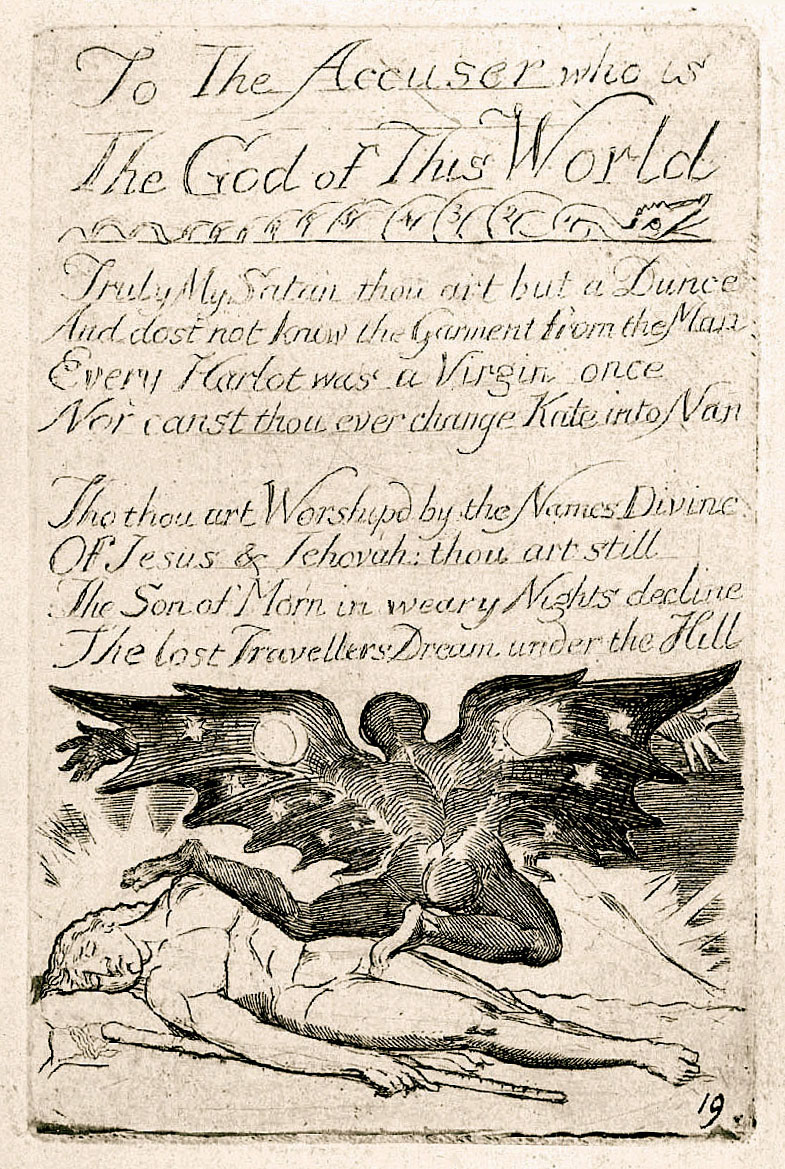
A remarkable aspect of Norvig's book is the way she traces themes which appear in Blake's Bunyan illustrations through the work of his lifetime. This is prominent in the work she does in linking The Gates of Paradise with the Pilgrim illustrations. 'Gates' itself was evidence of the continuity of Blake's work stretching over decades.

The fact that Blake produced his images through engravings gave them an existence beyond the printed page; they also existed as copper plates. As Blake modified or developed his ideas, the printed images of the same plates could evolve with his thought. It has frequently been noted that the pages of his books were rearranged in various of the printings, or that additional pages were included. Also 'Minute Particulars' were added or emphasized or obscured according to the meaning he wished to convey at a particular time or to a particular audience. Norvig gives substance to the appearance of Blake's ideas as they resurfaced in unexpected places.

The Gates of Paradise initially printed with the prefix of For Children in 1793, was reissued in 1818 prefixed For the Sexes. Three additional plates were engraved with the Keys to the Gates and a final poem and image as an epilogue. This final plate Norvig sees as a link to the Bunyan illustrations which were produced in 1824. That is a period of 35 years over which Blake was communicating related ideas on the development of the psyche in the framework of the journey of a pilgrim (or 'traveller' as Blake called him).

Gerda Norvig states on Page 114 of
Dark Figures in the Desired Country: Blake's Illustrations to the Pilgrim's Progress:
"In this late revision of the emblem series, however, by alluding to Christian's identity scroll in The Pilgrim's Progress, the walking stick of the epilogue plate serves to emblemize the function of the eternal personality, which is shown to be basically at odds with those states of change we enter into and out of all the time, like sleep. The message is a terse development of the whole metaphysics of individuals versus states as Blake had refined in the years since his experiences at Felpham; and it is given expression in the poem accompanying the emblem in terms of the difference between 'Man' and 'Garment' - a difference that Satan (our own intrapsychic Accuser aspect) has not learned 'distinct to know.'
 

"Once again, then we see Bunyan's image of the Christan mental Traveler linked by Blake with his own system of imaginal representation with which the concept of individuation via the route of differentiating self from "state," from his garment, permanent identity from temporary condition, the "Eternal Human" from "those States or Worlds in which the Spirit travels." (J 49).

Jerusalem, Plate 49, (E 198)
"Satan is the State of Death, & not a Human existence:
But Luvah is named Satan, because he has enterd that State.
A World where Man is by Nature the enemy of Man
Because the Evil is Created into a State. that Men
May be deliverd time after time evermore. Amen.
Learn therefore O Sisters to distinguish the Eternal Human
That walks about among the stones of fire in bliss & woe
Alternate! from those States or Worlds in which the Spirit
travels:
This is the only means to Forgiveness of Enemies[.]"


Illustrations to Pilgrim's Progress
Plate 17

Christian at the Arbor


In this picture Christian has recovered his lost identity scroll which will allow him passage into heaven. Norvig sees Christian "retrieving his testament of selfhood from the zone of the state of grace (the arbor) so that it can serve him in the forward journey through all other states." (Page 177)


Sunday, February 8, 2015

GIANT DESPAIR

Pilgrim's Progress
John Bunyan
"{292} Well, on Saturday, about midnight, they began to pray, and continued in prayer till almost break of day.
Now a little before it was day, good Christian, as one half amazed, brake out in passionate speech: What a fool, quoth he, am I, thus to lie in a stinking Dungeon, when I may as well walk at liberty. I have a Key in my bosom called Promise, that will, I am persuaded, open any Lock in Doubting Castle. Then said Hopeful, That's good news; good Brother pluck it out of thy bosom and try.
A key in Christian's bosom, called Promise, opens any lock in Doubting Castle"


Pilgrim's Progress
Plate 24
Christian and Hopeful in Doubting Castle
Not everything works out as one might hope. Pilgrim lost his friend Faithful and found himself in Doubting Castle. Although he had been given another companion, Hopeful, he felt trapped and abandoned. Blake's illustration shows Christian and Hopeful deep in a dark, dungeon which is controlled by the Giant Despair who holds the keys to locks which prevent their escape.

Blake was not unacquainted with despair as a result of his efforts being thwarted when his work was lampooned by critics or rejected by commercial outlets. Bunyan, who had spent years imprisoned for refusing to discontinue his preaching and meeting outside of orthodox venues, knew the same feelings of rejection and isolation. Both men overcame their despair by finding avenues to redirect their pursuits in response to the leadership of the Spirit.

Northrop Frey in Fearful Symmetry reminds us that Blake's turning to illustrating the Bible, Milton, Bunyan and Dante was in response to  the lack of encouragement he received for his Illuminated Poetry:

"We have seen how important in Blake's theory of art is his conception of the recreation of the archetype, the process which unites a sequence of visions, first into a tradition, then into a Scripture. The next step for Blake is obviously, therefore, to illustrate other poets' visions so that their readers may more easily understand their archetypal significance. Blake had always done this to some extent, but not so systematically as he began to do it now. Here he found a formula for uniting the work of the creator with that of the teacher, of combining mythopoeic art with instruction in how to read it, not as spectacular as the one he had planned, but possibly no less rewarding." (Page 415)

We see in Blake's illustration that the Giant Despair is taunting Christian and Hopeful by holding his set of keys out of their reach. But Bunyan's Pilgrim eventually realizes than he can escape without Despair's keys. Christian, like Bunyan and Blake in the midst of trouble, brings into consciousness a profound truth: the keys to continuing the journey are within. This is an example of what Frye means by archetypal significance which Blake can teach through illustrating another poet's work.

Despair may seem a giant to those who doubt their ability to continue in the face of the world's crushing attacks. Blake's picture is a reminder that the keys we need are available, and they are not the ones in the hand of Despair. 


Letters, To Cumberland, (E 784)  
  "As to Myself about whom you are so kindly Interested.  I
live by Miracle.  I am Painting small Pictures from the Bible.
For as to Engraving in which art I cannot reproach myself with
any neglect yet I am laid by in a corner as if I did not Exist &
Since my Youngs Night Thoughts have been publishd Even Johnson &
Fuseli have discarded my Graver.  But as I know that He who Works
& has his health cannot starve.  I laugh at Fortune & Go on &
on.  I think I foresee better Things than I have ever seen.  My
Work pleases my employer & I have an order for Fifty small
Pictures at One Guinea each which is Something better than mere
copying after another artist.  But above all I feel myself happy
& contented let what will come having passed now near twenty
years in ups & downs I am used to them & perhaps a little
practise in them may turn out to benefit.  It is now Exactly
Twenty years since I was upon the ocean of business & Tho I laugh
at Fortune I am perswaded that She Alone is the Governor of
Worldly Riches. & when it is Fit She will call on me till then I
wait with Patience in hopes that She is busied among my Friends.
     With Mine & My Wifes best compliments to Mr Cumberland
I remain
Yours sincerely
WILLm BLAKE" 

Letters, To Cumberland, (E 786)
 "I begin to
Emerge from a Deep pit of Melancholy, Melancholy without any real
reason for it, a Disease which God keep you from & all good men." 

.

Friday, February 6, 2015

OPENING THE GATE

Pilgrim's Progress
John Bunyan
"{16} Then said Evangelist, If this be thy condition, why standest thou still? He answered, Because I know not whither to go. Then he gave him a parchment roll, and there was written within, Flee from the wrath to come. [Matt. 3.7]

{17} The man therefore read it, and looking upon Evangelist very carefully, said, Whither must I fly? Then said Evangelist, pointing with his finger over a very wide field, Do you see yonder wicket-gate? [Matt. 7:13,14] The man said, No. Then said the other, Do you see yonder shining light? [Ps. 119:105; 2 Pet. 1:19] He said, I think I do. Then said Evangelist, Keep that light in your eye, and go up directly thereto: so shalt thou see the gate; at which, when thou knockest, it shall be told thee what thou shalt do.
{18} So I saw in my dream that the man began to run.
...
 So, in process of time, Christian got up to the gate. Now, over the gate there was written, 'Knock, and it shall be opened unto you.' [Matt 7:8]

{60} "He that will enter in must first without
Stand knocking at the Gate, nor need he doubt
That is A KNOCKER but to enter in;
For God can love him, and forgive his sin."

He knocked, therefore, more than once or twice, saying--

"May I now enter here? Will he within
Open to sorry me, though I have been
An undeserving rebel? Then shall I
Not fail to sing his lasting praise on high."

At last there came a grave person to the gate, named Good-will, who asked who was there? and whence he came? and what he would have?

{61} CHR. Here is a poor burdened sinner. I come from the City of Destruction, but am going to Mount Zion, that I may be delivered from the wrath to come. I would therefore, Sir, since I am informed that by this gate is the way thither, know if you are willing to let me in?

GOOD-WILL. I am willing with all my heart, said he; and with that he opened the gate."


Illustrations to Pilgrim's Progress
Plate 10
Christian Knocks at the Wicket Gate
Illustrations to Pilgrim's Progress
Plate 11
The Gate is Opened by Good-will


Two of Blake's illustrations for Pilgrim's Progress, Plates 10 and 11, are devoted to the scene at the wicket-gate. Blake saw passing though gates as symbolic of undergoing transition to altered states of consciousness. Blake's Gates of Paradise depicts man passing through 18 gates as he traverses life from birth to death. Bunyan's Pilgrim was directed to pass through the wicket-gate in order to proceed in his quest to escape the 'wrath to come.'

In his illustrations Blake desires to change the emphasis on wrath to an emphasis on forgiveness. In the prologue to Gates of Paradise Blake states: "Mutual Forgiveness of each Vice Such are the Gates of Paradise." Jesus called himself "the door" and ''the way" indicating that his function is not to limit or restrict but to advance man as he progresses toward completion. Through Jesus man is able to forgive God, himself and his brothers, thereby receiving forgiveness in return.

The gate which Pilgrim passes through in Blake's images is the process of embracing the essence of forgiveness and being embraced by it. The potential energy of forgiveness has been changed to kinetic action.  

Matthew 7
[13] Enter ye in at the strait gate: for wide is the gate, and broad is the way, that leadeth to destruction, and many there be which go in thereat:
[14] Because strait is the gate, and narrow is the way, which leadeth unto life, and few there be that find it.


Matthew 7
[7] Ask, and it shall be given you; seek, and ye shall find; knock, and it shall be opened unto you:
[8] For every one that asketh receiveth; and he that seeketh findeth; and to him that knocketh it shall be opened.


Matthew 9
[2] And, behold, they brought to him a man sick of the palsy, lying on a bed: and Jesus seeing their faith said unto the sick of the palsy; Son, be of good cheer; thy sins be forgiven thee.
[3] And, behold, certain of the scribes said within themselves, This man blasphemeth.
[4] And Jesus knowing their thoughts said, Wherefore think ye evil in your hearts?
[5] For whether is easier, to say, Thy sins be forgiven thee; or to say, Arise, and walk?
[6] But that ye may know that the Son of man hath power on earth to forgive sins, (then saith he to the sick of the palsy,) Arise, take up thy bed, and go unto thine house.
[7] And he arose, and departed to his house.


John 10
[7] Then said Jesus unto them again, Verily, verily, I say unto you, I am the door of the sheep.
[8] All that ever came before me are thieves and robbers: but the sheep did not hear them.
[9] I am the door: by me if any man enter in, he shall be saved, and shall go in and out, and find pasture.


Gates of Paradise, (E 259)
"For The Sexes
THE GATES of PARADISE
              [Prologue]
Mutual Forgiveness of each Vice
Such are the Gates of Paradise"


Songs and Ballads, My Spectre, (E 477)
"Then shall we return & see
The worlds of happy Eternity

& Throughout all Eternity      
I forgive you you forgive me
As our dear Redeemer said                                   
This the Wine & this the Bread"


Everlasting Gospel, [Textural Notes], (E 876)
"It was when Jesus said to Me
     Thy Sins are all forgiven thee
     The Christian trumpets loud proclaim
     Thro all the World in Jesus name
     Mutual forgiveness of each Vice
     And oped the Gates of Paradise
     The Moral Virtues in Great fear
     Formed the Cross & Nails & Spear
     And the Accuser standing by
     Cried out Crucify Crucify
     Our Moral Virtues neer can be
     Nor Warlike pomp & Majesty
     For Moral Virtues all begin
     In the Accusations of Sin"
. 

Wednesday, February 4, 2015

PILGRIM & EVANGELIST

Pilgrims's Progress John Bunyan
"{12} Now, I saw, upon a time, when he was walking in the fields, that he was, as he was wont, reading in his book, and greatly distressed in his mind; and, as he read, he burst out, as he had done before, crying, "What shall I do to be saved?"
{13} I saw also that he looked this way and that way, as if he would run; yet he stood still, because, as I perceived, he could not tell which way to go. I looked then, and saw a man named Evangelist coming to him and asked, Wherefore dost thou cry? [Job 33:23]
{14} He answered, Sir, I perceive by the book in my hand, that I am condemned to die, and after that to come to judgement [Heb. 9:27]; and I find that I am not willing to do the first [Job 16:21], nor able to do the second. [Ezek. 22:14]
CHRISTIAN no sooner leaves the World but meets EVANGELIST, who lovingly him greets With tidings of another: and doth show Him how to mount to that from this below.
{15} Then said Evangelist, Why not willing to die, since this life is attended with so many evils? The man answered, Because I fear that this burden is upon my back will sink me lower than the grave, and I shall fall into Tophet. [Isa. 30:33] And, Sir, if I be not fit to go to prison, I am not fit, I am sure, to go to judgement, and from thence to execution; and the thoughts of these things make me cry.
{16} Then said Evangelist, If this be thy condition, why standest thou still? He answered, Because I know not whither to go. Then he gave him a parchment roll, and there was written within, Flee from the wrath to come. [Matt. 3.7]
{17} The man therefore read it, and looking upon Evangelist very carefully, said, Whither must I fly? Then said Evangelist, pointing with his finger over a very wide field, Do you see yonder wicket-gate? [Matt. 7:13,14] The man said, No. Then said the other, Do you see yonder shining light? [Ps. 119:105; 2 Pet. 1:19] He said, I think I do. Then said Evangelist, Keep that light in your eye, and go up directly thereto: so shalt thou see the gate; at which, when thou knockest, it shall be told thee what thou shalt do."


Illustrations to Pilgrim's Progress
Plate 3
Christian Meets Evangelist
Blake's third illustration to Bunyan's Pilgrim's Progress shows the meeting of Christian and the Evangelist. Bunyan himself could be the Evangelist since he was employed as both a tinker and an itinerant preacher. Blake pictures alternatives which are available to Pilgrim as he considers his journey: the city of destruction from which he came, the forest of confusion, the mountain of illumination, and the gate to which Evangelist directs him. The gate, however, is not pictured in the direction Evangelist points but close-by if Christian were to look back. Significantly Pilgrim is no longer is scrutinizing his book of scripture from which he could directly encounter God's Word. 

There was a broad range of dissenting Christians in England from the time of Bunyan and Milton and Fox in the 17th century to Blake's time in the 18th and 19th centuries. Although Blake and Bunyan were both dissenters their theologies were vastly different. Bunyan was from the Puritan tradition, Blake determined to create his own system rather than be enslaved to another mans. Pilgrim's Progress conforms to the approach to religious faith and practice which Bunyan sought to propagate. The path was predetermined and one's choices were limited. Bunyan and Blake both went to scripture as their primary source of spiritual teaching but approached it differently. 

Gerda Norvig explains this difference on Page 37 of Dark Figures in the Desired Country:
"The reason for this rigidity was that there was no [Puritan] sanction for interpreting episodes of Scripture as dynamic myth or vision, quite the reverse. Many influential tracts warned readers not to 'raise their contemplations by fancy and imagination above Scripture revelation' lest they dark[en] counsel without  knowledge, uttering thing which they understood not, which have no substance or spiritual food of faith in them.' Blake's conception that the purpose of scriptural prophecy, like that of art, was 'to open the immortal Eyes of Man inwards into the Worlds of Thought: into Eternity / Ever expanding' would have seemed anathema to the Puritan exegete of Bunyan's day. The inner worlds of thought were simply not felt to be trustworthy enough regions in which to find truth, and the idea of expanding into eternity would have terrified men and women who sought definitive boundaries to clarify a shaky divine identity and to keep them safely focused on the straight and narrow."

Blake searched Pilgrim's Progress for episodes which would lend themselves to support his own experience that the scripture was meant to be internalized, enabling it to become transformative. Bunyan thought in terms of altering outward behavior by following the path to salvation outlined by his Puritan faith. Blake, however, recognized the critical events in Pilgrim's journey were changes in the psyche which allowed the pilgrim or the dreamer to achieve further growth toward becoming healed and whole (or individuated as Jung would define it.)

Letters, Number 52, (E 758) 
 "For O happiness never enough to be
grateful for! I have lost my Confusion of Thought while at work &
am as much myself when I take the Pencil or Graver into my hand
as I used to be in my Youth I have indeed fought thro a Hell of
terrors & horrors (which none could know but myself.) in a
Divided Existence now no longer Divided. nor at war with myself I
shall travel on in the Strength of the Lord God as Poor Pilgrim
says" 
Vision of Last Judgment, (E 554)
"The Last Judgment is not Fable or Allegory
but Vision   Fable or Allegory are a totally distinct & inferior
kind of Poetry.  Vision or Imagination is a Representation of
what Eternally Exists.  Really & Unchangeably.  Fable or Allegory
is Formd by the Daughters of Memory.  Imagination is Surrounded
by the daughters of Inspiration who in the aggregate are calld
Jerusalem     The Hebrew Bible & the Gospel of
Jesus are not Allegory but Eternal Vision or Imagination of All
that Exists   Pilgrims Progressis full of it   the Greek Poets the
same but  ought
to be known as Two Distinct Things & so calld for the Sake of
Eternal Life"   
. 

Monday, February 2, 2015

SHINING ONES

Bunyan and Blake did not do their writing with a blank slate; imprinted on their minds were the scriptures in which they had been saturated from their youth. Although Blake was more proficient in using symbolic constructions in his writing, Bunyan too, brought to his work the accumulation of unspoken references which had built up around objects and incidents mentioned in the Bible.
 
Plate 14 portrayed a numinous experience at which one may arrive in consciousness through intuition. Pilgrim had become convinced of his acceptance into the Kingdom through feeling the love and forgiveness in the image of the Crucified Christ. Such an experience enters the soul of man as a unity not as a group of parts. Notice that the aspects of consciousness which participate in such an experience are the intuition and the emotions.
 
Following the conversion experience of Pilgrim, there is related experience of affirmation and assimilation. Bunyan characterizes this, and Blake pictures this, as beholding the "three Shining ones." The inward experience of being transformed by a vision of the Eternal is confirmed in the outer world through the reasoning mind, and may be enacted as an initiation in the physical world. This completes the quaternary of psychic realities with reason and the body.

The outward signs of the inward transformation are signified by awareness of forgiveness taught it the Gospel, being reclothed in raiment suitable for the Kingdom and being sealed with one's true identity as a Child of God.
Illustrations to Pilgrim's Progress
Plate 15
Christian Meets the Three Shining Ones


Pilgrim's Progress
John Bunyan
"Now, as he stood looking and weeping, behold three Shining Ones came to him and saluted him with "Peace be unto thee". So the first said to him, "Thy sins be forgiven thee" [Mark 2:5]; the second stripped him of his rags, and clothed him with change of raiment [Zech. 3:4]; the third also set a mark on his forehead, and gave him a roll with a seal upon it, which he bade him look on as he ran, and that he should give it in at the Celestial Gate. [Eph. 1:13] So they went their way.

"Who's this? the Pilgrim. How! 'tis very true, Old things are past away, all's become new. Strange! he's another man, upon my word, They be fine feathers that make a fine bird.

Then Christian gave three leaps for joy, and went on singing--

'Thus far I did come laden with my sin;
Nor could aught ease the grief that I was in
Till I came hither: What a place is this!
Must here be the beginning of my bliss?
Must here the burden fall from off my back?
Must here the strings that bound it to me crack?
Blest cross! blest sepulchre! blest rather be
The Man that there was put to shame for me!'"

These are the verses of the Bible to which Bunyan refers, and additional related passages.

Mark 2
[5] When Jesus saw their faith, he said unto the sick of the palsy, Son, thy sins be forgiven thee.


Zechariah 3
[3] Now Joshua was clothed with filthy garments, and stood before the angel.
[4] And he answered and spake unto those that stood before him, saying, Take away the filthy garments from him. And unto him he said, Behold, I have caused thine iniquity to pass from thee, and I will clothe thee with change of raiment.


Ephesians 1
[13] In whom ye also trusted, after that ye heard the word of truth, the gospel of your salvation: in whom also after that ye believed, ye were sealed with that holy Spirit of promise,
 

Revelation 22
[3] And there shall be no more curse: but the throne of God and of the Lamb shall be in it; and his servants shall serve him:
[4] And they shall see his face; and his name shall be in their foreheads.
[5] And there shall be no night there; and they need no candle, neither light of the sun; for the Lord God giveth them light: and they shall reign for ever and ever.
 

Deuteronomy 33
[1] And this is the blessing, wherewith Moses the man of God blessed the children of Israel before his death.
[2] And he said, The LORD came from Sinai, and rose up from Seir unto them; he shined forth from mount Paran, and he came with ten thousands of saints: from his right hand went a fiery law for them.
[3] Yea, he loved the people; all his saints are in thy hand: and they sat down at thy feet; every one shall receive of thy words.
 

Daniel 12
[3] And they that be wise shall shine as the brightness of the firmament; and they that turn many to righteousness as the stars for ever and ever.
[4] But thou, O Daniel, shut up the words, and seal the book, even to the time of the end: many shall run to and fro, and knowledge shall be increased.
[5] Then I Daniel looked, and, behold, there stood other two, the one on this side of the bank of the river, and the other on that side of the bank of the river.
[6] And one said to the man clothed in linen, which was upon the waters of the river, How long shall it be to the end of these wonders?
[7] And I heard the man clothed in linen, which was upon the waters of the river, when he held up his right hand and his left hand unto heaven, and sware by him that liveth for ever that it shall be for a time, times, and an half; and when he shall have accomplished to scatter the power of the holy people, all these things shall be finished.


Luke 24
[2] And they found the stone rolled away from the sepulchre.
[3] And they entered in, and found not the body of the Lord Jesus.
[4] And it came to pass, as they were much perplexed thereabout, behold, two men stood by them in shining garments:
[5] And as they were afraid, and bowed down their faces to the earth, they said unto them, Why seek ye the living among the dead?
[6] He is not here, but is risen: remember how he spake unto you when he was yet in Galilee,
...
[31] And their eyes were opened, and they knew him; and he vanished out of their sight.
[32] And they said one to another, Did not our heart burn within us, while he talked with us by the way, and while he opened to us the scriptures?
[33] And they rose up the same hour, and returned to Jerusalem, and found the eleven gathered together, and them that were with them,
[34] Saying, The Lord is risen indeed, and hath appeared to Simon.
[35] And they told what things were done in the way, and how he was known of them in breaking of bread.
[36] And as they thus spake, Jesus himself stood in the midst of them, and saith unto them, Peace be unto you.
[37] But they were terrified and affrighted, and supposed that they had seen a spirit.

Blake's poem "Night" evokes some of the same feeling of process and completion as he portrays in his illustrations 14 and 15 for Pilgrim's Progress.
Songs of Innocence & of Experience, (E 13)
SONGS 20 
"Night 
The sun descending in the west.
The evening star does shine.
The birds are silent in their nest,
And I must seek for mine,
The moon like a flower, 
In heavens high bower;
With silent delight,
Sits and smiles on the night.

Farewell green fields and happy groves,
Where flocks have took delight;  
Where lambs have nibbled, silent moves
The feet of angels bright;
Unseen they pour blessing,
And joy without ceasing,

On each bud and blossom,
And each sleeping bosom.

They look in every thoughtless nest,
Where birds are coverd warm;
They visit caves of every beast,
To keep them all from harm;  
If they see any weeping,
That should have been sleeping
They pour sleep on their head
And sit down by their bed.

SONGS 21
When wolves and tygers howl for prey  
They pitying stand and weep;
Seeking to drive their thirst away,
And keep them from the sheep.
But if they rush dreadful;
The angels most heedful,    
Recieve each mild spirit,
New worlds to inherit.

And there the lions ruddy eyes,
Shall flow with tears of gold:
And pitying the tender cries, 
And walking round the fold:
Saying: wrath by his meekness
And by his health, sickness,
Is driven away,
From our immortal day. 
    
And now beside thee bleating lamb,
I can lie down and sleep;
Or think on him who bore thy name,
Graze after thee and weep.           
For wash'd in lifes river,   
My bright mane for ever,
Shall shine like the gold,
As I guard o'er the fold."  
.