Blake seeks to provide the Golden String which can lead us through the labyrinth of our experience or his own poetry.

Saturday, April 23, 2016

IMAGES OF CHRIST 8

Yale Center for British Art 
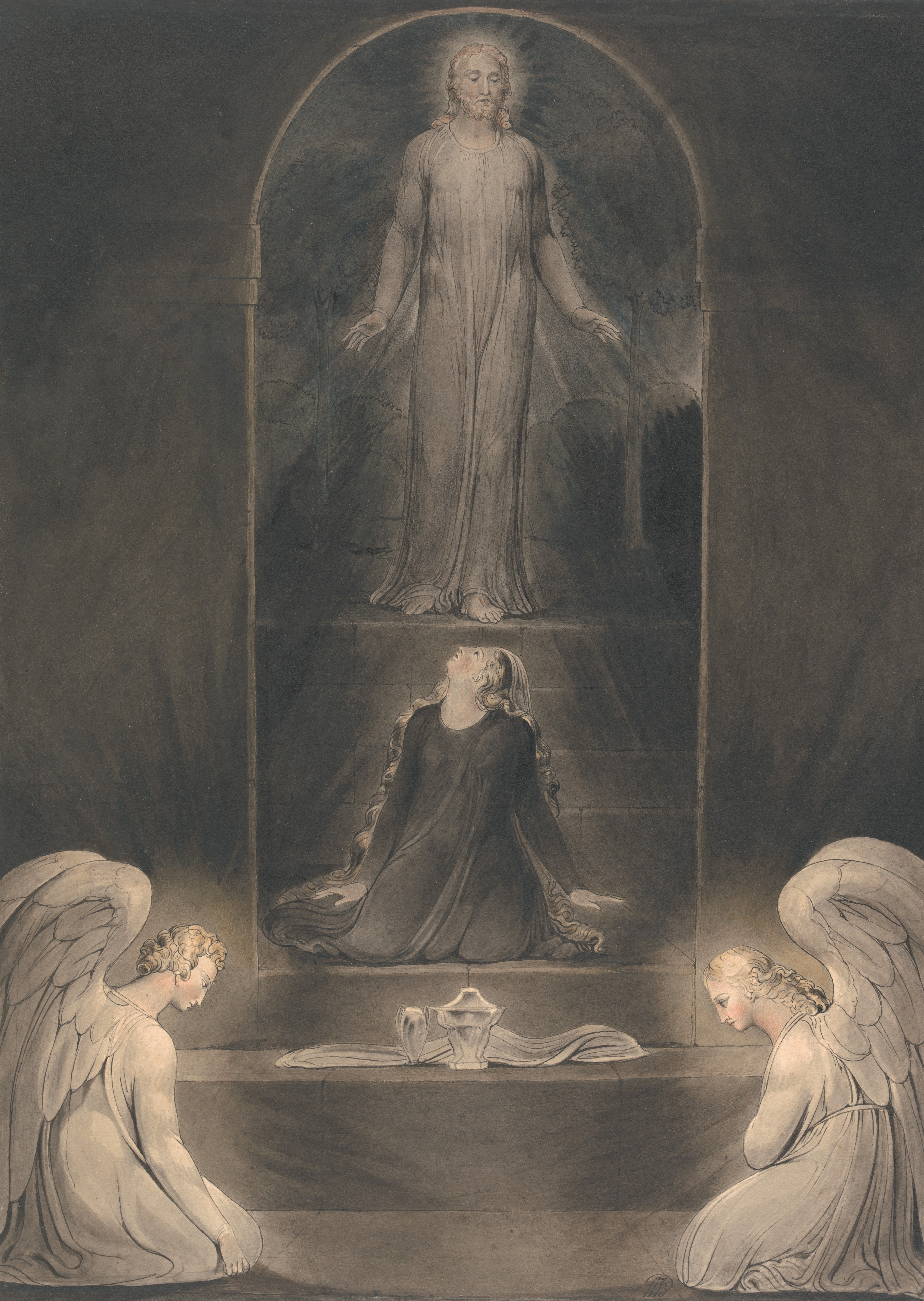
The Magdalene at the Sepulchre
1805
When Jesus engaged in his ministry on earth he sought to change the minds and hearts of individuals. Those who encountered Jesus had the opportunity to be introduced to a level of perception beyond the ordinary. No individual in the gospels was transformed by her interaction with Jesus more than was Mary Magdalene. Her original encounter with Jesus does not provide details of their meeting, but we are told that it involved her touching him and her being released from seven devils. Mary Magdalene reacted extravagantly by weeping, kissing his feet, anointing his feet with oil and wiping them with her hair.
 
Mary Magdalene's initial response to Jesus was not a temporary thing. She continued to follow with him as he conducted his ministry. She witnessed his trial, crucifixion and burial, but her faith was not shaken by the events Jesus experienced at the hands of 'rulers of the darkness of this world.'
 
When Mary visited the tomb of Jesus on the third day after his burial she encountered a man whom she suspected was the gardener. But she soon realized that it was Jesus in his Spiritual Body.
 
Blake has pictured the risen Christ within the tomb with Mary Magdalene who was able to recognize the transformation which Jesus had undergone. Mary Magdalene had learned to see through the physical to the spiritual. She could perceive the risen Christ because Christ in Jesus had become perceptible to her through faith. Blake would have us, like Mary Magdalene, able to see through the sensual world to the activating force which generates it. The individual puts on his Spiritual Body in order to perceive the Spirit.
 
Luke 7
[37] And, behold, a woman in the city, which was a sinner, when she knew that Jesus sat at meat in the Pharisee's house, brought an alabaster box of ointment,
[38] And stood at his feet behind him weeping, and began to wash his feet with tears, and did wipe them with the hairs of her head, and kissed his feet, and anointed them with the ointment.
[39] Now when the Pharisee which had bidden him saw it, he spake within himself, saying, This man, if he were a prophet, would have known who and what manner of woman this is that toucheth him: for she is a sinner.
[40] And Jesus answering said unto him, Simon, I have somewhat to say unto thee. And he saith, Master, say on.
[41] There was a certain creditor which had two debtors: the one owed five hundred pence, and the other fifty.
[42] And when they had nothing to pay, he frankly forgave them both. Tell me therefore, which of them will love him most?
[43] Simon answered and said, I suppose that he, to whom he forgave most. And he said unto him, Thou hast rightly judged.
[44] And he turned to the woman, and said unto Simon, Seest thou this woman? I entered into thine house, thou gavest me no water for my feet: but she hath washed my feet with tears, and wiped them with the hairs of her head.
[45] Thou gavest me no kiss: but this woman since the time I came in hath not ceased to kiss my feet.
[46] My head with oil thou didst not anoint: but this woman hath anointed my feet with ointment.
[47] Wherefore I say unto thee, Her sins, which are many, are forgiven; for she loved much: but to whom little is forgiven, the same loveth little.
[48] And he said unto her, Thy sins are forgiven.
[49] And they that sat at meat with him began to say within themselves, Who is this that forgiveth sins also?
[50] And he said to the woman, Thy faith hath saved thee; go in peace.
Luke 8
[1] And it came to pass afterward, that he went throughout every city and village, preaching and shewing the glad tidings of the kingdom of God: and the twelve were with him,
[2] And certain women, which had been healed of evil spirits and infirmities, Mary called Magdalene, out of whom went seven devils,
[3] And Joanna the wife of Chuza Herod's steward, and Susanna, and many others, which ministered unto him of their substance.
 
First Corinthians 15
[35] But some man will say, How are the dead raised up? and with what body do they come?
[36] Thou fool, that which thou sowest is not quickened, except it die:
[37] And that which thou sowest, thou sowest not that body that shall be, but bare grain, it may chance of wheat, or of some other grain:
[38] But God giveth it a body as it hath pleased him, and to every seed his own body.
[39] All flesh is not the same flesh: but there is one kind of flesh of men, another flesh of beasts, another of fishes, and another of birds.
[40] There are also celestial bodies, and bodies terrestrial: but the glory of the celestial is one, and the glory of the terrestrial is another.
[41] There is one glory of the sun, and another glory of the moon, and another glory of the stars: for one star differeth from another star in glory.
[42] So also is the resurrection of the dead. It is sown in corruption; it is raised in incorruption:
[43] It is sown in dishonour; it is raised in glory: it is sown in weakness; it is raised in power:
[44] It is sown a natural body; it is raised a spiritual body. There is a natural body, and there is a spiritual body.
[45] And so it is written, The first man Adam was made a living soul; the last Adam was made a quickening spirit.
[46] Howbeit that was not first which is spiritual, but that which is natural; and afterward that which is spiritual.
[47] The first man is of the earth, earthy: the second man is the Lord from heaven.
[48] As is the earthy, such are they also that are earthy: and as is the heavenly, such are they also that are heavenly.
[49] And as we have borne the image of the earthy, we shall also bear the image of the heavenly.


Jerusalem, Plate 61, (E 212) 
"Man in the Resurrection changes his Sexual Garments at will
Every Harlot was once a Virgin: every Criminal an Infant Love!
PLATE 62
Repose on me till the morning of the Grave. I am thy life.

Jerusalem replied. I am an outcast: Albion is dead!
I am left to the trampling foot & the spurning heel!
A Harlot I am calld. I am sold from street to street!
I am defaced with blows & with the dirt of the Prison!           
And wilt thou become my Husband O my Lord & Saviour?
Shall Vala bring thee forth! shall the Chaste be ashamed also?
I see the Maternal Line, I behold the Seed of the Woman!
Cainah, & Ada & Zillah & Naamah Wife of Noah.
Shuahs daughter & Tamar & Rahab the Canaanites:                  
Ruth the Moabite & Bathsheba of the daughters of Heth
Naamah the Ammonite, Zibeah the Philistine, & Mary
These are the Daughters of Vala, Mother of the Body of death
But I thy Magdalen behold thy Spiritual Risen Body
Shall Albion arise? I know he shall arise at the Last Day!
I know that in my flesh I shall see God: but Emanations
Are weak. they know not whence they are, nor whither tend.

Jesus replied. I am the Resurrection & the Life.
I Die & pass the limits of possibility, as it appears
To individual perception. Luvah must be Created                  
And Vala; for I cannot leave them in the gnawing Grave.
But will prepare a way for my banished-ones to return
Come now with me into the villages. walk thro all the cities.
Tho thou art taken to prison & judgment, starved in the streets
I will command the cloud to give thee food & the hard rock       
To flow with milk & wine, tho thou seest me not a season
Even a long season & a hard journey & a howling wilderness!
Tho Valas cloud hide thee & Luvahs fires follow thee!
Only believe & trust in me, Lo. I am always with thee!

So spoke the Lamb of God"
. 

Tuesday, April 19, 2016

IMAGES OF CHRIST 7

British Museum 
Illustrations to Young's Night Thoughts
Hell for Blake was not a place of eternal punishment but a state from which man may escape through perceiving and accepting truth. It is up to man to make a heaven of hell by implementing love and forgiveness when a situation seems to call for hate and vengeance. The act of annihilation does not destroy evil but replaces it with good.
 

In the picture Jesus does not point a finger, but offers a hand; he does not lock the suffering man out, but offers him a key which will let him in.
 

Redeeming the contraries known as Good & Evil is accomplished by Annihilation, subjecting them to the light of truth which reveals all. Truth shows that they work together to, as light and shadow do, provide dimension to space.
 

There is, however, the Negation which is incompatible with the unified psyche. It prevents the reconciliation of the Contraries by blocking expressions of love and forgiveness which are necessary for Annihilation. The Contraries are to be reconciled; the Negation to be destroyed.
 

Hebrews 12
[27] And this word, Yet once more, signifieth the removing of those things that are shaken, as of things that are made, that those things which cannot be shaken may remain.
[28] Wherefore we receiving a kingdom which cannot be moved, let us have grace, whereby we may serve God acceptably with reverence and godly fear:
[29] For our God is a consuming fire.

Ephesians 6
[10] Finally, my brethren, be strong in the Lord, and in the power of his might.
[11] Put on the whole armour of God, that ye may be able to stand against the wiles of the devil.
[12] For we wrestle not against flesh and blood, but against principalities, against powers, against the rulers of the darkness of this world, against spiritual wickedness in high places.
[13] Wherefore take unto you the whole armour of God, that ye may be able to withstand in the evil day, and having done all, to stand.


Songs of Innocence & of Experience, SONGS 32, (E 19) 
"The CLOD & the PEBBLE

Love seeketh not Itself to please,
Nor for itself hath any care;
But for another gives its ease,
And builds a Heaven in Hells despair."

Milton, Plate 14 [15], (E 108)
"I will go down to self annihilation and eternal death,
Lest the Last Judgment come & find me unannihilate
And I be siez'd & giv'n into the hands of my own Selfhood
The Lamb of God is seen thro' mists & shadows, hov'ring          
Over the sepulchers in clouds of Jehovah & winds of Elohim
A disk of blood, distant; & heav'ns & earth's roll dark between
What do I here before the Judgment? without my Emanation?
With the daughters of memory, & not with the daughters of inspiration[?]
I in my Selfhood am that Satan: I am that Evil One!              
He is my Spectre! in my obedience to loose him from my Hells
To claim the Hells, my Furnaces, I go to Eternal Death."

Milton, Plate 32 [35], (E 132)
"And thou O Milton art a State about to be Created
Called Eternal Annihilation that none but the Living shall
Dare to enter: & they shall enter triumphant over Death
And Hell & the Grave! States that are not, but ah! Seem to be.

Judge then of thy Own Self: thy Eternal Lineaments explore       
What is Eternal & what Changeable? & what Annihilable!" 
Milton, Plate 38 [43], (E 139)
[Milton speaks]
"Mine is to teach Men to despise death & to go on            
In fearless majesty annihilating Self, laughing to scorn
Thy Laws & terrors, shaking down thy Synagogues as webs
I come to discover before Heavn & Hell the Self righteousness
In all its Hypocritic turpitude, opening to every eye
These wonders of Satans holiness shewing to the Earth     
The Idol Virtues of the Natural Heart, & Satans Seat
Explore in all its Selfish Natural Virtue & put off
In Self annihilation all that is not of God alone:
To put off Self & all I have ever & ever Amen

Satan heard! Coming in a cloud, with trumpets & flaming fire     

Saying I am God the judge of all, the living & the dead
Fall therefore down & worship me. submit thy supreme
Dictate, to my eternal Will & to my dictate bow"

Milton, Plate 40 [46], (E 142) 
"There is a Negation, & there is a Contrary
The Negation must be destroyd to redeem the Contraries
The Negation is the Spectre; the Reasoning Power in Man
This is a false Body: an Incrustation over my Immortal           
Spirit; a Selfhood, which must be put off & annihilated alway
To cleanse the Face of my Spirit by Self-examination."

Jerusalem, Plate 12, (E 155)
"I saw the finger of God go forth                
Upon my Furnaces, from within the Wheels of Albions Sons:
Fixing their Systems, permanent: by mathematic power
Giving a body to Falshood that it may be cast off for ever.
With Demonstrative Science piercing Apollyon with his own bow!
God is within, & without! he is even in the depths of Hell!      

Such were the lamentations of the Labourers in the Furnaces!" 
Jerusalem, Plate 10, (E 152)
"They take the Two Contraries which are calld Qualities, with which
Every Substance is clothed, they name them Good & Evil
From them they make an Abstract, which is a Negation             
Not only of the Substance from which it is derived
A murderer of its own Body: but also a murderer
Of every Divine Member: it is the Reasoning Power
An Abstract objecting power, that Negatives every thing
This is the Spectre of Man: the Holy Reasoning Power             
And in its Holiness is closed the Abomination of Desolation

Therefore Los stands in London building Golgonooza"

Jerusalem, Plate 17, (E 162)
"Negations are not Contraries: Contraries mutually Exist:
But Negations Exist Not: Exceptions & Objections & Unbeliefs
Exist not: nor shall they ever be Organized for ever & ever:     
If thou separate from me, thou art a Negation: a meer
Reasoning & Derogation from Me, an Objecting & cruel Spite
And Malice & Envy: but my Emanation, Alas! will become
My Contrary: O thou Negation, I will continually compell
Thee to be invisible to any but whom I please, & when            
And where & how I please, and never! never! shalt thou be Organized
But as a distorted & reversed Reflexion in the Darkness"


Blake's formulation of the the concepts of the Contraries and the Negation may be seen as his commentary on the 7th and 8th chapter of Romans. Blake and Paul sought to bring everything under the dominion of the Divine but they saw that there was a resistance which prevented man from entering the kingdom which is prepared for him. To Paul this was the Law of Sin & Death which acted as a barrier between accepting Christ as the Spirit Within, and seeking to be righteous before the Law. The Law as an abstraction will not allow infractions to be forgiven. This abstraction is Blake's Negation: the unwillingness to allow the Contraries to mutually exist.

The Contraries are to examined, evaluated, judged and assimilated; but Negations which will not let this process proceed are to be destroyed in the consuming fires.

Romans 7
[8] But sin, taking occasion by the commandment, wrought in me all manner of concupiscence. For without the law sin was dead.
[9] For I was alive without the law once: but when the commandment came, sin revived, and I died.
[10] And the commandment, which was ordained to life, I found to be unto death.
[11] For sin, taking occasion by the commandment, deceived me, and by it slew me.
[12] Wherefore the law is holy, and the commandment holy, and just, and good.
[13] Was then that which is good made death unto me? God forbid. But sin, that it might appear sin, working death in me by that which is good; that sin by the commandment might become exceeding sinful.
[14] For we know that the law is spiritual: but I am carnal, sold under sin.
[15] For that which I do I allow not: for what I would, that do I not; but what I hate, that do I.
[16] If then I do that which I would not, I consent unto the law that it is good.
[17] Now then it is no more I that do it, but sin that dwelleth in me.
[18] For I know that in me (that is, in my flesh,) dwelleth no good thing: for to will is present with me; but how to perform that which is good I find not.
[19] For the good that I would I do not: but the evil which I would not, that I do.
[20] Now if I do that I would not, it is no more I that do it, but sin that dwelleth in me.
[21] I find then a law, that, when I would do good, evil is present with me.
[22] For I delight in the law of God after the inward man:
[23] But I see another law in my members, warring against the law of my mind, and bringing me into captivity to the law of sin which is in my members.
[24] O wretched man that I am! who shall deliver me from the body of this death?
[25] I thank God through Jesus Christ our Lord. So then with the mind I myself serve the law of God; but with the flesh the law of sin.

Romans 8
[1] There is therefore now no condemnation to them which are in Christ Jesus, who walk not after the flesh, but after the Spirit.
[2] For the law of the Spirit of life in Christ Jesus hath made me free from the law of sin and death.
[3] For what the law could not do, in that it was weak through the flesh, God sending his own Son in the likeness of sinful flesh, and for sin, condemned sin in the flesh:
[4] That the righteousness of the law might be fulfilled in us, who walk not after the flesh, but after the Spirit.
[5] For they that are after the flesh do mind the things of the flesh; but they that are after the Spirit the things of the Spirit.
[6] For to be carnally minded is death; but to be spiritually minded is life and peace.
[7] Because the carnal mind is enmity against God: for it is not subject to the law of God, neither indeed can be.
[8] So then they that are in the flesh cannot please God.
[9] But ye are not in the flesh, but in the Spirit, if so be that the Spirit of God dwell in you. Now if any man have not the Spirit of Christ, he is none of his.
[10] And if Christ be in you, the body is dead because of sin; but the Spirit is life because of righteousness.
[11] But if the Spirit of him that raised up Jesus from the dead dwell in you, he that raised up Christ from the dead shall also quicken your mortal bodies by his Spirit that dwelleth in you.
[12] Therefore, brethren, we are debtors, not to the flesh, to live after the flesh.
[13] For if ye live after the flesh, ye shall die: but if ye through the Spirit do mortify the deeds of the body, ye shall live.
[14] For as many as are led by the Spirit of God, they are the sons of God.
[15] For ye have not received the spirit of bondage again to fear; but ye have received the Spirit of adoption, whereby we cry, Abba, Father.
[16] The Spirit itself beareth witness with our spirit, that we are the children of God: 
.

Sunday, April 17, 2016

IMAGES OF CHRIST 6


British Museum       Illustrations to Young's Night Thoughts
Not all images are visual ones. Blake obviously created verbal images as well. Jesus created images by speaking in parables. Parables produce mental images which lodge in the mind and surface as thoughts, emotions or actions. We move today to an image of Christ created by Jesus in a parable and illustrated by Blake in his watercolors for Night Thoughts. The Parable of the Prodigal is found only in the 15th chapter of the Gospel of Luke.

Blake discerned that a major theme of the ministry of Jesus was the concept of forgiveness. Blake made forgiveness a major theme of his poetry as well.
Songs and Ballads, My Spectre, (E 476)
"& Throughout all Eternity 
I forgive you you forgive me
As our dear Redeemer said                              
This the Wine & this the Bread"

Jerusalem, Plate 7, (E 149)
"O holy Generation! [Image] of regeneration!     
O point of mutual forgiveness between Enemies!
Birthplace of the Lamb of God incomprehensible!"

Gates of Paradise, Prologue, (E 259)
"Mutual Forgiveness of each Vice
Such are the Gates of Paradise"

Everlasting Gospel, Notes, (E 876)
     "It was when Jesus said to Me
     Thy Sins are all forgiven thee
     The Christian trumpets loud proclaim
     Thro all the World in Jesus name
     Mutual forgiveness of each Vice
     And oped the Gates of Paradise"
Jesus' parable emphasizes the compassion and forgiveness which the father offered to his son who had chosen to dissociate himself from his family, home and childhood. Left unsaid in the parable is the reasons that compelled younger son to engage in his journey of exploration. Implicit in the decision of the boy to return is his willingness to turn back to the situation which had he had left. He had to forgive the father whom he had rejected by leaving. Forgiveness to Blake and to Jesus is mutual, not one-sided. Both the father and son sought to be forgiven as well as to forgive.
 
Luke 15
[10] Likewise, I say unto you, there is joy in the presence of the angels of God over one sinner that repenteth.
[11] And he said, A certain man had two sons:
[12] And the younger of them said to his father, Father, give me the portion of goods that falleth to me. And he divided unto them his living.
[13] And not many days after the younger son gathered all together, and took his journey into a far country, and there wasted his substance with riotous living.
[14] And when he had spent all, there arose a mighty famine in that land; and he began to be in want.
[15] And he went and joined himself to a citizen of that country; and he sent him into his fields to feed swine.
[16] And he would fain have filled his belly with the husks that the swine did eat: and no man gave unto him.
[17] And when he came to himself, he said, How many hired servants of my father's have bread enough and to spare, and I perish with hunger!
[18] I will arise and go to my father, and will say unto him, Father, I have sinned against heaven, and before thee,
[19] And am no more worthy to be called thy son: make me as one of thy hired servants.
[20] And he arose, and came to his father. But when he was yet a great way off, his father saw him, and had compassion, and ran, and fell on his neck, and kissed him.
[21] And the son said unto him, Father, I have sinned against heaven, and in thy sight, and am no more worthy to be called thy son.
[22] But the father said to his servants, Bring forth the best robe, and put it on him; and put a ring on his hand, and shoes on his feet:
[23] And bring hither the fatted calf, and kill it; and let us eat, and be merry:
[24] For this my son was dead, and is alive again; he was lost, and is found. And they began to be merry.

Blake did not make a major picture to illustrate the Prodigal son. However Samuel Palmer related a recollection of Blake which indicated that Blake had a deep emotional response to the story. The importance to Blake of forgiving and being forgiven was evident in his tears when he focused on the father and son being reunited after their alienation. This quote is included in William Blake (Bloom's Classic Critical Views) by Harold Bloom: 
 
"Nor was the mouth less expressive; the lips flexible and quivering with feeling. I can yet recall it when, on one occasion, dwelling on the exquisite beauty of the parable of the Prodigal, he began to repeat a part of it; but as the words "When he was a great way off, his father saw him," could go no no farther; his voice faltered, and he was in tears."
 
Jerusalem, Plate 61,(E 211)   
"Saying, Doth Jehovah Forgive a Debt only on condition that it shall   
Be Payed? Doth he Forgive Pollution only on conditions of Purity 
That Debt is not Forgiven! That Pollution is not Forgiven 
Such is the Forgiveness of the Gods, the Moral Virtues of the   
Heathen, whose tender Mercies are Cruelty. But Jehovahs Salvation   
Is without Money & without Price, in the Continual Forgiveness of Sins 
In the Perpetual Mutual Sacrifice in Great Eternity! for behold! 
There is none that liveth & Sinneth not! And this is the Covenant 
Of Jehovah: If you Forgive one-another, so shall Jehovah Forgive You: 
That He Himself may Dwell among You."
.

Saturday, April 16, 2016

IN MY DREAMS

Larry posted this to another blog on September 22, 2010.

British Museum I take away from thee the Desire of thine Eyes
1794
Catherine Blake said her only problem with her husband was that he spent too much time in Heaven. In our dreams we may be closer to Blake's Heaven than is possible in our waking hours. Some day we may realize that where we live now is largely vaporous.

Dream sequence:

The other day I had dinner with Blake, and I asked him if he had said all he had to say by 1828. He said "'pretty much', 'pretty much', especially if you've experienced all the words and pictures that I left behind."

I asked him if there was anything more he would like to tell us now from his present life. He said, "Oh yes, a great deal; but I've experienced nothing that your corporeal mind would find meaningful." He went on to say that where he now lived and what he now knew was separated from me by a great chasm, much like the one between Lazarus in Abraham's bosom and Dives.

He reminded me of Paul's experience in the Third Heaven where "He heard unspeakable words, which it is not lawful for a man to utter".


I asked Blake if he had recently come in contact with Isaiah or Ezekiel. He said that Ezekiel and he had become bosom buddies, "We laughed together over the peculiar directive that Ezekiel had received from God." He also told Ezekiel that that affair had meant a lot to him and given him a vivid awareness of the "perception of the infinite". (MHH13, E39)

Blake went on to say that in due course, at the acceptable time, he would be glad to introduce me to Ezekiel or to anyone else I desired to meet. He also would arrange a tennis match for me with Kenny Rosewall.

I was just about to make further requests when the alarm clock sounded, and I was aroused from my Heavenly Vision or perhaps I went back to the corporeal sleep.

.
.

Wednesday, April 13, 2016

IMAGES OF CHRIST 5

Yale Center for British Art Jerusalem
Plate 76
The second image of Christ in Jeusalem, like the first, is of Jesus and Albion. It is something of a reversal of the first image for Jesus is at the depth of degradation as he hangs helplessly on a Druiadic oak of suffering. Albion standing and facing Jesus spreads his arms in a posture of rejoicing rather than despair. Albion who had been in the depths has been raised to the heights, and Jesus who had been at the height of his ministry has reached the nadir of rejection.

Stuart Curran states in Blake's Sublime Allegory that:
"Only once in Jerusalem does Blake epitomize his meaning simply and totally upon a single plate. On the full page illumination on Plate 76 {36}, Albion stretches his arms wide in unconscious sympathy, contemplates the crucified Christ. The structure of Jerusalem continually returns its participants - Albion, Los, Blake, the reader - to this essential symbol until our contemplation attains the visionary penetration that transforms the pathos of suffering humanity into the sublime of willing self-annihilation." (Page 346)

Although we can apply all that Blake has been teaching about God and Humanity to understanding this picture, the appropriate response to the image is not analysis but contemplation.

Jerusalem, Plate 24, (E 169)
[Albion speaks]
"O Jerusalem Jerusalem I have forsaken thy Courts
Thy Pillars of ivory & gold: thy Curtains of silk & fine
Linen: thy Pavements of precious stones: thy Walls of pearl
And gold, thy Gates of Thanksgiving thy Windows of Praise:       
Thy Clouds of Blessing; thy Cherubims of Tender-mercy
Stretching their Wings sublime over the Little-ones of Albion
O Human Imagination O Divine Body I have Crucified
I have turned my back upon thee into the Wastes of Moral Law:"
Four Zoas, Night VIII, PAGE 107 [115], (E 381)
"Jerusalem pitying them wove them mantles of life & death
Times after times And those in Eden sent Lucifer for their Guard
Lucifer refusd to die for Satan & in pride he forsook his charge
Then they sent Molech Molech was impatient They sent
Molech impatient They Sent Elohim who created Adam
To die for Satan Adam refusd but was compelld to die
By Satans arts. Then the Eternals Sent Shaddai
Shaddai was angry Pachad descended Pachad was terrified
And then they Sent Jehovah who leprous stretchd his hand to Eternity
Then Jesus Came & Died willing beneath Tirzah & Rahab" 
Hebrews 9
[24] For Christ is not entered into the holy places made with hands, which are the figures of the true; but into heaven itself, now to appear in the presence of God for us:
[25] Nor yet that he should offer himself often, as the high priest entereth into the holy place every year with blood of others;
[26] For then must he often have suffered since the foundation of the world: but now once in the end of the world hath he appeared to put away sin by the sacrifice of himself.
[27] And as it is appointed unto men once to die, but after this the judgment:
[28] So Christ was once offered to bear the sins of many; and unto them that look for him shall he appear the second time without sin unto salvation.

 
The Wesley brothers were older contemporaries of William Blake. John and Charles Wesley were both ministers and poets who composed hymns of faith. Blake shared their love of music and their willingness to express enthusiasm - the emotional response to religious experience. This hymn by Charles may have been included in the Wesley hymnals which Blake owned and used.
 
1 O Love Divine what hast thou done!
The incarnate God hath died for me!
The Father's co-eternal Son,
Bore all my sins upon the tree!
The son of God for me hath died:
My Lord, my Love, is crucified.

 
2 Behold him, all ye that pass by,
The bleeding Prince of life and peace!
Come, sinners, see your Saviour die,
And say, was ever grief like his 

Come, feel with me his blood applied:
My Lord, my Love, is crucified:

 
3 Is crucified for me and you,
To bring us rebels back to God:
Believe, believe the record true,
Ye all are bought with Jesus' blood:
Pardon for all flows from his side:
My Lord, my Love, is crucified.

 
4 Then let us sit beneath his cross,
And gladly catch the healing stream;
All things for him account but loss,
And give up all our hearts to him:
Of nothing think or speak beside,
My Lord, my Love, is crucified.

.

Monday, April 11, 2016

IMAGES OF CHRIST 4


Yale Center for British Art Jerusalem Plate 37
Blake's illuminated books on only a few occasions picture Jesus. There are two images in Jerusalem. On Plate 37 the image on the upper part of the page pictures Albion prostrate in the arms of Jesus. Blake would have been familiar with reproductions of Michelangelo's Pieta which shows the body of Jesus prostrate in the arms of Mary. Blake calls to mind the same agonizing sadness in showing Jesus supporting Albion, as the representative of all mankind, sunk in the despair of disbelief and rebellion.  
 

Jerusalem, Plate 32 [36], (E 179)
"Then those in Great Eternity who contemplate on Death
Said thus.  What seems to Be: Is: To those to whom  It seems to Be, & is productive of the most dreadful  Consequences to those to whom it seems to Be: even of 
Torments, Despair, Eternal Death; but the Divine Mercy
Steps beyond and Redeems Man in the Body of Jesus Amen
And Length Bredth Highth again Obey the Divine Vision Hallelujah
PLATE 33 [37]  And One stood forth from the Divine Family &,said I feel my Spectre rising upon me! Albion! arouze thyself!
Why dost thou thunder with frozen Spectrous wrath against us?
The Spectre is, in Giant Man; insane, and most deform'd.
Thou wilt certainly provoke my Spectre against thine in fury!    
He has a Sepulcher hewn out of a Rock ready for thee:
And a Death of Eight thousand years forg'd by thyself, upon
The point of his Spear! if thou persistest to forbid with Laws
Our Emanations, and to attack our secret supreme delights

So Los spoke: But when he saw blue death in Albions feet, 
Again he join'd the Divine Body, following merciful;
While Albion fled more indignant! revengeful covering"

Jerusalem, Plate 41, (E 189)
"Alas!--The time will come, when a mans worst enemies   
Shall be those of his own house and family: in a Religion
Of Generation, to destroy by Sin and Atonement, happy Jerusalem,
The Bride and Wife of the Lamb. O God thou art Not an Avenger!
PLATE 42
Thus Albion sat, studious of others in his pale disease:
Brooding on evil: but when Los opend the Furnaces before him:
He saw that the accursed things were his own affections,
And his own beloveds: then he turn'd sick! his soul died within him
Also Los sick & terrified beheld the Furnaces of Death           
And must have died, but the Divine Saviour descended
Among the infant loves & affections, and the Divine Vision wept
Like evening dew on every herb upon the breathing ground

Albion spoke in his dismal dreams: O thou deceitful friend
Worshipping mercy & beholding thy friend in such affliction:   
Los! thou now discoverest thy turpitude to the heavens.
I demand righteousness & justice. O thou ingratitude!
Give me my Emanations back[,] food for my dying soul!
My daughters are harlots! my sons are accursed before me.
Enitharmon is my daughter: accursed with a fathers curse!     
O! I have utterly been wasted! I have given my daughters to devils

So spoke Albion in gloomy majesty, and deepest night
Of Ulro rolld round his skirts from Dover to Cornwall."

Jerusalem, Plate 34 [38], (E 180)
"Albion! Our wars are wars of life, & wounds of love,
With intellectual spears, & long winged arrows of thought:       
Mutual in one anothers love and wrath all renewing
We live as One Man; for contracting our infinite senses
We behold multitude; or expanding: we behold as one,
As One Man all the Universal Family; and that One Man
We call Jesus the Christ: and he in us, and we in him,        
Live in perfect harmony in Eden the land of life,
Giving, recieving, and forgiving each others trespasses.
He is the Good shepherd, he is the Lord and master:
He is the Shepherd of Albion, he is all in all,
In Eden: in the garden of God: and in heavenly Jerusalem.        
If we have offended, forgive us, take not vengeance against us.
Thus speaking; the Divine Family follow Albion:
I see them in the Vision of God upon my pleasant valleys." 
The biblical story which represented to Blake the plight of Albion was the account of the raising of Lazarus. Blake's faith that the fall of man did not end in eternal death but in eternal life, was iterated as he explored with Milton the 'ways of God' which led back to Eden. Jesus did not leave Lazarus or Albion in the grave but called them forth to live again.  
 

John 11
[21] Then said Martha unto Jesus, Lord, if thou hadst been here, my brother had not died.
[22] But I know, that even now, whatsoever thou wilt ask of God, God will give it thee.
[23] Jesus saith unto her, Thy brother shall rise again.
[24] Martha saith unto him, I know that he shall rise again in the resurrection at the last day.
[25] Jesus said unto her, I am the resurrection, and the life: he that believeth in me, though he were dead, yet shall he live:
[26] And whosoever liveth and believeth in me shall never die. Believest thou this?
[27] She saith unto him, Yea, Lord: I believe that thou art the Christ, the Son of God, which should come into the world.

 
Lazarus in No Natural Religion 
  Lazarus in Tate Gallery
  Lazarus in Young's Night Thoughts
.

Thursday, April 7, 2016

IMAGES OF CHRIST 3


British Museum
Illustrations to Young's Night Thoughts
Watercolor, 1795
Our experience in this world is framed by two doors: birth or the entrance into life and death or the entrance into the grave. But poets encourage us to explore additional meanings to life and death by using the word 'door' symbolically.  

In the Book of Revelation, John of Patmos stated 'Behold, I stand at the door, and knock: if any man hear my voice, and open the door, I will come in to him, and will sup with him, and he with me.' He was inviting his readers to be conscious of an invitation to enter a relationship. His readers subsequently have attached John's invitation to Jesus and portrayed him inviting us to open the door which will allow Christ to transform us.
 
Revelation 3
[19] As many as I love, I rebuke and chasten: be zealous therefore, and repent.
[20] Behold, I stand at the door, and knock: if any man hear my voice, and open the door, I will come in to him, and will sup with him, and he with me.


The writer of the Gospel of John develops the image of the 'door' in a different way. Jesus states that it is the shepherd who enters the door and is recognized by his sheep who follow him. However, Jesus follows the narrative of the parable with an explanation identifying himself with the door. By
passing through Christ men may find salvation, enter and exit, and be fed.

John 10
[1] Verily, verily, I say unto you, He that entereth not by the door into the sheepfold, but climbeth up some other way, the same is a thief and a robber.
[2] But he that entereth in by the door is the shepherd of the sheep.
[3] To him the porter openeth; and the sheep hear his voice: and he calleth his own sheep by name, and leadeth them out.
[4] And when he putteth forth his own sheep, he goeth before them, and the sheep follow him: for they know his voice.
[5] And a stranger will they not follow, but will flee from him: for they know not the voice of strangers.
[6] This parable spake Jesus unto them: but they understood not what things they were which he spake unto them.
[7] Then said Jesus unto them again, Verily, verily, I say unto you, I am the door of the sheep.
[8] All that ever came before me are thieves and robbers: but the sheep did not hear them.
[9] I am the door: by me if any man enter in, he shall be saved, and shall go in and out, and find pasture.

Blake was fascinated by the use of the symbol of the 'door' as the transition between mortal life and Eternal life. Man's ability to perceive is a 'door' which may be cleansed to reveal the infinite and eternal. The limited individual perception may be passed through to revel the resurrected possibilities of the spiritual body.

Marriage of Heaven & Hell, Plate 14, (E 39)
 "If the doors of perception were cleansed every thing would
appear  to man as it is: infinite.
   For man has closed himself up, till he sees all things thro'
narrow chinks of his cavern." 
Jerusalem, Plate 62, (E 213)
"Jesus replied. I am the Resurrection & the Life.
I Die & pass the limits of possibility, as it appears
To individual perception. Luvah must be Created                  
And Vala; for I cannot leave them in the gnawing Grave.
But will prepare a way for my banished-ones to return"
The contrary activity of entering the mortal world of decay and death, is passing through the same door in the opposite direction. Los entered the door of Death for the sake of Albion, an echo of Christ entering the mortal body for the sake of humanity.

Jerusalem, Plate 1, (E 144)
"Half Friendship is the bitterest Enmity said Los
As he enterd the Door of Death for Albions sake Inspired
The long sufferings of God are not for ever there is a Judgment" 
When an individual perceives his Immortality, the door between death and life is opened to him. He may enter and exit as John said of the sheepfold in the gospel. But to the awakened man the world of mortality increasingly becomes a dream world - less real than the world on the other side of the door.

Gates of Paradise, The Keys, (E 268)
"13   But when once I did descry 
     The Immortal Man that cannot Die
14   Thro evening shades I haste away 
     To close the Labours of my Day
15   The Door of Death I open found                             
     And the Worm Weaving in the Ground
16   Thou'rt my Mother from the Womb 
     Wife, Sister, Daughter to the Tomb 
     Weaving to Dreams the Sexual strife
     And weeping over the Web of Life"
The grave which is final to the man who sleeps in doubt, is seen to be a Golden Door which opens to heaven's blossoming to those who use the key. Blake's key is the visions which his soul has seen. By illustrating Edward's poem The Grave he has encouraged the reader to open his soul to the vision which flies on wings of imagination.

Songs and Ballads, (E 480)
[Dedication to Blake's Illustrations to Blair's Grave, printed 1808]

             "TO THE QUEEN    
The Door of Death is made of Gold,
That Mortal Eyes cannot behold;
But, when the Mortal Eyes are clos'd,
And cold and pale the Limbs repos'd,
The Soul awakes; and, wond'ring, sees
In her mild Hand the golden Keys:
The Grave is Heaven's golden Gate,
And rich and poor around it wait;
O Shepherdess of England's Fold,
Behold this Gate of Pearl and Gold!        

  To dedicate to England's Queen 
The Visions that my Soul has seen,
And, by Her kind permission, bring 
What I have borne on solemn Wing,
From the vast regions of the Grave,
Before Her Throne my Wings I wave;
Bowing before my Sov'reign's Feet,
"The Grave produc'd these Blossoms sweet
"In mild repose from Earthly strife;
"The Blossoms of Eternal Life!"            

                         WILLIAM BLAKE"