Blake seeks to provide the Golden String which can lead us through the labyrinth of our experience or his own poetry.

Monday, August 21, 2017

PARADISE LOST 9

Wikipedia Commons
Illustrations to Milton's Paradise Lost 
Illustration 9
The Temptation and Fall of Eve

Genesis 3
[2] And the woman said unto the serpent, We may eat of the fruit of the trees of the garden:
[3] But of the fruit of the tree which is in the midst of the garden, God hath said, Ye shall not eat of it, neither shall ye touch it, lest ye die.
[4] And the serpent said unto the woman, Ye shall not surely die:
[5] For God doth know that in the day ye eat thereof, then your eyes shall be opened, and ye shall be as gods, knowing good and evil.
[6] And when the woman saw that the tree was good for food, and that it was pleasant to the eyes, and a tree to be desired to make one wise, she took of the fruit thereof, and did eat, and gave also unto her husband with her; and he did eat.

Romans 7
[18] For I know that in me (that is, in my flesh,) dwelleth no good thing: for to will is present with me; but how to perform that which is good I find not.
[19] For the good that I would I do not: but the evil which I would not, that I do.
[20] Now if I do that I would not, it is no more I that do it, but sin that dwelleth in me.
[21] I find then a law, that, when I would do good, evil is present with me.

Paradise Lost
John Milton
Book I
Lline 34

"The infernal serpent; he it was, whose guile
Stirred up with envy and revenge, deceived
The mother of mankind,"

Book VIII
Line 366
"Trial will come unsought.
Wouldst thou approve thy constancy, approve
First thy obedience; the other who can know,
Not seeing thee attempted, who attest?
But, if thou think, trial unsought may find
Us both securer than thus warned thou seemest,
Go; for thy stay, not free, absents thee more;
Go in thy native innocence, rely
On what thou hast of virtue; summon all
For God towards thee hath done his part, do thine.
So spake the patriarch of mankind; but Eve
Persisted; yet submiss, though last, replied.
With thy permission then, and thus forewarned
Chiefly by what thy own last reasoning words
Touched only; that our trial, when least sought,
May find us both perhaps far less prepared,
The willinger I go, nor much expect
A foe so proud will first the weaker seek;
So bent, the more shall shame him his repulse.
Thus saying, from her husband's hand her hand
Soft she withdrew; and, like a Wood-Nymph light,
Oread or Dryad, or of Delia's train,
Betook her to the groves;

Line 404
 Oh much deceived, much failing, hapless Eve,
Of thy presumed return event perverse!
Thou never from that hour in Paradise
Foundst either sweet repast, or sound repose;
Such ambush, hid among sweet flowers and shades,
Waited with hellish rancor imminent
To intercept thy way, or send thee back
Despoiled of innocence, of faith, of bliss.
For now, and since first break of dawn, the Fiend,
Mere serpent in appearance, forth was come;
And on his quest, where likeliest he might find
The only two of mankind, but in them
The whole included race, his purposed prey.

Line 494
"So spake the enemy of mankind, enclosed
In serpent, inmate bad, and toward Eve
Addressed his way: not with indented wave,
Prone on the ground, as since; but on his rear,
Circular base of rising folds, that towered
Fold above fold, a surging maze, his head
Crested aloft, and carbuncle his eyes;
With burnished neck of verdant gold, erect
Amidst his circling spires, that on the grass
Floated redundant: pleasing was his shape
And lovely; never since of serpent-kind
Lovelier,"
 

Line 643
 So glistered the dire Snake, and into fraud
Led Eve, our credulous mother, to the tree
Of prohibition, root of all our woe;
Which when she saw, thus to her guide she spake.
Serpent, we might have spared our coming hither,
Fruitless to me, though fruit be here to excess,
The credit of whose virtue rest with thee;
Wondrous indeed, if cause of such effects.
But of this tree we may not taste nor touch;
God so commanded, and left that command
Sole daughter of his voice; the rest, we live
Law to ourselves; our reason is our law."

Line 685
  "ye shall not die:
How should you? by the fruit? it gives you life
To knowledge; by the threatener? look on me,
Me, who have touched and tasted; yet both live,
And life more perfect have attained than Fate
Meant me, by venturing higher than my lot.
Shall that be shut to Man, which to the Beast
Is open? or will God incense his ire
For such a petty trespass?"

Line 705
"He knows that in the day
Ye eat thereof, your eyes that seem so clear,
Yet are but dim, shall perfectly be then
Opened and cleared, and ye shall be as Gods,
Knowing both good and evil, as they know.

Line 776
  "Here grows the cure of all, this fruit divine,
Fair to the eye, inviting to the taste,
Of virtue to make wise: What hinders then
To reach, and feed at once both body and mind?
So saying, her rash hand in evil hour
Forth reaching to the fruit, she plucked, she ate.
Earth felt the wound; and nature from her seat,
Sighing through all her works, gave signs of woe,
That all was lost."

Although a disaster may seem to happen suddenly, it is more likely the result of a chain of occurrences which was allowed to continue instead of being broken by wise decisions and strong resolve. In Milton's Paradise Lost, Eve's bite of the apple began long before she accepted the fruit from the serpent. First Adam requested a companion with a separate existence different from himself and outside of himself. The being whom God provided was dependent on Adam but tended to be absorbed in her own autonomy. She was accustomed to having Adam instruct her and guide her but failed to learn for herself the conduct which he was trying to impart. Instead she wanted to be freer and wiser than she had been instructed to be. She was susceptible to flattery and to promises of extravagant benefits. Although it was not inevitable that she would fall, she failed to avoid it by exercising good judgment.

It seems evident from Milton's life script that he may have identified with Eve as he puzzled over his part in the overthrow of King Charles, the rise and fall of Cromwell's government, and the restoration of monarchy. His decisions and those of his associates had consequences which were meant to do good but often led to suffering of the nation and her people. In developing his character Eve in Paradise Lost, Milton seems to have been confessing his own flaws or the failings of Britain. 

Four Zoas, Night VII, Page 87, (E 369)
"But Los stood on the Limit of Translucence weeping & trembling
Filled with doubts in self accusation beheld the fruit  
Of Urizens Mysterious tree For Enitharmon thus spake

When In the Deeps beneath I gatherd of this ruddy fruit 
It was by that I knew that I had Sinnd & then I knew
That without a ransom I could not be savd from Eternal death
That Life lives upon Death & by devouring appetite
All things subsist on one another thenceforth in Despair
I spend my glowing time but thou art strong & mighty  
To bear this Self conviction take then Eat thou also of
The fruit & give me proof of life Eternal or I die

Then Los plucked the fruit & Eat & sat down in Despair
And must have given himself to death Eternal But
Urthonas spectre in part mingling with him comforted him  
Being a medium between him & Enitharmon   But This Union
Was not to be Effected without Cares & Sorrows & Troubles
Of six thousand Years of self denial and of bitter Contrition" 

Songs of Experience, Song 47, (E 27)  
"The Human Abstract. 

Pity would be no more,          
If we did not make somebody Poor:
And Mercy no more could be,
If all were as happy as we;

And mutual fear brings peace;
Till the selfish loves increase.
Then Cruelty knits a snare,
And spreads his baits with care. 

He sits down with holy fears,
And waters the ground with tears:
Then Humility takes its root
Underneath his foot.

Soon spreads the dismal shade
Of Mystery over his head;
And the Catterpiller and Fly,
Feed on the Mystery.

And it bears the fruit of Deceit,
Ruddy and sweet to eat; 
And the Raven his nest has made
In its thickest shade.

The Gods of the earth and sea,
Sought thro' Nature to find this Tree
But their search was all in vain:
There grows one in the Human Brain"
. 

Sunday, August 20, 2017

PARADISE LOST 10


Wikipedia Commons
Illustrations to Milton's Paradise Lost
Illustration 10
So Judged He Man
Genesis 3
[1] Now the serpent was more subtil than any beast of the field which the LORD God had made. And he said unto the woman, Yea, hath God said, Ye shall not eat of every tree of the garden?
...
[6] And when the woman saw that the tree was good for food, and that it was pleasant to the eyes, and a tree to be desired to make one wise, she took of the fruit thereof, and did eat, and gave also unto her husband with her; and he did eat.
[7] And the eyes of them both were opened, and they knew that they were naked; and they sewed fig leaves together, and made themselves aprons.
[8] And they heard the voice of the LORD God walking in the garden in the cool of the day: and Adam and his wife hid themselves from the presence of the LORD God amongst the trees of the garden.
...
[14] And the LORD God said unto the serpent, Because thou hast done this, thou art cursed above all cattle, and above every beast of the field; upon thy belly shalt thou go, and dust shalt thou eat all the days of thy life:
[15] And I will put enmity between thee and the woman, and between thy seed and her seed; it shall bruise thy head, and thou shalt bruise his heel.
[16] Unto the woman he said, I will greatly multiply thy sorrow and thy conception; in sorrow thou shalt bring forth children; and thy desire shall be to thy husband, and he shall rule over thee.
[17] And unto Adam he said, Because thou hast hearkened unto the voice of thy wife, and hast eaten of the tree, of which I commanded thee, saying, Thou shalt not eat of it: cursed is the ground for thy sake; in sorrow shalt thou eat of it all the days of thy life;

First John 2
[1] My little children, these things write I unto you, that ye sin not. And if any man sin, we have an advocate with the Father, Jesus Christ the righteous:
[2] And he is the propitiation for our sins: and not for ours only, but also for the sins of the whole world.


Paradise Lost
John Milton
Book IX


Line 816
"But to Adam in what sort
Shall I appear? shall I to him make known
As yet my change, and give him to partake
Full happiness with me, or rather not,
But keeps the odds of knowledge in my power
Without copartner? so to add what wants
In female sex, the more to draw his love,
And render me more equal; and perhaps,
A thing not undesirable, sometime
Superior; for, inferior, who is free
This may be well: But what if God have seen,
And death ensue? then I shall be no more,
And Adam, wedded to another Eve,
Shall live with her enjoying, I extinct;
A death to think! Confirmed then I resolve,
Adam shall share with me in bliss or woe:
 
So dear I love him, that with him all deaths
I could endure, without him live no life."


Line 888
  "On the other side Adam, soon as he heard
The fatal trespass done by Eve, amazed,
Astonied stood and blank, while horror chill
Ran through his veins, and all his joints relaxed;
From his slack hand the garland wreathed for Eve
Down dropt, and all the faded roses shed:
Speechless he stood and pale, till thus at length
First to himself he inward silence broke.
Oh fairest of creation, last and best
Of all God's works, Creature in whom excelled
Whatever can to sight or thought be formed,
Holy, divine, good, amiable, or sweet,
 
How art thou lost! how on a sudden lost,
Defaced, deflowered, and now to death devote!
Rather, how hast thou yielded to transgress
The strict forbiddance, how to violate
The sacred fruit forbidden? Some cursed fraud
Of enemy hath beguiled thee, yet unknown,
And me with thee hath ruined; for with thee
Certain my resolution is to die:
How can I live without thee? how forego
Thy sweet converse, and love so dearly joined,
To live again in these wild woods forlorn?"


Line 1070 "since our eyes
Opened we find indeed, and find we know
Both good and evil; good lost, and evil got;
Bad fruit of knowledge, if this be to know;
Which leaves us naked thus, of honor void,
Of innocence, of faith, of purity,"

 
Line 1087
"Thus they in mutual accusation spent
The fruitless hours, but neither self-condemning;
And of their vain contest appeared no end."
 
Book XLine 55
  "But whom send I to judge them? whom but thee,
Vicegerent Son? To thee I have transferred
All judgment, whether in Heaven, or Earth, or Hell.
Easy it may be seen that I intend
Mercy colleague with justice, sending thee
Man's friend, his Mediator, his designed
Both ransom and Redeemer voluntary,
And destined man himself to judge man fallen.
So spake the Father;"


Line 192
  "And to the Woman thus his sentence turned.
 
Thy sorrow I will greatly multiply
By thy conception; children thou shalt bring
In sorrow forth; and to thy husband's will
Thine shall submit; he over thee shall rule.
On Adam last thus judgment he pronounced.
Because thou hast hearkened to the voice of thy wife,
And eaten of the tree, concerning which
I charged thee, saying, Thou shalt not eat thereof:
 
Cursed is the ground for thy sake; thou in sorrow
Shalt eat thereof, all the days of thy life;
Thorns also and thistles it shall bring thee forth
Unbid; and thou shalt eat the herb of the field;
In the sweat of thy face shalt thou eat bread,
Till thou return unto the ground; for thou
Out of the ground wast taken, know thy birth,
 For dust thou art, and shalt to dust return.
So judged he man, both Judge and Savior sent;"
 

Milton's Eden before the fall was the state of innocence: a state in which only the most isolated and protected could exist. (Think of life in the womb.) Most would choose to venture forth from a condition so static and predictable. Both Eve and Adam were offered something different from the comfort and obedience that they knew. The unknown was more inviting to them than the status quo. They ate the forbidden fruit and suffered the consequences. 

Christ, who was delegated to judge the serpent, Adam and Eve, set the conditions of their probation. The serpent (Satan) would continue to have the role of tempter and tester in the more challenging world they would enter. Eve would endure the woe of of bearing, raising children and sending them forth into a world she could not enter. Adam was assigned the task of finding work which would provide for his family and make his environment productive.

At the top of Illustration ten we meet again Sin and Death who were pictured in the second illustration. They are separated from Adam, Eve and Christ but are prepared to release their poisons when the disobedient pair are forced out of Eden. Most severe of the punishment was that the lifespan of humans would be limited by death and that the consciousness of sin will be always with them.

Milton in his telling of the tale had been careful to indicate that Adam and Eve had not been condemned to unremitting suffering and hopelessness. The judgment had been both just and merciful because it was made by God's son who was sent to save the world. But Adam and Eve would not return to their earlier status without experiencing a world which demanded that they develop beyond a childlike state.

Jerusalem, Plate 42, (E 189)
"Thus Albion sat, studious of others in his pale disease:
Brooding on evil: but when Los opend the Furnaces before him:
He saw that the accursed things were his own affections,
And his own beloveds: then he turn'd sick! his soul died within him
Also Los sick & terrified beheld the Furnaces of Death           
And must have died, but the Divine Saviour descended
Among the infant loves & affections, and the Divine Vision wept
Like evening dew on every herb upon the breathing ground"

Jerusalem, Plate 42, (E 189)
"In every Individual Man, and the limit of Opakeness,             
Is named Satan: and the limit of Contraction is named Adam.
But when Man sleeps in Beulah, the Saviour in mercy takes
Contractions Limit, and of the Limit he forms Woman: That
Himself may in process of time be born Man to redeem"

Jerusalem, Plate 62, (E 213)
"Shall Albion arise? I know he shall arise at the Last Day!
I know that in my flesh I shall see God: but Emanations
Are weak. they know not whence they are, nor whither tend.

Jesus replied. I am the Resurrection & the Life.
I Die & pass the limits of possibility, as it appears
To individual perception. Luvah must be Created                  
And Vala; for I cannot leave them in the gnawing Grave.
But will prepare a way for my banished-ones to return
    
Come now with me into the villages. walk thro all the cities.
Tho thou art taken to prison & judgment, starved in the streets
I will command the cloud to give thee food & the hard rock       
To flow with milk & wine, tho thou seest me not a season
Even a long season & a hard journey & a howling wilderness!
Tho Valas cloud hide thee & Luvahs fires follow thee!
Only believe & trust in me, Lo. I am always with thee!

So spoke the Lamb of God while Luvahs Cloud reddening above      
Burst forth in streams of blood upon the heavens"
. 

Thursday, August 17, 2017

PARADISE LOST 11

Wikipedia Commons
Illustrations to Milton's Paradise Lost
Illustration 11
Michael Foretells the Crucifixion
Luke 10
[17] And the seventy returned again with joy, saying, Lord, even the devils are subject unto us through thy name.
[18] And he said unto them, I beheld Satan as lightning fall from heaven.
[19] Behold, I give unto you power to tread on serpents and scorpions, and over all the power of the enemy: and nothing shall by any means hurt you.
[20] Notwithstanding in this rejoice not, that the spirits are subject unto you; but rather rejoice, because your names are written in heaven.

Paradise Lost
John Milton 
Book 12 
 
Line 368
  "A virgin is his mother, but his sire
The power of the Most High: He shall ascend
The throne hereditary, and bound his reign
With Earth's wide bounds, his glory with the Heavens.
He ceased, discerning Adam with such joy
Surcharged, as had like grief been dewed in tears,
Without the vent of words; which these he breathed.
Oh prophet of glad tidings, finisher
Of utmost hope, now clear I understand
What oft my steadiest thoughts have searched in vain;
Why our great Expectation should be called
The seed of Woman: Virgin Mother, hail,
High in the love of Heaven; yet from my loins
Thou shalt proceed, and from thy womb the Son
Of God Most High: so God with man unites!
Needs must the Serpent now his capital bruise
Expect with mortal pain: Say where and when
Their fight, what stroke shall bruise the victor's heel.
To whom thus Michael. Dream not of their fight,
As of a duel, or the local wounds
Of head or heel: Not therefore joins the Son
Manhood to Godhead, with more strength to foil
Thy enemy; nor so is overcome
Satan, whose fall from Heaven, a deadlier bruise,
Disabled, not to give thee thy death's wound:
Which he, who comes thy Savior, shall recur,
Not by destroying Satan, but his works
In thee, and in thy seed: Nor can this be,
But by fulfilling that which thou didst want,
Obedience to the law of God, imposed
On penalty of death, and suffering death;
The penalty to thy transgression due,
And due to theirs which out of thine will grow:
So only can high Justice rest appaid.
The law of God exact he shall fulfill
Both by obedience and by love, though love
Alone fulfill the law; thy punishment
He shall endure, by coming in the flesh
To a reproachful life, and cursed death;
Proclaiming life to all who shall believe
In his redemption; and that his obedience
Imputed, becomes theirs by faith; his merits
To save them, not their own, though legal, works."

Line 574
To whom thus also the angel last replied.
This having learned, thou hast attained the sum
Of wisdom; hope no higher, though all the stars
Thou knewest by name, and all the ethereal powers,
All secrets of the deep, all Nature's works,
Or works of God in Heaven, air, earth, or sea,
And all the riches of this world enjoyedst,
And all the rule, one empire; only add
Deeds to thy knowledge answerable; add faith,
Add virtue, patience, temperance; add love,
By name to come called charity, the soul
Of all the rest: then wilt thou not be loath
To leave this Paradise, but shalt possess
A Paradise within thee, happier far.
Let us descend now therefore from this top
Of speculation; for the hour precise
Exacts our parting hence; and see the guards,
By me encamped on yonder hill, expect
Their motion; at whose front a flaming sword,
In signal of remove, waves fiercely round:
We may no longer stay: go, waken Eve;
Her also I with gentle dreams have calmed
Portending good, and all her spirits composed
To meek submission: thou, at season fit,
Let her with thee partake what thou hast heard;
Chiefly what may concern her faith to know,
The great deliverance by her seed to come
(For by the Woman's seed) on all mankind:
That ye may live, which will be many days,
Both in one faith unanimous, though sad,
With cause, for evils past; yet much more cheered
With meditation on the happy end.
He ended, and they both descend the hill;
Descended, Adam to the bower, where Eve
Lay sleeping, ran before; but found her waked;
And thus with words not sad she him received." 

Four Zoas (E 369)
"Then Los plucked the fruit & Eat & sat down in Despair
And must have given himself to death Eternal But
Urthonas spectre in part mingling with him comforted him  
Being a medium between him & Enitharmon   But This Union
Was not to be Effected without Cares & Sorrows & Troubles
Of six thousand Years of self denial and of bitter Contrition 
Urthonas Spectre terrified beheld the Spectres of the Dead
Each Male formd without a counterpart without a concentering vision
The Spectre of Urthona wept before Los Saying I am the cause
That this dire state commences I began the dreadful state
Of Separation & on my dark head the curse & punishment
Must fall unless a way be found to Ransom & Redeem     

But I have thee my [Counterpart Vegetating] miraculous 
These Spectres have no Counterparts therefore they ravin
Without the food of life Let us Create them Counterparts
For without a Created body the Spectre is Eternal Death

Los trembling answerd Now I feel the weight of stern repentance
Tremble not so my Enitharmon at the awful gates    
Of thy poor broken Heart I see thee like a shadow withering
As on the outside of Existence but look! behold! take comfort!
Turn inwardly thine Eyes & there behold the Lamb of God
Clothed in Luvahs robes of blood descending to redeem
O Spectre of Urthona take comfort O Enitharmon   
Couldst thou but cease from terror & trembling & affright
When I appear before thee in forgiveness of ancient injuries 
Why shouldst thou remember & be afraid. I surely have died in pain
Often enough to convince thy jealousy & fear & terror
Come hither be patient let us converse together because  
I also tremble at myself & at all my former life

Enitharmon answerd I behold the Lamb of God descending
To Meet these Spectres of the Dead I therefore fear that he
Will give us to Eternal Death fit punishment for such
Hideous offenders Uttermost extinction in eternal pain    
An ever dying life of stifling & obstruction shut out
Of existence to be a sign & terror to all who behold
Lest any should in futurity do as we have done in heaven
Such is our state nor will the Son of God redeem us but destroy

PAGE 98 [90] 
So Enitharmon spoke trembling & in torrents of tears"
 
Much of Milton's Paradise Lost was told by the voices of angels who were messengers from God. Satan, who had much to say, of course was the angel Lucifer who rebelled and fell from heaven. The angel Gabriel was sent to Eden to warn Adam and Eve when Satan was threatening to destroy God's new creation. When Adam and Eve failed to heed the warning and lost their place in the garden, it was the angel Michael who was sent to escort them out of the gate which would be closed and guarded behind them. Michael is the same angel who was a leader in God's army which in battle expelled Satan from heaven and wounded him in the process.
 
In the final books of Paradise Lost Michael was called upon to give hope to humanity in the form of Adam and Eve as they entered a world which would challenge their abilities to survive and mature. Michael revealed the future including the promise of salvation through which mankind by faith would overcome the 'law of sin and death.' This passage in Romans carries the message Michael was conveying to Adam and Eve.
 
Romans 5
[1] Therefore being justified by faith, we have peace with God through our Lord Jesus Christ:
[2] By whom also we have access by faith into this grace wherein we stand, and rejoice in hope of the glory of God.
[3] And not only so, but we glory in tribulations also: knowing that tribulation worketh patience;
[4] And patience, experience; and experience, hope:
[5] And hope maketh not ashamed; because the love of God is shed abroad in our hearts by the Holy Ghost which is given unto us.
[6] For when we were yet without strength, in due time Christ died for the ungodly.
[7] For scarcely for a righteous man will one die: yet peradventure for a good man some would even dare to die.
[8] But God commendeth his love toward us, in that, while we were yet sinners, Christ died for us.

 
Milton and Blake agreed that the Christ was sent to redeem the fallen creation by altering the relationship between God and man. There, however, is a further step in the process. The created world of time and space will succumb to Eternity and Infinity. The journey on which Adam and Eve embarked culminated in the birth, life, death and resurrection of Jesus. The new age which Jesus introduced culminates in the entry into the New Jerusalem where man is not encumbered by materiality or limited by the opaqueness that clouds his vision.
 
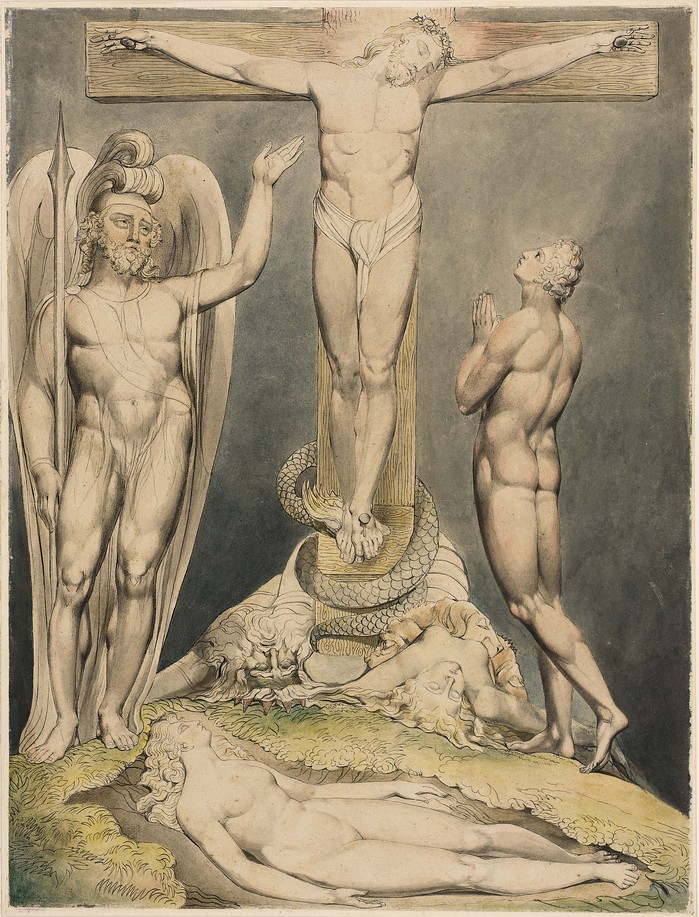
In Illustration eleven to Paradise Lost, Blake pictured Michael's vision in which he showed Adam seeing Jesus giving his life by hanging on the cross. The accomplishment of the work of redemption was indicated by the representations of the Serpent, Sin and Death lying dead at the feet of Jesus. Eve whom Milton indicated was not present when Michael presented the future of mankind, lies asleep, where she received in a dream a message tailored to her own circumstance.
 
The sleeping, dreaming Eve held great significance for Blake. His myth of creation, fall, redemption and apocalypse, included female characters - especially Enitharmon and Vala - whose dream states incorporated the idea that the dominance of woman over man epitomized the fallen state of turmoil and suffering. The image of Eve lying asleep in a grave-like depression represented for Blake a foretelling of the end of female (the outer, material) dominance which was required when mankind entered Eternity. 
 
Jerusalem, Plate 92, (E 252)
"So Los spoke. Enitharmon answerd in great terror in Lambeths Vale

The Poets Song draws to its period & Enitharmon is no more.
For if he be that Albion I can never weave him in my Looms
But when he touches the first fibrous thread, like filmy dew   
My Looms will be no more & I annihilate vanish for ever
Then thou wilt Create another Female according to thy Will.

Los answerd swift as the shuttle of gold. Sexes must vanish & cease
To be, when Albion arises from his dread repose O lovely Enitharmon:
When all their Crimes, their Punishments their Accusations of Sin: 
All their Jealousies Revenges. Murders. hidings of Cruelty in Deceit
Appear only in the Outward Spheres of Visionary Space and Time.
In the shadows of Possibility by Mutual Forgiveness forevermore
And in the Vision & in the Prophecy, that we may Foresee & Avoid
The terrors of Creation & Redemption & Judgment." 
.
 

Tuesday, August 15, 2017

PARADISE LOST 12


Wikipedia Commons
Illustrations to Milton's Paradise Lost
Illustration 12
The Expulsion
Genesis 3
[20] And Adam called his wife's name Eve; because she was the mother of all living.
[21] Unto Adam also and to his wife did the LORD God make coats of skins, and clothed them.
[22] And the LORD God said, Behold, the man is become as one of us, to know good and evil: and now, lest he put forth his hand, and take also of the tree of life, and eat, and live for ever:
[23] Therefore the LORD God sent him forth from the garden of Eden, to till the ground from whence he was taken.
[24] So he drove out the man; and he placed at the east of the garden of Eden Cherubims, and a flaming sword which turned every way, to keep the way of the tree of life.


Blake's twelfth illustration to Milton's Paradise Lost shows the exit of Adam and Eve from Eden escorted by the angel Michael. There could be no turning back because the gate was closed behind and guarded by the flaming swords of the Cherubims.

As we consider the exit of Adam and Eve from the Garden of Eden, we confront the question of the entrance they made into the world of generation. The next stage of psychic development must have required that they learn to make choices between good and evil. The protected environment of the garden without challenges in the outer world would have forced them to remain inept at evolving inwardly. Man was created in the image of God. To be fully human he needed to become adept at choosing the good when tempted. The missteps and errors which were implicit in living on earth contributed to developing a psyche which was capable of discerning a path of obedience which was voluntary and chosen from strength not weakness. 

The first lines of Paradise Lost reveal both the plot and the ending:

" Of man’s first disobedience, and the fruit
Of that forbidden tree, whose mortal taste
Brought death into the world, and all our woe,
With loss of Eden, till one greater man
Restore us, and regain the blissful seat,"


Milton was using this well known story to reveal the possibilities for mankind to correct the errors that chained him to moral failure, bodily suffering and spiritual poverty. He was relating from experience, and was writing to inform both individuals and the nation. He intended to do more that show the spiritual consequences for Adam and Eve of failing to observe the rules which were implicit in their society; Paradise Lost was meant to show political consequences as well. Throughout his career the two aims of Milton's thought and writing were to set men free from the bondage of tyranny and from imposed religion. He was not an anarchist. He believed that the Providence of God would lead man to the same liberty of mind and spirit that Blake promoted. If man were to cultivate a 'paradise within' resulting from his deeds of faith, virtue, patience, temperance, and love his happiness was assured.
 

Anna Beer in her biography, Milton: Poet, Pamphleteer, and Patriot made the following statement about the reader's responsibility as he pursued Paradise Lost:
 

"Milton is attempting to rouse the political nation...
The reader's involvement is critical, not just spiritually and emotionally, but politically. Milton believed that republicanism was the best mode of government for his country, but he also, by the time of writing Paradise Lost, knew what the English people would not, perhaps could not, deliver it.
...
Yet, alongside this elitist view is a concern to create those leaders, to create a nation that can enjoy political and religious liberty. Paradise Lost seeks to create 'fit readers', not just to preach to them. The hope is that those who pick it up will, through reading it, be able, for example to see how tyrants gain their power and, perhaps, next time, stand firm against tyranny. Paradise Lost therefore demands and creates readers who will be able to be alert to all its complexities, able to appreciate its ironies, able to share its anger and its compassion." (Page 347) 

Paradise Lost
John Milton
Book XII

Line 466
[Adam heard the promise of salvation]
 "So spake the archangel Michael; then paused,
As at the world's great period; and our sire,
Replete with joy and wonder, thus replied.
Oh goodness infinite, goodness immense!
That all this good of evil shall produce,
And evil turn to good; more wonderful
Than that which by creation first brought forth
Light out of darkness! Full of doubt I stand,
Whether I should repent me now of sin
By me done, and occasioned; or rejoice
Much more, that much more good thereof shall spring;
To God more glory, more good-will to men
From God, and over wrath grace shall abound.
But say, if our Deliverer up to Heaven
Must re-ascend, what will betide the few
His faithful, left among the unfaithful herd,
The enemies of truth? Who then shall guide
His people, who defend? Will they not deal
Worse with his followers than with him they dealt?
Be sure they will, said the angel; but from Heaven
He to his own a comforter will send,
The promise of the Father, who shall dwell
His Spirit within them; and the law of faith,
Working through love, upon their hearts shall write,
To guide them in all truth; and also arm
With spiritual armor, able to resist
Satan's assaults, and quench his fiery darts;"

Line 610
[Eve speaks]
"Whence thou returnest, and whither wentest, I know;
For God is also in sleep; and dreams advise,
Which he hath sent propitious, some great good
Presaging, since with sorrow and heart's distress
Wearied I fell asleep: But now lead on;
In me is no delay; with thee to go,
Is to stay here; without thee here to stay,
Is to go hence unwilling; thou to me
Art all things under Heaven, all places thou,
Who for my willful crime art banished hence.
This further consolation yet secure
I carry hence; though all by me is lost,
Such favor I unworthy am vouchsafed,
By me the Promised Seed shall all restore.
So spake our mother Eve; and Adam heard
Well pleased, but answered not: For now, too nigh
The archangel stood; and, from the other hill
To their fixed station, all in bright array
The Cherubim descended; on the ground
Gliding meteorous, as evening-mist
Risen from a river o'er the marsh glides,
And gathers ground fast at the laborer’s heel
Homeward returning. High in front advanced,
The brandished sword of God before them blazed,
Fierce as a comet; which with torrid heat,
And vapor as the Libyan air adust,
Began to parch that temperate clime; whereat
In either hand the hastening angel caught
Our lingering parents, and to the eastern gate
Led them direct, and down the cliff as fast
To the subjected plain; then disappeared.
They, looking back, all the eastern side beheld
Of Paradise, so late their happy seat,
Waved over by that flaming brand; the gate
With dreadful faces thronged, and fiery arms:
Some natural tears they dropt, but wiped them soon;
The world was all before them, where to choose
Their place of rest, and Providence their guide:
They, hand in hand, with wandering steps and slow,
Through Eden took their solitary way."

Jerusalem, Plate 13, (E 156)
"And that toward Eden, four, form'd of gold, silver, brass, & iron.

The South, a golden Gate, has four Lions terrible, living!
That toward Generation, four, of iron carv'd wondrous:
That toward Ulro, four, clay bak'd, laborious workmanship
That toward Eden, four; immortal gold, silver, brass & iron.     

The Western Gate fourfold, is closd: having four Cherubim
Its guards, living, the work of elemental hands, laborious task!
Like Men, hermaphroditic, each winged with eight wings
That towards Generation, iron; that toward Beulah, stone;
That toward  Ulro, clay: that toward Eden, metals.               
But all clos'd up till the last day, when the graves shall yield their dead"

Marriage of Heaven & Hell, Plate 14, (E 39)
   "The ancient tradition that the world will be consumed in fire
at the end of six thousand years is true. as I have heard from
Hell.
   For the cherub with his flaming sword is hereby commanded to 
leave his guard at the tree of life, and when he does, the whole 
creation will be consumed, and appear infinite and holy whereas
it now  appears finite & corrupt.
   This will come to pass by an improvement of sensual enjoyment.
   But first the notion that man has a body distinct from his
soul, is to  be expunged; this I shall do, by printing in the
infernal method, by corrosives, which in Hell are salutary and
medicinal, melting apparent surfaces away, and displaying the
infinite which was hid.
   If the doors of perception were cleansed every thing would
appear  to man as it is: infinite.
   For man has closed himself up, till he sees all things thro'
narrow chinks of his cavern."
. 

Sunday, August 13, 2017

Blake & Milton

Wikimedia Commons
British Museum
Milton
Copy A, Plate 1

In 2011 Larry taught a short enrichment course in Blake at the Senior Learning Institute of the College of Central Florida. He concluded the course with this precis of Blake's Milton.


The Mature Works


Milton, Blake's first overtly Christian work, is his testimony of faith. It's also his way of rehabilitating his childhood hero, John Milton. Finally it's a difficult poem; it contains unfathomable depths. This review can do no more than introduce the reader to the poem and call attention to some of the new elements in the mature development of Blake's myth.

Milton is a very autobiographical work. Blake used many of the characters that his readers might be familiar with from earlier works, but in this very personal poem they often assume other (although related) identities. Particularly we understand that Blake was Los, and Hayley was Satan (he had suborned Blake from his true work to hack work: from Eternity to Ulro.)

John Milton, the author of Paradise Lost, had been a major force in Blake's life; he had been many things to Blake since his childhood. In Blake's day Milton enjoyed enormous spiritual stature among the English people. Even today the general understanding of Heaven, Hell, God and Satan (among people interested in those concepts) tends to be more often Miltonic than Biblical. All subsequent English poets lived and wrote in Milton's shadow, and the greatest ones aspired to achieve an epic comparable to Paradise Lost. In the first half of his life Blake was very much under the shadow of Milton who was respected as the great epic poet of the English people.

Although Blake had much in common with the puritan poet, he disagreed with Milton about a number of things. For example, as a young man he despised the God of Paradise Lost and admired Milton's Devil. Blake made that clear in The Marriage of Heaven and Hell and tried to put Milton in his place by saying that he was of the Devil's party without knowing it. Ten years later the experience of grace empowered Blake to deal with Milton in a better way. He called him back to earth to straighten out his theology, and he identified with him and his spiritual power in a radical way. He recreated Milton as Milton had recreated the Bible.

As Blake's poem begins, Milton has been in Heaven for a hundred years, obedient although not very happy there. The 'Bard's Song' (which takes up the first third of the poem) recreates the war in Heaven of Paradise Lost. The other Eternals find the Bard's song appalling, but Milton embraces the Bard and his song. In a thrilling imaginative triumph he announces his intention of leaving Heaven to complete the work on earth that he had left undone. Although Blake doesn't say this, any Christian should recognize that Milton thus follows in the footsteps of Christ as described in the famous Kenosis passage in Philippians 2: 
Philippians 2
[5] Let this mind be in you, which was also in Christ Jesus:
[6] Who, being in the form of God, thought it not robbery to be equal with God:
[7] But made himself of no reputation, and took upon him the form of a servant, and was made in the likeness of men:
[8] And being found in fashion as a man, he humbled himself, and became obedient unto death, even the death of the cross.
[9] Wherefore God also hath highly exalted him, and given him a name which is above every name

Milton, Plate 14 [15], (E 108) "He took off the robe of the promise and ungirded himself from the oath of God.
And Milton said: "I go to Eternal Death The Nations still
Follow after the detestable Gods of Priam [king of Troy], in pomp of Warlike Selfhood."

Milton: plate 14 reads
"----contradicting and blaspheming.
When will the Resurrection come to deliver the sleeping body From corruptibility?
O when, Lord Jesus, wilt thou come?
Tarry no longer, for my soul lies at the gates of death.
I will arise and look forth for the morning of the grave:
I will go down to the sepulcher to see if morning breaks:
I will go down to self annihilation and eternal death, Lest the Last Judgment come and find me unannihilate
And I be seized and given into the hands of my own Selfhood"

Anyone familiar with the gospel story will see biblical allusions and references here.

In Blake's cottage he sees Milton's shadow, a horrible vision:

Milton Plate 37:
"Miltons Shadow heard & condensing all his Fibres
Into a strength impregnable of majesty & beauty infinite
I saw he was the Covering Cherub & within him Satan
And Rahab, ... in the Selfhood deadly
And he appeard the Wicker Man of Scandinavia in whom
Jerusalems children consume in flames among the Stars
Descending down into my Garden, a Human Wonder of God
Reaching from heaven to earth a Cloud & Human Form
I beheld Milton with astonishment & in him beheld
The Monstrous Churches of Beulah, the Gods of Ulro dark
Twelve monstrous dishumanizd terrors Synagogues of Satan.
...
All these are seen in Miltons Shadow who is the Covering Cherub
The Spectre of Albion"

An attempt to translate this visionary poetry into "common sense" might suggest that in Milton's shadow Blake suddenly became immediately aware of all the fallen nature of the world (and his own mind) that had consumed most of his poetry to that point. Now he became aware of all these things, but in the light of a person now full of light.
Back on earth Milton encounters many of the characters whom we met in The Four Zoas. Tirzah and Rahab tempt him; his contest with Urizen has special interest as a record of the resolution of Blake's life long struggle with the things that Urizen represented to him:

"Silent they met and silent strove among the streams of Arnon  Even to Mahanaim, when with cold hand Urizen stoop'd down
And took up water from the river Jordan, pouring on
To Milton's brain the icy fluid from his broad cold palm.
But Milton took of the red clay of Succoth, moulding it with care
Between his palms and filling up the furrows of many years,
Beginning at the feet of Urizen, and on the bones
Creating new flesh on the Demon cold and building him
As with new clay, a Human form in the Valley of Beth Peor." 
[Milton, Plate 19 [21], (E 112)]

A Bible dictionary, or even better, Damon's Blake Dictionary, will help to clarify the associations with biblical locations. Here we see the old Urizen still trying to freeze the poet's brain, but instead he finds himself being humanized by an emissary from Heaven. Blake is vividly depicting the battle between the forces of positivism and spirit.

Milton meets other obstacles and temptations on his journey, a journey that begins to bear increasing resemblance to that of Bunyan's Pilgrim or even of Jesus himself. He unites with Los and with Blake. He finally meets Satan, confronts him and overcomes him as Jesus had done. These dramatic events give Blake ample opportunity to describe in detail the eternal and satanic dimensions of life, the conflict between the two and the inevitable victory of the eternal. For the first and perhaps the only time Blake is writing a traditional morality story.

This material is autobiographical and written in the honeymoon phase of his new spiritual life. Blake's full meanings yield only to intensive study, but from the beginning there are thrilling lines to delight and inspire the reader. In his esoteric language Blake describes for us what has happened to him, and nothing could be more engrossing for the reader interested in the life of the spirit and in Blake. The relationship of this story to the myth described above should be obvious. But Milton is more real than the previous material because Blake has lived it and writes (and sketches) with spiritual senses enlarged and tuned by his recent experience of grace.
 
A digression occurs in the second half of Book One of Milton, a detailed description of the "World of Los"; it contains much of Blake's most delightful poetry. The reader will remember that in 4Z Los had passed through several stages of development. Beginning as the primitive prophetic boy, he became first disciple and later adversary of Urizen. He bound Urizen into fallen forms of life, then 'became what he beheld'. But in Night VII of the Four Zoas we recall that he embraced his Spectre, actually the Urizen within, and thereupon Los became the hero of the epic.

Letters, To Flaxman, (E 707) 
"Now my lot in the Heavens is this; Milton lovd me in childhood & shewd me his face Ezra came with Isaiah the Prophet, but Shakespeare in riper years gave me his hand Paracelsus & Behmen appeard to me. terrors appeard in the Heavens above And in Hell beneath & a mighty & awful change threatend the Earth The American War began All its dark horrors passed before my face" 

 Milton, Plate 28, [30], (E 126) 
"But others of the Sons of Los build Moments & Minutes & Hours
And Days & Months & Years & Ages & Periods; wondrous buildings   
And every Moment has a Couch of gold for soft repose,
(A Moment equals a pulsation of the artery)    ,
And between every two Moments stands a Daughter of Beulah
To feed the Sleepers on their Couches with maternal care.
And every Minute has an azure Tent with silken Veils.         
And every Hour has a bright golden Gate carved with skill.
And every Day & Night, has Walls of brass & Gates of adamant,
Shining like precious stones & ornamented with appropriate signs:
And every Month, a silver paved Terrace builded high:
And every Year, invulnerable Barriers with high Towers.    
And every Age is Moated deep with Bridges of silver & gold.
And every Seven Ages is Incircled with a Flaming Fire.
Now Seven Ages is amounting to Two Hundred Years
Each has its Guard. each Moment Minute Hour Day Month & Year.
All are the work of Fairy hands of the Four Elements             
The Guard are Angels of Providence on duty evermore
Every Time less than a pulsation of the artery
Is equal in its period & value to Six Thousand Years.

PLATE 29 [31]
For in this Period the Poets Work is Done: and all the Great
Events of Time start forth & are concievd in such a Period
Within a Moment: a Pulsation of the Artery."

Saturday, August 5, 2017

Blake and Religion

This post was first published on Monday August 02, 2010 by Larry.

Northrup Frye, an ordained Canadian minister, as a young man wrote a thesis entitled Fearful Symmetry, which became the influential exposure of Blake's thought to the academic world. His primary calling became English Literary Criticism, and he won signal distinction in that field (especially a book called The Anatomy of Criticism).

Later in life Frye said that if he had it to do over he would not write a sophisticated academic work about Blake, but something more like Percival's introductory survey. He called his last (monumental!) two volume work The Great Code: The Bible as Literature. That's an invaluable work for learning Blake.

 
British Museum 
Illustrations to Young's Night Thoughts
In Britain's early 19th Century the Enlightenment had a marked effect on religious thought; Deism was ascendant - the idea that God created the world and wound it up like a clock and thereafter retired from any interest in it. We are to God what ants are to us.

As you can imagine Bible soaked and God intoxicated Blake despised Deism. But he equally despised what he took to be the opposite, which he called (among other things) Druidism, the most primitive form of religion, including human sacrifice.

Druidism fit Blake's concept of established religion, whose leaders enthusiastically supported the king's wars; in the same way the religious leaders today have emphatically supported the government's wars. (The government, established religion and the military industrial complex were like three peas in a pod in Blake's day.)

Here's one of Blake's reactions to that sad reality:

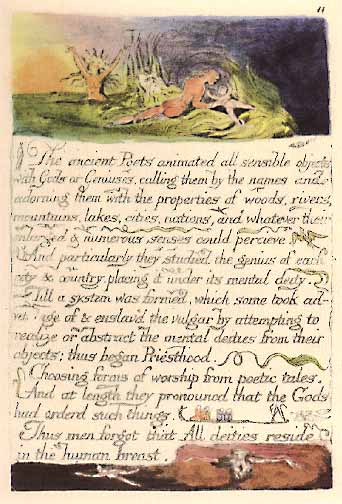
Marriage of Heaven and Hell, Plate 11, (E 38)
"The ancient Poets animated all sensible objects with Gods or Geniuses, calling them by the names and adorning them with the properties of woods, rivers, mountains, lakes, cities, nations, and whatever their enlarged & numerous senses could percieve.
And particularly they studied the genius of each city & country, placing it under its mental deity.
Till a system was formed, which some took advantage of & enslav'd the vulgar by attempting to realize or abstract the mental deities from their objects; thus began Priesthood.

Choosing forms of worship from poetic tales.
And at length they pronounc'd that the Gods had order'd such things.
Thus men forgot that All deities reside in the human breast."
According to Blake God is within - you and me, everyone. In this he closely resembles the Quakers who fundamentally speak of that of God in you/me/everyone. The God within is creative, a Creator of Art. This depends upon imagination, intuition, the expression of spiritual/eternal ideas in tangible things - like words (the Bible), music, and representations of the human form in its various states.

Here's an example in Blake's Laocoon (E274) of how he expressed this idea:

"Prayer is the Study of Art
Praise is the Practise of Art
Fasting &c. all relate to Art
The outward Ceremony is Antichrist
Without Unceasing Practise nothing can be done

Practise is Art If you leave off you are Lost

A Poet a Painter a Musician an Architect: the Man
Or Woman who is not one of these is not a
Christian" 
. 

Thursday, August 3, 2017

MILTON & JOB


Jung developed a technique he called 'active imagination' which put him in touch with facets of his inner world.

You might say that Blake had experienced altered states of consciousness by exploring his inner world. Blake seems to be applying an understanding of various states of consciousness when describing Milton's entry into multiple levels of awareness of inner and outer realities.

Milton, PLATE 15 [17], (E 109)
"As when a man dreams, he reflects not that his body sleeps,
Else he would wake; so seem'd he entering his Shadow: but
With him the Spirits of the Seven Angels of the Presence
Entering; they gave him still perceptions of his Sleeping Body;
Which now arose and walk'd with them in Eden, as an Eighth
Image Divine tho' darken'd; and tho walking as one walks
In sleep; and the Seven comforted and supported him.

Like as a Polypus that vegetates beneath the deep!
They saw his Shadow vegetated underneath the Couch
Of death: for when he enterd into his Shadow: Himself:
His real and immortal Self: was as appeard to those
Who dwell in immortality, as One sleeping on a couch
Of gold; and those in immortality gave forth their Emanations
Like Females of sweet beauty, to guard round him & to feed
His lips with food of Eden in his cold and dim repose!

But to himself he seemd a wanderer lost in dreary night."

Blake talks about the dream state, the waking state, consciousness of the Shadow, awareness of the inner guide or protector, and becoming conscious of the 'immortal Self' (which Jung call the Self). Finally there is recognition of the Emanations or Jung's Anima.
Wikipedia CommonsIllustrations to the Book of Job
Linnell Set, Page 11
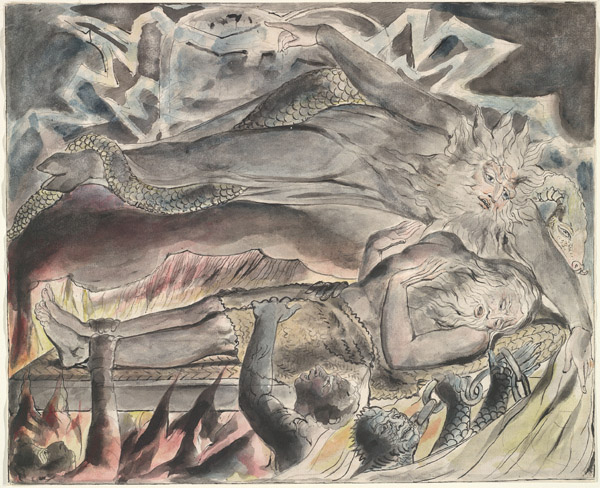
Job's Evil Dreams
Blake portrays another dream state in the Book of Job, Plate 11.

According to Edinger in Encounter with the Self, this picture illustrates Job's remark in the Book of Job, 7:13-14:

"If I say, 'My bed will comfort me,
my couch will soothe my pain,'
you frighten me with dreams
and terrify me with visions."

Aspects of Job's unconscious of which he was previously unaware have been activated. Likewise the scene in Milton portrays the activation of facets of his unconscious which will play a role in Milton's exploration of his psychic depths as the poem unfolds. 

.
.