First posted in Oct 2009.
This might be considered Blake's first attempt to create his own system
(in order not to be "enslaved by another's"). He at least begins the
myth; but through the years it will take many turns.
Plate 3
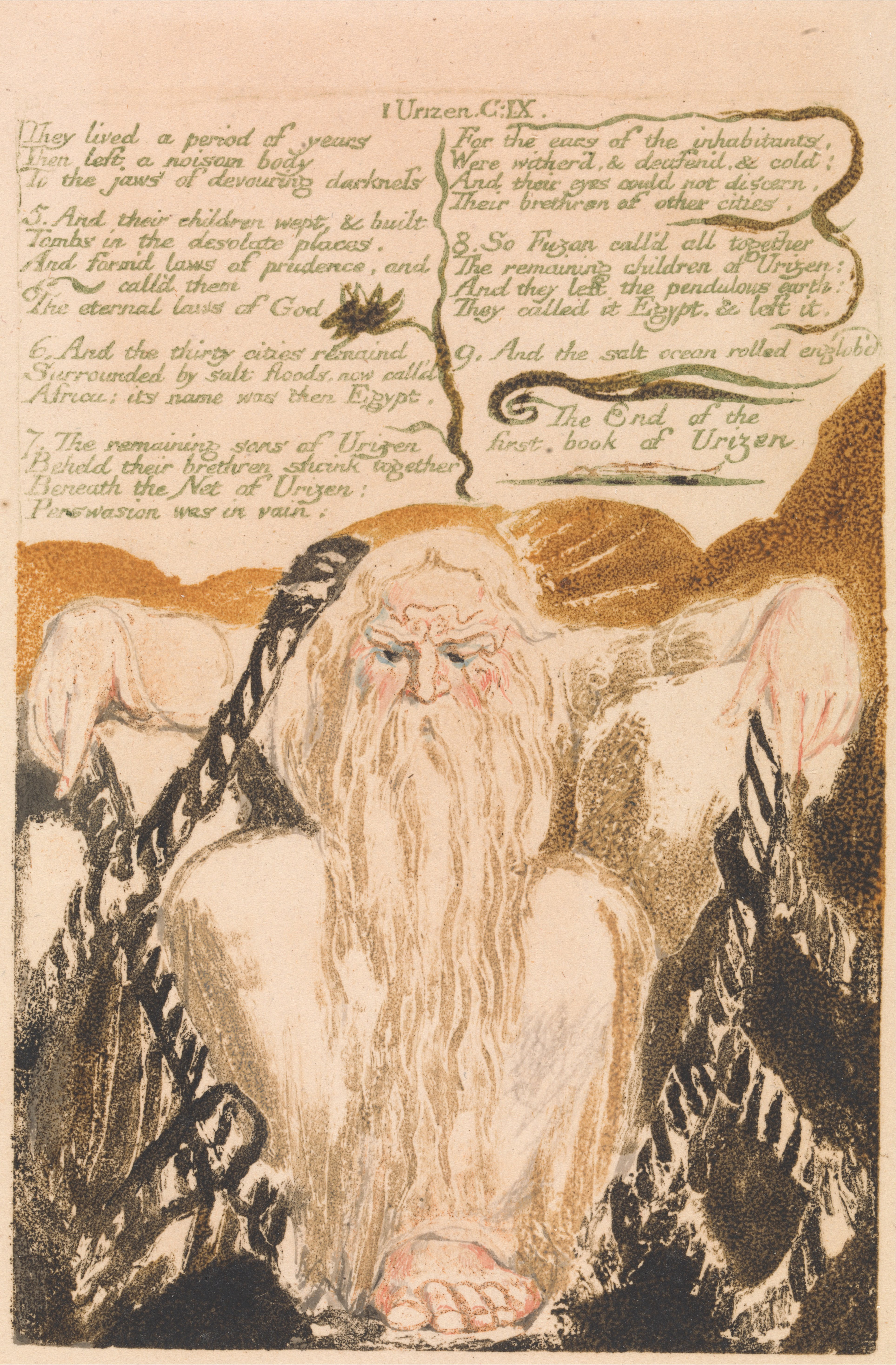
He began with 'a horrible event', the separation
of Urizen from Eternity, from a condition where
Earth was not; Death was not. For most of the book things are going from bad to worse.
Urizen proceeded to write the Book of Brass with the "seven deadly sins
of the soul", with laws of peace, laws of love, of unity.... one
command, one joy, one King, one Law.
Plate 5
After aeons of anguish and howlings and pains and fierce madness "the vast world of Urizen appeared".
Los (introduced here) "kept watch for the Eternals
to confine the obscure separation alone".
Plate 6
"Los wept.....Urizen was rent from his side...
and rent from Eternity." And "the Eternals said
'what is this? Death. Urizen is a clod of clay.'"
In Plate 9 "Los howl'd in a dismal stupor....till the wrenching apart was healed.
But the wrenching of Urizen heal'd not."
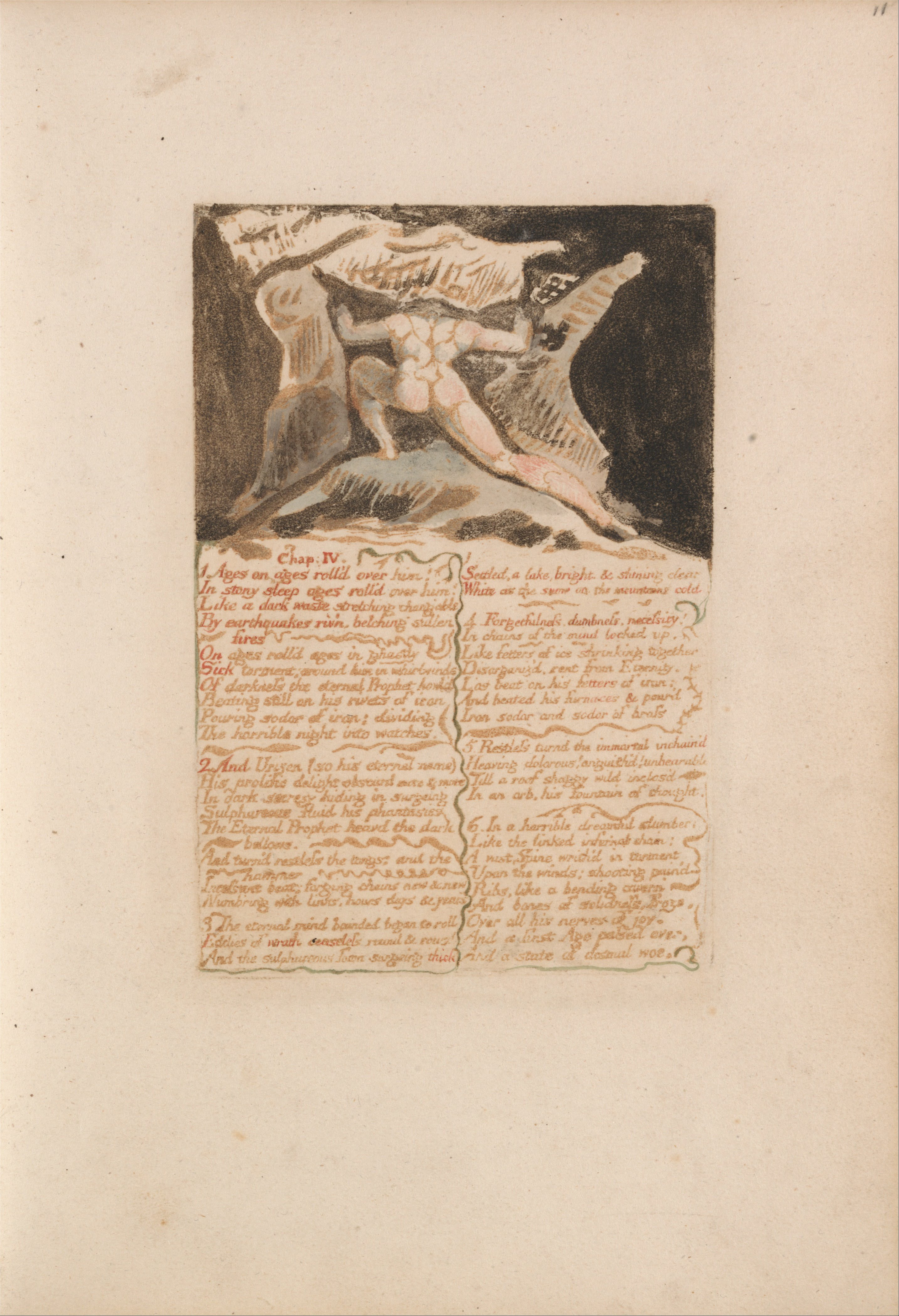
In Plate 12 Los, "The Eternal Prophet" (a blacksmith) proceeds to work on Urizen who was cursed by
"Forgetfulness, dumbness,necessity!
In chains of the mind locked up."
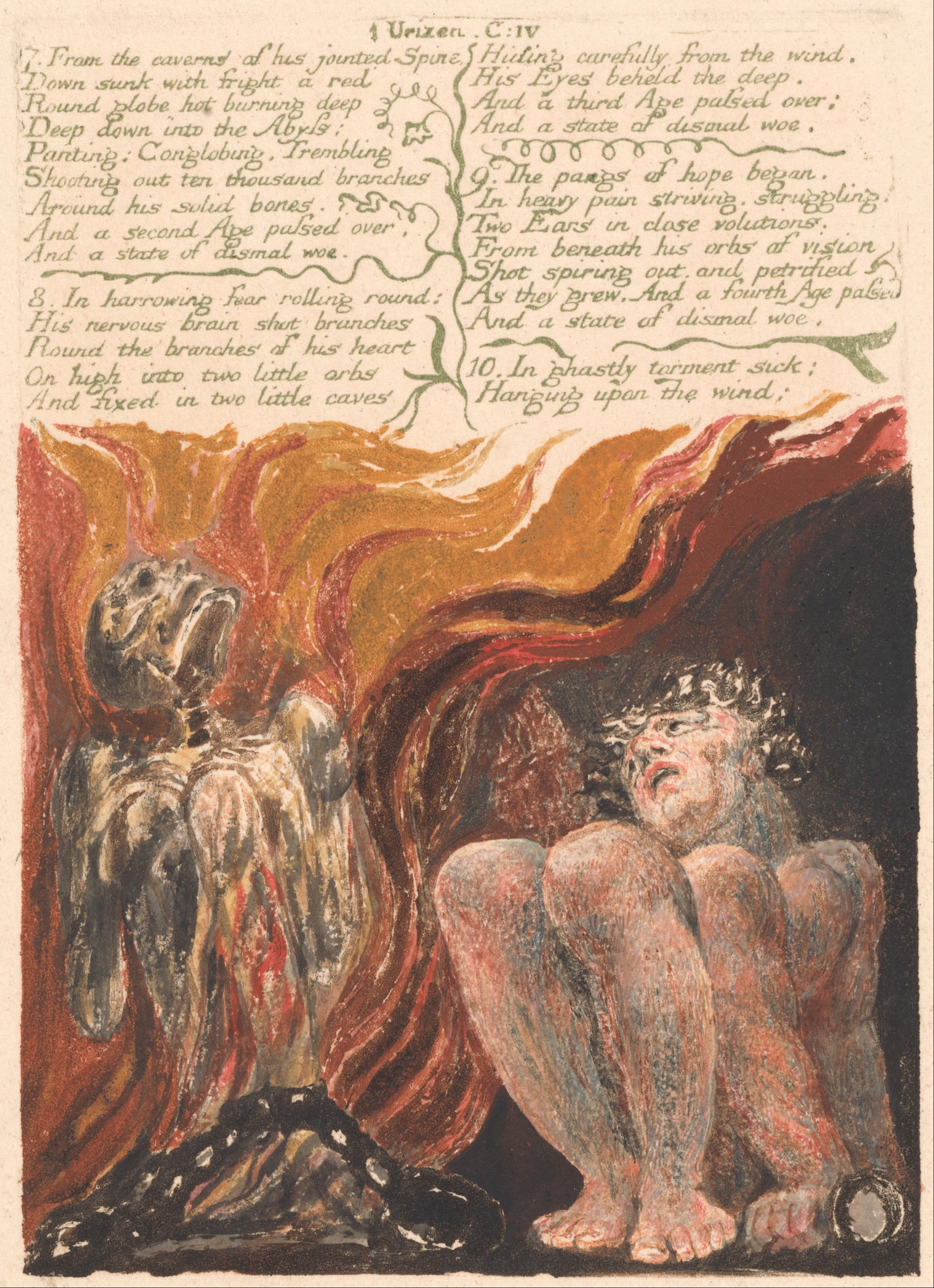
Thus began the Seven Ages in which Los gave the five senses to Urizen; each one involved "a state of dismal woe". (Plate 12-13, and 15)
Los appreciated the misery and horror of Urizen's state, but
nevertheless "The Eternal Prophet and Urizen clos'd"; (a pregnant
sentence! Urizen had been rent from Los' side (in plate 7), but now in Plate 15 they clos'd.
Plate 16
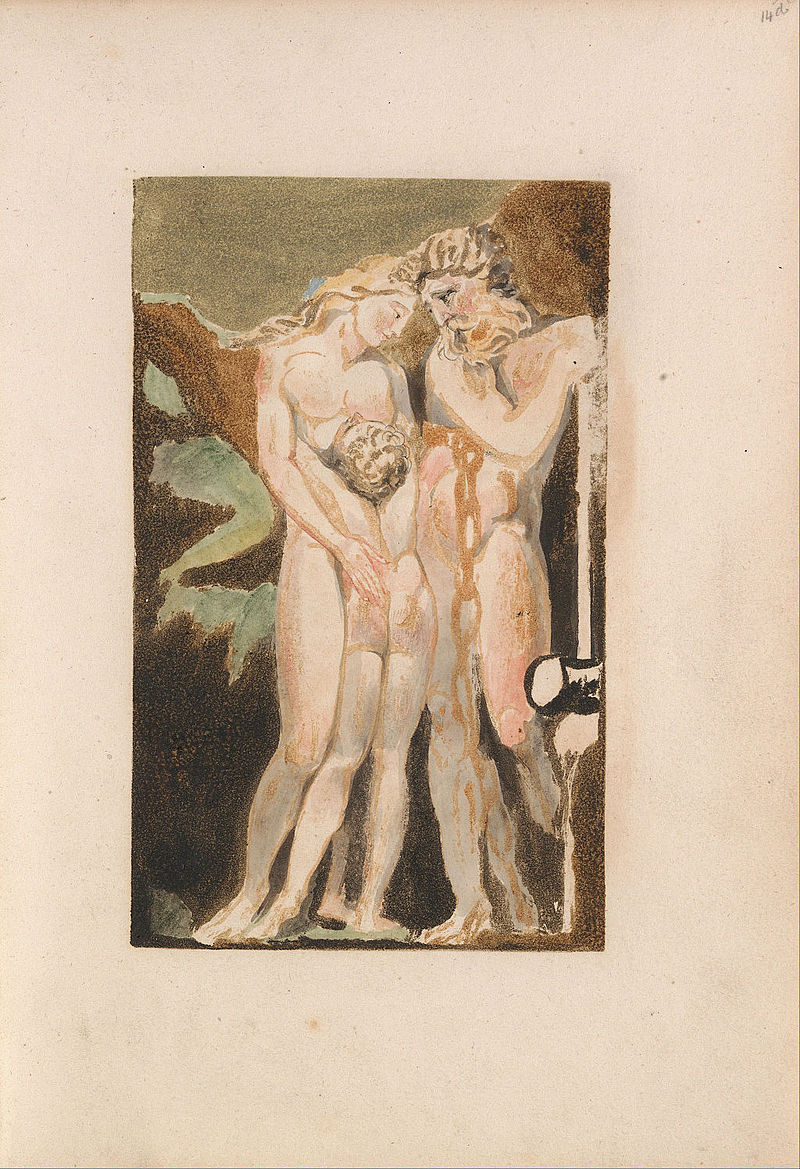
Which led to Pity, which led to a globe of blood which became the first
female (not very high among Blake's values,) but perhaps a precursor to
a better value! Look at The Four Zoas at the end of Night 7,
where we learn that having finally subdued his enemy, Urizen, Los find
that "his whole soul loved him he beheld him an infant."
This is a sort of turning point in the Book of Urizen.
Plate 17
The Eternals thought poorly of Los' division into male and female (cf
Matthew 2:20-25), but Los pitied and embrac'd her. In due course
Enitharmon experienced pregancy; out of that came a child whom they
called Orc. And a shriek ran thro' Eternity ...at the birth of the
Human shadow.
Plate 18
As Orc grew there developed the "Chain of Jealousy", and Orc wound up chained to the top of a mountain.
(Orc represented revolution, which Blake had found to be of little or no value!). But Enitharmon "bore and enormous race'.
Plate 22
With the "globe of fire" lighting his journey Urizen sicken'd...to see
his sons and daughters weeping, wailing. He cursed them "for he saw
that no flesh nor spirit could keep his iron laws one moment."
"For he saw that life lived upon death."
Plate 23
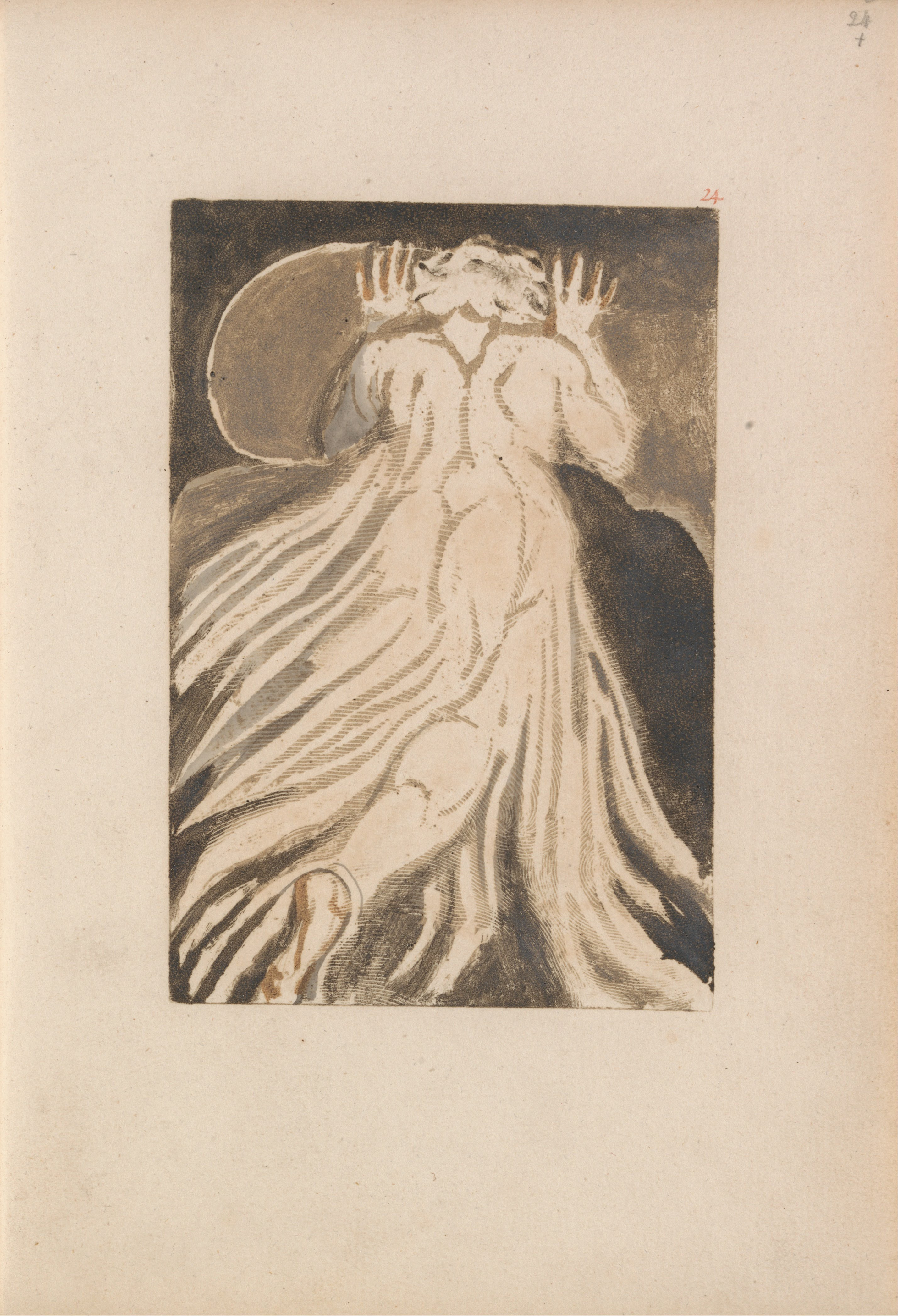
Urizen wandered in sorrow and wherever he walked a strong Web formed
(like a Female in embryo) "like to the human brain." And all call'd it
the Net of Religion.
Plate 27
"Then the inhabitants of those (Urizen's) cities for "Six days they shrunk up from existence,
And on the seventh day they rested,
And they blessed the seventh day, in sick hope
And forgot their eternal life."
At the end we might say that Fuzon (Urizen's "first begotten, last born") initiated a sort of rebellion or exodus.
.
Wednesday, July 4, 2018

Tuesday, July 3, 2018
Stones of Fire
Updated from Oct 2009.
A very prominent symbol in the Bible, 'stones' occurs 161 times in the Old and New Testaments. One that Blake especially loved accrues thus in Ezekiel:
Ezekiel 28
13 Thou hast been in Eden the garden of God; every precious stone was thy covering, the sardius, topaz, and the diamond, the beryl, the onyx, and the jasper, the sapphire, the emerald, and the carbuncle, and gold: the workmanship of thy tabrets and of thy pipes was prepared in thee in the day that thou wast created.
14 Thou art the anointed cherub that covereth; and I have set thee so: thou wast upon the holy mountain of God; thou hast walked up and down in the midst of the stones of fire.
The covering cherub! the stones of fire!
Blake may be best understood as an expander of the Bible. He made very good use of the two symbols mentioned above, and amplified the meanings used by Ezekiel:
Stones of Fire appears in the Prologue of The Gates of Paradise:
"Mutual Forgiveness of each Vice
Such are the Gates of Paradise
Against the Accusers chief desire
Who walkd among the Stones of Fire" (E 258)
To get a clue of the meaning we go to 1 Kings 18:38:
"Then the fire of the LORD fell, and consumed the burnt sacrifice, and the wood, and the stones, and the dust, and licked up the water that was in the trench."
This is from the account of Elijah's contest with the prophets of Baal.
We notice how the fire consumed the stone. We know the fire was from God, the stone a symbol of matter: Spirit burns up matter. That's Blake's message in a nutshell: spirit takes the place of matter. In our pilgrimage through life the material is gradually superseded by the spirit (God, Heaven).
'Stones of fire' represents a conjunction of matter and spirit. Ezekiel was speaking of a brilliant, successful potentate of his day, who had achieved greatly but who would be brought down by God. One such as was Lucifer, associated by Ezekiel and by Blake with the Covering Cherub (another name for Satan or the Selfhood).
Although Blake's source for the Covering Cherub was Ezekiel, Genesis 3:23 might have been Ezekiel's source:
"So he drove out the man; and he placed at the east of the garden of Eden Cherubims, and a flaming sword which turned every way, to keep the way of the tree of life."
In The Marriage of Heaven and Hell Blake had this to say about the Covering Cherub:
"The ancient tradition that the world will be consumed in fire
at the end of six thousand years is true. as I have heard from
Hell.
This shows what Blake thought of the biblical story of the Fall. In his myth the Fall occurs when man is kicked out of Eden (or just falls asleep), but the Return is set in motion also. In all versions of Blake's myth the end of the story is a happy event; the literary heads might call it a Romance rather than a Tragedy.
There's a great deal more to be said about the story of the Fall, especially about the Tree of Good and Evil; I'll tell you more about the Tree at a later date.
.
A very prominent symbol in the Bible, 'stones' occurs 161 times in the Old and New Testaments. One that Blake especially loved accrues thus in Ezekiel:
Ezekiel 28
13 Thou hast been in Eden the garden of God; every precious stone was thy covering, the sardius, topaz, and the diamond, the beryl, the onyx, and the jasper, the sapphire, the emerald, and the carbuncle, and gold: the workmanship of thy tabrets and of thy pipes was prepared in thee in the day that thou wast created.
14 Thou art the anointed cherub that covereth; and I have set thee so: thou wast upon the holy mountain of God; thou hast walked up and down in the midst of the stones of fire.
The covering cherub! the stones of fire!
Blake may be best understood as an expander of the Bible. He made very good use of the two symbols mentioned above, and amplified the meanings used by Ezekiel:
Stones of Fire appears in the Prologue of The Gates of Paradise:
"Mutual Forgiveness of each Vice
Such are the Gates of Paradise
Against the Accusers chief desire
Who walkd among the Stones of Fire" (E 258)
 |
| British Museum Gates of Paradise, For the Sexes Prologue |
"Then the fire of the LORD fell, and consumed the burnt sacrifice, and the wood, and the stones, and the dust, and licked up the water that was in the trench."
This is from the account of Elijah's contest with the prophets of Baal.
We notice how the fire consumed the stone. We know the fire was from God, the stone a symbol of matter: Spirit burns up matter. That's Blake's message in a nutshell: spirit takes the place of matter. In our pilgrimage through life the material is gradually superseded by the spirit (God, Heaven).
'Stones of fire' represents a conjunction of matter and spirit. Ezekiel was speaking of a brilliant, successful potentate of his day, who had achieved greatly but who would be brought down by God. One such as was Lucifer, associated by Ezekiel and by Blake with the Covering Cherub (another name for Satan or the Selfhood).
Although Blake's source for the Covering Cherub was Ezekiel, Genesis 3:23 might have been Ezekiel's source:
"So he drove out the man; and he placed at the east of the garden of Eden Cherubims, and a flaming sword which turned every way, to keep the way of the tree of life."
In The Marriage of Heaven and Hell Blake had this to say about the Covering Cherub:
"The ancient tradition that the world will be consumed in fire
at the end of six thousand years is true. as I have heard from
Hell.
   For the cherub with his flaming sword is hereby commanded to
leave his guard at the tree of life, and when he does, the whole
creation will be consumed, and appear infinite. and holy whereas
it now  appears finite & corrupt." (Marriage of Heaven and Hell, Plate 14)
This shows what Blake thought of the biblical story of the Fall. In his myth the Fall occurs when man is kicked out of Eden (or just falls asleep), but the Return is set in motion also. In all versions of Blake's myth the end of the story is a happy event; the literary heads might call it a Romance rather than a Tragedy.
There's a great deal more to be said about the story of the Fall, especially about the Tree of Good and Evil; I'll tell you more about the Tree at a later date.
.
Monday, July 2, 2018
AFTER BARD'S SONG
First posted by Larry in Oct 2009.
The Bard's Song led to a loud murmuring in the Heavens of Albion, and "the loud voic'd Bard terrify'd took refuge in Miltons bosom;" then Milton "took off the robe of the promise, & ungirded himself from the oath of God.
Milton, Plate 14 [15], (E 108)
"And Milton said, I go to Eternal Death! The Nations still
Follow after the detestable Gods of Priam; in pomp
Of warlike selfhood, contradicting and blaspheming.
When will the Resurrection come; to deliver the sleeping body
From corruptibility: O when Lord Jesus wilt thou come?
Tarry no longer; for my soul lies at the gates of death.
I will arise and look forth for the morning of the grave.
I will go down to the sepulcher to see if morning breaks!
I will go down to self annihilation and eternal death,
Lest the Last Judgment come & find me unannihilate."
And I be siez'd & giv'n into the hands of my own Selfhood
The Lamb of God is seen thro' mists & shadows, hov'ring
Over the sepulchers in clouds of Jehovah & winds of Elohim
A disk of blood, distant; & heav'ns & earth's roll dark between
What do I here before the Judgment? without my Emanation?
With the daughters of memory, & not with the daughters of
inspiration[?]
I in my Selfhood am that Satan: I am that Evil One!
He is my Spectre! in my obedience to loose him from my Hells
To claim the Hells, my Furnaces, I go to Eternal Death."
The way Blake saw him.
This
of course is a climactic moment in the poem. An unheard of thing! One
leaves Heaven to return to 'this vale of tears'. Well, not quite
unprecedented; Milton simply followed the path of Jesus. In that way
Blake gave Milton (the man) the highest approval possible.
Blake's myth was to a large degree patterned after Paradise Lost. His difference with Milton resembled one of those "severe contentions of Friendship." Milton had spoken; Blake replied in MHH; now he replies again! That's the shape of the poem as far as Blake himself was concerned.
Thereafter Milton allied himself with Los, giving with Blake a triumvirate against which none could stand.
Milton is an essay describing the triumph of Jesus over all the forces of the world.
It is difficult to immediately grasp, but yields immense returns to anyone determined enough to come to an understanding of it.
.
.
The Bard's Song led to a loud murmuring in the Heavens of Albion, and "the loud voic'd Bard terrify'd took refuge in Miltons bosom;" then Milton "took off the robe of the promise, & ungirded himself from the oath of God.
Milton, Plate 14 [15], (E 108)
"And Milton said, I go to Eternal Death! The Nations still
Follow after the detestable Gods of Priam; in pomp
Of warlike selfhood, contradicting and blaspheming.
When will the Resurrection come; to deliver the sleeping body
From corruptibility: O when Lord Jesus wilt thou come?
Tarry no longer; for my soul lies at the gates of death.
I will arise and look forth for the morning of the grave.
I will go down to the sepulcher to see if morning breaks!
I will go down to self annihilation and eternal death,
Lest the Last Judgment come & find me unannihilate."
And I be siez'd & giv'n into the hands of my own Selfhood
The Lamb of God is seen thro' mists & shadows, hov'ring
Over the sepulchers in clouds of Jehovah & winds of Elohim
A disk of blood, distant; & heav'ns & earth's roll dark between
What do I here before the Judgment? without my Emanation?
With the daughters of memory, & not with the daughters of
inspiration[?]
I in my Selfhood am that Satan: I am that Evil One!
He is my Spectre! in my obedience to loose him from my Hells
To claim the Hells, my Furnaces, I go to Eternal Death."
The way Blake saw him.
 |
| British Museum Milton Plate 13 |
Blake's myth was to a large degree patterned after Paradise Lost. His difference with Milton resembled one of those "severe contentions of Friendship." Milton had spoken; Blake replied in MHH; now he replies again! That's the shape of the poem as far as Blake himself was concerned.
Thereafter Milton allied himself with Los, giving with Blake a triumvirate against which none could stand.
Milton is an essay describing the triumph of Jesus over all the forces of the world.
It is difficult to immediately grasp, but yields immense returns to anyone determined enough to come to an understanding of it.
.
.
Thursday, June 28, 2018
UNITING MILTON
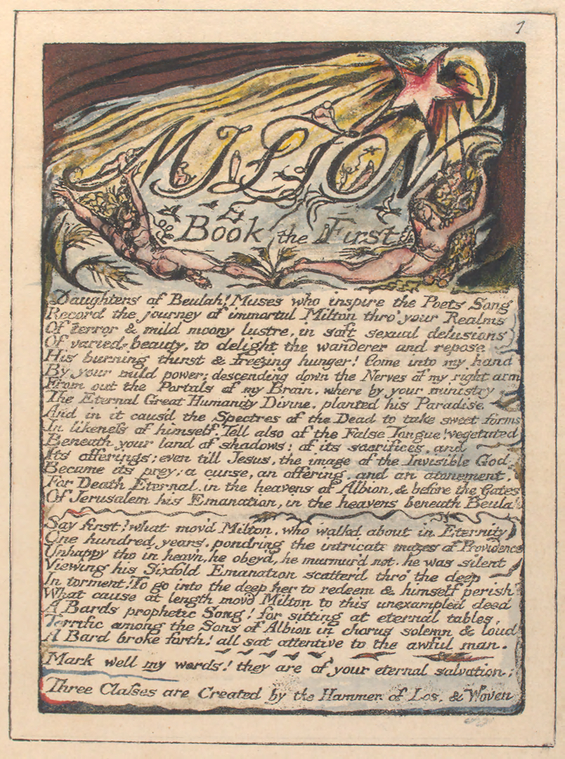 |
| New York Public Library Milton Book I, Page I, Title Page |
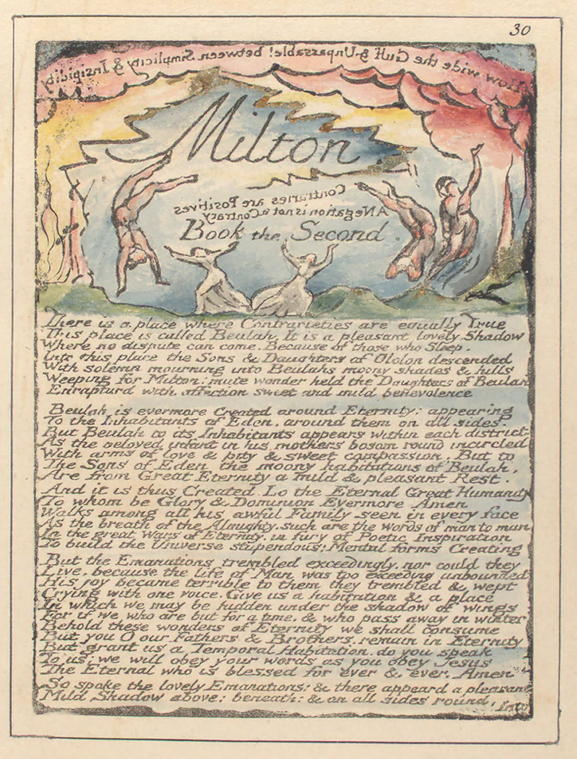 |
| New York Public Library Milton Book II, Page 30, Title Page |
The posts which followed Ololon's adventures in Book II of Milton have been rearranged so that they more easily are read in order. However, Blake's technique in presenting his revelation does not follow a straightforward path. What may appear to be repetition is Blake illuminating the same moment from various perspectives and from the point of view of multiple characters. Blake make his reader responsible for building up the import of the action which culminates in transcending our ordinary experience in time and space.
Susan Fox in Poetic Form in Blake's Milton on Page 127-8 gives us a short summary of the overall themes of the two books of Milton:
"Book I is concerned with the 'masculine' assertiveness of the poet, his responsibility to his vision and to his compeers; Book II is concerned with the 'feminine' portion which is his inspiration and support, the mercy he learns to exercise in Book I. The second book is an expansion of the single plate of Book I in which Ololon appears: on plate 21 she, having lamented of seven mornings her driving Milton into Ulro, repents and descends to him; Book II is an extended analysis of that act which, like all acts in Milton, is identical with its consequences. Book I is a poem of struggle, Book II of resolution.
...In Book I , the union is primarily the consolidation of the masculine forces of creativity; in Book II it is the concomitant merger of the feminine forces with the masculine."
Letters, To Hayley, (E 767
"You Dear Sir are one who has my Particular Gratitude. having
conducted me thro Three that would have been the Darkest Years
that ever Mortal Sufferd. which were renderd thro your means a
Mild & Pleasant Slumber.  I speak of Spiritual Things.  Not of
Natural. of Things known only to Myself & to Spirits Good &
Evil. but Not Known to Men on Earth.  It is the passage thro
these Three Years that has brought me into my Present State. & I
know that if I had not been with You I must have
Perish'd--Those Dangers are now Passed & I can see them beneath
my feet It will not be long before I shall be able to present the
full history of my Spiritual Sufferings to the Dwellers upon
Earth. & of the Spiritual Victories obtaind for me by my
Friends"
Milton, Plate 21 [23], (E 115)
"But Milton entering my Foot; I saw in the nether
Regions of the Imagination; also all men on Earth,
And all in Heaven, saw in the nether regions of the Imagination
In Ulro beneath Beulah, the vast breach of Miltons descent.
But I knew not that it was Milton, for man cannot know
What passes in his members till periods of Space & Time
Reveal the secrets of Eternity: for more extensive
Than any other earthly things, are Mans earthly lineaments."
The Library of Congress has a large collection of Blake's Illuminated Books which were donated by Lessing J. Rosenwald. The 50 plates of Copy D of Milton can be viewed in this pdf file. Perhaps you would like to read at least part of Milton plate by plate as Blake intended it to be read
.
DESCENT OF OLOLON
 |
| Wikipedia
Commons Illustrations to Milton's On the Morning of Christ's Nativity Annunciation to Shepherds |
In the second book of Milton Ololon followed Milton out of Eternity into the world of matter. She mistakenly thought that she had forced Milton to descend from Eden into our world of Generation. She elected to enter the lowest level of decay and be exposed to depravity.
In Eternity Blake's Ololon was not an individual but a multitude of spirits. She was striped of her retinue and becomes singular in order to experience the world of mortality. Before entering she looked through the Gates of the Dead and saw the world that mankind had created without the imaginative vision which he had lost in the Fall from Eden. She saw that she must fully participate in the society which had grown out of the failure to love and nurture and forgive, and which lay in stark brutality before her. She could not avoid passing the Polypus - the ugly, grasping manifestations of 'man's inhumanity to man.' But beyond the Polypus lay Golgonooza - the efforts that man makes to live by Eternal principles in spite of what he sees happening around him.
Milton, Plate 34 [38], (E 134)
"Seeing Miltons Shadow, some Daughters of Beulah trembling
Returnd, but Ololon remaind before the Gates of the Dead

And Ololon looked down into the Heavens of Ulro in fear
They said. How are the Wars of Man which in Great Eternity
Appear around, in the External Spheres of Visionary Life
Here renderd Deadly within the Life & Interior Vision
How are the Beasts & Birds & Fishes, & Plants & Minerals
Here fixd into a frozen bulk subject to decay & death?
Those Visions of Human Life & Shadows of Wisdom & Knowledge
Plate 35 [39]
Are here frozen to unexpansive deadly destroying terrors.
And War & Hunting: the Two Fountains of the River of Life
Are become Fountains of bitter Death & of corroding Hell
Till Brotherhood is changd into a Curse & a Flattery
By Differences between Ideas, that Ideas themselves, (which are
The Divine Members) may be slain in offerings for sin
O dreadful Loom of Death! O piteous Female forms compelld
To weave the Woof of Death, On Camberwell Tirzahs Courts
Malahs on Blackheath, Rahab & Noah. dwell on Windsors heights
Where once the Cherubs of Jerusalem spread to Lambeths Vale
Milcahs Pillars shine from Harrow to Hampstead where Hoglah
On Highgates heights magnificent Weaves over trembling Thames
To Shooters Hill and thence to Blackheath the dark Woof! Loud
Loud roll the Weights & Spindles over the whole Earth let down
On all sides round to the Four Quarters of the World, eastward on
Europe to Euphrates & Hindu, to Nile & back in Clouds
Of Death across the Atlantic to America North & South

So spake Ololon in reminiscence astonishd, but they
Could not behold Golgonooza without passing the Polypus
A wondrous journey not passable by Immortal feet, & none
But the Divine Saviour can pass it without annihilation.
For Golgonooza cannot be seen till having passd the Polypus
It is viewed on all sides round by a Four-fold Vision
Or till you become Mortal & Vegetable in Sexuality
Then you behold its mighty Spires & Domes of ivory & gold"
.
Wednesday, June 27, 2018
MIGHTY ANGEL
 |
| Illustration to Milton's L'Allegro and Il Penseroso Night Startled by the Lark |
As Blake saw it, the Immortals who lived in Eternity took the initiative of reaching down to him and entering the world of mortality. They sent a messenger in the form of a mighty angel, but on earth the appearance was that of a Lark:
Milton, Plate 31 [34], (E 130)
"The Lark sitting upon his earthy bed: just as the morn
Appears; listens silent; then springing from the waving Corn-field! loud
He leads the Choir of Day! trill, trill, trill, trill,
Mounting upon the wings of light into the Great Expanse:
Reecchoing against the lovely blue & shining heavenly Shell:
His little throat labours with inspiration; every feather
On throat & breast & wings vibrates with the effluence Divine
All Nature listens silent to him & the awful Sun
Stands still upon the Mountain looking on this little Bird"
The arrival of Ololon in Blake's cottage garden at Felpham was announced by the voice of the lark. She appeared not in time and space but in a flash of illumination like lightening. Blake was describing a vision in which Ololon assumed the appearance of a prepubescent child. She was innocent - unmarred by the demands or wounds which the world inflicts. She would become a vehicle for reconciliation.
Milton 36 [40], (E 136)
"Thus are the Messengers dispatchd till they reach the Earth again
In the East Gate of Golgonooza, & the Twenty-eighth bright
Lark met the Female Ololon descending into my Garden
Thus it appears to Mortal eyes & those of the Ulro Heavens
But not thus to Immortals, the Lark is a mighty, Angel.

For Ololon step'd into the Polypus within the Mundane Shell
They could not step into Vegetable Worlds without becoming
The enemies of Humanity except in a Female Form
And as One Female, Ololon and all its mighty Hosts
Appear'd: a Virgin of twelve years nor time nor space was
To the perception of the Virgin Ololon but as the
Flash of lightning but more  quick the Virgin in my Garden
Before my Cottage stood for the Satanic Space is delusion

For when Los joind with me he took me in his firy whirlwind
My Vegetated portion was hurried from Lambeths shades
He set me down in Felphams Vale & prepard a beautiful
Cottage for me that in three years I might write all these Visions
To display Natures cruel holiness: the deceits of Natural Religion"
.
SHADOW OF MILTON
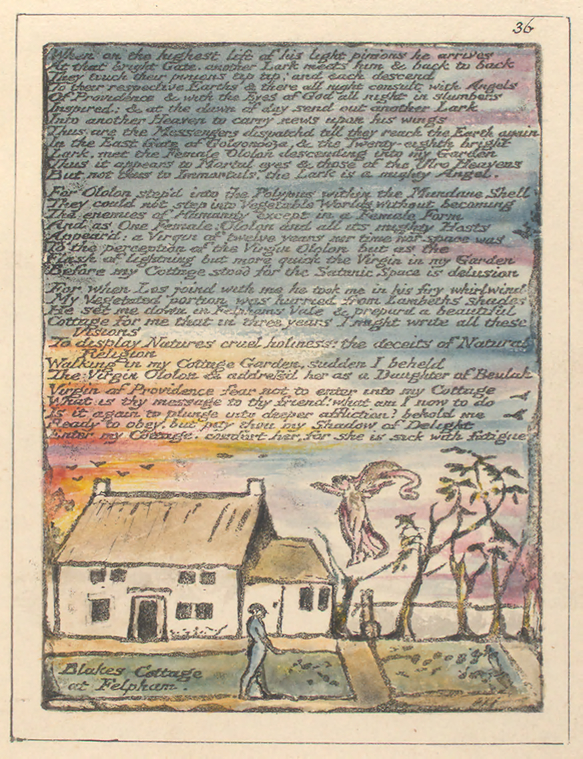 |
| New York Public Library Milton Plate 36 |
One particular error which Blake saw in Milton was his adherence to the Puritan faith which was based on a system of law and punishment. To the Puritan, man was by nature sinful and whatever adversity he experienced was God's justified punishment. Blake saw the tenets of Milton's religious faith expressed in his Paradise Lost.
It was Ololon who had been sent to complete the redemption of Milton. Blake was to be the witness to the process and to be redeemed in Milton's redemption.
Milton, Plate 36 [40], (E 137)
"Walking in my Cottage Garden, sudden I beheld
The Virgin Ololon & address'd her as a Daughter of Beulah[:]

Virgin of Providence fear not to enter into my Cottage
What is thy message to thy friend: What am I now to do
Is it again to plunge into deeper affliction? behold me
Ready to obey, but pity thou my Shadow of Delight
Enter my Cottage, comfort her, for she is sick with fatigue
Plate 37 [41]
The Virgin answerd. Knowest thou of Milton who descended
Driven from Eternity; him I seek! terrified at my Act
In Great Eternity which thou  knowest!  I come him to seek

So Ololon utterd in words distinct the anxious thought
Mild was the voice, but more distinct than any earthly
That Miltons Shadow heard & condensing all his Fibres
Into a strength impregnable of majesty & beauty infinite
I saw he was the Covering Cherub & within him Satan
And Rahab, in an outside which is fallacious! within
Beyond the outline of Identity, in the Selfhood deadly
And he appeard the Wicker Man of Scandinavia in whom
Jerusalems children consume in flames among the Stars
Descending down into my Garden, a Human Wonder of God
Reaching from heaven to earth a Cloud & Human Form
I beheld Milton with astonishment & in him beheld
The Monstrous Churches of Beulah, the Gods of Ulro dark
Twelve monstrous dishumanizd terrors Synagogues of Satan.
A Double Twelve & Thrice Nine: such their divisions.

And these their Names & their Places within the Mundane Shell"

Plate 37 [41], (E 138)
"All these are seen in Miltons Shadow who is the Covering Cherub
The Spectre of Albion in which the Spectre of Luvah inhabits
In the Newtonian Voids between the Substances of Creation"
Phillips Translation
Corinthians II
5:16-19
        This means that our knowledge of men can no longer be
        based on their outward lives (indeed, even though we knew
        Christ as a man we do not know him like that any longer).
        For if a man is in Christ he becomes a new person
        altogether - the past is finished and gone, everything
        has become fresh and new. All this is God's doing, for he
        has reconciled us to himself through Jesus Christ; and he
        has made us agents of the reconciliation. God was in
        Christ personally reconciling the world to himself - not
        counting their sins against them - and has commissioned
        us with the message of reconciliation.
.
Subscribe to:
Posts (Atom)