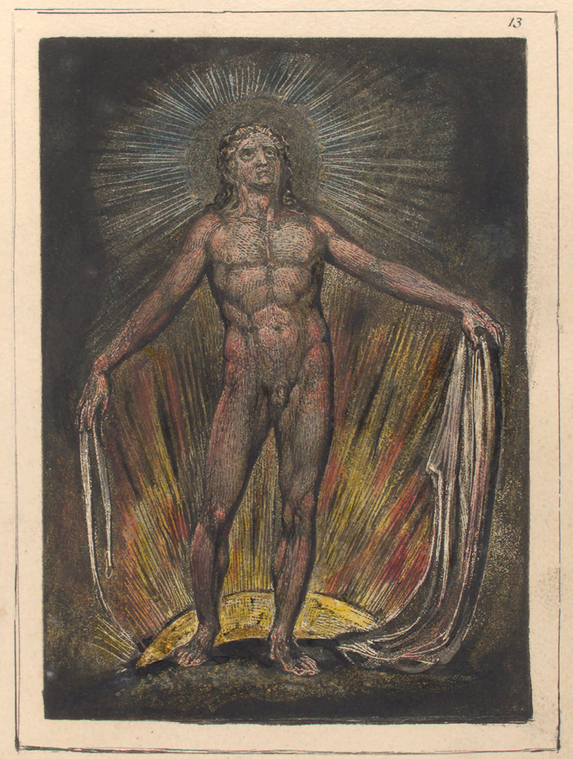
Blake seeks to provide the Golden String which can lead us through the labyrinth of our experience or his own poetry.

Thursday, December 12, 2019

Clipped

First posted by Larry on Sunday, November 22, 2009

It's doubtful that Blake knew much about being a human father, but he had serious misgivings about 'the Heavenly Father':
Gates of Paradise 
Emblem 11
1793
Gates of Paradise, For the Sexes, (E 268) 
[Revised 1818]
The Keys...
"10 In Times Ocean falling drownd
In Aged Ignorance profound
11 Holy & cold I clipd the Wings
Of all Sublunary Things
12 And in depths of my Dungeons
Closed the Father & the Sons"

Aged Ignorance! what might that be?

Could it be Jehovah, who came with a thump on the head!

Or the Father, who whips (stunts) the growing sprout, for
whatever reason, basically for not obeying a convention?

Could it be School! which systematically molds (or tries to mold) the pupil into obedience?

Blake (so far as we know) was never a biological father. But perhaps he understood that no father (or at least very few) adequately raise a son without (at least some) clipping.

The clipped son becomes a father; he may swear he'll never do to his sons what his father did to him; but he does.

And so it goes: inadequate fathers, inadequate schools, inadequate conventions, inadequate lives for the multitude--raised without creativity or imagination.

The dutiful multitude are the Redeemed; 
the rulers or the Elect are the schoolmasters, judges, senators. 
A few who escaped the clipping (or at least were clipped less) may hear the call to prophesy. They are the Reprobate.

From Milton, Plate 7, (E 100)
"The Elect from before the foundation of the World:
The second, The Redeem'd. The Third. The Reprobate & Form'd
To destruction from the mothers womb: follow with me my plow.
Of the first class was Satan: with incomparable mildness;
His primitive tyrannical attempts on Los: with most endearing love
He soft intreated Los to give to him Palamabrons station"

Aged Ignorance is really a very searching critique of society. We all could do better. Urizen was terrified of futurity. Thank God for the Saviour who brought to us forgiveness.

Read again the Intro to the fourth chapter in Jerusalem. 
To the Christians: Plate 77 (E 231)
"We are told to abstain from fleshly desires that we may lose no
time from the Work of the Lord. Every moment lost, is a moment
that cannot be redeemed every pleasure that intermingles with
the duty of our station is a folly unredeemable & is planted
like the seed of a wild flower among our wheat. All the
tortures of repentance. are tortures of self-reproach on account
of our leaving the Divine Harvest to the Enemy, the struggles of
intanglement with incoherent roots. I know of no other Christianity and of no other Gospel than the liberty both of body & mind to exercise the Divine Arts of Imagination.
Christianity and of no other Gospel than the liberty both of
body & mind to exercise the Divine Arts of Imagination.
Imagination the real & eternal World of which this Vegetable
Universe is but a faint shadow & in which we shall live in our
Eternal or Imaginative Bodies, when these Vegetable Mortal
Bodies are no more."


Saturday, December 7, 2019

Symbolism

Wikipedia Commons
Arlington Court Devon
Arlington Tempera

First posted by Larry January 16, 2015


Blake was a highly symbolic poet (and painter); to understand much of his thought requires acquaintance with a body of symbols that go back to the dawn of civilization, and up to the 19th century. In an age when only the material seemed to matter Blake was (and continues to be) highly opaque to the pure materialist. Such a person will find most of Blake's ideas meaningless.


But at the deepest level his ideas are the veritable stuff of life: love and hate, good and evil, life and death, and many ideas with urgent meaning. A high proportion of people prefer to turn aside from these questions, but you can be sure that their unconscious is full of them.


Above all Blake is about matter and spirit, at the great dividing line: do you see yourself primarily as a body or as spirit?


Begin with the conclusion, to be supported by an overwhelming body of evidence stretching from Heraclitus in the 6th century BC to the present:Our mortal life is a vale of tears to which we have lapsed from Eternity and from which we will (may?) eventually escape back into the Higher Realm. This myth conforms very closely to the Gnostics, the Platonists, and of course most of Eastern Religion. In the Christian tradition one can find vestiges of it in many of the mystics, notably Meister Eckhart, in Mexican folk culture and in fact universally.


The western mind revolts from this "never-never land" at least on the conscious level, but Freud, Jung, and many other psychologists find strong evidence for it in the unconscious. At this point many readers may dismiss Blake's myth as not worth their attention.
The select few who remain may rightfully expect an entirely new world of grace and enchantment to open before their minds. The Biblically oriented may perceive that all Blake's poetic and artistic work fits into a scheme of cosmic/psychic meaning; closely following the Bible it describes the pattern of Paradise, the Fall, a gradual redemption, and the final Rapture.  


Understanding Blake's myth can be expedited by the study of Blake's women. A most significant key to Blake's symbolism came to light only in 1947 when Arlington Court was bequeathed to the British National Trust. Among the furnishings there was a large tempera by Blake, called alternatively The Sea of Time and Space or The Cave of the Nymphs. This treasure had been hidden from public eyes for a century.


       (Most of us are unlikely to see the original, but Blake and Antiquity by Kathleen Raine offers several glimpses of the picture with a detailed account of the symbols it contains. There is no better way to begin an understanding of Blake at the deeper level than to read carefully and study this small and accessible book.)


       The picture contains the essential symbolism of Blake's myth; the theme goes back to Homer, then to Plato and Porphyry. (To understand Blake's myth one would be well advised to study this link with care--at least the first part of Taylor's article.)


       Blake and Taylor were approximately the same age and as young men close friends. Many people think that Taylor introduced Blake to the Platonic and Neoplatonic traditions. It seems certain that Taylor's On the Homeric Cave of the Nymphs deeply influenced the painting of the Arlington Tempera. It also introduced a great number of the most common symbols used in Blake's myth; they were used over and over throughout Blake's work.


       Another good introduction to Blake's myth is The Marriage of Heaven and Hell. It comes from an angry young man pouring his scorn on the conventions that cripple us; the language is pungent, the words are pointed, provocative, and outrageous.


       A conventional person will find this whole work offensive and repulsive, but the young person at the stage of life where he's ready to kick over the traces, is quickly attracted-- if he has enough wit to understand irony and not take everything at face value.


       We might call it an ironic satire. In 1789 Blake was 32, at the height of his physical (though perhaps not mental) powers. He had experienced the Divine Vision.  He knew it was meant for mankind, but so far limited to Jesus and a few others. But with the advent of the French Revolution he foresaw its spread throughout the world. (Of course in that he was soon doomed to disappointment-- with the appearance of Madame Guillotine.) Nevertheless with a peak of spiritual exuberance he proceeded to announce the coming New Age: 


Marriage of Heaven and Hell, Plate 14, (E 39)The ancient tradition that the world will be consumed in fire
at the end of six thousand years is true. as I have heard fromHell. For the cherub with his flaming sword is hereby commanded toleave his guard at the tree of life, and when he does, the wholecreation will be consumed, and appear infinite. and holy whereasit now appears finite & corrupt...If the doors of perception were cleansed every thing wouldappear to man as it is: infinite.For man has closed himself up, till he sees all things thro' narrow chinks of his cavern


Europe, Plate 10, (E 63)
In thoughts perturb'd, they rose from the bright ruins silent following
The fiery King, who sought his ancient temple serpent-form'dThat stretches out its shady length along the Island white.Round him roll'd his clouds of war; silent the Angel went,Along the infinite shores of Thames to golden Verulam.
There stand the venerable porches that high-towering rear Their oak-surrounded pillarsTheir oak-surrounded pillars, form'd of massy stones, uncutWith tool; stones precious; such eternal in the heavens,Of colours twelve, few known on earth, give light in the opake,Plac'd in the order of the stars, when the five senses whelm'd In deluge o'er the earth-born manIn deluge o'er the earth-born man; then turn'd the fluxile eyesInto two stationary orbs, concentrating all things.The ever-varying spiral ascents to the heavens of heavensWere bended downward; and the nostrils golden gates shutTurn'd outward, barr'd and petrify'd against the infinite.
Thought chang'd the infinite to a serpent; that which pitieth:
To a devouring flame; and man fled from its face and hid In forests of nightIn forests of night; then all the eternal forests were dividedInto earths rolling in circles of space, that like an ocean rush'd And overwhelmed all except this finite wall of fleshAnd overwhelmed all except this finite wall of flesh.
Then was the serpent temple form'd, image of infiniteShut up in finite revolutions, and man became an Angel;Heaven a mighty circle turning; God a tyrant crown'd. Now arriv'd the ancient Guardian at the southern porch,That planted thick with trees of blackest leaf, & in a valeObscure, inclos'd the Stone of Night; oblique it stood, o'erhungWith purple flowers and berries red; image of that sweet south, Once open to the heavens and elevated on the human neck,Now overgrown with hair and coverd with a stony roof,Downward 'tis sunk beneath th' attractive north, that round the feet
A raging whirlpool draws the dizzy enquirer to his grave:"

       For this gem Blake drew upon Genesis and Plato.

.

Friday, December 6, 2019

Reading the Gospel

British Museum
Illustrations to Young's Night Thoughts

First posted Nov 2010

How Blake Read the Gospel


All his life Blake read the Bible, loved it, and engaged in dialogue with its immortal authors. Virtually every line of his poetry and every picture he painted had direct reference to some biblical idea that Blake had meditated upon.

In vivid contrast many of the orthodox don't read the Bible at all; they just wave it! Little wonder they dislike Blake. His early ironic description of his work as the Bible of Hell certainly helped to confirm their prejudice.
__________________________________________________________________

"Thou read'st black where I read white."

(Everlasting Gospel)
There are essentially two ways to read the Bible; Blake referred to them as black and white. What did he mean? We might look at Urizen's Book of Brass as the black book. It's a book of rules, a book of law. It tells people what to do, and more poignantly, what not to do.
Even today ordinary people see the Bible in this way, which helps to explain why hardly anyone reads it today. The few who do read it dutifully and dully. Such a reading constrains consciousness; it makes the reader obedient and unimaginative. The faithful few who feel that they should read their Bible often approach it in a child like way bordering on the childish. Reading the black book inhibits the imagination, deadens the mind and prevents spiritual development. At its worst it has led to many instances of religious persecution and mass murder.

But Blake read it white. The white book is not a book of rules, but a book of visions, a book of wonders. It provokes thought, causes the imagination to soar. Blake must have learned to read at about the age of four, when he had his first vision-- the frightful face at the window. Perhaps we've all been frightened by the Bible in one way or another; most people have had a sufficiently negative experience to leave it strictly alone. But little William overcame his fright and kept reading, and the next vision we hear of was more positive--a tree full of angels.

All the evidence suggests that for the next sixty five years Blake's Bible reading and his visions went hand in hand; his art is the record of it all. Whoever becomes really interested in Blake's visions will find himself reading the Bible because that's where most of them begin. In spite of this his secular critics have looked all over the world for his sources.

One of the greatest things that Blake has to offer the reader is that he makes you see and read the Bible in a new and better way. Not for nothing did the youthful circle of admirers of Blake's last years refer to him as the Interpreter.

The black book has most often been read as law, as history, in a restricted, literal interpretation. If the priest can get people to see it this way, and only this way, then he has secure control over his flock of sheep. In contrast Blake suggests that it's symbolic. Although written in categories of time and space, the temporal dimension is only instrumental; it points to the Beyond, the Eternal, the Real.

Too often people reading 'black' concern themselves with foolish questions such as "Did it really happen? Was Jonah really swallowed by the whale, or rather by the big fish?" But in Blake's vision that isn't the important thing. The important thing is "What does it mean?" The reader of the black book gets himself tied up in knots about the veracity or historicity of Jonah and his aquatic friend.

Blake shows you the Jonah in your psyche and helps you get some grasp of what the turbulent sea means to you personally. It's experiential, exciting! it puts you in touch with reality!, which is not material at all but spiritual. Literal or symbolic is black or white, and probably the two minds will never meet. At this point I simply urge you to join Blake and read white:
    "Why is the Bible more Entertaining & Instructive than any other book? Is it not because [it is] addressed to the Imagination which is Spiritual Sensation, and but mediately to the Understanding or Reason?"
    (Letter To Trusler; Erdman 702-3)                                                                                                                                                                                                                                  All of the above is taken from Chapter Six of the Blake Primer.                                                                                                                                                                                                                        .

Tuesday, December 3, 2019

WEAVING 8

Yale Center for British Art
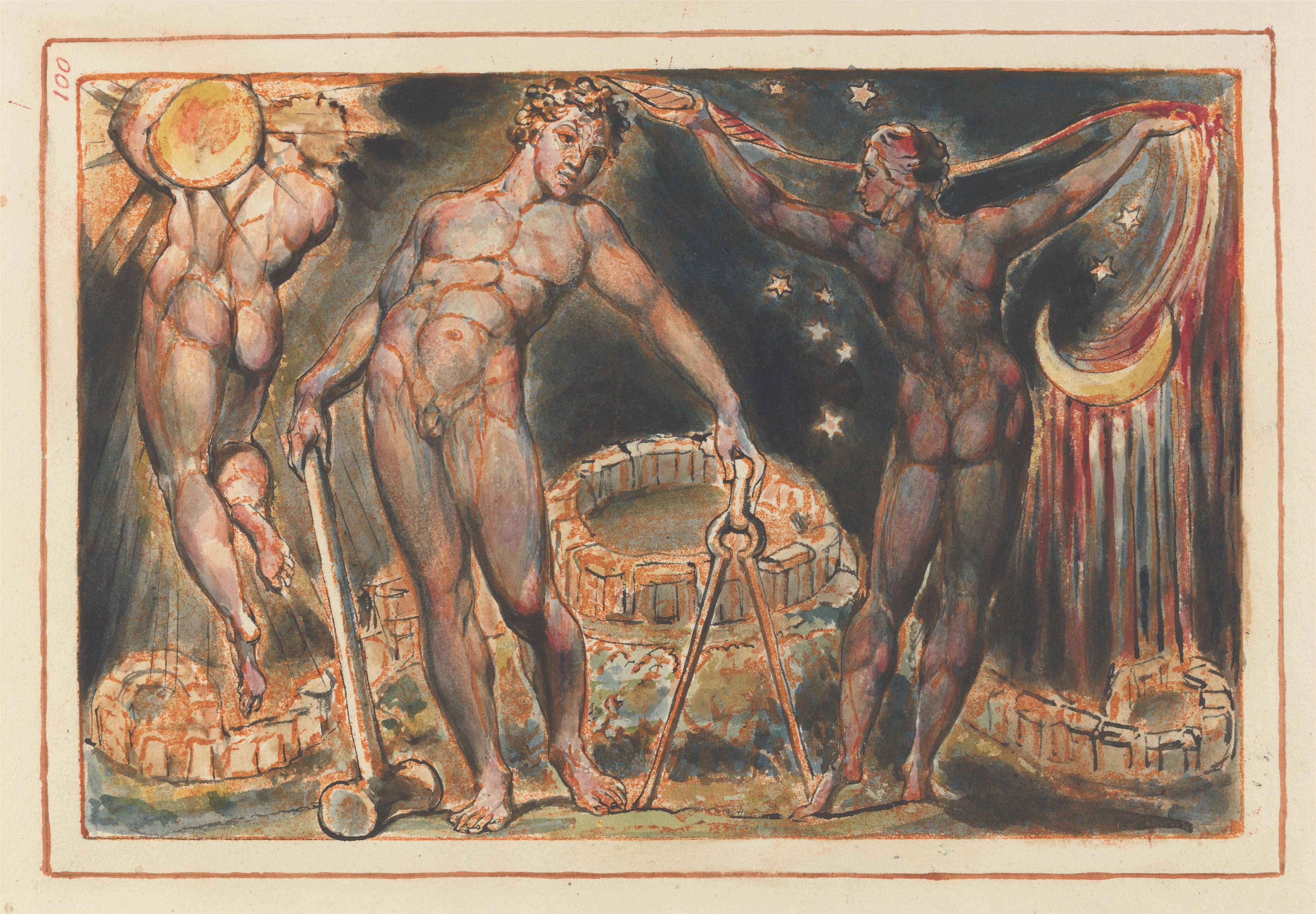
Jerusalem 
Plate 100

Apparently Blake perceived Eternity as dynamic rather than static. The soul was capable of receiving a covering shaped by Los and woven by Enitharmon even in the Resurrected Body. The Infinite could still be hidden in finite revolutions. The final page of Jerusalem bears no text. The image can be read as an allegory of a state beyond the senses ability to comprehend.

On page 138 of Blake's Sublime Allegoryin his chapter titled The Figure of the Garment, Morton B Paley stated: 
"If the garment is a mediator between humanity and the forces 'without' and 'within' - let us say cosmic forces and biological drives - we would expect the figure to be dispensed with at the Last Judgment. Yet in Jerusalem Blake's attitude is more complex than this. 'Man in the Resurrection changes his Sexual Garments at will' [Jerusalem, Plate 62]. 
Also on the ultimate plate of Jerusalem we see Enitharmon with a spindle in her upraised left hand and a distaff in her right, weaving, as Damon says, 'the dark garment of the flesh.'" 

Four Zoas, Night I, Page 3, (E 301)
Los was the fourth immortal starry one, & in the Earth
Of a bright Universe Empery attended day & night                 
Days & nights of revolving joy, Urthona was his name

PAGE 4  
In Eden; in the Auricular Nerves of Human life
Which is the Earth of Eden, he his Emanations propagated
Fairies of Albion afterwards Gods of the Heathen, Daughter of Beulah Sing
His fall into Division & his Resurrection to Unity
His fall into the Generation of Decay & Death & his Regeneration 
     by the Resurrection from the dead 

Europe, Plate 1, (E 63)
Thought chang'd the infinite to a serpent; that which pitieth:   
To a devouring flame; and man fled from its face and hid
In forests of night; then all the eternal forests were divided
Into earths rolling in circles of space, that like an ocean rush'd
And overwhelmed all except this finite wall of flesh.            
Then was the serpent temple form'd, image of infinite
Shut up in finite revolutions, and man became an Angel;
Heaven a mighty circle turning; God a tyrant crown'd.
Jerusalem, Plate 13, (E 157)
"And all that has existed in the space of six thousand years:
Permanent, & not lost not lost nor vanishd, & every little act,  
Word, work, & wish, that has existed, all remaining still
In those Churches ever consuming & ever building by the Spectres
Of all the inhabitants of Earth wailing to be Created:
Shadowy to those who dwell not in them, meer possibilities:
But to those who enter into them they seem the only substances   
For every thing exists & not one sigh nor smile nor tear,
PLATE 14
One hair nor particle of dust, not one can pass away."

Jerusalem, Plate 71, (E 225)
"For all are Men in Eternity. Rivers Mountains Cities Villages,
All are Human & when you enter into their Bosoms you walk
In Heavens & Earths; as in your own Bosom you bear your Heaven
And Earth, & all you behold, tho it appears Without it is Within
In your Imagination of which this World of Mortality is but a Shadow."

Vision of Last Judgment, (E 560)
"If the Spectator could Enter into these Images in his
Imagination approaching them on the Fiery Chariot of his
Contemplative Thought if he could Enter into Noahs Rainbow or
into his bosom or could make a Friend & Companion of one of these
Images of wonder which always intreats him to leave mortal things
as he must know then would he arise from his Grave then would he
meet the Lord in the Air & then he would be happy   General
Knowledge is Remote Knowledge it is in Particulars that Wisdom
consists & Happiness too.  Both in Art & in Life General Masses
are as Much Art as a Pasteboard Man is Human Every Man has Eyes
Nose & Mouth this Every Idiot knows but he who enters into &
discriminates most minutely the Manners & Intentions the
Characters in all their branches is the
alone Wise or Sensible Man & on this discrimination All Art is
founded.  I intreat then that the Spectator will attend to the
Hands & Feet to the Lineaments of the Countenances they are all
descriptive of Character & not a line is drawn without intention
& that most discriminate & particular as Poetry admits not a
Letter that is Insignificant so Painting admits not a Grain of
Sand or a Blade of Grass Insignificant much less an
Insignificant Blur or Mark"

The parallels between Blake's uses of the symbol of clothing and the way it is used in the Bible is shown in a passage on Page 381 of Fearful Symmetry by Northrop Frye:

"Most of the references to clothing in the Bible represent the transparent 'net' which the fallen world flings around us, woven by Vala, who weaves armor of conflict, shells of stupidity, or coverings of concealment and shame, like the fig leaves of Adam and Eve. The swaddling clothes of the infant Jesus are a sign of his descent to a fallen world; and the curtians of the ark, and the veil in the temple concealed the nothingness if the Pharisees' God and which are rent by Jesus, need no further explanation. As the story of Joseph is an account of the Fall, the coat of many colors is a symbol corresponding to the coats of skin made for Adam and Eve and to what those coats represent, their exile from a Paradise of innocence now guarded by the Covering Cherub, the monstrous dragon who glitters in gold and precious stones."

Sunday, December 1, 2019

WEAVING 7


Yale Center for British Art
Milton
Plate 13

In his chapter of Blake's Sublime Allegory Paley emphasizes the double purpose which the symbol of the garment serves. Which garment is worn depends upon the nature of the body being clothed, the entity weaving the garment, the stage of development for which the garment is provided, and the direction of the movement which is taking place. Further the perceiver may be deceived concerning the nature of the clothing if he is unable to recognize the underlying essence which is covered. 

Blake scatters references to weaving the garment throughout his work making them into a framework underlying his system rather than specific instances of an activity. From this we can be reminded that the garment may appear in our lives in many guises. It may conceal or reveal deeper levels of reality according to our ability to discern. We may be weaving garments to hide from ourselves or others or to avoid harsh conditions which need to be brought to light. Blake's protagonist in Milton found if necessary to remove the protection of his garment in order to expose himself to the dark corners of the grave, the sepulcher and death.

Here are a couple of comments from Morton B Paley in the chapter The Figure of the Garment which is included in Blake's Sublime Allegory:
"Yet the garment itself is an ambiguous symbol. It can be put on or taken off; it can become confused with one's real self. ... Blake's own terminology, there is always the danger of becoming a dunce like Satan, who "dost not know the Garment from the Man," of mistaking the Individual, and his State. Potentially redemptive the garment of flesh can yet be imprisoning and destructive, and in his three long poems Blake gives considerable attention to each possibility." (Page 127) 

"Here the full ambiguity of the weaving activity is expressed. It is in one sense is terrible betrayal of human identity, reducing it in Yeats's words 'a tattered coat upon a stick.'...Yet it is equally a regenerative activity, making it possible for the redemptive activity of the Seven Eyes of God to operate in the world of time and space. Perhaps it is no coincidence that in the Book of Zachariah, where Blake found the Seven Eyes, there is also a vision of the high priest Joshua 'clothed with filthy garments,' followed with a vision in which he is clothed with clean garments, showing that he will keep the ways of the Lord. (Zach 3:3)." (Page 132) 


 Milton, Plate 13, (E 106)
"Then Milton rose up from the heavens of Albion ardorous!         
The whole Assembly wept prophetic, seeing in Miltons face
And in his lineaments divine the shades of Death & Ulro
He took off the robe of the promise, & ungirded himself from the oath of God

And Milton said, I go to Eternal Death! The Nations still
Follow after the detestable Gods of Priam; in pomp               
Of warlike selfhood, contradicting and blaspheming.
When will the Resurrection come; to deliver the sleeping body
From corruptibility: O when Lord Jesus wilt thou come?
Tarry no longer; for my soul lies at the gates of death.
I will arise and look forth for the morning of the grave.       
I will go down to the sepulcher to see if morning breaks!
I will go down to self annihilation and eternal death,
Lest the Last Judgment come & find me unannihilate
And I be siez'd & giv'n into the hands of my own Selfhood"
Gates of Paradise, For the Sexes, The Keys, (E 268)
"6   I rent the Veil where the Dead dwell   
     When weary Man enters his Cave
     He meets his Saviour in the Grave
     Some find a Female Garment there
     And some a Male, woven with care
     Lest the Sexual Garments sweet           
     Should grow a devouring Winding sheet"

Gates of Paradise, For the Sexes, (E 269)
[Epilogue]     
  "To The Accuser Who is
  The God of This World

Truly My Satan thou art but a Dunce
And dost not know the Garment from the Man
Every Harlot was a Virgin once
Nor canst thou ever change Kate into Nan

Tho thou art Worshipd by the Names Divine         
Of Jesus & Jehovah thou art still
The Son of Morn in weary Nights decline
The lost Travellers Dream under the Hill"

Tuesday, November 26, 2019

WEAVING 6

Wikipedia Commons
Fitzwilliam Museum

Soldiers Casting Lots for Christ's Garments
Four Zoas, Night I, Page 5, (E 302)
"In Eden,Females sleep the winter in soft silken veils 
Woven by their own hands to hide them in the darksom grave
But Males immortal live renewd by female deaths.     in soft
Delight they die & they revive in spring with music & songs
Enion said Farewell I die     I hide. from thy searching eyes    

So saying--From her [Enion's] bosom weaving soft in Sinewy threads
A tabernacle for Jerusalem she sat among the Rocks    
Singing her lamentation. Tharmas groand among his Clouds
Weeping, then bending from his Clouds he stoopd his innocent head
And stretching out his holy hand in the vast Deep sublime        
Turnd round the circle of Destiny with tears & bitter sighs
And said.     Return O Wanderer when the Day of Clouds is oer"

The Garments of Jesus stripped from him before his crucifixion were not all treated the same. Some were divided into four parts to be distributed among the soldiers. Blake may have thought of these as the qualities of his Four Zoas which has served Jesus as his clothing when living in a mortal body, being redivided into parts for the use of ordinary men. The one garment which was woven without seam would remain whole and go to an individual according not to natural but spiritual cause.
Milton, Plate 26 [28], (E 124)
"In Bowlahoola; & as the Spectres choose their affinities
So they are born on Earth, & every Class is determinate
But not by Natural but by Spiritual power alone, Because         
The Natural power continually seeks & tends to Destruction
Ending in Death: which would of itself be Eternal Death
And all are Class'd by Spiritual, & not by Natural power.

And every Natural Effect has a Spiritual Cause, and Not
A Natural: for a Natural Cause only seems, it is a Delusion      
Of Ulro: & a ratio of the perishing Vegetable Memory."
Matthew 27
[35] And they crucified him, and parted his garments, casting lots: that it might be fulfilled which was spoken by the prophet, They parted my garments among them, and upon my vesture did they cast lots.

John 19
[23] Then the soldiers, when they had crucified Jesus, took his garments, and made four parts, to every soldier a part; and also his coat: now the coat was without seam, woven from the top throughout.
[24] They said therefore among themselves, Let us not rend it, but cast lots for it, whose it shall be: that the scripture might be fulfilled, which saith, They parted my raiment among them, and for my vesture they did cast lots. These things therefore the soldiers did.

Jerusalem, Plate 60, (E 210) 
"Why wilt thou rend thyself apart, Jerusalem?
And build this Babylon & sacrifice in secret Groves,
Among the Gods of Asia: among the fountains of pitch & nitre
Therefore thy Mountains are become barren Jerusalem!             
Thy Valleys, Plains of burning sand. thy Rivers: waters of death
Thy Villages die of the Famine and thy Cities
Beg bread from house to house, lovely Jerusalem
Why wilt thou deface thy beauty & the beauty of thy little-ones
To please thy Idols, in the pretended chastities of Uncircumcision?    
Thy Sons are lovelier than Egypt or Assyria; wherefore
Dost thou blacken their beauty by a Secluded place of rest.
And a peculiar Tabernacle, to cut the integuments of beauty
Into veils of tears and sorrows O lovely Jerusalem!
They have perswaded thee to this, therefore their end shall come 
And I will lead thee thro the Wilderness in shadow of my cloud
And in my love I will lead thee, lovely Shadow of Sleeping
     Albion.
This is the Song of the Lamb, sung by Slaves in evening time."

Blake's Sublime Allegory
The Figure of the Garment
by Morton B Paley
Page 130

"For Blake, the seamless garment symbolizes man's perfect body, which must be divided as a prelude to resurrection. It is further possible to view the garment from two perspectives at once, as ' fallen' and as resurrected.

Four Zoas, Night VIII, Page 104 (Second Portion), (E 378)
Los said to Enitbarmon Pitying I saw
Pitying the Lamb of God Descended thro Jerusalems gates
To put off Mystery time after time & as a Man
Is born on Earth so was he born of Fair Jerusalem
In mysterys woven mantle & in the Robes of Luvah 

He stood in fair Jerusalem to awake up into Eden
The fallen Man but first to Give his vegetated body  
To be cut off & separated that the Spiritual body may be Reveald"


Monday, November 25, 2019

WEAVING 5

Victoria and Albert Museum
Theotormon Woven

Woven into the psyche of man is a consciousness of sin. It arises from love and jealousy which are the result of the split of the psyche into male and female, essence and emanation, the observer and the observed. Without being explicit Blake indicates that Theotormon, one of the four ungenerated Sons of Los, is the origin of this thread of dissension which finds its way into life as we experience it.  

Theotormon's Gospel is not the Gospel of Jesus which reveals the God Within. It focuses on an external God in the sky who dictates laws, pits man against man, and man against woman. In A Blake Dictionary, Damon states: 'Theotormon is Desire, when suppressed, he becomes Jealousy.' Without frequent mentions of Theotormon Blake indicates his presence in 'nets & gins & traps to catch the joys of Eternity.'

Visions of the Daughters of Albion, Plate ii, (E 45)              
  "The Eye sees more than the Heart knows.
      Printed by Will:m Blake: 1793.

PLATE ii, i
The Argument

I loved Theotormon
And I was not ashamed
I trembled in my virgin fears
And I hid in Leutha's vale!

I plucked Leutha's flower,                          
And I rose up from the vale;
But the terrible thunders tore
My virgin mantle in twain."

Visions of Daughtersn of Albion, Plate 2, (E 47), 
"Arise my Theotormon I am pure.
Because the night is gone that clos'd me in its deadly black.
They told me that the night & day were all that I could see;     
They told me that I had five senses to inclose me up.
And they inclos'd my infinite brain into a narrow circle,
And sunk my heart into the Abyss, a red round globe hot burning
Till all from life I was obliterated and erased."
Song of Los, Plate 3, (E 67)
"Then Oothoon hoverd over Judah & Jerusalem
And Jesus heard her voice (a man of sorrows) he recievd
A Gospel from wretched Theotormon.

The human race began to wither, for the healthy built            
Secluded places, fearing the joys of Love
And the disease'd only propagated:
So Antamon call'd up Leutha from her valleys of delight:
And to Mahomet a loose Bible gave.
But in the North, to Odin, Sotha gave a Code of War,             
Because of Diralada thinking to reclaim his joy."
Plate 4
These were the Churches: Hospitals: Castles: Palaces:
Like nets & gins & traps to catch the joys of Eternity
     And all the rest a desart;
Till like a dream Eternity was obliterated & erased."

Milton, Plate 22 [24], (E 117)
"Rintrah and Palamabron met us at the Gate of Golgonooza
Clouded with discontent. & brooding in their minds terrible things

They said. O Father most beloved! O merciful Parent!
Pitying and permitting evil, tho strong &  mighty to destroy.  
Whence is this Shadow terrible? wherefore dost thou refuse
To throw him into the Furnaces! knowest  thou not that he
Will unchain Orc? & let loose  Satan, Og, Sihon  &  Anak,
Upon the Body of Albion? for this he is come! behold it written
Upon his fibrous left Foot black! most dismal to our eyes  
The Shadowy Female shudders thro' heaven in torment inexpressible!
And all the Daughters of Los prophetic wail: yet in deceit,
They weave a new Religion from new Jealousy of Theotormon!
Miltons Religion is the cause: there is no end to destruction!"

Milton, Plate 28 [38], (E 126)
"The little weeping Spectre stands on the threshold of Death      
Eternal; and sometimes two Spectres like lamps quivering
And often malignant they combat (heart-breaking sorrowful & piteous)
Antamon takes them into his beautiful flexible hands,
As the Sower takes the seed, or as the Artist his clay
Or fine wax, to mould artful a model for golden ornaments,      
The soft hands of Antamon draw the indelible line:
Form immortal with golden pen; such as the Spectre admiring
Puts on the sweet form; then smiles Antamon bright thro his windows
The Daughters of beauty look up from their Loom & prepare.
The integument soft for its clothing with joy & delight.        

But Theotormon & Sotha stand in the Gate of Luban anxious
Their numbers are seven million & seven thousand & seven hundred
They contend with the weak Spectres, they fabricate soothing forms
The Spectre refuses. he seeks cruelty. they create the crested Cock
Terrified the Spectre screams & rushes in fear into their Net    
Of kindness & compassion & is born a weeping terror.
Or they create the Lion & Tyger in compassionate thunderings
Howling the Spectres flee: they take refuge in Human lineaments."

Jerusalem, Plate 72, (E 226)
"For Albion in Eternity has Sixteen Gates among his Pillars    
But the Four towards the West were Walled up & the Twelve
That front the Four other Points were turned Four Square
By Los for Jerusalems sake & called the Gates of Jerusalem
Because Twelve Sons of Jerusalem fled successive thro the Gates
But the Four Sons of Jerusalem who fled not but remaind     
Are Rintrah & Palamabron & Theotormon & Bromion
The Four that remain with Los to guard the Western Wall"

Europe, Plate 5, (E 62)
"Now comes the night of Enitharmons joy!                          
Who shall I call? Who shall I send?
That Woman, lovely Woman! may have dominion?
Arise O Rintrah thee I call! & Palamabron thee!
Go! tell the human race that Womans love is Sin!                 
That an Eternal life awaits the worms of sixty winters
In an allegorical abode where existence hath never come:
Forbid all joy, & from her childhood shall the little female
Spread nets in every secret path."