Blake seeks to provide the Golden String which can lead us through the labyrinth of our experience or his own poetry.

Saturday, November 7, 2020

STATE OF SATAN

Yale Center for British Art
Jerusalem

Plate 37

Perhaps the reason we are inclined to accept Satan as an evil force who spreads havoc in our world is because we need someone to blame for our own mistakes. If Satan made me do it, its his fault not mine. But there is no end to the damage which we do if we do not realize how and why we do what we do. One way that Blake teaches us to understand Satan is as a State through which one is passing until the error that supports the misguided behavior is corrected. We could say that the error to which we ascribe is projected onto Satan, because we do not accept it as a part of our own psyche.

When Blake writes about Annihilating the Selfhood, he is referring to this event: recognizing that we are in a state of error and eliminating it. The danger of remaining in a state of error is that it spreads from one person to another, and if it succeeds in one situation it reappears in other situations. Blake's myth can be seen a catalogue of the spread to everyone and everything which is touched by him, of the disease caused by Albion's loss of the Divine Vision. 

Jerusalem, Plate 49, (E 199)
"Remove from Albion, far remove these terrible surfaces.           
They are beginning to form Heavens & Hells in immense
Circles: the Hells for food to the Heavens: food of torment,
Food of despair: they drink the condemnd Soul & rejoice
In cruel holiness, in their Heavens of Chastity & Uncircumcision
Yet they are blameless & Iniquity must be imputed only           
To the State they are enterd into that they may be deliverd:
Satan is the State of Death, & not a Human existence:
But Luvah is named Satan, because he has enterd that State.
A World where Man is by Nature the enemy of Man
Because the Evil is Created into a State. that Men               
May be deliverd time after time evermore. Amen.
Learn therefore O Sisters to distinguish the Eternal Human
That walks about among the stones of fire in bliss & woe
Alternate! from those States or Worlds in which the Spirit travels:
This is the only means to Forgiveness of Enemies.              
Therefore remove from Albion these terrible Surfaces
And let wild seas & rocks close up Jerusalem away from
Plate 50
The Atlantic Mountains where Giants dwelt in Intellect;
Now given to stony Druids, and Allegoric Generation
To the Twelve Gods of Asia, the Spectres of those who Sleep:
Sway'd by a Providence oppos'd to the Divine Lord Jesus:
A murderous Providence! A Creation that groans, living on Death. 
Where Fish & Bird & Beast & Man & Tree & Metal & Stone
Live by Devouring, going into Eternal Death continually:
Albion is now possess'd by the War of Blood! the Sacrifice
Of envy Albion is become, and his Emanation cast out:

Come Lord Jesus, Lamb of God descend! for if; O Lord!            
If thou hadst been here, our brother Albion had not died."

Milton, Plate 38 [43], (E 139)

"I come to discover before Heavn & Hell the Self righteousness
In all its Hypocritic turpitude, opening to every eye
These wonders of Satans holiness shewing to the Earth     
The Idol Virtues of the Natural Heart, & Satans Seat
Explore in all its Selfish Natural Virtue & put off
In Self annihilation all that is not of God alone:
To put off Self & all I have ever & ever Amen

Satan heard! Coming in a cloud, with trumpets & flaming fire     

Saying I am God the judge of all, the living & the dead
Fall therefore down & worship me. submit thy supreme
Dictate, to my eternal Will & to my dictate bow
I hold the Balances of Right & Just & mine the Sword
Seven Angels bear my Name & in those Seven I appear             
But I alone am God & I alone in Heavn & Earth
Of all that live dare utter this, others tremble & bow
Plate 39 [44]
Till All Things become One Great Satan, in Holiness
Oppos'd to Mercy, and the Divine Delusion Jesus be no more"

Jerusalem, Plate 25, (E 170)
"Why did you take Vengeance O ye Sons of the mighty Albion? Planting these Oaken Groves: Erecting these Dragon Temples Injury the Lord heals but Vengeance cannot be healed: As the Sons of Albion have done to Luvah: so they have in him Done to the Divine Lord & Saviour, who suffers with those that suffer: For not one sparrow can suffer, & the whole Universe not suffer also, In all its Regions, & its Father & Saviour not pity and weep. But Vengeance is the destroyer of Grace & Repentance in the bosom Of the Injurer: in which the Divine Lamb is cruelly slain: Descend O Lamb of God & take away the imputation of Sin By the Creation of States & the deliverance of Individuals Evermore Amen Thus wept they in Beulah over the Four Regions of Albion But many doubted & despaird & imputed Sin & Righteousness To Individuals & not to States, and these Slept in Ulro."
 

Thursday, November 5, 2020

GOD, MAN, SATAN

Harold Bloom in this passage near the end of his chapter on Blake's Milton in Blake's Apocalypse, demonstrates connections in Milton between the two greatest influences on Blake: the Bible and John Milton. In the three works, the Book of Job, Paradise Regained and Blake's Milton, the triangle of relationships he observes is among Man, God and Satan.

Blake's Apocalypse by Harold Bloom, (Page 362)

"Like the Book of Job and Paradise Regained, Blake's Milton is a study of gathering self-awareness. Job and Milton's Son of God come to recognize themselves in their true relation to God. Blake's Milton recognizes himself as God or imaginative Man and proceeds to purge from himself everything opposed to that recognition. But whereas the Book of Job and Paradise Regained identify sonship to God with obedience to him, Blake's Milton urges us to 'seek not thy heavenly father beyond the skies' but rather 'obey thou the Words of the Inspired Man.' Job and Milton's Son of God overcame the temptations, which in Job are deeply involved with inner conflicts. Blake's Milton is close to Job in that he must rid himself of the conviction of his own righteousness before he can resolve the conflict within himself. 

The clearest link between the Book of Job, Paradise Regained, and Milton is that the protagonist of each work must overcome Satan or a condition brought on by Satan's activity. Here Milton occupies a kind of middle position with respect to both the earlier works. Like Job, Blake's Milton must overcome his Satanic situation or inwardness, rather than Satan himself. But like the Son of God, Blake's Milton must resist overt Satanic temptations as well. Blake's Milton is both a suffering man, like Job and a Son of God, very like Milton's Christ."  

Illustrations of the Book of Job
Satan Before The Throne of God
Butts Set

Job 1

[9] Then Satan answered the LORD, and said, Doth Job fear God for nought?
[10] Hast not thou made an hedge about him, and about his house, and about all that he hath on every side? thou hast blessed the work of his hands, and his substance is increased in the land.
[11] But put forth thine hand now, and touch all that he hath, and he will curse thee to thy face.
[12] And the LORD said unto Satan, Behold, all that he hath is in thy power; only upon himself put not forth thine hand. So Satan went forth from the presence of the LORD.

Job 42

[1] Then Job answered the LORD, and said,
[2] I know that thou canst do every thing, and that no thought can be withholden from thee.
[3] Who is he that hideth counsel without knowledge? therefore have I uttered that I understood not; things too wonderful for me, which I knew not.
[4] Hear, I beseech thee, and I will speak: I will demand of thee, and declare thou unto me.
[5] I have heard of thee by the hearing of the ear: but now mine eye seeth thee.
[6] Wherefore I abhor myself, and repent in dust and ashes.


New York Public Library
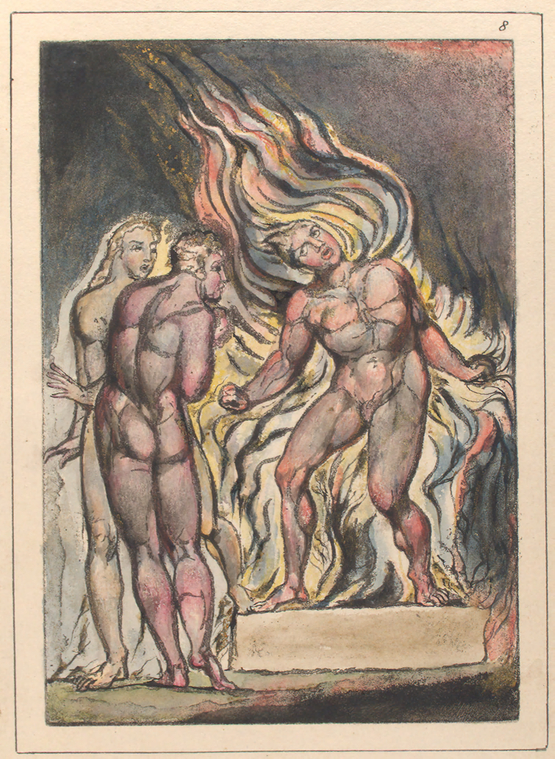
Milton, Plate 8
Satan and His Two Brothers
 

Milton, Plate 38 [43], (E 139)

"The Spectre of Satan stood upon the roaring sea & beheld
Milton within his sleeping Humanity! trembling & shuddring
He stood upon the waves a Twenty-seven-fold mighty Demon
Gorgeous & beautiful: loud roll his thunders against Milton
Loud  Satan thunderd, loud & dark upon mild Felpham shore
Not daring to touch one fibre he howld round upon the Sea.

I also stood in Satans bosom & beheld its desolations!           
A ruind Man: a ruind building of God not made with hands;"


Wikimedia Commons 
Paradise Regained 
Christ placed on the pinnacle of the Temple

Paradise Regained
By John Milton 
"Cast thy self down; safely if Son of God: 
For it is written, He will give command
Concerning thee to his Angels, in thir hands
They shall up lift thee, lest at any time
Thou chance to dash thy foot against a stone.
To whom thus Jesus: also it is written, 
Tempt not the Lord thy God; he said and stood.
But Satan smitten with amazement fell"


Sunday, November 1, 2020

WRATH & PITY

Wikimedia Commons
Songs of Innocence and of Experience
Plate 36
Little Girl Found

There are those in need of nurture and protection; we can call them the innocents, the children, the vulnerable, or the lambs. In the broad scheme of things these spirits who are not prepared for the harshness of life in the material world, are looked after by eternal spirits 'to keep them all from harm.' However there are wrathful elements in the physical world - the wolves and tygers - who would attack the bodies and minds of the vulnerable. Although they may fall prey to the destructive forces in their physical beings, their spiritual beings are provided for by those who 'Receive each mild spirit, New worlds to inherit.' In their new world the lion lies down with the lamb because 'everything that lives is holy.'

Songs of Innocence and of Experience, SONGS 20, (E 13)  
"Night
The sun descending in the west.
The evening star does shine.
The birds are silent in their nest,
And I must seek for mine,
The moon like a flower, 
In heavens high bower;
With silent delight,
Sits and smiles on the night.

Farewell green fields and happy groves,
Where flocks have took delight;  
Where lambs have nibbled, silent moves
The feet of angels bright;
Unseen they pour blessing,
And joy without ceasing,
On each bud and blossom, And each sleeping bosom. They look in every thoughtless nest, Where birds are coverd warm; They visit caves of every beast, To keep them all from harm; If they see any weeping, That should have been sleeping They pour sleep on their head And sit down by their bed. SONGS 21 When wolves and tygers howl for prey They pitying stand and weep; Seeking to drive their thirst away, And keep them from the sheep. But if they rush dreadful; The angels most heedful, Receive each mild spirit, New worlds to inherit. And there the lions ruddy eyes, Shall flow with tears of gold: And pitying the tender cries, And walking round the fold: Saying: wrath by his meekness And by his health, sickness, Is driven away, From our immortal day. And now beside thee bleating lamb, I can lie down and sleep; Or think on him who bore thy name, Graze after thee and weep. For wash'd in lifes river, My bright mane for ever, Shall shine like the gold, As I guard o'er the fold."


Isaiah 11
[1] And there shall come forth a rod out of the stem of Jesse, and a Branch shall grow out of his roots:
[2] And the spirit of the LORD shall rest upon him, the spirit of wisdom and understanding, the spirit of counsel and might, the spirit of knowledge and of the fear of the LORD;
[3] And shall make him of quick understanding in the fear of the LORD: and he shall not judge after the sight of his eyes, neither reprove after the hearing of his ears:
[4] But with righteousness shall he judge the poor, and reprove with equity for the meek of the earth: and he shall smite the earth with the rod of his mouth, and with the breath of his lips shall he slay the wicked.
[5] And righteousness shall be the girdle of his loins, and faithfulness the girdle of his reins.
[6] The wolf also shall dwell with the lamb, and the leopard shall lie down with the kid; and the calf and the young lion and the fatling together; and a little child shall lead them.
[7] And the cow and the bear shall feed; their young ones shall lie down together: and the lion shall eat straw like the ox.
[8] And the sucking child shall play on the hole of the asp, and the weaned child shall put his hand on the cockatrice' den.
[9] They shall not hurt nor destroy in all my holy mountain: for the earth shall be full of the knowledge of the LORD, as the waters cover the sea.

Isaiah 65
[24] And it shall come to pass, that before they call, I will answer; and while they are yet speaking, I will hear.
[25] The wolf and the lamb shall feed together, and the lion shall eat straw like the bullock: and dust shall be the serpent's meat. They shall not hurt nor destroy in all my holy mountain, saith the LORD.


Tuesday, October 27, 2020

ANCIENT BRITONS

Wikimedia Commons
Jerusalem 
Plate 70

Blake wrote his Descriptive Catalogue in conjunction with his exhibition of paintings in 1809. His major painting of The Ancient Britons has been lost as has his History of England which is noted in the Descriptive Catalogue. However Blake left a detailed description of what he intended to represent in his large fresco.

Advertisement of the Exhibition, (E 526)
                     "Exhibition of Paintings in Fresco,
                  Poetical and Historical Inventions,
                             BY. Wm.  Blake.
PAGE 1
  THE ANCIENT BRITONS--Three Ancient Britons overthrowing the
Army of armed Romans; the Figures full as large as Life--From the 
Welch Triades.

In the last Battle that Arthur fought, the most Beautiful was one
That return'd, and the most Strong another: with them also return'd 
The most Ugly, and no other beside return'd from the bloody Field.

The most Beautiful, the Roman Warriors trembled before and worshipped: 
The most Strong, they melted before him and dissolved in his presence: 
The most Ugly they fled with outcries and contortion of their Limbs."

The symbolic nature of the figures in The Ancient Britons is explained by Northrop Frye in Some British Romantics: A Collection of Essays. He relates the figures which Blake described to the arch of three stones which typify Druid architecture, and he points out the parallel with Blake's Three Classes of Men. 

"The central form of druid architecture is the trilithic cromlech or dolmen, the arch of three stones. According to Blake, the two uprights of this arch symbolize  the two aspects of creative power, strength and beauty, or sublimity and pathos, as he called them in the Descriptive Catalogue, the horizontal stone being the dominant Urizenic reason. Human society presents this arch in the form of an 'Elect' class tyrannizing over the 'Reprobate,' the unfashionable artists and prophets who embody human sublimity, and the 'Redeemed,' the gentler souls who are in the company of the beautiful and pathetic. This trilithic structure reappears in such later militaristic monuments as the Arch of Titus: in the 'Druid' form, it is illustrated with great power in Milton, Plate 6, and in Jerusalem, Plate 70...To pass under this arch is to be subjugated, in a fairly literal sense, to what is, according to the Descriptive Catalogue, both the human reason and the 'incapability of intellect,' as intellect in Blake is always associated with the creative and imaginative. Another form of tyrannical architecture characteristic of a degenerate civilization is the pyramid, representing the volcano or imprisoning mountain under which Orc lies. Blake connects the pyramids with the servitude of the Israelites among the brickkilns and the 'furanaces of iron' (1 Kings 8:51) applied to Egypt in the Bible. The association of the pyramids with fire is as old a Plato..." (Page 20)


Jerusalem, Plate 27, (E 171)
" Albion was the Parent of the Druids; & in his Chaotic State of Sleep Satan & Adam & the whole World was Created by the Elohim."

Descriptive Catalogue, (E 542)
" NUMBER V. The Ancient Britons In the last Battle of King Arthur only Three Britons escaped, these were the Strongest Man, the Beautifullest Man, and the Ugliest Man; these three marched through the field unsubdued, as Gods, ... The three general classes of men who are represented by the most Beautiful, the most Strong, and the most Ugly, could not be represented by any historical facts but those of our own country, the Ancient Britons; without violating costume. The Britons (say historians) were naked civilized men, learned, studious, abstruse in thought and contemplation; naked, simple, plain, in their acts and manners; wiser than after-ages."

Descriptive Catalogue, (E 543) "The Strong man represents the human sublime. The Beautiful man represents the human pathetic, which was in the wars of Eden divided into male and female. The Ugly man represents the human reason. They were originally one man, who was fourfold; he was self-divided, and his real humanity slain on the stems of generation, and the form of the fourth was like the Son of God. How he became divided is a subject of great sublimity and pathos. The Artist has written it under inspiration, and will, if God please, publish it; it is voluminous, and contains the ancient history of Britain, and the world of Satan and of Adam. In the mean time he has painted this Picture, which supposes that in the reign of that British Prince, who lived in the fifth century, there were remains of those naked Heroes, in the Welch Mountains; they are there now, Gray saw them in the person of his bard on Snowdon; there they dwell in naked simplicity; happy is he who can see and converse with them above the shadows of generation and death. The giant Albion, was Patriarch of the Atlantic, he is the Atlas of the Greeks, one of those the Greeks called Titans. The stories of Arthur are the acts of Albion, applied to a Prince of the fifth century, who conquered Europe, and held the Empire of the world in the dark age, which the Romans never again recovered." Descriptive Catalogue, (E 544)
"The Beauty proper for sublime art, is lineaments, or forms and features that are capable of being the receptacles of intellect; accordingly the Painter has given in his beautiful man, his own idea of intellectual Beauty. The face and limbs that deviates or alters least, from infancy to old age, is the face and limbs of greatest Beauty and perfection. The Ugly likewise, when accompanied and annexed to imbecility and disease, is a subject for burlesque and not for historical grandeur; the Artist has imagined his Ugly man; one approaching to the beast in features and form, his forehead small, without frontals; his jaws large; his nose high on the ridge, and narrow; his chest and the stamina of his make, comparatively little, and his joints and his extremities large; his eyes with scarce any whites, narrow and cunning, and every thing tending toward what is truly Ugly; the incapability of intellect. The Artist has considered his strong Man as a receptacle of Wisdom, a sublime energizer; his features and limbs do not spindle out into length, without strength, nor are they too large and unwieldy for his brain and bosom. Strength consists in accumulation of power to the principal seat, and from thence a regular gradation and subordination; strength is compactness, not extent nor bulk. The strong Man acts from conscious superiority, and marches on in fearless dependance on the divine decrees, raging with the inspirations of a prophetic mind. The Beautiful Man acts from duty, and anxious solicitude for the fates of those for whom he combats. The Ugly Man acts from love of carnage, and delight in the savage barbarities of war, rushing with sportive precipitation into the very teeth of the affrighted enemy."

Descriptive Catalogue, (E 545) "The Roman Soldiers rolled together in a heap before them: 'Like the rolling thing before the whirlwind;' each shew a different character, and a different expression of fear, or revenge, or envy, or blank horror, or amazement, or devout wonder and unresisting awe. The dead and the dying, Britons naked, mingled with armed Romans, strew the field beneath. Among these, the last of the Bards who were capable of attending warlike deeds, is seen falling, outstretched among the dead and the dying; singing to his harp in the pains of death. Distant among the mountains, are Druid Temples, similar to Stone Hedge. The Sun sets behind the mountains, bloody with the day of battle."
Milton, Plate 5, (E 100) "Thus they sing Creating the Three Classes among Druid Rocks Charles calls on Milton for Atonement. Cromwell is ready James calls for fires in Golgonooza. for heaps of smoking ruins In the night of prosperity and wantonness which he himself Created Among the Daughters of Albion among the Rocks of the Druids When Satan fainted beneath the arrows of Elynittria And Mathematic Proportion was subdued by Living Proportion" Milton, Plate 6, (E 100) "The Web of Life is woven: & the tender sinews of life created And the Three Classes of Men regulated by Los's hammer. Plate 7 The first, The Elect from before the foundation of the World: The second, The Redeem'd. The Third, The Reprobate & form'd To destruction from the mothers womb: follow with me my plow! Of the first class was Satan: with incomparable mildness; His primitive tyrannical attempts on Los: with most endearing love" Milton, Plate 25 [27], (E 222) "The Ancient Man upon the Rock of Albion Awakes, He listens to the sounds of War astonishd & ashamed; He sees his Children mock at Faith and deny Providence Therefore you must bind the Sheaves not by Nations or Families You shall bind them in Three Classes; according to their Classes So shall you bind them. Separating What has been Mixed Since Men began to be Wove into Nations by Rahab & Tirzah Since Albions Death & Satans Cutting-off from our awful Fields; When under pretence to benevolence the Elect Subdud All From the Foundation of the World. The Elect is one Class: You Shall bind them separate: they cannot Believe in Eternal Life Except by Miracle & a New Birth. The other two Classes; The Reprobate who never cease to Believe, and the Redeemd, Who live in doubts & fears perpetually tormented by the Elect These you shall bind in a twin-bundle for the Consummation-- But the Elect must be saved [from] fires of Eternal Death, To be formed into the Churches of Beulah that they destroy not the Earth For in every Nation & every Family the Three Classes are born
And in every Species of Earth, Metal, Tree, Fish, Bird & Beast"


Friday, October 23, 2020

VIDEOS

               Wikipedia Commons
Illustrations to Poems of Thomas Gray

Jerusalem, Plate 34 [38], (E 179)
"but mild the Saviour follow'd him, Displaying the Eternal Vision! the Divine Similitude! In loves and tears of brothers, sisters, sons, fathers, and friends Which if Man ceases to behold, he ceases to exist: Saying. Albion! Our wars are wars of life, & wounds of love, With intellectual spears, & long winged arrows of thought: Mutual in one anothers love and wrath all renewing We live as One Man; for contracting our infinite senses We behold multitude; or expanding: we behold as one, As One Man all the Universal Family; and that One Man We call Jesus the Christ: and he in us, and we in him, Live in perfect harmony in Eden the land of life, Giving, recieving, and forgiving each others trespasses."
Letters, To Thomas Butts, (E 722)
"Los flamd in my path & the Sun was hot With the bows of my Mind & the Arrows of Thought My bowstring fierce with Ardour breathes My arrows glow in their golden sheaves"

Blake was an innovator, an inventor. It is satisfying to see that in our age innovators and inventors have turned to the tools that are now available in order to present Blake in ways which were unavailable in his contemporary world. In order to give a flavor of ways Blake's life and work is being reinvented, I have selected four videos from the many which are available on YouTube. For more information about the subject of the video, click on the link to a post which treats similar ideas.


POST 

Inner Reality

VIDEO

William Blake South Bank Show

________________

POST

Imaginative Art

VIDEO

Spiritual Visions

______________

POST

Palmer

VIDEO

Ancients

__________

POST
 

This review is to prepare you for the nudity which is present in the film.

Review of In Lambeth

VIDEO

In Lambeth


Tuesday, October 20, 2020

OPEN THE DOOR

Wikipedia Commons
Book of Urizen
Copy G, Plate 26


When I asked Larry which of Blake's pictures he liked best he selected this one without an explanation. His response to the picture was not rational but emotional and intuitive. I can now give a rational explanation to his reaction to the image.

Larry saw through the image to those who stand outside of the closed door. The pleading child and the howling dog are on the outside without a way to get in. To Larry and to Blake this was the plight of humanity; the door is not closed because we are locked out of Eden but because we fail to open it. Built into the mind of man is his Divine Humanity but it is up to the conscious man to open the door or gate and invite the expression of his spirit into his expanded mind.

The poignancy of this image to me is that in adolescence when individuals are re-accessing the assumptions of their childhood, they may close the door to a perception of the internal vision of the Divine. Once the door is closed there has to be a decisive action to reopen it. If the mind of the individual has been turned over to the reasoning faculty exclusively, and the intuition and imagination have been stifled, there is little probability that the door to spiritual experience will be reopened. 

But all is not lost. Some become disillusioned with a one-sided dependence on reason through seeing its failure to provide a balanced way of living. Some are given an opening into a fuller life through a spontaneous awakening of the spirit. Some quietly find the lost piece from their childhood by continuing to seek for it in beauty, truth and love. As Pilgrim learned in Pilgrim's Progress we already possess the key, we needn't wait for someone to give it to us.

Milton Plate 2, (E 96)
"Come into my hand
By your mild power; descending down the Nerves of my right arm
From out the Portals of my Brain, where by your ministry
The Eternal Great Humanity Divine. planted his Paradise,
And in it caus'd the Spectres of the Dead to take sweet forms
In likeness of himself. Tell also of the False Tongue! vegetated
Beneath your land of shadows: of its sacrifices. and
Its offerings; even till Jesus, the image of the Invisible God
Became its prey; a curec, an offering, and an atonement,
For Death Eternal in the heavens of Albion, & before the Gates
Of Jerusalem his Emanation, in the heavens beneath Beulah" 

Milton, Plate 10 [11], (E 104)
"The nature of a Female Space is this: it shrinks the Organs
Of Life till they become Finite & Itself seems Infinite.   

And Satan vibrated in the immensity of the Space! Limited
To those without but Infinite to those within: it fell down and
Became Canaan: closing Los from Eternity in Albions Cliffs     
A mighty Fiend against the Divine Humanity mustring to War"

Milton, Plate 13 [14], (E 107)
"The Bard replied. I am Inspired! I know it is Truth! for I Sing Plate 14 [15] According to the inspiration of the Poetic Genius Who is the eternal all-protecting Divine Humanity To whom be Glory & Power & Dominion Evermore Amen" Milton 30 [33], (E 129) "But to The Sons of Eden the moony habitations of Beulah, Are from Great Eternity a mild & pleasant Rest. And it is thus Created. Lo the Eternal Great Humanity To whom be Glory & Dominion Evermore Amen Walks among all his awful Family seen in every face As the breath of the Almighty. such are the words of man to man In the great Wars of Eternity, in fury of Poetic Inspiration, To build the Universe stupendous: Mental forms Creating" Jerusalem, Plate 19, (E 164) "And Los was roofd in from Eternity in Albions Cliffs Which stand upon the ends of Beulah, and withoutside, all Appear'd a rocky form against the Divine Humanity. Albions Circumference was clos'd: his Center began darkning Into the Night of Beulah, and the Moon of Beulah rose Clouded with storms: Los his strong Guard walkd round beneath the Moon And Albion fled inward among the currents of his rivers." Four Zoas, Night II, PAGE 36, (E 325) "To listen to the hungry ravens cry in wintry season When the red blood is filld with wine & with the marrow of lambs It is an easy thing to laugh at wrathful elements To hear the dog howl at the wintry door, the ox in the slaughter house moan To see a god on every wind & a blessing on every blast To hear sounds of love in the thunder storm that destroys our enemies house To rejoice in the blight that covers his field, & the sickness that cuts off his children While our olive & vine sing & laugh round our door & our children bring fruits & flowers Then the groan & the dolor are quite forgotten & the slave grinding at the mill And the captive in chains & the poor in the prison, & the soldier in the field When the shatterd bone hath laid him groaning among the happier dead It is an easy thing to rejoice in the tents of prosperity Thus could I sing & thus rejoice, but it is not so with me!"
Urizen, Plate 24, (E 81) "4. He in darkness clos'd, view'd all his race, And his soul sicken'd! he curs'd Both sons & daughters; for he saw That no flesh nor spirit could keep His iron laws one moment. 5. For he saw that life liv'd upon death Plate 25 The Ox in the slaughter house moans The Dog at the wintry door And he wept, & he called it Pity And his tears flowed down on the winds"

Sunday, October 18, 2020

RECREATION OF THE WORD

Wikipedia Commons Jerusalem Plate 76
Wikipedia Commons
Jerusalem
Plate 76
Hebrews 11
[1] Now faith is the substance of things hoped for, the evidence of things not seen.
[2] For by it the elders obtained a good report.
[3] Through faith we understand that the worlds were framed by the word of God, so that things which are seen were not made of things which do appear.

From Larry Clayton's Ram Horn'd with Gold, Chapter 6 - Bible  

The Recreation of the Word

       Having said all this how can we summarize Blake's relationship to the Bible? First we recall that he didn't read it literally but symbolically, not historically, but poetically. Then we remember that he read it often enough and intensively enough to see it as a whole. That's a rare view nowadays. The Book has been almost universally blackened by simple ignorance (the failure to read it) and by preconceived theological notions that color and predetermine all of its meanings.


Few people have the happy faculty of looking at what's there without preconceptions of one kind or another. Blake's freedom from the conditioning of formal education gave him a most singular ability to do this. His powerful and energetic reading of the Bible therefore offers us the priceless gift of a new beginning, of getting behind our preconceptions and seeing the bedrock of western life in a new way.


This new way is not really a new way, but a very old way; it's a way that was lost when two things happened inaugurating the modern age. First, Bacon, Newton and Locke convinced the intellectual world that spirit doesn't really matter; all that matters is matter. Second, knowledge exploded in such an expansion that it became inconceivable to encompass it.


Blake's new way is a medieval way, but it's a lost way that we desperately need today, for failing an organized unity of spiritual direction, we all sink together into the abyss. The Bible according to Blake provides that direction. If you can make a commitment to the Bible like his, intensive enough to read it thoroughly, if you can put away the black book, if you can learn to read it imaginatively instead of binding it down to literal-historical categories of time and space (which Blake called "single vision"), if you can do all of these things, what emerges is a myth of meaning, a way of understanding life-- the Hebrews' life and your life.


You find this myth of meaning most explicitly stated in the earliest adventures of the children of Israel: they fall into Egypt, at the Exodus are delivered, wander in the wilderness and eventually occupy the Promised Land--but faithlessly. You see this story recreated by every writer of the Bible and applied one by one to a series of local scenes occurring over a period of about a thousand years. You see a man named Jesus who deliberately sets out to live this myth, and to live it in full, to do completely what the successive preceding generations had always failed to do. You see his death and resurrection and promise to come again to achieve for us all what he had achieved as an individual (he in us and we in him).


Finally you see John on Patmos still waiting for the Return and recreating the whole thing one more time in terms of the struggle between the Beast of Rome and the New Jerusalem. But is that the end of the story? For Blake it went on. In the City of God Augustine recreated it for the fourth century. There was Dante's recreation in the 13th, Milton's in the 17th, Blake's in the 18th--and yours and mine today! It's our myth of meaning; it's the way we get from time to eternity. Otherwise we stick with Locke, we decide there is no eternity, and we rot!


Milton, Plate 25 [27], (E 122)
"The Awakener is come. outstretchd over Europe! the Vision of God is fulfilled
The Ancient Man upon the Rock of Albion Awakes,
He listens to the sounds of War astonishd & ashamed;
He sees his Children mock at Faith and deny Providence          
Therefore you must bind the Sheaves not by Nations or Families
You shall bind them in Three Classes; according to their Classes
So shall you bind them. Separating What has been Mixed
Since Men began to be Wove into Nations by Rahab & Tirzah
Since Albions Death & Satans Cutting-off from our awful Fields;  
When under pretence to benevolence the Elect Subdud All
From the Foundation of the World. The Elect is one Class: You
Shall bind them separate: they cannot Believe in Eternal Life
Except by Miracle & a New Birth. The other two Classes;
The Reprobate who never cease to Believe, and the Redeemd,       
Who live in doubts & fears perpetually tormented by the Elect
These you shall bind in a twin-bundle for the Consummation--
But the Elect must be saved [from] fires of Eternal Death,
To be formed into the Churches of Beulah that they destroy not the Earth
For in every Nation & every Family the Three Classes are born"    

Milton, Plate 22 [24], (E 118)
"But then I rais'd up Whitefield, Palamabron raisd up Westley,    
And these are the cries of the Churches before the two Witnesses
Faith in God the dear Saviour who took on the likeness of men:
Becoming obedient to death, even the death of the Cross
The Witnesses lie dead in the Street of the Great City
No Faith is in all the Earth: the Book of God is trodden under Foot:       
He sent his two Servants Whitefield & Westley; were they Prophets
Or were they Idiots or Madmen? shew us Miracles!
PLATE 23 [25]
Can you have greater Miracles than these? Men who devote
Their lifes whole comfort to intire scorn & injury & death
Awake thou sleeper on the Rock of Eternity Albion awake"

Milton, Plate 41 [48], (E 142)
"He smiles with condescension; he talks of Benevolence & Virtue
And those who act with Benevolence & Virtue, they murder time on time
These are the destroyers of Jerusalem, these are the murderers
Of Jesus, who deny the Faith & mock at Eternal Life:
Who pretend to Poetry that they may destroy Imagination;
By imitation of Natures Images drawn from Remembrance
These are the Sexual Garments, the Abomination of Desolation
Hiding the Human lineaments as with an Ark & Curtains
Which Jesus rent: & now shall wholly purge away with Fire
Till Generation is swallowd up in Regeneration."


From The Double Vision, by Northrop Frye,

 "What 'the' truth is, is not available to human beings in spiritual matters: the goal of our spiritual life is God, who is spiritual Other, not a spiritual object, much less a conceptual object. That is why the Gospels keep reminding us how many listen and how few hear: the truth of the gospel kind cannot be demonstrated except through personal example. As the seventeenth-century Quaker Isaac Penington said every truth is substantial in its own place, but all truths are shadows except the last. The language which lifts us clear of the merely plausible and the merely credible is the language of the spirit; the language of the spirit is, Paul tells us, the language of love, and the language of love is the only language that we can be sure is spoken and understood by God." (Page 20)