Blake seeks to provide the Golden String which can lead us through the labyrinth of our experience or his own poetry.

Thursday, January 28, 2021

SLEEPING ALBION

Wikimedia Commons
Jerusalem
Detail of Plate 19

If man is created in the image of God, we have access to that image always and everywhere. But it takes some effort to remember to look and listen and respond to God within us. We have to remember that when we live in physical bodies, sensory data and rational processing interfere with the ability to receive intuitive information and to perceive the infinite. Blake wrote of Albion's fall as his losing the ability to remember the Divine Image. 

Memory is more than the ability to reconstruct past thoughts and events, it is the ability to create in the present a cohesive picture of a world beyond a moment in time or a location in space. Restoration of the ability to behold the Divine Image enables man to wake from the sleep of identifying himself a finite being instead of an infinite one. 


Quotes from the final chapter of Golgonooza: City of Imagination, by Kathleen Raine:

Page 172

"For Blake the 'Fall' is not, as for Milton', a fall into sin through disobedience, but a fall into 'sleep' through closing of consciousness and loss of the 'divine vision'; 

'Refusing to behold the Divine image which all behold And live thereby. he is sunk down into a deadly sleep' (E 825) The 'divine image' is the archetype of human nature imprinted in ever soul, as described in the first chapter of Genesis.

But Blake nowhere writes of the fall in terms of Christian theology (as Milton does) through man's disobedience and sin, rather he adopts the Platonic view of the human conditions one of forgetfulness of eternal things. All know Plato's myth, (in the Tenth Book of the Republic) of the souls who, as they approach generation, reach a river - the river of forgetfulness, where all must drink. Some drink deeply and their forgetfulness of eternity is complete. Others, who wisely refrain from drinking so deeply, retain some memory of eternal things. These are the philosophers, the lovers and the musical souls. For Blake held Plato's view that the soul knows everything, and needs only to remember what it already and forever knows."

Page 176

"Blake describes how Milton himself, for Blake the supreme poet, whom he calls 'the Awakener', takes on the human body and thereby enters the state of 'sleep'. But in his sleep he is fed by the angels 'the food of Eden, visions of eternal things.

'As when a man dreams, he reflects not that his body sleeps,
Else he would wake; so seem'd he entering his Shadow: but
With him the Spirits of the Seven Angels of the Presence
Entering; they gave him still perceptions of his Sleeping Body;
Which now arose and walk'd with them in Eden' (E 109)"

Page 177

"What is called for is a change in our consciousness itself, that will make us, like Blake, see 'not with but through the eye' - the rising and setting sun, the clouds, the moon and stars, the tree outside the window.

Our society is for ever thinking in terms of changing outer circumstances. Blake's revolution will come about when we change ourselves. From inner awakening out change will follow."


Jerusalem, Plate 39 [44], E 187) 
"Strucken with Albions disease they become what they behold;"
Jerusalem, Plate 66, (E 218)
"Ah! alas! at the sight of the Victim, & at sight of those who are smitten, All who see. become what they behold. their eyes are coverd With veils of tears and their nostrils & tongues shrunk up Their ear bent outwards. as their Victim, so are they in the pangs Of unconquerable fear! amidst delights of revenge Earth-shaking! And as their eye & ear shrunk, the heavens shrunk away The Divine Vision became First a burning flame, then a column Of fire, then an awful fiery wheel surrounding earth & heaven: And then a globe of blood wandering distant in all unknown night: Afar into the unknown night the mountains fled away: Six months of mortality; a summer: & six months of mortality; a winter: The Human form began to be alterd by the Daughters of Albion And the perceptions to be dissipated into the Indefinite."

Four Zoas, Night IV, Page 52, (E 336) 

"And thus began the binding of Urizen day & night in fear Circling round the dark Demon with howlings dismay & sharp blightings The Prophet of Eternity beat on his iron links & links of brass And as he beat round the hurtling Demon. terrified at the Shapes

Enslavd humanity put on he became what he beheld
Raging against Tharmas his God & uttering                        
Ambiguous words blasphemous filld with envy firm resolvd
On hate Eternal in his vast disdain he labourd beating
The Links of fate link after link an endless chain of sorrows
Page 54 
The Eternal Mind bounded began to roll eddies of wrath ceaseless
Round & round & the sulphureous foam surgeing thick
Settled a Lake bright & shining clear. White as the snow

Forgetfulness dumbness necessity in chains of the mind lockd up
In fetters of ice shrinking. disorganizd rent from Eternity      
Los beat on his fetters & heated his furnaces 
And pourd iron sodor & sodor of brass

Restless the immortal inchaind heaving dolorous
Anguished unbearable till a roof shaggy wild inclosd
In an orb his fountain of thought"                       

Marriage of Heaven and Hell, Plate 11, (E 38) 

"Thus men forgot that All deities reside in the human breast."

Book of Urizen, Plate 25, (E 83)
3. Six days they shrunk up from existence
And on the seventh day they rested                          
And they bless'd the seventh day, in sick hope:
And forgot their eternal life

4. And their thirty cities divided
In form of a human heart
No more could they rise at will                              
In the infinite void, but bound down
To earth by their narrowing perceptions"

Jerusalem, Plate 29 [33], (E 175)                                         
"Turning his back to the Divine Vision, his Spectrous Chaos before his face appeard: an Unformed Memory. Then spoke the Spectrous Chaos to Albion darkning cold From the back & loins where dwell the Spectrous Dead I am your Rational Power O Albion & that Human Form You call Divine, is but a Worm seventy inches long That creeps forth in a night & is dried in the morning sun In fortuitous concourse of memorys accumulated & lost It plows the Earth in its own conceit, it overwhelms the Hills Beneath its winding labyrinths, till a stone of the brook Stops it in midst of its pride among its hills & rivers[.] Battersea & Chelsea mourn, London & Canterbury tremble Their place shall not be found as the wind passes over[.] The ancient Cities of the Earth remove as a traveller And shall Albions Cities remain when I pass over them With my deluge of forgotten remembrances over the tablet So spoke the Spectre to Albion. he is the Great Selfhood Satan: Worshipd as God by the Mighty Ones of the Earth" Four Zoas, Night VII, Page 83, (E 358) "There he reveld in delight among the Flowers Vala was pregnant & brought forth Urizen Prince of Light First born of Generation. Then behold a wonder to the Eyes Of the now fallen Man a double form Vala appeard. A Male And female shuddring pale the Fallen Man recoild From the Enormity & calld them Luvah & Vala. turning down The vales to find his way back into Heaven but found none For his frail eyes were faded & his ears heavy & dull Urizen grew up in the plains of Beulah Many Sons And many daughters flourishd round the holy Tent of Man Till he forgot Eternity delighted in his sweet joy Among his family his flocks & herds & tents & pastures But Luvah close conferrd with Urizen in darksom night To bind the father & enslave the brethren Nought he knew Of sweet Eternity the blood flowd round the holy tent & rivn From its hinges uttering its final groan all Beulah fell In dark confusion mean time Los was born & Enitharmon But how I know not then forgetfulness quite wrapd me up A period nor do I more remember till I stood Beside Los in the Cavern dark enslavd to vegetative forms According to the Will of Luvah who assumed the Place Of the Eternal Man & smote him."

 Vision of Last Judgment, (E 555)
"Reality was Forgot & the Vanities of Time & Space only Rememberd
& calld Reality Such is the Mighty difference between Allegoric
Fable & Spiritual Mystery" 
Vision of Last Judgment, (E 559)
 "It is the God in all that is our companion &
friend, for our God himself says, you are my brother my sister &
my mother; & St John.  Whoso dwelleth in love dwelleth in God &
God in him. & such an one cannot judge of any but in love. & his
feelings will be attractions or repulses 
     See Aphorisms 549 & 554 
     God is in the lowest effects as well as in the highest
causes for he is become a worm that he may nourish the weak  
     For let it be rememberd that creation is. God descending
according to the weakness of man for our Lord is the word of God
& every thing on earth is the word of God & in its essence is God" 


Genesis 1 

[26] And God said, Let us make man in our image, after our likeness: and let them have dominion over the fish of the sea, and over the fowl of the air, and over the cattle, and over all the earth, and over every creeping thing that creepeth upon the earth.
[27] So God created man in his own image, in the image of God created he him; male and female created he them.
[28] And God blessed them, and God said unto them, Be fruitful, and multiply, and replenish the earth, and subdue it: and have dominion over the fish of the sea, and over the fowl of the air, and over every living thing that moveth upon the earth.

Genesis 2

[7] And the LORD God formed man of the dust of the ground, and breathed into his nostrils the breath of life; and man became a living soul.
[8] And the LORD God planted a garden eastward in Eden; and there he put the man whom he had formed.
[9] And out of the ground made the LORD God to grow every tree that is pleasant to the sight, and good for food; the tree of life also in the midst of the garden, and the tree of knowledge of good and evil.
 

...
[15] And the LORD God took the man, and put him into the garden of Eden to dress it and to keep it.
[16] And the LORD God commanded the man, saying, Of every tree of the garden thou mayest freely eat:
[17] But of the tree of the knowledge of good and evil, thou shalt not eat of it: for in the day that thou eatest thereof thou shalt surely die.

 .


Saturday, January 23, 2021

RECONCILATION

 Auguries of Innocence, (E 491)

"It is right it should be so 
Man was made for Joy & Woe
And when this we rightly know
Thro the World we safely go
Joy & Woe are woven fine
A Clothing for the soul divine 
Under every grief & pine
Runs a joy with silken twine
The Babe is more than swadling Bands
Throughout all these Human Lands"

We don't put the Joy in one pocket and the Woe in another. Joy & Woe go into the same pocket so that they can interact. As Blake says they are woven together.

If we never experienced Woe how we we find Wisdom, Strength, Compassion, Self-control and Empathy. Joy, on the other hand, can teach us Gratitude, Forgiving, Generosity, Peace, and Appreciation for Beauty and Truth and Love.

From the cloth which is woven from Joy & Woe, is constructed the garment which clothes the Essential Nature, the Soul. In this world we interact with one another through the garment which provides the tools for acting in ways which may feed the Soul.

Thank you William Blake for all you have to teach.

Wikimedia Commons
Mercy and Truth are Met Together, Righteousness and Peace have Kissed Each Other

Letters, To Butts, from Felpham, (E 725)
" My wife desires her kindest Love to Mrs Butts & I have
permitted her to send it to you also. we often wish that we could
unite again in Society & hope that the time is not distant when
we shall do so. being determind not to remain another winter 
here but to return to London

     I hear a voice you cannot hear that says I must not stay
     I see a hand you cannot see that beckons me away

Naked we came here naked of Natural things & naked we shall
return. but while clothd with the Divine Mercy we are richly
clothd in Spiritual & suffer all the rest gladly Pray give my
Love to Mrs Butts & your family I am Yours Sincerely

WILLIAM BLAKE" 
[embedded quote from Thomas Tickell]
Jerusalem, Plate 97, (E 256)
"Awake! Awake Jerusalem! O lovely Emanation of Albion
Awake and overspread all Nations as in Ancient Time
For lo! the Night of Death is past and the Eternal Day
Appears upon our Hills: Awake Jerusalem, and come away

So spake the Vision of Albion & in him so spake in my hearing   
The Universal Father. Then Albion stretchd his hand into Infinitude.
And took his Bow. Fourfold the Vision for bright beaming Urizen
Layd his hand on the South & took a breathing Bow of carved Gold
Luvah his hand stretch'd to the East & bore a Silver Bow bright shining
Tharmas Westward a Bow of Brass pure flaming richly wrought   
Urthona Northward in thick storms a Bow of Iron terrible thundering.

And the Bow is a Male & Female & the Quiver of the Arrows of Love,
Are the Children of this Bow: a Bow of Mercy & Loving-kindness: laying
Open the hidden Heart in Wars of mutual Benevolence Wars of Love
And the Hand of Man grasps firm between the Male & Female Loves  
And he Clothed himself in Bow & Arrows in awful state Fourfold
In the midst of his Twenty-eight Cities each with his Bow breathing"


Ephesians 2
[13] But now in Christ Jesus ye who sometimes were far off are made nigh by the blood of Christ.
[14] For he is our peace, who hath made both one, and hath broken down the middle wall of partition between us;
[15] Having abolished in his flesh the enmity, even the law of commandments contained in ordinances; for to make in himself of twain one new man, so making peace;
[16] And that he might reconcile both unto God in one body by the cross, having slain the enmity thereby:
[17] And came and preached peace to you which were afar off, and to them that were nigh.
[18] For through him we both have access by one Spirit unto the Father.


“There is some good in the worst of us and some evil in the best of us. When we discover this, we are less prone to hate our enemies.”

Martin Luther King Jr. 


.

Friday, January 15, 2021

LAST JUDGMENT 4

(For detail of image, right click on picture, select open in a new window, click on image, close window to return)  

National Gallery of Art
The Last Judgment
Pen & Ink drawing
1809

In Blake's images of the Last Judgment he was portraying the passage of man through states. The individuals in the images are not distinct humans but mental conditions through which a person may pass along his journey. We each have an image of oneself. When we reflect on our lives we may recognize that we are not the same person we were previously. For instance when I was a student in college I was focused on my own intellectual development. As young mother of three little boys I turned toward nurturing the growth of the children who were in my care. I have passed through various states without relinquishing my identity as a Soul created in the image of God.

Along our journeys we may fall into states of selfishness, greed, prejudice, guilt, hostility, self-righteousness or other errors which cause a falling away from the Truth which is Eternal. Blake's image of the Last Judgment shows that falling away when an individual has entered a state of error. But the individual is not consigned to remain in hell; he may be released to continue in the upward phase of the cycle. States are a mercy which are created that man may become aware of his error and may be delivered to his Eternal Humanity.

On page 153 of Golgonnoza, Kathleen Raine states:

"The heavens, the hells, all the possible states of the soul, are ever present possibilities through which men pass. Blake did not believe that either the heavens or hells are once-for-all assigned to human souls, but rather that man is a 'mental traveller' who explores all the possible states...But lost though he be in the hells, the Traveller is not is not bound to remain in these dark states.

"...it will be seen that I do not consider either the Just or the Wicked to be in a Supreme State but to be every one of them States of the Sleep which the Soul may fall into in its Deadly Dreams of Good & Evil when it leaves Paradise following the Serpent" (E 641)

... The 'State called Satan' cannot be redeemed, but individuals can be redeemed from that state. There is, besides, a 'supreme state,' and this is the Divine Humanity, who is, for Blake, the God within."

Jerusalem, Plate 49, (E 199)
"Yet they are blameless & Iniquity must be imputed only           
To the State they are enterd into that they may be deliverd:
Satan is the State of Death, & not a Human existence:
But Luvah is named Satan, because he has enterd that State.
A World where Man is by Nature the enemy of Man
Because the Evil is Created into a State. that Men               
May be deliverd time after time evermore. Amen.
Learn therefore O Sisters to distinguish the Eternal Human
That walks about among the stones of fire in bliss & woe
Alternate! from those States or Worlds in which the Spirit travels:
This is the only means to Forgiveness of Enemies" 

Milton, Plate 23 [25], (E 119)
"We were plac'd here by the Universal Brotherhood & Mercy
With powers fitted to circumscribe this dark Satanic death
And that the Seven Eyes of God may have space for Redemption.
But how this is as yet we know not, and we cannot know;
Till Albion is arisen; then patient wait a little while,"

Jerusalem, Plate 13, (E 157)
(But whatever is visible to the Generated Man,
Is a Creation of mercy & love, from the Satanic Void.)"  

Jerusalem, Page 20, (E 165)
"Jerusalem answer'd with soft tears over the valleys.

O Vala what is Sin? that thou shudderest and weepest
At sight of thy once lov'd Jerusalem! What is Sin but a little
Error & fault that is soon forgiven; but mercy is not a Sin
Nor pity nor love nor kind forgiveness! O! if I have Sinned      
Forgive & pity me! O! unfold thy Veil in mercy & love!

Jerusalem, Plate 42, (E 198)
"O! I have utterly been wasted! I have given my daughters to devils

So spoke Albion in gloomy majesty, and deepest night
Of Ulro rolld round his skirts from Dover to Cornwall.

Los answerd. Righteousness & justice I give thee in return
For thy righteousness! but I add mercy also, and bind            
Thee from destroying these little ones: am I to be only
Merciful to thee and cruel to all that thou hatest?
Thou wast the Image of God surrounded by the Four Zoa's
Three thou hast slain! I am the Fourth: thou canst not destroy me.
Thou art in Error; trouble me not with thy righteousness.      
I have innocence to defend and ignorance to instruct:
I have no time for seeming; and little arts of compliment,
In morality and virtue: in self-glorying and pride."

Jerusalem, Plate 76, (E 231)
"But Jesus breaking thro' the Central Zones of Death & Hell
Opens Eternity in Time & Space; triumphant in Mercy

Thus are the Heavens formd by Los within the Mundane Shell
And where Luther ends Adam begins again in Eternal Circle
To awake the Prisoners of Death; to bring Albion again           
With Luvah into light eternal, in his eternal day.

But now the Starry Heavens are fled from the mighty limbs of Albion"


Michelangelo and states.

.


Monday, January 11, 2021

LAST JUDGMENT 3

Last Judgment
William Blake
Enhanced Detail

In his images of the Last Judgment Blake was using symbolic language through the medium of graphic figures. He was not commenting on specific individuals but on people who have passed through various stages of development along the journey through life. Blake read the Bible not to learn what events had taken place in the past. He wanted to know what was going on in his own mental development by knowing how biblical characters were transformed. He wanted his readers to think about what they could learn by considering what Abraham had done or what Moses had done, not to imitate their behavior but to discern their motivation. Consciously thinking in symbols is an introspective process.

In Golgonooza by Kathleen Raine we are shown the contrast between writing history and presenting vision.

"This difference Between Michelangelo's Judgment, conceived as history and taking place in this world, and Blake's conception of the Apocalypse as a vision of the inner worlds accounts for many differences in composition and conception." (Page 146)

"[Blake's] purpose is not to represent nature but invisible inner worlds." (Page 147)

Jerusalem, Plate 73, (E 228)
"but around
These, to preserve them from Eternal Death Los Creates           
Adam Noah Abraham Moses Samuel David Ezekiel
[Pythagoras Socrates Euripedes Virgil Dante Milton]  
Dissipating the rocky forms of Death, by his thunderous Hammer
As the Pilgrim passes while the Country permanent remains
So Men pass on: but States remain permanent for ever"       

Kathleen Raine in Golgonooza states:

"Blake's symbolic figures are with very few exceptions Biblical, and in the infernal caverns reign not the Classical Hades but the seven-headed Satan of ST. John's Apocalypse. Nor did Blake attempt, as did both Dante and Michelangelo, to make his painting a political commentary on his own time by introducing living or recent historical figures...Adam and Eve, Cain and Able, Abraham and Noah are not for Blake historical figures but rather symbolical." (Page 150) 

Vision of Last Judgment, (E 556)
"it ought to be understood that the Persons
Moses & Abraham are not here meant but the States Signified by
those Names the Individuals being representatives or Visions of
those States as they were reveald to Mortal Man in the Series of
Divine Revelations. as they are written in the Bible these
various States I have seen in my Imagination when distant they
appear as One Man but as you approach they appear
Multitudes of Nations." 


Although Michelangelo painted to represent the condition of man and the outcome of failing to conform to the expectations of religious beliefs, he was more inclined to focus on his contemporaries. The consequences of offending or sinning led to agony.

This information is from Secrets of Michelangelo's Last Judgment:

"When Michelangelo began work on The Last Judgment mural, Pope Paul III instructed his Master of Ceremonies, Biagio da Cesena, to keep an eye on its progress. Biagio was a conservative man and, upon discovering the wall covered in nude figures, he attempted to persuade the Pope to have the figures covered.

Unfortunately for him, Michelangelo convinced the Pope to let him carry out his vision and, as an added touch, Biagio was later added as a portrayal of Minos, the judge of the underworld, with donkey ears and a snake wrapped around his groin. When Biagio returned to the Pontiff to ask for his face to be removed, Paul III jokingly explained that his jurisdiction did not extend to hell!"

Last Judgment 
Michelangelo
Group of the damned 
with Biagio da Cesena as Minos at right
 
.

Sunday, January 10, 2021

TRANSFORM THINKING

Philosophers give a lot of thought and study to the question of external existence and and the access we have to it. We tend to think of the images we have in our minds as having external referents, and we take sense data as being the evidence of that. But we 'know' that sense data is highly processed by the mind before it enters our consciousness. The mind has created a symbol which we can read as an object. So we postulate one of the first levels of 'symbol'; the processed data as opposed to the raw data with which we were originally bombarded. If the external world is the source of raw data, the question becomes what is the organization inherent in the external world or is there any. Does the organization (form) have an independent existence or was it created by us, through us, for us? 

We tend to think of the latest concept of perceiving as being the true representation of the outer world. But we can recognize that any representation is a symbol and not the object symbolized. The contrast between Jesus and the Christ demonstrates some of how symbols work. We take Jesus as less a symbol than Christ, because a historical person named Jesus had accounts written of his activities in the world we recognize as our exterior world. Christ is altogether symbol because it is an idea, a force, a constellation of characteristics, an archetype, a non-sensory entity. We can clarify our thinking by understanding our symbols: where we are coming from, how many layers of processing they have been through, what purpose they are serving, what meaning they convey to others and how they may be expressed in less symbolic language. But this is understanding symbols from the outside. 

Many think that Blake lived in a symbolic world to which few have access. Those learning a new language using words, undergo a transition to mastering the new language without translating from the original language. Those learning to process information in the symbolic language must learn to think in the language of symbols before they have a mastery of it. We translate ideas to and from symbols as an exterior exercise, Blake understood them through the very structure and organization of his mind. 

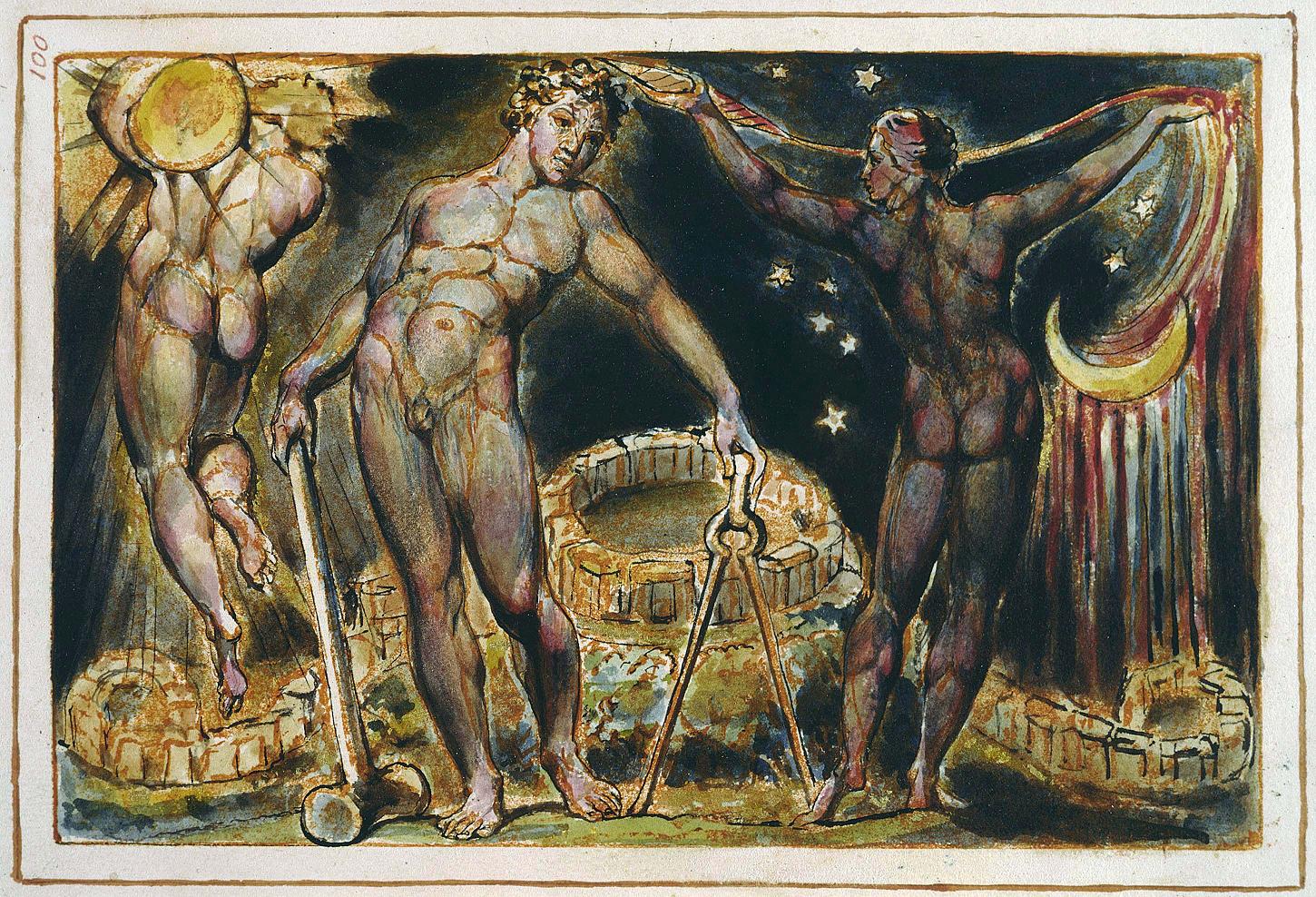
Jerusalem
Plate 100
Urizen, Los and Enitharmon

Many students of Blake tell us the same thing in different ways: the crux of reading Blake is in a transformation of one's thinking - not what you think but how you think. As I have said before Blake doesn't want us to go out the same door we came in. 

Pierre Berger, William Blake: poet and mystic, (Page 107) gives us an idea of how Blake developed the characters, Urizen and Los, as a symbols carried by a particular personalities: 

"By the same process, the Eternal Man has become a definite personality. The birth of Urizen is not merely a mystical representation of the world's creation : it symbolizes also the creation of man as a distinct being. Like Urizen, the Spirit of Man broke away from that of the Eternals, and found itself closed up in Time and Space. But, in this second interpretation, Los is no longer only symbolical of Time : he is also the Prophet of Eternity, the prophetic Spirit in humanity, sent by the Eternals to watch over man, even while he separates him from them. And as he fulfills this task, he cannot help retaining a remembrance of the Eternals, and a clear consciousness of their existence. His mission of separation reminds him perpetually of his former union with them. Consequently, he keeps alive in man's spirit the recollection of his first state, and a vague longing to return to it. He is the spirit of the Seers, the spirit that will later on inspire the poets and the artists, and speak by the mouth of the prophets. By him comes all that constitutes the Ideal, all that reaches us from the unseen world. He is at the root of all the arts and of all true religion ; for religion and art are nought but visions of Eternity. He it was who spoke through Milton. He it is who will enter into Blake, and dictate his words." 

Blake built his symbols by reaching into archetypal experience and incorporating mythopoeic images into poetic form. .

Wednesday, January 6, 2021

LAST JUDGMENT 2

Wikipedia Commons
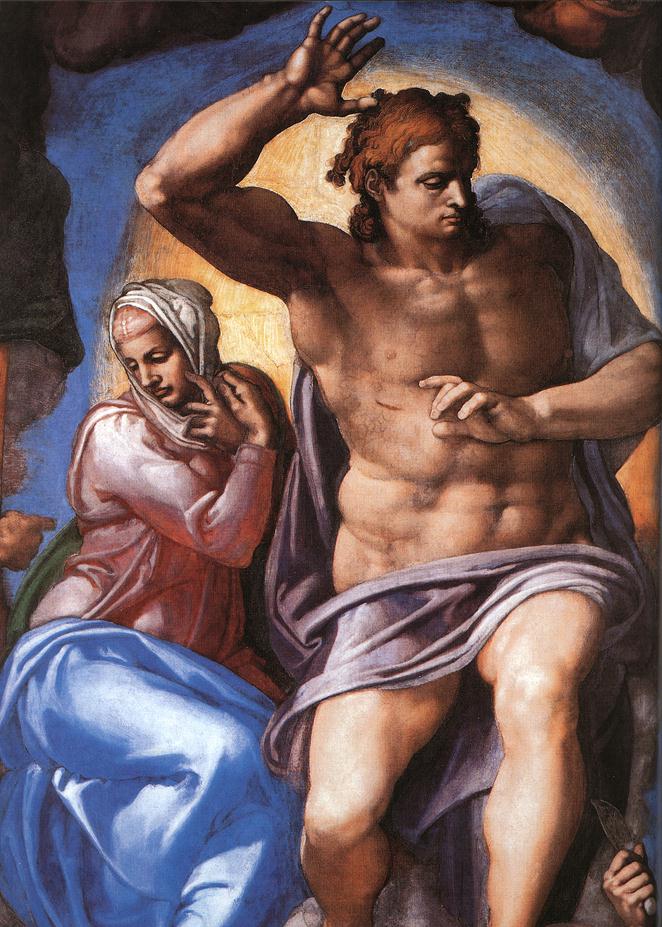
Michelangelo's Last Judgment
Detail of Jesus

On Page 148 of Golgoonoza Kathleen Raine explains the background of the culture in which Michelangelo worked on his image of the Last Judgment. His Jesus was the product of the religious mindset of Renaissance Italy in which he lived. The Reformation was underway but Jesus was still perceived a figure of wrath not mercy.

"The vision of the Apocalypse was for Michelangelo and for his time rather one of terror and of this world's ruin rather than of spiritual resurrection. So it has remained in the imagination of Christendom as a whole, and so it must be always for this secular world, whose foundations are to be shaken and overthrown. That Michelangelo's figure of Jesus comes rather as a figure of wrath than of serenity clearly reflects Michelangelo's own political bitterness at the Roman See.

...Michelangelo's vision considers the great event from the standpoint of this world."

National Gallery of Art Washington DC
Last Judgment
c 1809
Pen and Ink

Reine tells us on Page 149 of Golgonooza of the contrary perspective of Blake in presenting the Son of God. "Jesus is less a supreme ruler than a permeating presence, the heart of the great circulation of human figures ascending and descending in unbroken flow from the heavens down to the hells, and again rising upwards into the heavens.

...Blake's Jesus is not so much an individual as the heart of the light which emanates from a divine center."


There are several images of the Last Judgment by Blake which still exist including a drawing and watercolor images . He worked on a large image said to include "upwards of one thousand figures" in "exquisite finishing" until the end of his life but it is untraced since 1848. (Stranger from Paradise, G. E. Bentley, Jr, Page 355)

The pen and ink drawing in the National Gallery of Art can be viewed in detail by opening in a new window. -
Rt click on image, select open in a new window, left click on image for enlargement. Use directional arrows to view specific areas of the picture. Close window to return.

The image in the National Gallery is closest to the description which Blake wrote in a letter to his friend Ozias Humphry.


The Design of The Last Judgment, (E 552)

          "To Ozias Humphry Esqre

     The Design of The Last Judgment which I have completed by
your recommendation [under a fortunate star] for The
Countess of Egremont [by a happy accident] it is
necessary to give some account of & its various parts ought to be
described for the accomodation of those who give it the honor of
attention
     Christ seated on the Throne of judgment [The Heavens in
Clouds rolling before him & around him] before his feet &
around him the heavens in clouds are rolling like a scroll ready
to be consumed in the fires of the Angels who descend  
with the Four Trumpets sounding to the Four Winds Beneath Earth is convulsed with the labours of the Resurrection--in the Caverns of the Earth is the Dragon with Seven heads & ten Horns chained by two Angels & above his Cavern on the Earths Surface is the Harlot siezed & bound by two Angels with chains while her Palaces are falling into ruins & her councellors & warriors are descending into the Abyss in wailing & despair Hell opens beneath the Harlots seat on the left hand into which the Wicked are descending [while others rise from their Craves on the brink of the Pit] The right hand of the Design is appropriated to the Resurrection of the Just the left hand of the Design is appropriated to the Resurrection & Fall of the Wicked Immediately before the Throne of Christ is Adam & Eve kneeling in humiliation as representatives of the whole Human Race Abraham & Moses kneel on each side beneath them from the cloud on which Eve kneels [ & beneath Moses & from the Tables of Stone which utter lightnings] is seen Satan wound round by the Serpent & falling headlong the Pharisees appear on the left hand pleading their own righteousness before the Throne of Christ & before the Book of Death which is opend on clouds by two Angels & many groupes of Figures are falling from before the Throne & from before the Sea of Fire which flows before the steps of the Throne on which is seen the seven Lamps of the Almighty burning before the Throne many Figures chained & bound together & in various attitudes of Despair & Horror fall thro the air & some are scourged by Spirits with flames of fire into the Abyss of Hell which opens [to recieve them] beneath on the left hand of the Harlots Seat where others are howling & [descending into the flames & in the act of] dragging each other into Hell & in contending in fighting with each other on the brink of Perdition Before the Throne of Christ on the Right hand the Just in humiliation & in exultation rise thro the Air with their Children & Families some of whom are bowing before the Book of Life which is opend on clouds by two Angels many groupes arise in exultation among them is a Figure crownd with Stars & the Moon beneath her feet with six infants around her She represents the Christian Church Green hills appear beneath with the Graves of the Blessed which are seen bursting with their births of immortality Parents & Children Wives & Husbands embrace & arise together & in exulting attitudes of great joy tell each other that the New Jerusalem is ready to descend upon Earth they arise upon the Air rejoicing others newly awakend from the Grave stand upon the Earth embracing. & shouting to the Lamb who cometh in the Clouds in Power & great Glory The Whole upper part of the Design is a View of Heaven opened around the Throne of Christ in the Cloud which rolls away are the Four Living Creatures filled with Eyes attended by the Seven Angels with the Seven Vials of the Wrath of God & above these Seven Angels with the Seven Trumpets these compose the Cloud which by its rolling away displays the opening seats of the Blessed on the right & left of which are seen the Four & Twenty Elders seated on Thrones to Judge the Dead Behind the Seat & Throne of Christ appears the Tabernacle with its Veil opened & the Candlestick on the right the Table with the Shew bread on the left & in [the] midst is the Cross in place of the Ark [with the two] Cherubim bowing over it On the Right hand of the Throne of Christ is Baptism On the left is the Lords Supper the two introducers into Eternal Life Women with Infants approach the Figure of an aged Apostle which represents Baptism & on the left hand the Lords Supper is administerd by Angels from the hands of another Apostle these kneel on each side of the Throne which is surrounded by a Glory many Infants appear in the Glory representing the Eternal Creation flowing from the Divine Humanity in Jesus who opens the Scroll of Judgment upon his knees before the Living & the Dead Such is the Design which you my Dear Sir have been the cause of my producing & which but for you might have slept till the Last Judgment WILLIAM BLAKE [18 January 1808] Feby 1808"


Tuesday, January 5, 2021

LAST JUDGMENT

Wikipedia Commons
Michelangelo
Last Judgment
Sistine Chapel
Wikimedia Commons 
The Vision of the Last Judgment Petworth House, The National Trust

William Blake and Michelangelo each created images of the Last Judgment. Despite Blake's admiration for Michelangelo, he interpreted the scene in a different style to portray different content. Michelangelo's primary art was his sculpting which influenced his painting. Blake was trained as an engraver which determined the way that he painted.

Michelangelo's figures have bulk and weight while Blake's are light and flowing. The physical body is displayed by Michelangelo, the ethereal body by Blake. The image of Jesus shown by Michelangelo is that of a human man in the center of the drama. Blake's Jesus is clothed in light and reigns in heaven removed from the earthly activity. 

Kathleen Raine in Golgonooza: City of Imagination states that "in comparing Blake's Vision of the Last Judgment with that of Michelangelo - to whom Blake was so obviously and so deeply indebted - we are comparing a historical and ecclesiastical with a mystical understanding of the Apocalypse. As we compare the works of these two great Christian artists, each totally dedicated to the religion they professed, we discover that the many differences of overall conception and of detail do correspond to differences in each 'according to the situation he holds.'"(Page 145)

Vision of the Last Judgment, (E 554)
"The Last Judgment when all those are Cast away who trouble
Religion with Questions concerning Good & Evil or Eating of the
Tree of those Knowledges or Reasonings which hinder the Vision of
God turning all into a Consuming fire    Imaginative Art &
Science & all Intellectual Gifts all the Gifts of the Holy Ghost
are lookd upon as of no use & only Contention
remains to Man   then the Last Judgment begins & its Vision is seen
by the Imaginative Eye of Every one according to the
situation he holds
    The Last Judgment is not Fable or Allegory
but Vision"

Descriptive Catalogue, (E 544)
 "Poetry as it exists
now on earth, in the various remains of ancient authors, Music as
it exists in old tunes or melodies, Painting and Sculpture as it
exists in the remains of Antiquity and in the works of more
modern genius, is Inspiration, and cannot be surpassed; it is
perfect and eternal.  Milton, Shakspeare, Michael Angelo, Rafael,
the finest specimens of Ancient Sculpture and Painting, and
Architecture, Gothic, Grecian, Hindoo and Egyptian, are the
extent of the human mind.  The human mind cannot go beyond the
gift of God, the Holy Ghost.  To suppose that Art can go beyond
the finest specimens of Art that are now in the world, is not
knowing what Art is; it is being blind to the gifts of the
spirit."