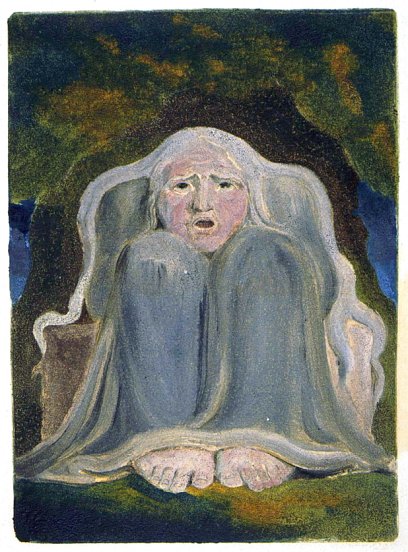
Blake seeks to provide the Golden String which can lead us through the labyrinth of our experience or his own poetry.

Thursday, April 14, 2022

URIZEN & AHANIA

                                       Wikipedia Commons
                                           Book of Urizen
Plate 2
 

Ahania without Urizen is passive, Urizien without Ahania is tormented by incessant unproductive activity. He repeats the same dull round because he receives no impulse from Ahania to break the cycle in which he is caught.

Take as an example the beating of the human heart. Each beat of the heart results from the discharge of an electrical charge in the upper right chamber. This causes contractions which pump blood into the arteries. But unless another charge has built up to create another impulse to cause another contraction, the heart stops beating. The period of rest when the electric charge is building is essential to the functioning of the heart. 

Ahania furnished that period of rest which impelled the mind of Urizen to have fresh ideas on which to base his reasoning. Many of us have been in the situation when our minds have constantly reviewed the same facts. Without a new thought to interrupt the loop we are blocked from any creative activity. Unfortunately Urizen did not have the self awareness to know that the loss of Ahania had left him crippled. 

NO NATURAL RELIGION, (E 2) 

"IV The bounded is loathed by its possessor. The same dull round even of a univer[s]e would soon become a mill with complicated wheels.
...

Conclusion, If it were not for the Poetic or Prophetic character. the Philosophic & Experimental would soon be at the ratio of all things & stand still, unable to do other than repeat the same dull round over again 

Application. He who sees the Infinite in all things sees God. He who sees the Ratio only sees himself only."

Book of Urizen, Plate 2, (E 70) 
"PRELUDIUM TO THE [FIRST] BOOK OF URIZEN  

Of the primeval Priests assum'd power,
When Eternals spurn'd back his religion;
And gave him a place in the north,
Obscure, shadowy, void, solitary.

Eternals I hear your call gladly,                                
Dictate swift winged words, & fear not
To unfold your dark visions of torment." 
Book of Ahania, Plate 2, (E 84)
"7: Dire shriek'd his invisible Lust                           
Deep groan'd Urizen! stretching his awful hand
Ahania (so name his parted soul)
He siez'd on his mountains of jealousy.
He groand anguishd & called her Sin,

Kissing her and weeping over her;           
Then hid her in darkness in silence;
Jealous tho' she was invisible.

8: She fell down a faint shadow wandring
In chaos and circling dark Urizen,
As the moon anguishd circles the earth;     
Hopeless! abhorrd! a death-shadow,
Unseen, unbodied, unknown,
The mother of Pestilence." 
Milton. Plate 10 [11], (E 104)
"Then Los & Enitharmon knew that Satan is Urizen          
Drawn down by Orc & the Shadowy Female into Generation
Oft Enitharmon enterd weeping into the Space, there appearing
An aged Woman raving along the Streets (the Space is named
Canaan) then she returnd to Los weary frighted as from dreams"   
Four Zoas, Night III, Page 41, (E 328) 
"O Urizen why art thou pale at the visions of Ahania 
Listen to her who loves thee lest we also are driven away.
They heard the Voice & fled swift as the winters setting sun   
And now the Human Blood foamd high, I saw that Luvah & Vala    
Went down the Human Heart where Paradise & its joys abounded   
In jealous fears in fury & rage, & flames roll'd round their fervid feet
And the vast form of Nature like a Serpent play'd before them
And as they went in folding fires & thunders of the deep
Vala shrunk in like the dark sea that leaves its slimy banks     
And from her bosom Luvah fell far as the east & west
And the vast form of Nature like a Serpent roll'd between.     

She ended. for from his wrathful throne burst forth the black hail storm    

Am I not God said Urizen. Who is Equal to me
Do I not stretch the heavens abroad or fold them up like a garment

He spoke mustering his heavy clouds around him black opake
...
PAGE 43 
Then thunders rolld around & lightnings darted to & fro
His visage changd to darkness & his strong right hand came forth
To cast Ahania to the Earth be siezd her by the hair
And threw her from the steps of ice that froze around his throne

Saying Art thou also become like Vala. thus I cast thee out      
Shall the feminine indolent bliss. the indulgent self of weariness

The passive idle sleep the enormous night & darkness of Death
Set herself up to give her laws to the active masculine virtue
Thou little diminutive portion that darst be a counterpart
Thy passivity thy laws of obedience & insincerity
Are my abhorrence. Wherefore hast thou taken that fair form
Whence is this power given to thee! once thou wast in my breast
A sluggish current of dim waters. on whose verdant margin
A cavern shaggd with horrid shades. dark cool & deadly. where
I laid my head in the hot noon after the broken clods            
Had wearied me. there I laid my plow & there my horses fed
And thou hast risen with thy moist locks into a watry image
Reflecting all my indolence my weakness & my death
To weigh me down beneath the grave into non Entity
Where Luvah strives scorned by Vala age after age wandering      
Shrinking & shrinking from her Lord & calling him the Tempter
And art thou also become like Vala thus I cast thee out.

So loud in thunders spoke the King folded in dark despair
And threw Ahania from his bosom obdurate She fell like lightning
Then fled the sons of Urizen from his thunderous throne petrific 
They fled to East & West & left the North & South of Heaven
A crash ran thro the immense The bounds of Destiny were broken
The bounds of Destiny crashd direful & the swelling Sea
Burst from its bonds in whirlpools fierce roaring with Human voice
Triumphing even to the Stars at bright Ahanias fall              

Down from the dismal North the Prince in thunders & thick clouds
PAGE 44 
As when the thunderbolt down falleth on the appointed place
Fell down down rushing ruining thundering shuddering    
Into the Caverns of the Grave & places of Human Seed
Where the impressions of Despair & Hope enroot forever
A world of Darkness. Ahania fell far into Non Entity             

She Continued falling. Loud the Crash continud loud & Hoarse
From the Crash roared a flame of blue sulphureous fire from the flame 
A dolorous groan that struck with dumbness all confusion
Swallowing up the horrible din in agony on agony
Thro the Confusion like a crack across from immense to immense   
Loud strong a universal groan of death louder
Than all the wracking elements deafend & rended worse
Than Urizen & all his hosts in curst despair down rushing
But from the Dolorous Groan one like a shadow of smoke appeard
And human bones rattling together in the smoke & stamping        
The nether Abyss & gnasshing in fierce despair. panting in sobs
Thick short incessant bursting sobbing. deep despairing stamping struggling  
Struggling to utter the voice of Man struggling to take the features of Man. Struggling
To take the limbs of Man at length emerging from the smoke
Of Urizen dashed in pieces from his precipitant fall             
Tharmas reard up his hands & stood on the affrighted Ocean
The dead reard up his Voice & stood on the resounding shore

Crying. Fury in my limbs. destruction in my bones & marrow
My skull riven into filaments. my eyes into sea jellies
Floating upon the tide wander bubbling & bubbling                
Uttering my lamentations & begetting little monsters
Who sit mocking upon the little pebbles of the tide
In all my rivers & on dried shells that the fish
PAGE 45 
Have quite forsaken. O fool fool to lose my sweetest bliss
Where art thou Enion ah too near to cunning too far off  
And yet too near. Dashd down I send thee into distant darkness" 
Four Zoas, Night IX, Page 120, (E 389)
"The Eternal Man sat on the Rocks & cried with awful voice

O Prince of Light where art thou   I behold thee not as once
In those Eternal fields in clouds of morning stepping forth 
With harps & songs where bright Ahania sang before thy face
And all thy sons & daughters gatherd round my ample table
See you not all this wracking furious confusion
Come forth from slumbers of thy cold abstraction come forth
Arise to Eternal births shake off thy cold repose 
Schoolmaster of souls great opposer of change arise
That the Eternal worlds may see thy face in peace & joy
That thou dread form of Certainty maist sit in town & village
While little children play around thy feet in gentle awe
Fearing thy frown loving thy smile O Urizen Prince of light" 


Genesis 2

[1] Thus the heavens and the earth were finished, and all the host of them.
[2] And on the seventh day God ended his work which he had made; and he rested on the seventh day from all his work which he had made.
[3] And God blessed the seventh day, and sanctified it: because that in it he had rested from all his work which God created and made.


Saturday, April 9, 2022

BLAKE'S EMANATION

Wikipedia Commons
Angel of the Divine Presence Bringing Eve to Adam

Each of the Zoas is both an inner being and an outer being. As an inner being his Emanation is part of himself. When his Emanation becomes expressed externally she is withdrawn from the total Zoa and he is depleted. The urge to return to the condition of completeness creates the dynamic of Blake's myth. 

Harold Bloom, Blake's Apocalypse, Page 195

"An emanation is literally what comes into being from a process of creation in which a series of effluxes flow from a creator. As a created form an emanation may be male of female or both; either way it is opposed to the Spectre of shadow, a baffled creation or residue of self that failed to emanate , to reach an outer but connected existence."

Northrop Frye, Fearful Symmetry, Page 73

"Abstract ideas are called spectres by Blake, and Spectre with a capital letter is the Selfhood. The corresponding term is 'Emanation', which means the total form of all the things a man loves and creates. In the fallen states the Emanation is conceived as outside, and hence it becomes the source of continuously tantalizing and elusive torment. In imaginative states it is united with and emanates from the man, hence its name." 

Milton O Percival, William Blake's Circle of Destiny, Page 98

"In union with her masculine source - the proper relation of the contraries undisturbed - the Emanation provides a 'concentering vision,' whereby faith in the unity of all life is maintained. The mind, having in this state a sympathetic and intuitive understanding of the Emanation (the life of the world of manifestations), accepts the body and its energies - all of them - and knows them to be good."

S Foster Damon, A Blake Dictionary, Page 121

"It will be noted that the Emanations, when they achieve a separate existence (and get names of their own, which Spectres never do), exhibit all the characteristics of the personae of the split personality which modern science discovered. They seek for dominion, can be dangerously destructive, and fight reintegration (which seems to them like annihilation): but the moment they are reabsorbed, their voice cease altogether.

...Meanwhile the male is left a selfish and ravening Spectre. His rational power, unchecked by his lost Emanation, dominates him. He denounces all delights as sin and condemns Jerusalem the mother of sin."

Jerusalem, Plate 53, E 203
"In eternal labours: loud the Furnaces & loud the Anvils Of Death thunder incessant around the flaming Couches of The Twentyfour Friends of Albion and round the awful Four For the protection of the Twelve Emanations of Albions Sons The Mystic Union of the Emanation in the Lord; Because Man divided from his Emanation is a dark Spectre His Emanation is an ever-weeping melancholy Shadow But she is made receptive of Generation thro' mercy In the Potters Furnace, among the Funeral Urns of Beulah From Surrey hills, thro' Italy and Greece, to Hinnoms vale. Plate 54 In Great Eternity, every particular Form gives forth or Emanates Its own peculiar Light, & the Form is the Divine Vision And the Light is his Garment This is Jerusalem in every Man A Tent & Tabernacle of Mutual Forgiveness Male & Female Clothings. And Jerusalem is called Liberty among the Children of Albion"
Jerusalem, Plate 88, (E 245)
When in Eternity Man converses with Man they enter Into each others Bosom (which are Universes of delight) In mutual interchange. and first their Emanations meet Surrounded by their Children. if they embrace & comingle The Human Four-fold Forms mingle also in thunders of Intellect But if the Emanations mingle not; with storms & agitations Of earthquakes & consuming fires they roll apart in fear For Man cannot unite with Man but by their Emanations Which stand both Male & Female at the Gates of each Humanity How then can I ever again be united as Man with Man While thou my Emanation refusest my Fibres of dominion. When Souls mingle & join thro all the Fibres of Brotherhood Can there be any secret joy on Earth greater than this? Enitharmon answerd: This is Womans World, nor need she any Spectre to defend her from Man. I will Create secret places And the masculine names of the places Merlin & Arthur. A triple Female Tabernacle for Moral Law I weave That he who loves Jesus may loathe terrified Female love Till God himself become a Male subservient to the Female."
 

Monday, March 28, 2022

Mythical


Larry Clayton's Primer, Chapter 10

      Many people have called William Blake unique among English poets as the creator of a complete mythology. In a standard dictionary "without foundation in fact" appears as the fifth meaning of 'mythical', but this is probably what the term conveys in common parlance. Therefore we must begin our study of Blake's myth by raising our consciousness of the word. 'Logos', 'myth', 'epic'--these three words have common roots. In literary and theological language myths are statements about the non-material ultimate. Some people of course avoid the non-material, considering it to be "without foundation in fact"; it's doubtful that any such reader has endured to this point of our study.

       Blake considered the non-material to be the real; his art centered around the endeavour to express the reality of the non-material. The meaning of his entire artistic enterprise we may call his myth. His object was to fit all of experience into a total framework of meaning that will inform life and "to raise other people to a perception of the Infinite". Our object is to grasp that total framework; once we do that, we have a myth of meaning.

With his story of the Prodigal Son, Jesus gave us a personal paradigm of the history of the Chosen People and of the Human Race. 

Luke 15
[10] Likewise, I say unto you, there is joy in the presence of the angels of God over one sinner that repenteth.
[11] And he said, A certain man had two sons:
[12] And the younger of them said to his father, Father, give me the portion of goods that falleth to me. And he divided unto them his living.
[13] And not many days after the younger son gathered all together, and took his journey into a far country, and there wasted his substance with riotous living.
[14] And when he had spent all, there arose a mighty famine in that land; and he began to be in want.
[15] And he went and joined himself to a citizen of that country; and he sent him into his fields to feed swine.
[16] And he would fain have filled his belly with the husks that the swine did eat: and no man gave unto him.
[17] And when he came to himself, he said, How many hired servants of my father's have bread enough and to spare, and I perish with hunger!
[18] I will arise and go to my father, and will say unto him, Father, I have sinned against heaven, and before thee,
[19] And am no more worthy to be called thy son: make me as one of thy hired servants.
[20] And he arose, and came to his father. But when he was yet a great way off, his father saw him, and had compassion, and ran, and fell on his neck, and kissed him.
[21] And the son said unto him, Father, I have sinned against heaven, and in thy sight, and am no more worthy to be called thy son.
[22] But the father said to his servants, Bring forth the best robe, and put it on him; and put a ring on his hand, and shoes on his feet:
 

[23] And bring hither the fatted calf, and kill it; and let us eat, and be merry:

[24] For this my son was dead, and is alive again; he was lost, and is found. And they began to be merry.

A striking modern analogy, although not Blakean per se, is provided by the cycle of alcoholism: progressive deterioration until the sufferer hits bottom, followed by recovery. Blake did use as a recurring motif the story of Lazarus found in the Gospel of John.

Luke 11
[1] Now a certain man was sick, named Lazarus, of Bethany, the town of Mary and her sister Martha.
[2] (It was that Mary which anointed the Lord with ointment, and wiped his feet with her hair, whose brother Lazarus was sick.)
[3] Therefore his sisters sent unto him, saying, Lord, behold, he whom thou lovest is sick.
[4] When Jesus heard that, he said, This sickness is not unto death, but for the glory of God, that the Son of God might be glorified thereby.

But the primary paradigm of this myth is the Incarnation, Crucifixion, Resurrection, and Ascension of Christ. However Blake did not express this, probably did not fully realize it, until 1800. 

Galations 2
[20] I am crucified with Christ: nevertheless I live; yet not I, but Christ liveth in me: and the life which I now live in the flesh I live by the faith of the Son of God, who loved me, and gave himself for me.

The next Chapter illustrates the application of this fundamental myth in Blake's major poetic works. The development of Blake's epic will be traced through the various stages of his spiritual journey. In essence it's the same journey we all take; you could call it the history of Man. Blake called it the Circle of Destiny in Night 1 of The Four Zoas.

Four Zoas, Night I, Page 5, (E 302)
"Enion said Farewell I die I hide. from thy searching eyes
So saying--From her bosom weaving soft in Sinewy threads
A tabernacle for Jerusalem she sat among the Rocks        
Singing her lamentation. Tharmas groand among his Clouds
Weeping, then bending from his Clouds he stoopd his innocent head 
And stretching out his holy hand in the vast Deep sublime        
Turnd round the circle of Destiny with tears & bitter sighs
And said.     Return O Wanderer when the Day of Clouds is oer

So saying he sunk down into the sea a pale white corse"
There are no easy solutions. There are no shortcuts to a more direct path. Milton O. Percival in William Blake's Circle of Destiny understood that Blake taught that entrenched error destroys the possibility of return.
"But if in Beulah the error deepens and the circuit of return is closed, 
then the wheel has to swing "downwards and outwards," over a greatly 
expanded periphery, into the worlds of Ulro and Generation. For the 
punishment for error in Blake's system as in life itself lies in the 
bitter experience of error. When man decides, as he does in Beulah, 
without yet realizing the import of his decision, to live the outward, 
the passive, the feminine, the selfish, and the rational, he must be 
delivered over into the reality of his dream world in order that he may 
know it and renounce it. For experience, in Blake's system is remedial. 
Error runs its course. The spiritual body, like the natural body, labors
to throw off infection and in the end succeeds. The path of experience 
is therefore circular. When the error which may be described as Nature 
or Natural Religion becomes formulated in  man's mind, the cycle over 
which it is destined to run takes shape and begins to move. This cycle, 
which descends from Beulah into Ulro and ascends from Ulro by way of 
Generation into Beulah, where it joins the supernal cycle, is the Circle
of Destiny." 
Jerusalem, Plate 41 [46], (E 188) 
"Thou art in Error Albion, the Land of Ulro:               
One Error not remov'd, will destroy a human Soul
Repose in Beulahs night, till the Error is remov'd
Reason not on both sides. Repose upon our bosoms
Till the Plow of Jehovah, and the Harrow of Shaddai
Have passed over the Dead, to awake the Dead to Judgment.     
But Albion turn'd away refusing comfort." 
 

Saturday, March 26, 2022

EARTH MOTHER

Book of Los
Plate 1
    
Book of Los, Plate 3, (E 90)
1: Eno aged Mother,
Who the chariot of Leutha guides,
 Since the day of thunders in old time
              
2: Sitting beneath the eternal Oak
Trembled and shook the stedfast Earth                 
And thus her speech broke forth.
              
3: O Times remote!
When Love & joy were adoration:
And none impure were deem'd.                           
Not Eyeless Covet
Nor Thin-lip'd Envy
Nor Bristled Wrath
Nor Curled Wantonness"

There are a variety of descriptions of how consciousness develops. Many think that we begin with awareness of a sense of wholeness in which there is no differentiation between internal and external activity. This is the stage of the Earth Mother where the individual does not act but is acted upon; it is a continuation of life in the womb. But just as the child must be born to natural life, his consciousness must be born in stages to realizations of additional perceptions.

Blake's particular interest was in how Man develops a Perception of the Infinite. He was aware that humanity has focused his attention on the outer world which contains all the interactions between physical things and beings. Blake saw that man was trapped in his limited perception. His goal was to free man from the limits of his own consciousness.

Realizing that each person is traversing his own psychic development, Blake spoke to ways of making the transition to higher levels from whatever level you have reached. There is always the necessity of crossing a gap with each transition. To be reborn, one must die. To begin again one must become as a child in order to rebuild. The path opens but it requires work.

The passages quoted here relate to making transitions in regard to several stages of consciousness and several perspectives of the observers.


Ram Horn'd with Gold, by Larry Clayton, Chapter 6, Section iii

Jehovah and Astarte

         " After the Biblical Fall the Old Testament drama unfolds as a protracted struggle between two Gods.  In every age the majority of Mankind have worshipped Mother Earth, Matter or the recurring cycle of vegetative life.  She has many names; in the Bible one of the most common is Astarte.  In our day "Astarte" exacts an acceptance of things as they are, an attempt to flow with the stream of Nature.  The Bible called this "whoring after other gods".  Blake called it Natural Religion or  Druidism.  He  meant by Natural Religion the worship of the principle of fallen life; those most conformed and faithful to it become the rulers of this world.

          Natural Religion involves choosing to remain at the level of the material, which Blake called vegetative life.  The believer in Natural Religion simply closes his  mind to the possibility of spiritual development; he turns his back upon the Spirit.  Unable to endure the tension of struggling and waiting for spiritual  evolution he erects a golden calf.  He either acquiesces in or actively contributes to the brutishness and horror of a life that "lives upon death".

       The Bible and Blake's poetry alike are filled with gory images of this ultimate horror, which comes from identifying life with the merely natural.  T.S.Eliot said  that Blake's poetry is unpleasant, as all great poetry is unpleasant. It is "unpleasant" basically because Blake, like the Bible, insists on calling a spade a spade.  Nowhere is Blake closer to the Bible than in his constant reiteration of the ultimate horror of unredeemed life, celebrated in page after page of minute particulars.  Blake and the Bible both insistently remind us that Nature is fallen, and that one flows with this fallen Nature to one's destruction.

          Abraham and Moses knew a higher God: he was above Nature; he was Spirit.  He called men to rise above the natural and to become sons of a God opposed to  everything Astarte stood for, to live by the laws, not of earth, but of heaven.  The children of Abraham tried to put this God first, but rarely with notable success. Instead at every opportunity they turned away from Jehovah "under every green tree", back to Nature.  This inevitably led back to Captivity in the iron furnace of Egypt/Babylon/Rome, etc.  The biblical cycle discussed above thus relates to the alternating dominance of Jehovah and Astarte.

          Blake's myth recreates this biblical story, but with one vital difference.  Vala and her fellow females--Tirzah, Rahab, the Daughters of Albion--represent the various forms of Astarte, the Earth Goddess.  Urizen represents Jehovah, the Sky God.  But in 'The Four Zoas' both are fallen.  Blake claims that the Hebrew consciousness of God is flawed at best.

          The materialists had reached this conclusion long before, but it was a startling and revolutionary idea for a man like Blake, embedded in the biblical faith and firmly attached to the life of the Spirit.  He had made as serious a commitment to the eternal as anyone could, and now at the mid point of his life he saw an eternal  without a God worthy of worship.  It was a dark night of the soul indeed!

          This honest and painful confrontation with what was for Blake an existential reality has made him into the pariah of the orthodox.  The black book has no place for any criticism of the Hebrew consciousness of God; he is perfect from first to last, and everything the Bible says about him is perfect (inerrant!) as well.  The  superstitious awe which has been called bibliolatry forbids any questions of Abraham's God or Moses' God, although when we read without blinders, we can see  heir consciousness of God changing before our eyes.  Note Abraham  bargaining with God for the survival of his nephew and Moses simply defying God if he refuses to forgive the worshippers of the golden calf.  In the spirit of these two revealing passages Blake in his own recreation of the biblical story dramatically portrayed an evolving God consciousness, which the black book simply cannot permit.  It was Blake's willingness to let the old die that made him notably ready for the new birth.  The dark night of the soul had intensified until it became the Sickness unto Death."


Four Zoas, Night I, Page 8, (E 304) 
"Thus Enion gave them all her spectrous life

Then Eno a daughter of Beulah took a Moment of Time        
And drew it out to Seven thousand years with much care & affliction                              t
And many tears & in Every year made windows into Eden 
She also took an atom of space & opend its center
Into Infinitude & ornamented it with wondrous art
Astonishd sat her Sisters of Beulah to see her soft affections
To Enion & her children & they ponderd these things wondring     
And they Alternate kept watch over the Youthful terrors
They saw not yet the Hand Divine for it was not yet reveald
But they went on in Silent Hope & Feminine repose

But Los & Enitharmon delighted in the Moony spaces of Eno    
Nine Times they livd among the forests, feeding on sweet fruits  
And nine bright Spaces wanderd weaving mazes of delight
Snaring the wild Goats for their milk they eat the flesh of Lambs
A male & female naked & ruddy as the pride of summer
Alternate Love & Hate his breast; hers Scorn & Jealousy
In embryon passions. they kiss'd not nor embrac'd for shame &  fear   
His head beamd light & in his vigorous voice was prophecy
He could controll the times & seasons, & the days & years
She could controll the spaces, regions, desart, flood & forest
But had no power to weave a Veil of covering for her Sins
She drave the Females all away from Los                          
And Los drave all the Males from her away
They wanderd long, till they sat down upon the margind sea.
Conversing with the visions of Beulah in dark slumberous bliss"

Uniting Heaven and Earth, by Sukie Colgrave

Page 133

"After being nurtured and protected by the mother-consciousness, every child reaches a moment when he or she feels the need to stand alone and discover a sense of 'I.' At this time the Great Mother and Her personification, the real mother, become experienced as a threat to the child's developing sense of individuality and independence. 
...

Only by killing the masculine in his [Oedipus'] own psyche could he return to the old consciousness of the Mother, only by killing the principle of differentiation could he find again the unity he sought. But Oedipus paid heavily for his regression. A consciousness appropriate and helpful for one stage of development causes sickness in another. This was the sin of Oedipus; he sought the mother when he needed the father and it cost him his sight. It was not physical blindness he suffered but spiritual blindness, the loss of individual consciousness. The Oedipus myth stands a warning to all who look nostalgically to the comfort and security of the pre-individual state." 


Monday, March 21, 2022

Building a System

Wikipedia Commons
Book of Thel
Plate 1 

       Early in his life Blake and his wife joined a new church of Swedenborgians, but he soon outgrew that 'system'. He had a contemptuous opinion of organized religion in England from early days and throughout his life.        

He read omnivorously and seemed to retain (and use) everything that came into his mind. Some of his most influential reading was the Bible, Plato, the Egyptians, the Neoplatonists, Paracelsus and Boehme. He assembled all this ancient and medieval wisdom (discarded by Western culture with the Enlightenment) into his system, what we call his myth.      

Most of the literature and art of special interest to Blake expressed the almost universal concept of metaphysical reality from the days of the earliest Mesopotamians and Egyptians to the present.  Blake drew on these symbols everywhere along the spectrum of time. 

Blake's friend Thomas Taylor had translated Sallust's On the Gods and the World giving Blake access to Sallust's ideas on the types of myths or fables current in the ancient world. 

In On the Gods and the World, Section IV Sallust taught that the Species of Myth are Five: Myths are natural (physical), metaphysical (theological), psychic (psychological), and material (literal); some are a combination. To these we might add the moral or ethical. Blake's myth is definitely a combination of all of them.


All of these various elements add up to a reality that exists in two spheres: upper and lower, above and below, Eternity and Time, spiritual and material, Heavenly and Worldly, dry and moist souls, good and evil. But at the deepest level these pairs belong to one another and God is in all ("as above so below"). These are all ways of looking at the fundamental metaphysical reality of life.        

The kernel of meaning in all this wisdom and in all of Blake's system was the myth of the descent of the soul into generation (this fallen world), her extensive travail here and eventual return to the fount of life from which she came.        

Blake drew on the earliest and latest examples of poetry and philosophy to elaborate his myth. Kathleen Raine in her little book, Blake and Antiquity, provides a very good means of elucidating the meanings that Blake intended in all his works. Perhaps the most common trap to avoid is assuming that his symbols connote literal or physical matters rather than psychological or metaphysical one.      

Blake had thorough familiarity with British poetry, where he found the same "kernel of meaning" as in every kind of literature.  For example Blake knew and loved Spenser (Queen Elizabeth's poet laureate who wrote The Faerie Queen).  Raine on page 18 provided examples from Spenser of the oldest myth central to Blake's poetry, namely the descent of the soul and eventual return:

Nevertheless with the Enlightenment this sort of idea had fallen into disrepute in most of the materialistic and rational minds of England. Bacon, Newton, and Locke were the primary exponents of rationalism in Blake's day. This meant in reality that no one was interested in the kind of poetry and philosophy that interested Blake.  
Jerusalem, Plate 10, (E 153)
"Therefore Los stands in London building Golgonooza
Compelling his Spectre to labours mighty; trembling in fear
The Spectre weeps, but Los unmovd by tears or threats remains

I must Create a System, or be enslav'd by another Mans           
I will not Reason & Compare: my business is to Create"

Sunday, March 20, 2022

Two Kinds of Language

Wikipedia Commons
Songs of Innocence
Plate 7
Echoing Green
 
Posted by Larry to:
Reflections of a Happy Old Man
Sunday, July 02, 2006

Two Kinds of Language

Literal and figurative!
"Proper language" and "poetry"

In college I studied Science, majoring in Biology and Chemistry. Then I spent a year in Medical School; later I worked for three years as a research chemist.

In seminary I found that language was used very differently.

Science used precise terms, each with one definite, exclusive meaning. In contrast religion used metaphors - pointing toward the ineffable.

Among the characteristics of metaphors is that they often mean two (or more) things, sometimes directly opposite. Take fire for example: in the Bible we read about both divine and demonic fire. Another characteristic of metaphors is that they are in a sense optional: among the many connotations of fire very different metaphors may serve the same purpose.

"Everyone shall be salted with fire". When you read that, if you have any curiosity about what it might mean, you begin to try to interpret it, that is, you cast about in your mind other metaphors! that might serve to make the meaning clear.

Metaphors are allusive, suggestive; they imply rather than specify as scientific terms do.

In the seminary I soon learned that to attempt to describe spiritual values precisely was unrewarding, unless, that is, one lived with a purely material consciousness. In that case it was the only recourse.

Our culture has been deeply affected by scientific learning and influence. People in general (unfortunately) have an almost purely materialistic consciousness; few people are comfortable talking about spiritual categories, often because they just don't have the mental equipment).

So we have a materialistic culture: things that can be observed with the senses, measured, weighed, evaluated in physical terms; these are what people talk about almost exclusively.

This is unfortunately true of religious discourse. So we talk about abortion, gay marriage, flag burning, etc. etc. and never say a word about love or integrity or honor, much less about purity, meekness, gentleness, and faithfulness.

A purely literal interpretation of the Bible condemns one to a purely material viewpoint about God. But God is not matter; God is Spirit! 
___________________________________________
THERE is NO NATURAL RELIGION, (E 2)
  "VII The desire of Man being Infinite the possession is Infinite
& himself Infinite
     Conclusion,   If it were not for the Poetic or Prophetic
character. the Philosophic & Experimental would soon be at the
ratio of all things & stand still, unable to do other than repeat
the same dull round over again
     Application.   He who sees the Infinite in all things sees
God.  He who sees the Ratio only sees himself only.

Therefore God becomes as we are, that we may be as he is"


Wednesday, March 16, 2022

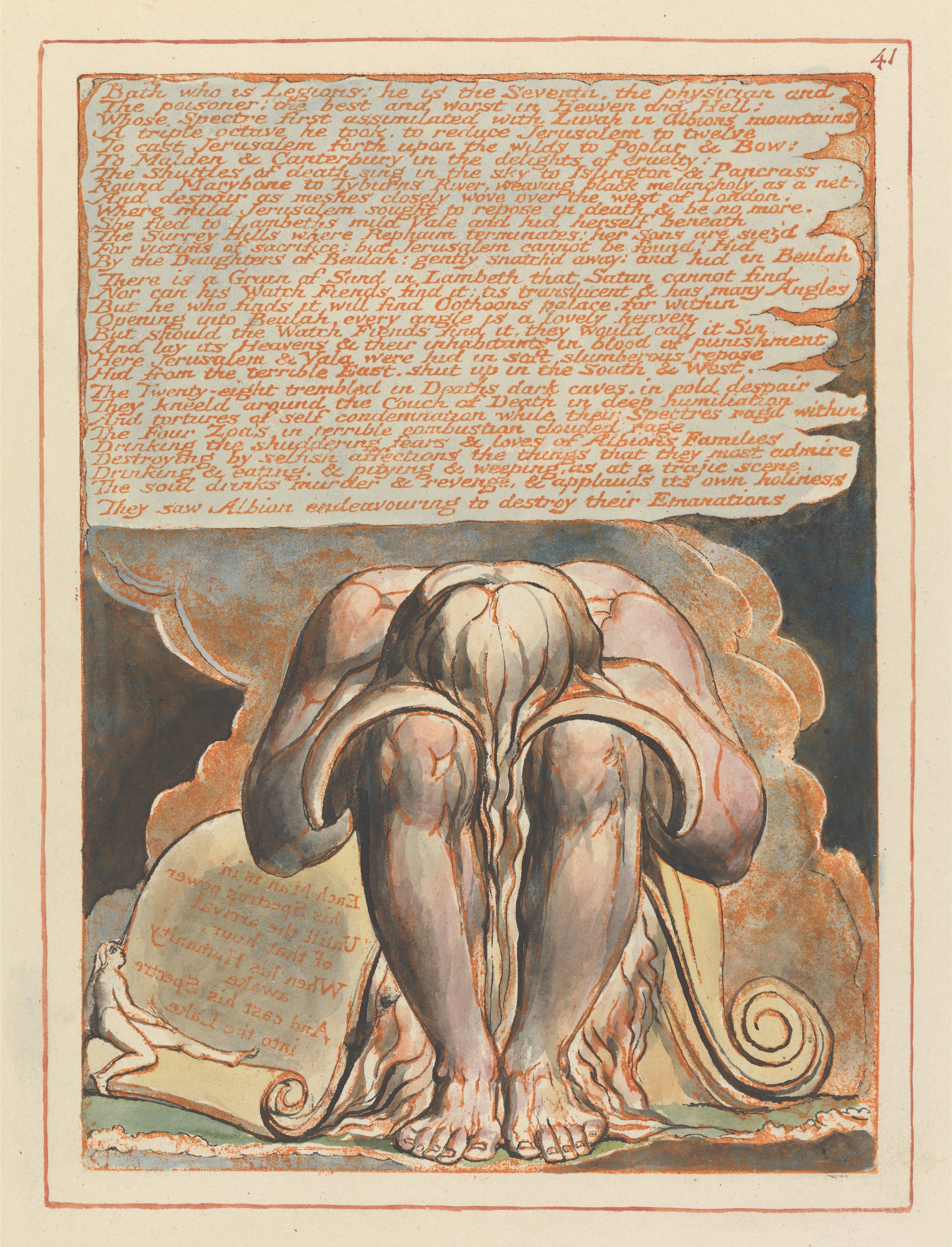
SEEING THROUGH

Yale Center for British Art
Jerusalem
Plate 41

There is a finite world - the material world of time and space. Humans receive physical bodies capable of living in the physical world of matter, time and space. But there is another world - the Infinite World - the Spiritual world of Eternity and Infinity. Humans are given Spiritual Bodies which live both in the physical and in the eternal worlds. The Spiritual Body is capable of perceiving the Divine Vision which is opaque to the corporeal body.

When Albion fell from his Unifying Form by closing himself off from the Divine Vision and following his own Selfhood, the delicate balance in the Human psyche lost its ability to function in the Spiritual world. We can think of the Natural World as a filter which separates us from the world which is not perceived by our natural senses. Even though the Natural World is a gift to be used and enjoyed in this life, it obscures the underlying import of the activity of Spiritual Reality. Blake tells us to look not at the world but 'thro' the world, not at the filter but at truths that underlie and give definition to what the senses perceive.

If we, like Albion, cannot discern the workings on the Spirit in ourselves and in the Natural World we cannot see the Divine Hand at work. Without Vision we find ourselves in the Furnace of Affliction until that hour when we awake.  

Proverbs 29
[18] Where there is no vision, the people perish: but he that keepeth the law, happy is he.

Jerusalem, Plate 37 [41], (E 184) 
[illustration, with inscription, reversed:]
"Each Man is in
his Spectre's power
Untill the arrival
of that hour,
When his Humanity
awake
And cast his Spectre
into the Lake"

Vision of Last Judgment, (E 566)
"I question not my Corporeal or Vegetative Eye any more than I would Question a Window concerning a Sight I look thro it & not with it."