Blake seeks to provide the Golden String which can lead us through the labyrinth of our experience or his own poetry.

Wednesday, June 22, 2022

BLAKE & TRADITION

First posted March 2015

Kathleen Raine became immersed in the study of William Blake when she was a student at Cambridge University. When, at the age of 85, she was interviewed by Donald Stanford, she was asked about the roots of Blake's sources which had formed the foundation of her masterwork Blake and Tradition, published in 1969, forty years after she received her masters degree from Cambridge. The following interview is available on the blog, Explorations: The Twentieth Century. 
 
An Interview Conducted with Kathleen Raine on July 12, 1993
Donald E. Stanford

"The audio tape of the interview that follows with Kathleen Raine is housed among the Donald E. Stanford Papers in the Louisiana and Lower Mississippi Valley Collections of the Louisiana State University Libraries, in Baton Rouge, Louisiana. Some of the questions that Donald Stanford posed in the interview, which took place, in London, in Kathleen Raine’s flat on July 12, 1993, were submitted by Herbert V. Fackler (January 23, 1942 – December 18, 1999) and Joseph Riehl, both members of the faculty of English at the University of Louisiana, Lafayette. Kathleen Raine had celebrated her 85th birthday on June 14."
...

"Stanford: Would you say a little more about this excluded tradition?

Raine: We know that he had read Swedenborg and Paracelsus, because he tells us so in the Marriage of Heaven and Hell. The first important source I discovered was the new Platonic writings translated into English during Blake’s lifetime by Thomas Taylor the Platonist, whom Blake knew at one time. He was a friend of Blake’s friend Flaxman. Blake had certainly read many of the Neo-Platonic writings in the translations of Taylor, and Neo-Platonism is one important source. He had also read the Bhagavad-Gītī. This we know because he had made a painting, since lost, of Mr. Wilkins translating the Bhagavad-Gītī. He had read a great deal of the mythologies, all the traditions that were accessible to him. He knew the Greek myths, the Norse, a certain amount about the American Indian myths. He’d read the Koran. In fact, he was working within a tradition which holds the prime element of life to be mind and not matter, which, of course, is the normal view of the perennial philosophy throughout the world and throughout all civilizations prior to our own, which takes matter to be the basic substance within the universe. And Blake’s great contribution, his great battle cry, was to open the eyes of men into the inner worlds, into the worlds of thought. He was challenging the materialism of his time. He challenged the thought of Newton, Bacon, Locke, the whole movement of the Royal Society, and the whole Western trend which was at that time towards materialism. Blake went on affirming the primacy of mind, spirit, imagination, and in order to do so he had a great tradition to draw on. In fact, when it comes to Jung, they both had read many of the same works, which accounts to a great extent for their undoubted similarities
...
     Sanford: Kathleen, could you please tell us a little more about your procedures in researching your volumes of
Blake and the Tradition?


Raine: Well, it was a life’s work. It was enormous fun, I must say. I started, as I have said, with Ruthven Todd and the sources that he had already pointed to, and then it was just that one thing led to another. One just went on winding in the golden thread and far from its being just a few odd books, like Bryant’s mythology and antiquities and so on, it proved that this golden thread wound in the works of Plato, the works of Plotinus, and the works of Jacob Boehme (of course one knows from Blake that these were his sources) and the works of Paracelsus. I spent weeks and months and years reading dusty volumes in the North Library of the British Museum, and my eyes were opened. I simply had no idea of the richness of the tradition which modern academia and our civilization as a whole, based as it is on material process, had exploded. It was virtually the wisdom of the world that Blake had drawn on. My most important contribution, I suppose, at that time was finding the importance of Thomas Taylor, the Platonist. Blake did not read Greek. Shelley of course did, and Coleridge, but Blake read only English and French. And his acquaintance with Thomas Taylor has since been verified by scholarship in a reference to Blake and [George] Cumberland. There is a description by a member of Cumberland’s family of visiting Thomas Taylor and finding him sitting talking with William Blake and expounding to him the theorem of Pythagoras and Blake saying, “Never mind the proofs, I can see it with my own eyes,” which is very characteristic of both, because Taylor, of course, was a mathematician and Blake was not. Well, I discovered quite early on that the Arlington Court tempera is an illustration of Porphyry’s work De antro nympharum and Keynes of course accepted that, but no other professional Blake scholars have done so hitherto, but it is just a plain fact that it is, every detail. Blake would have read it in Taylor’s “Essay on the Restoration of the Greek Theology by the Late Platonists” which was known to Blake. If two people live next door to one another the critics won’t accept that as evidence, it has to be in writing. And it is known that, for example, Taylor gave six lectures on Platonic theology at the house of Flaxman. It is known that Flaxman and Blake were close friends from youth, but “Oh, no,” they say; “this is no proof that Blake knew anything about Taylor,” you see. This is the sort of blinkered mentality of those who will only accept the evidence of written text. If people see each other every day, they don’t tend to write one another letters. On the whole, one writes letters to people one does not see every day.
...
British Museum
after Michelangelo
Copy of engraving by Adamo Ghisi
c. 1785

   Raine: What I’ve been trying to do all my life is to challenge and reverse the premises of modern Western materialism. That is what Blake was attempting. That is why the hippies had a sort of feeling for him—they felt there was something there—and that is what Yeats was trying to do and that is why I was taking up the torch in very frail hands myself, I don’t compare myself with Blake or Shelley or Yeats, but nevertheless that is what my life’s work has also been trying to do."


 Marriage of Heaven & Hell, Plate 21, (E 42)
  "I have always found that Angels have the vanity to speak of
themselves as the only wise; this they do with a confident
insolence sprouting from systematic reasoning:
  Thus Swedenborg boasts that what he writes is new; tho' it
is only the Contents or Index of already publish'd books
  A man carried a monkey about for a shew, & because he was a
little wiser than the monkey, grew vain, and conciev'd himself as
much
wiser than seven men.  It is so with Swedenborg; he shews the
folly of churches & exposes hypocrites, till he imagines that all
are religious. & himself the single 
Plate 22
One on earth that ever broke a net.
  Now hear a plain fact: Swedenborg has not written one new
truth: Now hear another: he has written all the old falshoods.
  And now hear the reason.  He conversed with Angels who are
all religious, & conversed not with Devils who all hate religion,
for he was incapable thro' his conceited notions.
  Thus Swedenborgs writings are a recapitulation of all
superficial opinions, and an analysis of the more sublime, but no
further.
  Have now another plain fact: Any man of mechanical talents
may from the writings of Paracelsus or Jacob Behmen, produce ten
thousand volumes of equal value with Swedenborg's.
and from those of Dante or Shakespear, an infinite number.
  But when he has done this, let him not say that he knows
better than his master, for he only holds a candle in sunshine."


Saturday, June 18, 2022

VISION

Mercy and Truth are Met Together 
Psalms 85:10

When Carl Jung was 69 years old he had a serious heart attack from which he slowly recovered. In the weeks before he fully reentered consciousness, his mind was occupied with visions which are recorded here:  

Carl Jung: Wounded Healer of the Soul, Claire Dunne, Page 158

"All of these experiences were glorious...So fantastically beautiful that by comparison this world appeared downright ridiculous. As I approached closer to life again, they grew fainter, and scarcely three weeks after the first vision they cease altogether....

We shy away from the use of the word 'eternal,' but I can describe the experience only as the ecstasy of a non-temporal state in which present, past and future are one. Everything that happens in time has been brought together into a concrete whole. Nothing was distributed over time, nothing could be measured by temporal concepts. The experience might best be defined as a state of feeling, one which cannot be produced by imagination.... One is woven into an indescribable whole and yet observes it with complete objectivity."  

William Blake had an analogous experience of enhanced consciousness when he first left London and moved to Felpham. The poem he sent to his friend Thomas Butts recorded his ecstasy at the expansion of consciousness he felt. He awoke to a new confidence in the voice with which he could speak to God's people. 

Letters, To Butts, (E 712)
"To my Friend Butts I write
     My first Vision of Light
     On the yellow sands sitting
     The Sun was Emitting
     His Glorious beams
     From Heavens high Streams
     Over Sea over Land
     My Eyes did Expand
     Into regions of air
     Away from all Care
     Into regions of fire
     Remote from Desire
     The Light of the Morning
     Heavens Mountains adorning
     In particles bright
     The jewels of Light
     Distinct shone & clear--
     Amazd & in fear
     I each particle gazed
     Astonishd Amazed
     For each was a Man
     Human formd.  Swift I ran
     For they beckond to me
     Remote by the Sea
     Saying.  Each grain of Sand
     Every Stone on the Land
     Each rock & each hill
     Each fountain & rill
     Each herb & each tree
     Mountain hill Earth & Sea
     Cloud Meteor & Star
     Are Men Seen Afar
     I stood in the Streams
     Of Heavens bright beams
     And Saw Felpham sweet
     Beneath my bright feet

     In soft Female charms
     And in her fair arms
     My Shadow I knew
     And my wifes shadow too
     And My Sister & Friend.
     We like Infants descend
     In our Shadows on Earth
     Like a weak mortal birth
     My Eyes more & more
     Like a Sea without shore
     Continue Expanding
     The Heavens commanding
     Till the jewels of Light
     Heavenly Men beaming bright
     Appeard as One Man
     Who Complacent began
     My limbs to infold
     In his beams of bright gold
     Like dross purgd away
     All my mire & my clay
     Soft consumd in delight
     In his bosom sun bright
     I remaind.  Soft he smild
     And I heard his voice Mild
     Saying This is My Fold
     O thou Ram hornd with gold
     Who awakest from sleep
     On the sides of the Deep
     On the Mountains around
     The roarings resound
     Of the lion & wolf
     The loud sea & deep gulf
     These are guards of My Fold
     O thou Ram hornd with gold
     And the voice faded mild
     I remaind as a Child
     All I ever had known
     Before me bright Shone
     I saw you & your wife
     By the fountains of Life
     Such the Vision to me
     Appeard on the Sea"

Isaiah 6

[1] In the year that king Uzziah died I saw also the Lord sitting upon a throne, high and lifted up, and his train filled the temple.
[2] Above it stood the seraphims: each one had six wings; with twain he covered his face, and with twain he covered his feet, and with twain he did fly.
[3] And one cried unto another, and said, Holy, holy, holy, is the LORD of hosts: the whole earth is full of his glory.
[4] And the posts of the door moved at the voice of him that cried, and the house was filled with smoke.
[5] Then said I, Woe is me! for I am undone; because I am a man of unclean lips, and I dwell in the midst of a people of unclean lips: for mine eyes have seen the King, the LORD of hosts.
[6] Then flew one of the seraphims unto me, having a live coal in his hand, which he had taken with the tongs from off the altar:
[7] And he laid it upon my mouth, and said, Lo, this hath touched thy lips; and thine iniquity is taken away, and thy sin purged.
[8] Also I heard the voice of the Lord, saying, Whom shall I send, and who will go for us? Then said I, Here am I; send me.
Vision of the Last Judgment, (E 555)
   "The Nature of Visionary Fancy or Imagination is very little
Known & the Eternal nature & permanence of its ever Existent
Images is considerd as less permanent than the things of
Vegetative & Generative Nature yet the Oak dies as well as the
Lettuce but Its Eternal Image & Individuality never dies. but
renews by its seed. just so the Imaginative Image
returns by the seed of Contemplative Thought 
the Writings of the Prophets illustrate these conceptions
of the Visionary Fancy by their various sublime & Divine Images
as seen in the Worlds of Vision"


Wednesday, June 15, 2022

Mortal and Eternal

Published Feb 2015

Blake read British poetry widely and found the same "kernel of meaning" in every kind of literature. He knew and loved Spenser, Queen Elizabeth's poet laureate who wrote The Faerie Queen. Kathleen Raine provided  two examples from Spenser of the oldest myth central to Blake's poetry, namely the descent of the soul and eventual return. 
 
These are the passages taken from 'THE THIRD BOOKE OF THE FAERIE QUEENE CANTO VI.....
"It sited was in fruitfull soyle of old,
And girt in with two walles on either side;
The one of yron, the other of bright gold,
That none might thorough breake, nor over-stride:
And double gates it had, which opened wide,
By which both in and out men moten pas;
Th'one faire and fresh, the other old and dride:
Old Genius the porter of them was,
Old Genius, the which a double nature has.
xxxii
He letteth in, he letteth out to wend,
All that to come into the world desire;
A thousand thousand naked babes attend
About him day and night, which doe require,
That he with fleshly weedes would them attire:
Such as him list, such as eternall fate
Ordained hath, he clothes with sinfull mire,
And sendeth forth to live in mortall state,
Till they againe returne backe by the hinder gate."

Blake used this (timeless idea) in one of his earliest works, Book of Thel, Plate 6:
"The eternal gates terrific porter lifted up the northern bar".
 
British Museum
Book of Thel
Plate 6


Blake used the Northern (down to earth) and Southern Gates more pointedly in The Arlington Tempera. Look closely and you may see Thel at the bottom of the northern stairs with her pail still full; she has seen more than she wants to see and she is purposefully going back against the stream of the nymphs which is heading for mortality.

The Angel is pointing the traveler back up the Southern Gate; he has tasted mortality fully and is ready to go home.

Nevertheless with the Enlightenment this sort of idea had fallen into obscurity in most of the materialistic and rational minds of England. Bacon, Newton, and Locke were the primary exponents of rationalism in Blake's day. This meant in reality that no one was interested in the kind of poetry and philosophy that interested Blake.


From the Beyond (Eternity) the world was created; man was created; time and space were created; birth and death were created; good and evil are creatures, figments of a frail and created mind.. In the world - in time and space - we perceive duality, or a multiplicity. In Eternity we imagine Unity.
 
The ultimate duality is between Eternity and the World, between God and man, but this is a sometime thing - until the end of time. As a creature the world will end; you, too, will end, as a creature.
 
But the vision of the mystic suggests that you are more than a creature. The writer of Genesis had such an inkling when he described man as made of the dust of the earth, but in the image of God. The Quakers believe there is 'that of God' in everyone.
 
Eternal Death in Blake's language refers to the soul's descent from Eden (and Beulah) to the nether regions (Ulro) where Eternity is lost and only the created remains. Lost! but not forever; Eternal Death dies, too; Eternity waits for the soul's Awakening, which may be at the moment of mortal death or whenever he casts off error and embraces truth.
 
Book of Thel, Plate 6, (E 6)
"The eternal gates terrific porter lifted the northern bar:
Thel enter'd in & saw the secrets of the land unknown;
She saw the couches of the dead, & where the fibrous roots
Of every heart on earth infixes deep its restless twists:
A land of sorrows & of tears where never smile was seen.

She wanderd in the land of clouds thro' valleys dark, listning
Dolours & lamentations: waiting oft beside a dewy grave
She stood in silence. listning to the voices of the ground,
Till to her own grave plot she came, & there she sat down.
And heard this voice of sorrow breathed from the hollow pit.     

Why cannot the Ear be closed to its own destruction?
Or the glistning Eye to the poison of a smile!
Why are Eyelids stord with arrows ready drawn,
Where a thousand fighting men in ambush lie?
Or an Eye of gifts & graces, show'ring fruits & coined gold!  
Why a Tongue impress'd with honey from every wind?
Why an Ear, a whirlpool fierce to draw creations in?
Why a Nostril wide inhaling terror trembling & affright.
Why a tender curb upon the youthful burning boy!
Why a little curtain of flesh on the bed of our desire?          

The Virgin started from her seat, & with a shriek.
Fled back unhinderd till she came into the vales of Har
                                    
                  The End" 
 

Thursday, June 9, 2022

CHOICE

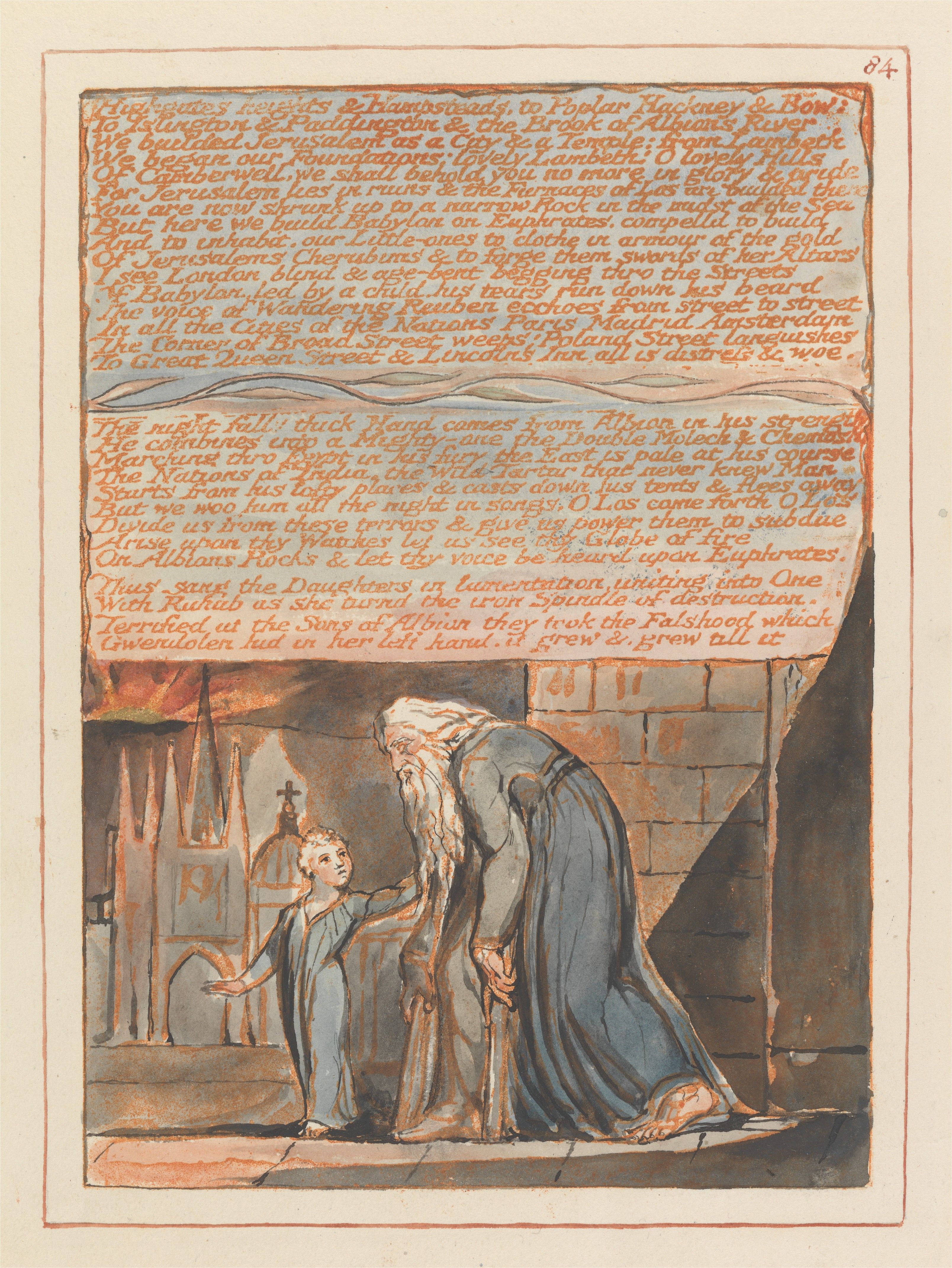
Yale Center for British Art
Jerusalem
Plate 84

We tend to think of crises as rare events which occur, are solved and can be forgotten. But as we look back over our lifetimes from the perspective of world events, we see a series of recurring crises with solutions which prove to be temporary. In Blake's lifetime he was affected by numerous crises going on in his personal life, his city and country, and around the world.

Each crisis presents a choice. Blake's poetry was his response. He knew that if we are not conscious of the nature of our circumstances, the solution would escape us. 

Northrop Frye understood what Blake was saying better than I. In Fearful Symmetry on Page 391 he wrote:

"The redeemable Luvah of Jerusalem approaching the crisis of vision is of course not Blake himself, who got past it long ago, but England. The Los, Luvah, and Satan of the great struggle, then, are in this case Jesus, Albion, and Satan. The England Blake is addressing is Albion in a fallen or sleeping state in the World of Generation which is Luvah's world: that is, Albion at present is Luvah. The function of Jerusalem is to recreate the vision of the Jesus of action, the divine man whose impact miraculously increased the bodily and mental powers of those who saw what he was, in order to bring the impact directly to bear on the English public. This occurs at a time when both English civilization and one of its artists have reached the point we described as imaginative puberty. England has to choose weather to turn its green and pleasant land into Jerusalem or a howling waste of Satanic mills, and Blake is practically the only Englishman who can express the fact that the choice is now before England and is still a choice. Jerusalem is Blake's contribution to the struggle between the prophet and the profiteer for the soul of England, Armageddon: it is the burning-glass focusing the the rays of a fiery city on London in the hope of kindling an answering flame." 

Jerusalem, Plate 83, (E 243)
"Our Father Albions land: O it was a lovely land! & the Daughters of Beulah
Walked up and down in its green mountains: but Hand is fled
Away: & mighty Hyle: & after them Jerusalem is gone: Awake
Plate 84
Highgates heights & Hampsteads, to Poplar Hackney & Bow:
To Islington & Paddington & the Brook of Albions River
We builded Jerusalem as a City & a Temple; from Lambeth
We began our Foundations; lovely Lambeth! O lovely Hills
Of Camberwell, we shall behold you no more in glory & pride    
For Jerusalem lies in ruins & the Furnaces of Los are builded there
You are now shrunk up to a narrow Rock in the midst of the Sea
But here we build Babylon on Euphrates, compelld to build
And to inhabit, our Little-ones to clothe in armour of the gold
Of Jerusalems Cherubims & to forge them swords of her Altars   
I see London blind & age-bent begging thro the Streets
Of Babylon, led by a child. his tears run down his beard
The voice of Wandering Reuben ecchoes from street to street
In all the Cities of the Nations Paris Madrid Amsterdam
The Corner of Broad Street weeps; Poland Street languishes     
To Great Queen Street & Lincolns Inn, all is distress & woe."

Four Zoas, Night VII, Page 87, (E 369)

"But I have thee my [Counterpart Vegetating] miraculous
These Spectres have no [Counter(parts)] therefore they ravin
Without the food of life Let us Create them Coun[terparts]
For without a Created body the Spectre is Eternal Death

Los trembling answerd Now I feel the weight of stern repentance
Tremble not so my Enitharmon at the awful gates    
Of thy poor broken Heart I see thee like a shadow withering
As on the outside of Existence but look! behold! take comfort!
Turn inwardly thine Eyes & there behold the Lamb of God
Clothed in Luvahs robes of blood descending to redeem
O Spectre of Urthona take comfort O Enitharmon   
Couldst thou but cease from terror & trembling & affright
When I appear before thee in forgiveness of ancient injuries  
Why shouldst thou remember & be afraid. I surely have died in pain
Often enough to convince thy jealousy & fear & terror
Come hither be patient let us converse together because  
I also tremble at myself & at all my former life"
  

Monday, June 6, 2022

RESURRECTION

Harvard Art Museum
Resurrection

John 11

[25] Jesus said unto her, I am the resurrection, and the life: he that believeth in me, though he were dead, yet shall he live:
[26] And whosoever liveth and believeth in me shall never die. Believest thou this?

First Corinthians 15 

[40] There are also celestial bodies, and bodies terrestrial: but the glory of the celestial is one, and the glory of the terrestrial is another.
[41] There is one glory of the sun, and another glory of the moon, and another glory of the stars: for one star differeth from another star in glory.
[42] So also is the resurrection of the dead. It is sown in corruption; it is raised in incorruption:
[43] It is sown in dishonour; it is raised in glory: it is sown in weakness; it is raised in power:
[44] It is sown a natural body; it is raised a spiritual body. There is a natural body, and there is a spiritual body.
[45] And so it is written, The first man Adam was made a living soul; the last Adam was made a quickening spirit.
[46] Howbeit that was not first which is spiritual, but that which is natural; and afterward that which is spiritual.
[47] The first man is of the earth, earthy: the second man is the Lord from heaven.
[48] As is the earthy, such are they also that are earthy: and as is the heavenly, such are they also that are heavenly.
[49] And as we have borne the image of the earthy, we shall also bear the image of the heavenly.

John 3

[5] Jesus answered, Verily, verily, I say unto thee, Except a man be born of water and of the Spirit, he cannot enter into the kingdom of God.
[6] That which is born of the flesh is flesh; and that which is born of the Spirit is spirit.
[7] Marvel not that I said unto thee, Ye must be born again.
[8] The wind bloweth where it listeth, and thou hearest the sound thereof, but canst not tell whence it cometh, and whither it goeth: so is every one that is born of the Spirit.
[9] Nicodemus answered and said unto him, How can these things be?
[10] Jesus answered and said unto him, Art thou a master of Israel, and knowest not these things?
[11] Verily, verily, I say unto thee, We speak that we do know, and testify that we have seen; and ye receive not our witness.
[12] If I have told you earthly things, and ye believe not, how shall ye believe, if I tell you of heavenly things?


The new birth is the the passage from death into life. Death is the experience of the mortal man, life is the experience of the eternal man. In the seplucher man probed the depths of alienation and despair. He annihilated what could be annihilated and embraced what could be redeemed. He was released from his natural body that he may be raised a spiritual body.

Milton, Plate 40 [46]. (E 142)

"Obey thou the Words of the Inspired Man 
All that can be annihilated must be annihilated    

That the Children of Jerusalem may be saved from slavery
There is a Negation, & there is a Contrary
The Negation must be destroyd to redeem the Contraries
The Negation is the Spectre; the Reasoning Power in Man
This is a false Body: an Incrustation over my Immortal           
Spirit; a Selfhood, which must be put off & annihilated alway
To cleanse the Face of my Spirit by Self-examination."

Jerusalem, Plate 62, (E 213)

"Jesus replied. I am the Resurrection & the Life.
I Die & pass the limits of possibility, as it appears
To individual perception. Luvah must be Created                  
And Vala; for I cannot leave them in the gnawing Grave.
But will prepare a way for my banished-ones to return"
Gates of Paradise, Keys of the GAtes, (E 289)
"13   But when once I did descry 
     The Immortal Man that cannot Die
14   Thro evening shades I haste away 
     To close the Labours of my Day
15   The Door of Death I open found                             
     And the Worm Weaving in the Ground
16   Thou'rt my Mother from the Womb 
     Wife, Sister, Daughter to the Tomb 
     Weaving to Dreams the Sexual strife
     And weeping over the Web of Life" 


Saturday, June 4, 2022

ENTOMBMENT

Entombment

 Matthew 27

[55] And many women were there beholding afar off, which followed Jesus from Galilee, ministering unto him:
[56] Among which was Mary Magdalene, and Mary the mother of James and Joses, and the mother of Zebedee's children.
[57] When the even was come, there came a rich man of Arimathaea, named Joseph, who also himself was Jesus' disciple:
[58] He went to Pilate, and begged the body of Jesus. Then Pilate commanded the body to be delivered.
[59] And when Joseph had taken the body, he wrapped it in a clean linen cloth,
[60] And laid it in his own new tomb, which he had hewn out in the rock
: and he rolled a great stone to the door of the sepulchre, and departed.
[61] And there was Mary Magdalene, and the other Mary, sitting over against the sepulchre.

John 19

[38] And after this Joseph of Arimathaea, being a disciple of Jesus, but secretly for fear of the Jews, besought Pilate that he might take away the body of Jesus: and Pilate gave him leave. He came therefore, and took the body of Jesus.
[39] And there came also Nicodemus, which at the first came to Jesus by night, and brought a mixture of myrrh and aloes, about an hundred pound weight.
[40] Then took they the body of Jesus, and wound it in linen clothes with the spices, as the manner of the Jews is to bury.
[41] Now in the place where he was crucified there was a garden; and in the garden a new sepulchre, wherein was never man yet laid.
[42] There laid they Jesus therefore because of the Jews' preparation day; for the sepulchre was nigh at hand.


 When you read Blake's poetry or Jung's psychology you learn of being placed in the seplucure to await the rebirth to greater consciousness.

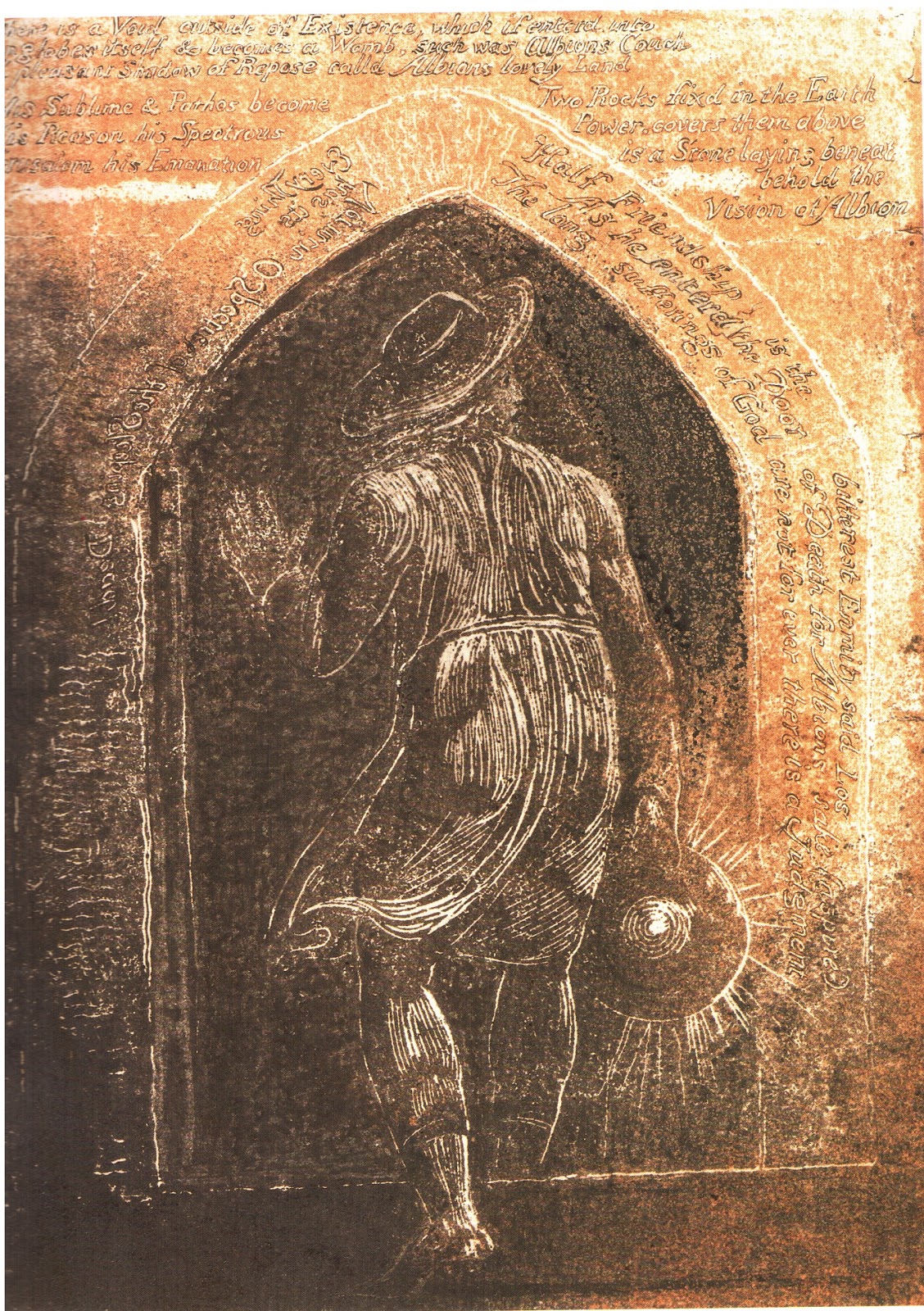
Jerusalem 
Frontispiece
Proof with Text
Right click on image and select open in new window; left click on image for enlargement, navigate with arrow keys.
You will be able to read text.
Jerusalem, Plate 1, (E 144)
[Above the archway:]

"There is a Void, outside of Existence, which if enterd into
Englobes itself & becomes a Womb, such was Albions Couch
A pleasant Shadow of Repose calld Albions lovely Land

His Sublime & Pathos become Two Rocks fixd in the Earth
His Reason his Spectrous Power, covers them above                
Jerusalem his Emanation is a Stone laying beneath
O [Albion behold Pitying] behold the Vision of Albion 

[On right side of archway:]

Half Friendship is the bitterest Enmity said Los
As he enterd the Door of Death for Albions sake Inspired
The long sufferings of God are not for ever there is a Judgment" 
Four Zoas, Night VII, Page 87, (E 369) 
"Los trembling answerd Now I feel the weight of stern repentance
Tremble not so my Enitharmon at the awful gates    
Of thy poor broken Heart I see thee like a shadow withering
As on the outside of Existence but look! behold! take comfort!
Turn inwardly thine Eyes & there behold the Lamb of God
Clothed in Luvahs robes of blood descending to redeem"

Existence to Blake is the life Eternal. What we usually call life is Eternal Death. The realization the we live eternally through Jesus, the Imagination, is our entry into Eternity. Eternal Death is consumed by Eternal Life because it has no eternal existence.  

Carl Jung Wounded Healer of the Soul, by Claire Dunne,  Page 178

"Have your congregation understood that they must close their eyes to the traditional teachings and go through the darkness of their own souls and set aside everything in order to become that which every individual bears in himself as his individual task, and that no one can take this burden from him?" Quote from letter of Carl Jung 


Thursday, June 2, 2022

BEHOLD THY MOTHER

Behold Thy Mother

In the Gospel of John we read that standing near the cross were the mother of Jesus and her sister, Mary the wife of Cleophas, and Mary Magdalene. Also present was a disciple. Jesus spoke to his mother saying, "Woman, behold thy son." Then looking to his disciple he said, "behold thy mother." Thus was a new bond created between the mother of Jesus and the disciple of Jesus. As Jesus was leaving his earthly life he acknowledged that a transformation in relationships was taking place. Those who had been dear to his in this life were becoming related in the Eternal life. Family was expanding. 

John 19

[25] Now there stood by the cross of Jesus his mother, and his mother's sister, Mary the wife of Cleophas, and Mary Magdalene.
[26] When Jesus therefore saw his mother, and the disciple standing by, whom he loved, he saith unto his mother, Woman, behold thy son!
[27] Then saith he to the disciple, Behold thy mother! And from that hour that disciple took her unto his own home.

As a young man entering puberty Jesus had visited Jerusalem with his parents for the Passover celebration. Jesus took on an adult role when without the knowledge of his parents, he stayed behind and entered into a discussion with the teachers in the temple.

Luke 2

[39] And when they had performed all things according to the law of the Lord, they returned into Galilee, to their own city Nazareth.
[40] And the child grew, and waxed strong in spirit, filled with wisdom: and the grace of God was upon him.
[41] Now his parents went to Jerusalem every year at the feast of the passover.
[42] And when he was twelve years old, they went up to Jerusalem after the custom of the feast.
[43] And when they had fulfilled the days, as they returned, the child Jesus tarried behind in Jerusalem; and Joseph and his mother knew not of it.
[44] But they, supposing him to have been in the company, went a day's journey; and they sought him among their kinsfolk and acquaintance.
[45] And when they found him not, they turned back again to Jerusalem, seeking him.
[46] And it came to pass, that after three days they found him in the temple, sitting in the midst of the doctors, both hearing them, and asking them questions.
[47] And all that heard him were astonished at his understanding and answers.
[48] And when they saw him, they were amazed: and his mother said unto him, Son, why hast thou thus dealt with us? behold, thy father and I have sought thee sorrowing.
[49] And he said unto them, How is it that ye sought me? wist ye not that I must be about my Father's business?
[50] And they understood not the saying which he spake unto them.
[51] And he went down with them, and came to Nazareth, and was subject unto them: but his mother kept all these sayings in her heart.
[52] And Jesus increased in wisdom and stature, and in favour with God and man.

In the Gospel of John we read of another tense situation between Jesus and his mother. But, never the less, the mother of Jesus was closely associated with the group who followed the ministry of Jesus.

John 2

[1] And the third day there was a marriage in Cana of Galilee; and the mother of Jesus was there:
[2] And both Jesus was called, and his disciples, to the marriage.
[3] And when they wanted wine, the mother of Jesus saith unto him, They have no wine.
[4] Jesus saith unto her, Woman, what have I to do with thee? mine hour is not yet come.
[5] His mother saith unto the servants, Whatsoever he saith unto you, do it.
[6] And there were set there six waterpots of stone, after the manner of the purifying of the Jews, containing two or three firkins apiece.
[7] Jesus saith unto them, Fill the waterpots with water. And they filled them up to the brim.
[8] And he saith unto them, Draw out now, and bear unto the governor of the feast. And they bare it.
[9] When the ruler of the feast had tasted the water that was made wine, and knew not whence it was: (but the servants which drew the water knew;) the governor of the feast called the bridegroom,
[10] And saith unto him, Every man at the beginning doth set forth good wine; and when men have well drunk, then that which is worse: but thou hast kept the good wine until now.
[11] This beginning of miracles did Jesus in Cana of Galilee, and manifested forth his glory; and his disciples believed on him.
[12] After this he went down to Capernaum, he, and his mother, and his brethren, and his disciples: and they continued there not many days.
[13] And the Jews' passover was at hand, and Jesus went up to Jerusalem,

A spiritual community had formed during the life of Jesus. It became the nucleus of the young church which developed after his death. The words spoken to his mother and his disciple before he acknowledged that his earthly life was finished were a way of signaling the transformation which was being enacted.

Phillips Translation

19:25-27 - While the soldiers were doing this, Jesus' mother was standing near the cross with her sister, and with them Mary, the wife of Clopas and Mary of Magdala. Jesus saw his mother and the disciple whom he loved standing by her side, and said to her, "Look, there is your son!" And then he said to the disciple, "And there is your mother!" And from that time the disciple took Mary into his own home.

19:28 - After this, Jesus realizing that everything was now completed said (fulfilling the saying of scripture), "I am thirsty."

19:29-30 - There was a bowl of sour wine standing there. So they soaked a sponge in the wine, put it on a spear, and pushed it up towards his mouth. When Jesus had taken it, he cried, "It is finished!" His head fell forward, and he died.

Luke 23

[43] And Jesus said unto him, Verily I say unto thee, To day shalt thou be with me in paradise.
[44] And it was about the sixth hour, and there was a darkness over all the earth until the ninth hour.
[45] And the sun was darkened, and the veil of the temple was rent in the midst.
[46] And when Jesus had cried with a loud voice, he said, Father, into thy hands I commend my spirit: and having said thus, he gave up the ghost.


Jerusalem, Plate 33 [37], (E 179) 
"Turning from Universal Love petrific as he [Albion] went,
His cold against the warmth of Eden rag'd with loud
Thunders of deadly war (the fever of the human soul)
Fires and clouds of rolling smoke! but mild the Saviour follow'd him,   
Displaying the Eternal Vision! the Divine Similitude!
In loves and tears of brothers, sisters, sons, fathers, and friends
Which if Man ceases to behold, he ceases to exist:

Saying. Albion! Our wars are wars of life, & wounds of love,
With intellectual spears, & long winged arrows of thought:       
Mutual in one anothers love and wrath all renewing
We live as One Man; for contracting our infinite senses
We behold multitude; or expanding: we behold as one,
As One Man all the Universal Family; and that One Man
We call Jesus the Christ: and he in us, and we in him,        
Live in perfect harmony in Eden the land of life,
Giving, recieving, and forgiving each others trespasses.
He is the Good shepherd, he is the Lord and master:
He is the Shepherd of Albion, he is all in all,
In Eden: in the garden of God: and in heavenly Jerusalem.        
If we have offended, forgive us, take not vengeance against us.

Thus speaking; the Divine Family follow Albion:
I see them in the Vision of God upon my pleasant valleys."