Blake seeks to provide the Golden String which can lead us through the labyrinth of our experience or his own poetry.

Tuesday, July 19, 2022

THE CHILD

                         Fitzwilliam Museum
                         Songs of Innocence
Plate 9, Copy AA

Two aspects of the child which Blake portrays are the potential of the child and the vulnerability of the child. He shows us the child who merrily requests the songs but whose joy brought tears to his eyes. The contradictory nature of childhood is present from the first of the songs. The same child who delights in the simplest of things - the smile, the touch, the sight, the sound, or the taste, can be devastated by a restraining hand, a critical word, or the admonition 'no'.  

As we read through the song of Innocence we hear of stresses which enter the life of the child. The Little Black Boy feels the alienation of not being accepted by the English child. The Little Boy lost can't keep up with his father and must 'weep' to get his attention. The Little Boy Found requires the intervention of God's guidance to reestablish his connection with his family. In the Divine Image the child learns that Mercy Pity Peace and Love are within him because they are synonymous with the Divine Image - the God within. In Nurse's Song we see children who have beyond the need for external supervision because they are aware of presence of the light and desire to enjoy it least it fade. In Anothers Sorrow the child has reached the maturity of knowing that there is suffering to be borne, but who realizes that there is One who shares the pains of the world. 

Songs of Innocence, Plate 4, (E 7)
"Introduction
Piping down the valleys wild
Piping songs of pleasant glee
On a cloud I saw a child.
And he laughing said to me.

Pipe a song about a Lamb;    
So I piped with merry chear,
Piper pipe that song again--
So I piped, he wept to hear.

Drop thy pipe thy happy pipe
Sing thy songs of happy chear,        
So I sung the same again
While he wept with joy to hear

Piper sit thee down and write
In a book that all may read--
So he vanish'd from my sight.
And I pluck'd a hollow reed.

And I made a rural pen,
And I stain'd the water clear,
And I wrote my happy songs
Every child may joy to hear" 
Songs of Innocence, Plate 9, (E 9)   
"The Little Black Boy.

My mother bore me in the southern wild,
And I am black, but O! my soul is white;
White as an angel is the English child:
But I am black as if bereav'd of light.

My mother taught me underneath a tree
And sitting down before the heat of day,
She took me on her lap and kissed me,
And pointing to the east began to say.

Look on the rising sun: there God does live
And gives his light, and gives his heat away.      
And flowers and trees and beasts and men recieve
Comfort in morning joy in the noon day.

And we are put on earth a little space,
That we may learn to bear the beams of love,
And these black bodies and this sun-burnt face      
Is but a cloud, and like a shady grove.
SONGS 10  
For when our souls have learn'd the heat to bear
The cloud will vanish we shall hear his voice.
Saying: come out from the grove my love & care,
And round my golden tent like lambs rejoice.

Thus  did my mother say and kissed me,
And thus I say to little English boy;
When I from black and he from white cloud free,
And round the tent of God like lambs we joy:

Ill shade him from the heat till lie can bear,
To lean in joy upon our fathers knee.
And then I'll stand and stroke his silver hair,
And be like him and he will then love me."

Songs of Innocence, Plate 13, (E 11) 
"The Little Boy lost     

Father, father, where are you going
O do not walk so fast.
Speak father, speak to your little boy
Or else I shall be lost,

The night was dark no father was there   
The child was wet with dew,
The mire was deep, & the child did weep
And away the vapour flew."

Songs of Innocence, Plate 14, (E 11)
"The Little Boy Found 

The little boy lost in the lonely fen,
Led by the wand'ring light,
Began to cry, but God ever nigh,
Appeard like his father in white.

He kissed the child & by the hand led  
And to his mother brought,
Who in sorrow pale, thro' the lonely dale
Her little boy weeping sought." 
Songs of Innocence, Plate 18, (E 12)
"The Divine Image.             

To Mercy Pity Peace and Love,
All pray in their distress:
And to these virtues of delight
Return their thankfulness.

For Mercy Pity Peace and Love,  
Is God our father dear:
And Mercy Pity Peace and Love,
Is Man his child and care.

For Mercy has a human heart
Pity, a human face:
And Love, the human form divine,
And Peace, the human dress.

Then every man of every clime,
That prays in his distress,
Prays to the human form divine   
Love Mercy Pity Peace.

And all must love the human form,
In heathen, turk or jew.
Where Mercy, Love & Pity dwell,
 
There God is dwelling too"  
Songs of innocence, Plate 24, (E 15) 
"Nurse's Song                      
When the voices of children are heard on the green   
And laughing is heard on the hill,       
My heart is at rest within my breast
And every thing else is still

Then come home my children, the sun is gone down    
And the dews of night arise
Come come leave off play, and let us away
Till the morning appears in the skies

No no let us play, for it is yet day
And we cannot go to sleep      
Besides in the sky, the little birds fly     
And the hills are all coverd with sheep

Well well go & play till the light fades away
And then go home to bed
The little ones leaped & shouted & laugh'd  
And all the hills ecchoed"
 
Songs of Innocence, Plate 27, (E 17)   
"On Anothers Sorrow   

Can I see anothers woe,
And not be in sorrow too.
Can I see anothers grief,
And not seek for kind relief?

Can I see a falling tear,
And not feel my sorrows share,
Can a father see his child,
Weep, nor be with sorrow fill'd.

Can a mother sit and hear,
An infant groan an infant fear--
No no never can it be.
Never never can it be.

And can he who smiles on all
Hear the wren with sorrows small,
Hear the small birds grief & care
Hear the woes that infants bear--

And not sit beside the nest
Pouring pity in their breast,
And not sit the cradle near
Weeping tear on infants tear. 

And not sit both night & day,
Wiping all our tears away.
O! no never can it be.
Never never can it be.

He doth give his joy to all. 
He becomes an infant small.
He becomes a man of woe
He doth feel the sorrow too.

Think not, thou canst sigh a sigh,
And thy maker is not by.
Think not, thou canst weep a tear,
And thy maker is not near.

O! he gives to us his joy,
That our grief he may destroy
Till our grief is fled & gone
He doth sit by us and moan"
Fitzwilliam Museum
            Songs of Innocence
Plate 24, Copy AA
 
 
Fitzwilliam Museum
          Songs of Innocence
Plate 14, Copy AA

Tuesday, July 12, 2022

SANITY

Wikipedia Commons
Frontispiece
Songs of Experience

Here is a section of An Interview Conducted with Kathleen Raine on July 12, 1993 by Donald E. Stanford:

interview 

"Stanford: One critic has said recently that Blake was not mad, but he understood and described the mental suffering of madness in a profound way. Do concepts of madness such as schizophrenia, hallucination, and so on have a useful place in Blake criticism and will you comment on the direct question, “was Blake mad?”


Raine: No, of course he wasn’t mad. He was a sane man in a mad world, roughly speaking. Great genius has a wider field of consciousness. That is what genius is: seeing rather more than other men do, perhaps being in advance of his time. Certainly the nature of genius is to not accept current opinion, and Blake certainly did not accept current opinion. I don’t think that words like “schizophrenia” and “paranoia” add much to human discussion of whatever these words mean. Blake himself says, “Plato says that poets do not know what they write and utter. In that case, why is a lesser kind to be called knowing?” In other words, a poet is an inspired man. Blake believed in inspiration. This must be especially remembered with Blake, but all poets have believed in inspiration, that in an inspired state there is a widening of the field of consciousness. Yeats describes genius as bringing together at certain moments the waking and the sleeping mind. The available knowledge is greater in states of inspiration. Blake certainly had this. 


There is much suffering, as your critic says, in the writings of Blake: the turmoil, the anguish of Jerusalem. But this was not a personal thing; he was talking about the nation. He was a spiritual patriot, and he was speaking of the suffering of the giant Albion, as he calls the English nation. He was a prophet in the sense of the Old Testament prophets in the Jewish Bible, who also were speaking for their nation. They were not speaking of their individual suffering; they were speaking of the national psyche, if you like, into which Blake had certainly a remarkably clear insight. He speaks of living. He says, 'in South Molton Street I see and hear' what is going on in the soul of Albion, which is, of course, the soul of England. In other words, here in South Moulton Street I both see and hear the sufferings of the military, or the war against France that broke out after the French Revolution, of the conscription of soldiers, and the suffering of child labor, the endless sufferings of his people at that time, the hangings of boys at Tyburn for the theft of a yard of cloth, the injustices, the national crimes against which Blake spoke out. You may say these were descriptions of deep, deep suffering, the psychological sufferings of various kinds of mental and physical and spiritual tyrannies in his nation at the time. I wonder what he would have been writing about had he lived now. Certainly many things would have been the same — perhaps not all — but when he writes of London and marking, 'in every face marks of weakness, marks of woe,' he felt the collective suffering: that was the nature of his inspiration. He was not a personal poet expressing himself. He was a national prophet, calling to his nation to awake from their 'deadly sleep,' which is unconsciousness of what is going on, and to awake to the truths of the imagination and to reform many things. This is not madness."


Laocoon, (E 274)
 "There are States in which all Visionary Men are accounted Mad 
   Men   such are Greece & Rome"
 Poetical Sketches, (E 415)
"   MAD SONG.
The wild winds weep,
  And the night is a-cold;
Come hither, Sleep,
  And my griefs infold:   
But lo! the morning peeps          
  Over the eastern steeps,
And the rustling birds of dawn 
The earth do scorn.

Lo! to the vault
  Of paved heaven,              
With sorrow fraught
  My notes are driven:
They strike the ear of night,
  Make weep the eyes of day;
They make mad the roaring winds,      
  And with tempests play.

Like a fiend in a cloud
  With howling woe,
After night I do croud,
  And with night will go;         
I turn my back to the east,

From whence comforts have increas'd;
For light doth seize my brain
With frantic pain."

Annotations to Spurzheim's Observations on Insanity, (E 663) 
 "Cowper came to me & said. O that I
were insane always I will never rest.  Can you not make me truly
insane.  I will never rest till I am so. O that in the bosom of
God I was hid.  You retain health & yet are as mad as any of us
all--over us all--mad as a refuge from unbelief--from Bacon
Newton & Locke"
Letters, to Butts Jany 10 180(3), (E 724) 
"The Thing I
have most at Heart! more than life or all that seems to make life
comfortable without.  Is the Interest of True Religion & Science
& whenever any thing appears to affect that Interest. (Especially
if I myself omit any duty to my [self] <Station> as a
Soldier of Christ) It gives me the greatest of torments, I am not
ashamed afraid or averse to tell You what Ought to be Told.  That
I am under the direction of Messengers from Heaven Daily &
Nightly but the nature of such things is not as some suppose.
without trouble or care.  Temptations are on the right hand &
left behind the sea of time & space roars & follows swiftly he
who keeps not right onward is lost & if our footsteps slide in
clay how can we do otherwise than fear & tremble. but I should
not have troubled You with this account of my spiritual state
unless it had been necessary in explaining the actual cause of my
uneasiness into which you are so kind as to Enquire for I never
obtrude such things on others unless questiond & then I never
disguise the truth--But if we fear to do the dictates of our
Angels & tremble at the Tasks set before us. if we refuse to do
Spiritual Acts. because of Natural Fears or Natural Desires!  Who
can describe the dismal torments of such a state!--I too well
remember the Threats I heard!--If you who are organized by Divine
Providence for Spiritual communion.  Refuse & bury your Talent in
the Earth even tho you should want Natural Bread. Sorrow & Desperation 
pursues you thro life! & after death shame & confusion of face to
eternity--Every one in Eternity will leave you aghast at the Man
who was crownd with glory & honour by his brethren & betrayd
their cause to their enemies.  You will be calld the base Judas
who betrayd his Friend!--Such words would make any Stout man
tremble & how then could I be at ease? But I am now no longer in
That State & now go on again with my Task Fearless. and tho my
path is difficult.  I have no fear of stumbling while I keep it" 
Letters, April 25: 1803, To Butts, (E 728)
"Now I may say to you what perhaps I should not dare to say
to any one else.  That I can alone carry on my visionary studies
in London unannoyd & that I may converse with my friends in
Eternity.  See Visions, Dream Dreams, & prophecy & speak Parables
unobserv'd & at liberty from the Doubts of other Mortals. perhaps
Doubts proceeding from Kindness. but Doubts are always pernicious
Especially when we Doubt our Friends Christ is very decided on
this Point.  'He who is Not With Me is Against Me' There is no
Medium or Middle state & if a Man is the Enemy of my Spiritual
Life while he pretends to be the Friend of my Corporeal. he is a
Real Enemy--but the Man may be the friend of my Spiritual Life
while he seems the Enemy of my Corporeal but Not Vice Versa" 
  

Friday, July 8, 2022

SEEING

British Museum
Illustrations for Young's Night Thoughts
 

We hear what we want to hear or what we are capable of hearing. Blake teaches that we are capable of seeing more, hearing more, understanding more; that we have closed ourselves in a cavern of our minds and look out through narrow chinks.  

We see in the picture a man whose eyes are closed, whose ears are stopped, whose face shows anxiety, whose head is turned away. He shows no desire to open himself to becoming aware of the possibility of expanding his physical or spiritual senses to a wider and deeper experience. Blake proclaims that there are gates through which man may pass if he is able to discern them and realizes the benefits of developing the potentials which are within him. He tells us that we all partake of the "faculty of vision" but lose it if we fail to cultivate it.


Henry Crabb Robinson, Reminiscences, Page 24 

"Dined with Aders. A very remarkable and interesting evening. The party at dinner Blake the painter, and Linnell, also a painter. In the evening, Miss Denman and Miss Flaxman came.

Shall I call Blake artist, genius, mystic, or madman? Probably he is all. I will put down without method what I can recollect of the conversation of this remarkable man.

He has a most interesting appearance. He is now old (sixty -eight), pale, with a Socratic countenance and an expression of great sweetness, though with something of languor about it except when animated, and then he has about him an air of inspiration. The conversation turned on art, poetry, and religion. He brought with him an engraving of his "Canterbury Pilgrims." One of the figures in it is like a figure in a picture belonging to Mr. Aders. “They say I stole it from this picture,” said Blake, "but I did it twenty years before I knew of this picture. However, in my youth, I was always studying paintings of this kind. No wonder there is a resemblance.” In this he seemed to explain humanly what he had done. But at another time he spoke of his paintings as being what he had seen in his visions. And when he said “my visions,” it was in the ordinary unemphatic tone in which we speak of every-day matters. In the same tone he said repeatedly, "The Spirit told me.” I took occasion to say: “ You express yourself as Socrates used to do. What resemblance do you suppose there is between your spirit and his?”, “ The same as between our countenances." He paused and added, "I was Socrates”; and then, as if correcting himself, said, “a sort  of brother. I must have had conversations with him. So I had with Jesus Christ. I have an obscure recollection of having been with both of them.” I suggested, on philosophical grounds, the impossibility of supposing an immortal being created, an eternity à parte post without an eternity à parte ante. His eye brightened at this, and he fully concurred with me. “To be sure, it is impossible. We are all coexistent with God, members of the Divine body. We are all partakers of the Divine nature.” In this, by the by, Blake has but adopted an ancient Greek idea. As connected with this idea, I will mention here, though it formed part of our talk as we were walking homeward, that on my asking in what light he viewed the great question concerning the deity of Jesus Christ, he said : “He is the only God". But then, he added, “and so am I, and so are you." He had just before (and that occasioned my question ) been speaking of the errors of Jesus Christ. Jesus Christ should not have allowed himself to be crucified, and should not have attacked the government. On my inquiring how this view could be reconciled with the sanctity and Divine qualities of Jesus, Blake said: “He was not then become the Father.” Connecting, as well as one can, these fragmentary sentiments, it would be hard to fix Blake's station between Christianity, Platonism, and Spinozism . Yet he professes to be very hostile to Plato , and reproaches Wordsworth with being not a Christian, but a Platonist.  
...
Page 29-30 
His faculty of vision, he says, he has had from early infancy. He thinks all men partake of it, but it is lost for want of being cultivated. He eagerly assented to a remark I made, that all men have all faculties in a greater or less degree."


Marriage of Heaven and Hell, Plate 14, (E 39) 
 "If the doors of perception were cleansed every thing would
appear  to man as it is: infinite.
   For man has closed himself up, till he sees all things thro'
narrow chinks of his cavern."
THERE is NO NATURAL RELIGION, (E 2)
 "Mans perceptions are not bounded by organs of perception. he
percieves more than sense (tho' ever so acute) can discover. 

Marriage of Heaven and Hell, Plate 12, (E 38)
                    "A Memorable Fancy.                            
   The Prophets Isaiah and Ezekiel dined with me, and I asked
them how they dared so roundly to assert. that God spake to them; 
and  whether they did not think at the time, that they would be 
misunderstood, & so be the cause of imposition.
   Isaiah answer'd. I saw no God. nor heard any, in a finite
organical perception; but my senses discover'd the infinite in
every thing, and as  I was then perswaded. & remain confirm'd;
that the voice of honest indignation is the voice of God, I cared
not for consequences but  wrote.
   Then I asked: does a firm perswasion that a thing is so, make it so?
   He replied.  All poets believe that it does, & in ages of imagination
this firm perswasion removed mountains; but many are not capable
of a firm perswasion of any thing."
Jerusalem, Plate 30 [34], (E 177) 
"If Perceptive Organs vary: Objects of Perception seem to vary:  
If the Perceptive Organs close: their Objects seem to close also:" 
Jerusalem, Plate 49, (E 198) 
"In one night the Atlantic Continent was caught up with the Moon,
And became an Opake Globe far distant clad with moony beams.     
The Visions of Eternity, by reason of narrowed perceptions,
Are become weak Visions of Time & Space, fix'd into furrows of death;
Till deep dissimulation is the only defence an honest man has left
O Polypus of Death O Spectre over Europe and Asia
Withering the Human Form by Laws of Sacrifice for Sin            
By Laws of Chastity & Abhorrence I am witherd up.
Striving to Create a Heaven in which all shall be pure & holy
In their Own Selfhoods, in Natural Selfish Chastity to banish Pity
And dear Mutual Forgiveness; & to become One Great Satan
Inslavd to the most powerful Selfhood: to murder the Divine Humanity    
In whose sight all are as the dust & who chargeth his Angels with folly!
Ah! weak & wide astray! Ah shut in narrow doleful form!
Creeping in reptile flesh upon the bosom of the ground!
The Eye of Man, a little narrow orb, closd up & dark,
Scarcely beholding the Great Light; conversing with the [Void]:
The Ear, a little shell, in small volutions shutting out
True Harmonies, & comprehending great, as very small:
The Nostrils, bent down to the earth & clos'd with senseless flesh.
That odours cannot them expand, nor joy on them exult:
The Tongue, a little moisture fills, a little food it cloys,     
A little sound it utters, & its cries are faintly heard," 
Descriptive Catalogue, (E 544)
"Tell me the Acts, O
historian, and leave me to reason upon them as I please; away
with your reasoning and your rubbish.  All that is not action is
not [P 45] worth reading.  Tell me the What; I do not want you to
tell me the Why, and the How; I can find that out myself, as well
as you can, and I will not be fooled by you into opinions, that
you please to impose, to disbelieve what you think improbable or
impossible.  His opinions, who does not see spiritual agency, is
not worth any man's reading; he who rejects a fact because it is
improbable, must reject all History and retain doubts only." 
Four Zoas, Night VII, Page 67, (E 369) 
"Los trembling answerd Now I feel the weight of stern repentance
Tremble not so my Enitharmon at the awful gates    
Of thy poor broken Heart I see thee like a shadow withering
As on the outside of Existence but look! behold! take comfort!
Turn inwardly thine Eyes & there behold the Lamb of God
Clothed in Luvahs robes of blood descending to redeem
O Spectre of Urthona take comfort O Enitharmon   
Couldst thou but cease from terror & trembling & affright
When I appear before thee in forgiveness of ancient injuries 
Why shouldst thou remember & be afraid. I surely have died in pain
Often enough to convince thy jealousy & fear & terror
Come hither be patient let us converse together because  
I also tremble at myself & at all my former life" 

Little Drummer Boy - "Do you know what I know?"


Tuesday, July 5, 2022

SUFFERING

Small Book of Designs
from Book of Urizen, Plate 11
Object 19
"I sought Pleasure and found Pain/Unutterable"

 In his conversations with Crabb Robinson, Blake revealed more of himself than was stated in his poetry or in his visual images. He tried to express himself in language that Robinson could understand but it was usually a losing battle. Fortunately Robinson attempted to record Blake's words although the meaning was often opaque to him.

Blake did not want to do what he accused Swedenborg of doing in the first sentence of this quote, but it was difficult to reach a man who depended upon his reasoning function to understand spiritual realities. Blake was concerned that Wordsworth sought God through Natural Religion which makes the error of seeking God through sense and reason excluding love and imagination as essential to the consciousness of the presence. Perhaps Blake saw the passage from "The Excursion" as showing these two deficits in Wordsworth's ability to perceive the infinite, eternal realities. 

Blake pointed out to Robinson examples of men who comprehended a higher truth: Boehme, Law, Michael Angelo. By shifting to a recognition of the role of suffering along the journey to the consciousness of being in the presence of God, Blake went a step further than Robinson was prepared to take.  

Henry Crabb Robinson, Reminiscences, Page 27  

"Yet Swedenborg was wrong in endeavoring to explain to the rational faculty what the reason cannot comprehend. He should have left that." Blake, as I have said, thinks Wordsworth no Christian, but a Platonist. He asked me whether Wordsworth believed in the Scriptures. On my replying in the affirmative, he said he had been much pained by reading the Introduction to “ The Excursion .” It brought on a fit of illness. The passage was produced and read :  

" Jehovah, with his thunder and the choir
Or shouting angels, and the empyreal thrones,
I pass them unalarmed .”

This “pass them unalarmed” greatly offended  Blake. Does Mr. Wordsworth think his mind can surpass Jehovah? I tried to explain this passage in a sense in harmony with Blake's  own theories, but failed, and Wordsworth was finally set down as a Pagan; but still with high praise, as the greatest poet of the age. Jacob Boehme was spoken of as a divinely inspired man. Blake praised, too, the figures in Law's translation as being very beautiful. Michael Angelo could not have done better. Though he spoke of his happiness, he also alluded to past sufferings, and to suffering as necessary. There is suffering in heaven, for where there is the capacity of enjoyment, there is also the capacity of pain."


Auguries of Innocence, (E 491)

"It is right it should be so 
Man was made for Joy & Woe
And when this we rightly know
Thro the World we safely go
Joy & Woe are woven fine
A Clothing for the soul divine 
Under every grief & pine
Runs a joy with silken twine
The Babe is more than swadling Bands
Throughout all these Human Lands"

Songs and Ballads, (E 472)
[How to know Love from Deceit]        

"Love to faults is always blind
Always is to joy inclind                             
Lawless wingd & unconfind             
And breaks all chains from every mind

Deceit to secresy confind             
Lawful cautious & refind              
To every thing but interest blind     
And forges fetters for the mind"       

Songs and Ballads,(E 481)
"I rose up at the dawn of day
Get thee away get thee away
Prayst thou for Riches away away
This is the Throne of Mammon grey

Said I this sure is very odd                                     
I took it to be the Throne of God
For every Thing besides I have
It is only for Riches that I can crave

I have Mental Joy & Mental Health
And Mental Friends & Mental wealth   
Ive a Wife I love & that loves me
Ive all But Riches Bodily
                
I am in Gods presence night & day    
And he never turns his face away
The accuser of sins by my side does stand                      
And he holds my money bag in his hand

For my worldly things God makes him pay            
And hed pay for more if to him I would pray
And so you may do the worst you can do
Be assurd Mr Devil I wont pray to you                         
                
Then If for Riches I must not Pray
God knows I little of Prayers need say
So as a Church is known by its Steeple             
If I pray it must be for other People                

He says if I do not worship him for a God                     
I shall eat coarser food & go worse shod
So as I dont value such things as these
You must do Mr Devil just as God please"

Milton, Plate 33 [36], (E 132)
"And the Divine Voice was heard in the Songs of Beulah Saying     

When I first Married you, I gave you all my whole Soul
I thought that you would love my loves & joy in my delights
Seeking for pleasures in my pleasures O Daughter of Babylon
Then thou wast lovely, mild & gentle. now thou art terrible      
In jealousy & unlovely in my sight, because thou hast cruelly
Cut off my loves in fury till I have no love left for thee
Thy love depends on him thou lovest & on his dear loves
Depend thy pleasures which thou hast cut off by jealousy
Therefore I shew my jealousy  & set  before you Death.     
Behold Milton descended to Redeem the Female Shade

From Death Eternal; such your lot, to be continually Redeem'd
By death & misery of those you love & by Annihilation"


Thursday, June 30, 2022

GREAT SIN


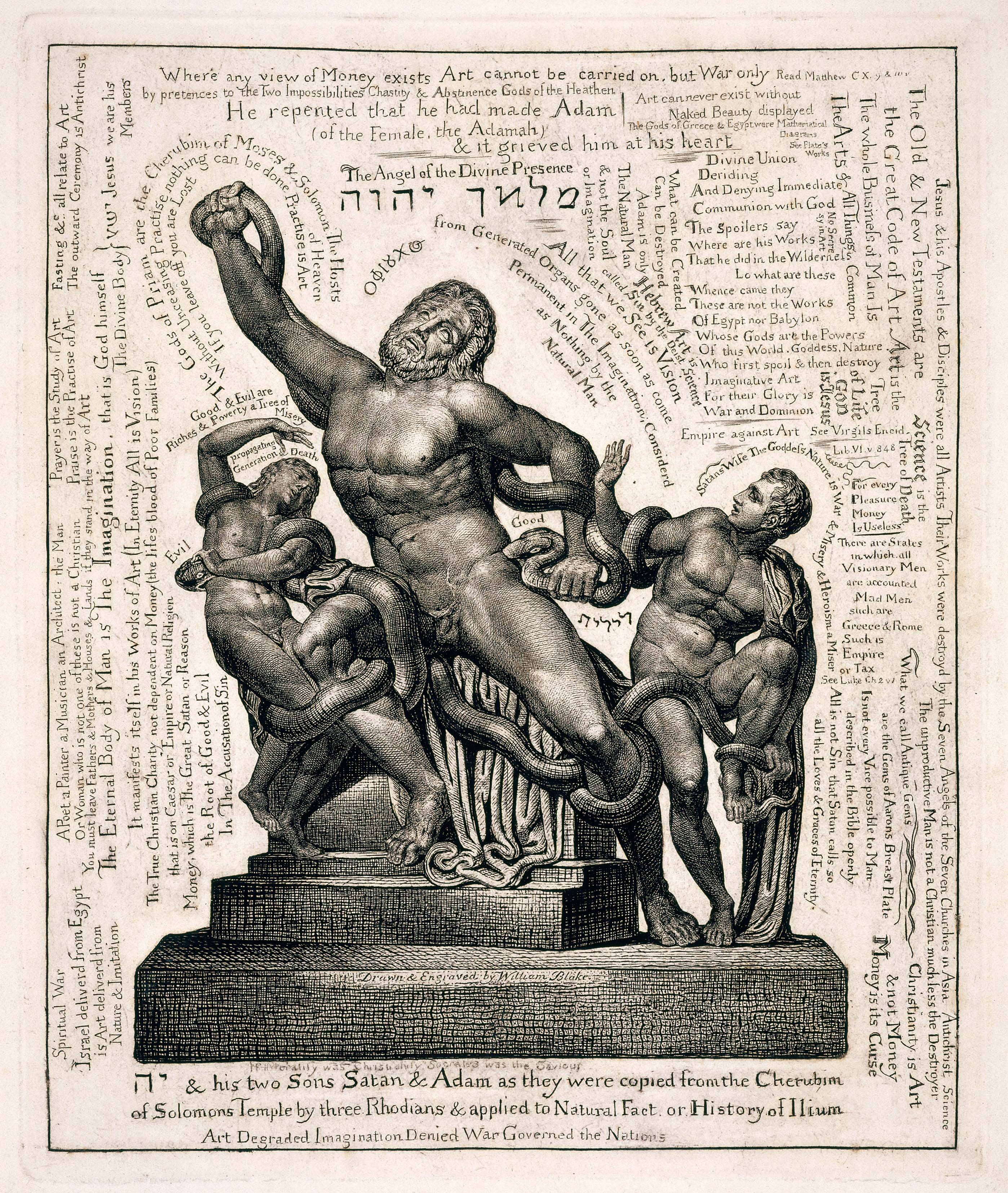
Laocoon
Jehovah & his two Sons Satan & Adam
 

William Blake was a man who interested Henry Crabb Robinson who made a hobby of interviewing the people who interested him. Robinson was not daunted by the fact that Blake spoke of subjects which were beyond his comprehension. We are indebted to Robinson for recording his first hand conversations with Blake, something which was done by no one else.

Henry Crabb Robinson, Reminiscences, Page 26

"It is one of the subtle remarks of Hume, on certain religious speculations, that the tendency of them is to make men indifferent to whatever takes place, by destroying all ideas of good and evil. I took occasion to apply this remark to something Blake had said. 'If so,' I said, 'there is no use in discipline or education, - no difference between good and evil.' He hastily broke in upon me: 'There is no use in education . I hold it to be wrong. It is the great sin. It is eating of the tree of the knowledge of good and evil. This was the fault of Plato. He knew of nothing but the virtues and vices, and good and evil. There is nothing in all that. Everything is good in God's eyes.' On my putting the obvious question, 'Is there nothing absolutely evil in what men do ?' — 'I am no judge of that. Perhaps not in God's eyes.'

He sometimes spoke as if he denied altogether the existence of evil, and as if we had nothing to do with right and wrong ; it being sufficient to consider all things as alike the work of God. Yet at other times he spoke of there being error in heaven. I asked about the moral character of Dante, in writing his 'Vision,' — was he pure ? -- ' Pure,' said Blake, 'do you think there is any purity in God's eyes? The angels in heaven are no more so than we. 'He chargeth his angels with folly.'' He afterwards represented the Supreme Being as liable to error. 'Did he not repent him that he had made Nineveh?' It is easier to repeat the personal remarks of Blake than these metaphysical speculations, so nearly allied to the most opposite systems of philosophy. Of himself, he said he acted by command. The Spirit said to him, 'Blake, be an artist, and nothing else.' In this there is felicity. His eye glistened while he spoke of the joy of devoting himself solely to divine art. 'Art is inspiration. When Michael Angelo, or Raphael, or Mr. Flaxman, does any of his fine things, he does them in the Spirit.' Blake said: 'I should be sorry if I had any earthly fame, for whatever natural glory a man has is so much taken from his spiritual glory. I wish to do nothing for profit. I wish to live for art. I want nothing whatever. I am quite happy.'

Among the unintelligible things he expressed was his distinction between the natural world and the spiritual. The natural world must be consumed. Incidentally, Swedenborg was referred to. Blake said: 'He was a divine teacher. He has done much good, and will do much. He has corrected many an error.'"

In Fearful Symmetry, Northrop Frey clarifies Blake's objection to Plato's objective in education. 

 "The fact that in the world of vision or art we see what we want to see implies that it is a world of fulfilled desire and unbounded freedom. The rejection of art from Plato's Republic is an essential part of a vision of the human soul which puts desire in bondage to reason, a vision of a universe turning on a spindle of necessity, and an assumption that a form is an idea rather than an image...Imagination is energy incorporated in form...imagination creates reality, and as desire is a part of imagination, the world we desire is more real than the world we passively accept." (Page 26,27)

Marriage of Heaven and Hell, Plate 4, (E 34)

'2. Energy is the only life and is from the Body and Reason is the bound or outward circumference of Energy. 
3. Energy is Eternal Delight'

Laocoon, (E 273)

"Good & Evil are

Riches & Poverty a Tree of Misery 
propagating Generation & Death 
The whole Business of Man Is The Arts & All Things Common

Christianity is Art & not Money 
Money is its Curse

The Old & New Testaments are the Great Code of Art

Jesus & his Apostles & Disciples were all Artists
Adam is only The Natural Man & not the Soul or Imagination

The Eternal Body of Man is The IMAGINATION.
          God himself  |
that is                |<Hebrew>[Yeshua] JESUS We are his Members
        The Divine Body|

It manifests itself in his Works of Art (In Eternity All is Vision)
All that we See is VISION from Generated Organs gone as soon as come
Permanent in The Imagination; considered as Nothing by the NATURAL MAN 
All is not Sin that Satan calls so    all the Loves & Graces of Eternity." 
Jerusalem, Plate 9, (E 152)
"And this is the manner of the Sons of Albion in their strength
They take the Two Contraries which are calld Qualities, with which
Every Substance is clothed, they name them Good & Evil
From them they make an Abstract, which is a Negation             
Not only of the Substance from which it is derived
A murderer of its own Body: but also a murderer
Of every Divine Member: it is the Reasoning Power
An Abstract objecting power, that Negatives every thing
This is the Spectre of Man: the Holy Reasoning Power             
And in its Holiness is closed the Abomination of Desolation"
Jerusalem, Plate 74, (E 230)
"the Daughters of Albion ran around admiring
His awful beauty: with Moral Virtue the fair deciever; offspring 
Of Good & Evil," 

Jerusalem, Plate 98, (E 258)

"Where is the Covenant of Priam, the Moral Virtues of the Heathen
Where is the Tree of Good & Evil that rooted beneath the cruel heel
Of Albions Spectre the Patriarch Druid! where are all his Human Sacrifices" 
On Homers Poetry, (E 269) 
"It is the same with the Moral of a whole Poem as with the Moral Goodness
of its parts Unity & Morality, are secondary considerations &
belong to Philosophy & not to Poetry, to Exception & not to Rule,
to Accident & not to Substance. the Ancients calld it eating of
the tree of good & evil." 
Everlasting Gospel, (E 521)
"Good & Evil are no more     
Sinais trumpets cease to roar
Cease finger of God to Write
The Heavens are not clean in thy Sight
Thou art Good & thou Alone     
Nor may the sinner cast one stone
To be Good only is to be
A Devil or else a Pharisee" 
Vision of Last Judgment,(E 554) 
"The Last Judgment when all those are Cast away who trouble
Religion with Questions concerning Good & Evil or Eating of the
Tree of those Knowledges or Reasonings which hinder the Vision of
God turning all into a Consuming fire <When> Imaginative Art &
Science & all Intellectual Gifts all the Gifts of the Holy Ghost
are [despisd] lookd upon as of no use & only Contention
remains to Man then the Last Judgment begins & its Vision is seen
by the [Imaginative Eye] of Every one according to the
situation he holds" 
Vision of Last Judgment, (E 620)
"Here they are no longer talking of what is Good &
Evil or of what is Right or Wrong & puzzling themselves in Satans
[Maze] Labyrinth But are Conversing with Eternal
Realities as they Exist in the Human Imagination   We are in a
World of Generation & death & this world we must cast off if we
would be Painters [P 91] Such as Rafa[e]l Mich Angelo & the
Ancient Sculptors. if we do not cast off this world we shall be
only Venetian Painters who will be cast off & Lost from Art"  

Vision of Last Judgment, (E 565)

" Angels are happier than Men <&
Devils> because they are not always Prying after Good & Evil in
One Another & eating the Tree of Knowledge for Satans
Gratification"
Annotations to Swedenborg, (E 604)
"Good & Evil are here both Good & the two contraries Married" 
Annotations to Bacon, (E 621)
"Self Evident Truth is one Thing and Truth the result of Reasoning is another Thing    Rational Truth is not the Truth of Christ but of Pilate  It is the Tree of the Knowledge of Good & Evil" 


Sunday, June 26, 2022

Sources

 Posted Feb 2014

British Museum
Illustrations to Young's Night Thoughts

Although he was many other things, Blake might well be considered a "man of books". His reading was omnivorous. He might also be considered a Renaissance man if such a thing were possible in the 19th Century.

In The Sacred Wood T.S.Eliot wrote an essay on Blake. He found him lacking in the poetic tradition. Kenneth Rexroth wrote more extensively about Eliot's relation to Blake; he referred to Blake's sources as "the tradition of organized heterodoxy." 
 
And this from a lecture given by Kathleen Raine:
"Blake's sources and reading proved to be not 'odds and ends' as T.S. Eliot had rather rashly described them. On the contrary, Blake's sources proved to be the mainstream of human wisdom. It was the culture of his age that was provincial, whereas Blake had access to the 'perennial philosophy', an excluded knowledge in the modern West in its pursuit of the natural sciences in the light of a materialist philosophy."

Blake was not 'unlettered'! Quite the contrary he was a modern throwback to medievalism when 'it all' could be known; he knew all of which Eliot knew nothing. Bacon, Newton (and presumably Eliot) cared little for these cultures, but Blake included them in his 'library' of acquaintance. He despised Bacon and Newton as shallow materialists.

In a Letter to Flaxman Blake wrote:
"Now my lot in the Heavens is this; Milton lovd me in childhood & shewd me his face, Ezra came with Isaiah the Prophet, but Shakespeare in riper years gave me his hand; Paracelsus & Behmen appeard to me."

His "nodding acquaintance" was actually much, much broader. Here are some of the disciplines with which Blake had at least a nodding acquaintance.

Some of Blake's Sources:

Swedenborg

 To Tirzah (K 220) was a concise summary of Swedenborg's teaching (Golgonooza page 96.)
 
A Vision of the Last Judgment, page 84:
"Around the Throne Heaven is opend & the Nature of Eternal Things Displayd All Springing from the Divine Humanity"
 
Although Blake owed much to Michaelangelo, his Vision of the Last Judgment was more closely related to Swedenborg's; Michaelangelo' picture had an exoteric orientation, while that of Swedenborg and Blake had a mystical one. To put it otherwise the great Italian painter suggested a material event some time in the future, while the other two concerned spiritual rather than material realities. Swedenborg and Blake, but not Michaelangelo, perceived the Last Judgment as an end and a beginning, or a death and rebirth (of individuals, nations, and the world).

Swedenborg has another very significant contribution to the thought forms of Blake in what they both referred to as states. A state is a condition through which a person travels in his journey through life.

Swedenborg taught that there had been 27 churches, those of Adam, Noah, Abraham, Solomon...Paul, Constantine,Charlemayne and Luther. Blake substantially agreed with that:
 
"Distinguish therefore States from Individuals in those States.
States Change: but Individual Identities never change nor cease:
You cannot go to Eternal Death in that which can never Die.
Satan & Adam are States Created into Twenty-seven Churches."
(Milton 32:22-25 Erdman 321) 
The first ones were Adam, Seth..., and the last one as I recall was Luther. After which the same old round began again to repeat itself in the Great Year, a depressing form of church history. Neither Blake nor Swedenborg thought much of the organized church. The latter thought that it had passed out, to be replaced by a new church in the New Age. He dated it at 1757, the year of Blake's birth as it happened.

According to Raine it was "Swedenborg whose leading doctrine Blake was summarized in the Everlasting Gospel." But this is a very difficult poem; not really a poem but intermittent snatches of poetic thought. Very hard to understand because Blake's mood and tone modulates continually, sometimes ironic, sometimes not. It's a source book for whatever gems speak to you. It does indicate rather clearly Blake's (and Swedenborg's) view about the organized church and conventional theology.

Homer 

The primary source of the Cave of the Nymphs is certainly Homer's Odyssey, while the Myth of Persephone stems of course from the Iliad..
 
(from a lecture in India of Kathleen Raine re her initial search for Blake's sources)
"Then I came upon a marvellous clue in the works of Thomas Taylor the platonist, whose translations of the complete works of Plato, most of Plotinus, Proclus and the other Neoplatonic writings of the third century A.D were appearing contemporaneously with Blake's works."
  Taylor and Blake were almost the same age. Taylor, with his translations of Greek philosophy turned Blake's interest in this direction and led to his use of many of them in his search for symbolic material.

Plato

Blake also used a great variety of 'spiritual' documents beginning before Plato and stretching down to his own day. Some of the writings were:

Plato's Myth of the Cave can be seen as the locale of Visions of the Daughters of Albion. 

Plotinus

Plotinus, Platonism, neoPlatonism - Blake may have thought more of the latter than the former. He used Thomas Taylor's translations extensively in his myth making.  Blake in particular depended heavily upon Taylor's Dissertation on the Eleusinian and Bacchic Mysteries.

Hermes

Hermes Trismegistus: Wikipedia offers a useful introduction to this mythic figure.

Blake included the Hermetic writings in his library and made use of them in his own creations. The Divine Poemander was perhaps the most important of many works. In Jerusalem plate 91 Blake mentioned the Smaragdine Table of Hermes as the baleful influence on one of his failing characters. 
He endorsed Proposition 2:
"What is below is like that which is above, and what is above is like that which is below, to accomplish the miracles of the one thing." but felt that Hermes was a magician trying to pass as a mystic. (Magicians try to pull the beyond down to the material, while mystics have visions of the Beyond.)

Paracelsus

Paracelsus introduced Blake to the rich symbolic language of astrology.

Boehme

Boehme's Divine Vision not only figured largely in Blake's works, but expressed most aptly his personal approach to creativity.

Boehme provided one of many sources for Blake's doctrine of the descent (or fall) of Albion (man): "The one only element fell into a division of four.. and that is the heavy fall of Adam...for the principle of the outward world passeth away and goeth into ether and the four elements into one again, and God is manifested. Blake expressed "the division of four" of course with the Four Zoas. (Percival p 19). The divided four represent the principalities against which Paul wrestled (as he wrote in Ephesians 6:12).

Dante

Blake illustrated Dante's Divine Comedy. 

Shakespeare, Milton, Michaelangelo,
Bacon, Newton, Locke, Berkeley, The Bible


Saturday, June 25, 2022

SWEDENBORG

Library of Congress
Marriage of Heaven and Hell
Plate 3

 Quote from an earlier post by Larry:

"In the 18th century Emmanuel Swedenborg, the Swedish scientist, philosopher and religionist, had a very high reputation. In London a 'new church' sprang up espousing his values. William Blake's parents were members of the New Church. That probably explains several interesting things about Blake's early life. For example his father appeared to be about as permissive as the average modern father in our culture today, but very atypical for his generation.

Blake was imbued with a great many of the famous man's values, particularly his esoteric religious ones. As a young adult Blake found many of the same ideas among the great thinkers of the ages. He thus became less dependent on Swedenborg's thought forms. With MHH Plates 21 and 22 he declared his independence of his childhood teacher.

Marriage of Heaven and Hell, (E 42)

"Plate 21
  I have always found that Angels have the vanity to speak of
themselves as the only wise; this they do with a confident
insolence sprouting from systematic reasoning:
  Thus Swedenborg boasts that what he writes is new; tho' it
is only the Contents or Index of already publish'd books"
Plate 22
 "Now hear a plain fact: Swedenborg has not written one new
truth: Now hear another: he has written all the old falshoods.
  And now hear the reason.  He conversed with Angels who are
all religious, & conversed not with Devils who all hate religion,
for he was incapable thro' his conceited notions.
  Thus Swedenborgs writings are a recapitulation of all
superficial opinions, and an analysis of the more sublime, but no
further."

Perhaps the chief objection of the mature Blake was that Swedenborg had a positive demeanor re the established church. But one of the things that stayed with Blake was Swedenborg's concept of the Divine Humanity." 

Here is a section of An Interview Conducted with Kathleen Raine on July 12, 1993 by Donald E. Stanford:

interview 

"Stanford: Why did he leave the Church of the New Jerusalem? 

Raine: Ah, that’s a good question. He wasn’t a churchman really. But he remained to the end of his life a Swedenborgian. This is this much-disputed Blake system. The scholars all scratch their heads about this; but it’s no problem. If you read the “Everlasting Gospel,” which is one of his latest works, it is in fact a point-by-point summary of the five leading beliefs of the Swedenborgian Church of the New Jerusalem, and in his interviews with Crabb Robinson, Robinson asked him about Swedenborg, and Blake said that he was a sent and inspired man, and then added, “but sometimes inspired men go beyond their commission from God.” He followed the Swedenborgian teaching. In fact, we’re all deeply familiar with the phrase “Divine Humanity,” but this phrase is not Blake’s invention; this is Swedenborg. And the Grand Man of the heavens, the one in many, and many in one, of all human souls — this is Swedenborg, and Blake uses this concept in a very beautiful passage in the Four Zoas in which he talks about man contracting our exalted senses with the multitude and expanding what we hold as one, as one man, all the universal family. Swedenborg’s greatest idea, I think, was this of the one in many, and many in one, and the divine presence in man. It was a really very wonderful idea because for him, the Divine Humanity was the eternal Christ, not the historical Christ. That was the Divine Humanity of whom Blake speaks and writes and speaks of as “Jesus the Imagination.” This is purely Swedenborgian. He disagreed with Swedenborg only in one respect: He said Swedenborg put all the good in heaven and the sinners in hell and didn’t realize that both the good and the evil are included in the Divine Humanity who transcends good and evil. That is what The Marriage of Heaven and Hell is about. Point-by-point, it’s quite a funny book. It takes up Swedenborg and his memorable experiences—it’s a running discussion with Swedenborg in semi-satirical terms, but although he poked fun at Swedenborg in certain respects, nevertheless, his system is pure Swedenborgian. I’m sure the only reason why everyone doesn’t know this is that the works of Swedenborg are so boring to read that none of the academics have read them, and I don’t blame them."

Descriptive Catalogue,(E 544)
   "Reasons and opinions concerning acts, are not
history.  Acts themselves alone are history, and these are
neither the exclusive property of Hume, Gibbon nor Voltaire,
Echard, Rapin, Plutarch, nor Herodotus.  Tell me the Acts, O
historian, and leave me to reason upon them as I please; away
with your reasoning and your rubbish.  All that is not action is
not [P 45] worth reading.  Tell me the What; I do not want you to
tell me the Why, and the How; I can find that out myself, as well
as you can, and I will not be fooled by you into opinions, that
you please to impose, to disbelieve what you think improbable or
impossible.  His opinions, who does not see spiritual agency, is
not worth any man's reading; he who rejects a fact because it is
improbable, must reject all History and retain doubts only."
Annotations to Reynolds,(E 658) 
 "The Ancients did not mean to Impose when they  affirmd 
their  belief  in Vision & Revelation  Plato was in Earnest. 
Milton was in Earnest.  They believd that God did Visit Man
Really & Truly & not as Reynolds pretends" 
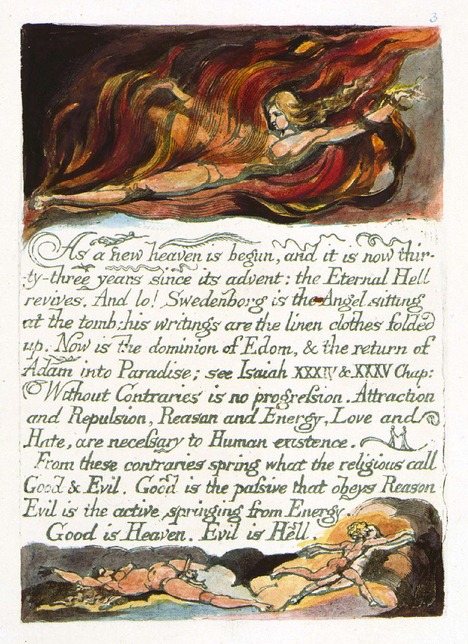
Marriage of Heaven and Hell, Plate 3, (E 34)
  "As a new heaven is begun, and it is now thirty-three years
since its advent: the Eternal Hell revives. And lo! Swedenborg is
the Angel sitting at the tomb; his writings are the linen clothes folded up. 
Now is the dominion of Edom, & the return of Adam into
Paradise; see Isaiah XXXIV & XXXV Chap:
  Without Contraries is no progression.  Attraction and
Repulsion, Reason and Energy, Love and Hate, are necessary to
Human existence.
  From these contraries spring what the religious call Good &
Evil. Good is the passive that obeys Reason[.] Evil is the active
springing from Energy.
  Good is Heaven. Evil is Hell." 
Milton, Plate 22 [24], (E 117)
"O Swedenborg! strongest of men, the Samson shorn by the Churches!
Shewing the Transgresors in Hell, the proud Warriors in Heaven:
Heaven as a Punisher & Hell as One under Punishment:
With Laws from Plato & his Greeks to renew the Trojan Gods,
In Albion; & to deny the value of the Saviours blood.
But then I rais'd up Whitefield, Palamabron raisd up Westley,    

And these are the cries of the Churches before the two Witnesses' 
Faith in God  the dear Saviour who took on the likeness of men:
Becoming obedient to death, even the death of the Cross
The Witnesses lie dead in the Street of the Great City
No Faith is in all the Earth: the Book of God is trodden under Foot:       
He sent his two Servants Whitefield & Westley; were they Prophets
Or were they Idiots or Madmen? shew us Miracles!
Plate 23 [25]
Can you have greater Miracles than these? Men who devote
Their lifes whole comfort to intire scorn & injury & death
Awake thou sleeper on the Rock of Eternity Albion awake
The trumpet of Judgment hath twice sounded: all Nations are awake
But thou art still heavy and dull: Awake Albion awake!" 
Descriptive Catalogue, (E 546) 
 "The spiritual Preceptor, an experiment Picture.

THIS subject is taken from the visions of Emanuel Swedenborg.
Universal Theology, [P 53] No. 623.  The Learned, who strive to
ascend into Heaven by means of learning, appear to Children like
dead horses, when repelled by the celestial spheres.  The works
of this visionary are well worthy the attention of Painters and 
Poets; they are foundations for grand things; the reason they 
have not been more attended to, is, because corporeal demons 
have gained a predominance; who the leaders of these are, will 
be shewn below.  Unworthy Men who gain fame among Men, 
continue to govern mankind after death, and in their spiritual 
bodies, oppose the spirits of those, who worthily are famous; 
and as Swedenborg observes, by entering into disease and 
excrement, drunkenness and concupiscence, they possess
themselves of the bodies of mortal men, and shut the doors of
mind and of thought, by placing Learning above Inspiration, O
Artist! you may disbelieve all this, but it shall be at your own
peril."