Blake seeks to provide the Golden String which can lead us through the labyrinth of our experience or his own poetry.

Thursday, October 13, 2016

THE LARK I

William Blake's religious position is that God and man are not separated by a chasm which requires bridging. God resides in man, and the life of man is within the Divinity. Just as a magnet exercises its force on iron filings which come into its field of influence causing them to create a pattern, so the Spiritual force draws man to it. Within the magnetic field there is a reciprocal response from the particles within it; each particle attracts the magnet and the other particles within the field. Blake's position is that God and man are in such a reciprocal relationship, influencing one another and responding to each other. In reality there is no isolation of man from man, or man from God.
 
But the ties which bind the system must be in communication. Blake postulates that the Spiritual Force never rests but is always reaching out to draw together the scattered pieces. Blake uses 'Gates' as an image to suggest that man must be prepared to receive communication. Blake specifies a particular gate through which the communication between man and God passes. This he names the Gate of Los. Furthermore Blake develops a metaphor for the movement of communication or messages which pass through the Gate of Los: messages are carried by 'Larks' from the human perspective or 'Angels' from the divine.
 
When Blake illustrated Milton's poem L'Allegro he choose to enhance these four lines with an illustration:
         "To hear the Lark begin his flight
          And singing startle the dull Night
          From his Watch Tower in the Skies
          Till the dappled Dawn does rise"

Blake added this explanatory note to clarify his illustration: 

"The Lark is an Angel on the Wing Dull Night starts from his
Watch Tower on a Cloud.  The Dawn with her dappled Horses arises
above the Earth   The Earth beneath awakes at the Larks Voice"

Wikipedia Commons
Illustrations to Milton's L'Allegro
Night Startled by the Lark
The arrival of the Lark or angel announces an awakening. Night is dispelled with a message to man (or to Earth) which comes in the form of a dawning. Earth has become receptive to communication from the Eternal dimension and has responded by passing the message on to receptive ears.
 
God's communications to us comes in such a way: an awakening to a possibility which had previously been concealed. Messages from God to man are not rare. Any time man seeks an opening in the surrounding wall he has constructed around himself in order to remain separated, the Lark can find the Gate of Los and arrive with a new dawning. 


Milton, Plate 31 [34], (E 130)
"Thou hearest the Nightingale begin the Song of Spring;
The Lark sitting upon his earthy bed: just as the morn
Appears; listens silent; then springing from the waving Corn-field! loud
He leads the Choir of Day! trill, trill, trill, trill,
Mounting upon the wings of light into the Great Expanse:
Reecchoing against the lovely blue & shining heavenly Shell:
His little throat labours with inspiration; every feather
On throat & breast & wings vibrates with the effluence Divine    
All Nature listens silent to him & the awful Sun
Stands still upon the Mountain looking on this little Bird
With eyes of soft humility, & wonder love & awe.

Then loud from their green covert all the Birds begin their Song
The Thrush, the Linnet & the Goldfinch, Robin & the Wren         
Awake the Sun from his sweet reverie upon the Mountain:
The Nightingale again assays his song, & thro the day,
And thro the night warbles luxuriant; every Bird of Song
Attending his loud harmony with admiration & love.
This is a Vision of the lamentation of Beulah over Ololon!"       

Milton, Plate 35 [39], (E 136)
"Beside the Fount above the Larks nest in Golgonooza
Luvah slept here in death & here is Luvahs empty Tomb
Ololon sat beside this Fountain on the Rock of Odours.           

Just at the place to where the Lark mounts, is a Crystal Gate
It is the enterance of the First Heaven named Luther: for
The Lark is Los's Messenger thro the Twenty-seven Churches
That the Seven Eyes of God who walk even to Satans Seat
Thro all the Twenty-seven Heavens may not slumber nor sleep      

But the Larks Nest is at the Gate of Los, at the eastern
Gate of wide Golgonooza & the Lark is Los's Messenger"


Saturday, October 8, 2016

Enlightenments

First posted March 2011.
 
We all reach God in some way, but among those closest to God were several Soldiers of the Cross. These examples all show a long continued inner turmoil and struggle rewarded in due course by that special gift that Eternity offers to the most faithful.
-----------------------------------------------------

His heart leapt for joy

“Now after I had received that opening from the Lord that to be trained at Oxford or Cambridge was not enough to equip a man to be a minister of Christ, I respected the priests less, and looked more after the dissenting Christians. And among them I saw there was some tenderness, and many of them came afterwards to be convinced, for they had some openings from God. But as I had forsaken all the priests, so I left the separatist Preachers, also, together with those called the most experienced people. For I saw there was no one among them all who could speak to my condition. And when all my hope in them and in all men were gone, so that I had nothing outwardly to help me, nor could I even tell what to do, then, Oh then, I heard a voice which said, “There is one — even Christ Jesus — who can speak to thy condition!” And when I heard it, my heart leapt for joy. Then the Lord showed me why there was no one on the earth who could speak to my condition. The reason was that I was to give him all the glory. For all are concluded under sin, and shut up in unbelief as I had been, so that Jesus Christ might have the pre-eminence, as the one who enlightens, and gives grace, faith and power. So, when God works, who shall prevent it? And I knew this experimentally through my experiences.”"
(From the Journal of George Fox)

------------------------------------------------------------------------------

The Loss of the Burden in Pilgrims Progress

Blake's Illustrations to Bunyan's Pilgrims Progress
Christian is at the Cross; his burden is cast off (at the lower left of the picture):
"To take my cross up day by day,
And serve the Lord with fear.
Now I saw in my dream, that they went on,
and Great-Heart before them. So they went,
and came to the place where Christian's
burden fell off his back and tumbled into a
sepulchre. Here then they made a pause; and
here also they blessed God."
(from Pilgrim's Progress)

----------------------------------------------

His Heart was strangely warmed

.John Wesley was a super-Christian at Oxford. He demanded rigorous adherence to certain practices, carried out by his disciples; they were called methodists.
Once ordained he went to Georgia to save the heathen, but he came to realize that
he needed salvation himself.

Returning to England there was a terrible storm at sea and everyone quailed with fear for their lives; everyone that is except a group of Moravians who continued in prayer and showed great equanimity.

Back in London Wesley continued to worry about his salvation until, in 1738:
"In the evening I went very unwillingly to a society in Aldersgate Street, where one was reading Luther’s preface to the Epistle to the Romans. About a quarter before nine, while he was describing the change which God works in the heart through faith in Christ, I felt my heart strangely warmed. I felt I did trust in Christ, Christ alone, for salvation; and an assurance was given me that he had taken away my sins, even mine, and saved me from the law of sin and death."

He was generally considered to be the greatest man in the 18th century and was thought by many to have saved England from Revolution.
----------------------------------------------------------------------

The Truchsessian Museum

The Enlightenment of William Blake was on this wise:
"O lovely Felpham, parent of Immortal Friendship, to thee I am eternally
indebted for my three years rest from perturbation and the strength I now
enjoy. Suddenly, on the day after visiting the Truchsessian Gallery of
pictures, I was again enlightened with the light I enjoyed in my youth, and
which has for exactly twenty years been closed from me as by a door and by window-shutters. Consequently I can, with confidence, promise you ocular demonstration of my altered state on the plates I am now engraving after
Romney, whose spiritual aid has not a little conduced to my restoration to
the light of Art." (Erdman 756)
He wrote this in Letter 51 (To William Hayley) 23 October 1804.

-----------------------------------------------------

Renunciation

".....Albert Schweitzer's biography of J. S. Bach, written in 1905, had also proved an immediate success. At 30 years of age Schweitzer was tall, broad-shouldered, darkly handsome, and a witty charismatic writer, preacher, and lecturer: clearly, a bright future lay before him. However, one spring morning in 1905, he experienced a
stunning religious revelation: it came to him that at some point in the years just ahead he must renounce facile success and devote himself unsparingly to the betterment of mankind's condition.Accordingly, several years later, Schweitzer threw over his several careers as author, lecturer, and organ recitalist and plunged into the study of medicine - his aim being to go to Africa as a medical missionary. He won his medical degree in 1912. The year before, he had married Helene Bresslau, a professor's daughter who had studied nursing in order to work at his side in Africa; in 1919 the couple had a daughter, Rhena.
In 1913 the Schweitzers journeyed to what was then French Equatorial Africa. There, after various setbacks, they founded the Albert Schweitzer Hospital at Lambaréné, on the Ogooué River, "at the edge of the primeval forest." This area now lies within the independent West African republic of Gabon. Funds were scarce and equipment primitive, but native Africans thronged to the site, and in the decades that followed, many thousands were treated." (From Answers.Com)
----------------------------------------
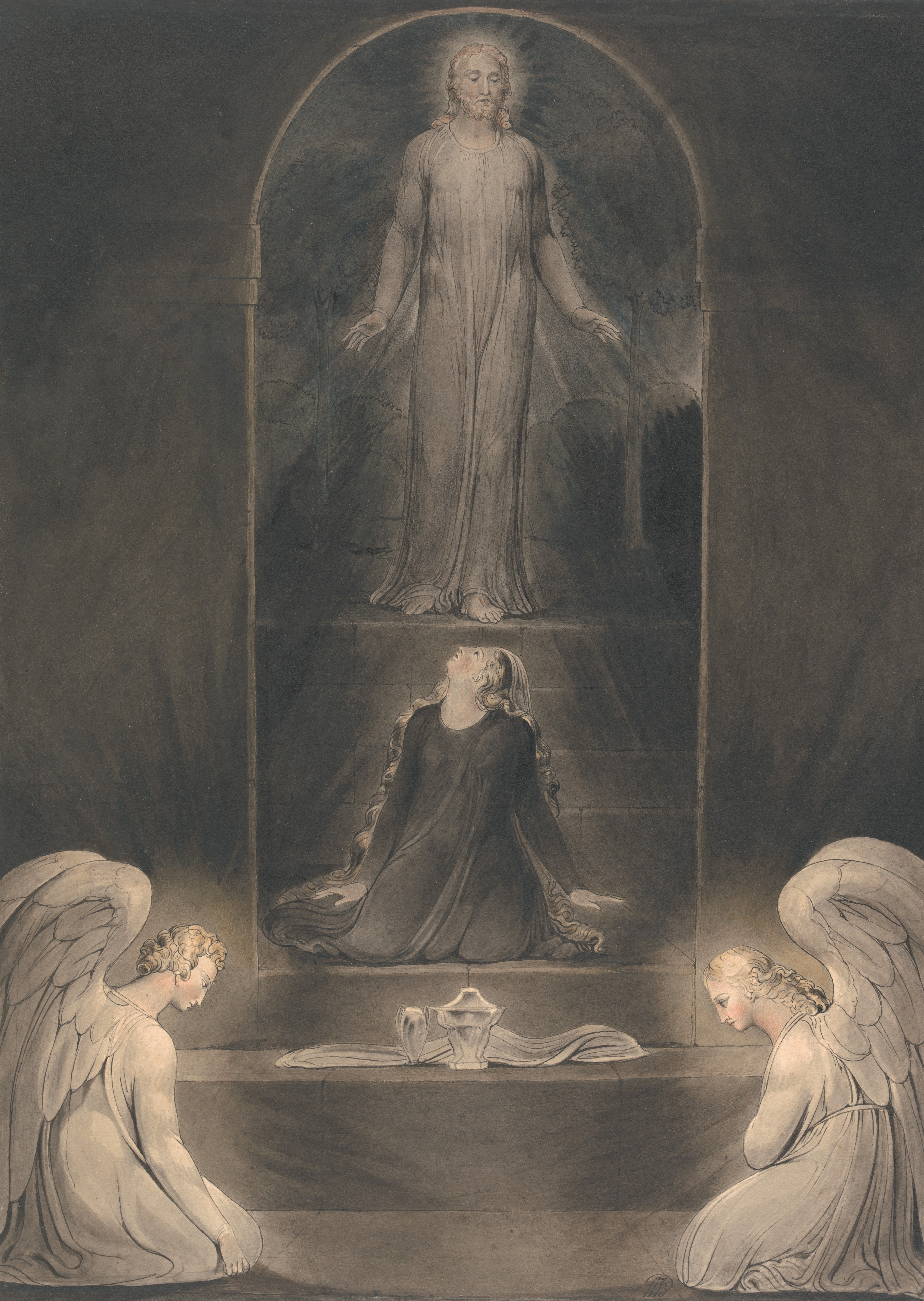
Magdalene Encounters the Risen Christ 

Yale Center for British Art
Mary Magdalen at the Sepulchre


Jerusalem, Plate 62, (E 213)
"But I thy Magdalen behold thy Spiritual Risen Body"
 
 . 

Wednesday, October 5, 2016

BLAKE & MERTON

British Museum                  Small Book of Designs    
From Visions of Daughters of Albion
Although Thomas Merton acknowledged that he owed a debt to William Blake, the spiritual paths of the two men deviated dramatically. Ultimately the path of Merton led through Orthodoxy and that of Blake followed the nonconformist route.
 
On Page 97 of Thomas Merton's autobiography, The Seven Storey Mountain, he made this statement about the role Blake played in his his spiritual development:
 

"The Providence of God was eventually to use Blake to awaken something of faith and love in my own soul in spite of all the misleading notions, and all the almost infinite possibilities of error that underlie his weird and violent figures. I do not, therefore, want to seem to canonize him. But I have to acknowledge my own debt to him, and the truth which may appear curious to some, although it is really not so: that through Blake I would one day come, in a round-about way, to the only true Church, and to the One Living God, through His Son, Jesus Christ."

Merton was a graduate student at Columbia University deciding on what topic he should write his thesis. He had been introduced to Blake as a young child by his father who was an artist. His mother, who died of cancer after a long illness when Thomas was only six years old, had been a practicing Quaker. The conjunction of art and religion in William Blake may have the motivation leading Merton to select William Blake's philosophy for studying and writing his thesis:
"Nature and Art in William Blake, an Essay in Interpretation."

In his autobiography on page 221-2 Merton wrote:

"The subject I had finally chosen was 'Nature and Art in William Blake.' I did not realize how providential a subject it actually was! What it amounted to, was Blake's reaction to every kind of literalism and naturalism and narrow, classical realism in art, because of his own ideal which was essentially mystical and supernatural. In other words, if I treated it at all sensibly, could not help but cure me of all naturalism and materialism in my own philosophy, besides resolving the inconsistencies and self-contradictions that had persisted in my mind for years, without my being able to explain them."      
...
"I had learned from my own father that it was almost blasphemy to regard the function of art as merely to reproduce some kind of sensible pleasure or, at best, to stir the emotions to a transitory thrill. I had always understood art as contemplation, and that it involved the highest faculties in man.
When I was once able to discover the key to Blake, in his rebellion against literalism and naturalism in art, I saw that his Prophetic Books and the rest of his verse at large represented a rebellion against naturalism in the moral order as well."
...
"What he was glorifying was the transfiguration of man's natural love, his natural powers, in the refining fires of mystical experience; and that, in itself, implied an arduous and total purification, by faith and love and desire, from all the petty materialism and commonplace and earthly ideals of his rationalist friends."


At that point in Merton's life he was a crossroads. His reading had led him to Scholasticism, a system of philosophy and theology based on Aristotelian logic for promoting and defending traditional thought. He was drawn to Catholicism to provide the structure both intellectually and morally which he sought for his life. He explored the Catholic religion for the first time in his life and soon adopted it wholeheartedly. The internal discernment of light and truth which Blake advocated and followed was a blind alley for a young man who was eager to place himself under the guidance of traditional Catholicism. Blake's rebellion against natural religion and an art devoted to outer, worldly imagery acted as a catalyst for Merton's spiritual development which turned in another direction.
 
Jerusalem, Plate 91, (E 251)
"It is easier to forgive an Enemy than to forgive a Friend:
The man who permits you to injure him, deserves your vengeance:
He also will recieve it; go Spectre! obey my most secret desire:
Which thou knowest without my speaking: Go to these Fiends of Righteousness
Tell them to obey their Humanities, & not pretend Holiness;
When they are murderers: as far as my Hammer & Anvil permit
Go, tell them that the Worship of God, is honouring his gifts
In other men: & loving the greatest men best, each according
To his Genius: which is the Holy Ghost in Man; there is no other
God, than that God who is the intellectual fountain of Humanity; 
He who envies or calumniates: which is murder & cruelty,
Murders the Holy-one: Go tell them this & overthrow their cup,
Their bread, their altar-table, their incense & their oath:
Their marriage & their baptism, their burial & consecration:
I have tried to make friends by corporeal gifts but have only    
Made enemies: I never made friends but by spiritual gifts;
By severe contentions of friendship & the burning fire of thought.
He who would see the Divinity must see him in his Children
One first, in friendship & love; then a Divine Family, & in the midst
Jesus will appear; so he who wishes to see a Vision; a perfect Whole        
Must see it in its Minute Particulars;"

Milton, Plate 38 [43], (E 139)
"but Laws of Eternity
Are not such: know thou: I come to Self Annihilation
Such are the Laws of Eternity that each shall mutually     
Annihilate himself for others good, as I for thee[.]
Thy purpose & the purpose of thy Priests & of thy Churches
Is to impress on men the fear of death; to teach
Trembling & fear, terror, constriction; abject selfishness
Mine is to teach Men to despise death & to go on            
In fearless majesty annihilating Self, laughing to scorn
Thy Laws & terrors, shaking down thy Synagogues as webs
I come to discover before Heavn & Hell the Self righteousness
In all its Hypocritic turpitude, opening to every eye
These wonders of Satans holiness shewing to the Earth     
The Idol Virtues of the Natural Heart, & Satans Seat
Explore in all its Selfish Natural Virtue & put off
In Self annihilation all that is not of God alone:
To put off Self & all I have ever & ever Amen

Satan heard! Coming in a cloud, with trumpets & flaming fire     

Saying I am God the judge of all, the living & the dead
Fall therefore down & worship me. submit thy supreme
Dictate, to my eternal Will & to my dictate bow"

Songs of Innocence and of Experience, Song 44, (E 26) 
The GARDEN of LOVE                   
"I went to the Garden of Love,
And saw what I never had seen:          
A Chapel was built in the midst,        
Where I used to play on the green.

And the gates of this Chapel were shut, 
And Thou shalt not. writ over the door;
So I turn'd to the Garden of Love,      
That so many sweet flowers bore.

And I saw it was filled with graves,
And tomb-stones where flowers should be: 
And Priests in black gowns, were walking their rounds,
And binding with briars, my joys & desires."
. 

Sunday, October 2, 2016

Natural Religion

First posted by Larry November 2010.

After the Biblical Fall the Old Testament drama unfolds as a protracted struggle between two Gods. In every age the majority of Mankind have worshipped Mother Earth, Matter or the recurring cycle of vegetative life. She has many names; in the Bible one of the most common is Astarte. In our day "Astarte" exacts an acceptance of things as they are, an attempt to flow with the stream of Nature. The Bible called this "whoring after other gods".

Blake called it Natural Religion or Druidism. He meant by Natural Religion the worship of the principle of fallen life; those most conformed and faithful to it become the rulers of this world. Natural Religion involves choosing to remain at the level of the material, which Blake called vegetative life.

The believer in Natural Religion closes his mind to the reality of spiritual development; he turns his back upon the Spirit. Unable to endure the tension of struggling and waiting for spiritual evolution he erects a golden calf. He either acquiesces in or actively contributes to the brutishness and horror of a life that "lives upon death".

The Bible and Blake's poetry alike are filled with gory images of this ultimate horror, which comes from identifying life with the merely natural. T.S.Eliot said in The Sacred Wood that Blake's poetry is unpleasant, as all great poetry is unpleasant. It is "unpleasant" basically because Blake, like the Bible, insists on calling a spade a spade. Nowhere is Blake closer to the Bible than in his constant reiteration of the ultimate horror of unredeemed life, celebrated in page after page of minute particulars.

Blake and the Bible both insistently remind us that Nature is fallen , and that one flows with this fallen Nature to one's destruction. Abraham and Moses knew a higher God: he was above Nature; he was Spirit. He called men to rise above the natural and to become sons of a God opposed to everything Astarte stood for, to live by the laws, not of earth, but of heaven.

The children of Abraham tried to put this God first, but rarely with notable success. Instead at every opportunity they turned away from Jehovah "under every green tree", back to Nature. This inevitably led back to Captivity in the iron furnaces of Egypt/Babylon/Rome, etc. The biblical cycle discussed above thus relates to the alternating dominance of Jehovah and Astarte. Blake's myth recreates this biblical story, but with one vital difference.

Vala and her fellow females--Tirzah, Rahab, the Daughters of Albion--represent the various forms of Astarte, the Earth Goddess. Urizen represents Jehovah, the Sky God. But in 'The Four Zoas' both are fallen. Blake claims that the Hebrew consciousness of God is flawed at best. Secular materialists had reached this conclusion long before, but it was a startling and revolutionary idea for a man like Blake, embedded in the biblical faith and firmly attached to the life of the Spirit.

Blake had made as serious a commitment to the Eternal as anyone could, and now at the mid point of his life he saw an Eternal without a God worthy of worship. It was a dark night of the soul indeed!

This honest and painful confrontation with what was for Blake an existential reality has made him into the pariah of the orthodox. To them the black book has no place for any criticism of the Hebrew consciousness of God; he is perfect from first to last, and everything the Bible says about him is perfect (inerrant!) as well. The superstitious awe which has been called bibliolatry forbids any questions of Abraham's God or Moses' God.

Although when we read without blinders, we can see their consciousness of God changing before our eyes. Note Abraham bargaining with God for the survival of his nephew in Sodom and Moses simply defying God if he refuses to forgive the worshippers of the golden calf. In the spirit of these two revealing passages Blake in his own recreation of the biblical story dramatically portrayed an evolving God consciousness, which the black book simply cannot permit. It was Blake's willingness to let the old die that made him notably ready for the new birth. The dark night of the soul had intensified until it became the "Sickness unto Death."

(The above taken from Chapter Six of the Blake Primer)

Yale Center for British Art 
Jerusalem
Plate 75
Jerusalem, Plate 52, (E 201)
"Every Religion that Preaches
Vengeance for Sins the Religion of the Enemy & Avenger; and not
the Forgiver of Sin, and their God is Satan, Named by the Divine
Name   Your Religion O Deists: Deism, is the Worship of the God
of this World by the means of what you call Natural Religion and
Natural Philosophy, and of Natural Morality or
Self-Righteousness, the Selfish Virtues of the Natural Heart. 
This was the Religion of the Pharisees who murderd Jesus.  Deism
is the same & ends in the same.
  Voltaire Rousseau Gibbon Hume. charge the Spiritually Religious
with Hypocrisy!"

Jerusalem, Plate 73, (E 228)
"Where Luvahs World of Opakeness grew to a period: It
Became a Limit, a Rocky hardness without form & void
Accumulating without end: here Los. who is of the Elohim
Opens the Furnaces of affliction in the Emanation                
Fixing The Sexual into an ever-prolific Generation
Naming the Limit of Opakeness Satan & the Limit of Contraction
Adam, who is Peleg & Joktan: & Esau & Jacob: & Saul & David

Voltaire insinuates that these Limits are the cruel work of God
Mocking the Remover of Limits & the Resurrection of the Dead     
Setting up Kings in wrath: in holiness of Natural Religion
Which Los with his mighty Hammer demolishes time on time
In miracles & wonders in the Four-fold Desart of Albion
Permanently Creating to be in Time Reveald & Demolishd
Satan Cain Tubal Nimrod Pharoh Priam Bladud Belin                
Arthur Alfred the Norman Conqueror Richard John
[Edward Henry Elizabeth James Charles William George]
And all the Kings & Nobles of the Earth & all their Glories
These are Created by Rahab & Tirzah in Ulro: but around

These, to preserve them from Eternal Death Los Creates           
Adam Noah Abraham Moses Samuel David Ezekiel
[Pythagoras Socrates Euripedes Virgil Dante Milton]  
Dissipating the rocky forms of Death, by his thunderous Hammer
As the Pilgrim passes while the Country permanent remains
So Men pass on: but States remain permanent for ever" 
. 

Wednesday, September 28, 2016

NO NATURAL RELIGION

Reformatted from February 26, 2015.

We saw in a previous post that Blake thought Natural Religion an "Impossible absurdity." Something which calls itself religion and limits perception to sensing and reasoning, has misunderstood the meaning of the concept of religion. Without God religion is absurd. In one of Blake's earliest engraved poems he presented his argument that man sees only himself, not God, if he relies of his senses and his reasoning to provide him with a religion.

There is no Natural Religion, (E 2)

THERE is NO NATURAL RELIGION
  The Author & Printer W Blake 
  The Argument     
Man has no notion of moral
  fitness but from Education.   
 
Naturally he is only a nat-
   ural organ subject to Sense.     
I
 Man cannot naturally Per- 
 cieve, but through his natural 
or bodily organs
As a natural man all data from the exterior world comes through the senses.

II 

 Man by his reason- 
 ing power. can only
 compare & judge of 
 
what he has already
 perciev'd.
  Man's reason can only process what it has received

III 

From a perception of 
only 3 senses or 3 ele-
 ments none could de-   
duce a fourth or fifth
  Each sense is limited to its own ability to receive data.

IV 

None could have other
 than natural or organic 

 thoughts if he had none 
but organic perceptions 
  Sense perceptions provide only material which can be processed mechanically.

V 

 Mans desires are 
limited by his percepti
ons. none can de 
 -sire what he has not 
perciev'd
  Without the ability to perceive extra-sensory data man is cut off from desire for more.

VI 

The desires & percepti- 
 ons of man untaught by
 any thing but organs 

of sense, must be limited 
to objects of sense.
  Without desire or additional means of perceptions, man is trapped in a state of 'single vision.'

THERE is NO NATURAL RELIGION 

[b] I 

  Mans percepti-
ons are not bound- 
 ed by organs of 
perception. he per- 
 cieves more than 
sense (tho' ever   
so acute) can
 discover.
  Man's senses provide limited information. However man has the ability to perceive more than the narrow range which his eyes, ears, nose, mouth and skin can sense.

II 

Reason or the ra-
 tio of all we have 
already known. 
is not the same that 
it shall be when
 we know more.
  If we were to depend on reason alone we would not be able to go beyond the limit that reason is able to discern.

[III lacking]  
IV 

The bounded is
 loathed by its pos- 
 sessor. The same   
dull round even 
of a univer[s]e would 
soon become a 
mill with complica-
 ted wheels.
  Input from outside of a limited system prevents it from becoming a continual repetition of the same events. 
V 

 If the many be-
 come the same as 
the few, when pos-
sess'd, More! More! 
is the cry of a mista
-ken soul, less than 
All cannot satisfy  
Man.
  Continually treading the same ground cannot satisfy man no matter how often it is repeated.

VI 

If any could de- 
sire what he is in- 
 capable of pos-
 sessing, despair must  
be his eternal 
lot.
  The desire for more than man can access through his senses and reasoning power would lead to a dead end if he were incapable of perceiving more.

VII  

The desire of 
Man being Infi-
nite the possession   
is Infinite & him-
 self Infinite
  If man is capable of desiring more than his limited faculties provide, he opens himself to achieving a perception of the Infinite through perceiving the Infinite within himself. 
Conclusion, 
 If it were not for the   
Poetic or Prophetic 
character. the Philo- 
 sophic & Experimen- 
 tal would soon be   
at the ratio of all 
things & stand still,
 unable to do other
 than repeat the same
 dull round over a- 
gain
  There is a level of perception which is beyond that which is reached by sensing and reasoning. Poetry and Prophecy are expressions which allow man to reach outside of the static repetition of natural patterns.

Application. 

He who sees the In- 
 finite in all things 
sees God. He who 
sees the Ratio only 
sees himself only.
  Unless an individual develops the ability to go beyond depending on his own sense perception and reasoning power, he is trapped within himself. Seeing more than the surface - into the depths - will open the way to seeing the Infinite in all things and God.

***

Wikimedia Commons


The presence of God within man provides him with the ability to recognize that Presence. Through that recognition he develops the ability to see as God sees - the Infinite in all things. We are in the process of becoming with God. The whole of creation is an expression of God. As creation recognizes God, God becomes as we are and we as he is. God has chosen to be articulated through his creation. As creation strives to respond to the God which is embodied in it, Man and God become One. 


 John 17
[20] Neither pray I for these alone, but for them also which shall believe on me through their word;
[21] That they all may be one; as thou, Father, art in me, and I in thee, that they also may be one in us: that the world may believe that thou hast sent me.
[22] And the glory which thou gavest me I have given them; that they may be one, even as we are one:
[23] I in them, and thou in me, that they may be made perfect in one; and that the world may know that thou hast sent me, and hast loved them, as thou hast loved me.

Romans 12
[2] And be not conformed to this world: but be ye transformed by the renewing of your mind, that ye may prove what is that good, and acceptable, and perfect, will of God.

Colossians 1
[15] He is the image of the invisible God, the first-born of all creation;
[16] for in him all things were created, in heaven and on earth, visible and invisible, whether thrones or dominions or principalities or authorities -- all things were created through him and for him.
[17] He is before all things, and in him all things hold together.
[18] He is the head of the body, the church; he is the beginning, the first-born from the dead, that in everything he might be pre-eminent.
[19] For in him all the fulness of God was pleased to dwell,
[20] and through him to reconcile to himself all things, whether on earth or in heaven, making peace by the blood of his cross

. 
 .

Tuesday, September 27, 2016

PORTLAND VASE II

“'All men yearn after God,' says Homer. The object of Plato is to present to us the fact that there are in the soul certain ideas or principles, innate and connatural, which are not derived from without, but are anterior to all experience, and are developed and brought to view, but not produced by experience. These ideas are the most vital of all truths, and the purpose of instruction and discipline is to make the individual conscious of them and willing to be led and inspired by them." [Quote from Philaletheians website]

Portland Vase
Engraved by Blake for Erasmus Darwin's Botanic Garden
HIEROPHANT
Blake was eclectic is his approach to gathering ideas for his own system of thought. We have often focused on the Biblical references in his writings and pictures. Recently we have concentrated on the influences from ancient Greece in his work. But Blake reached much further than that to draw in insights from Norse poetry, alchemy, Gnostic teachings, Astrology, eastern religions and whatever literature and philosophy became available to him. We have posted 18 times in the last few months on aspects of the Greek influences which are apparent in his work. A thorough treatment of this subject is available in Kathleen Raine's Blake and Tradition. Today we will end our series of posts with a return to the Portland Vase.
 

The interpretation of the Portland Vase to which Blake was introduced found in it figures representing stages traversed in the Eleusinian Mysteries. The lesser mystery of the mortal journey was portrayed in one image, and the greater mystery of the journey through immortality in the image on the reverse side. On the handles there are two images of Pan who assisted in facilitating the return of Demeter to her life-giving function. One Pan displays his goat horns and the other shows him as he as he appeared with donkey ears. On the underside of the vase we see Atis, the great hierophant, or teacher of mysteries as the guide who leads one through the various episodes. To be initiated into the mysteries was an existential not a rational experience. What is known about the mysteries indicates that the initiate was led through a series of activities which impelled him deeper and deeper into incorporating psychic experiences of death and rebirth. To Blake this meant undergoing the experience of dying to the world of time and space and being born into the world of eternity.
 

Reading these myths enriches ones understanding of the images on the Portland Vase and of Blake's myth of creation, fall, wandering and return: Demeter (Earth mother), Persephone (Renewal), Pluto (Ruler of the underworld), and Pan (who located the hidden Demeter). 

Four Zoas, Night IX, Page 117, (E 386)
               "VALA
          Night the Ninth
               Being
          The Last Judgment

And Los & Enitharmon builded Jerusalem weeping    
Over the Sepulcher & over the Crucified body
Which to their Phantom Eyes appear'd still in the Sepulcher
But Jesus stood beside them in the Spirit Separating
Their Spirit from their body. Terrified at Non Existence 
For such they deemd the death of the body. Los his vegetable hands
Outstretchd his right hand branching out in fibrous Strength
Siezd the Sun. His left hand like dark roots coverd the Moon
And tore them down cracking the heavens across from immense to immense
Then fell the fires of Eternity with loud & shrill 
Sound of Loud Trumpet thundering along from heaven to heaven
A mighty sound articulate Awake ye dead & come
To judgment from the four winds Awake & Come away
Folding like scrolls of the Enormous volume of Heaven & Earth" 

As one looks at the minute details of Blake's engravings of the images on the
    Portland Vase, reads Erasmus Darwin's descriptive comments, and
    considers what is known about the Eleusinian
    Mysteries, one may see that, together, they contain archetypal
    themes which travel throughout Blake's work. We meet the garment,
    the portal between worlds, sleep and awakening, and contraries repeated
    with regularity. The traveller who journeys from one level to another, is with us
    throughout. Perhaps the lesser and greater mysteries of mortality and
    immortality were forever appearing in Blake's imagination. He may
    have written and illuminated Milton and Jerusalem as
    his own guidebooks through the mysteries as he encountered them. 
 

A close reading of the import of the figures on the Portland vase as they relate to Blake's thought was published by Nelson Hilton in Blake: An Illustrated Quarterly as he reviewed Darwin's Botanic Garden. 
.

Wednesday, September 21, 2016

BLAKE & DIOGENES

Isaiah 20
[1] In the year that Tartan came unto Ashdod, (when Sargon the king of Assyria sent him,) and fought against Ashdod, and took it;
[2] At the same time spake the LORD by Isaiah the son of Amoz, saying, Go and loose the sackcloth from off thy loins, and put off thy shoe from thy foot. And he did so, walking naked and barefoot.
[3] And the LORD said, Like as my servant Isaiah hath walked naked and barefoot three years for a sign and wonder upon Egypt and upon Ethiopia;
[4] So shall the king of Assyria lead away the Egyptians prisoners, and the Ethiopians captives, young and old, naked and barefoot, even with their buttocks uncovered, to the shame of Egypt.
[5] And they shall be afraid and ashamed of Ethiopia their expectation, and of Egypt their glory.
[6] And the inhabitant of this isle shall say in that day, Behold, such is our expectation, whither we flee for help to be delivered from the king of Assyria: and how shall we escape?

 Marriage of Heaven and Hell
"I also asked Isaiah what made him go naked and barefoot three
years? he answerd, the same that made our friend Diogenes the
Grecian."
 Blake's Memorable Fancy on Plates 12 and 13 of Marriage of Heaven and Hell uses the Hebrew prophets Isaiah and Ezekiel to emphasize the point that a conventional mindset that follows the popular mores fails to understand the voice of prophecy. Isaiah and Ezekiel developed their ability to listen to the voice that spoke from within. To convey the message they received, they occasionally behaved in ways which startled their contemporaries. They sought to change their societies by demonstrating what were the consequences of continuing in behaviors which were leading to destruction. Blake further emphasized the technique of shocking people out of habitual nonproductive attitudes by indicating that Isaiah attributed his going naked and barefoot for three years to the influence of Diogenes who had practiced the same kinds of outrageous stunts to his Greek contemporaries.

Blake was not averse to looking to the Greek philosophy of Diogenes to reinforce his principle that man could not depend upon only data from his senses to interpret his environment and experience. Isaiah, Ezekiel and Diogenes risked being outcast from their societies in order to encourage men to have their intellect and courage opened to perceiving the limitations of conventional thinking. In writing Marriage of Heaven and Hell Blake was engaging in similar strategies to those used by his heroes. He was presenting his ideas in forms and statements which were unacceptable to his public. He risked the ridicule of the critics and the indifference of potential readers by writing poetry which seemed ridiculous on the surface, and making images which appeared unpolished and obscure to current taste.
Library of Congress
Marriage of Heaven and Hell
Plate 21

We can judge that Blake had an affinity toward Diogenes from the label cynic which is often attached to the name of the fourth century BC philosopher. As a young man Blake wrote An Island in the Moon: satirical observations on the set of people with whom he was acquainted. He gave himself the name Quid the Cynic. The Greek word cynic was derived from a word meaning dog-like, and Diogenes was thought of as a dog by his critics. Perhaps the unexpected pictures of dogs in Blake's images is meant to point out his viewing whatever situation was being illustrated from a cynical perspective which he shared with Diogenes.

Marriage of Heaven and Hell, PLATE 12, (E 38)
                    "A Memorable Fancy.                            
   The Prophets Isaiah and Ezekiel dined with me, and I asked
them how they dared so roundly to assert. that God spake to them; 
and  whether they did not think at the time, that they would be 
misunderstood, & so be the cause of imposition.
   Isaiah answer'd. I saw no God. nor heard any, in a finite
organical perception; but my senses discover'd the infinite in
every thing, and as  I was then perswaded. & remain confirm'd;
that the voice of honest indignation is the voice of God, I cared
not for consequences but  wrote.
   Then I asked: does a firm perswasion that a thing is so, make it so?
   He replied.  All poets believe that it does, & in ages of imagination
this firm perswasion removed mountains; but many are not capable
of a firm perswasion of any thing.
   Then Ezekiel said. The philosophy of the east taught the first 
principles of human perception     some nations held one
principle for  the origin & some another, we of Israel taught
that the Poetic Genius (as  you now call it) was the first
principle and all the others merely  derivative, which was the
cause of our despising the Priests & Philosophers  of other
countries, and prophecying that all Gods [PL 13] would at last be
proved. to originate in ours & to be the tributaries of the
Poetic  Genius, it was this. that our great poet King David
desired so fervently  & invokes so patheticly, saying by this he
conquers enemies & governs kingdoms; and we so loved our God.
that we cursed in his name all  the deities of surrounding
nations, and asserted that they had rebelled; from these opinions
the vulgar came to think that all nations would at last be
subject to the jews.
   This said he, like all firm perswasions, is come to pass, for all 
nations believe the jews code and worship the jews god, and what
greater subjection can be
   I heard this with some wonder, & must confess my own
conviction.  After dinner I ask'd Isaiah to favour the world with
his lost works, he said none of equal value was lost.  Ezekiel
said the same of his.
   I also asked Isaiah what made him go naked and barefoot three
years? he answerd, the same that made our friend Diogenes the
Grecian.
   I then asked Ezekiel. why he eat dung, & lay so long on his
right  & left side? he answerd. the desire of raising other men
into a  perception of the infinite this the North American tribes
practise. & is he honest who resists his genius or conscience.
only for the sake of present  ease or gratification?"