Blake seeks to provide the Golden String which can lead us through the labyrinth of our experience or his own poetry.

Thursday, August 30, 2018

BLAKES PRAYER


Huntington Library
Book of Los
Plate 1, Copy E

Dr Robert John Thornton for whom Blake had engraved woodcuts to illustrate his book translating Virgil for use with children, later tried his hand at translating the Lord's Prayer from the original Greek. Thornton published a booklet in 1827 which he titled The Lord's Prayer, Newly Translated from the Original Greek, with Critical and Explanatory Notes. Perhaps with encouragement from his friend John Linnell Blake annotated a copy of Thornton's translation. The flavor of Blake's comments is indicated by his comment on the title page:  

 "I look upon this as a Most Malignant & Artful attack upon
the Kingdom of Jesus By the Classical Learned thro the
Instrumentality of Dr Thornton   The Greek & Roman Classics is
the Antichrist   I say Is & not Are as most expressive & correct
too" (E 667) 

Annotations to Thornton, (E 668)
THE LORD'S PRAYER, (Translated from the Greek,) by Dr. Thornton.

Thornton: "Come let us worship, and bow down, and kneel, before the LORD, OUR MAKER   Psalm xcv.

O FATHER OF MANKIND, THOU, who dwellest in the highest of the HEAVENS, Reverenc'd be THY Name!
May THY REIGN be, every where, proclaim'd so that
THY Will may, be done  upon the 
Earth, as it is in the MANSIONS of HEAVEN:

Grant unto me, and the whole world, day by
day, an abundant supply of spiritual and
corporeal FOOD:

FORGIVE US OUR TRANSGRESSIONS against THEE, AS WE extend OUR
Kindness, and Forgiveness, TO ALL: 

O GOD! ABANDON us not, when surrounded, by TRIALS; 

But PRESERVE us from the Dominion of SATAN: For THINE
only, is THE SOVEREIGNTY, THE POWER, and THE GLORY, throughout
ETERNITY!!!
     AMEN."

A Comment from Thornton:
"Men from their childhood have been so accustomed to
mouth the LORD'S PRAYER, that they continue this through
life, and call it .'Saying their Prayers.'"

Some of Blake’s Comments:
     "It is the learned that Mouth & not the Vulgar" 

     "Lawful Bread Bought with Lawful Money & a Lawful Heaven seen
thro a Lawful Telescope by means of Lawful Window Light The Holy
Ghost cannot be Taxed is Unlawful &
Witchcraft."
     
"Spirits are Lawful but not Ghosts  especially Royal Gin is
Lawful Spirit  No Smuggling British Spirit & Truth"

"His Accusation shall be Forgiveness that he may be consumd in his own Shame"
  
"Thus we see that the Real God is the Goddess Nature & that
God Creates nothing but what can be Touchd & Weighed & Taxed &
Measured   all else is Heresy & Rebellion against Caesar - Virgils
Only God" 

 "So you See That God is just such a Tyrant as Augustus Caesar
& is not this Good & Learned & Wise & Classical"

 "Give us the Bread that is our due & Right by taking away
Money or a Price or Tax upon what is Common to all in thy Kingdom" 

Blake's Prayer:
     "Jesus our Father who art in Heaven calld by thy
Name the Holy Ghost   
      
      Thy Kingdom on Earth is Not  nor thy Will
done but Satans Will who is the God of this World   The Accuser 

     Give us This Eternal Day our
own right Bread & take away Money or Debt or
Tax  as we have all things common among us   
Every Thing has as much right to Eternal Life as God who is the
Servant of Man

     Leave us not in Parsimony
but liberate us from the
Natural Man & want or Jobs Kingdom

     For thine is the Kingdom & the Power & the Glory & not
Caesars or Satans Amen."

Morton Paley in his book Traveller in the Evening: The Last Works of William Blake, included a section on Blake's reaction to Thornton's Lord's Prayer.
He states:
"Blake, who could read New Testament Greek and at least some Hebrew, regarded the meaning of the Bible not as the province of scholars but rather as something to be intuited. In Thornton's proposal for an entire new translation, he saw only an opportunity for priest and king to subject the Bible, and especially the most uncompromising doctrines of the New Testament, to the language of accommodation. For Blake the life of the spiritual and earthly kingdoms were distinct, though linked, and projects like Thornton's were an attempt to blur the distinction."
Paley points to this passage in Blake's letter to Cumberland as expressing Blake's attitude toward entering one's 'own Eternal House' by 'Leaving the Delusive Goddess Nature.' This Blake sees to be God's will which will be done 'on earth as it is in Heaven.' 

Letters, To Cumberland, (E 92)
"Flaxman is Gone & we must All soon follow every one to his
Own Eternal House Leaving the Delusive Goddess Nature & her Laws
to get into Freedom from all Law of the Members into The Mind in
which every one is King & Priest in his own House God Send it so
on Earth as it is in Heaven
I am Dear Sir Yours Affectionately
WILLIAM BLAKE"

Monday, August 27, 2018

THEL'S DECISION

British Museum
The Book of Thel
Plate 8

Blake wrote small books but the ideas contained in them are invariably large. The Book of Thel was one of the earliest illuminated books. It contained only 8 pages including Thel's Motto. The illuminations occupied almost as much space as the poetry and displayed pleasant scenes in a gentle world.

There are striking differences in what is said in the poetry and what is shown in the pictures. The paradoxical nature of human experience is one of the messages Blake conveys in this supposedly simple production. The pictures show Thel's world to be a lovely place but the questions she asks point to difficult issues to be solved.

It is possible to be accepting of whatever status befalls one. It is also possible to observe the options which are presented by alternate modes of existence. One may attempt to adopt the choices which seem to work for others. However if one choose to follow one's own path, she must strike out into the unknown seeking one's own destiny.

Thel found herself in a state of limbo: she was not in Eternity nor in the material world of time and space. She wanted to develop past the innocent world of her companions: the Clod of Clay, the Lilly, the Cloud and the Worm. She fearfully stepped into the world of generation but drew back when she gazed into her own grave which spoke to her of the vicissitudes of living in a mortal body with access through the five senses. She was faint of heart; she lacked the desire which would have induced her to accept life as a human, uniting body and soul, the mortal with the immortal.

The final illustration shows the ups and downs of mortal life as three children playfully enjoy riding a serpent which is no threat to them.

Book of Thel, Plate 6, (E 6)
"The eternal gates terrific porter lifted the northern bar:
Thel enter'd in & saw the secrets of the land unknown;
She saw the couches of the dead, & where the fibrous roots
Of every heart on earth infixes deep its restless twists:
A land of sorrows & of tears where never smile was seen.

She wanderd in the land of clouds thro' valleys dark, listning
Dolours & lamentations: waiting oft beside a dewy grave
She stood in silence. listning to the voices of the ground,
Till to her own grave plot she came, & there she sat down.
And heard this voice of sorrow breathed from the hollow pit.    

Why cannot the Ear be closed to its own destruction?
Or the glistning Eye to the poison of a smile!
Why are Eyelids stord with arrows ready drawn,
Where a thousand fighting men in ambush lie?
Or an Eye of gifts & graces, show'ring fruits & coined gold! 
Why a Tongue impress'd with honey from every wind?
Why an Ear, a whirlpool fierce to draw creations in?
Why a Nostril wide inhaling terror trembling & affright.
Why a tender curb upon the youthful burning boy!
Why a little curtain of flesh on the bed of our desire?         

The Virgin started from her seat, & with a shriek.
Fled back unhinderd till she came into the vales of Har
                                   
                  The End"

Psalms 27
[11] Teach me thy way, O LORD, and lead me in a plain path, because of mine enemies.
[12] Deliver me not over unto the will of mine enemies: for false witnesses are risen up against me, and such as breathe out cruelty.
[13] I had fainted, unless I had believed to see the goodness of the LORD in the land of the living.

[14] Wait on the LORD: be of good courage, and he shall strengthen thine heart: wait, I say, on the LORD.


Thursday, August 23, 2018

ETERNITY'S SUN RISE

Wikimedia Commons
Europe
Plate 11

 Appearances are deceiving. Beneath the surface is the reality which determines the import of what appears to be. For this reason we are responsible for knowing how to act in whatever circumstance is presented. We learn to act in accordance not with the appearance but with the underlying reality. The Angel perceives one reality and responds accordingly. To the Devil the situation appears opposite because his mind processes what he sees differently.

Blake could see from the perspective of both that of the Angel and the Devil and so avoided being trapped in either the Night or the Day. In his mind he discerned the fluctuations which brought together the knowledge which came from his unconscious and his conscious mind. He knew that Reason, Emotion, Sensation and Imagination contributed to understanding.

In the poem Joy & Woe Blake indicated that both perspectives are valid if they are rightly known and integrated into one fabric.

Songs and Ballads, from Notebook, (E 470)
         "Eternity

He who binds to himself a joy           
Does the winged life destroy
But he who kisses the joy as it flies    
Lives in eternity's sun rise            
               *                        
I heard an Angel singing
When the day was springing                                      
Mercy Pity Peace                        
Is the worlds release

Thus he sung all day                         
Over the new mown hay
Till the sun went down
And haycocks looked brown

I heard a Devil curse
Over the heath & the furze                
Mercy could be no more
If there was nobody poor

And pity no more could be
If all were as happy as we
At his curse the sun went down          
And the heavens gave a frown

Down pourd the heavy rain               
Over the new reapd grain
And Miseries increase                   
Is Mercy Pity Peace               
               *
Silent Silent Night
Quench the holy light
Of thy torches bright

For possessd of Day
Thousand spirits stray         
That sweet joys betray

Why should joys be sweet
Used with deceit
Nor with sorrows meet

But an honest joy               
Does itself destroy
For a harlot coy"

Auguries on Innocence, (E 491)
"It is right it should be so 
Man was made for Joy & Woe
And when this we rightly know
Thro the World we safely go
Joy & Woe are woven fine
A Clothing for the soul divine 
Under every grief & pine
Runs a joy with silken twine
The Babe is more than swadling Bands
Throughout all these Human Lands"
.

Sunday, August 19, 2018

PIT OF DESPAIR

Wikipedia Commons
Sistine Chapel Ceiling 
Michelangelo
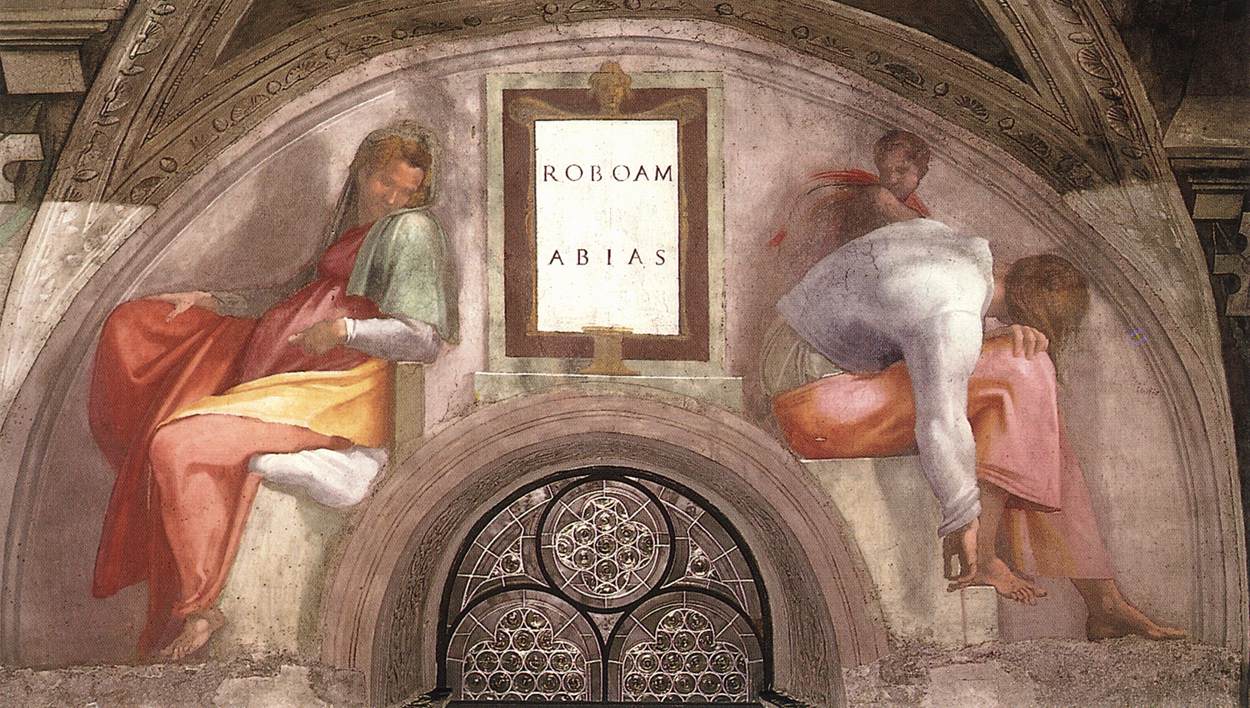
Roboam Abias
Matthew 1
[6] And Jesse begat David the king; and David the king begat Solomon of her that had been the wife of Urias;
[7] And Solomon begat Roboam; and Roboam begat Abia; and Abia begat Asa;
[8] And Asa begat Josaphat; and Josaphat begat Joram; and Joram begat Ozias

British Museum
Copy after Michelangelo's Sistine Ceiling
Abias
When problems are overwhelming and the answers that occur to the conscious mind are unacceptable, the reaction is despair. But despair need not be an end; it can be a beginning. The problems can be redefined; new answers from other sources can be considered. Carl Jung searched for answers to some fundamental issues which led men to despair. His answers included looking within one's own psyche for solutions and connecting to archetypal realities through dreams, myths, and symbolic occurrences.

Here is a C.G. Jung quotation available on Wikipedia. It is from Jung's Synchronicity: An Acausal Connecting Principle:

"This grasping of the whole is obviously the aim of science as well, but it is a goal that necessarily lies very far off because science, whenever possible, proceeds experimentally and in all cases statistically. Experiment, however, consists in asking a definite question which excludes as far as possible anything disturbing and irrelevant. *It makes conditions, imposes them on Nature, and in this way forces her to give an answer to a question devised by man. She is prevented from answering out of the fullness of her possibilities since these possibilities are restricted as far as practible.* For this purpose there is created in the laboratory a situation which is artificially restricted to the question which compels Nature to give an unequivocal answer. The workings of Nature in her unrestricted wholeness are completely excluded. If we want to know what these workings are, we need a method of inquiry which imposes the fewest possible conditions, or if possible no conditions at all, and then leave Nature to answer out of her fullness." (Page 35) 

Visions of Daughters of Albion, Plate 2, (E 47)
"Why does my Theotormon sit weeping upon the threshold;
And Oothoon hovers by his side, perswading him in vain:
I cry arise O Theotormon for the village dog
Barks at the breaking day. the nightingale has done lamenting.
The lark does rustle in the ripe corn, and the Eagle returns     
From nightly prey, and lifts his golden beak to the pure east;
Shaking the dust from his immortal pinions to awake
The sun that sleeps too long. Arise my Theotormon I am pure.
Because the night is gone that clos'd me in its deadly black.
They told me that the night & day were all that I could see;     
They told me that I had five senses to inclose me up.
And they inclos'd my infinite brain into a narrow circle,
And sunk my heart into the Abyss, a red round globe hot burning
Till all from life I was obliterated and erased.
Instead of morn arises a bright shadow, like an eye              
In the eastern cloud: instead of night a sickly charnel house;
That Theotormon hears me not! to him the night and morn
Are both alike: a night of sighs, a morning of fresh tears;" 
Songs of Experience, SONGS 31, (E 18) 
"EARTH'S Answer.

Earth rais'd up her head,From the darkness dread & drear.
Her light fled:   
Stony dread!
And her locks cover'd with grey despair.

Prison'd on watry shore
Starry jealousy does keep my tent
Cold and hoar
Weeping o'er
I hear the Father of the ancient men

Selfish father of men
Cruel jealous selfish fear
Can delight
Chain'd in night      
The virgins of youth and morning bear.

Does spring hide its joy   
When buds and blossoms grow?
Does the sower?
Sow by night?
Or the plowman in darkness plow?

Break this heavy chain,
That does freeze my bones around
Selfish! vain!
Eternal bane!                                 
That free Love with bondage bound."

Milton, Plate 41 [48], (E 142)
"To cast off the idiot Questioner who is always questioning,
But never capable of answering; who sits with a sly grin
Silent plotting when to question, like a thief in a cave;
Who publishes doubt & calls it knowledge; whose Science is Despair
Whose pretence to knowledge is Envy, whose whole Science is
To destroy the wisdom of ages to gratify ravenous Envy;"

Jerusalem, Plate 12, (E 155)
"What shall I do! or how exist, divided from Enitharmon?
Yet why despair! I saw the finger of God go forth                
Upon my Furnaces, from within the Wheels of Albions Sons:
Fixing their Systems, permanent: by mathematic power
Giving a body to Falshood that it may be cast off for ever.
With Demonstrative Science piercing Apollyon with his own bow!
God is within, & without! he is even in the depths of Hell!

 Such were the lamentations of the Labourers in the Furnaces!"

Poetical Sketches, (E 415)
          SONG.

"Memory, hither come,
  And tune your merry notes;
And, while upon the wind,
  Your music floats,
I'll pore upon the stream,
Where sighing lovers dream,    
And fish for fancies as they pass
Within the watery glass.

I'll drink of the clear stream,
  And hear the linnet's song;    
And there I'll lie and dream
  The day along:
And, when night comes, I'll go
  To places fit for woe;
Walking along the darken'd valley,   
  With silent Melancholy."

Letters, To Cumberland, (E 706)
"I begin to
Emerge from a Deep pit of Melancholy, Melancholy without any real
reason for it, a Disease which God keep you from & all good men."


Friday, August 17, 2018

CHAIN OFJEALOUSY

Wikipedia Commons  
Sistine Chapel Ceiling      Michelangelo      Abiud
Matthew 1
[12] And after they were brought to Babylon, Jechonias begat Salathiel; and Salathiel begat Zorobabel;
[13] And Zorobabel begat Abiud; and Abiud begat Eliakim; and Eliakim begat Azor;
[14] And Azor begat Sadoc; and Sadoc begat Achim; and Achim begat Eliud; 


British Museum
Copy after Michelangelo's Sistine ceiling
Abiud
Another of the drawings which Blake made from copies of individuals from the Michelangelo frescoes on the ceiling of the Sistine chapel is an ancestor of Jesus named Abiud. We see pictured in this the bond between a mother and her infant. It was an innocent scene but Blake may have related it to the tensions which grow in a family if the parents are possessive of each other, or if the love of a mate is withdrawn and transferred to the child they produced.

Fathers and sons do not always get along with one another. A mother who becomes over-attached to a son may force the child's father to become resentful and jealous. Blake describes this situation in conjunction with Los, Enitharmon and their first-born Orc. Blake's Chain of Jealousy, which developed out of Los' fears, contained many links including hostility, depression, withdrawal, secrecy and plotting revenge. Blake subtitled the Four Zoas:  "The torments of Love & Jealousy in The Death and Judgement of Albion the Ancient Man."

Four Zoas, Night V, Page 59, (E 340)
"Enitharmon nursd her fiery child in the dark deeps              
Sitting in darkness. over her Los mournd in anguish fierce
Coverd with gloom. the fiery boy grew fed by the milk
Of Enitharmon. Los around her builded pillars of iron
Page 60 
And brass & silver & gold fourfold in dark prophetic fear
For now he feard Eternal Death & uttermost Extinction       
He builded Golgonooza on the Lake of Udan Adan
Upon the Limit of Translucence then he builded Luban
Tharmas laid the Foundations & Los finishd it in howling woe     

But when fourteen summers & winters had revolved over
Their solemn habitation Los beheld the ruddy boy
Embracing his bright mother & beheld malignant fires
In his young eyes discerning plain that Orc plotted his death
Grief rose upon his ruddy brows. a tightening girdle grew        
Around his bosom like a bloody cord. in secret sobs
He burst it, but next morn another girdle succeeds
Around his bosom. Every day he viewd the fiery youth
With silent fear & his immortal cheeks grew deadly pale
Till many a morn & many a night passd over in dire woe          
Forming a girdle in the day & bursting it at night
The girdle was formd by day by night was burst in twain
Falling down on the rock an iron chain link by link lockd

Enitharmon beheld the bloody chain of nights & days
Depending from the bosom of Los & how with griding pain  
He went each morning to his labours. with the spectre dark
Calld it the chain of jealousy. Now Los began to speak   
His woes aloud to Enitharmon. since he could not hide
His uncouth plague. He siezd the boy in his immortal hands
While Enitharmon followd him weeping in dismal woe              
Up to the iron mountains top & there the Jealous chain
Fell from his bosom on the mountain. The Spectre dark
Held the fierce boy Los naild him down binding around his limbs
The accursed chain O how bright Enitharmon howld & cried 
Over her son. Obdurate Los bound down her loved joy"            

Book of Ahania, Plate 5, (E 90)
"14: But now alone over rocks, mountains
Cast out from thy lovely bosom:                          
Cruel jealousy! selfish fear!
Self-destroying: how can delight,
Renew in these chains of darkness
Where bones of beasts are strown
On the bleak and snowy mountains
Where bones from the birth are buried
Before they see the light."

Milton, Plate 20 [22], (E 115)
"He recollected an old Prophecy in Eden recorded,
And often sung to the loud harp at the immortal feasts
That Milton of the Land of Albion should up ascend
Forwards from Ulro from the Vale of Felpham; and set free        
Orc from his Chain of Jealousy, he started at the thought"


Thursday, August 16, 2018

BLAKE'S DANIEL


Wikimedia Commons
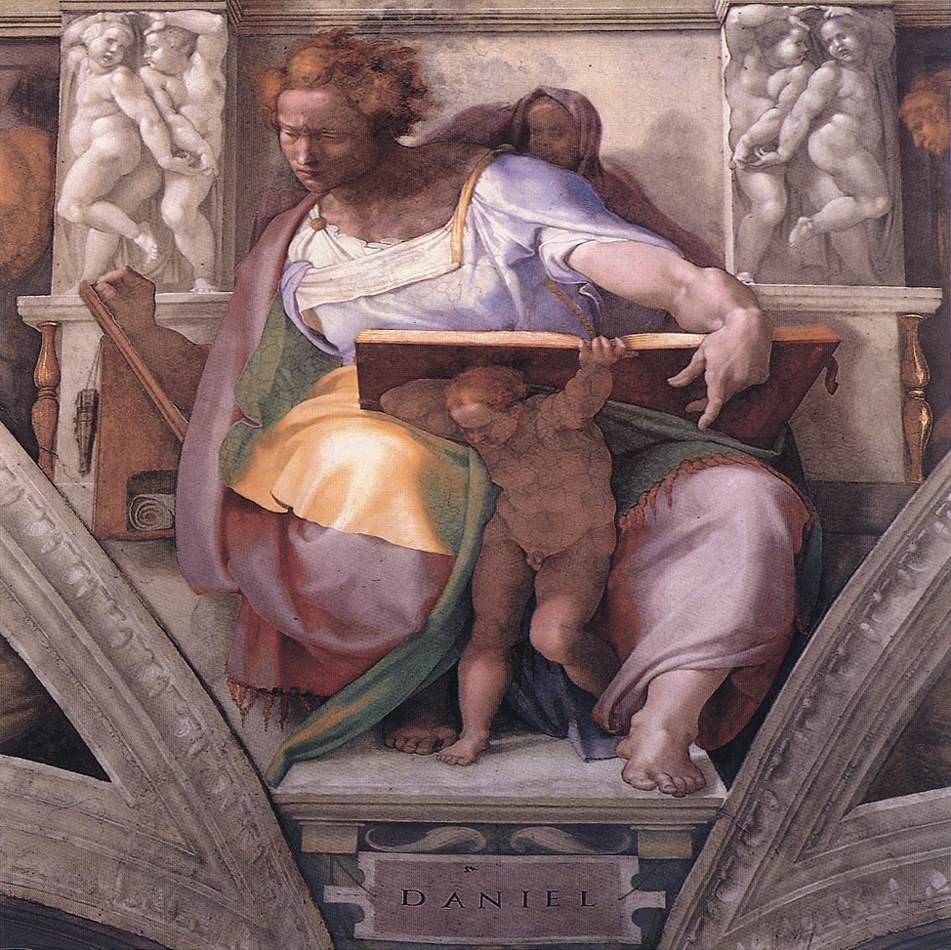
Michelangelo
Sistine Chapel - Daniel

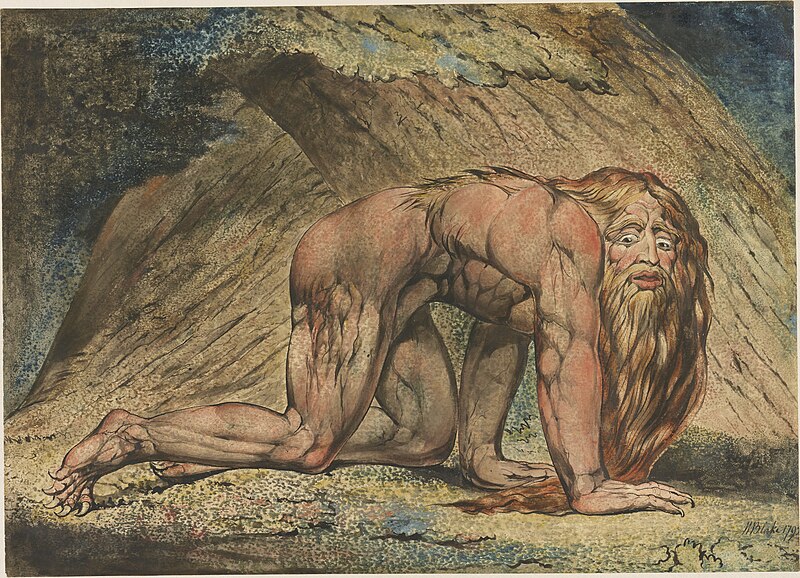
There are several dramatic stories in Book of Daniel with which Blake was thoroughly familiar. Blake's well known figure of Nebuchadnezzar is his representation of the powerful king who was reduced to the condition of a beast until he developed awareness. Daniel's accounts of the three prophets who were consigned to the furnace being accompanied by 'the son of man' influenced Blake's poignant accounts of characters being thrown into the furnaces of affliction to be made whole. The image of the man with legs of iron, loins of brass, breast of silver and head of gold was equally influential on Blake. But in his portrait of Daniel, Blake did not refer to these incidents but to the representation of Daniel among the prophets painted by Michelangelo on the ceiling of the Sistine Chapel.
British Museum Daniel
Copy after Michelangelo's Sistine Ceiling
To Blake, Daniel was a true prophet: a man who dreamed dreams and saw visions; a man who could discern truth which was hidden from others. Both Blake and Daniel conveyed the truth which was given to them according to their individual abilities, but always with the caveat that they could only reveal what their audience was able to receive.   

Daniel 7
[25] And he shall speak great words against the most High, and shall wear out the saints of the most High, and think to change times and laws: and they shall be given into his hand until a time and times and the dividing of time.
[26] But the judgment shall sit, and they shall take away his dominion, to consume and to destroy it unto the end.
[27] And the kingdom and dominion, and the greatness of the kingdom under the whole heaven, shall be given to the people of the saints of the most High, whose kingdom is an everlasting kingdom, and all dominions shall serve and obey him.
[28] Hitherto is the end of the matter. As for me Daniel, my cogitations much troubled me, and my countenance changed in me: but I kept the matter in my heart.

Descriptive Catalogue, (E 543)
 "The antiquities of every Nation Under Heaven, is no less
sacred than that of the Jews.  They are the same thing as Jacob
Bryant, [P 44] and all antiquaries have proved.  How other
antiquities came to be neglected and disbelieved, while those of
the Jews are collected and arranged, is an enquiry, worthy of
both the Antiquarian and the Divine.  All had originally one
language, and one religion, this was the religion of Jesus, the
everlasting Gospel.  Antiquity preaches the Gospel of Jesus.  The
reasoning historian, turner and twister of causes and
consequences, such as Hume, Gibbon and Voltaire; cannot with all
their artifice, turn or twist one fact or disarrange self evident
action and reality.  Reasons and opinions concerning acts, are not
history.  Acts themselves alone are history, and these are
neither the exclusive property of Hume, Gibbon nor Voltaire,
Echard, Rapin, Plutarch, nor Herodotus.  Tell me the Acts, O
historian, and leave me to reason upon them as I please; away
with your reasoning and your rubbish.  All that is not action is
not [P 45] worth reading.  Tell me the What; I do not want you to
tell me the Why, and the How; I can find that out myself, as well
as you can, and I will not be fooled by you into opinions, that
you please to impose, to disbelieve what you think improbable or
impossible.  His opinions, who does not see spiritual agency, is
not worth any man's reading; he who rejects a fact because it is
improbable, must reject all History and retain doubts only."

Wednesday, August 15, 2018

BLAKE'S REPOSE


British Museum The Reposing Traveller
1785
Matt.1
[1] The book of the generation of Jesus Christ, the son of David, the son of Abraham.
[2] Abraham begat Isaac; and Isaac begat Jacob; and Jacob begat Judas and his brethren;
[3] And Judas begat Phares and Zara of Thamar; and Phares begat Esrom; and Esrom begat Aram;
[4] And Aram begat Aminadab; and Aminadab begat Naasson; and Naasson begat Salmon;
...
[16] And Jacob begat Joseph the husband of Mary, of whom was born Jesus, who is called Christ.
[17] So all the generations from Abraham to David are fourteen generations; and from David until the carrying away into Babylon are fourteen generations; and from the carrying away into Babylon unto Christ are fourteen generations.

William Blake was an enthusiastic admirer of Michelangelo from his youth. The first image he created independently as an apprentice engraver was a copy of a figure from the Pauline Chapel of the Vatican. Another of the images from Michelangelo's frescos which he copied from a print which was available to him was named by Blake The Reposing Traveller. Michelangelo identified the figure as Aminadab and pictured him among the ancestors of Jesus in accordance with the list of generations of Jesus Christ listed in the gospels of Matthew and Luke.

Wikipedia Commons
Sistine Chapel Ceiling
Aminadab

Although The Reposing Traveller was an early work of Blake it epitomized themes which he incorporated in his system of thought throughout his life. We follow the metaphor of life as a journey applied in Blake's poetry from beginning to end. Simultaneously we encounter the image of rest and repose as equally essential as are movement and activity.

The state of repose for Blake finds expression in 'becoming receptive to Generation', in becoming a 'Womb', and in the sleep of Beulah.

Jerusalem, Plate 53, (E 203)
"Here on the banks of the Thames, Los builded Golgonooza,   
Outside of the Gates of the Human Heart, beneath Beulah
In the midst of the rocks of the Altars of Albion. In fears
He builded it, in rage & in fury. It is the Spiritual Fourfold
London: continually building & continually decaying desolate!
In eternal labours: loud the Furnaces & loud the Anvils          
Of Death thunder incessant around the flaming Couches of
The Twentyfour Friends of Albion and round the awful Four
For the protection of the Twelve Emanations of Albions Sons
The Mystic Union of the Emanation in the Lord; Because    
Man divided from his Emanation is a dark Spectre                 
His Emanation is an ever-weeping melancholy Shadow
But she is made receptive of Generation thro' mercy
In the Potters  Furnace, among the Funeral Urns of Beulah
From Surrey hills, thro' Italy and Greece, to Hinnoms vale." 
Milton, Plate 34 [38], (E 133)
"And all the Songs of Beulah sounded comfortable notes
To comfort Ololons lamentation, for they said:
Are you the Fiery Circle that late drove in fury & fire
The Eight Immortal Starry-Ones down into Ulro dark
Rending the Heavens of Beulah with your thunders & lightnings
And can you thus lament & can you pity & forgive?
Is terror changd to pity O wonder of Eternity!

And the Four States of Humanity in its Repose,
Were shewed them. First of Beulah a most pleasant Sleep
On Couches soft, with mild music, tended by Flowers of Beulah    
Sweet Female forms, winged or floating in the air spontaneous
The Second State is Alla & the third State Al-Ulro;
But the Fourth State is dreadful; it is named Or-Ulro:
The First State is in the Head, the Second is in the Heart:
The Third in the Loins & Seminal Vessels & the Fourth            
In the Stomach & Intestines terrible, deadly, unutterable
And he whose Gates are opend in those Regions of his Body
Can from those Gates view all these wondrous Imaginations
...
Then view'd from Miltons Track they see the Ulro: a vast Polypus
Of living fibres down into the Sea of Time & Space growing       
A self-devouring monstrous human Death Twenty-seven fold
Within it sit Five Females & the nameless Shadowy Mother
Spinning it from their bowels with songs of amorous delight
And melting cadences that lure the Sleepers of Beulah down
The River Storge (which is Arnon) into the Dead Sea:             
Around this Polypus Los continual builds the Mundane Shell

Jerusalem, Plate 41 [46], (E 188)
"with eloquence
Divine, he wept over Albion: speaking the words of God
In mild perswasion: bringing leaves of the Tree of Life.

Thou art in Error Albion, the Land of Ulro:               
One Error not remov'd, will destroy a human Soul
Repose in Beulahs night, till the Error is remov'd
Reason not on both sides. Repose upon our bosoms
Till the Plow of Jehovah, and the Harrow of Shaddai
Have passed over the Dead, to awake the Dead to Judgment.     
But Albion turn'd away refusing comfort."

Jerusalem, Plate 74, (E 229)
"And the Four Zoa's are Urizen & Luvah & Tharmas & Urthona
In opposition deadly, and their Wheels in poisonous              
And deadly stupor turn'd against each other loud & fierce
Entering into the Reasoning Power, forsaking Imagination
They became Spectres; & their Human Bodies were reposed
In Beulah, by the Daughters of Beulah with tears & lamentations

The Spectre is the Reasoning Power in Man; & when separated      
From Imagination, and closing itself as in steel, in a Ratio
Of the Things of Memory. It thence frames Laws & Moralities
To destroy Imagination! the Divine Body, by Martyrdoms & Wars"

Gates of Paradise:For the Sexes, The Keys, (E 267)     
"1    My Eternal Man set in Repose
     The Female from his darkness rose
     And She found me beneath a Tree                     
     A Mandrake & in her Veil hid me
     Serpent Reasonings us entice
     Of Good & Evil: Virtue & Vice"