Blake seeks to provide the Golden String which can lead us through the labyrinth of our experience or his own poetry.

Tuesday, November 20, 2018

Myth in Blake 9

Blake never forgot the involvement of the Christian Church in 2000 years of bloodshed, but here, under the influence of grace, he has a more understanding view of it than he has expressed elsewhere (See Chapter Seven).

In the last Night Blake let all of his feelings out in a magnificent vision of apocalypse that bears comparison with the one John wrote:

Four Zoas, Night IX, Page 117, (E 386)
"Los his vegetable hands 
Outstretched; his right hand branching out in fibrous strength 
Seized the Sun; His left hand, like dark roots, cover'd the Moon, 
And tore them down, cracking the heavens across from immense to immense. 
Then fell the fires of Eternity with loud & shrill 
Sound of Loud Trumpet thundering along from heaven to heaven
A mighty sound articulate Awake ye dead & come
To judgment from the four winds Awake & Come away
Folding like scrolls of the Enormous volume of Heaven & Earth"

And on and on it goes, much too imposing to describe in this short review. But two things will be said:
First, Blake draws on John's Apocalypse as he already has in Night viii. Revelation, the strangest book in the Bible, utterly incomprehensible to the literal mind, has much to offer to the trained imagination. To read the end of Plate 42 of Jerusalem with complete attention gives one a purchase on Blake's great source; Revelation begins to come alive in an exciting new way.

Jerusalem, Plate 42, (E 190)
"Los stood before his Furnaces awaiting the fury of the Dead: 
And the Divine hand was upon him, strengthening him mightily. 
The Spectres of the Dead cry out from the deeps beneath 
Upon the hills of Albion; Oxford groans in his iron furnace 
Winchester in his den & cavern; they lament against 
Albion: they curse their human kindness & affection 
They rage like wild beasts in the forests of affliction 
In the dreams of Ulro they repent of their human kindness. 
Come up, build Babylon, Rahab is ours & all her multitudes 
With her in pomp and glory of victory. Depart 
Ye twenty-four into the deeps! let us depart to glory! 
Their Human majestic forms sit up upon their Couches 
Of death: they curb their Spectres as with iron curbs 
They enquire after Jerusalem in the regions of the dead, 
With the voices of dead men, low, scarcely articulate, 
And with tears cold on their cheeks they weary repose. 
O when shall the morning of the grave appear, and when 
Shall our salvation come? we sleep upon our watch 
We cannot awake! and our Spectres rage in the forests 
O God of Albion where art thou! pity the watchers! 
Thus mourn they. Loud the Furnaces of Los thunder upon 
The clouds of Europe & Asia, among the Serpent Temples! 
And Los drew his Seven Furnaces around Albions Altars 
And as Albion built his frozen Altars, Los built the Mundane Shell, 
In the Four Regions of Humanity East & West & North & South,
Till Norwood & Finchley & Blackheath & Hounslow, coverd the whole Earth.
This is the Net & Veil of Vala, among the Souls of the Dead."
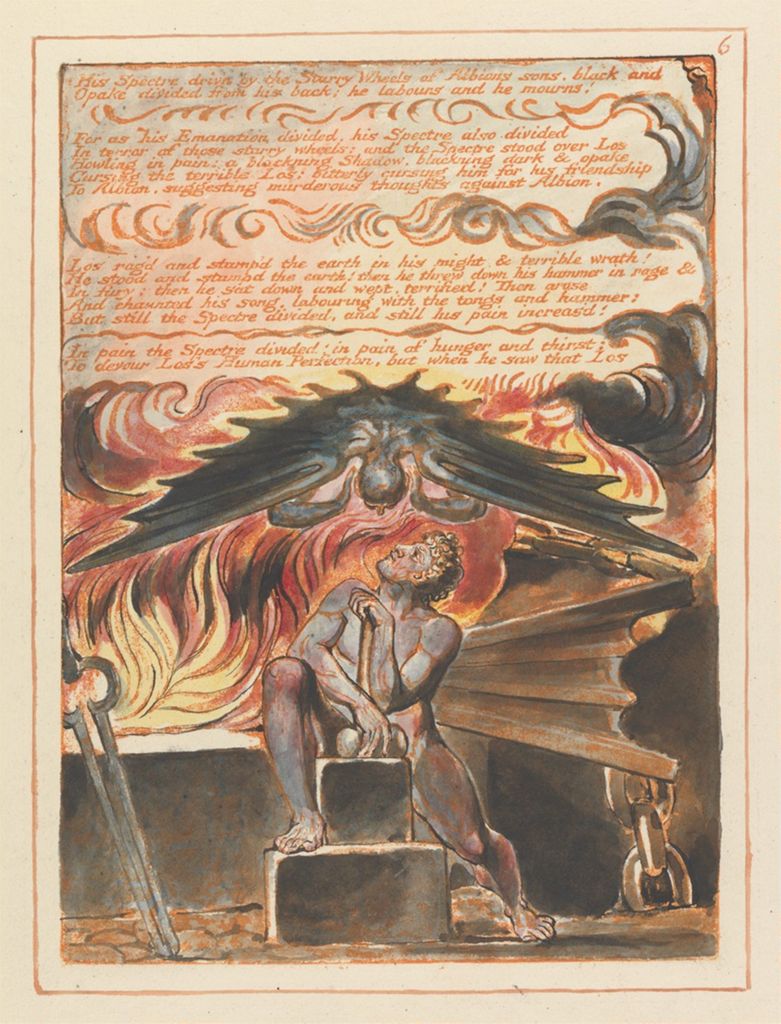
Yale center for British Art 
Jerusalem
Plate 6

Second, as magnificent as it is, Blake simply wasn't able to 'Christianize' his apocalypse as he had done the two previous Nights. Perhaps it was already too deeply stamped with his pre-Christian mind. Forgiveness is the soul, virtually the alpha and omega of Blake's Christ, but Night ix shows little or no evidence of this new spirit. Only in Jerusalen, in its last plates, do we find a thoroughly Christian apocalypse. Neither Revelation nor Night ix has much of forgiveness; what they do have is vengeance and retribution. Both writers had suffered much at the hands of the ungodly, and both looked with anticipation to the Day of Vengeance. So we must say that Night ix is a modern redoing of John's Apocalypse, while the end of Jerusalem is a Christian recreation of it.

Blake's epic ends with the eternal man awake, his four zoas back in union, each carrying out his appointed function in the harmonious consummation of the Age. In the last harvest Urizen reaps, Tharmas threshes, Luvah tramples out the vineyard and Urthona bakes the bread.

Night ix contains much magnificent poetry. A few lines near the end will provide an appropriate end to this all too inadequate description of Blake's great poem:

Four Zoas, Night IX, Page 138, (E 406)
"The Sun has left his blackness & has found a fresher morning,
And the mild moon rejoices in the clear & cloudless night,
And Man walks forth from the midst of the fires: the evil is all consumed.
He walks upon the Eternal Mountains, raising his heavenly voice,
Conversing with the Animal forms of wisdom night & day,
...
They raise their faces from the Earth, conversing with the Man:
How is it we have walk'd thro' fires & yet are not consum'd?
How is it that all things are chang'd, even as in ancient times?

The Sun arises from his dewey bed, & the fresh airs
Play in his smiling beams giving the seeds of life to grow,
And the fresh Earth beams forth ten thousand thousand springs of life."

Christian or not, it does have the most beautiful visions!
.

Sunday, November 18, 2018

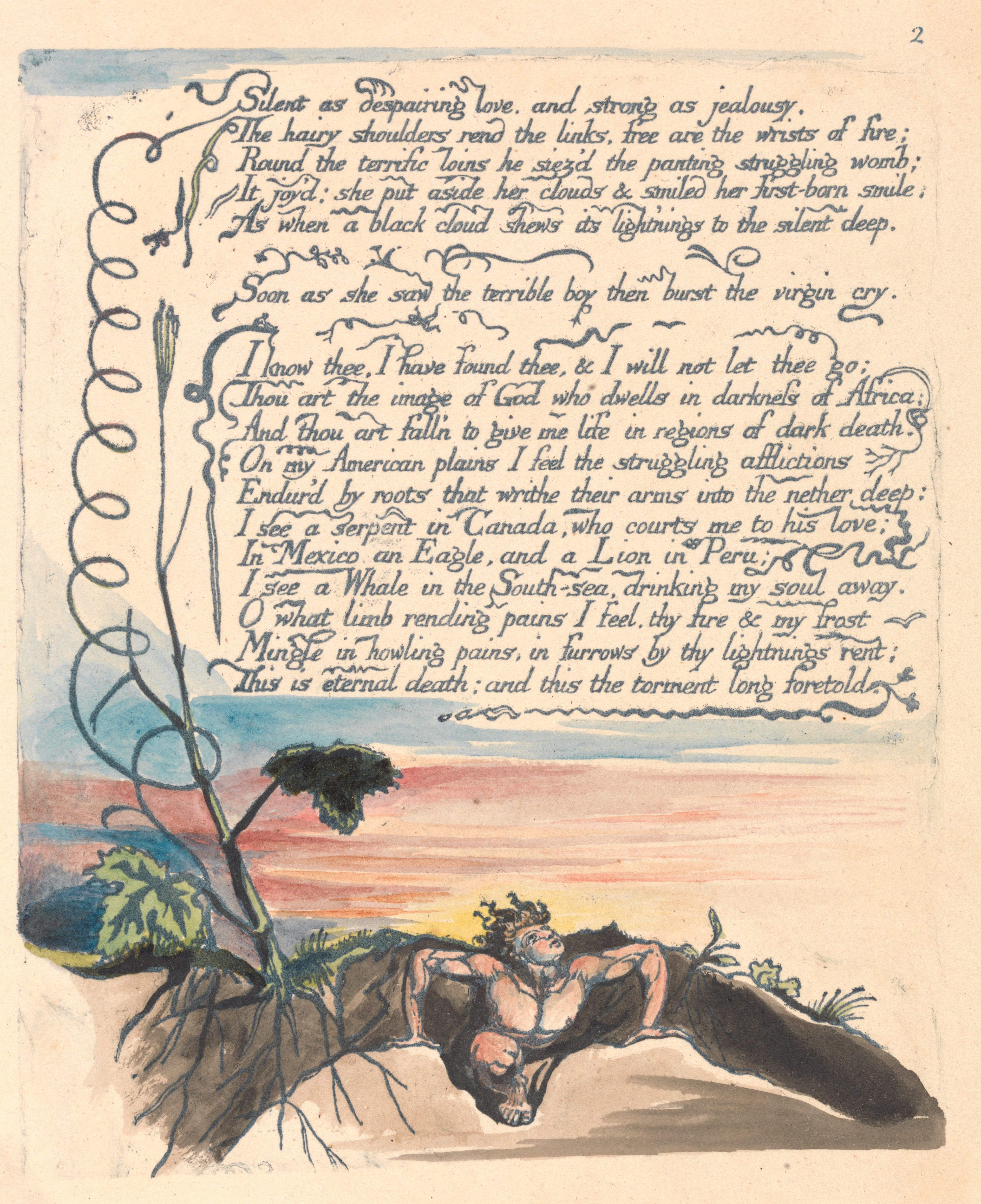
AMERICA PRELUDIUM 2


Yale Center for British Art
America a Prophecy
 Plate 2
 
America a Prophecy, Plate 2, (E 52)
"Silent as despairing love, and strong as jealousy,
The hairy shoulders rend the links, free are the wrists of fire;
Round the terrific loins he siez'd the panting struggling womb;
It joy'd: she put aside her clouds & smiled her first-born smile;
As when a black cloud shews its lightnings to the silent deep.   

Soon as she saw the terrible boy then burst the virgin cry.

I know thee, I have found thee, & I will not let thee go;
Thou art the image of God who dwells in darkness of Africa; 
And thou art fall'n to give me life in regions of dark death.
On my American plains I feel the struggling afflictions          
Endur'd by roots that writhe their arms into the nether deep:
I see a serpent in Canada, who courts me to his love;
In Mexico an Eagle, and a Lion in Peru;
I see a Whale in the South-sea, drinking my soul away.
O what limb rending pains I feel. thy fire & my frost            
Mingle in howling pains, in furrows by thy lightnings rent;
This is eternal death; and this the torment long foretold.

[The stern Bard ceas'd, asham'd of his own song; enrag'd he swung
His harp aloft sounding, then dash'd its shining frame against
A ruin'd pillar in glittring fragments; silent he turn'd away,   
And wander'd down the vales of Kent in sick & drear lamentings.]"

The voice that has been silent speaks, the body that has been chained breaks forth. The combination of the fire of Orc and the frost of the Daughter of Urthona mingle to release the pent up anger which was long suppressed.
 
The forces of renewal are not limited to one continent, one race or one time. Change stirs beneath the surface as a serpent, a lion or a whale: it breaks forth as a falling Image of God, or as those struggling with afflictions. It is given a voice when the imprisoned power climbs from the dark cavern into the air and light of realization.

The last line, 'This is eternal death; and this the torment long foretold,' speaks of two alternatives. The decision is not between the status quo and the outbreak of revolution. Revolution is the symptom not the disease. The choice is between the endless cycle of birth and death, and the torment of the end-time: the long hoped for reordering which marks the reentry into Eden embodied in the annihilation of everything which can be annihilated.

When Blake was producing America he struggled with how open he could or should be in exposing his sentiments about his opposition to monarchy. Write he must, but should he risk his life by putting into print his 'seditious' thoughts about the government? He deleted plates which he decided were too inflammatory. At the end of two copies of this page are the lines beginning, 'The stern Bard ceas'd, asham'd.' These lines are thought to be late additions to the text which were eliminated before printing. Perhaps the deleted lines from the Preludium expressed the shame Blake felt for not having the courage to maintain overt references to the king which were on the deleted plates.
 
.

Wednesday, November 14, 2018

AMERICA PRELUDIUM

Fitzwilliam Museum
Cambridge University
America A Prophecy
Plate 3, Preludium
America a Prophecy, Plate 1, (E 51)
                                "PRELUDIUM

The shadowy daughter of Urthona stood before red Orc.
When fourteen suns had faintly journey'd o'er his dark abode;
His food she brought in iron baskets, his drink in cups of iron;
Crown'd with a helmet & dark hair the nameless female stood;
A quiver with its burning stores, a bow like that of night,
When pestilence is shot from heaven; no other arms she need:
Invulnerable tho' naked, save where clouds roll round her loins,
Their awful folds in the dark air; silent she stood as night;
For never from her iron tongue could voice or sound arise;
But dumb till that dread day when Orc assay'd his fierce embrace.

Dark virgin; said the hairy youth, thy father stern abhorr'd;
Rivets my tenfold chains while still on high my spirit soars;
Sometimes an eagle screaming in the sky, sometimes a lion,
Stalking upon the mountains, & sometimes a whale I lash
The raging fathomless abyss, anon a serpent folding              

Around the pillars of Urthona, and round thy dark limbs,
On the Canadian wilds I fold, feeble my spirit folds.
For chaind beneath I rend these caverns; when thou bringest food
I howl my joy! and my red eyes seek to behold thy face
In vain! these clouds roll to & fro, & hide thee from my sight." 
 
This poem is dated 1793. It was written between the American Revolution and the French Revolution, or as the British might say between the Rebellion of the Thirteen Colonies and The Reign of Terror. Blake was not writing about the American Revolution per se but about the periodic eruption of violent change to overthrow oppressive conditions by an awakened consciousness. Blake named the spirit of revolution Orc; the spirit which maintained the entrenched status quo he referred to as the Daughter of Urthona.

Orc had come of age and become empowered to flex his muscles. In his childhood he had been restrained by chains each link of which had been forged by Urthona. We later are told that his father was Los, the active form of Urthona through whom the cohesive spiritual force of the psyche is expressed. The immature Orc was not only chained mentally but he was physically restrained in an underground cavern which may be thought of as the body of a child before the age of puberty.

In his lonely prison Orc was fed by the aspect of Urthona which is known as the Daughter of Urthona. She supplied the food which nourished the developing unconscious of the restrained boy. Forms of rebellion (the eagle, the lion, the whale or the serpent) festered within the dormant child whom the voiceless female nourished. The Daughter of Urthona brought joy to Orc because there are constant eruptions of dissent within the status quo.

The table was being set for Orc to enjoy his feast of active expression as rebellion, war, and a 'reign of terror'.

We read in Blake's Visionary forms Dramatic, edited by David V. Erdman and John E. Grant, from chapter 5, America New Expanses:

"The action of the poem-picture is larger and more complex than would be indicated by the picture or the words taken separately, for these point not to each other (as in the usual picture book) but beyond themselves. The artifact only opens the sensory doors to the mental theater.

In other words, the text is not there to help us follow the picture, nor the picture to help us visualize the text; both lead us to an imaginative leap in the dark, a leap beyond the dark and the fire - from perception to Intellectual Vision, a last judgement in which fools perish.

We must attend to Blake's definition (Jerusalem 98) of true communication as practiced by humans in paradise:

And they conversed together in Visionary forms dramatic which bright
Redounded from their Tongues in thunderous majesty, in Visions
In new Expanses, creating exemplars...

Their converse involves mastery of all the arts of discourse, ornamentation, dramaturgy, exploration, and moral suasion (exemplars). Using only the arts of poetry and painting (and engraving) Blake must suggest all the others. And all must serve Intellectual Vision, seen through the window of the artifact." 
.
.

Friday, November 9, 2018

INTERLUDE

Yale Center for British Art
America
Plate 9
Larry wrote this in his Journal in January 1985:

Four Zoas Night IX - reading a passage from Vala's interlude, I am charmed with the language. I realize that much of Blake's attraction to me is as an escape from the sordid world, a pleasant world like great music - with very little relationship to the rest of life. That passage, owing much to the myth of Cupid and Psyche and to the biblical Song of Solomon shows Blake as teller of tales, as bearer of the culture of the millennia. That is so foreign to our heedless, blind, 20th century consciousness. It is a form of transcendence, and an approach to the immortality for which Vala longs; a bright airy world of limitless dimensions.

Los is that prophet who walks walks up and down 6000 years allowing time and space for such moments to occur and to be made permanent in the Body and the Spirit."  

In November 2018 Ellie added:

When we read the Old Testament or Blake's Prophecies we find many disturbing passages. We may be inclined to close the book to avoid subjecting ourselves to the negative feelings engendered by reading of struggles among competing individuals or entities. Were it not for the hope of finding gems of truth and beauty embedded in the mire of confusion and dissension we may not read on.

One on Larry's favorite expressions was, "The Bible is all poetry, and poetry is the highest form of truth." Like the Bible, Blake's writing (even the prose) is poetry. It is not to be taken literally but metaphorically. It points to truth which is beyond expression. Blake's God availed himself of the opportunity to begin again repeatedly. We might follow that lead and begin again when reading gets rough.
Jerusalem, Plate 75, (E 230)
"For Los in Six Thousand Years walks up & down continually
That not one Moment of Time be lost & every revolution
Of Space he makes permanent in Bowlahoola & Cathedron."

Four Zoas, Night IX, Page 128, (E 397) 
"So spoke the Sinless Soul & laid her head on the downy fleece 
Of a curld Ram who stretchd himself in sleep beside his mistress
And soft sleep fell upon her eyelids in the silent noon of day

Then Luvah passed by & saw the sinless Soul
And said   Let a pleasant house arise to be the dwelling place
Of this immortal Spirit growing in lower Paradise 

He spoke & pillars were builded & walls as white as ivory
The grass she slept upon was pavd with pavement as of pearl
Beneath her rose a downy bed & a cieling coverd all

Vala awoke. When in the pleasant gates of sleep I enterd
I saw my Luvah like a spirit stand in the bright air 
Round him stood spirits like me who reard me a bright house
And here I see thee house remain in my most pleasant world
Page 129 
My Luvah smild I kneeled down he laid his hand on my head
And when he laid his hand upon me from the gates of sleep I came
Into this bodily house to tend my flocks in my pleasant garden

So saying she arose & walked round her beautiful house
And then from her white door she lookd to see her bleating lambs 
But her flocks were gone up from beneath the trees into the hills

I see the hand that leadeth me doth also lead my flocks
She went up to her flocks & turned oft to see her shining house
She stopd to drink of the clear spring & eat the grapes & apples

She bore the fruits in her lap she gatherd flowers for her bosom
She called to her flocks saying follow me O my flocks

They followd her to the silent valley beneath the spreading trees
And on the rivers margin she ungirded her golden girdle
She stood in the river & viewd herself within the watry glass
And her bright hair was wet with the waters She rose up from the river
And as she rose her Eyes were opend to the world of waters"
Song of Solomon
Chapter 2
[8] The voice of my beloved! behold, he cometh leaping upon the mountains, skipping upon the hills.
[9] My beloved is like a roe or a young hart: behold, he standeth behind our wall, he looketh forth at the windows, shewing himself through the lattice.
[10] My beloved spake, and said unto me, Rise up, my love, my fair one, and come away.
[11] For, lo, the winter is past, the rain is over and gone;
[12] The flowers appear on the earth; the time of the singing of birds is come, and the voice of the turtle is heard in our land;
[13] The fig tree putteth forth her green figs, and the vines with the tender grape give a good smell. Arise, my love, my fair one, and come away.
[14] O my dove, that art in the clefts of the rock, in the secret places of the stairs, let me see thy countenance, let me hear thy voice; for sweet is thy voice, and thy countenance is comely.
[15] Take us the foxes, the little foxes, that spoil the vines: for our vines have tender grapes.
[16] My beloved is mine, and I am his: he feedeth among the lilies.
[17] Until the day break, and the shadows flee away, turn, my beloved, and be thou like a roe or a young hart upon the mountains of Bether.
.
.

Monday, November 5, 2018

LOSS OF SONS

British Museum
Book of Urizen
Copy D, Plate 8

Larry made this short entry in his journal in November of 1984:

"Reading Milton Book 1 - The associations become richer and richer, more poignant and meaningful. At the end of Plate 23 Los recollects the loss of his twelve sons - a parallel to the Orc myth. A lost son embodies the failure to maintain the gold of one's life, a failure of the harvest, which by faith we must see as a postponement of the harvest knowing that the Union was not to be Effected without Care and Sorrows and Trouble of 6000 Years of self-denial and of bitter Contrition. 4Z'S, Night 7"


Ellie's reply in November of 2018 - Larry caught the sorrow of being a child of time and space. Whatever projects which may be initiated, whatever fertile ideas may be generated, whatever progeny may be germinated, whatever seedlings may be nourished, the outcome is not ours but belongs to a future generation. We harvest the fruits of earlier initiatives as sustenance for what belongs to a future time and space. Our joy must be in the conception and cultivation rather than in anticipated results. Expecting immediate or short term payback generates sorrow. 

Blake and Larry undoubtedly had the loss of ten of the twelve tribes of Israel in mind when they pondered a potential loss of sons. For Blake a period of 6000 years represented the time from creation to the present. Seven periods of spiritual development (Seven Eyes of God) took place in that time. Two thousand years represented the time occupied between Jesus' and Blake's day. I think that Jesus had some apprehension that the work that he accomplished in his life on Earth would be lost after his death. His disciples were entrusted with preserving what had been given to them. But they were only vessels; the message would be passed on to other sons who would carry it until all is brought together in the glory of the final reconciliation.
Milton, Plate 23 [25], (E 119)
"And Los thus spoke. O noble Sons, be patient yet a little
I have embracd the falling Death, he is become One with me
O Sons we live not by wrath. by mercy alone we live!
I recollect an old Prophecy in Eden recorded in gold; and oft
Sung to the harp: That Milton of the land of Albion.
Should up ascend forward from Felphams Vale & break the Chain
Of jealousy from all its roots; be patient therefore O my Sons
These lovely Females form sweet night and silence and secret
Obscurities to bide from Satans Watch-Fiends. Human loves        
And graces; lest they write them in their Books, & in the Scroll
Of mortal life, to condemn the accused: who at Satans Bar
Tremble in Spectrous Bodies continually day and night
While on the Earth they live in sorrowful Vegetations
O when shall we tread our Wine-presses in heaven; and Reap      
Our wheat with shoutings of joy, and leave the Earth in peace
Remember how Calvin and Luther in fury premature
Sow'd War and stern division between Papists & Protestants
Let it not be so now! O go not forth in Martyrdoms & Wars
We were plac'd here by the Universal Brotherhood & Mercy
With powers fitted to circumscribe this dark Satanic death
And that the Seven Eyes of God may have space for Redemption.
But how this is as yet we know not, and we cannot know;
Till Albion is arisen; then patient wait a little while,
Six Thousand years are passd away the end approaches fast;       
This mighty one is come from Eden, he is of the Elect,
Who died from Earth & he is returnd before the Judgment. This thing
Was never known that one of the holy dead should willing return
Then patient wait a little while till the Last Vintage is over:
Till we have quenchd the Sun of Salah in the Lake of Udan Adan 
O my dear Sons! leave not your Father, as your brethren left me[.]
Twelve Sons successive fled away in that thousand years of sorrow
Plate 24 [26]
Of Palamabrons Harrow, & of Rintrahs wrath & fury:
Reuben & Manazzoth & Gad & Simeon & Levi,
And Ephraim & Judah were Generated, because
They left me, wandering with Tirzah: Enitharmon wept
One thousand years, and all the Earth was in a watry deluge
We calld him Menassheh because of the Generations of Tirzah
Because of Satan: & the Seven Eyes of God continually
Guard round them, but I the Fourth Zoa am also set
The Watchman of Eternity, the Three are not! & I am preserved
Still my four mighty ones are left to me in Golgonooza           
Still Rintrah fierce, and Palamabron mild & piteous
Theotormon filld with care, Bromion loving Science

You O my Sons still guard round Los. O wander not & leave me"

Four Zoas, Night VII, Page 87, (E 369)
"But Los stood on the Limit of Translucence weeping & trembling
Filled with doubts in self accusation beheld the fruit   
Of Urizens Mysterious tree For Enitharmon thus spake

When In the Deeps beneath I gatherd of this ruddy fruit 
It was by that I knew that I had Sinnd & then I knew
That without a ransom I could not be savd from Eternal death
That Life lives upon Death & by devouring appetite
All things subsist on one another thenceforth in Despair
I spend my glowing time but thou art strong & mighty  
To bear this Self conviction take then Eat thou also of
The fruit & give me proof of life Eternal or I die

Then Los plucked the fruit & Eat & sat down in Despair
And must have given himself to death Eternal But
Urthonas spectre in part mingling with him comforted him  
Being a medium between him & Enitharmon   But This Union
Was not to be Effected without Cares & Sorrows & Troubles
Of six thousand Years of self denial and of bitter Contrition 

Urthonas Spectre terrified beheld the Spectres of the Dead
Each Male formd without a counterpart without a concentering vision
The Spectre of Urthona wept before Los Saying I am the cause
That this dire state commences I began the dreadful state
Of Separation & on my dark head the curse & punishment
Must fall unless a way be found to Ransom & Redeem  

But I have thee my [Counterpart Vegetating] miraculous
These Spectres have no [Counter(parts)] therefore they ravin
Without the food of life Let us Create them Coun[terparts]
For without a Created body the Spectre is Eternal Death"


Luke 22
[39] And he came out, and went, as he was wont, to the mount of Olives; and his disciples also followed him.
[40] And when he was at the place, he said unto them, Pray that ye enter not into temptation.
[41] And he was withdrawn from them about a stone's cast, and kneeled down, and prayed,
[42] Saying, Father, if thou be willing, remove this cup from me: nevertheless not my will, but thine, be done.
[43] And there appeared an angel unto him from heaven, strengthening him.
[44] And being in an agony he prayed more earnestly: and his sweat was as it were great drops of blood falling down to the ground.
[45] And when he rose up from prayer, and was come to his disciples, he found them sleeping for sorrow,
[46] And said unto them, Why sleep ye? rise and pray, lest ye enter into temptation.
[47] And while he yet spake, behold a multitude, and he that was called Judas, one of the twelve, went before them, and drew near unto Jesus to kiss him.
[48] But Jesus said unto him, Judas, betrayest thou the Son of man with a kiss?

John 17
[13] And now come I to thee; and these things I speak in the world, that they might have my joy fulfilled in themselves.
[14] I have given them thy word; and the world hath hated them, because they are not of the world, even as I am not of the world.
[15] I pray not that thou shouldest take them out of the world, but that thou shouldest keep them from the evil.
[16] They are not of the world, even as I am not of the world.
[17] Sanctify them through thy truth: thy word is truth.
[18] As thou hast sent me into the world, even so have I also sent them into the world.
 
.

Thursday, November 1, 2018

SLAVERY 4

Wikimedia Commons
IIllustration to Stedman's Five Years Expedition 
Europe Supported By Africa and America
 Stedman's comments on Europe Supported By Africa and America:
"Going now to take my leave of Surinam, after all the horrors and
    cruelties with which I have hurt both the eye and heart of the
    feeling reader, I will close the scene with an emblematical picture
    of Europe supported by Africa and America, accompanied by an ardent
    wish that the friendly manner as they are represented, they may
    henceforth and to all eternity be the props of each other. I might
    have included Asia, but this I omitted, as having no connection with
    the present narrative:  we only differ in colour but are certainly
    all created by the same Hand. Thus, if it has not pleased fortune to
    make us equal in rank, let us at least use the superiority we
    possess with moderation, and not only proffer that happiness which
    we have to bestow on our equals, but let us extend it with
    cheerfulness to our deserving dependents." 
The final picture in Stedman's book, created by Stedman and engraved by Blake, is of three lovely young women. In spite of the requirements of his profession that he quell a slave rebellion and brutally punish disobedience, Stedman married a slave woman himself and with her had a child whom he later took to Europe. Although he realized that he had participated in injustices, he recognized the essential human value of all races. His hope was that the three races may learn that their differences were assets which might be shared with one another to increase the happiness of all. 

Blake did not try to reconcile Stedman's ideas with his own. As I read Blake's poetic statements, I see this as something of what he was saying in his illustrations to The Narrative of a Five Years Expedition against the Revolted Negroes of Surinam and his own poem Vision of the Daughters of Albion :
The African bears the burden of slavehood, of loss of liberty and of cruel punishment.
The European is under the hegemony of marriage laws which rob women of autonomy.
The American is suffering the destruction of the land and culture.

Africa loses her population and labor.
Europe loses the contribution which her women could make to life and liberty.
America loses the diversity and creativity of her native people.

Erdman in Prophet against Empire drew together the complexities of Blake's insights into the issues of diverse human beings living together for mutual benefit. Oothoon from Visions of Daughters of Albion, Europe Supported By Africa and America, from Blake's illustrations to Stedman's book, and the lessons learned in Little Black Boy, all contributed to understanding the difficulties of pursuing brotherhood.

Exerts from Page 239-40 - read the section :
"The argument of Oothoon is triplex, as she herself is. Stedman's emblematic picture treats Europe, Africa and America as three separate women: Blake treats them as one. He can do this because Oothoon is not a person but a 'soul.' Pictured in chains she is the female slave, but she does not have the black skin and tight ringlets of the emblem...Oothoon is the American Indian of the emblem wirh the same loose black hair, sad mouth and angular limbs.
...
To avoid a chauvinistic interpretation Blake explained that any skin color is a cloud that cannot obscure the essential brotherhood of man in a fully enlightened society, such as Heaven.
...
If the Negro is to be free of his black cloud, the little English boy must be free of his 'white cloud' which is equally opaque.
...
  As Africa she is urging the London citizens to ignore color differences. As America she is urging British law-makers to rescue her from the muddy feet of the slaver. As a woman enslaved by the Marriage Act morality, she is imploring her lover to rise above accusations of adultery" 

Marriage of Heaven and Hell, Plate 25, (E 44)
A song of Liberty
"12. Look up! look up! O citizen of London. enlarge thy
countenance; O Jew, leave counting gold! return to thy oil and
wine; O African! black African! (go. winged thought widen his forehead.)"
Marriage of Heaven and Hell, Plate 13, (E 39)
 "I then asked Ezekiel. why he eat dung, & lay so long on his
right  & left side? he answerd. the desire of raising other men
into a  perception of the infinite this the North American tribes
practise." 

Jerusalem, Plate 72, (E 227)
"All these Center in London & in Golgonooza. from whence
They are Created continually East & West & North & South
And from them are Created all the Nations of the Earth           
Europe & Asia & Africa & America, in fury Fourfold!

And Thirty-two the Nations: to dwell in Jerusalems Gates
O Come ye Nations Come ye People Come up to Jerusalem
Return Jerusalem & dwell together as of old! Return
Return! O Albion let Jerusalem overspread all Nations            
As in the times of old! O Albion awake! Reuben wanders
The Nations wait for Jerusalem. they look up for the Bride

France Spain Italy Germany Poland Russia Sweden Turkey
Arabia Palestine Persia Hindostan China Tartary Siberia
Egypt Lybia Ethiopia Guinea Caffraria Negroland Morocco          
Congo Zaara Canada Greenland Carolina Mexico
Peru Patagonia Amazonia Brazil. Thirty-two Nations
And under these Thirty-two Classes of Islands in the Ocean
All the Nations Peoples & Tongues throughout all the Earth"

Jerusalem, Plate 97, (E 256)
"Awake! Awake Jerusalem! O lovely Emanation of Albion
Awake and overspread all Nations as in Ancient Time
For lo! the Night of Death is past and the Eternal Day
Appears upon our Hills: Awake Jerusalem, and come away

So spake the Vision of Albion & in him so spake in my hearing   
The Universal Father."

Vision of Last Judgment, (E 556)
"it ought to be understood that the Persons
Moses & Abraham are not here meant but the States Signified by
those Names the Individuals being representatives or Visions of
those States as they were reveald to Mortal Man in the Series of
Divine Revelations. as they are written in the Bible these
various States I have seen in my Imagination when distant they
appear as One Man but as you approach they appear
Multitudes of Nations."

Monday, October 29, 2018

SLAVERY 3

British Museum
Visions of the Daughters of Albion
Copy A, Plate 11
Perhaps political situations are never simple, as Larry and I frequently commiserated there were too many variables.

During Blake's lifetime there were innumerable variables (rebellion, war, slavery, republicanism, liberation, etc.), each of which was influenced by multiple forces. Caution was called for in manipulating a single variable which would have a rippling effect. When Blake wrote Visions of the Daughters of Albion he attempted to affect the treatment of women and the treatment of slaves simultaneously. By allowing the work to be interpreted in multiple ways he avoided suggesting dramatic change in any single variable.

Two problems addressed in Visions of the Daughters of Albion were marriage laws which resulted in oppression of women, and failure of the law to prevent the use of British ships to transport slaves. David Erdman in Prophet Against Empire directed our attention to the subtle ways Blake referenced the slave trade when writing of the sexual triangle among Oothoon, Bromian and Theotormon. Before the lovers Oothoon and Theotormon could be married she was violated by Bromian. Oothoon was rejected by both men but she knew herself to be pure and undefiled. Shift to the situation regarding slavery - Oothoon is the African slave as the pawn being manipulated by outside forces; Bromian in the slave trader who makes it possible for slavery to increase; Theotormon is the Parliament who refuses to act against the power of the economic system sustained by slavery. 

The tensions which existed in either of the triangles is expressed in this way by Erdman on page 241 of his book:

"In her effort to prod him across the threshold of indecision - 'I cry O Theotormon for the village dog Barks at the breaking day'- Oothoon insists that the revolutionary dawn is at hand and overdue and the corn is ripe. But the 'citizen of London' does not look up... he fears the new philosophy may carry his thought to a 'remote land' (America) or may bring 'poison from the desert wilds' rather that 'dews and honey and balm.' And he grows silent when Bromian shakes the cavern with rhetorical question, just as the Abolitionists were silenced in 1793 by the clamor of Antijacobinism."

Visions of the Daughters of Albion, Plate 2, (E 46) 
"The Daughters of Albion hear her woes. & eccho back her sighs.
Why does my Theotormon sit weeping upon the threshold;
And Oothoon hovers by his side, perswading him in vain:
I cry arise O Theotormon for the village dog
Barks at the breaking day. the nightingale has done lamenting.
The lark does rustle in the ripe corn, and the Eagle returns     
From nightly prey, and lifts his golden beak to the pure east;
Shaking the dust from his immortal pinions to awake
The sun that sleeps too long. Arise my Theotormon I am pure.
Because the night is gone that clos'd me in its deadly black.
They told me that the night & day were all that I could see;     
They told me that I had five senses to inclose me up.
And they inclos'd my infinite brain into a narrow circle,
And sunk my heart into the Abyss, a red round globe hot burning
Till all from life I was obliterated and erased.
Instead of morn arises a bright shadow, like an eye              
In the eastern cloud: instead of night a sickly charnel house;
That Theotormon hears me not! to him the night and morn
Are both alike: a night of sighs, a morning of fresh tears;
Plate 3
And none but Bromion can hear my lamentations."
.