Blake seeks to provide the Golden String which can lead us through the labyrinth of our experience or his own poetry.

Saturday, June 4, 2022

ENTOMBMENT

Entombment

 Matthew 27

[55] And many women were there beholding afar off, which followed Jesus from Galilee, ministering unto him:
[56] Among which was Mary Magdalene, and Mary the mother of James and Joses, and the mother of Zebedee's children.
[57] When the even was come, there came a rich man of Arimathaea, named Joseph, who also himself was Jesus' disciple:
[58] He went to Pilate, and begged the body of Jesus. Then Pilate commanded the body to be delivered.
[59] And when Joseph had taken the body, he wrapped it in a clean linen cloth,
[60] And laid it in his own new tomb, which he had hewn out in the rock
: and he rolled a great stone to the door of the sepulchre, and departed.
[61] And there was Mary Magdalene, and the other Mary, sitting over against the sepulchre.

John 19

[38] And after this Joseph of Arimathaea, being a disciple of Jesus, but secretly for fear of the Jews, besought Pilate that he might take away the body of Jesus: and Pilate gave him leave. He came therefore, and took the body of Jesus.
[39] And there came also Nicodemus, which at the first came to Jesus by night, and brought a mixture of myrrh and aloes, about an hundred pound weight.
[40] Then took they the body of Jesus, and wound it in linen clothes with the spices, as the manner of the Jews is to bury.
[41] Now in the place where he was crucified there was a garden; and in the garden a new sepulchre, wherein was never man yet laid.
[42] There laid they Jesus therefore because of the Jews' preparation day; for the sepulchre was nigh at hand.


 When you read Blake's poetry or Jung's psychology you learn of being placed in the seplucure to await the rebirth to greater consciousness.

Jerusalem 
Frontispiece
Proof with Text
Right click on image and select open in new window; left click on image for enlargement, navigate with arrow keys.
You will be able to read text.
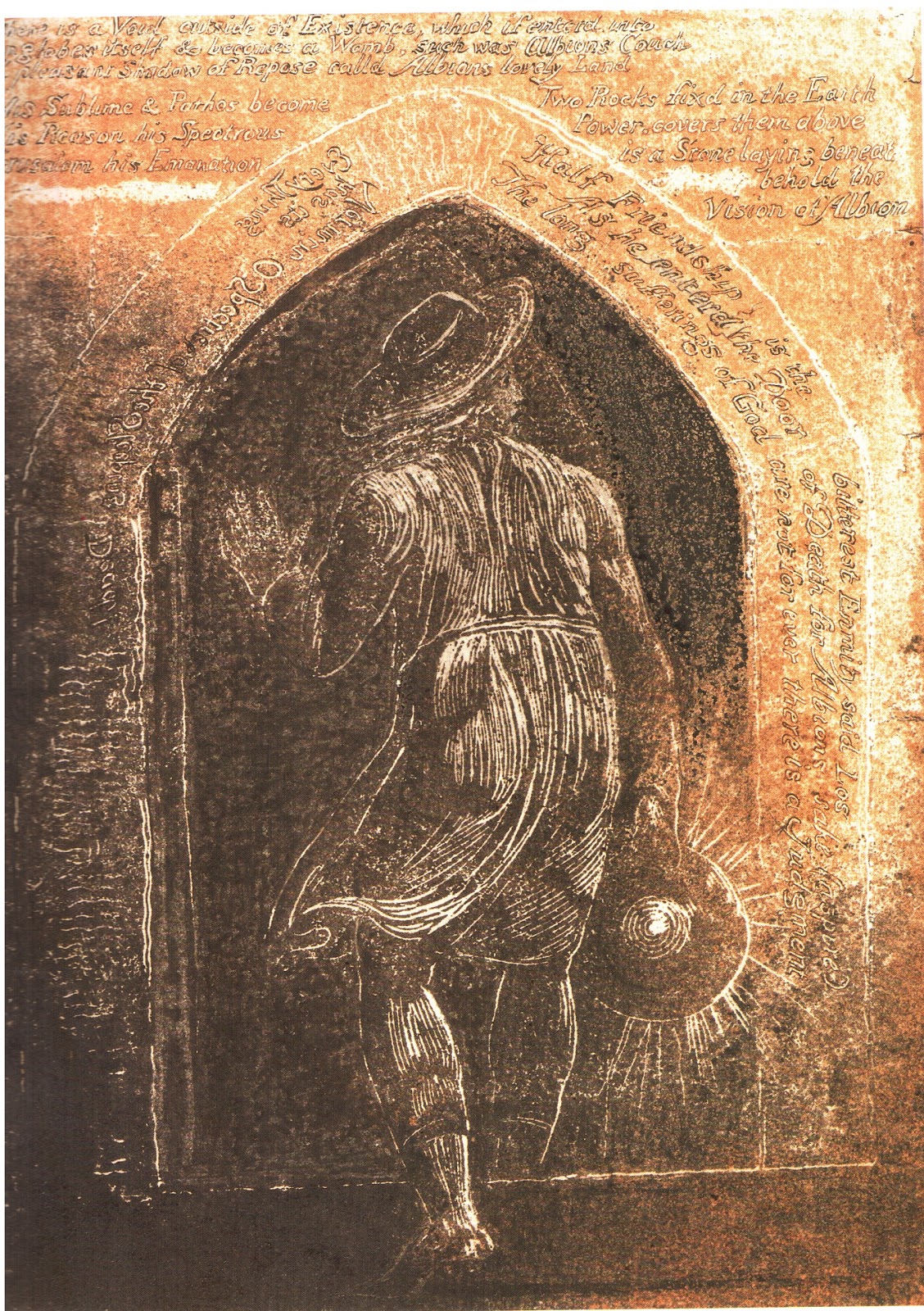
Jerusalem, Plate 1, (E 144)
[Above the archway:]

"There is a Void, outside of Existence, which if enterd into
Englobes itself & becomes a Womb, such was Albions Couch
A pleasant Shadow of Repose calld Albions lovely Land

His Sublime & Pathos become Two Rocks fixd in the Earth
His Reason his Spectrous Power, covers them above                
Jerusalem his Emanation is a Stone laying beneath
O [Albion behold Pitying] behold the Vision of Albion 

[On right side of archway:]

Half Friendship is the bitterest Enmity said Los
As he enterd the Door of Death for Albions sake Inspired
The long sufferings of God are not for ever there is a Judgment" 
Four Zoas, Night VII, Page 87, (E 369) 
"Los trembling answerd Now I feel the weight of stern repentance
Tremble not so my Enitharmon at the awful gates    
Of thy poor broken Heart I see thee like a shadow withering
As on the outside of Existence but look! behold! take comfort!
Turn inwardly thine Eyes & there behold the Lamb of God
Clothed in Luvahs robes of blood descending to redeem"

Existence to Blake is the life Eternal. What we usually call life is Eternal Death. The realization the we live eternally through Jesus, the Imagination, is our entry into Eternity. Eternal Death is consumed by Eternal Life because it has no eternal existence.  

Carl Jung Wounded Healer of the Soul, by Claire Dunne,  Page 178

"Have your congregation understood that they must close their eyes to the traditional teachings and go through the darkness of their own souls and set aside everything in order to become that which every individual bears in himself as his individual task, and that no one can take this burden from him?" Quote from letter of Carl Jung 


Thursday, June 2, 2022

BEHOLD THY MOTHER

Behold Thy Mother

In the Gospel of John we read that standing near the cross were the mother of Jesus and her sister, Mary the wife of Cleophas, and Mary Magdalene. Also present was a disciple. Jesus spoke to his mother saying, "Woman, behold thy son." Then looking to his disciple he said, "behold thy mother." Thus was a new bond created between the mother of Jesus and the disciple of Jesus. As Jesus was leaving his earthly life he acknowledged that a transformation in relationships was taking place. Those who had been dear to his in this life were becoming related in the Eternal life. Family was expanding. 

John 19

[25] Now there stood by the cross of Jesus his mother, and his mother's sister, Mary the wife of Cleophas, and Mary Magdalene.
[26] When Jesus therefore saw his mother, and the disciple standing by, whom he loved, he saith unto his mother, Woman, behold thy son!
[27] Then saith he to the disciple, Behold thy mother! And from that hour that disciple took her unto his own home.

As a young man entering puberty Jesus had visited Jerusalem with his parents for the Passover celebration. Jesus took on an adult role when without the knowledge of his parents, he stayed behind and entered into a discussion with the teachers in the temple.

Luke 2

[39] And when they had performed all things according to the law of the Lord, they returned into Galilee, to their own city Nazareth.
[40] And the child grew, and waxed strong in spirit, filled with wisdom: and the grace of God was upon him.
[41] Now his parents went to Jerusalem every year at the feast of the passover.
[42] And when he was twelve years old, they went up to Jerusalem after the custom of the feast.
[43] And when they had fulfilled the days, as they returned, the child Jesus tarried behind in Jerusalem; and Joseph and his mother knew not of it.
[44] But they, supposing him to have been in the company, went a day's journey; and they sought him among their kinsfolk and acquaintance.
[45] And when they found him not, they turned back again to Jerusalem, seeking him.
[46] And it came to pass, that after three days they found him in the temple, sitting in the midst of the doctors, both hearing them, and asking them questions.
[47] And all that heard him were astonished at his understanding and answers.
[48] And when they saw him, they were amazed: and his mother said unto him, Son, why hast thou thus dealt with us? behold, thy father and I have sought thee sorrowing.
[49] And he said unto them, How is it that ye sought me? wist ye not that I must be about my Father's business?
[50] And they understood not the saying which he spake unto them.
[51] And he went down with them, and came to Nazareth, and was subject unto them: but his mother kept all these sayings in her heart.
[52] And Jesus increased in wisdom and stature, and in favour with God and man.

In the Gospel of John we read of another tense situation between Jesus and his mother. But, never the less, the mother of Jesus was closely associated with the group who followed the ministry of Jesus.

John 2

[1] And the third day there was a marriage in Cana of Galilee; and the mother of Jesus was there:
[2] And both Jesus was called, and his disciples, to the marriage.
[3] And when they wanted wine, the mother of Jesus saith unto him, They have no wine.
[4] Jesus saith unto her, Woman, what have I to do with thee? mine hour is not yet come.
[5] His mother saith unto the servants, Whatsoever he saith unto you, do it.
[6] And there were set there six waterpots of stone, after the manner of the purifying of the Jews, containing two or three firkins apiece.
[7] Jesus saith unto them, Fill the waterpots with water. And they filled them up to the brim.
[8] And he saith unto them, Draw out now, and bear unto the governor of the feast. And they bare it.
[9] When the ruler of the feast had tasted the water that was made wine, and knew not whence it was: (but the servants which drew the water knew;) the governor of the feast called the bridegroom,
[10] And saith unto him, Every man at the beginning doth set forth good wine; and when men have well drunk, then that which is worse: but thou hast kept the good wine until now.
[11] This beginning of miracles did Jesus in Cana of Galilee, and manifested forth his glory; and his disciples believed on him.
[12] After this he went down to Capernaum, he, and his mother, and his brethren, and his disciples: and they continued there not many days.
[13] And the Jews' passover was at hand, and Jesus went up to Jerusalem,

A spiritual community had formed during the life of Jesus. It became the nucleus of the young church which developed after his death. The words spoken to his mother and his disciple before he acknowledged that his earthly life was finished were a way of signaling the transformation which was being enacted.

Phillips Translation

19:25-27 - While the soldiers were doing this, Jesus' mother was standing near the cross with her sister, and with them Mary, the wife of Clopas and Mary of Magdala. Jesus saw his mother and the disciple whom he loved standing by her side, and said to her, "Look, there is your son!" And then he said to the disciple, "And there is your mother!" And from that time the disciple took Mary into his own home.

19:28 - After this, Jesus realizing that everything was now completed said (fulfilling the saying of scripture), "I am thirsty."

19:29-30 - There was a bowl of sour wine standing there. So they soaked a sponge in the wine, put it on a spear, and pushed it up towards his mouth. When Jesus had taken it, he cried, "It is finished!" His head fell forward, and he died.

Luke 23

[43] And Jesus said unto him, Verily I say unto thee, To day shalt thou be with me in paradise.
[44] And it was about the sixth hour, and there was a darkness over all the earth until the ninth hour.
[45] And the sun was darkened, and the veil of the temple was rent in the midst.
[46] And when Jesus had cried with a loud voice, he said, Father, into thy hands I commend my spirit: and having said thus, he gave up the ghost.


Jerusalem, Plate 33 [37], (E 179) 
"Turning from Universal Love petrific as he [Albion] went,
His cold against the warmth of Eden rag'd with loud
Thunders of deadly war (the fever of the human soul)
Fires and clouds of rolling smoke! but mild the Saviour follow'd him,   
Displaying the Eternal Vision! the Divine Similitude!
In loves and tears of brothers, sisters, sons, fathers, and friends
Which if Man ceases to behold, he ceases to exist:

Saying. Albion! Our wars are wars of life, & wounds of love,
With intellectual spears, & long winged arrows of thought:       
Mutual in one anothers love and wrath all renewing
We live as One Man; for contracting our infinite senses
We behold multitude; or expanding: we behold as one,
As One Man all the Universal Family; and that One Man
We call Jesus the Christ: and he in us, and we in him,        
Live in perfect harmony in Eden the land of life,
Giving, recieving, and forgiving each others trespasses.
He is the Good shepherd, he is the Lord and master:
He is the Shepherd of Albion, he is all in all,
In Eden: in the garden of God: and in heavenly Jerusalem.        
If we have offended, forgive us, take not vengeance against us.

Thus speaking; the Divine Family follow Albion:
I see them in the Vision of God upon my pleasant valleys."

Monday, May 30, 2022

CASTING LOTS

To maintain the continuity of the images with which Blake illustrated the Passion Week for Thomas Butts, I include this post previously published in 2013 and 2020.   

Courtesy of wiki commons
Original in Fitzwilliam Museum
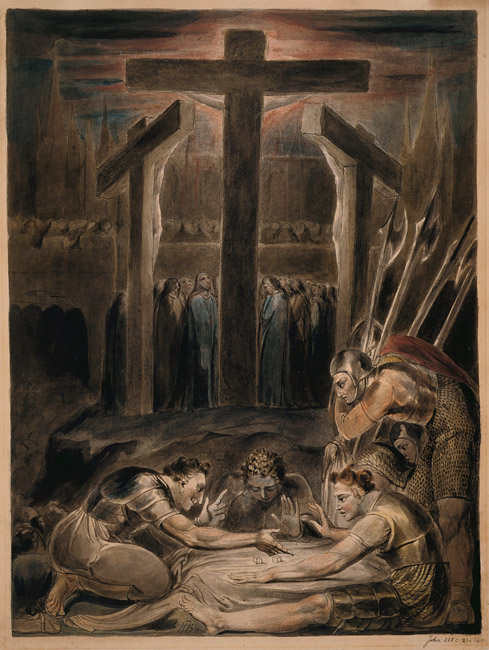
The Soldiers Casting Lots for Christ's Garments

Matthew 27
[26] Then released he Barabbas unto them: and when he had scourged Jesus, he delivered him to be crucified.
[27] Then the soldiers of the governor took Jesus into the common hall, and gathered unto him the whole band of soldiers.
[28] And they stripped him, and put on him a scarlet robe.
[29] And when they had platted a crown of thorns, they put it upon his head, and a reed in his right hand: and they bowed the knee before him, and mocked him, saying, Hail, King of the Jews!
[30] And they spit upon him, and took the reed, and smote him on the head.
[31] And after that they had mocked him, they took the robe off from him, and put his own raiment on him, and led him away to crucify him.
[32] And as they came out, they found a man of Cyrene, Simon by name: him they compelled to bear his cross.
[33] And when they were come unto a place called Golgotha, that is to say, a place of a skull,
[34] They gave him vinegar to drink mingled with gall: and when he had tasted thereof, he would not drink.
[35] And they crucified him, and parted his garments, casting lots: that it might be fulfilled which was spoken by the prophet, They parted my garments among them, and upon my vesture did they cast lots.

Psalms 22
[16] For dogs have compassed me: the assembly of the wicked have inclosed me: they pierced my hands and my feet.
[17] I may tell all my bones: they look and stare upon me.
[18] They part my garments among them, and cast lots upon my vesture.
[19] But be not thou far from me, O LORD: O my strength, haste thee to help me.
[20] Deliver my soul from the sword; my darling from the power of the dog.
[21] Save me from the lion's mouth: for thou hast heard me from the horns of the unicorns.
[22] I will declare thy name unto my brethren: in the midst of the congregation will I praise thee.

In this picture the foreground is occupied by the Roman soldiers whose duty is to carry out the execution of Jesus as ordered by the political and religious authorities. The inscription on the cross identifying Jesus as King of the Jews was abbreviated in three languages: in the language of the military/political authority, in the language of the religious authority and in a common spoken language of the people. Blake includes three groups of people in his image, the soldiers in the foreground, the people who supported Jesus around the foot of the cross, and a shadowy group in the background who followed the religious leaders in rejecting Jesus.
 
Blake uses this picture in which the crucified Jesus is not himself visible, to emphasize the reaction that individuals make to the treatment that Jesus received from those who had the opportunity of watching him, hearing him and interacting with him. The prominence of the soldiers remind us of Blake's opposition to war and empire. Their activity of casting lots reminds us of his belief that choices should not be left to chance.

The image in the Blake Archive provides greater detail. Click on image to enlarge.

Jerusalem, Plate 60, (E 211)
"But the Divine Lamb stood beside Jerusalem. oft she saw          
The lineaments Divine & oft the Voice heard, & oft she said:

O Lord & Saviour, have the Gods of the Heathen pierced thee?
Or hast thou been pierced in the House of thy Friends?
Art thou alive! & livest thou for-evermore? or art thou
Not: but a delusive shadow, a thought that liveth not.  
Babel mocks saying, there is no God nor Son of God
That thou O Human Imagination, O Divine Body art all
A delusion. but I know thee O Lord when thou arisest upon
My weary eyes even in this dungeon & this iron mill.
The Stars of Albion cruel rise; thou bindest to sweet influences:
For thou also sufferest with me altho I behold thee not;
And altho I sin & blaspheme thy holy name, thou pitiest me;
Because thou knowest I am deluded by the turning mills.
And by these visions of pity & love because of Albions death.

Thus spake Jerusalem, & thus the Divine Voice replied.           

Mild Shade of Man, pitiest thou these Visions of terror & woe!
Give forth thy pity & love. fear not! lo I am with thee always.
Only believe in me that I have power to raise from death
Thy Brother who Sleepeth in Albion: fear not trembling Shade

PLATE 61
Behold: in the Visions of Elohim Jehovah, behold Joseph & Mary   
And be comforted O Jerusalem in the Visions of Jehovah Elohim" 
 

Sunday, May 29, 2022

TWO THIEVES

Harvard Art Museum
Christ Crucified Between the Two Thieves ("Lord Remember Me")

Between two thieves or malefactors was Jesus crucified, but the outcome for each was different. Blake pictures the man on the right of Jesus as acknowledging that he had broken the law. The thief on the left went along with the casual observers in mocking Jesus' teachings of salvation. With a compassionate expression Jesus looks into the eyes of the man who understands that Jesus came into the world to save sinners such as he. 

Blake focuses on three themes in this image and the scripture it illustrates. First that Jesus chose to be among the reprobates, those who knew they were in need of redemption because they had failed in some way to measure up. Second that the way to mend the broken is through forgiveness, not through punishment. Third is that the gift of salvation is not earned, it comes through believing that grace will set us free and make us whole. Salvation is a gift but it was rejected by the second thief, by the worldly crowd, and by the religious authorities who demanded proof.

Matthew 27

 [38] Then were there two thieves crucified with him, one on the right hand, and another on the left.
[39] And they that passed by reviled him, wagging their heads,
[40] And saying, Thou that destroyest the temple, and buildest it in three days, save thyself. If thou be the Son of God, come down from the cross.
[41] Likewise also the chief priests mocking him, with the scribes and elders, said,
[42] He saved others; himself he cannot save. If he be the King of Israel, let him now come down from the cross, and we will believe him.
[43] He trusted in God; let him deliver him now, if he will have him: for he said, I am the Son of God.
[44] The thieves also, which were crucified with him, cast the same in his teeth.

Luke 23

[39] And one of the malefactors which were hanged railed on him, saying, If thou be Christ, save thyself and us.
[40] But the other answering rebuked him, saying, Dost not thou fear God, seeing thou art in the same condemnation?
[41] And we indeed justly; for we receive the due reward of our deeds: but this man hath done nothing amiss.
[42] And he said unto Jesus, Lord, remember me when thou comest into thy kingdom.
[43] And Jesus said unto him, Verily I say unto thee, To day shalt thou be with me in paradise.
[44] And it was about the sixth hour, and there was a darkness over all the earth until the ninth hour. 

First Timothy 1

[15] This is a faithful saying, and worthy of all acceptation, that Christ Jesus came into the world to save sinners; of whom I am chief.  

John 3

  1. [17] For God sent not his Son into the world to condemn the world; but that the world through him might be saved.
  2. [18] He that believeth on him is not condemned: but he that believeth not is condemned already, because he hath not believed in the name of the only begotten Son of God.
  3. [19] And this is the condemnation, that light is come into the world, and men loved darkness rather than light, because their deeds were evil.

Matthew 9

[11] And when the Pharisees saw it, they said unto his disciples, Why eateth your Master with publicans and sinners?
[12] But when Jesus heard that, he said unto them, They that be whole need not a physician, but they that are sick.
[13] But go ye and learn what that meaneth, I will have mercy, and not sacrifice: for I am not come to call the righteous, but sinners to repentance.

Isaiah 53

[1] Who hath believed our report? and to whom is the arm of the LORD revealed?
[2] For he shall grow up before him as a tender plant, and as a root out of a dry ground: he hath no form nor comeliness; and when we shall see him, there is no beauty that we should desire him.
[3] He is despised and rejected of men; a man of sorrows, and acquainted with grief: and we hid as it were our faces from him; he was despised, and we esteemed him not.
[4] Surely he hath borne our griefs, and carried our sorrows: yet we did esteem him stricken, smitten of God, and afflicted.
[5] But he was wounded for our transgressions, he was bruised for our iniquities: the chastisement of our peace was upon him; and with his stripes we are healed.
[6] All we like sheep have gone astray; we have turned every one to his own way; and the LORD hath laid on him the iniquity of us all.
[7] He was oppressed, and he was afflicted, yet he opened not his mouth: he is brought as a lamb to the slaughter, and as a sheep before her shearers is dumb, so he openeth not his mouth.
[8] He was taken from prison and from judgment: and who shall declare his generation? for he was cut off out of the land of the living: for the transgression of my people was he stricken.


Milton, Plate 13 [14], (E 107)

"Around the Lamb, a Female Tabernacle woven in Cathedrons Looms
He died as a Reprobate. he was Punish'd as a Transgressor!
Glory! Glory! Glory! to the Holy Lamb of God
I touch the heavens as an instrument to glorify the Lord!

The Elect shall meet the Redeem'd. on Albions rocks they shall meet      
Astonish'd at the Transgressor, in him beholding the Saviour."
Milton, Plate 24 [26], (E 122)
"The Elect is one Class: You
Shall bind them separate: they cannot Believe in Eternal Life
Except by Miracle & a New Birth. The other two Classes;
The Reprobate who never cease to Believe, and the Redeemd,       
Who live in doubts & fears perpetually tormented by the Elect" 
Four Zoas, Night IX, Page 109 [105], (E 388)
"The Lamb of God stood before Satan opposite    
In Entuthon Benithon in the shadows of torments & woe  
Upon the heights of Amalek taking refuge in his arms      
The Victims fled from punishment for all his words were peace

Urizen calld together the Synagogue of Satan in dire Sanhedrim 
To Judge the Lamb of God to Death as a murderer & robber
As it is written he was numberd among the transgressors"
 Jerusalem, Plate 3, (E 145)
  "The Spirit of Jesus is continual forgiveness of Sin: he who
waits to be righteous before he enters into the Saviours kingdom,
the Divine Body; will never enter there.  I am perhaps the most
sinful of men! I pretend not to holiness! yet I pretend to love,
to see, to converse with daily, as man with man, & the more to
have an interest in the Friend of Sinners." 
Jerusalem, Plate 60, (E 211)
"For thou also sufferest with me altho I behold thee not;
And altho I sin & blaspheme thy holy name, thou pitiest me;
Because thou knowest I am deluded by the turning mills.
And by these visions of pity & love because of Albions death.

Thus spake Jerusalem, & thus the Divine Voice replied.           
Mild Shade of Man, pitiest thou these Visions of terror & woe!
Give forth thy pity & love. fear not! lo I am with thee always.
Only believe in me that I have power to raise from death
Thy Brother who Sleepeth in Albion: fear not trembling Shade" 
Jerusalem, Plate 63, (E 213)
"Jesus replied. I am the Resurrection & the Life.
I Die & pass the limits of possibility, as it appears
To individual perception. Luvah must be Created                  
And Vala; for I cannot leave them in the gnawing Grave.
But will prepare a way for my banished-ones to return
Come now with me into the villages. walk thro all the cities.
Tho thou art taken to prison & judgment, starved in the streets
I will command the cloud to give thee food & the hard rock       
To flow with milk & wine, tho thou seest me not a season
Even a long season & a hard journey & a howling wilderness!
Tho Valas cloud hide thee & Luvahs fires follow thee!
Only believe & trust in me, Lo. I am always with thee!"


Wednesday, May 25, 2022

NAILED TO THE CROSS


Inscriptions from Blake Archive

“INRI” (on the wood above Christ’s head) stands for “Iesus Nazarenus Rex Iudaeorum” (“Jesus of Nazareth King of the Jews”).

Morgan Museum
Christ Nailed to the Cross: The Third Hour

This image was shown at the Morgan Museum in the exhibition William Blake's World: "A New Heaven Is Begun". A comment on the picture stated, "This highly finished watercolor is one of several drawings Blake made to depict the Passion of Christ for Thomas Butts's 1799 commission to illustrate the Bible. The Passion cycle as a whole is distinguished by the cumulative emotional power derived from the repetition of Christ's form at the center of each sheet." 

To a large extent William and Catherine survived on commissions from Thomas Butts, an ordinary man with an extraordinary commitment to supporting the artistic creations of William Blake. 

On Page 86 of William Blake, Tate Exhibition, Introduction by Martin Butlin, is a statement about the Biblical Paintings which Thomas Butts commissioned from William Blake:

"The small tempera paintings of Biblical subjects were followed by an even larger number of Biblical subjects painted in watercolor, also painted for Butts, numbering over eighty in all. Some we dated 1800 while others were dated or documented 1803 and 1805, a few dated 1806 and 1809, seem to be afterthoughts, signed in a different form..."

Blake was interpreting the passages rather than illustrating the incidents that he pictured. In Christ Nailed to the Cross Blake included details from the Biblical accounts and added reactions of the people involved. First we notice that Jesus does not resist the procedure which would take his life. His facial expression is of calm and compassion rather than of fear and hatred. Although the nails have not yet been driven into his hands and feet, he accepts his position with humble acquiescence.

Above his head have been placed the words which led to his conviction - King of the Jews. The Roman government could not recognize another king besides Caesar. 

Blake included the chief priest holding the sign which Pilate ordered be placed on the cross. The sign displays Pilate's ironic words and not the words which the priests demanded which would have subjected Jesus to the accusation of blasphemy. 

The first of the people who surround the cross may represent the crowd who wanted a spectacle; the second the religious authorities to whom Jesus was a threat; the third may represent some Jews who were willing to go along with the majority; and finally we observe the supporters of Jesus who were afraid to speak up. Only a couple of people seem visibly troubled about what they saw happening. 

Mark 15

[20] And when they had mocked him, they took off the purple from him, and put his own clothes on him, and led him out to crucify him.
[21] And they compel one Simon a Cyrenian, who passed by, coming out of the country, the father of Alexander and Rufus, to bear his cross.
[22] And they bring him unto the place Golgotha, which is, being interpreted, The place of a skull.
[23] And they gave him to drink wine mingled with myrrh: but he received it not.
[24] And when they had crucified him, they parted his garments, casting lots upon them, what every man should take.
[25] And it was the third hour, and they crucified him.
[26] And the superscription of his accusation was written over, THE KING OF THE JEWS.

John 18

[29] Pilate then went out unto them, and said, What accusation bring ye against this man?
[30] They answered and said unto him, If he were not a malefactor, we would not have delivered him up unto thee.
[31] Then said Pilate unto them, Take ye him, and judge him according to your law. The Jews therefore said unto him, It is not lawful for us to put any man to death:
[32] That the saying of Jesus might be fulfilled, which he spake, signifying what death he should die.
[33] Then Pilate entered into the judgment hall again, and called Jesus, and said unto him, Art thou the King of the Jews?
[34] Jesus answered him, Sayest thou this thing of thyself, or did others tell it thee of me?
[35] Pilate answered, Am I a Jew? Thine own nation and the chief priests have delivered thee unto me: what hast thou done?
[36] Jesus answered, My kingdom is not of this world: if my kingdom were of this world, then would my servants fight, that I should not be delivered to the Jews: but now is my kingdom not from hence.
[37] Pilate therefore said unto him, Art thou a king then? Jesus answered, Thou sayest that I am a king. To this end was I born, and for this cause came I into the world, that I should bear witness unto the truth. Every one that is of the truth heareth my voice.
[38] Pilate saith unto him, What is truth? And when he had said this, he went out again unto the Jews, and saith unto them, I find in him no fault at all.
[39] But ye have a custom, that I should release unto you one at the passover: will ye therefore that I release unto you the King of the Jews?
[40] Then cried they all again, saying, Not this man, but Barabbas.
Now Barabbas was a robber.

John 19

[19] And Pilate wrote a title, and put it on the cross. And the writing was, JESUS OF NAZARETH THE KING OF THE JEWS.
[20] This title then read many of the Jews: for the place where Jesus was crucified was nigh to the city: and it was written in Hebrew, and Greek, and Latin.
[21] Then said the chief priests of the Jews to Pilate, Write not, The King of the Jews; but that he said, I am King of the Jews.
[22] Pilate answered, What I have written I have written.


Notes to The Everlasting Gospel, Page 3, (E 876)

 "It was when Jesus said to Me
     Thy Sins are all forgiven thee
     The Christian trumpets loud proclaim
     Thro all the World in Jesus name
     Mutual forgiveness of each Vice
     And oped the Gates of Paradise
     The Moral Virtues in Great fear
     Formed the Cross & Nails & Spear
     And the Accuser standing by
     Cried out Crucify Crucify
     Our Moral Virtues neer can be
     Nor Warlike pomp & Majesty
     For Moral Virtues all begin
     In the Accusations of Sin"


Sunday, May 22, 2022

MATTHEW

Cleveland Museum of Art

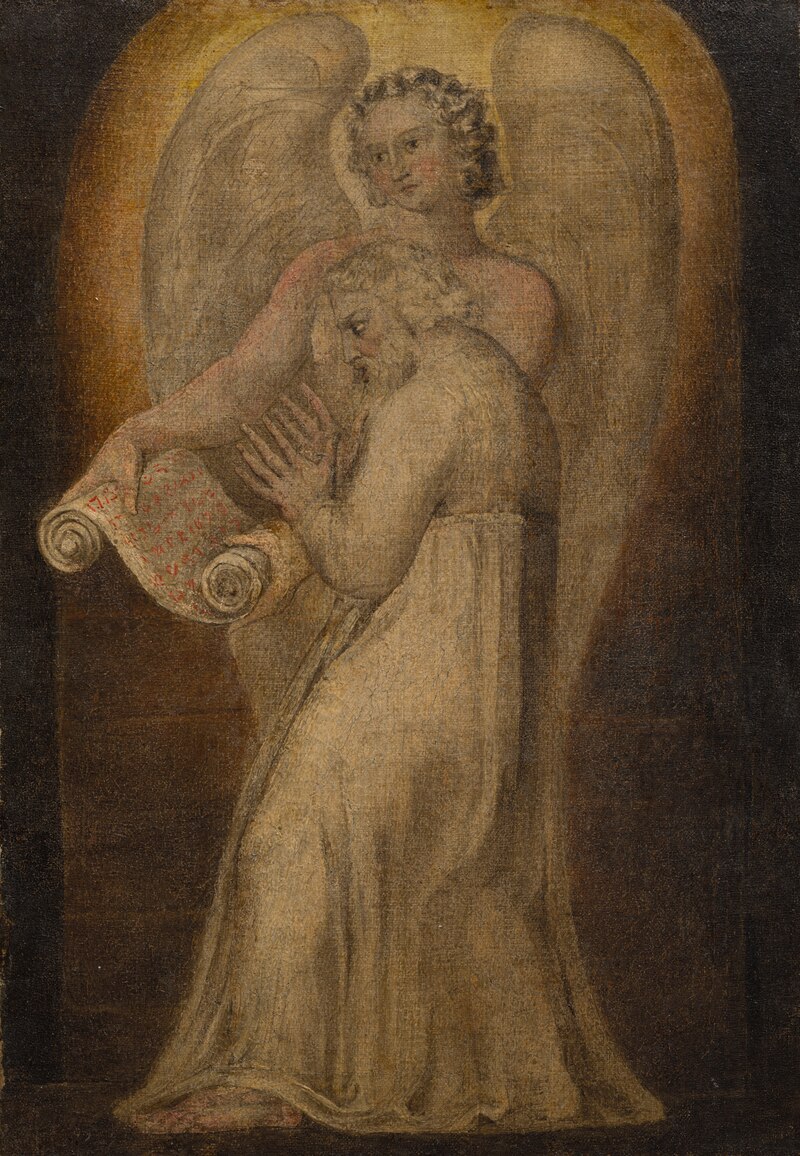
 In Blake's picture St Matthew is composing his Gospel with the oversight of an angel. They are consulting a scroll of the Hebrew bible seeking the passages which apply to the coming of the messiah. Matthew was particularly interested in writing a gospel which would speak to the Jewish Christians in Palestine and Syria whom he was teaching. Blake captured the struggle Matthew experienced when linking the revelations of the Hebrew bible with God's message which came through the life, death, and resurrection of Jesus.

Annotations to Lavater, (E 594)

   "Man is a twofold being. one part capable of evil & the other
capable of good   that which is capable of good is not also
capable of evil.  but that which is capable of evil is also
capable of good.  this aphorism seems to consider man as simple &
yet capable of evil. now both evil & good cannot exist in a 
simple being. for thus 2 contraries would. spring from one
essence which is impossible. but if man is considerd as only
evil. & god only good. how then is regeneration effected which
turns the evil to good. by casting out the evil. by the good. 
See Matthew XII. Ch. 26. 27. 28. 29 vs" 

Matthew 12
[26] And if Satan cast out Satan, he is divided against himself; how shall then his kingdom stand?
[27] And if I by Beelzebub cast out devils, by whom do your children cast them out? therefore they shall be your judges.
[28] But if I cast out devils by the Spirit of God, then the kingdom of God is come unto you.
[29] Or else how can one enter into a strong man's house, and spoil his goods, except he first bind the strong man? and then he will spoil his house. 

Phillips Translation
Jesus knew what they were thinking and said to them, “Any kingdom divided against itself is bound to collapse, and no town or household divided against itself can last for long. If it is Satan who is expelling Satan, then he is divided against himself—so how do you suppose that his kingdom can continue? And if I expel devils because I am an ally of Beelzebub, what alliance do your sons make when they do the same thing? They can settle that question for you! But if I am expelling devils by the Spirit of God, then the kingdom of God has swept over you unawares! How do you suppose anyone could get into a strong man’s house and steal his property unless he first tied up the strong man? But if he did that, he could ransack his whole house.
 

The First Christians


Friday, April 29, 2022

FIRST VISION

First posted Feb 2019
 
British Museum
Small Book of Designs
From Marriage of Heaven and Hell

 Milton Klonsky's book William Blake, The Seer and His Visions, published in 1977, approaches the study of Blake from his own unique position as do each of us. Klonsky was the product of his time and his environment and wrote with the zeal of one immersed in the dawning of a new age.

W. C. Bamberger on the blog named Zoamorphosis tells us that:

"Klonsky was a classic 'Village Intellectual' who set out to know everything interesting there was to know—about drugs, drink, poetry, politics, and most memorably, the great poet artist William Blake. And, further, to combine all this in unexpected ways, give it some topspin, and serve it back with style."

Klonsky began his book with a striking account of his 'first and only' use of LSD. Were it not for the role that Blake's poetry played in that experience it would not have had such a profound impact on Klonsky.
On page 8 of Klonsky's book he relates the consequences of his 'trip' as opening him to a new way of seeing and an alteration of his awareness of time and eternity:  

"My 'trip', I knew, would last from five to six hours...but suppose it were to take fifty years, sixty, a whole lifetime? What then? As if existence itself were a more subtly corrosive kind of acid, consuming and flaying us, almost unawares, from within and without, to whose pangs we gradually become accustomed until the end. It occurred to me then, as I lurched and plodded off the beach, that this is what Blake must have meant when he wrote: 'Time is the mercy of Eternity; without Times swiftness/Which is the swiftest of all things: all were eternal torment':
...
"Looking back now I can recall neither visions nor apparitions, disembodied genii nor spirits out of the vasty deep - unless, perhaps, that of Blake himself, whom I invoked to preside over the scene. What I saw instead ('As the Eye,' said Blake, 'such the Object') was the world as I had always conceived it to be, the only 'real' reality of matter reduced to minuter and minuter particles in a space-time expanding to infinity-eternity, no more no less,  according to the scientific dispensation of Newton & Einstein, but which I had never perceived so 'im-mediativtely' and 'into-it-ively' until then."

These are the passages from Blake which were incorporated in Klonsky's intense LSD experience:

Marriage of Heaven and Hell, Plate 14, (E 39)
 "If the doors of perception were cleansed every thing would
appear  to man as it is: infinite.
   For man has closed himself up, till he sees all things thro'
narrow chinks of his cavern."

Songs of Experience, Introduction, (E 18)
"Turn away no more:
Why wilt thou turn away
The starry floor
The watry shore
Is giv'n thee till the break of day."

Auguries of Innocence, (E 490)
"To see a World in a Grain of Sand
And a Heaven in a Wild Flower
Hold Infinity in the palm of your hand
And Eternity in an hour"

Milton, Plate 17, (E 110) 
"The Mundane Shell, is a vast Concave Earth: an immense
Hardend shadow of all things upon our Vegetated Earth
Enlarg'd into dimension & deform'd into indefinite space,
In Twenty-seven Heavens and all their Hells; with Chaos
And Ancient Night; & Purgatory. It is a cavernous Earth
Of labyrinthine intricacy,"

Milton, Plate 24 [26], (E 121)
"Time is the mercy of Eternity; without Times swiftness
Which is the swiftest of all things: all were eternal torment:"  
                                   _________________
In addition W. C. Bamberger has this to say about Klonsky's  involvement with Blake:
"Blake intoxicates Klonsky, helps him look at the world with sustained energy, and from new perspectives - with the added benefit of avoiding the damaging effects of less literary and artistic drugs."

"Such perception, Klonsky points out, 'must be personal. . .  [Has] to be seen by himself alone. There can be no other eyewitness.'"

Letters, To Rev Trusler, (E 701)
But I
hope that none of my Designs will be destitute of Infinite
Particulars which will present themselves to the Contemplator. 
And tho I call them Mine   I know that they are not Mine being of
the same opinion with Milton when he says That the Muse visits
his Slumbers & awakes & governs his Song when Morn purples The
East. & being also in the predicament of that prophet who says  I
cannot go beyond the command of the Lord to speak good or bad 

Letters, To Thomas Butts, (E 712)
"To my Friend Butts I write
     My first Vision of Light
     On the yellow sands sitting
     The Sun was Emitting
     His Glorious beams
     From Heavens high Streams
     Over Sea over Land
     My Eyes did Expand
     Into regions of air
     Away from all Care
     Into regions of fire
     Remote from Desire
     The Light of the Morning
     Heavens Mountains adorning
     In particles bright
     The jewels of Light
     Distinct shone & clear--
     Amazd & in fear
     I each particle gazed
     Astonishd Amazed
     For each was a Man
     Human formd.  Swift I ran
     For they beckond to me
     Remote by the Sea
     Saying.  Each grain of Sand
     Every Stone on the Land
     Each rock & each hill
     Each fountain & rill
     Each herb & each tree
     Mountain hill Earth & Sea
     Cloud Meteor & Star
     Are Men Seen Afar"