|
| Illustrations to the Book of Job
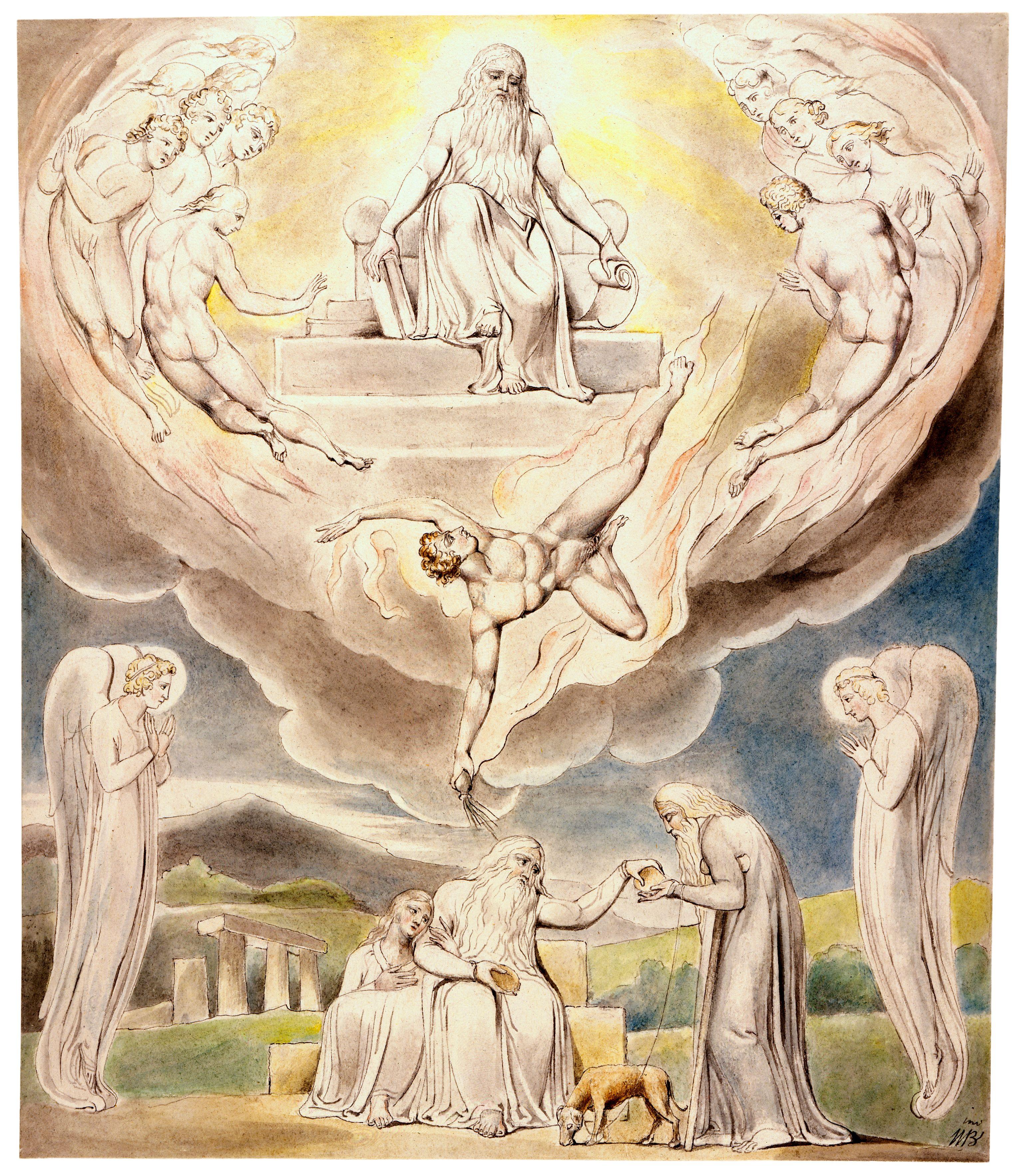
Linnell Set Image 17 Now my Eye seeth thee Job 42 [1] Then Job answered the LORD, and said, [2] I know that thou canst do every thing, and that no thought can be withholden from thee. [3] Who is he that hideth counsel without knowledge? therefore have I uttered that I understood not; things too wonderful for me, which I knew not. [4] Hear, I beseech thee, and I will speak: I will demand of thee, and declare thou unto me. [5] I have heard of thee by the hearing of the ear: but now mine eye seeth thee. [6] Wherefore I abhor myself, and repent in dust and ashes. From Larry Clayton's Ram Horn'd with Gold, Chapter 6 - Bible Job and Jerusalem If Ezekiel and Revelation are the most symbolic books of the Bible, Job is the most poetic and indirect. It's significance lies not in its theological statements, but in the questions it raises. The primary question is how or why does a good and all powerful God permit untold suffering to his most faithful servant. The gospel of course provides the definitive answer, but an answer grasped and accepted only by those committed to it as final truth. The modern prophet, C.G.Jung, in his Answer to Job, made some comments about God (the Hebrew God consciousness) very reminiscent of those which fill Blake's earlier prophecies. By the time Blake got around to his recreation of Job he had less interest in commenting on God than in retelling the old, old story. Job, the most indirect book of the Bible, proved an ideal vehicle for this, Blake's last and plainest statement of the truth of his life. The biblical Job is presented as a good man whom God allows the devil to torment. Blake presents him as a moral but self-centered and self-righteous man. He prays for his children, but what about other people's children? Is he praying for God to favor his children over others? In no uncertain terms, writing in another work, Blake let us know what he thought of that kind of goodness: "It this thy soft Family-Love, Thy cruel Patriarchal pride, Planting thy Family alone, Destroying all the World beside?" (Jerusalem, 27.79; Erdman 173) The point is that it's okay to pray for your children, but be careful how you pray for them. If your prayer for them to be first amounts to a curse on their fellows--to be second or last--that curse will fall upon your children's heads, just as it did upon Job's. Job's self-centered prayers and his left handed charity (See Plate 5 of the Job series) won him no reward but in fact delivered him into the hands of his Selfhood (Satan). Good Christians take warning: Blake's Job is the same rich man Jesus spoke about, and he fills the pews (and too often the pulpit) of our churches. Here once again, in the twilight of his life, we find Blake dissenting from conventional religion, but now, unlike some of his youthful protests, his dissent completely agrees with the earlier dissent of the Prophet of Galilee: "Many that are first shall be last."
So much of our goodness is rotten; let's face it. The image of the boil ridden man haunted Blake and appears frequently in his prophecies. In his hands it became a vivid symbol of the general fallenness of man. Job's boils represent the physical misery of the fallen state of nature. Blake's Job, like the O.T. Job, represents Man. His adventures are a paradigm of the destiny of Man: he falls, but he is redeemed. The importance of Job for the biblical writer as well as for our poet is to make us poignantly aware once again that we're not okay until we have experienced grace. Job's goodness got him nowhere, but his faith opened him to redemption. Now look at Job's God; he resembles Job. Once again Blake reminds us that man's God is an image, a construct of his mind. In the beginning Job saw God as a solid moralist like himself. In the dark night his God turned bad, but in the end gave way to a new and better image. The whole thing foreshadows Incarnation, Crucifixion, and Resurrection. If we could learn that our experience of God comes only through our image of him, then we would be less prone to attempt (wickedly) to impose our God on others. Then we might experience a loving rather than a coercive God, and the others, not feeling compelled, might be attracted, like Job's friends are in the end. Blake's Job is a beautiful series of pictures, a perfect wedding of exquisite art and lofty faith, Blake at his plainest and best.
In 'Jerusalem', his most mature poem, Blake's basic technique is to superimpose bodily the biblical scene, the biblical story, the biblical truth upon the history and geography of England, and of the rest of the world as well. Understood in its literal sense 'Jerusalem', like the book of Revelation, is grotesque in the extreme. The reader will turn away in despair or derision unless he succeeds in going beyond the literal meaning and learns to see through rather than with the eye. In reality the biblical truth is just as relevant to 18th Century England as it is to first century (or any century) Palestine. The same spiritual events continue to unfold today that Ezekiel, John and the others saw and described in their day. The same choices are to be made by 18th Century Britons (or 20th Century Americans!) as were made by first (or any) century Palestinians, and these choices have the same consequences. Truth is spiritual and timeless; the passing scene is only a shadow of the eternal reality.
Blake's grotesque juxtaposition of Canaan with England may conceivably shock the reader into an understanding of these profound truths. When this happens, the Bible suddenly takes on new and gripping significance. It's no longer about all those events way back in the past; it's about the stories unfolded in this morning's newspaper. Blake's ability to live in the eternal, his visionary capability enabled him to see with vivid clarity the immediate relevance of scripture--personally, socially, and politically. His young friends called him Interpreter
because he taught them to see it also. If we read his work with
aroused and concentrated attention, we, too, may see how
scripture relates to us--with immeasurable enrichment to our
spirits. Jerusalem, Plate 70, (E 224)
Jerusalem, Plate 84, (E 343)
Jerusalem, Plate 91, (E 252)
Annotations to Watson, (E 614) |
Thursday, October 15, 2020
JOB & JERUSALEM

Monday, October 12, 2020
BOOK OF REVELATION
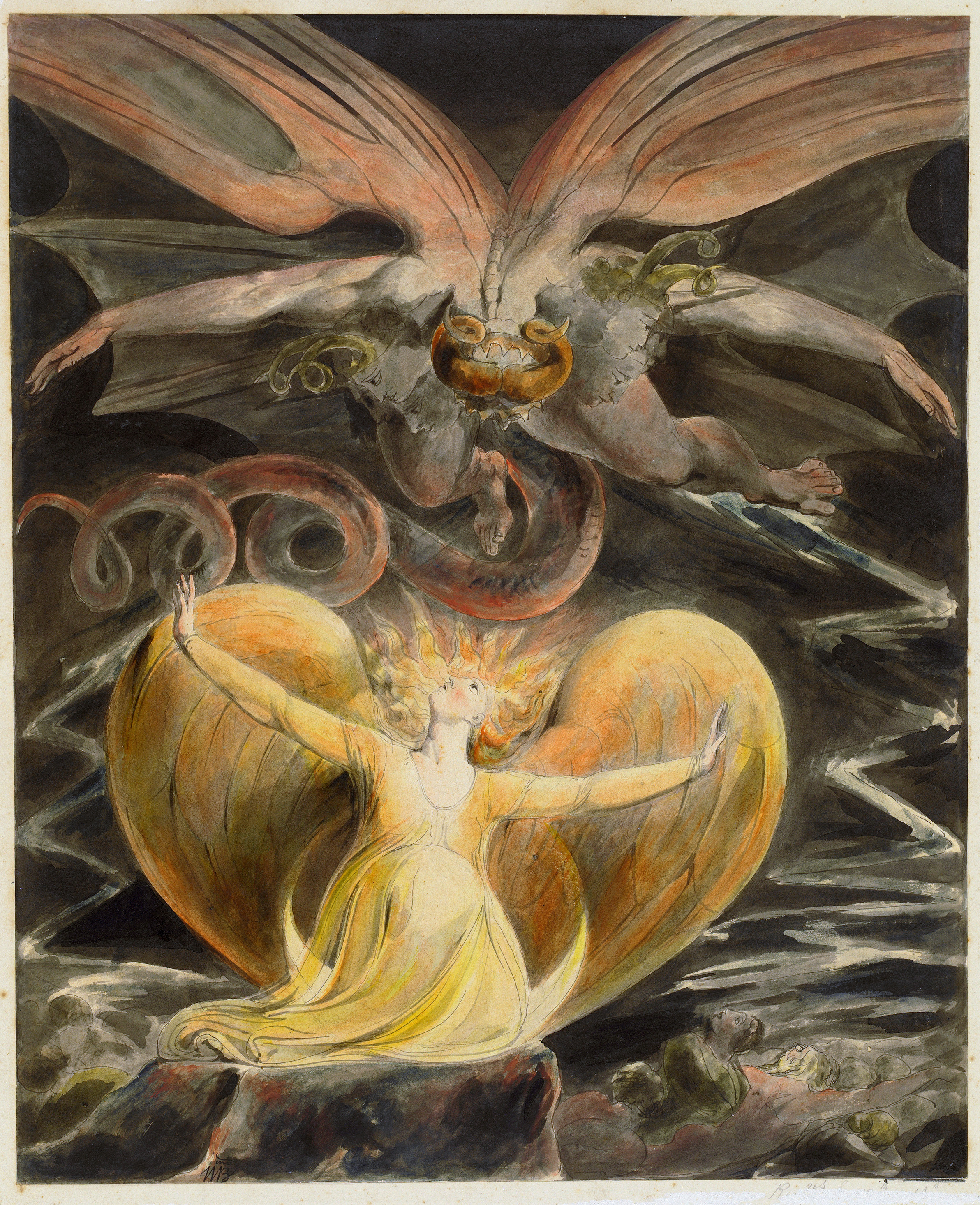 |
| Wikipedia Commons The Great Red Dragon and the Woman Clothed in the Sun |
[3] And there appeared another wonder in heaven; and behold a great red dragon, having seven heads and ten horns, and seven crowns upon his heads.
[4] And his tail drew the third part of the stars of heaven, and did cast them to the earth: and the dragon stood before the woman which was ready to be delivered, for to devour her child as soon as it was born.
[5] And she brought forth a man child, who was to rule all nations with a rod of iron: and her child was caught up unto God, and to his throne.
[6] And the woman fled into the wilderness, where she hath a place prepared of God, that they should feed her there a thousand two hundred and threescore days.
[7] And there was war in heaven: Michael and his angels fought against the dragon; and the dragon fought and his angels,
[8] And prevailed not; neither was their place found any more in heaven.
[9] And the great dragon was cast out, that old serpent, called the Devil, and Satan, which deceiveth the whole world: he was cast out into the earth, and his angels were cast out with him.
From Larry Clayton's Ram Horn'd with Gold, Chapter 6 - Bible - Revelation.
John of Patmos, the writer of the Apocalypse, had been a bishop of the Church, a man of authority, a man of action, a man who had committed himself with a whole heart to actualizing the ideals of Jesus of Nazareth. John had seen his religious program overwhelmed by a heartless political structure, his congregation scattered, and himself exiled to a small island where he had little to do but reflect upon the past and gaze into the future.
In his reflections John was informed by an intimate knowledge of scripture. The vivid images of the Hebrew writers ignited his imagination. They took the place of the people and events which had formerly filled his mind. The seven eyes of God, the plagues, the beasts from the sea and from the land, the harlot, the Lamb, the bride, the new heaven and the new earth-- all these and many more of John's images originate in various books of the Old Testament.
Northrup Frye referred to Revelation as "a dense mosaic of allusions and quotations" from the Bible. The Apocalypse is an imaginative recreation of the entire Hebrew religious consciousness in an epic that carries us to the end of time and the return of man to the golden age.Blake attempted to do the same thing with the English religious consciousness, which explains why Revelation meant so much to him. His epic can just as rightly be called a "dense mosaic of allusions and quotations" from the Bible. In particular he seized upon John's images and combined them into the stuff of his prophetic poems.
When Christ ascended into Heaven, he left his disciples with the expectation that he would soon return (See John 21:22). The writer of Revelation had lived through the years when this hope was increasingly deferred. It became more and more apparent that the return of Jesus was not within the time frame of their original expectations. John outlived his associates, and he differed from the other New Testament writers in that he was forced to look beyond the immediate events and their immediately expected outcome.
He was forced to look into a more complex future. The rigor of this necessity freed him from the limited time frame that characterizes most of the New Testament. He knew the Old Testament truth that "a thousand years in thy sight are but as yesterday". He of all the writers of the New Testament had been most significantly disappointed in his temporal hopes and forced to lift his mind from time to the eternal. That's why his is the most symbolic book, and that's why it most appealed to Blake.
Blake used all of the symbols we have just noted and many others as well. He had brooded over these images for a life time, and they were fraught with meaning to him. They conveyed to him not only John's meanings but the original meanings of the O.T. writers from whom John had borrowed them, plus untold accretions of additional meanings acquired in the two millennia since.
It's doubtful that John's images mean to anyone today exactly what they meant to him. That's the nature of the symbols of eternity: their temporal meanings change with the times. Our religious consciousness changes with the times; even our images of God change with the times--not just in the historical frame but in the personal frame of a man's lifetime.
Blake took the images of Revelation--and of the rest of the Bible as well--and recreated them so as to express the evolving spiritual consciousness of his day, and ours. The images link us to our heritage, the consciousness evolves, the Spirit is timeless.
Two of the primary images of Revelation are the "the Woman Clothed with the Sun" and the "great whore that sitteth upon many waters". Much of the interest of John's epic lies in the conflict between these two women; they respectively represent spiritual Jerusalem and spiritual Rome. The first woman is driven into the wilderness by the Great Red Dragon; the Whore sits upon his back. But in due time the Whore is burned (much to the satisfaction of the faithful) while the other woman becomes the Bride of the Lamb.
A minimal knowledge of this symbolism prepares one to
appreciate Blake's use of the same images to tell the same story.
'The Four Zoas' was first called 'Vala': she is the woman with
whom Blake began, and she originally included both of John's
women. But the Moment of Grace released in Blake the vision of
Jerusalem, and the long poem bearing her name recounts her
suffering at the hands of the other, who gradually evolves into
the Whore.
Like John's woman clothed with the sun Jerusalem is driven into the wilderness and continually oppressed and afflicted by the forces of the Beast and the Whore. Vala, eventually manifested as Rahab, is finally burned; the scene in The Four Zoas at the end of Night viii, contains one of Blake's most explicit and extended quotations from Revelation.
Here as in all of Blake's work he takes the biblical material, and while remaining largely faithful to its accidents, shows us new essence. Part of the final essence of Jerusalem is that her name is Liberty (Jerusalem plate 26), another manifestation of Blake's most vital lesson for us.
Four Zoas, Night VIII, PAGE 115 [111], (E 386)"Rahab triumphs over all she took Jerusalem
Captive A Willing Captive by delusive arts impelld
To worship Urizens Dragon form to offer her own Children
Upon the bloody Altar. John Saw these things Reveald in Heaven
On Patmos Isle & heard the Souls cry out to be deliverd
He saw the Harlot of the Kings of Earth & saw her Cup
Of fornication food of Orc & Satan pressd from the fruit of Mystery
But when she saw the form of Ahania weeping on the Void
And heard Enions voice sound from the caverns of the Grave
No more spirit remained in her She secretly left the Synagogue of Satan
She commund with Orc in secret She hid him with the flax
That Enitharmon had numberd away from the Heavens
She gatherd it together to consume her Harlot Robes
In bitterest Contrition sometimes Self condemning repentant
And Sometimes kissing her Robes & jewels & weeping over them
Sometimes returning to the Synagogue of Satan in Pride
And Sometimes weeping before Orc in humility & trembling
The Synagogue of Satan therefore uniting against Mystery
Satan divided against Satan resolvd in open Sanhedrim
To burn Mystery with fire & form another from her ashes
For God put it into their heart to fulfill all his will

The Ashes of Mystery began to animate they calld it Deism
And Natural Religion as of old so now anew began
Babylon again in Infancy Calld Natural Religion"

Milton, Plate 37[41], (E 138)
"Abraham, Moses, Solomon, Paul, Constantine, Charlemaine
Luther, these seven are the Male-Females, the Dragon Forms
Religion hid in War, a Dragon red & hidden Harlot

All these are seen in Miltons Shadow who is the Covering Cherub
The Spectre of Albion in which the Spectre of Luvah inhabits
In the Newtonian Voids between the Substances of Creation"Jerusalem, Plate 53, (E 203)
"But the Spectre like a hoar frost & a Mildew rose over Albion
Saying, I am God O Sons of Men! I am your Rational Power!
Am I not Bacon & Newton & Locke who teach Humility to Man!
Who teach Doubt & Experiment & my two Wings Voltaire: Rousseau.
Where is that Friend of Sinners! that Rebel against my Laws!
Who teaches Belief to the Nations, & an unknown Eternal Life
Come hither into the Desart & turn these stones to bread.
Vain foolish Man! wilt thou believe without Experiment?
And build a World of Phantasy upon my Great Abyss!
A World of Shapes in craving Lust & devouring appetite

So spoke the hard cold constrictive Spectre he is named Arthur
Constricting into Druid Rocks round Canaan Agag & Aram & Pharoh

Then Albion drew England into his bosom in groans & tears
But she stretchd out her starry Night in Spaces against him. like
A long Serpent, in the Abyss of the Spectre which augmented
The Night with Dragon wings coverd with stars & in the Wings
Jerusalem & Vala appeard: & above between the Wings magnificent
The Divine Vision dimly appeard in clouds of blood weeping."

Jerusalem, Plate 93. (E 253)
 "Then Los again took up his speech as Enitharmon ceast

Fear not my Sons this Waking Death. he is become One with me
Behold him here! We shall not Die! we shall be united in Jesus.
Will you suffer this Satan this Body of Doubt that Seems but Is Not
To occupy the very threshold of Eternal Life. if Bacon, Newton, Locke,
Deny a Conscience in Man & the Communion of Saints & Angels
Contemning the Divine Vision & Fruition, Worshiping the Deus
Of the Heathen, The God of This World, & the Goddess Nature
Mystery Babylon the Great, The Druid Dragon & hidden Harlot
Is it not that Signal of the Morning which was told us in the Beginning

Thus they converse upon Mam-Tor. the Graves thunder under their feet"

DESCRIPTIONS OF THE LAST JUDGMENT, To Ozias Humphry, (E 552)
 "Beneath Earth is convulsed with the labours
of the Resurrection--in the Caverns of the Earth is the Dragon
with Seven heads & ten Horns chained by two Angels & above his
Cavern on the Earths Surface is the Harlot siezed & bound by
two Angels with chains while her Palaces are falling
into ruins & her councellors & warriors are
descending into the Abyss in wailing & despair
     Hell opens beneath the Harlots seat on the left hand into
which the Wicked are descending [while others rise from their
Craves on the brink of the Pit]
     The right hand of the Design is appropriated to the
Resurrection of the Just the left hand of the Design is
appropriated to the Resurrection & Fall of the Wicked"
Friday, October 9, 2020
FROM BEYOND
 |
British Museum Illustrations to Young's Night Thoughts |
But the fourth feature of Jesus came into Blake's consciousness as a new experience. It came from Beyond. That is to say it was not an inward expression of Blake's psyche; it came like the Son of God who had joined the three friends in Nebuchadnezzar's furnace. It wasn't something he thought of; it was something that happened to him.
Daniel 3
[19] Then was Nebuchadnezzar full of fury, and the form of his
visage was changed against Shadrach, Meshach, and Abed-nego:
therefore he spake, and commanded that they should heat the
furnace one seven times more than it was wont to be heated.
[20] And he commanded the most mighty men that were in his army to
bind Shadrach, Meshach, and Abed-nego, and to cast them into the
burning fiery furnace.
[21] Then these men were bound in their coats, their hosen, and
their hats, and their other garments, and were cast into the midst
of the burning fiery furnace.
[22] Therefore because the king's commandment was urgent, and the
furnace exceeding hot, the flame of the fire slew those men that
took up Shadrach, Meshach, and Abed-nego.
[23] And these three men, Shadrach, Meshach, and Abed-nego, fell
down bound into the midst of the burning fiery furnace.
[24] Then Nebuchadnezzar the king was astonied, and rose up in
haste, and spake, and said unto his counsellers, Did not we cast
three men bound into the midst of the fire? They answered and said
unto the king, True, O king.
[25] He answered and said, Lo, I see four men loose, walking in
the midst of the fire, and they have no hurt; and the form
of the fourth is like the Son of God.
[26] Then Nebuchadnezzar came near to the mouth of the burning
fiery furnace, and spake, and said, Shadrach, Meshach, and
Abed-nego, ye servants of the most high God, come forth, and come
hither. Then Shadrach, Meshach, and Abed-nego, came forth of the
midst of the fire.
[27] And the princes, governors, and captains, and the king's
counsellers, being gathered together, saw these men, upon
whose bodies the fire had no power, nor was an hair of their
head singed, neither were their coats changed, nor the smell of
fire had passed on them.
[28] Then Nebuchadnezzar spake, and said, Blessed be the God of
Shadrach, Meshach, and Abed-nego, who hath sent his angel, and
delivered his servants that trusted in him, and have changed the
king's word, and yielded their bodies, that they might not serve
nor worship any god, except their own God.
It was the experience of forgiveness and self-annihilation, which are two sides of the same coin. No one forgives until he has found the grace to annihilate at least momentarily the law bound accusing Spectre which is his Selfhood. And this is only possible as an act of the Imagination, which is Eternal, which is Christ. Whenever you successfully annihilate your old self to the point of truly forgiving another, the eternal Christ is alive and at work in your soul. In fact it is he who does it. He is in you, and you are in him; that's Eternal life.
Reduced to its barest essential that's what Jesus finally came to mean for Blake. The only unique thing about the man of Nazareth was that he taught forgiveness of one's enemies. In this sense he incarnated God. God is love, is forgiveness. "If Morality was Christianity, Socrates was the Saviour." Unlike Socrates Jesus was a man in whom God dwelt through his vision and his acts of forgiveness.
The significance of the resurrection lies in the coming to life of Forgiveness, Jesus, in you and me. In this way we defeat death.
Everlasting Gospel, from Notebook, (E 875)
"There is not one Moral Virtue that Jesus Inculcated but Plato
and Cicero did Inculcate before him; what then did Christ
Inculcate? Forgiveness of Sins. This alone is the Gospel,
and this is the Life and Immortality brought to light by Jesus,
Even the Covenant of Jehovah, which is This: If you forgive
one another your Trespasses, so shall Jehovah forgive you,
That he himself may dwell among you; but if you Avenge, you
Murder the Divine Image, and he cannot dwell among you; because
you Murder him he arises again, and you deny that he is Arisen,
and are blind to Spirit."
It's quite a trick (or gift) to go from time to eternity.
Colossians 1
[25]
Whereof I am made a minister, according to the dispensation of God
which is given to me for you, to fulfil the word of God;
[26] Even the mystery which hath been hid from ages and
from generations, but now is made manifest to his saints:
[27] To whom God would make known what is the riches of the
glory of this mystery among the Gentiles; which is Christ in
you, the hope of glory:
[26] But the Comforter, which is the Holy Ghost, whom the Father will send in my name, he shall teach you all things, and bring all things to your remembrance, whatsoever I have said unto you.
John 17
[1] These words spake Jesus, and lifted up his eyes to heaven, and said, Father, the hour is come; glorify thy Son, that thy Son also may glorify thee:
[2] As thou hast given him power over all flesh, that he should give eternal life to as many as thou hast given him.
[3] And this is life eternal, that they might know thee the only true God, and Jesus Christ, whom thou hast sent.
Letters, To Butts, 1804, (E 757)
"I speak with
perfect confidence and certainty of the fact which has passed
upon me.  Nebuchadnezzar had seven times passed over him; I have
had twenty; thank God I was not altogether a beast as he was; but
I was a slave bound in a mill among beasts and devils; these
beasts and these devils are now, together with myself, become
children of light and liberty, and my feet and my wife's feet are
free from fetters."

Jerusalem, Plate 27, (E 173)
 "He witherd up the Human Form,
By laws of sacrifice for sin:
  Till it became a Mortal Worm:
But O! translucent all within.

  The Divine Vision still was seen
Still was the Human Form, Divine
  Weeping in weak & mortal clay
O Jesus still the Form was thine.

  And thine the Human Face & thine
The Human Hands & Feet & Breath
  Entering thro' the Gates of Birth
And passing thro' the Gates of Death

  And O thou Lamb of God, whom I
Slew in my dark self-righteous pride:
  Art thou return'd to Albions Land!
And is Jerusalem thy Bride?

  Come to my arms & never more
Depart; but dwell for ever here:
  Create my Spirit to thy Love:
Subdue my Spectre to thy Fear,

  Spectre of Albion! warlike Fiend!
In clouds of blood & ruin roll'd:
  I here reclaim thee as my own
My Selfhood! Satan! armd in gold."
Monday, October 5, 2020
LAW & GRACE

British Museum Illustrations to Young's Night Thoughts
2nd Corinthians 3
[15] But even unto this day, when Moses is read, the vail is upon their heart.
[16] Nevertheless when it shall turn to the Lord, the vail shall be taken away.
[17] Now the Lord is that Spirit: and where the Spirit of the Lord is, there is liberty.
[18] But we all, with open face beholding as in a glass the glory of the Lord, are changed into the same image from glory to glory, even as by the Spirit of the Lord.
From Larry Clayton's Ram Horn'd with Gold, Chapter 5 - God.
iiia
As soon as people attempt to frame Christianity within rules and fit it into a prescribed law and order, it stops being Christianity. There is a general failure to understand that Christians are handed over to the Holy Ghost.... Where God's Spirit is, there freedom must be; there Moses must keep silent, all laws withdraw, and let no one be so bold as to prescribe law, rules, order, goals, and measures to the Holy Ghost, nor attempt to reach, govern, and lead those who belong to him.All his life Blake had an implacable hatred of law, which he equated with coercion or hindering of others; to him that was the only sin. Consequently Blake's Jesus was a thorough going antinomian. Perhaps his most extreme expression of this occurs in MHH, written before his conversion:
"if Jesus Christ is the
greatest man, you ought to love him in the greatest degree; now
hear how he has given his sanction to the law of ten
commandments: did he not mock at the sabbath, and so mock the
sabbaths God? murder those who were murderd because of him? turn
away the law from the woman taken in adultery? steal the labor of
others to support him? bear false witness when he omitted making
a defence before Pilate? covet when he pray'd for his disciples,
and when he bid them shake off the dust of their feet against
such as refused to lodge them? I tell you, no virtue can exist
without breaking these ten commandments: Jesus was all virtue,
and acted from impulse: not from rules."
Marriage of Heaven and Hell, Plate 23, (E 43)
That's the proud, tongue in cheek, announcement of a young man not
yet marked by the suffering of life. As he matured, his language
became more moderate, but his attitude remained substantially the
same. Blake hates the law, and his Jesus forgives the lawbreaker.
The letter kills, but the Spirit gives life.
Law is an expression of authority. Life presents to us two
kinds of authority: spiritual authority or God and political
authority, his worldly shadow. Blake consumed his early years in
rebellion against the shadow. Then at age 43 he met God and was
able to submit to and affirm the true authority.
Some means of coercion characterizes all forms of political
authority; ecclesiastical authority is no exception. Blake
temperamentally renounced all forms of political authority; he
felt that they were satanic, based on coercion and fear and
earthly power. Political authority is the authority of this world,
and he had no use for it.
In contrast spiritual authority as Blake experienced it is
the exercise of the purest form of love with an absence of any
sort of constraint. The release from constraint by the active good
will calls forth the Divine Image from the dark sepulcher or cave
of corporeal life. Blake had uniquely experienced this spiritual
authority as a child; he rediscovered it in the experience which
he understood as Self-annihilation or Forgiveness.
Henceforth for him this was the basic and intimate
character and quality of Jesus. This was the good news. In
'Milton' the old antinomian made his commitment to the law of self
giving love, referring to it as the "Universal Dictate". A free
Blakean translation of John 3.16 with a touch of Philippians 2
added might read: God so forgave the world that he annihilated his
transcendent Deity and united himself through a corporeal
sepulcher with sinful, materialistic man to lift us up to
Eternity. Here is the ultimate of spiritual authority, and those
who meet Jesus begin to exercise it in the way that he did.
Although Blake did not often use the conventional Christian
symbolism of the cross, after his conversion he did believe from
the depths that by dying for one another we live eternally:
Freedom from materialism and from the law are the philosophic and moral coloring which Blake gave to his portrait of Jesus the One. In this way he accommodated his new vision of God to his existing value structure.
Four Zoas, Night VIII, PAGE 104, (E 377)
"We now behold the Ends of Beulah & we now behold
Where Death Eternal is put off Eternally
Assume the dark Satanic body in the Virgins womb
O Lamb divine it cannot thee annoy O pitying one
Thy pity is from the foundation of the World & thy Redemption
Begun Already in Eternity   Come then O Lamb of God
Come Lord Jesus come quickly

So sang they in Eternity looking down into Beulah."
Saturday, October 3, 2020
FIRST VISION OF LIGHT

From Larry Clayton's Ram Horn'd with Gold.
The prophetic poems which Blake wrote prior to 1800 concern his efforts to know, describe and deal with the old, jealous, wrathful, creator image; he finally dismissed it as a 'shadow of his wearied intellect' (FZ3-40.3). The later, major prophecies, Milton and Jerusalem, also contain this theme, happily outweighed by the new vision. Prior to the 'Felpham Moment' Blake had worshiped his own visionary endowment, his Pot on the Mantle; he called it the Poetic Genius and later the Imagination. The evolving figure of Los building Golgonooza personified what we might call a pre-Christian God. When grace fell upon Blake, he came to see the true embodiment of God in Jesus.
In a letter to his friend and patron, Thomas Butts, he described the experience of redemption that had come to him:
"And now let me finish with assuring you that tho I have been very unhappy I am so no longer I am again Emerged into the light of Day I still & shall to Eternity Embrace Christianity and Adore him who is the Express image of God..."
At this point we look again at the lovely poem Blake wrote to Butts in October, 1800 reporting on an early appearance of Jesus to him, perhaps the first - when he was 43. He aptly called it "My first Vision of Light":
Letters, (E 712)
"Recieve from me a return of verses such as Felpham produces by me tho not
such as she produces by her Eldest Son. however such as they
are.  I cannot resist the temptation to send them to you

     To my Friend Butts I write
     My first Vision of Light
     On the yellow sands sitting
     The Sun was Emitting
     His Glorious beams
     From Heavens high Streams
     Over Sea over Land
     My Eyes did Expand
     Into regions of air
     Away from all Care
     Into regions of fire
     Remote from Desire
     The Light of the Morning
     Heavens Mountains adorning
     In particles bright
     The jewels of Light
     Distinct shone & clear--
     Amazd & in fear
     I each particle gazed
     Astonishd Amazed
     For each was a Man
     Human formd.  Swift I ran
     For they beckond to me
     Remote by the Sea
     Saying.  Each grain of Sand
     Every Stone on the Land
     Each rock & each hill
     Each fountain & rill
     Each herb & each tree
     Mountain hill Earth & Sea
     Cloud Meteor & Star
     Are Men Seen Afar
     I stood in the Streams
     Of Heavens bright beams
     And Saw Felpham sweet
     Beneath my bright feet
     In soft Female charms
     And in her fair arms
     My Shadow I knew
     And my wifes shadow too
     And My Sister & Friend.
     We like Infants descend
     In our Shadows on Earth
     Like a weak mortal birth
     My Eyes more & more
     Like a Sea without shore
     Continue Expanding
     The Heavens commanding
     Till the jewels of Light
     Heavenly Men beaming bright
     Appeard as One Man
     Who Complacent began
     My limbs to infold
     In his beams of bright gold
     Like dross purgd away
     All my mire & my clay
     Soft consumd in delight
     In his bosom sun bright
     I remaind.  Soft he smild
     And I heard his voice Mild
     Saying This is My Fold
     O thou Ram hornd with gold
     Who awakest from sleep
     On the sides of the Deep
     On the Mountains around
     The roarings resound
     Of the lion & wolf
     The loud sea & deep gulf
     These are guards of My Fold
     O thou Ram hornd with gold
     And the voice faded mild
     I remaind as a Child
     All I ever had known
     Before me bright Shone
     I saw you & your wife
     By the fountains of Life
     Such the Vision to me
     Appeard on the Sea"
Following John and Paul quite literally Blake believed that all things belong to Jesus. He is in them (us) and they (we) are in him. All his life Blake had kept a firm grip on the oneness of humanity and its identity with God. At the Moment of Grace he came to see all as One Man and his own forgiven and accepted place in that Man's bosom. In the poem the Man refers to the All as "My Fold" and names the awakened Blake as his herald: "Thou Ram horn'd with gold".
John 14
[26] But the Comforter, which is the Holy Ghost, whom the Father will send in my name, he shall teach you all things, and bring all things to your remembrance, whatsoever I have said unto you.
Monday, September 28, 2020
EZEKIEL'S VISION

This post is from Chapter 6 of Ram Horn' with Gold.
Ezekiel
If a poll were taken to choose the most obscure of the major books of the Bible, Ezekiel in the Old Testament and Revelation in the New might win by a wide margin. Strangely enough these very books seemed to mean the most to Blake. Their meanings are largely symbolic; Blake adopted their symbols and strenuously commented upon their meanings.
In his major work, 'Jerusalem', Blake took a great deal from Ezekiel: the structural format, the oratorical style, the dialectic of judgment and grace. But he used Ezekiel's style and material to refute Ezekiel's vision of a jealous and punishing God.
The first chapter of Ezekiel contains his definitive epiphany, the encounter with God that initiated and sustained his prophetic activity. The vision of the four living creatures, the wheels, the fiery chariot, all are the trappings of the Shekinah, the Glory of God. This vision originally empowered Ezekiel to prophesy; it recurred throughout his prophetic life.
In a climactic scene shortly
before the destruction of Jerusalem the prophet saw it hovering
over the Temple and departing (read Ezekiel 10 with special
attention to verse 18). Years later he
saw it when returning to Jerusalem as
the liberated pilgrims arrived from Babylon. (Ezekiel 43)
Ezekiel 10
[14] And every one had four
faces: the first face was the face of a cherub, and the second
face was the face of a man, and the third the face of a lion,
and the fourth the face of an eagle.
[15] And the cherubims were lifted up. This is the living
creature that I saw by the river of Chebar.
[16] And when the cherubims went, the wheels went by
them: and when the cherubims lifted up their wings to mount up
from the earth, the same wheels also turned not from beside
them.
[17] When they stood, these stood; and when they were
lifted up, these lifted up themselves also: for the spirit of
the living creature was in them.
[18] Then the glory of the LORD departed from off the
threshold of the house, and stood over the cherubims.
[19] And the cherubims lifted up their wings, and mounted
up from the earth in my sight: when they went out, the wheels
also were beside them, and every one stood at the door of the
east gate of the LORD's house; and the glory of the God of
Israel was over them above.
Ezekiel 43
[1] Afterward he brought me to the gate, even the gate that looketh toward the east:[2] And, behold, the glory of the God of Israel came from the way of the east: and his voice was like a noise of many waters: and the earth shined with his glory.
[3] And it was according to the appearance of the vision which I saw, even according to the vision that I saw when I came to destroy the city: and the visions were like the vision that I saw by the river Chebar; and I fell upon my face.
[4] And the glory of the LORD came into the house by the way of the gate whose prospect is toward the east.
[5] So the spirit took me up, and brought me into the inner court; and, behold, the glory of the LORD filled the house.
[6] And I heard him speaking unto me out of the house; and the man stood by me.
[7] And he said unto me, Son of man, the place of my throne, and the place of the soles of my feet, where I will dwell in the midst of the children of Israel for ever, and my holy name, shall the house of Israel no more defile, neither they, nor their kings, by their whoredom, nor by the carcases of their kings in their high places.
Blake took Ezekiel's living creatures (zoas in Greek) as the subject of his epic poem, 'The Four Zoas'. He humanized the Zoas and enacted through them the divisive tendencies of the human psyche which have led to the fracture and fall of Mankind. With their fall Blake's Zoas became the "rulers of the darkness of this world". As you study 4Z, keeping always in mind the biblical source, you become aware that it all relates to Ezekiel's vision of God.
The striving found in 4Z was interrupted by the Moment of Grace. This led to a radical reorientation of Blake's theology. He didn't change his mind about Ezekiel's God, but he met a new and more loving God in the person of Jesus. In 'Jerusalem' he gave the most overt and candid evaluation of the relationship between these two visions. The African American spiritual has it that Ezekiel saw the wheel. Here, in the language of Old Testament prophecy, Blake tells us what the Wheel has meant to Mankind:
Plate 77 of 'Jerusalem' might well be considered Blake's valedictory: he tells us pretty plainly the meaning of true religion:
"I stood among my valleys of the south
And saw a flame of fire, even as a WheelOf fire surrounding all the heaven: it went
From west to east, against the current of
Creation, and devour'd all things in its loud
Fury & thundering course round heaven & earth.
By it the Sun was roll'd into an orb,
By it the Moon faded into a globe
Travelling thro' the night; for, from its dire
And restless fury, Man himself shrunk up
Into a little root a fathom long.
And I asked a Watcher & a Holy-one
Its Name; he answered: "It is the Wheel of Religion."
I wept & said: "Is this the law of Jesus,
"This terrible devouring sword turning every way?"
He answer'd: "Jesus died because he strove
"Against the current of this Wheel; its Name
"Is Caiaphas, the dark Preacher of Death,
"Of sin, of sorrow & of punishment:
"Opposing Nature! It is Natural Religion;
"But Jesus is the bright Preacher of Life
"Creating Nature from this fiery Law
"By self-denial & forgiveness of Sin.
"Go therefore, cast out devils in Christ's name,
"Heal thou the sick of spiritual disease,
"Pity the evil, for thou art not sent
"To smite with terror & with punishments
"Those that are sick, like to the Pharisees
"Crucifying & encompassing sea & land
"For proselytes to tyranny & wrath;
"But to the Publicans & harlots go,
"Teach them True Happiness, but let no
curse
"Go forth out of thy mouth to blight their peace;
"For Hell is open'd to Heaven: thine eyes beheld
"The dungeons burst & the Prisoners set free."
Here Blake with unparalleled eloquence has set forth the opposition between the God of Wrath and the God of Mercy, the dark Preacher of Death and the bright Preacher of Life. Mankind in every age has turned Ezekiel's wheel into a juggernaut to enforce a worldly solidarity under the banner of priest and king. And every age has had its dissenters who strove against it and were all too often crushed.
Friday, September 25, 2020
URIZEN'S BIBLE

Book of Urizen
Copy A, Plate 8
"Both read the Bible day & night
But thou readst black where I read white"
If the Bible is read as poetry, it is not a book of rules but a book that stimulates the imagination and opens the mind to vision. Urizen intended his book to be used to control the unruly, to oppress the poor and to promise rewards for obedience. Such a reading of the Bible could only result if mercy were suppressed, conformity were enforced, threats were implicit, and love were narrowly defined.
Although
Urizen was a complex character as Blake presented him, in simplest
terms he was the reasoning faculty of the mind. He did not have empathy
because he felt no emotions, he did not write poetry because every term
had only one meaning, he did not listen to other points of view because
he knew his own righteousness. His system was the only system, and he
intended to use it to dominate the weak and compliant. Blake saw the
problem with Urizen's book not with the content only, but with the 'iron
pen' with which it had been written.
Everlasting Gospel, (E 524)
"The Vision of Christ that thou dost see
Is my Visions Greatest Enemy
Thine has a great hook nose like thine
Mine has a snub nose like to mine
Thine is the Friend of All Mankind
Mine speaks in parables to the Blind
Thine loves the same world that mine hates
Thy Heaven doors are my Hell Gates
Socrates taught what Melitus
Loathd as a Nations bitterest Curse
And Caiphas was in his own Mind
A benefactor of Mankind
Both read the Bible day & night
But thou readst black where I read white"

Four Zoas, Night VII. Page 79, (E355)
"But Urizen remitted not their labours upon his rock
PAGE 80
And Urizen Read in his book of brass in sounding tones

Listen O Daughters to my voice Listen to the Words of Wisdom
So shall ye govern over all let Moral Duty tune your tongue
But be your hearts harder than the nether millstone
To bring the shadow of Enitharmon beneath our wondrous tree
That Los may Evaporate like smoke & be no more
Draw down Enitharmon to the Spectre of Urthona
And let him have dominion over Los the terrible shade

Compell the poor to live upon a Crust of bread by soft mild arts
Smile when they frown frown when they smile & when a man looks  pale
With labour & abstinence say he looks healthy & happy
And when his children Sicken let them die there are enough
Born even too many & our Earth will be overrun
Without these arts If you would make the poor live with temper
With pomp give every crust of bread you give with gracious cunning
Magnify small gifts reduce the man to want a gift & then give with pomp
Say he smiles if you hear him sigh If pale say he is ruddy
Preach temperance   say he is overgorgd & drowns his wit
In strong drink tho you know that bread & water are all
He can afford   Flatter his wife pity his children till we can

Reduce all to our will as spaniels are taught with art
Lo how the heart & brain are formed in the breeding womb
Of Enitharmon how it buds with life & forms the bones
The little heart the liver & the red blood in its labyrinths"

Four Zoas, Night VII. Page 38, (E 326)
[Ahania to Urizen}
"O Prince the Eternal One hath set thee leader of his hosts
PAGE 39
Leave all futurity to him Resume thy fields of Light
Why didst thou listen to the voice of Luvah that dread morn
To give the immortal steeds of light to his deceitful hands
No longer now obedient to thy will thou art compell'd
To forge the curbs of iron & brass to build the iron mangers
To feed them with intoxication from the wine presses of Luvah
Till the Divine Vision & Fruition is quite obliterated
They call thy lions to the fields of blood, they rowze thy tygers
Out of the halls of justice, till these dens thy wisdom framd
Golden & beautiful but O how unlike those sweet fields of bliss
Where liberty was justice & eternal science was mercy
Then O my dear lord listen to Ahania, listen to the vision
The vision of Ahania in the slumbers of Urizen
When Urizen slept in the porch & the Ancient Man was smitten"

Four Zoas, Night VI, Page 71, (E 348)
"But still his books he bore in his strong hands & his iron pen
For when he died they lay beside his grave & when he rose
He siezd them with a gloomy smile for wrapd in his death clothes
He hid them when he slept in death when he revivd the clothes
Were rotted by the winds the books remaind still unconsumd
Still to be written & interleavd with brass & iron & gold
Time after time for such a journey none but iron pens
Can write And adamantine leaves recieve nor can the man who goes
PAGE 72
The journey obstinate refuse to write time after time"