Blake seeks to provide the Golden String which can lead us through the labyrinth of our experience or his own poetry.

Thursday, May 19, 2016

Sin & Forgiveness

First published Dec 27, 2013. This is a section of Larry's online book: A Blake Primer.

Sin and Forgiveness 

  "Whosoever of you are justified by the law: ye are fallen from grace"

Just as he redefined hell, so Blake redefined sin. The only sin for Blake consisted in hindering, oneself or another: "Murder is Hindering Another, Theft is Hindering Another."(Annotations to Lavater, E 601) To subvert one's individuality is the sin against the Holy Spirit. "He who desires but acts not, breeds pestilence".

The responsibility for hindering another falls upon the Lawmaker and Enforcer, who has polluted life with his prohibitions: "over the doors Thou shalt not". One could say that Blake took Paul's letters to the Romans and to the Galatians too seriously. Luther had taken those epistles seriously enough to throw off the Roman yoke. Blake took them more radically and threw off the mosaic yoke--as Paul had suggested.

Paul had identified the Law with the flesh and opposed it with the Spirit. Our poet took with utmost seriousness these stirring passages calling the Christian to freedom from the Law. He didn't have the benefit of the 'interpretations' of such ideas afforded by the educational process. Sin stems from our ideas of morality, which Blake called hindering. When we presume to know what someone else should or must do, we have entered the state of Caiaphas, the Pharisee, who crucified Jesus, but "was in his own Mind a benefactor to Mankind."
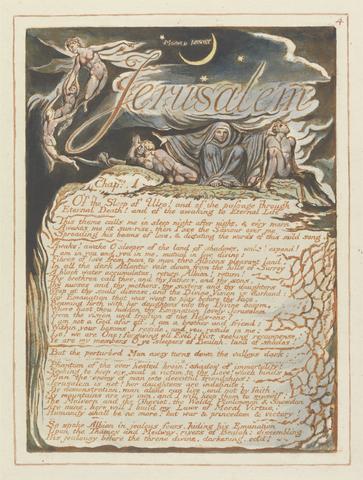
 
Yale Center for British Art Jerusalem Plate 4
We lay down the law to another--our law--and thus violate the other's nature: "One law for the Lion and Ox is Oppression". We tell him what to do, and then we use the power of the Accuser, the God of this World, to compel him to do it and to punish him for his failures. This is sin, the way life happens in Ulro. As we have seen, Blake didn't call it life, he called it Eternal Death. Paul had said, "The wages of sin is death but the gift of God is eternal life."
 
The categories of sin and righteousness divide mankind. The division often proceeds to the point of physical violence. Corporeal war always rests upon a base of self-righteousness and condemnation of the sins of the enemy. Religion too often allies itself with those attitudes and their violent results. Long before the peaceniks of the sixties Blake said in effect, "Make love, not war!" He said it at great length in dozens of different ways. He saw war as the ultimate end of hindering another.  In the Book of Urizen we read how Urizen, the great Lawgiver (who lives in all of us!) discovers that none of his children can obey his laws, "for he saw that no flesh nor spirit could keep His iron laws one moment".

       So we see that Blake opposed the idea of sin; he opposed morality; he opposed Law. Paradoxically Blake lived a very law abiding life. Only such a person can afford the luxury of antinomianism without losing his integrity. For example Blake despised the marriage laws--and lived as a faithful and dutiful husband for forty years. But beyond the surface absurdities of his anarchism Blake tells us something profound about life: Goodness cannot be compelled; goodness grows only in a context of freedom. "To the pure all things are pure". Blake was basically pure; one of his mottoes was "everything that lives is holy". That in itself would have been enough to make him famous.

If we can suspend our judgements about people's conduct and stop tormenting ourselves because of our failures to do the good which we have laid upon ourselves, if we can accept what we have called bad, but which may be simply disowned facets of our true nature, in Blake's terminology if we can forgive, then we can put sin behind us and receive the gift of eternal life. Blake, drinking deeply from the primary fountains of scripture, intuitively expressed these universal truths in poetic terms. (100 years later Jung came along and clothed them with the respectability of a scientific jargon.)

From what has been said it is obvious that Blake didn't believe in Sin as it is commonly understood: "Satan thinks that Sin is displeasing to God; he ought to know that Nothing is displeasing to God but Unbelief & Eating of the Tree of Knowledge of Good & Evil".  (VLJ)

Jerusalem, Blake's symbol of the redeemed and pure consciousness, speaking to Vala, his symbol of the fallen mind, expressed Blake's candid evaluation of Sin as such: "Oh Vala...what is sin but a little error & fault that is soon forgiven?" (Jerusalem 20:23-25)

If the primary moral wrong is hindering, the primary grace is forgiveness. Redemption came for Blake when forgiveness first entered the horizon of his vision; it increasingly came to dominate it. Prior to 1800 with all his denunciations of Urizen, the Restrainer, and of morality Blake was growing more and more into the role of judge. He was becoming in fact a judge of judges. The later Lambeth books witness the resultant decrease in vitality; in the language of Zion he suffered a loss of faith. It coincided with a slowly dawning realization that Urizen had infested his own mind all the while he was denouncing him in others. There awakened in his mind a new awareness of sin, a sin more basic than hindering others, or rather an awareness of the inner cause of hindering. He called it the Selfhood, the Spectre, Satan. As many of us have since that day, Blake realized that he saw the God-playing in others because he was so good at it himself. This new vision of his Selfhood led to the Moment of Grace.

At Felpham, in the major crisis of his life, he faced the need to forgive both the impositions of his corporeal friend, Hayley, and the resentful thunderer, William Blake, as well. The appearance of his first Vision of Light marks the coming of Christ into his life with the power of this forgiveness; henceforth he called him Jesus, the Forgiveness.

The old Urizenic monstrosity that had haunted him, first in the outer world and increasingly as a component of his own psyche, was recognized, accepted, subdued, and forgiven. It was undoubtedly the greatest event of his life, a new birth of hope at the age of 43. He shared with us the psychic unfolding of this experience in Night vii of The Four Zoas where Los embraces his Spectre (equivalent to Jung's acceptance of the shadow) and soon thereafter finds Urizen miraculously changed:
Four Zoas, Night VII, Page 98 [90], (E 371)  
"But Tharmas most rejoicd in hope of Enions return
For he beheld new Female forms born forth upon the air    
Who wove soft silken veils of covering in sweet rapturd trance
Mortal & not as Enitharmon without a covering veil

First his immortal spirit drew Urizen[s] Shadow away   
From out the ranks of war separating him in sunder
Leaving his Spectrous form which could not be drawn away     
Then he divided Thiriel the Eldest of Urizens sons
Urizen became Rintrah Thiriel became Palamabron
Thus dividing the powers of Every Warrior
Startled was Los he found his Enemy Urizen now
In his hands. he wonderd that he felt love & not hate     
His whole soul loved him he beheld him an infant
Lovely breathd from Enitharmon he trembled within himself"
Has anyone better portrayed the psychodynamics of forgiveness? In order to forgive you first withdraw the projection, then you forgive yourself. It's your baby!

We can't say that's the end of the story; in Night viii Urizen continues to afflict life with his judgements, hostility and violence; Satan comes forth from his War. The Saviour dies for him, and we are still waiting for the ultimate victory. Nor was Blake himself fully delivered from the resentments and self justifications of the old man. Hard times ahead, the deceitfulness and opprobrium of others continued to afflict and to warp his psyche and caused him to participate in sin (mostly by suffering through the sins of others against him), but now he knew the answer: through recurring awareness and Self-annihilation he could forgive again and again. The wheat and tares continued to grow together.
.

Monday, May 16, 2016

READ ABOUT BLAKE

A post published by Larry in 2009 and expanded by ellie.
Wikimedia Commons
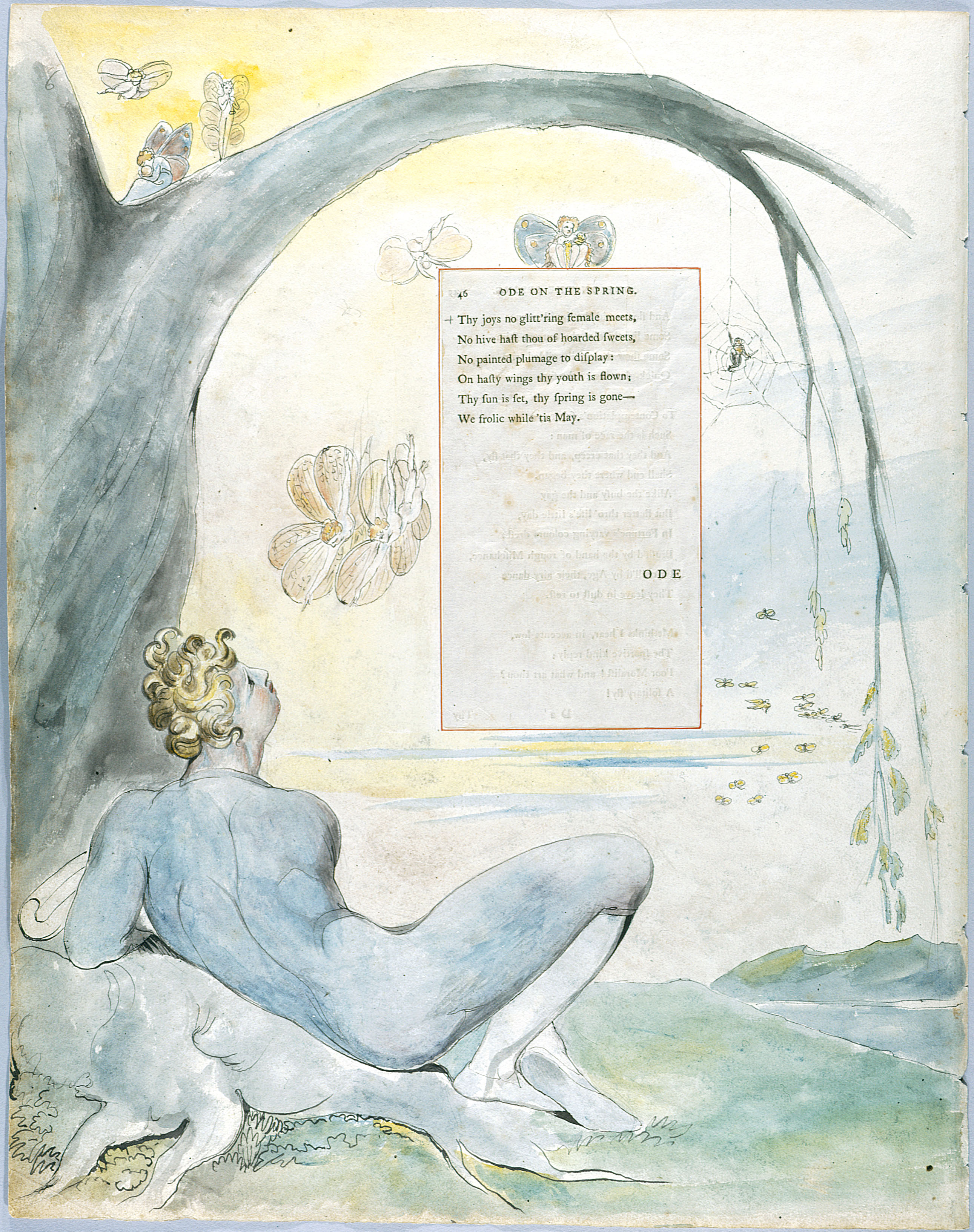
Blake's Watercolors for Poems of Thomas Gray
Ode to Spring, Page 6
People interested in Blake are more apt to read about Blake than to read Blake. Reading The Four Zoas, Milton, and Jerusalem are awesome undertakings. Until you've begun to understand the man's language, it's a losing proposition. There's a core set of metaphors that he used repeatedly, although like all metaphors his are subject to various interpretations, and often used for an object or its opposite.

To enable intelligent reading of the major prophecies there is a great abundance of commentary on his works. Where does one begin? Those of us who have made a few steps in that direction can perhaps give a bit of guidance to the beginning student.

Northrup Frye's Fearful Symmetry was the work that made me a life long lover of Blake's poetry. It's not easy; I read it five times before I was able to get more than a few glimmers of light. But it's very rewarding; you're likely smarter than me, in which case one or two readings may get you well into the long poems.

Frye was a minister of the United Church of Canada as well as celebrated literature critique; after finishing Fearful Symmetry he said that if he had it to do over, he would have written more of an introduction than what he actually did. But more than a half century after it was published Fearful Symmetry is introducing serious readers to an experience of discovery:

"Blake's cosmology, of which the symbol is Ezekiel's vision of the chariot of God with its 'wheels within wheels,' is a revolutionary vision of the universe transformed by the creative imagination of a human shape. This cosmology is not speculative but concerned, not reactionary but revolutionary, not a vision of things as they are ordered but of things as they could be ordered...Blake's poetry, like that of every poet who knows what he is doing, is mythical, for myth is the language of concern: it is cosmology in movement, a living form not a mathematical one." (Preface) 

The one who gave the simplest introduction for me was Milton Percival in William Blake's Circle of Destiny; it's more systematic and more elementary. Percival connects the myth Blake created with literature which fed its development:

"I predict, then, that when the evidence is in, it will be found that in the use of tradition Blake exceeded Milton, and was second, if to anyone, only to Dante. To be sure, a great deal of the Blakean tradition might not be called 'accepted.' It certainly was not orthodox. But the Blakean heterodoxy was equally traditional with Dante's orthodoxy. The Orphic and Pythagorean tradition, Neoplatonism in the whole of its extent, the Hermetic, kabbalistic, Gnostic, and alchemical writings, Erigena, Paracelsus, Boehme, and Swedenborg - here is a consistent body of tradition extending over nearly twenty-five hundred years. In the light of this tradition, not the light of Christian orthodoxy, Blake read his Bible, weighing and deciding for himself, formulating a 'Bible of Hell'; for he was one in whose veins ran the dissidence of dissent and the protestantism of the Protestant religion." (Page 1)    

But Kathleen Raine's Blake and Tradition was what made me a real enthusiast. That's the most easily readable one, and it's filled with some of Blake's loveliest pictures. Unfortunately Blake and Tradition is out of print now, but a fairly good substitute may be found in her little book, Blake and Antiquity or in her biography titled William Blake. Raine sees the whole of Blake's art enmeshed in the tradition which it expands: 

"Blake was such an artist; and his work, as he believed, represents 'portions of Eternity' seen in imaginative vision. Blake himself writes of 'ever Existent Images' which may be seen 'by the Imaginative Eye of Every one according to the situation he holds' - a collective archetypal world whose reality is more credible in our century that it was in his own. 'To different people it appears differently, as everything else does.' Such art comes from a source deeper than the individual experience of poet or painter, and has the power of communication to that same level of the spectator. To our superficial selves this is a source of the 'obscurity' of visionary art; to our deepest selves, of its lucidity." (Page 7)
Vision of Last Judgment, (E 560)
    "If the Spectator could Enter into these Images in his
Imagination approaching them on the Fiery Chariot of his
Contemplative Thought if he could Enter into Noahs Rainbow or
into his bosom or could make a Friend & Companion of one of these
Images of wonder which always intreats him to leave mortal things
as he must know then would he arise from his Grave then would he
meet the Lord in the Air & then he would be happy   General
Knowledge is Remote Knowledge it is in Particulars that Wisdom
consists & Happiness too.  Both in Art & in Life General Masses
are as Much Art as a Pasteboard Man is Human Every Man has Eyes
Nose & Mouth this Every Idiot knows but he who enters into &
discriminates most minutely the Manners & Intentions  the
Expression of Character in all their branches is the
alone Wise or Sensible Man & on this discrimination All Art is
founded.  I intreat then that the Spectator will attend to the
Hands & Feet to the Lineaments of the Countenances they are all
descriptive of Character & not a line is drawn without intention
& that most discriminate & particular  as Poetry admits not a
Letter that is Insignificant so Painting admits not a Grain of
Sand or a Blade of Grass  much less an Insignificant Blur or Mark"
. 

Saturday, May 14, 2016

CONVERSION

Nels Ferre, an influential theologian, reported on his threefold conversion:
"The first time I was converted, in content, to traditional Christianity; the second time, to honesty; the third time to the love of God and men, first in theology and gradually in life." 

 
Library of Congress Milton
Plate 47
William Blake made reference to multiple conversions in his life - if we mean by conversion an inner realization which precipitates a change in one's ability to behave differently in some aspect of his activities.

 
Here is an account of a conversion experience of William Blake which he included in Milton. Blake speaks in the first person in this passage which he rarely does in his poetry. The experience he describes took place near the end of his sojourn in Felpham where he had been sorely tried by outer circumstances and inner doubts.

Some may say that this passage is merely a poetic device to further the narrative of the poem, but Milton is recognized as autobiographical. Blake saw the experience of an encounter with the figure of Los as a powerful movement of his own psyche to enter a new phase of psychic/spiritual development. In fact the confidence to write the poem Milton grew from such an expansion of his consciousness.

We see in this passage that Blake has been given a new ability to write from the Universal Dictate as had been Milton before him. The spiritual level that enabled him to receive this gift is the suffering he had endured. Because he can pity the world of sorrow, he can help to renew it to Eternal Life. Blake is ready to walk forward in spite of his fears because he perceives that Los, the Eternal Prophet, has inducted him into the brotherhood of prophets.   

Milton, Plate 21 [23], (E 116)
"Then the Divine Family said. Six Thousand Years are now
Accomplish'd in this World of Sorrow; Miltons Angel knew
The Universal Dictate; and you also feel this Dictate.
And now you know this World of Sorrow, and feel Pity. Obey
The Dictate! Watch over this World, and with your brooding wings,
Renew it to Eternal Life: Lo! I am with you alway
But you cannot renew Milton he goes to Eternal Death

So spake the Family Divine as One Man even Jesus
Uniting in One with Ololon & the appearance of One Man
Jesus the Saviour appeard coming in the Clouds of Ololon!        
Plate 22 [24]
Tho driven away with the Seven Starry Ones into the Ulro
Yet the Divine Vision remains Every-where For-ever. Amen.
And Ololon lamented for Milton with a great lamentation.

While Los heard indistinct in fear, what time I bound my sandals
On; to walk forward thro' Eternity, Los descended to me:         
And Los behind me stood; a terrible flaming Sun: just close

Behind my back; I turned round in terror, and behold.
Los stood in that fierce glowing fire; & he also  stoop'd down
And bound my sandals on in Udan-Adan; trembling I stood
Exceedingly with fear & terror, standing in the Vale             
Of Lambeth: but he kissed me and wishd me health.
And I became One  Man  with  him  arising in my strength:
Twas too late now to recede. Los had enterd into my soul:
His terrors now posses'd me whole! I arose in fury & strength.
[change of voice]
I am that Shadowy Prophet who Six Thousand Years ago    
Fell from my station in the Eternal bosom. Six Thousand Years
Are finishd. I return! both Time & Space obey my will.
I in Six Thousand Years walk up and down: for not one Moment
Of Time is lost, nor one Event of Space unpermanent
But all remain: every fabric of Six Thousand Years               
Remains permanent: tho' on the Earth where Satan
Fell, and was cut off all things vanish & are seen no more
They vanish not from me & mine, we guard them first & last
The generations of men run on in the tide of Time
But leave their destind lineaments permanent for ever & ever.    

So spoke Los as we went along to his supreme abode."

These are the phrases which lead me to call this a conversion experience:
1) "reveal the secrets of Eternity"
2) "I stooped down & bound it on to walk forward thro' Eternity."
3) "And Los behind me stood; a terrible flaming Sun: just close Behind my back; I turned round in terror, and behold."
4) "And I became One Man with him arising in my strength:"
5) "Twas too late now to recede. Los had enterd into my soul: His terrors now posses'd me whole! I arose in fury & strength"

.

Sunday, May 8, 2016

IMAGES OF CHRIST 12


The Huntington Library, Art Collections, and Botanical Gardens
The Conversion of Saul
c. 1800

The final image in this series of posts focusing on Images of Christ is Blake's watercolor from 1800 which is titled Conversion of Saul. This image portrays Christ appearing to Saul who was working to eliminate the movement of believers which had sprung up following the reports that Christ lived. Saul was a reluctant convert. Christ visited Saul as a light and a voice which communicated to his inner being. Saul's activities in the outer world - persecuting disciples of the Lord - was not congruent with in inner conscience. He responded to the question the Lord put to him with a question of his own. He arose, he listened, he followed the path that opened to him. 
 
Acts 9
[1] And Saul, yet breathing out threatenings and slaughter against the disciples of the Lord, went unto the high priest,
[2] And desired of him letters to Damascus to the synagogues, that if he found any of this way, whether they were men or women, he might bring them bound unto Jerusalem.
[3] And as he journeyed, he came near Damascus: and suddenly there shined round about him a light from heaven:
[4] And he fell to the earth, and heard a voice saying unto him, Saul, Saul, why persecutest thou me?
[5] And he said, Who art thou, Lord? And the Lord said, I am Jesus whom thou persecutest: it is hard for thee to kick against the pricks.
[6] And he trembling and astonished said, Lord, what wilt thou have me to do? And the Lord said unto him, Arise, and go into the city, and it shall be told thee what thou must do.
[7] And the men which journeyed with him stood speechless, hearing a voice, but seeing no man.
[8] And Saul arose from the earth; and when his eyes were opened, he saw no man: but they led him by the hand, and brought him into Damascus.
 
The conviction that the life of Christ did not end in the grave, that his spirit was released to live in a higher plane of existence, is a transforming experience. This conviction comes from hearing a voice which speaks not to the outer, natural man but to the inner, spiritual man who wakes in response to the call. The conversion of Saul went a step further than the earlier accounts of encountering the risen Christ because it was not mediated by previous association with the ministry of Jesus in the flesh. Paul's conversion becomes the prototype for the spread of Christianity to the wide segment of the population who would encounter Christ as a spiritual reality not a physical man.  Each individual can make the transition to an altered consciousness when he begins to perceive himself as an Immortal Spirit. Christ introduces his followers to the spirit which will live in them and give them the power to live the Eternal Life.
Jerusalem, Plate 75, (E 231) 
"But Jesus breaking thro' the Central Zones of Death & Hell
Opens Eternity in Time & Space; triumphant in Mercy

Thus are the Heavens formd by Los within the Mundane Shell
And where Luther ends Adam begins again in Eternal Circle
To awake the Prisoners of Death; to bring Albion again           
With Luvah into light eternal, in his eternal day." 
1ST Corinthians 15 
[4] And that he was buried, and that he rose again the third day according to the scriptures: 
[5] And that he was seen of Cephas, then of the twelve:
[6] After that, he was seen of above five hundred brethren at once; of whom the greater part remain unto this present, but some are fallen asleep.
[7] After that, he was seen of James; then of all the apostles.
[8] And last of all he was seen of me also, as of one born out of due time.
[9] For I am the least of the apostles, that am not meet to be called an apostle, because I persecuted the church of God.
[10] But by the grace of God I am what I am: and his grace which was bestowed upon me was not in vain; but I laboured more abundantly than they all: yet not I, but the grace of God which was with me. 

Philippians 3
[20] For our conversation is in heaven; from whence also we look for the Saviour, the Lord Jesus Christ:
[21] Who shall change our vile body, that it may be fashioned like unto his glorious body, according to the working whereby he is able even to subdue all things unto himself.

In the following two letters Blake gives us an inkling of the process he underwent as he experienced a transition to living in the light of spiritual consciousness.
Letters, To Butts, Nov 1802, (E 720)
 "And now let me finish with assuring you that Tho I have been
very unhappy I am so no longer I am again Emerged into the light
of Day I still & shall to Eternity Embrace Christianity and Adore
him who is the Express image of God but I have traveld thro
Perils & Darkness not unlike a Champion I have Conquerd and shall
still Go on Conquering Nothing can withstand the fury of my
Course among the Stars of God & in the Abysses of the Accuser My
Enthusiasm is still what it was only Enlarged and confirmd" 
Letters, To Hayley, Oct 1804, (E 756)
"I have entirely reduced that
spectrous Fiend to his station, whose annoyance has been the ruin
of my labours for the last passed twenty years of my life.  He is
the enemy of conjugal love and is the Jupiter of the Greeks, an
iron-hearted tyrant, the ruiner of ancient Greece.  I speak with
perfect confidence and certainty of the fact which has passed
upon me.  Nebuchadnezzar had seven times passed over him; I have
had twenty; thank God I was not altogether a beast as he was; but
I was a slave bound in a mill among beasts and devils; these
beasts and these devils are now, together with myself, become
children of light and liberty, and my feet and my wife's feet are
free from fetters.  O lovely Felpham, parent of Immortal
Friendship, to thee I am eternally indebted for my three years'
. 

Wednesday, May 4, 2016

IMAGES OF CHRIST 11


Yale Center for British Art
Illustrations to Young's Night Thoughts 
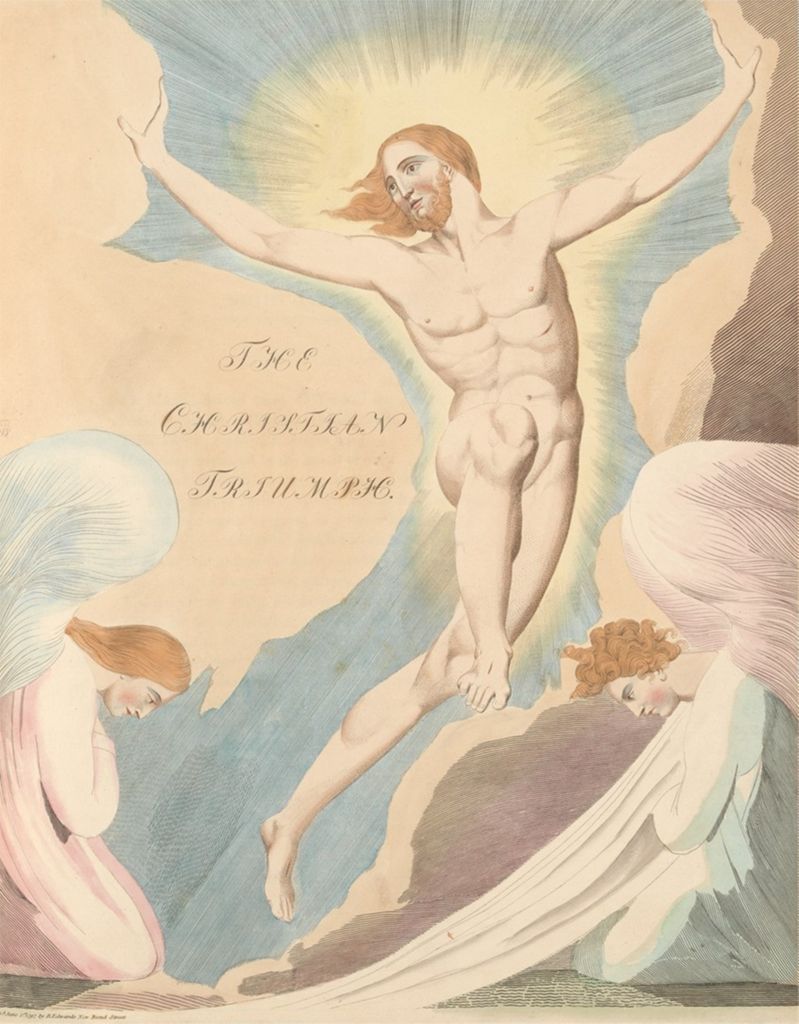
This image of Christ portrays him transformed. He has shed the linen cloths he wore in the grave as well as garment of flesh which he wore in the mundane world. He is not confined to the cave of death or to the earth on which he walked in Palestine or on England's green and pleasant hills. Air is his medium; light is his garment.
 
Blake presents this image to show more than the condition of Christ when he achieved the passage through death to life. Blake's intension is that his reader/viewer also shed his encumbrances and enter the state of consciousness where he can see clearly that he is a member of the Brotherhood of Eden. That man may enter Life Eternal through following the path that Jesus trod, is pictured in the illustration by Christ parting the clouds and opening a clear way for entry into a world beyond experience.  

Milton, PLATE 41 [48], (E 142)
 "To bathe in the Waters of Life; to wash off the Not Human
 I come in Self-annihilation & the grandeur of Inspiration
 To cast off Rational Demonstration by Faith in the Saviour
 To cast off the rotten rags of Memory by Inspiration
 To cast off Bacon, Locke & Newton from Albions covering
 To take off his filthy garments, & clothe him with Imagination
 To cast aside from Poetry, all that is not Inspiration"
 
1ST Corinthians 15
[53] For this corruptible must put on incorruption, and this mortal must put on immortality.
[54] So when this corruptible shall have put on incorruption, and this mortal shall have put on immortality, then shall be brought to pass the saying that is written, Death is swallowed up in victory.
[55] O death, where is thy sting? O grave, where is thy victory?
[56] The sting of death is sin; and the strength of sin is the law.
[57] But thanks be to God, which giveth us the victory through our Lord Jesus Christ.
Jerusalem, Plate 96, (E 255)
"Then Jesus appeared standing by Albion as the Good Shepherd
By the lost Sheep that he hath found & Albion knew that it
Was the Lord the Universal Humanity, & Albion saw his Form     
A Man. & they conversed as Man with Man, in Ages of Eternity
And the Divine Appearance was the likeness & similitude of Los

Albion said. O Lord what can I do! my Selfhood cruel
Marches against thee deceitful from Sinai & from Edom
Into the Wilderness of Judah to meet thee in his pride       
I behold the Visions of my deadly Sleep of Six Thousand Years
Dazling around thy skirts like a Serpent of precious stones & gold
I know it is my Self. O my Divine Creator & Redeemer

Jesus replied Fear not Albion unless I die thou canst not live
But if I die I shall arise again & thou with me            
This is Friendship & Brotherhood without it Man Is Not

So Jesus spoke! the Covering Cherub coming on in darkness
Overshadowd them & Jesus said Thus do Men in Eternity
One for another to put off by forgiveness, every sin

Albion replyd. Cannot Man exist without Mysterious          
Offering of Self for Another, is this Friendship & Brotherhood
I see thee in the likeness & similitude of Los my Friend

Jesus said. Wouldest thou love one who never died
For thee or ever die for one who had not died for thee
And if God dieth not for Man & giveth not himself           
Eternally for Man Man could not exist. for Man is Love:
As God is Love: every kindness to another is a little Death
In the Divine Image nor can Man exist but by Brotherhood

So saying. the Cloud overshadowing divided them asunder
Albion stood in terror: not for himself but for his Friend     
Divine, & Self was lost in the contemplation of faith
And wonder at the Divine Mercy & at Los's sublime honour"

Four Zoas, Night VIII, PAGE 104 (FIRST PORTION), (E 376) 
"And Enitharmon namd the Female Jerusalem the holy
Wondring she saw the Lamb of God within Jerusalems Veil
The divine Vision seen within the inmost deep recess
Of fair Jerusalems bosom in a gently beaming fire

Then sang the Sons of Eden round the Lamb of God & said 
Glory Glory Glory to the holy Lamb of God
Who now beginneth to put off the dark Satanic body
Now we behold redemption Now we know that life Eternal
Depends alone upon the Universal hand & not in us
Is aught but death In individual weakness sorrow & pain"

John 10
[7] Then said Jesus unto them again, Verily, verily, I say unto you, I am the door of the sheep.
[8] All that ever came before me are thieves and robbers: but the sheep did not hear them.
[9] I am the door: by me if any man enter in, he shall be saved, and shall go in and out, and find pasture.
[10] The thief cometh not, but for to steal, and to kill, and to destroy: I am come that they might have life, and that they might have it more abundantly.
[11] I am the good shepherd: the good shepherd giveth his life for the sheep.
[12] But he that is an hireling, and not the shepherd, whose own the sheep are not, seeth the wolf coming, and leaveth the sheep, and fleeth: and the wolf catcheth them, and scattereth the sheep.
[13] The hireling fleeth, because he is an hireling, and careth not for the sheep.
[14] I am the good shepherd, and know my sheep, and am known of mine.
[15] As the Father knoweth me, even so know I the Father: and I lay down my life for the sheep.
.

Saturday, April 30, 2016

IMAGES OF CHRIST 10


Victoria & Albert Museum
The Resurrection:
The angel rolling away the stone from the sepulchre
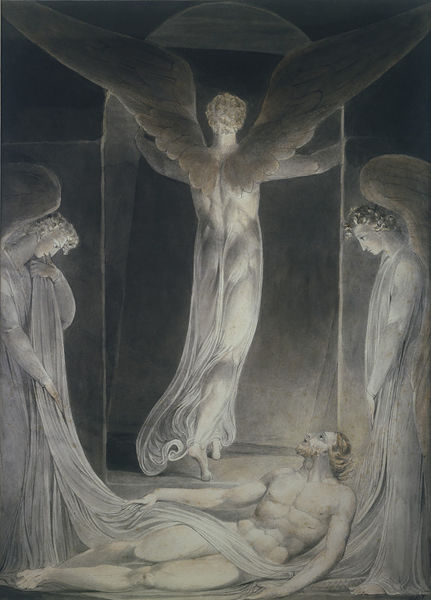
Within the sepulcher where the body of Jesus was lain, transformation took place. Blake interest was in the process through which the spirit was freed from the body which had encumbered it. The goal was to see the new spiritual man emerging from the tomb in which it had been enclosed.

Assistance from above was needed for release to occur. Angels were sent to remove the garment which Jesus wore in the world of matter. An angel also removed the stone which secured the body in a prison of law which had been provided as the pedagogue until man could live in the liberty of the spirit.

The apostle Paul wrote to the Galatians of the dichotomy between living under the liberty of faith, or under the dominance the law. Jesus introduced the reign of faith, and its incipience can be represented by the removal of the stone blocking the exit from the grave.

Galatians 3
[23] But before faith came, we were kept under the law, shut up unto the faith which should afterwards be revealed.
[24] Wherefore the law was our schoolmaster to bring us unto Christ, that we might be justified by faith.
[25] But after that faith is come, we are no longer under a schoolmaster.
[26] For ye are all the children of God by faith in Christ Jesus

Blake sets this picture within the sepulcher rather than in the garden where Mary first encountered and recognized the risen Christ. Angels are removing from the body of Jesus the linen cloth which will remain behind when Jesus is adorned with the glory of his new spiritual body. The stone which is removed from the entrance to the sepulcher is a rectangular, finished stone to indicate that it is the stone on which the law was written. The angel took it away because it blocked the door to the abundant life in the spirit. 

In esoteric teaching truth which is codified and hardened becomes an impediment to spiritual growth. To reach a higher level of truth, rigid, literal truth must be transcended, making way for the mind to be receptive to perceiving the infinite. 


Four Zoas, Night IX, PAGE 117, (E 386)
"               VALA

          Night the Ninth
               Being
          The Last Judgment

And Los & Enitharmon builded Jerusalem weeping      
Over the Sepulcher & over the Crucified body
Which to their Phantom Eyes appear'd still in the Sepulcher
But Jesus stood beside them in the Spirit Separating
Their Spirit from their body. Terrified at Non Existence 
For such they deemd the death of the body. Los his vegetable hands
Outstretchd his right hand branching out in fibrous Strength
Siezd the Sun. His left hand like dark roots coverd the Moon
And tore them down cracking the heavens across from immense to immense
Then fell the fires of Eternity with loud & shrill 
Sound of Loud Trumpet thundering along from heaven to heaven
A mighty sound articulate Awake ye dead & come
To judgment from the four winds Awake & Come away
Folding like scrolls of the Enormous volume of Heaven & Earth"

Everlasting Gospel, (E 522)
"My Sin thou hast forgiven me        
Canst thou forgive my Blasphemy
Canst thou return to this dark Hell
And in my burning bosom dwell
And canst thou Die that I may live
And canst thou Pity & forgive       
Then Rolld the shadowy Man away
From the Limbs of Jesus to make them his prey
An Ever devouring appetite
Glittering with festering Venoms bright
Crying Crucify this cause of distress
Who dont keep the secrets of Holiness
All Mental Powers by Diseases we bind
But he heals the Deaf & the Dumb & the Blind
Whom God has afflicted for Secret Ends
He comforts & Heals & calls them Friends  
But when Jesus was Crucified
Then was perfected his glittring pride
In three Nights he devourd his prey
And still he devours the Body of Clay
For Dust & Clay is the Serpents meat
Which never was made for Man to Eat"

Mark 15
[43] Joseph of Arimathaea, and honourable counseller, which also waited for the kingdom of God, came, and went in boldly unto Pilate, and craved the body of Jesus.
[44] And Pilate marvelled if he were already dead: and calling unto him the centurion, he asked him whether he had been any while dead.
[45] And when he knew it of the centurion, he gave the body to Joseph.
[46] And he bought fine linen, and took him down, and wrapped him in the linen, and laid him in a sepulchre which was hewn out of a rock, and rolled a stone unto the door of the sepulchre.
[47] And Mary Magdalene and Mary the mother of Joses beheld where he was laid.

John 20
[1] The first day of the week cometh Mary Magdalene early, when it was yet dark, unto the sepulchre, and seeth the stone taken away from the sepulchre.
[2] Then she runneth, and cometh to Simon Peter, and to the other disciple, whom Jesus loved, and saith unto them, They have taken away the Lord out of the sepulchre, and we know not where they have laid him.
[3] Peter therefore went forth, and that other disciple, and came to the sepulchre.
[4] So they ran both together: and the other disciple did outrun Peter, and came first to the sepulchre.
[5] And he stooping down, and looking in, saw the linen clothes lying; yet went he not in.
[6] Then cometh Simon Peter following him, and went into the sepulchre, and seeth the linen clothes lie,
[7] And the napkin, that was about his head, not lying with the linen clothes, but wrapped together in a place by itself.
[8] Then went in also that other disciple, which came first to the sepulchre, and he saw, and believed.
[9] For as yet they knew not the scripture, that he must rise again from the dead.
[10] Then the disciples went away again unto their own home.
[11] But Mary stood without at the sepulchre weeping: and as she wept, she stooped down, and looked into the sepulchre,
[12] And seeth two angels in white sitting, the one at the head, and the other at the feet, where the body of Jesus had lain.
[13] And they say unto her, Woman, why weepest thou? She saith unto them, Because they have taken away my Lord, and I know not where they have laid him.
[14] And when she had thus said, she turned herself back, and saw Jesus standing, and knew not that it was Jesus.

2ND Corinthians 3
[1] Do we begin again to commend ourselves? or need we, as some others, epistles of commendation to you, or letters of commendation from you?
[2] Ye are our epistle written in our hearts, known and read of all men:
[3] Forasmuch as ye are manifestly declared to be the epistle of Christ ministered by us, written not with ink, but with the Spirit of the living God; not in tables of stone, but in fleshy tables of the heart.
[4] And such trust have we through Christ to God-ward:
[5] Not that we are sufficient of ourselves to think any thing as of ourselves; but our sufficiency is of God;
[6] Who also hath made us able ministers of the new testament; not of the letter, but of the spirit: for the letter killeth, but the spirit giveth life.
[7] But if the ministration of death, written and engraven in stones, was glorious, so that the children of Israel could not stedfastly behold the face of Moses for the glory of his countenance; which glory was to be done away:
[8] How shall not the ministration of the spirit be rather glorious?
...
[15] But even unto this day, when Moses is read, the vail is upon their heart.
[16] Nevertheless when it shall turn to the Lord, the vail shall be taken away.
[17] Now the Lord is that Spirit: and where the Spirit of the Lord is, there is liberty.
[18] But we all, with open face beholding as in a glass the glory of the Lord, are changed into the same image from glory to glory, even as by the Spirit of the Lord.

Maurice Nicoll in his book The New Man taught of the process of transition as man develops psychologically:
 
Page 11
"Stone represents the most external and literal form of esoteric Truth. It represents esoteric Truth in its most inflexible sense. The commandments were written on tables of stone.
It must be understood that Truth about a higher evolution must rest upon a firm basis, for those incapable of seeing any deeper meaning."

Page 17
"What they taught a man was that he was an individual—that is, unique—who could reach this higher state of himself and that this was his real meaning and that this only could satisfy him most deeply. They began with teaching this Truth—or knowledge of this special Truth—but they led to something else. They led from Truth to a definite state of a man where he acted no longer from the Truth that brought him up to this level, but from the level itself. This was sometimes called  Good. All Truth must lead to some good state as its goal.
This was the idea belonging to the term "vineyard". Wine was produced. A man began to act from Good, not Truth, thus becoming a New Man."

.

Wednesday, April 27, 2016

IMAGES OF CHRIST 9

British Museum
Illustrations to Young's Night Thoughts
Pontius Pilate didn't choose to be involved. The case against Jesus shouldn't have been his concern. The Jewish Sanhedrin, not the Roman government initiated the complaint against Jesus. According to the Jewish authorities Jesus was breaking the law of Moses. But if he could be found to have plotted against Roman rule, he could be executed for the crime of which he was accused.
 
Although Pilate found no fault with Jesus before Roman law, he was too weak to set Jesus free. When a bloodthirsty mob demanded his crucifixion, Jesus was sentenced and delivered by Pilate to humiliation and death.
 
Pilate represents the contrasting attitude to that of Mary Magdalene. She could see the truth of the message of love and forgiveness Jesus offered. He could see only that it was politically expedient for him to ignore the truth of the innocence of Jesus. Mary Magdalene was open to receiving the gift of life which Jesus offered her; Pilate was closed to understanding that he was being offered a choice between following the path of integrity or the path of injustice.
 
Hymn by James Russell Lowell
"Once to every man and nation,
Comes the moment to decide,
In the strife of truth with falsehood,
For the good or evil side;
Some great cause, God’s new Messiah,
Offering each the bloom or blight,
And the choice goes by forever,
‘twixt that darkness and that light."
 

Luke 23
[10] And the chief priests and scribes stood and vehemently accused him.
[11] And Herod with his men of war set him at nought, and mocked him, and arrayed him in a gorgeous robe, and sent him again to Pilate.
[12] And the same day Pilate and Herod were made friends together: for before they were at enmity between themselves.
[13] And Pilate, when he had called together the chief priests and the rulers and the people,
[14] Said unto them, Ye have brought this man unto me, as one that perverteth the people: and, behold, I, having examined him before you, have found no fault in this man touching those things whereof ye accuse him:
[15] No, nor yet Herod: for I sent you to him; and, lo, nothing worthy of death is done unto him.
[16] I will therefore chastise him, and release him.
[17] (For of necessity he must release one unto them at the feast.)
[18] And they cried out all at once, saying, Away with this man, and release unto us Barabbas:
[19] (Who for a certain sedition made in the city, and for murder, was cast into prison.)
[20] Pilate therefore, willing to release Jesus, spake again to them.
[21] But they cried, saying, Crucify him, crucify him.
[22] And he said unto them the third time, Why, what evil hath he done? I have found no cause of death in him: I will therefore chastise him, and let him go.
[23] And they were instant with loud voices, requiring that he might be crucified. And the voices of them and of the chief priests prevailed.
[24] And Pilate gave sentence that it should be as they required.
[25] And he released unto them him that for sedition and murder was cast into prison, whom they had desired; but he delivered Jesus to their will.
 

Mark 15
[14] Then Pilate said unto them, Why, what evil hath he done? And they cried out the more exceedingly, Crucify him.
[15] And so Pilate, willing to content the people, released Barabbas unto them, and delivered Jesus, when he had scourged him, to be crucified.
 

Everlasting Gospel, (E 876)
"The Moral Virtues in Great fear
     Formed the Cross & Nails & Spear
     And the Accuser standing by
     Cried out Crucify Crucify
     Our Moral Virtues neer can be
     Nor Warlike pomp & Majesty
     For Moral Virtues all begin
     In the Accusations of Sin"

Description of the Last Judgment, (E 558)
"Two persons one in Purple the other in Scarlet are
descending 
these are Caiphas & Pilate Two States where all those reside who
Calumniate & Murder under Pretence of Holiness & Justice
Caiphas has a Blue Flame like a Miter on his head   Pilate has
bloody hands that never can be cleansed the Females behind them 
represent the Females belonging to such States who are under
perpetual terrors & vain dreams plots & secret deceit.  Those
figures that descend into the Flames before Caiphas & Pilate are
Judas & those of his Class"  

Annotations to Bacon, (E 621)
"Self Evident Truth is one Thing and Truth the result of
Reasoning is another Thing Rational Truth is not the Truth of
Christ but of Pilate   It is the Tree of the Knowledge of Good &
Evil"

Annotations to Thornton, (E 667)
"Christ & his Apostles were Illiterate Men   Caiphas Pilate &
Herod were Learned.
     The Beauty of the Bible is that the most Ignorant & Simple
Minds Understand it Best"

Blake pictures Jesus, his hands shackled, standing passively in the Hall of Judgment before Pilate. The crowd shouts for Jesus to be crucified as Pilate turns away denying responsibility for the chain of events that his refusal to act from his own inner sense of justice had initiated.
.