Blake seeks to provide the Golden String which can lead us through the labyrinth of our experience or his own poetry.

Friday, April 10, 2020

HOLY WEEK 3

First Posted July 2012 as AGONY IN THE GARDEN.

Luke 22
[39] And he came out, and went, as he was wont, to the mount of Olives; and his disciples also followed him.
[40] And when he was at the place, he said unto them, Pray that ye enter not into temptation.
[41] And he was withdrawn from them about a stone's cast, and kneeled down, and prayed,
[42] Saying, Father, if thou be willing, remove this cup from me: nevertheless not my will, but thine, be done.
[43] And there appeared an angel unto him from heaven, strengthening him.
[44] And being in an agony he prayed more earnestly: and his sweat was as it were great drops of blood falling down to the ground.
[45] And when he rose up from prayer, and was come to his disciples, he found them sleeping for sorrow,
[46] And said unto them, Why sleep ye? rise and pray, lest ye enter into temptation.
[47] And while he yet spake, behold a multitude, and he that was called Judas, one of the twelve, went before them, and drew near unto Jesus to kiss him.
Wikidata.org 
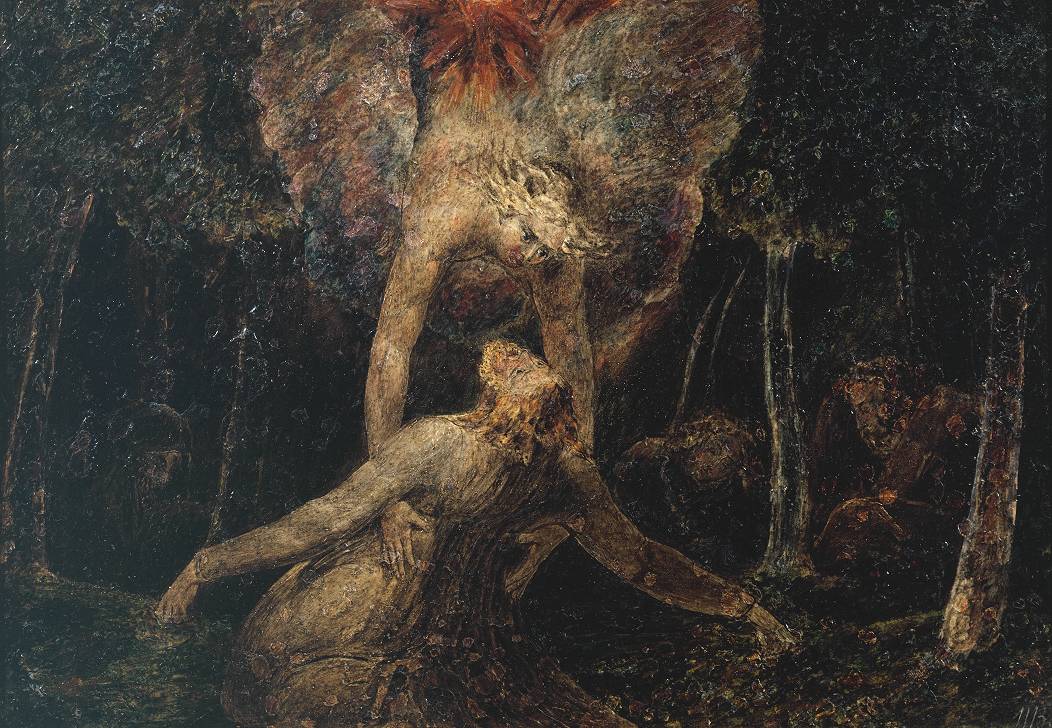
 Agony in the Garden 
In Blake's image called 'Agony in the Garden' the two central figures, Jesus and the comforter, are in the light. The disciples who accompanied Jesus are barely visible in the surrounding shadows. The title of the picture aptly describes the state of mind of Jesus as he struggles to understand and accept the role he is to play in the redemption of humanity. But the figure reaching down to support Jesus is portrayed as equally central to the dynamic event. We may name this figure, who is in the human form although reaching out of a cloud and the source of radiating energy and light, the Holy Spirit.

Many times Blake reiterated the theme that man is not alone in his situation no matter how bleak the circumstances look. God has made provisions for the return of man to the eternal condition of unity, forgiveness and brotherhood.
 

Four Zoas, Page 56, (E 338)
"And first he found the Limit of Opacity & namd it Satan
In Albions bosom for in every human bosom these limits stand
And next he found the Limit of Contraction & namd it Adam
While yet those beings were not born nor knew of good or Evil

Then wondrously the Starry Wheels felt the divine hand. Limit
Was put to Eternal Death Los felt the Limit & saw
The Finger of God touch the Seventh furnace in terror
And Los beheld the hand of God over his furnaces
Beneath the Deeps in dismal Darkness beneath immensity
And he who takes vengeance alone is the criminal of Providence;"

Jerusalem, Plate 62, (E 213)
"Jesus replied. I am the Resurrection & the Life.
I Die & pass the limits of possibility, as it appears
To individual perception. Luvah must be Created
And Vala; for I cannot leave them in the gnawing Grave.
But will prepare a way for my banished-ones to return
Come now with me into the villages. walk thro all the cities.
Tho thou art taken to prison & judgment, starved in the streets
I will command the cloud to give thee food & the hard rock
To flow with milk & wine, tho thou seest me not a season
Even a long season & a hard journey & a howling wilderness!
Tho Valas cloud hide thee & Luvahs fires follow thee!
Only believe & trust in me, Lo. I am always with thee!"

Jerusalem, Plate 82, (E 241) 
"Los saw & was comforted at his Furnaces uttering thus his voice.
I know I am Urthona keeper of the Gates of Heaven,
And that I can at will expatiate in the Gardens of bliss;
But pangs of love draw me down to my loins which are
Become a fountain of veiny pipes: O Albion! my brother!
Plate 83
Corruptibility appears upon thy limbs, and never more
Can I arise and leave thy side, but labour here incessant
Till thy awaking! yet alas I shall forget Eternity! Against the
Patriarchal pomp and cruelty, labouring incessant
I shall become an Infant horror. Enion! Tharmas! friends
Absorb me not in such dire grief: O Albion, my brother!
Jerusalem hungers in the desart! affection to her children!
The scorn'd and contemnd youthful girl, where shall she fly?
Sussex shuts up her Villages. Hants, Devon & Wilts
Surrounded with masses of stone in orderd forms, determine then
A form for Vala and a form for Luvah, here on the Thames
Where the Victim nightly howls beneath the Druids knife:
A Form of Vegetation, nail them down on the stems of Mystery:
O when shall the Saxon return with the English his redeemed brother!
O when shall the Lamb of God descend among the Reprobate!"

Much of Blake's vision is the ability to recognize and understand the 'ways of God' as he provides the means that man may perceive his own Divine Humanity. For Blake the spirit is always reaching down and lifting up and becoming one with his beloved mankind.

.

Thursday, April 9, 2020

HOLY WEEK 2

First posted May 2012.

LAST SUPPER

Letters, (E 703)
"Mr [George] Cumberland, Bishopsgate, Windsor Great Park
Hercules Buildings, Lambeth. Augst 26. 1799
Dear Cumberland
...
Pray let me intreat you to persevere in your Designing it is the only source of Pleasure all your other pleasures depend upon It. It is the Tree Your Pleasures are the Fruit. Your Inventions of Intellectual Visions are the Stamina of every thing you value. Go on if not for your own sake yet for ours who love & admire your works. but above all For the Sake of the Arts. Do not throw aside for any long time the honour intended you by Nature to revive the Greek workmanship. I study your outlines as usual just as if they were antiques. As to Myself about whom you are so kindly Interested. I live by Miracle. I am Painting small Pictures from the Bible. For as to Engraving in which art I cannot reproach myself with any neglect yet I am laid by in a corner as if I did not Exist & Since my Youngs Night Thoughts have been publishd Even Johnson & Fuseli have discarded my Graver. But as I know that He who Works & has his health cannot starve. I laugh at Fortune & Go on & on. I think I foresee better Things than I have ever seen. My Work pleases my employer & I have an order for Fifty small Pictures at One Guinea each which is Something better than mere copying after another artist. But above all I feel myself happy & contented let what will come having passed now near twenty years in ups & downs I am used to them & perhaps a little practise in them may turn out to benefit. It is now Exactly Twenty years since I was upon the ocean of business & Tho I laugh at Fortune I am perswaded that She Alone is the Governor of Worldly Riches. & when it is Fit She will call on me till then I wait with Patience in hopes that She is busied among my Friends. With Mine & My Wifes best compliments to Mrs Cumberland I remain
Yours sincerely
WILLm BLAKE"

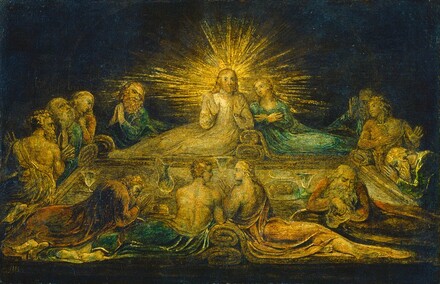
One of the tempera paintings which Blake made for Thomas Butts in 1799 is a portrayal of the Last Supper. Blake created a dramatic image of Jesus and the twelve disciples involved in a scene where each displays his individual emotions at this critical juncture. Jesus himself, surrounded by the radiance, looks beyond his present circumstances to a future that is to be revealed. His hand gesture seems to be that of reluctant acceptance. 

Gathered around Jesus are the twelve men whom he chose as his special companions. Each seems to be in his own separate world: praying, contemplating the past or future, or meditating on the strange events which have taken place and where they might lead. Beside Jesus sits 'the disciple whom Jesus loved' appearing in Blake's portrayal to assume feminine characteristics. In the foreground to the left there might be Peter already traumatised by knowing he would be tempted to deny his Lord. To his right the two figures deep in discussion may be continuing their earlier discussion about who would be greatest in the kingdom. Most easily recognised is Judas to the right counting the coins he had accepted to betray Jesus to the authorities. Each disciple struggles with his own issues including doubts, awe, disappointment, fears and anticipation of possible outcomes.


National Gallery Washington
1799
Rosenwald Collection

A Descriptive Catalog, (E 543)
"Mr. B. has done, as all the ancients did, and as all the moderns, who are worthy of fame, given the historical fact in its poetical vigour; so as it always happens, and not in that dull way that some Historians pretend, who being weakly organized themselves, cannot see either miracle or prodigy; all is to them a dull round of probabilities and possibilities; but the history of all times and places, is nothing else but improbabilities and impossibilities; what we should say, was impossible if we did not see it always before our eyes."

Jerusalem , Plate 13, (E 157)
"And all that has existed in the space of six thousand years:
Permanent, & not lost not lost nor vanishd, & every little act,
Word, work, & wish, that has existed, all remaining still
In those Churches ever consuming & ever building by the Spectres
Of all the inhabitants of Earth wailing to be Created:
Shadowy to those who dwell not in them, meer possibilities:
But to those who enter into them they seem the only substances
For every thing exists & not one sigh nor smile nor tear,
Plate 14
One hair nor particle of dust, not one can pass away." 

Wednesday, April 8, 2020

HOLY WEEK 1

Entry of Christ into Jerusalem 
Reposted from April 2015 
 
Luke 19
[28] And when he had thus spoken, he went before, ascending up to Jerusalem.
[29] And it came to pass, when he was come nigh to Bethphage and Bethany, at the mount called the mount of Olives, he sent two of his disciples,
[30] Saying, Go ye into the village over against you; in the which at your entering ye shall find a colt tied, whereon yet never man sat: loose him, and bring him hither.
[31] And if any man ask you, Why do ye loose him? thus shall ye say unto him, Because the Lord hath need of him.
[32] And they that were sent went their way, and found even as he had said unto them.
[33] And as they were loosing the colt, the owners thereof said unto them, Why loose ye the colt?
[34] And they said, The Lord hath need of him.
[35] And they brought him to Jesus: and they cast their garments upon the colt, and they set Jesus thereon.
[36] And as he went, they spread their clothes in the way.
[37] And when he was come nigh, even now at the descent of the mount of Olives, the whole multitude of the disciples began to rejoice and praise God with a loud voice for all the mighty works that they had seen;
[38] Saying, Blessed be the King that cometh in the name of the Lord: peace in heaven, and glory in the highest.

[39] And some of the Pharisees from among the multitude said unto him, Master, rebuke thy disciples.
[40] And he answered and said unto them, I tell you that, if these should hold their peace, the stones would immediately cry out.
[41] And when he was come near, he beheld the city, and wept over it,
 
John 12
[12] On the next day much people that were come to the feast, when they heard that Jesus was coming to Jerusalem,
[13] Took branches of palm trees, and went forth to meet him, and cried, Hosanna: Blessed is the King of Israel that cometh in the name of the Lord.
[14] And Jesus, when he had found a young ass, sat thereon; as it is written,
[15] Fear not, daughter of Sion: behold, thy King cometh, sitting on an ass's colt.
[16] These things understood not his disciples at the first: but when Jesus was glorified, then remembered they that these things were written of him, and that they had done these things unto him.

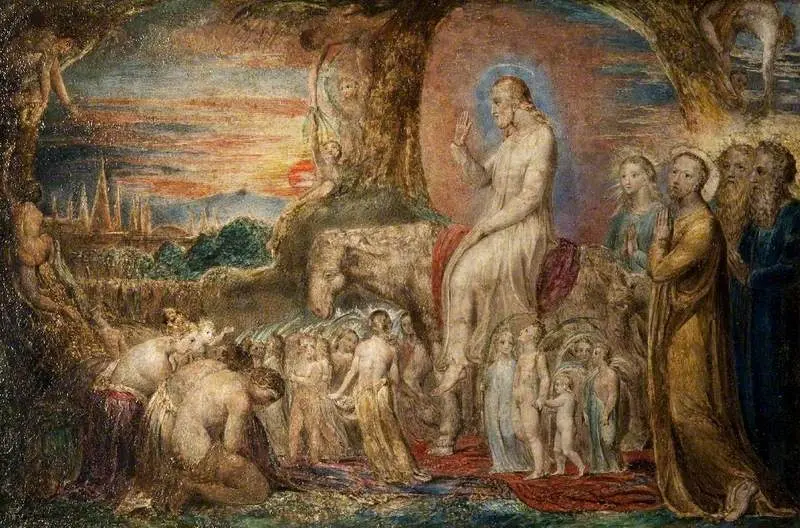
This image by Blake painted in oil on copper for Thomas Butts is out of the ordinary even for Blake. The subject of Jesus entering Jerusalem on Palm Sunday receives a distinctive treatment. Jesus and his party of disciples enjoy a conventional treatment although they display the elongated bodies and reduced sized heads which Blake adopted for a period of time. The crowd gathered around Jesus are definitely unconventional since they are in various degrees of undress. The contrasting sizes of the various figures leads to a confusion of scale and perspective.
 

The 'window' through which Jerusalem is visible is framed by trees which are being climbed by figures of individuals attempting to reach a higher level. Jerusalem is not pictured as the earthly city of Jesus's day but as the heavenly Jerusalem of the vision of John of Patmos.
 

During the period when Blake was reevaluating Classical thought as an influence on his myth and prophecy, he seems to have reconsidered the neoclassical style of art which he had adopted in much of his work. Neoclassicism gained prominence with the enlightenment; Blake looked to replace them both. This picture owes much to Mannerism, a style of the 16th century. According to this National Gallery website Mannerism demonstrated that "excellence in painting demanded refinement, richness of invention, and virtuoso technique, criteria that emphasized the artist’s intellect." Blake found that this technique allowed him to use his intellect  and inventiveness to stimulate a fresh view of a Biblical scene which could be opened to vision.
Four Zoas, Night IX, Page 122, (E 391)
"The times revolve the time is coming when all these delights
Shall be renewd & all these Elements that now consume            
Shall reflourish. Then bright Ahania shall awake from death
A glorious Vision to thine Eyes a Self renewing Vision  
The spring. the summer to be thine then Sleep the wintry days
In silken garments spun by her own hands against her funeral
The winter thou shalt plow & lay thy stores into thy barns       
Expecting to recieve Ahania in the spring with joy
Immortal thou. Regenerate She & all the lovely Sex
From her shall learn obedience & prepare for a wintry grave
That spring may see them rise in tenfold joy & sweet delight
Thus shall the male & female live the life of Eternity           
Because the Lamb of God Creates himself a bride & wife
That we his Children evermore may live in Jerusalem
Which now descendeth out of heaven a City yet a Woman
Mother of myriads redeemd & born in her spiritual palaces
By a New Spiritual birth Regenerated from Death
 
. 

Friday, April 3, 2020

REMEMBERING

British Museum
Illustrations to Young's Night Thoughts

In 2011 Larry and I each selected some passages from Blake's poetry which we found had entered our minds and lodged there because they are appropos to our condition. Here are a few more quotes which move me although I have not committed them to memory. I wish I had as ready mental access to Blake's poetry as I have to simple songs that I learned in childhood, to popular songs from in youth, and to hymns I learned through years of church attendance. It seems to me that the combination of music and words was the key to remembering. Writing posts for this blog is now my tool for learning what Blake had to teach.
 
Four Zoas, Night V, Page 64, (E 343)
"He gave to me a silver scepter & crownd me with a golden crown
& said Go forth & guide my Son who wanders on the ocean   
I went not forth. I hid myself in black clouds of my wrath"

Four Zoas, Night VII,  Page 98 [90], (E 370)
"if thou my Los
Wilt in sweet moderated fury. fabricate forms sublime     
Such as the piteous spectres may assimilate themselves into
They shall be ransoms for our Souls that we may live"

Four Zoas, Night VII,  Page 98 [90], (E 370)
"And first he drew a line upon the walls of shining heaven    
And Enitharmon tincturd it with beams of blushing love"

Milton, Plate 28 [30], (E 126)
"While the poor indigent is like the diamond which tho cloth'd
In rugged covering in the mine, is open all within
And in his hallowd center holds the heavens of bright eternity"

Jerusalem, Plate 88, (E 247)
"The blow of his Hammer is Justice. the swing of his Hammer: Mercy.
The force of Los's Hammer is eternal Forgiveness;" 

Four Zoas, Night I, Page 9, (E 304)
"Then Eno a daughter of Beulah took a Moment of Time      
And drew it out to Seven thousand years with much care & affliction 
And many tears & in Every year made windows into Eden   
She also took an atom of space & opend its center
Into Infinitude & ornamented it with wondrous art"

Letters,  To Trusler, (E 702)
"But you ought to know that What is Grand is necessarily obscure to
Weak men.  That which can be made Explicit to the Idiot is not
worth my care.  The wisest of the Ancients considerd what is not
too Explicit as the fittest for Instruction because it rouzes the
faculties to act."

Letters, to Butts, (E 712)
"Each grain of Sand
     Every Stone on the Land
     Each rock & each hill
     Each fountain & rill
     Each herb & each tree
     Mountain hill Earth & Sea
     Cloud Meteor & Star
     Are Men Seen Afar
...
And I heard his voice Mild
     Saying This is My Fold
     O thou Ram hornd with gold
...
The loud sea & deep gulf
     These are guards of My Fold
     O thou Ram hornd with gold"

Letters, to Butts, (E 722)
"This Earth breeds not our happiness"
     "Another Sun feeds our lifes streams"
     "We are not warmed with thy beams"
     "Thou measurest not the Time to me"
     "Nor yet the Space that I do see"
     "My Mind is not with thy light arrayd"
     "Thy terrors shall not make me afraid"
...
 Now I a fourfold vision see
     And a fourfold vision is given to me
     Tis fourfold in my supreme delight
     And three fold in soft Beulahs night
     And twofold Always.  May God us keep
     From Single vision & Newtons sleep"

Milton, Plate 30 (E 808)
[Inscription in reverse writing]
"How wide the Gulf &
Unpassable! between Simplicity & Insipidity / Contraries are
Positives / A Negation is not a Contrary"

.

Saturday, March 28, 2020

Read White

Wikipedia Commons
Little Tom the Sailor
Illustration for Broadside

A Temperal and Eternal Bible 

Posted by Larry in Nov 2010; added picture and quotes.

Speaking of the Bible in The Everlasting Gospel Blake wrote:
"Both read the Bible day & night
But thou readst black where I read white"

Too often people reading 'black' concern themselves with foolish questions such as "Did it really happen? Was Jonah really swallowed by the whale, or rather by the big fish?" But in Blake's vision that isn't the important thing. The important thing is "What does it mean?" The reader of the black book gets himself tied up in knots about the veracity or historicity of Jonah and his aquatic friend.


Blake shows you the Jonah in your psyche and helps you get some grasp of what the turbulent sea means to you personally. It's experiential, exciting! it puts you in touch with reality! Literal or symbolic is black or white, and probably the two minds will never meet. At this point I simply urge you to join Blake and read white:

    "Why is the Bible more Entertaining & Instructive than any other book? Is it not because [it is] addressed to the Imagination which is Spiritual Sensation, and but mediately to the Understanding or Reason?"
    (Letter To Trusler; Erdman 702-3)
Blake ascribes this imaginative faculty to his hero, Los;

    "He could controll the times & seasons & the days & years."
    [And Los says of himself:]
    I am that Shadowy Prophet who Six Thousand Years ago
    Fell from my station in the Eternal bosom. Six Thousand Years
    Are finish'd. I return! both Time & Space obey my will.
    I in Six Thousand Years walk up and down; for not one Moment
    Of Time is lost, nor one Event of Space unpermanent,
    But all remain: every fabric of Six Thousand Years
    Remains permanent, tho' on the Earth where Satan
    Fell and was cut off, all things vanish & are seen no more,
    They vanish not from me & mine, we guard them first & last.
    The generations of men run on in the tide of Time,
    But leave their destin'd lineaments permanent for ever & ever."
    (The Four Zoas [Night 1], 9.27, and Milton 22:15-25; Erdman 305 and 116)
Like Los Blake walks up and down the biblical scene from Adam to John of Patmos. He takes what best serves his purpose, or rather the biblical symbols rearrange themselves kaleidoscopically into his visions of Eternity. These together add up to a cogent and provocative commentary on the Bible and on its child, the Christian faith.
 
Out of this intuitive unconscious process arose the great themes of his faith, embodied in his art: the universal man, fallen and fractured, struggling, redeemed and returning in the fullness of time into the blessed Unity from which he came. This is the essential story of the Bible for one who reads it whole and without the constraints and blinders of what I have called the black book.


Four Zoas, Night VIII, Page 114 [110], (E 385)
"The Lamb of God has rent the Veil of Mystery soon to return
In Clouds & Fires around the rock & the Mysterious tree
As the seed waits Eagerly watching for its flower & fruit
Anxious its little soul looks out into the clear expanse
To see if hungry winds are abroad with their invisible army 
So Man looks out in tree & herb & fish & bird & beast
Collecting up the scatterd portions of his immortal body
Into the Elemental forms of every thing that grows
He tries the sullen north wind riding on its angry furrows
The sultry south when the sun rises & the angry east 
When the sun sets when the clods harden & the cattle stand
Drooping & the birds hide in their silent nests. he stores his thoughts
As in a store house in his memory he regulates the forms
Of all beneath & all above   & in the gentle West
Reposes where the Suns heat dwells   he rises to the Sun
And to the Planets of the Night & to the stars that gild
The Zodiac & the stars that sullen stand to north & south
He touches the remotest pole & in the Center weeps
That Man should Labour & sorrow & learn & forget & return
To the dark valley whence he came to begin his labours anew
In pain he sighs in pain he labours in his universe
Screaming in birds over the deep & howling in the Wolf
Over the slain & moaning in the cattle & in the winds
And weeping over Orc & Urizen in clouds & flaming fires  
And in the cries of birth & in the groans of death his voice 
Is heard throughout the Universe whereever a grass grows
Or a leaf buds   The Eternal Man is seen is heard   is felt
And all his Sorrows till he reassumes his ancient bliss

Such are the words of Ahania & Enion. Los hears & weeps"  

Annotations to Watson, (E 617)
"Prophets in the modern sense of the word have never existed
Jonah was no prophet in the modern sense for his prophecy of
Nineveh failed   Every honest man is a Prophet he utters his
opinion both of private & public matters/Thus/If you go on So/the
result is So/He never says such a thing shall happen let you do
what you will. a Prophet is a Seer not an Arbitrary Dictator.  
It is mans fault if God is not able to do him good. for he gives
to the just & to the unjust but the unjust reject his gift"

Poetical Sketches, (E 415)
           "SONG.
Memory, hither come,
  And tune your merry notes;
And, while upon the wind,
  Your music floats,
I'll pore upon the stream,
Where sighing lovers dream,      
And fish for fancies as they pass
Within the watery glass.

I'll drink of the clear stream,
  And hear the linnet's song;      
And there I'll lie and dream
  The day along:
And, when night comes, I'll go
  To places fit for woe;
Walking along the darken'd valley,   
  With silent Melancholy.


Tuesday, March 24, 2020

FRYE & ARCHETYPE

Yale Center for British Art
Jerusalem
Detail of Plate 62
After writing Fearful Symmetry, Northrop Frye wrote Anatomy of Criticism to further explore the aspects of literary criticism to which his acquaintance with Blake had led. Although Frye understood the use to which Jung had put the word Archetype, he choose to use the word as a more general term. His archetype referred to a pervasive, widely accepted symbol rather than content of the unconscious working its way into conscious thought.

He recognized that in trying to link literary works over time and type, some symbols played a particularly significant role. But he did not draw the conclusion that the symbols he studied in Blake and linked with antiquity, lived within his own mind through the collective unconscious. Perhaps because we inherently think of ourselves as separate individuals we initially resist the idea that there is a symbolic language to which we can all tune our ears because it is written in the psyche. 

Anatomy  of  Criticism, by Northrop Frye
FOUR  ESSAYS 
With  a  Foreword by Harold Bloom


Page xiii
"This book forced itself on me while I was trying to write some­thing else, and it probably still bears the marks of the reluctance with which a great part of it was composed. After completing a study of William Blake (Fearful Symmetry, 1947), I determined to apply the principles of literary symbolism and Biblical typology which I had learned from Blake to another poet, preferably one who had taken these principles from the critical theories of his own day, instead of working them out by himself as Blake did. I therefore began a study of Spenser's Faerie Queene, only to dis­cover that in my beginning was my end. The introduction to Spenser became an introduction to the theory of allegory, and that theory obstinately adhered to a much larger theoretical structure. The basis of argument became more and more discursive, and less and less historical and Spenserian. I soon found myself entangled in those parts of criticism that have to do with such words as "myth," "symbol," "ritual," and "archetype," and my efforts to make sense of these words in various published articles met with enough interest to encourage me to proceed further along these lines. Eventually the theoretical and the practical aspects of the task I had begun completely separated. What is here offered is pure critical theory, and the omission of all specific criticism, even, in three of the four essays, of quotation, is deliberate. The present book seems to me, so far as I can judge at present, to need a com­plementary volume concerned with practical criticism, a sort of morphology of literary symbolism."

Page 99
"It is concerned, therefore, with the social aspect of poetry, with poetry as the focus of a community. The symbol in this phase is the communicable unit, to which I give the name archetype: that is, a typical or recurring image. I mean by an archetype a symbol which connects one poem with another and thereby helps to unify and integrate our literary experience. And as the archetype is the communicable symbol, archetypal criticism is primarily con­cerned with literature as a social fact and as a mode of communica­tion. By the study of conventions and genres, it attempts to fit poems into the body of poetry as a whole."

Page 118
"If archetypes are communicable symbols, and there is a center of archetypes, we should expect to find, at that center, a group of universal symbols. I do not mean by this phrase that there is any archetypal code book which has been memorized by all human societies without exception. I mean that some symbols are images of things common to all men, and therefore have a communicable power which is potentially unlimited. Such symbols include those of food and drink, of the quest or journey, of light and darkness, and of sexual fulfilment, which would usually take the form of marriage."

Page 291
"This is why I call the form the archetypal masque, the word archetype being in this con­text used in Jung's sense of an aspect of the personality capable of dramatic projection. Jung's persona and anima and counsellor and shadow throw a great deal of light on the characterization of mod­ern allegorical, psychic, and expressionist dramas, with their circus barkers and wraith-like females and inscrutable sages and obsessed demons."

Page 304
The essential difference between novel and romance lies in the conception of characterization. The romancer does not attempt to create "real people" so much as stylized figures which expand into psychological archetypes. It is in the romance that we find Jung's libido, anima, and shadow reflected in the hero, heroine, and vil­lain respectively. That is why the romance so often radiates a glow of subjective intensity that the novel lacks, and why a suggestion of allegory is constantly creeping in around its fringes. Certain elements of character are released in the romance which make it nat­urally a more revolutionary form than the novel. The novelist deals with personality, with characters wearing their personae or social masks. He needs the framework of a stable society, and many of our best novelists have been conventional to the verge of fussiness. The romancer deals with individuality, with characters in vacuo idealized by revery, and, however conservative he may be, something nihilistic and untamable is likely to keep breaking out of his pages."

Page 353
"It looks now as though Freud's view of the Oedipus complex were a psychological conception that throws some light on literary criticism. Perhaps we shall eventually decide that we have got it the wrong way round: that what happened was that the myth of Oedi­pus informed and gave structure to some psychological investiga­tions at this point. Freud would in that case be exceptional only in having been well read enough to spot the source of the myth. It looks now as though the psychological discovery of an oracular mind "underneath" the conscious one forms an appropriate al­legorical explanation of a poetic archetype that has run through literature from the cave of Trophonius to our own day. Perhaps it was the archetype that informed the discovery: it is after all con­siderably older, and to explain it in this way would involve us in less anachronism. The informing of metaphysical and theological constructs by poetic myths, or by associations and diagrams analo­gous to poetic myths, is even more obvious."


Try reading this as an archetype of birth into the physical world.
Jerusalem, Plate 56, (E 206)
"This World is all a Cradle for the erred wandering Phantom:
Rock'd by Year, Month, Day & Hour; and every two Moments
Between, dwells a Daughter of Beulah, to feed the Human Vegetable
Entune: Daughters of Albion. your hymning Chorus mildly!
Cord of affection thrilling extatic on the iron Reel:
To the golden Loom of Love! to the moth-labourd Woof
A Garment and Cradle weaving for the infantine Terror:
For fear; at entering the gate into our World of cruel           
Lamentation: it flee back & hide in Non-Entitys dark wild
Where dwells the Spectre of Albion: destroyer of Definite Form.
The Sun shall be a Scythed Chariot of Britain: the Moon; a Ship
In the British Ocean! Created by Los's Hammer; measured out
Into Days & Nights & Years & Months. to travel with my feet      
Over these desolate rocks of Albion: O daughters of despair!
Rock the Cradle, and in mild melodies tell me where found
What you have enwoven with so much tears & care? so much
Tender artifice: to laugh: to weep: to learn: to know;
Remember! recollect what dark befel in wintry days               

O it was lost for ever! and we found it not: it came
And wept at our wintry Door: Look! look! behold! Gwendolen
Is become a Clod of Clay! Merlin is a Worm of the Valley!"
 
. 

Saturday, March 21, 2020

DISINTEGRATION

Yale Center for British Art
Jerusalem
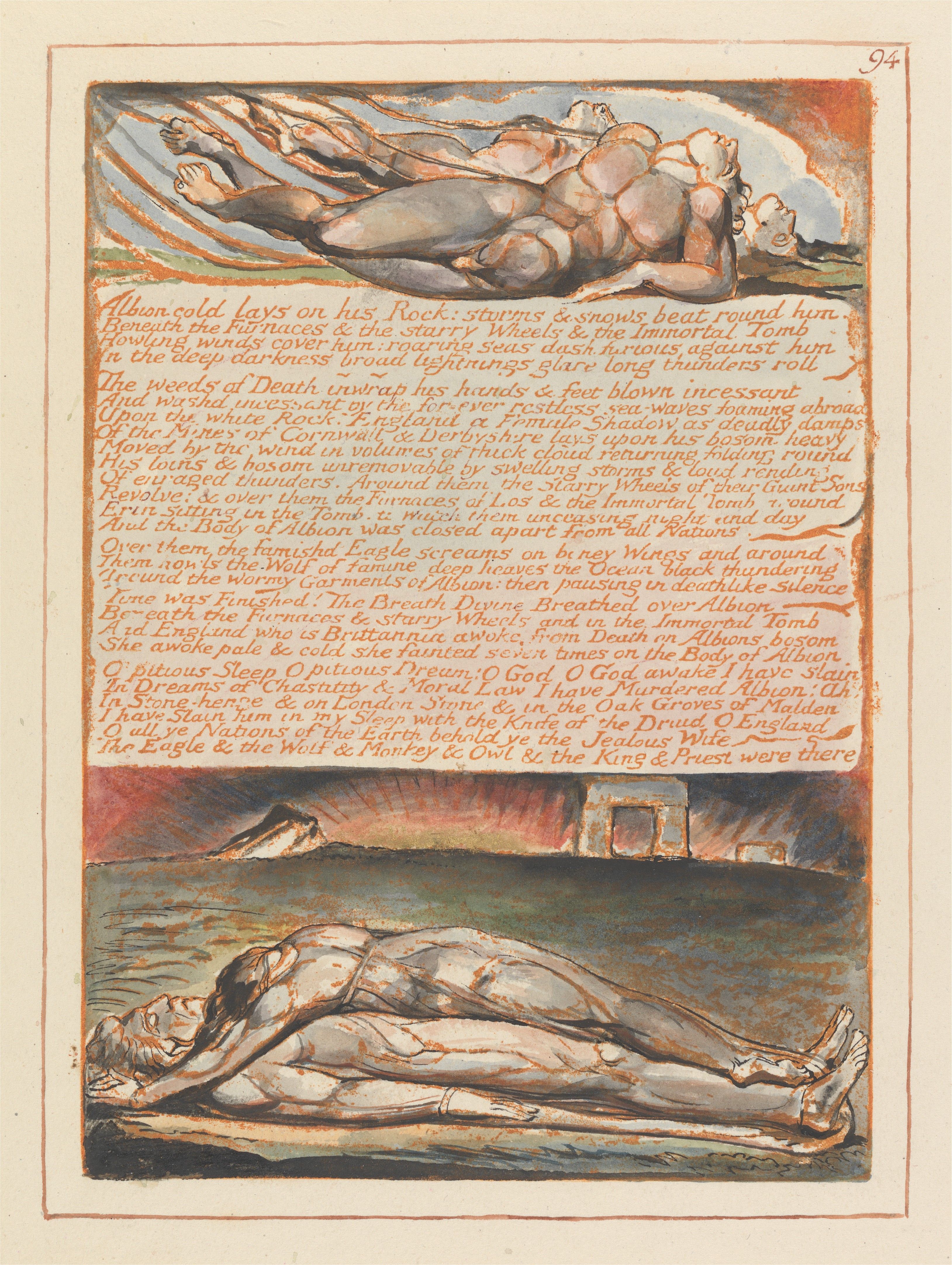
Plate 94

In his little book Blake: A Psychological Study Witcutt included a Chapter titled The Anatomy of Disintegration. In it he attempted to associate Blake's experiences in growing up with the conflicts among Blake's characters in his poems. Witcutt thought that there was an event in Blake's youth which was so traumatic for him that he enacted his psychic reactions in the interactions among his characters. Witcutt was a minister as well as a student of psychology: to him Blake endured a religious and a psychic trauma as he matured. He considers that there was a breakdown (perhaps associated with a sense of sinfulness) in Blake's psychological organization at about 14 years of age. This is the age at which Blake began his apprenticeship as well as the age associated with puberty. Whatever trauma may have occurred, it has not been identified.

Blake's early or juvenile poetry, which was published in Poetical Sketches, suggests a transition from an idyllic childhood to an adolescence of exploration. Since Blake did not attend school, he apparently assumed responsibility for educating himself. The poems included in Poetical Sketches were written between the ages of 12 and 20. It is clear from Frye's analysis of this work that Blake was not only writing poetry but learning from the masters how to write poetry. He would copy the styles of other poets in order to learn from them, but his intention was to invent his own style suitable for his intended content.

So Blake's teen years were occupied with studying literature, teaching himself how to be a poet, and learning the craft of engraving through his apprenticeship to Basire. He submitted to the discipline of being apprenticed in an exacting field. At the same time he educated himself in a complementary art to balance his ability to communicate graphically. He used his rational and physical abilities in learning engraving; he depended on his imagination and emotion to master poetry. If there was a struggle to coordinate multitude abilities, it helped him to see the inner facets of his mind which might either be in conflict or harmony.   

Perhaps the mythic figures which Blake created did not come from consciousness of failure and guilt as Witcutt indicated, but from the overwhelming sense of possibilities which must be coordinated in order for each to contribute to the wholeness of the man of the new age.


Quotes from W P Witcutt's Blake: A Psychological Study:
 
Page 52
"Sin causes the disorientation of all the powers of the soul;...
Blake, with his clear view of the symbolic forms in which the imagination clothes the inner workings of the soul, saw the whole drama enacted and re-enacted. It haunted him continually; literally he could think of little else...underneath the surface of his mind, a surface clear and transparent to him, he could not help seeing the turmoil caused by that shattering event."


Jerusalem, Plate 32 [36], (E 178)
"And the Four Zoa's clouded rage East & West & North & South      
They change their situations, in the Universal Man.
Albion groans, he sees the Elements divide before his face.
And England who is Brittannia divided into Jerusalem & Vala
And Urizen assumes the East, Luvah assumes the South
In his dark Spectre ravening from his open Sepulcher             

And the Four Zoa's who are the Four Eternal Senses of Man
Became Four Elements separating from the Limbs of Albion
These are their names in the Vegetative Generation
[West Weighing East & North dividing Generation South bounding]
And Accident & Chance were found hidden in Length Bredth & Highth
And they divided into Four ravening deathlike Forms
Fairies & Genii & Nymphs & Gnomes of the Elements.
These are States Permanently Fixed by the Divine Power" 
Page 58   
"Orc ('who is Luvah') is unloosed at the age of fourteen in the poem 'America' and bound at the same age in 'Vala.' These apparentlely contradictory symbols evidently refer to the same event, and seem to point to the conclusion that the Trauma took place in Blake's fourteenth year.

After his repression of Luvah Albion sinks down into a deathlike sleep upon a rock amid the waters of the unconscious."

Page 81
"The man of dominant thought would write out these psychological events in his own abstract terminology: but to the intuitive introvert such as Blake or Shelley they appear as the conflicts of awesome figures...The figures first of all appeared to his imagination just like a vivid dream, and enacted their dreamlike conflicts, made their speeches. It was afterwards that he puzzled, wondering, over what could be the meaning of their symbolic actions; and gave them names. His first instinct was always to draw what he had seen; thus it is that Blake's poetry is really a commentary on his engravings."

Page 90
"Jungian psychology recognizes another world from which thought may draw data - the inner world of the unconscious mind, the world of the archetypes. This was the only world in which Blake was interested; he repressed extroverted sensation to the utmost"

Page 91
"Blake was obsessed by the conflict of the four functions within himself and spent his life trying to resolve the conflict."

Page 102
"It would be hard to find a better statement of the process of disintegration, of the sinking of repressed functions into the unconscious ("buried beneath in dark obliviom") and of eventual reintegration." 
  
Four Zoas, Night IX, Page 126,(E 395)
"If Gods combine against Man Setting their Dominion above
The Human form Divine. Thrown down from their high Station       
In the Eternal heavens of Human Imagination: buried beneath  
In dark Oblivion with incessant pangs ages on ages
In Enmity & war first weakend then in stern repentance
They must renew their brightness & their disorganizd functions
Again reorganize till they resume the image of the human 
Cooperating in the bliss of Man obeying his Will
Servants to the infinite & Eternal of the Human form"

Milton, Plate 1, (E 95)
                 "To justify the Ways of God to Men

                           Preface.

The Stolen and Perverted Writings of Homer & Ovid: of Plato &
Cicero. which all Men ought to contemn: are set up by artifice
against the Sublime of the Bible. but when the New Age is at
leisure to Pronounce; all will be set right: & those Grand Works
of the more ancient & consciously & professedly Inspired Men,
will hold their proper rank, & the Daughters of Memory shall
become the Daughters of Inspiration. Shakspeare & Milton were
both curbd by the general malady & infection from the silly Greek
& Latin slaves of the Sword.

     Rouze up O Young Men of the New Age! set your foreheads
against the ignorant Hirelings! For we have Hirelings in the
Camp, the Court, & the University: who would if they could, for
ever depress Mental & prolong Corporeal War. Painters! on you I
call! Sculptors! Architects! Suffer not the fash[i]onable Fools
to depress your powers by the prices they pretend to give for
contemptible works or the expensive advertizing boasts that they
make of such works; believe Christ & his Apostles that there is a
Class of Men whose whole delight is in Destroying. We do not 
want either Greek or Roman Models if we are but just & true to
our own Imaginations, those Worlds of Eternity in which we shall
live for ever; in Jesus our Lord."