Blake seeks to provide the Golden String which can lead us through the labyrinth of our experience or his own poetry.

Showing posts with label Arlington Tempera. Show all posts

Monday, January 13, 2025

The Cave

 First posted Feb 2013

The Cave is often considered a place where consciousness is submerged as for example Plato’s Cave:

                    "The Allegory of the Cave

Plato realized that the general run of humankind can think, and speak, etc.,
without (so far as they acknowledge) any awareness of his realm of Forms.
The allegory of the cave is supposed to explain this.

In the allegory, Plato likened people untutored in the Theory of Forms to
prisoners chained in a cave, unable to turn their heads. All they can see is
the wall of the cave. Behind them burns a fire. Between the fire and the
prisoners there is a parapet, along which puppeteers can walk. The
puppeteers, who are behind the prisoners, hold up puppets that cast
shadows on the wall of the cave. The prisoners are unable to see these
puppets, the real objects, that pass behind them. What the prisoners see
and hear are shadows and echoes cast by objects that they do not see.
Such prisoners would mistake appearance for reality. They would think the
things they see on the wall (the shadows) were real; they would know nothing
of the real causes of the shadows."

(From Great Dialogues of Plato (Warmington and Rouse, eds.) New York,
Signet Classics: 1999. p. 316.)


The Cave appears often in Genesis:

Genesis 19:30
And Lot went up out of Zoar, and dwelt in the mountain, and his
two daughters with him; for he feared to dwell in Zoar:
and he dwelt in a cave, he and his two daughters.

Genesis 23:9
That he may give me the cave of Machpelah, which he hath, which is
in the end of his field; for as much money as it is worth he shall give it
me for a possession of a buryingplace amongs you.

Genesis 23:11
Nay, my lord, hear me: the field give I thee, and the cave that is herein, I give
it thee; in the presence of the sons of my people give I it thee: bury thy dead.

Genesis 23:17
And the field of Ephron which was in Machpelah, which was before Mamre,
the field, and the cave which was therein, and all the trees that were in the
field, that were in all the borders round about, were made sure.

Genesis 23:19
And after this, Abraham buried Sarah his wife in the cave of the field of
Machpelah before Mamre: the same is Hebron in the land of Canaan.

Genesis 23:20
And the field, and the cave that is therein, were made sure unto Abraham for
a possession of a buryingplace by the sons of Heth.

Genesis 25:9
And his sons Isaac and Ishmael buried him in the cave of Machpelah, in the
field of Ephron the son of Zohar the Hittite, which is before Mamre;
And he charged them, and said unto them, I am to be gathered unto my
people: bury me with my fathers in the cave that is in the field of Ephron the
Hittite,

Genesis 49:30
In the cave that is in the field of Machpelah, which is before Mamre, in the
land of Canaan
, which Abraham bought with the field of Ephron the Hittite
for a possession of a buryingplace.

Genesis 49:32
The purchase of the field and of the cave that is therein was from the
children of Heth.

Genesis 50:13
For his sons carried him into the land of Canaan, and buried him in the cave
of the field of Machpelah, which Abraham bought with the field for a
possession of a buryingplace of Ephron the Hittite, before Mamre.


The most prominent Cave in Genesis is the one Abraham bought for his wife.

Scattered through the corpus of Blake's images are many showing a cave.
Virtually all of them reflect the import of Plato's Cave.

There is a continuous contrary in life which Blake memorializes incessantly.  For example in Plate 14 of the Marriage of Heaven and Hell we read that:
" If the doors of perception were cleansed every thing would
appear to man as it is: infinite. For man has closed himself up,
till he sees all things thro' narrow chinks of his cavern."

A bit later he wrote this account of an angel's description of
our fate (Erdman 41):
"So he took me thro' a stable & thro' a church and down into
the church vault at the end of which was a mill: thro' the mill
we went, and came to a cove; down the winding cavern we
groped our tedious way.
"

According to Kathleen Raine:
"A great part of The Four Zoas tells of the exploration of the "Caverns of the Grave, and the 'dens', of spiritual darkness, by which he means this present world."

Beside his biblical sources Blake was indebted (among other things) to Greek myths. Here is his study of The Cave of the Nymphs:


The Cave is in the upper 
right and in the center a
stairway going up into
Eternity.

Look also at this post.

Saturday, October 21, 2023

Circle of Destiny

Previously posted Nov 2013 and Sep 2016 as Sea of Time and Space.

Kathleen Raines' book Blake and Tradition is a good source for interpretation of the Cave of the Nymphs. A condensation of Raines' great work may be found in Blake and Antiquity, which contains considerable stuff on the Sea of Time and Space: 


Three things stand out prominently in this wonderful picture:
 
On the right is the cave of the nymphs who conduct innocent souls by the northern gate down into mortal life. Below the cave spread across the bottom is the Sea of Time and Space. On the upper left you see a representation of the Heavenly Realm.

Homer wrote about the Cave of the Nymphs in the 13th book of the Odyssey:

"At the head of this harbour there is a large olive tree, and at no great distance a fine overarching cavern sacred to the nymphs who are called Naiads. There are mixing bowls within it and wine-jars of stone, and the bees hive there.

Moreover, there are great looms of stone on which the nymphs weave their robes of sea purple--very curious to see--and at all times there is water within it. It has two entrances, one facing North by which mortals can go down into the cave, while the other comes from the South and is more mysterious; mortals cannot possibly get in by it, it is the way taken by the gods."

The Arlington Tempera contains virtually all of the items in Homer's description.  Blake faithfully followed Homer in furnishing his cave. The Naiads use the mixing bowls  and stone jars to prepare provisions for the descending souls. On the looms the nymphs  weave bodies for them; the purple indicates these bodies contain blood.


Blake loved the looms and used them repeatedly in his prophecies; in his larger prophecies
he described the "nymphs" as vicious wicked women; in fact there are pages of these wicked women. (The feminine of course connotes the earthly (under the moon), and the masculine heavenly (under the sun.) (As offensive as this may be to many readers, I don't know any help for it. It might be considered the guideline that men used in their subjugation of women. Blake wasn't responsible; he adopted all the ancient symbols, including this one.)

Blake's picture portrays the two realms, connected by two passages, sometimes called gates or bars or stairs. The picture shows them as stairs. The prominent gate on the right, called the northern bar, is especially rich in symbols that Blake used over and over as he wrote, etched, drew and painted.
 
Immediately to the left of the northern gate is the southern gate of 'return' where worthy mortals ascend into the higher realm of Eternity.

In the upper part of the picture the nymphs prepare souls for the descent into the "sea of time and space". The northern gate is filled with a stream, the current moving downward into the sea. Blake shows two souls scheduled for mortal life; each possesses a tub or pail which the nymphs prepared for them containing spiritual truth and power for the hazardous journey into the world.

At the bottom of the cave one of these 'women' lies in the water blissfully asleep; her tub is turned on its side, all the spiritual things spilled and replaced by the water of mortal life.

The other woman has carefully protected her pail and against the opposition of the nymphs turned decisively back toward the higher realm; following Heraclitus she may be said to be a dry soul. (This scene evokes Jesus' story of the wise and foolish virgins.)

The dry soul also suggests Thel, who crossed the northern bar, but drew back in horror at the miry clay ahead. The two imaginary humans represent the choices that each of us make every moment: to go the heavenly way or the worldly way, the two ways that Jesus spoke of).

In the symbolic language water denotes matter, the inferior, the worldly. Souls in the higher realm are attracted by the moisture. 'Time and space' is a sea where mortal creatures suffer adventures that may be creative or destructive.

Similar and closely related to dry and moist souls are those awake and those sleeping (this runs like a current throughout the Bible and through Blake as well.)

The River of Adonis in the cave issues into the Sea of Time and Space (one of the common titles of Blake's tempera). There is (relatively) little to report about the sea; it's just about life, about my life and your life and every brother or sister's life.
 
But emerging from the sea we find Odysseus, the hero of Homer's Odyssey on the near shore; with his back to the shore he is putting something in the water: in accordance with Leucothea's instructions he is returning her (magic) girdle which she had lent him so he could swim ashore. In the distance Leucothea appears getting her girdle and dissolving "in a spiral of radiant cloud" (Blake and Antiquity page 6).

Behind Odysseus stands his protector goddess, Athena (or Luvah or Jesus) pointing him to the courts above. (The return of Odysseus to his home closely parallels Elijah's ascent on the fiery chariot into Heaven, and of course the Ascension of Our Lord. The thing to remember is that rather than material events these are metaphors. Our metaphors are spacious and temporal; not so in Eternity.)


The upper left of the picture shows God upon a chariot, driven by the four Zoas and surrounded by the immortals. God appears to be a right sleepy god; the import is that it's the inner God who goes to sleep when the soul finds the couch of death and awakens to mortal life (Blake and Antiquity page 15). Raine quotes from The Gates of Paradise:

"My Eternal Man set in Repose
The Female from his darkness rose"


Once you've grasped the whole of this story you may notice how closely it parallels the primary Bible myth of Creation, Fall and eventual Redemption. It's the old, old story, and in the end there's only one story. (Jesus gave us an abbreviated version of it with The Prodigal Son.)
 
You may find a lot more information about the Arlington Tempera in these posts.

Thursday, September 9, 2021

Heaven's Gate

First posted Nov 2009

Wikimedia Commons
Book of Thel
Plate 1

Among other things this abiding image provides a
link between Blake and Dylan 's Knocking on Heaven's Door.

Once again:
"I give you the end of a golden string
Only wind it into a ball:
It will lead you in at Heaven's gate
Built in Jerusalem's wall."
Jeusalem (E 231)

What about the gate? Can you go in? go out?
The Arlington Tempera offers visual instruction
in the matter. From the beginning of time
there have been two passages: to and from
Heaven. The northern passage leads down into
the Sea of Time and Space; the southern passage
leads back up to Eternity. This is the crux of
Blake's myth, and of the Judeo-Chistian one as
well.

If you apply 'gate' to the concordance, you
will find 262 of them. Quite a few gates of
Hell! Two noteworthy gates are (1) at the little
poem, To Morning (E410):

"O holy virgin! clad in purest white,
Unlock heav's' golden gates, and issue forth;
Awake the dawn that sleeps in heaven; let light..."

And then Thel notably traversed the gate in
both directions. From the Vales of Thar (a
region in Heaven) Thel considered the subject
of mortal life, and decided to give it a whirl:
" The eternal gates' terrific porter lifted the
northern bar. Thel enter'd in & saw the
secrets of the land unknown."

But seeing the horrors of 'this vale of tears'
Thel screamed and "Fled back unhinder'd till
she came into the vales of Har."

From the Arlington Tempera you may notice a
maiden holding her bucket and making her way
upward against the stream. Like Thel she had
seen enough and refused mortality.

-----------------------------

"O Christ who holds the open gate,
O Christ who drives the furrow straight,
O Christ, the plough, 0 Christ, the laughter
Of holy white birds flying after,
Lo, all my heart’s field red and torn,
And Thou wilt bring the young green corn,
The young green corn divinely springing,
The young green corn forever singing;
And when the field is fresh and fair
Thy blessed feet shall glitter there,
And we will walk the weeded field,
And tell the golden harvest’s yield,
The corn that makes the holy bread
By which the soul of man is fed,
The holy bread, the food unpriced,
Thy everlasting mercy, Christ." 

Hymn by John Masefield. How Blakean can you get!


Wednesday, September 8, 2021

SOUL'S JOURNEY VIII

Central figures of Arlington Tempera 


First posted Apr 2012  

Kathleen Raine has much more to say about the Arlington Tempera from the perspective of one immersed in the classic literature. She traced the influences on Blake from the ancients on through the wisdom handed down through the ages which is known as the perennial philosophy. Because she was conversant with Blake's sources she was able to recognise both the minute detail and the complete design in Blake's symbolism.   

Quotes from Blake and Tradition:

Page 78
"Behind Odysseus, Athena's hand reaches to the lowest steps of the staircase that ascends to the sun's shining realm. Both godesses are pointing the way to the eternal world, though for the moment Odysseus sees neither of them - Leucothea by her own command, Athena because (as Homer tells) he has not yet recognized her. The body, like the soul, returns to eternity, the one as a dissolving cloud, the other as 'the true man.'"

Page 86 
"Porphyry's cave is the womb by which man enters life; but, seen otherwise, it is the grave in which he dies to eternity. However, for those who leave it by the southern gate, it is, conversely, the grave of this world, from which returning souls are born into the world of immortals." 

Page 93
"Homer speaks of the northern and southern entrances of the Cave of the Nymphs; and in explaining these Porphyry passes to astronomical symbolism...by the logic of astrological symbolism it follows that souls enter generation by the moon-governed gate of Cancer, since the moon is the ruler of generation and also of the waters. Conversely, souls leaving this world through the gate of Capricorn enter Saturn's golden country of eternity...These two entrances Blake faithfully depicted in the vital downward current of generation and the radiant staircase rising from the distant extremity of the cave into the golden world."

Page 96
"Blake is suggesting the contrasting states of life in this world as death in the other; or, in this case, the waking in the one as sleep in the other, for the symbolic meaning of sleep and death is the same: the lost vision becomes, in psychological terms, the 'unconscious.'" 

Page 97
"Job is the traveler who enters Experience, the state in which the divine in man sleeps, of dies; when the lost traveller returns, the God awakes. The contrasting states of sleep and waking, a death into life and a reawakening into eternity, form the very substance of Blake's thought."    
  
Just as the consciousness of Odysseus developed through the experiences of his travels, the consciousness of the soul is altered by its passage through materiality. The individual psyche is not static; it is given the opportunity to evolve. The process can be thought of as cyclical. The old is discarded in order that it may be replaced by the new. The awakening is a consequence of going to sleep. Entering into the feminine or projected (externalised) status provides the means of gaining experience. When a new level of development has been assimilated, the psyche returns to the unified wholeness called eternity. Although eternity may not be altered in its completeness by the return of the psyche, the patterns of expression are modified.     

Europe, Plate 3, (E 61)
A PROPHECY
"The deep of winter came; 
What time the secret child,
Descended thro' the orient gates of the eternal day:
War ceas'd, & all the troops like shadows fled to their abodes.

Then Enitharmon saw her sons & daughters rise around. 
Like pearly clouds they meet together in the crystal house:
And Los, possessor of the moon, joy'd in the peaceful night:
Thus speaking while his num'rous sons shook their bright fiery wings

Again the night is come 
That strong Urthona takes his rest, 
And Urizen unloos'd from chains 
Glows like a meteor in the distant north
Stretch forth your hands and strike the elemental strings!
Awake the thunders of the deep."

Here is an earlier post based on the Arlington Tempera.


Thursday, September 2, 2021

SOUL'S JOURNEY VII


Center portion of Arlington Tempera
 From Myspace


First posted Apr 2012 

In the Odyssey, when he returns to Ithaca, Odysseus has a additional task to accomplish. It is that of reuniting with his wife after a ten year absence without communication. He enlists the assistance of Athena and is eventually reunited with Penelope after their long separation. 

To Blake the reunion of the Zoa with his Emanation is an important step in achieving regeneration. Symptomatic of the disintegration of the whole man is the loss of the feminine. An example of the recovery of the emanation is reported in this post of Ahania's return to Urizen. The process is that of re-generation, not of simple return to former conditions.

The central figure in the Arlington Tempera may be simple in appearance but she represents a complex symbol because she is the reconciliation or culmination of multiple mythopoeic threads. If seen as Athena she is the divine assistance which aided Odysseus in his travels and brought about his reunion with his wife. Some may see as well as Athena (the intuition or imagination), Aphrodite (the emotions or source of life, born herself from the sea). 

In Blake's mythic construction she is primarily Jerusalem the spiritual connection of man to God. She is also Vala from whom the veil has been removed returning her to her unblemished beauty of eternity. She is Enitharmon whose work with Los wrought the bodies in which generation traversed the Sea of Time and Space. She is Enion who knew most acutely what it meant for spirit to be separated from matter.   

The emanations are necessary in the created world; in fact they are the expression outwardly of internal realities:  

Jerusalem, Plate 88, (E 246)
"For Man cannot unite with Man but by their Emanations 
Which stand both Male & Female at the Gates of each Humanity
How then can I ever again be united as Man with Man
While thou my Emanation refusest my Fibres of dominion.
When Souls mingle & join thro all the Fibres of Brotherhood
Can there be any secret joy on Earth greater than this?" 

The paradox of Blake's use of the female to connect heaven and earth, is that the separateness of the female is extinguished when man awakes to the unity of Eternity. The fragmentation, which in some accounts began with the appearance of the first female, ends with her disappearance:

Jerusalem, Plate 92, (E 252)
"So Los spoke. Enitharmon answerd in great terror in Lambeths Vale

The Poets Song draws to its period & Enitharmon is no more.
For if he be that Albion I can never weave him in my Looms
But when he touches the first fibrous thread, like filmy dew 
My Looms will be no more & I annihilate vanish for ever
Then thou wilt Create another Female according to thy Will.

Los answerd swift as the shuttle of gold. Sexes must vanish & cease
To be, when Albion arises from his dread repose O lovely Enitharmon:
When all their Crimes, their Punishments their Accusations of Sin: 
All their Jealousies Revenges. Murders. hidings of Cruelty in Deceit
Appear only in the Outward Spheres of Visionary Space and Time.
In the shadows of Possibility by Mutual Forgiveness forevermore
And in the Vision & in the Prophecy, that we may Foresee & Avoid
The terrors of Creation & Redemption & Judgment."


Thursday, August 26, 2021

THE SOUL'S JOURNEY VI

First posted April 2012

Center left portion of Arlington Tempera

By relating the themes in Blake's Arlington Tempera to myths from ancient Greece, Kathleen Raine, in Blake and Tradition, supplies a key to understanding the puzzling picture:

"The living spirits of light and water, reborn in their everlasting youth from Blake's imagination are age-old. They enact the perpetual cycle of the descent and return of souls between an eternal and a temporal world, and the journey through life, under the symbol of a crossing of the sea. Of this journey, the voyage of Odysseus, his dangers and his adventures, his departure and his home-coming to Ithaca, is the type and symbol. In Blake's painting the figure on the sea-verge is Odysseus, newly landed on his native shore, in the cove of the sea god Phorcys, close to the Cave of the Nymphs." (Page 75)

The picture is opened to Homer's archetypal myth by looking through Raine's eyes:
"Odysseus, for the Neoplatonists, symbolised man, whose progress from birth to death, through material existence, is likened to the hero's perilous journey." (Page 79)

The sea itself dominates this segment to the picture. Kathleen Raine identifies the kneeling man in the red robe as Odysseus. The Odyssey records an account of Odysseus' return to his home over the waters after the Battle of Troy. In his sea journey he encounters a series of adventures which expose him to various situations which have psychological import.

Instead of representing the trials of man as he gains experience, Blake suggests the whole of life's journey by portraying a single event from Odysseus' story upon the mighty sea. Probably the main clue to the identity of the man kneeling on the shore is the turning of the gaze away from the direction in which the man is tossing an object into the sea. The account of such an event is in Book V of the Odyssey where the goddess Leucothea (Ino) instructs Odysseus on how to return her girdle which has saved his life:

"Which you shall cast far distant from the shore
Into the Deep, Turning thy face away."

Leucothea had come to the rescue of Odysseus after he had lost all his men and his last ship and even the raft to which he was clinging. In his desperation, Odysseus is assisted by the sea itself in the form of the girdle of the goddess providing the means through which he may reach the islands of the Phaeacians.

On the horizon, the sea goddess accompanied by four horses, is reaching upward into a cloud. Raine tells us that Blake identified the girdle with the body, and that Blake often used the cloud to represent the body. So this portion of the image represents the end of the cycle of physical embodiment of the Soul. Odysseus has relinquished the physical body which was lent to him to traverse the sea (of time and space). Raine points out that Homer used a team of four stallions as a metaphor for the ship which took Odysseus on the final stage of his journey from Phaeacia where he relinquished the girdle. His ultimate destination was Ithaca, the home to which he was returning. The Cave of the Nymphs in the upper right portion of the Arlington Tempera where the descent into a material body began lies near the shore of his homeland.

In The Eternal Drama, Edward Edinger provides this insight into the conclusion of the journey of Odysseus: for the final stage of the return, the body was not required because the ships of the Phaeacians themselves understand the thoughts and minds of men. (Page 121)


Milton, Plate 25 [27], (E 121)
"And Los stood & cried to the Labourers of the Vintage in voice of awe.

Fellow Labourers! The Great Vintage & Harvest is now upon Earth
The whole extent of the Globe is explored: Every scatterd Atom
Of Human Intellect now is flocking to the sound of the Trumpet
All the Wisdom which was hidden in caves & dens, from ancient
Time; is now sought out from Animal & Vegetable & Mineral

The Awakener is come. outstretchd over Europe! the Vision of God is fulfilled
The Ancient Man upon the Rock of Albion Awakes,"

Four Zoas, Night IX, Page 138, (E 406)
"The Sun has left his blackness & has found a fresher morning     
And the mild moon rejoices in the clear & cloudless night 
And Man walks forth from midst of the fires the evil is all consumd
His eyes behold the Angelic spheres arising night & day
The stars consumd like a lamp blown out & in their stead behold
The Expanding Eyes of Man behold the depths of wondrous worlds 
One Earth one sea beneath nor Erring Globes wander but Stars
Of fire rise up nightly from the Ocean & one Sun
Each morning like a New born Man issues with songs & Joy"


Tuesday, August 24, 2021

THE SOUL'S JOURNEY V

First posted April 2012

Lower left portion of Arlington Tempera

Following the clockwise circle of life, the soul having been clothed in the garment of flesh, is prepared to enter the Sea of Time and Space. Human life flows into the river of time to be under the dominion to the three fates. Providing the cord with which the fates will allot the life span of each individual, is Blake's Zoa Tharmas. Here is the third male in the picture. In Blake's myth he represents the body including the senses; his element is water. This portion of the Arlington Tempera represents the entry of the soul into the mortal world. The body is experienced as divided from the soul and subject to death.

The three fates are seen allocating the thread of life, measuring it and determining its length. Through the fates we are introduced to the death of the physical life.

Four Zoas , Night IV. PAGE 56, (E 337)
"The Corse of Albion lay on the Rock the sea of Time & Space
Beat round the Rock in mighty waves & as a Polypus
That vegetates beneath the Sea the limbs of Man vegetated
In monstrous forms of Death a Human polypus of Death"

Milton O. Percival, who wrote William Blake's Circle of Destiny, helps us to connect entry into the wartry world of Tharmas with the division into the contraries of spirit and matter; male and female:

"Henceforth the world will know both good and evil and the rigors of vengeance for sin.

Still, Tharmas is not satisfied. Though, as the principle of life within the physical universe he scorns matter, he cannot live with out it. Separated from Enion, he finds himself little more than a formless and meaningless will to be. What is more, he can find no release from his suffering; he is now "immortal in immortal torment." Deathless in his despair, he wanders seeking oblivion. Enion alone can provide it. It is to satisfy this hunger of one contrary for another that the mortal world is made. It is built at Tharmas's command in forms of "death and decay," in the hope that "some little semblance" of Enion may return. In short a mortal world is the logical answer to a dualism of spirit and matter. It is the only conceivable world that will take account of both the physical contraries, one of which has been driven into matter."
(Page 184)
 
Milton, Plate 29 [31], (E 128) 
"Tirzah & her Sisters 
Weave the black Woof of Death upon Entuthon Benython 
In the Vale of Surrey where Horeb terminates in Rephaim 
The stamping feet of Zelophehads Daughters are coverd with Human gore 
Upon the treddles of the Loom, they sing to the winged shuttle: 
The River rises above his banks to wash the Woof: 
He takes it in his arms: be passes it in strength thro his current 
The veil of human miseries is woven over the Ocean 
From the Atlantic to the Great South Sea, the Erythrean.
Such is the World of Los the labour of six thousand years.
Thus Nature is a Vision of the Science of the Elohim.            

                 End of the First Book."
Four Zoas , Night IV, Page 48, (E 332)
"Deformd I see these lineaments of ungratified Desire
The all powerful curse of an honest man be upon Urizen & Luvah
But thou My Son Glorious in brightness comforter of Tharmas
Go forth Rebuild this Universe beneath my indignant power
A Universe of Death & Decay.
Let Enitharmons hands
Weave soft delusive forms of Man above my watry world
Renew these ruind souls of Men thro Earth Sea Air & Fire
To waste in endless corruption. renew thou I will destroy
Perhaps Enion may resume some little semblance
To ease my pangs of heart & to restore some peace to Tharmas

Los answerd in his furious pride sparks issuing from his hair
Hitherto shalt thou come. no further. here thy proud waves cease
"


Sunday, August 22, 2021

THE SOUL'S JOURNEY IV

First posted April 2012

Lower right portion of Arlington Tempera
From Myspace

Only four males are encountered in the Arlington Tempera. The first was the sleeping charioteer; the second was the partner in the couple outside of the cave commented on in the last post. This section of the image contains no males. Raine sees the work of Los going on the flames which are visible in a few spots of this portion; but we see only females engaging in the activities here portrayed. The female when separated from the male becomes the projected or outer world to the interior world of form represented by the divided male. The import of the picture in its entirety is the Cycle of Life, or as I have entitled it in my series of posts: The Soul's Journey.

Represented in this section is the Soul's being born to Death, and her dying to to Life Eternal. The womb of the cave has become a tomb because the entry into this new life ends the Soul's consciousness of life Eternal. Death is the metaphor for man's journey through experience to regain awareness of the Eternal.

Blake represents this birth/death in the metaphor of receiving a garment or body which clothes the soul in this world of mortality. The females in this section are in the process of descending or ascending; weaving a garment or receiving a woven garment; carrying their water or spilling their water; winding or unwinding the 'golden string'. Entering the world of generation is a blessing and a curse, a mercy and a trial; both aspects are suggested here.

Look for the spindles being held aloft by three joyful maidens with a loom; the thread which connects the girl with the thread wound on her hands to the woman behind the tree with the ball in her right hand; the girl on the right who is being woven into a net; the figure who holds the fabric which is being dragged into the water; the woman climbing the stair with her bucket and reaching upward; the sleeping girl whose container is being emptied into the stream.

From Blake and Tradition by Kathleen Raine:

"Two figures in the right foreground provide visible evidence that Blake was working not merely from Homer but from Porphyry; for of them there is no mention in Homer's text. They illustrate the parable of the tubs, from the Gorgias; Socrates tell how the temperate soul possesses of full tub, whereas the soul overcome by passion is like a pierced tub which can never be filled... These two conditions Blake has illustrated by two women. One sober and resolute, has turned her back on the swirling waters and begun to climb the steps of the cave, against the current of generation.
...
Close to her, in the right foreground, the uninitiated soul, dominated by desire, lies sunk in 'deadly sleep.'" (Page 13) 
 
Jerusalem, Plate 1, (E 144)
"There is a Void, outside of Existence, which if enterd into

Englobes itself & becomes a Womb, such was Albions Couch in the world of mortality
A pleasant Shadow of Repose calld Albions lovely Land

His Sublime & Pathos become Two Rocks fixd in the Earth
His Reason his Spectrous Power, covers them above
Jerusalem his Emanation is a Stone laying beneath
O behold the Vision of Albion

Half Friendship is the bitterest Enmity said Los
As he enterd the Door of Death for Albions sake Inspired

The long sufferings of God are not for ever there is a Judgment

Every Thing has its Vermin O Spectre of the Sleeping Dead!"

Jerusalem, Plate 67, (E 220)
"And the Twelve Daughters of Albion united in Rahab & Tirzah
A Double Female: and they drew out from the Rocky Stones
Fibres of Life to Weave, for every Female is a Golden Loom
The Rocks are opake hardnesses covering all Vegetated things
And as they Wove & Cut from the Looms in various divisions
Stretching over Europe & Asia from Ireland to Japan
They divided into many lovely Daughters to be counterparts
To those they Wove, for when they Wove a Male, they divided
Into a Female to the Woven Male. in opake hardness
They cut the Fibres from the Rocks groaning in pain they Weave;
Calling the Rocks Atomic Origins of Existence; denying Eternity
By the Atheistical Epicurean Philosophy of Albions Tree
Such are the Feminine & Masculine when separated from Man
They call the Rocks Parents of Men, & adore the frowning Chaos
Dancing around in howling pain clothed in the bloody Veil."


Thursday, August 19, 2021

THE SOUL'S JOURNEY III

First posted April 2012

 Upper right portion of Arlington Tempera


Moving clockwise from the image in the last post we get the first intimation that Blake is weaving Homer's Odyssey into the fabric of his picture. As noted earlier Blake and Thomas Taylor were friends during the time that the Neoplatonist Taylor was translating Porphyry's Greek to English. From Chapter 13 of Taylor's translation on the Odyssey we read:

"High at the head a branching olive grows
And crowns the pointed cliffs with shady boughs.
A cavern pleasant, though involved in night,
Beneath it lies, the Naiades delight:
Where bowls and urns of workmanship divine
And massy beams in native marble shine;
On which the Nymphs amazing webs display,
Of purple hue and exquisite array,
The busy bees within the urns secure
Honey delicious, and like nectar pure.
Perpetual waters through the grotto glide,
A lofty gate unfolds on either side;
That to the north is pervious to mankind:
The sacred south t'immortals is consign'd."

ON THE CAVE OF THE NYMPHS IN THE THIRTEENTH BOOK OF THE ODYSSEY
Taylor's translation of Porphyry

In Blake and Antiquity, Kathleen Raine wrote:

"Porphyry says that the Cave of the Nymphs was no invention of Homer's, and that such caves have been from very ancient times sacred to the female powers. A cave, or den, he says, is a symbol of the world; and he quotes from Plato's Republic the famous passage that describes mankind as dwelling in a cavern where only shadows of real things are seen." (Page 8) 
...
The small figure of a nymph pouring water from an urn and the reclining lovers near her are an emblem of the source of all life...birth into the cave is a death from eternity, the sleep of forgetfulness that overcomes those who, as in Plato's parable, drink the waters of Lethe and are born to earth." (Page 9)

Blake's picture has moved away from the initial unity in Eternity which was broken by the fall into unconsciousness symbolized by the sleeping charioteer. Appropriately the process of generation is to begin in a cave as human life begins in the Mother's womb. The particular cave Blake uses as his symbol is the Cave of the Nymphs described by Homer. Within the cave in Blake's portrayal are the Naiades with urns upon their heads. Signalling the process which is beginning is a Nymph emptying her urn producing a stream of water flowing down the hillside. Nearby lies a couple reminding us that male and female have been differentiated and will unite in procreation, the process of dividing by uniting which characterizes our world.

Two prevalent symbols
of life for Blake in this world are water and the female. Water represents the milieu which wipes away the consciousness of the Eternal. The flood introduces the Sea of Time and Space which masks from man his origin. The ability to perceive the Eternal and Infinite, from which man proceeds, is lost in the sensory data from matter. The female is the emanative portion of man which provides the perspective of dualism which leads to the constant dividing, judging and discarding in which man engages. These two processes are introduced in this little portion of the picture and will be developed as we proceed through the clockwise cycle.

Milton, Plate 37 [41], (E 138)
"From Star to Star, Mountains & Valleys, terrible dimension
Stretchd out, compose the Mundane Shell, a mighty Incrustation
Of Forty-eight deformed Human Wonders of the Almighty
With Caverns whose remotest bottoms meet again beyond
The Mundane Shell in Golgonooza, but the Fires of Los, rage
In the remotest bottoms of the Caves, that none can pass
Into Eternity that way, but all descend to Los
To Bowlahoola & Allamanda & to Entuthon Benython"

Four Zoas , Page 43, (E 329)

"Down from the dismal North the Prince in thunders & thick clouds
As when the thunderbolt down falleth on the appointed place
Fell down down rushing ruining thundering shuddering
Into the Caverns of the Grave & places of Human Seed
Where the impressions of Despair & Hope enroot forever
A world of Darkness. Ahania fell far into Non Entity"

Post on the Work of Los.


Tuesday, August 17, 2021

THE SOUL'S JOURNEY II

 First posted April 2012

Detail of Upper Left 


 The
upper left area of the Arlington Tempera can represent the starting point in the cycle which is portrayed in the picture. Sitting in a chariot or on a throne is a figure who appears to be asleep. Behind him is a radiant sun. In Greek mythology the sun god is Apollo; the parallel in Blake's mythology is Urizen whom Damon calls the 'Charioteer of the material sun.'

To the right is a team of four horses under the precarious control of four maidens. Urizen is the 'limiter of Energy' as well as the 'Prince of Light' (Damon.) As Urizen falls asleep his horses are loosed to destroy the unity which is the condition of Eternity. Energy is released to become manifest in time and space. The section of the picture shone above captures the fire, light and activity of Eternity. Moving into time and space this energy will be contained and transformed.

Kathleen Raine in Blake and Tradition makes these comments on this section of the picture (Page 96):

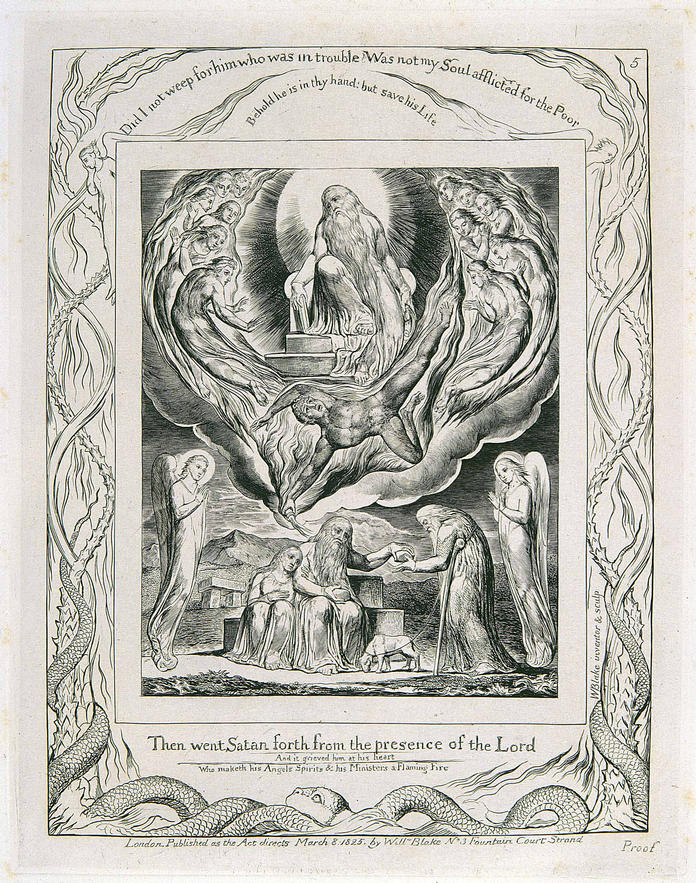
"The god in the chariot of the sun is a strange figure. He appears to be intended to resemble the traditional Apollo, although he has no 'bow of burning gold' - and there is a striking resemblance to the figure of in God in the Job engravings, the fifth plate, 'Then went Satan forth from the presence of the Lord.' There the drowsy God is not actually sleeping, as he appears to be here; yet the symbolic event, though stated in other terms, is parallel. The separation of Satan (the Selfhood, as Blake invariably defines him) from God (the Divine Humanity) is about to initiate a cycle of Experience, a descent and return, in the suffering of Job, as is here symbolized by the voyage of Odysseus across the stormy sea of time and space, and his final home-coming. One thinks of the opening lines of The Gates of Paradise:

My Eternal Man set in Repose,
The Female from his darkness rose."


This description of the fall by Urizen in the Four Zoas presents images reminiscent of those in the portion of the Arlington Tempera shown above:

Four Zoas, Night V, Page 64, (E 343)
"I siezd thee beauteous Luvah thou art faded like a flower
And like a lilly is thy wife Vala witherd by winds
When thou didst bear the golden cup at the immortal tables
Thy children smote their fiery wings crownd with the gold of heaven
PAGE 65
Thy pure feet stepd on the steps divine. too pure for other feet
And thy fair locks shadowd thine eyes from the divine effulgence
Then thou didst keep with Strong Urthona the living gates of heaven
But now thou art bound down with him even to the gates of hell

Because thou gavest Urizen the wine of the Almighty
For steeds of Light that they might run in thy golden chariot of pride
I gave to thee the Steeds I pourd the stolen wine
And drunken with the immortal draught fell from my throne sublime"