Blake seeks to provide the Golden String which can lead us through the labyrinth of our experience or his own poetry.

Showing posts with label Symbols. Show all posts

Saturday, October 24, 2026

LAST JUDGMENT 3

 Previously posted Jan 2021

Last Judgment
William Blake
     Petworth House comissioned by Countess of Egremont 
Enhanced Detail

In his images of the Last Judgment Blake was using symbolic language through the medium of graphic figures. He was not commenting on specific individuals but on people who have passed through various stages of development along the journey through life. Blake read the Bible not to learn what events had taken place in the past. He wanted to know what was going on in his own mental development by knowing how biblical characters were transformed. He wanted his readers to think about what they could learn by considering what Abraham had done or what Moses had done, not to imitate their behavior but to discern their motivation. Consciously thinking in symbols is an introspective process.

In Golgonooza by Kathleen Raine we are shown the contrast between writing history and presenting vision.

"This difference Between Michelangelo's Judgment, conceived as history and taking place in this world, and Blake's conception of the Apocalypse as a vision of the inner worlds accounts for many differences in composition and conception." (Page 146)

"[Blake's] purpose is not to represent nature but invisible inner worlds." (Page 147)

Jerusalem, Plate 73, (E 228)
"but around
These, to preserve them from Eternal Death Los Creates           
Adam Noah Abraham Moses Samuel David Ezekiel
[Pythagoras Socrates Euripedes Virgil Dante Milton]  
Dissipating the rocky forms of Death, by his thunderous Hammer
As the Pilgrim passes while the Country permanent remains
So Men pass on: but States remain permanent for ever"       

Kathleen Raine in Golgonooza states:

"Blake's symbolic figures are with very few exceptions Biblical, and in the infernal caverns reign not the Classical Hades but the seven-headed Satan of ST. John's Apocalypse. Nor did Blake attempt, as did both Dante and Michelangelo, to make his painting a political commentary on his own time by introducing living or recent historical figures...Adam and Eve, Cain and Able, Abraham and Noah are not for Blake historical figures but rather symbolical." (Page 150) 

Vision of Last Judgment, (E 556)
"it ought to be understood that the Persons
Moses & Abraham are not here meant but the States Signified by
those Names the Individuals being representatives or Visions of
those States as they were reveald to Mortal Man in the Series of
Divine Revelations. as they are written in the Bible these
various States I have seen in my Imagination when distant they
appear as One Man but as you approach they appear
Multitudes of Nations." 


Although Michelangelo painted to represent the condition of man and the outcome of failing to conform to the expectations of religious beliefs, he was more inclined to focus on his contemporaries. The consequences of offending or sinning led to agony.

This information is from Secrets of Michelangelo's Last Judgment:

"When Michelangelo began work on The Last Judgment mural, Pope Paul III instructed his Master of Ceremonies, Biagio da Cesena, to keep an eye on its progress. Biagio was a conservative man and, upon discovering the wall covered in nude figures, he attempted to persuade the Pope to have the figures covered.

Unfortunately for him, Michelangelo convinced the Pope to let him carry out his vision and, as an added touch, Biagio was later added as a portrayal of Minos, the judge of the underworld, with donkey ears and a snake wrapped around his groin. When Biagio returned to the Pontiff to ask for his face to be removed, Paul III jokingly explained that his jurisdiction did not extend to hell!"

Last Judgment 
Michelangelo
Group of the damned 
with Biagio da Cesena as Minos at right


Wednesday, August 6, 2025

Blake's Poetry

 From Chapter Two of Ram Horn'd with Gold  by Larry Clayton..

                                Style

Poetry by its nature yields meaning at more than one level. Most of Blake's poetry has significance at three primary levels: political or historical, personal or psychological, and religious or metaphysical. Blake would have denied these distinctions because life to him was all one. He saw the political spiritually, the historical metaphysically. This means that the reader may encounter an initial confusion, but if he perseveres in the face of the complexities of symbols and thought forms, he eventually discovers a wealth of meaning. Once again the guiding principle is that everything points to and converges upon the eternal reality underlying what Blake called the shadows of life.

To think and speak eternally is no small achievement for him or for us. Pursuing this aim he floundered for many years (See CHAPTER ONE). The words of Los in 'The Four Zoas' record the moment when Blake got a firm grip on what he sought for himself and for us:

..."I already feel a World within
Opening its gates, & in it all the real substances
Of which these in the outward World are shadows which
pass away."

After twenty years in the visionary wilderness that "World within" opened its gates into the mind of the mature artist and poet. Then he began to exercise the greatest freedom in his artistic use of the shadows. They served him in every conceivable way to elucidate the real world within. All the shadows, all natural phenomena, all historical events, all works of art, his own included, he treated as fluctuating insubstantials which illustrate or point to the eternal reality.

Blake thought so much of Infinity that he learned to take great liberties with time and space. In this he followed the style of the most imaginative books of the Bible. As a young man sitting at the feet of Swedenborg he had learned the doctrine of correspondences which had come down from the Bible through the heterodox tradition. As Blake applied it, every material thing has a spiritual or eternal referrent. In the words of the alchemical tradition, "As above, so below". In the Book of Revelation for example Babylon, a code word for Rome, more generally connotes the citadel of worldly power and evil. Blake of course used it in the same way. He used geographical locations of all sorts to point to spiritual realities. Africa symbolizes slavery in all its forms, particularly the "mind forg'd manacles" of the moral law. America symbolizes the hope of freedom.  

He often succeeded in translating historical events and personages into spiritual realities. Constantine and Charlemayne symbolize war with religion as its handmaid. Albion is Blake's master symbol for Man, but sometimes Moses symbolizes Man; Michael and Satan then symbolize the forces of light and darkness in contest for Man. 
Harvard Art Museums
"Angel Michael Binding Satan"

Beginning with the traditional language of symbolic discourse Blake learned to translate every facet of man's experience into a symbol of the ultimate:

Letters, To Thomas Butts, (E 712)

                      ..."Each grain of Sand,
                      Every Stone on the Land,
                      Each rock & each hill,
                      Each fountain & rill,
                      Each herb & each tree,
                      Mountain, hill, earth & sea,
                      Cloud, Meteor & Star,
                      Are Men Seen Afar."

          And two years later, in another letter poem:

Letters, To Thomas Butts, (E 721)
            "For double the vision my Eyes do see,
            And a double vision is always with me.
            With my inward Eye 'tis an old Man grey;
            With my outward, a Thistle across my way."

Four Zoas, Night VII, Page 85, ( E 368)
Los speaking to Spectre
"If we unite in one, another better world will be  
Opend within your heart & loins & wondrous brain
Threefold as it was in Eternity & this the fourth Universe 
Will be Renewd by the three & consummated in Mental fires
But if thou dost refuse Another body will be prepared
PAGE 86 
For me & thou annihilate evaporate & be no more
For thou art but a form & organ of life & of thyself
Art nothing being Created Continually by Mercy & Love divine

Los furious answerd. Spectre horrible thy words astound my Ear
With irresistible conviction I feel I am not one of those 
Who when convincd can still persist. tho furious.controllable
By Reasons power. Even I already feel a World within
Opening its gates & in it all the real substances
Of which these in the outward World are shadows which pass away
Come then into my Bosom & in thy shadowy arms bring with thee   
My lovely Enitharmon. I will quell my fury & teach
Peace to the Soul of dark revenge & repentance to Cruelty

So spoke Los & Embracing Enitharmon & the Spectre 

Clouds would have folded round in Extacy & Love uniting"


Saturday, June 7, 2025

UNIVERSAL SYMBOLS

 First posted by Larry on March 7, 2011, his 85TH birthday.

Yale Center for British Art
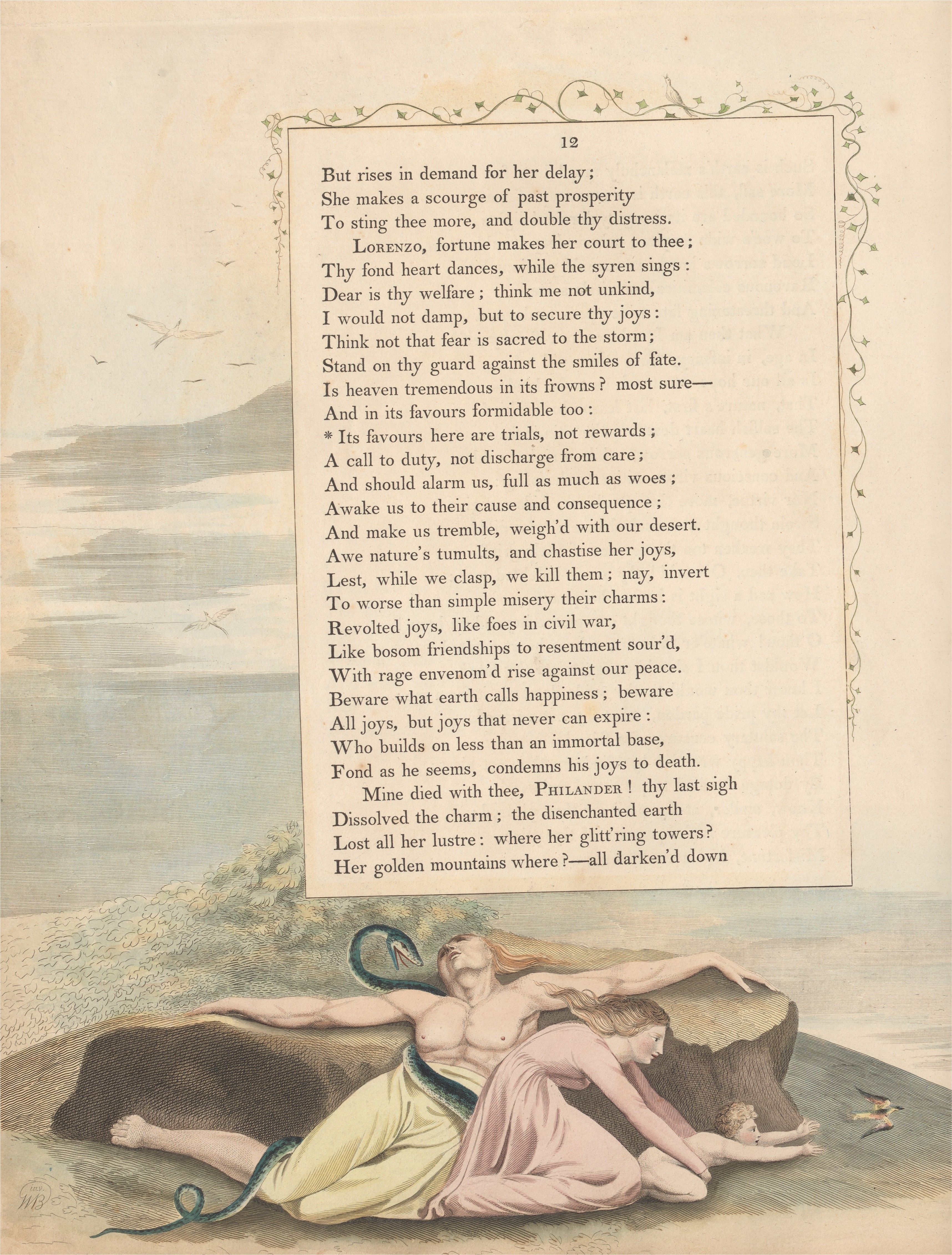
Illustrations for Young's Night Thoughts
Perhaps Blake's greatest gift to any of us may be the Faculty of perceiving the realities around us in terms of the Universal Symbols:

For example the character Jane in Jane Eyre may serve as a Christ Symbol (or in Blake's lexicon as Eternity). Rochester represents Everyman; the flossie, to whom he was considering marriage, is the Way of the World, the purely material.

The half cousin who wanted Jane to marry him and go to Africa with him represents Conventional Religion; his sisters are the Blakean Redeemed.

Rochester's wife is the victim of his accumulated moral failings, which led to spiritual blindness.

The happy ending is echoed by the ending of most Detective Stories. The crime is solved, the detective enjoys real life, the harm remains, but it no longer affects him. In the Sacred Story every tear has been wiped away.

In this post I've expressed the reality of the story in terms of the Blakean universal symbols. That's only one of many ways you might find universal meaning is a work of art.

IMO it was Northrup Frye who introduced to the Blake community (in 1947) to an understanding of Blake's use of symbols, images, metaphor; armed with that knowledge understanding of his poetry, his myth, the import of his pictures proceeded apace. But that's appropriate for another post.

Four Zoas, Night IX, PAGE 121, (E 390) 
"Urizen wept in the dark deep anxious his Scaly form
To reassume the human & he wept in the dark deep

Saying O that I had never drank the wine nor eat the bread
Of dark mortality nor cast my view into futurity nor turnd  
My back darkning the present clouding with a cloud               
And building arches high & cities turrets & towers & domes  
Whose smoke destroyd the pleasant gardens & whose running Kennels
Chokd the bright rivers burdning with my Ships the angry deep
Thro Chaos seeking for delight & in spaces remote
Seeking the Eternal which is always present to the wise          
Seeking for pleasure which unsought falls round the infants path
And on the fleeces of mild flocks who neither care nor labour
But I the labourer of ages whose unwearied hands
Are thus deformd with hardness with the sword & with the spear
And with the Chisel & the mallet I whose labours vast            
Order the nations separating family by family
Alone enjoy not   I alone in misery supreme
Ungratified give all my joy unto this Luvah & Vala    
Then Go O dark futurity I will cast thee forth from these
Heavens of my brain nor will I look upon futurity more   
I cast futurity away & turn my back upon that void       
Which I have made for lo futurity is in this moment      
Let Orc consume let Tharmas rage let dark Urthona give
All strength to Los & Enitharmon & let Los self-cursd
Rend down this fabric as a wall ruind & family extinct           
Rage Orc Rage Tharmas Urizen no longer curbs your rage

So Urizen spoke he shook his snows from off his Shoulders & arose"

Thursday, January 5, 2023

Sex as Symbol 3

 Summary

       After all this detail We can begin our summary of Blake's theory of sex with Jesus' reply to the Sadducee's mocking question about the woman married to seven husbands: "for when they shall rise from the dead, they neither marry nor are given in marriage, but are as the angels which are in heaven."

       Blake begins here, with the assumption that sexual division relates to this world, but not to Eternity. Sex appears in Beulah, a moony rest from the arduous creative activity of Eden. The "Female Will" condemns Man to the loss of Eternity, which Blake calls "the Sleep of Ulro".

Sex signifies fallenness, and the jealous and proudly chaste female symbolizes the active principle of evil, also identified with a materialistic viewpoint whose values are coercion and love of power.

Blake's vision of Jesus humanized his theory of sex. He began to use the biblical image of Jerusalem as the bride of Christ, named his last and greatest epic Jerusalem, and ultimately was able to rationalize the heterodox doctrine of sex with the glorified female as the emanation of the Eternal Man. Blake's female thus joined all the rest of his personal images in traveling the Circle of Destiny, materializing in the Fall and etherealizing in the Return.

Through all his journey Blake had a characteristically liberal and enlightened view of womankind, an entirely different matter from the sexual symbolism that filled his pages. His true and abiding feelings about the relation between men and women appear early in his works in his "Annotations to Lavater": "Let the men do their duty and the women will be such wonders; the female life lives from the light of the male: see a man's female dependants, you know the man." Admittedly short of the high standards of present day feminism, Blake's vision of womanhood considerably surpassed that of most of his contemporaries-- and perhaps most of ours.

End of Chapter

Perhaps Blake's attitude toward sex as a symbol is best represented by this image from Milton. The pairing of the male and female could represent the couple Milton and Ololon, any Zoa and his emanation, Los and Enitharmon, William and Catherine, or any couple who have reached the status of inspiration by being joined in body, mind and spirit.
 
In of the book Jerusalem Blake is at liberty to acknowledge the union of Jesus or the Lamb of God, and Jerusalem, his spiritual manifestation in the physical world.  
Milton, Plate 25 [27], (E 122)
"Wait till the Judgement is past, till the Creation is consumed
And then rush forward with me into the glorious spiritual    
Vegetation; the Supper of the Lamb & his Bride; and the
Awaking of Albion our friend and ancient companion.

So Los spoke." 
Jerusalem, Plate 20, (E 165) 
"Jerusalem answer'd ... 
I redounded from Albions bosom in my virgin loveliness.
The Lamb of God reciev'd me in his arms he smil'd upon us:
He made me his Bride & Wife: he gave thee to Albion."    
Jerusalem, Plate 27, (E 171)
  "Her Little-ones ran on the fields                             
The Lamb of God among them seen
  And fair Jerusalem his Bride:
Among the little meadows green."
Jerusalem, Plate 27, (E 172)
  "She walks upon our meadows green:
The Lamb of God walks by her side:
  And every English Child is seen,
Children of Jesus & his Bride,"                
New York Public Liberty
Milton 
Plate 28, Copy C 
 

Friday, December 30, 2022

Sex as Symbol 2

  The Two Women

       When Blake began to work on his epic myth, he intended to focus upon the wicked career of Vala, but as time went by, he became more interested in the Zoas, which no doubt helped to relieve the anti-feminine bent of his metaphysics. Vala temporarily sank to the level of a minor character, and Blake laid most of the guilt for man's sorry state upon Urizen. The Moment of Grace brought another significant change: Vala fumed into two females, Rahab and Jerusalem, both of whom issue from Enitharmon.

       When Blake gave Rahab the alternate name of Babylon, he came into conformance with the basic symbology of the Bible. Throughout the scripture we read about these two women/cities. Jerusalem is at least potentially the city of God, while Babylon always represents the seat of the God of this World. In his last epic Blake's Vala has become virtually interchangeable with Babylon.

       We have already noted the biblical sources of Blake's two symbolic women in the 12th and 17th chapters of Revelation. In the first of these John sees a woman "clothed with the sun and the moon under her feet". In the second he described "the great whore that sitteth upon many waters". These two women in the Bible aptly prefigure Blake's Jerusalem and Vala, and a careful study of the two chapters will help the reader to shape in his own mind the identity of Blake's two characters.

       John and Blake both drew their paired women from earlier sources. Frye calls them "royal metaphors" for the twin totalities of good and evil, of redemption and damnation that fill the pages of the Bible. The Tower of Babel, the first city of sin, led to the confusion of tongues. Following God's command Abraham, the father of the Hebrews, left Ur, a few miles from Babylon and eventually settled in the Promised Land. The first Captivity occurred in Egypt, which later biblical literature often treats as synonymous with Babylon. The second Captivity took place at Babylon. A later captivity was to Rome, which John the Apocalyptist called Babylon: in Revelation he celebrated the burning of the Whore of Babylon.

       Meanwhile Melchizidek, King of Salem and priest of the Most High God, had blessed Abraham. Some centuries later David established Jerusalem as his capital. The Song of Solomon is a poem and love song about a king and his bride. This theme became a primary symbol of the relation between Jerusalem, representing the Chosen People, and God. The prophets constantly referred to Jerusalem as a woman, married to God, but too often faithless, whoring after other gods. Hosea's stories about the love of the betrayed husband for his faithless wife, Gomer, poetically express the highest level of the Hebrew consciousness of God. On occasion the prophets became so enraged that they identified Jerusalem with Babylon. For example John spoke of "the great city which spiritually is called Sodom and Egypt, where also our Lord was crucified".

       This biblical background prepares us to cope with the woman found in Blake's poem, Jerusalem . As we have seen, in the poetry of the first half of Blake's life the woman is sinister. She represents the material; the material is unworthy, reprehensible, satanic. This is the typical Gnostic position and to a lesser extent the Neo-platonic position. Blake stated it very explicitly and with his usual hyperbole in 'Visions of the Last Judgment' (E 565) (See also the image): "I assert for My Self that I do not behold the outward Creation & that to me it is hindrance and not Action; it is as the Dirt upon my feet. No part of Me."

       He wrote that as late as 1810. Nevertheless after the Moment of Grace Blake's perspective on matter (and Woman!) softened. At first there had been only the sinister woman, but now the Woman of Grace appeared as well.

       In the poem, Jerusalem, we find a discourse and a conflict between these two women. Vala speaks for the kingdom of Satan, and Jerusalem speaks for the kingdom of Heaven. Their interaction dominates the poem and must fascinate anyone interested in those two subjects. The epic is a straightforward conflict between light and darkness as Blake understood those two realities. Vala wins most of the battles, but we always know who must win the war.

       Blake describes reality imaginatively and dramatically in terms of ultimate value; this is basically an expression of faith. If one believes in the higher values: in spirit, in truth, in justice and love, then one imagines these things ultimately victorious. Blake did, and he concluded the passage from VLJ quoted above: "What, it will be Question'd, 'When the Sun rises, do you not see a round disk of fire somewhat like a Guinea?' 0 no, no, I see an Innumerable company of the Heavenly host crying 'Holy, holy, Holy is the Lord God Almighty.'" In Blake's final epic Vala represents the guinea sun and Jerusalem the "innumerable company of the Heavenly host". Needless to say those who see only the guinea sun will not be attracted to the poem.

vi

'Jerusalem'

       At the very beginning of Blake's poem, Jerusalem, he makes us fully aware that the new woman represents something entirely other than the disreputable matter of earlier writing. She is just the opposite; she is Spirit or rather the manifestation of Spirit in this world. The Saviour confronts the sleeping Albion and identifies his disease, "where hast thou hidden thy Emanation, lovely Jerusalem". But the "perturbed Man" denies Christ and denies Jerusalem: "Jerusalem is not! her daughters are indefinite: By demonstration man alone can live, and not by faith." A few lines further the poet announces that

       The place names represent the six heathen nations or the powers of evil that surround the Chosen People. The import of all this in another biblical phrase is that "He who departs from evil makes himself a prey".

       Very shortly we meet the Daughters of Albion; they represent the feminine dimension of the materialistic impulses of Man: "Names anciently remember'd, but now contemn'd as fictions. Although in every bosom they controll our Vegetative powers". Eventually a redemptive moment occurs when, Los having subdued and integrated his Spectre, his Sons and Daughters "come forth from the Furnaces". Erin, like America a symbol of redemption, addresses Jerusalem:

       The fallen Sons of Albion express the opposite viewpoint. In Plate 18, in a prophetic statement worthy of Isaiah in its irony, the twelve Sons of Albion describe explicitly and in detail their relationship to Jerusalem and to Vala:

       In an extended passage too long to quote here Blake gives a colloquy with the fainting, confused Albion and the two females competing for his heart. It's actually a recreation of the earlier colloquy in VDA, and infinitely richer and fuller. Albion wavers exactly like Theotormon; Vala, like Bromion, is implacably blind, and Jerusalem has the eloquence of the earlier heroine. In this scene, like the earlier one, Blake describes the eternal battle between faith and worldliness.

       Look also at the passage on Plates 32-34 and remember that Albion, Vala and Los each speaks from his own viewpoint. To understand Blake's vision the reader must imaginatively enter the psychic state of each of the three characters. Los most often speaks from the poet's true standpoint, and the following lines put his position about as plainly as it can be put:

       The idea of building Jerusalem gains prominence in Blake's poetry after the Moment of Grace. Jerusalem, "a city, yet a woman", is builded in the heart of every man by acts of love and kindness, and this is the work of the imagination.

       As the third chapter of Jerusalem begins, Blake describes Jerusalem for us once more:

       Blake's ethics of sexual love, his symbolism, and his Christian faith all fit together and reach a climax in a sketch virtually guaranteed to astound and provoke the reader (and no doubt dismay and disgust some). This passage, Plates 61 and 62, is called "Visions of Elohim Jehovah". Here once again forgiveness is the key, and to Blake forgiveness was everything. Vala, the soul of materialism, knows nothing of forgiveness. Jerusalem's liberty is expressed most fully in forgiveness. In this passage Mary, the mother of Jesus, merges with the other Mary, who was forgiven because "she loved much".

       "Visions of Elohim Jehovah" could only have been written by a poet who despised the social value placed upon virginity. In an earlier work he had called it "pale religious letchery that wishes but acts not". Blake hated the ideal of chastity, which meant to him a virtuous withholding of woman's body as an exercise of power over the deprived male, and he struck directly at the archetype of the chaste woman. "Visions of Elohim Jehovah" is not a theological statement, but an imaginative vision about meaning and value. The love of Blake will always be confined to people who discriminate between those two things and whose theological perspective is neither glassy eyed nor otherwise rigid.

       Blake's Mary has perfect trust in the forgiveness of sin, and her relationship with Joseph becomes a type for the relationship of Jerusalem with Jesus:

       The allegoric drama of good and evil in terms of the two females continues and intensifies throughout the epic poem until the final awakening of Albion, when sexes disappear. The first indication of this is in the dialogue of Los and Enitharmon:

       Soon comes the last mention of the woman of the world. She is connected with her sexual counterpart and described in the very specific terms which John used in Revelation 17:

       And after the final chorus of the multiple aspects of Man, Blake tells us that he "heard the Name of their Emanation: they are named Jerusalem." And so ends Jerusalem.

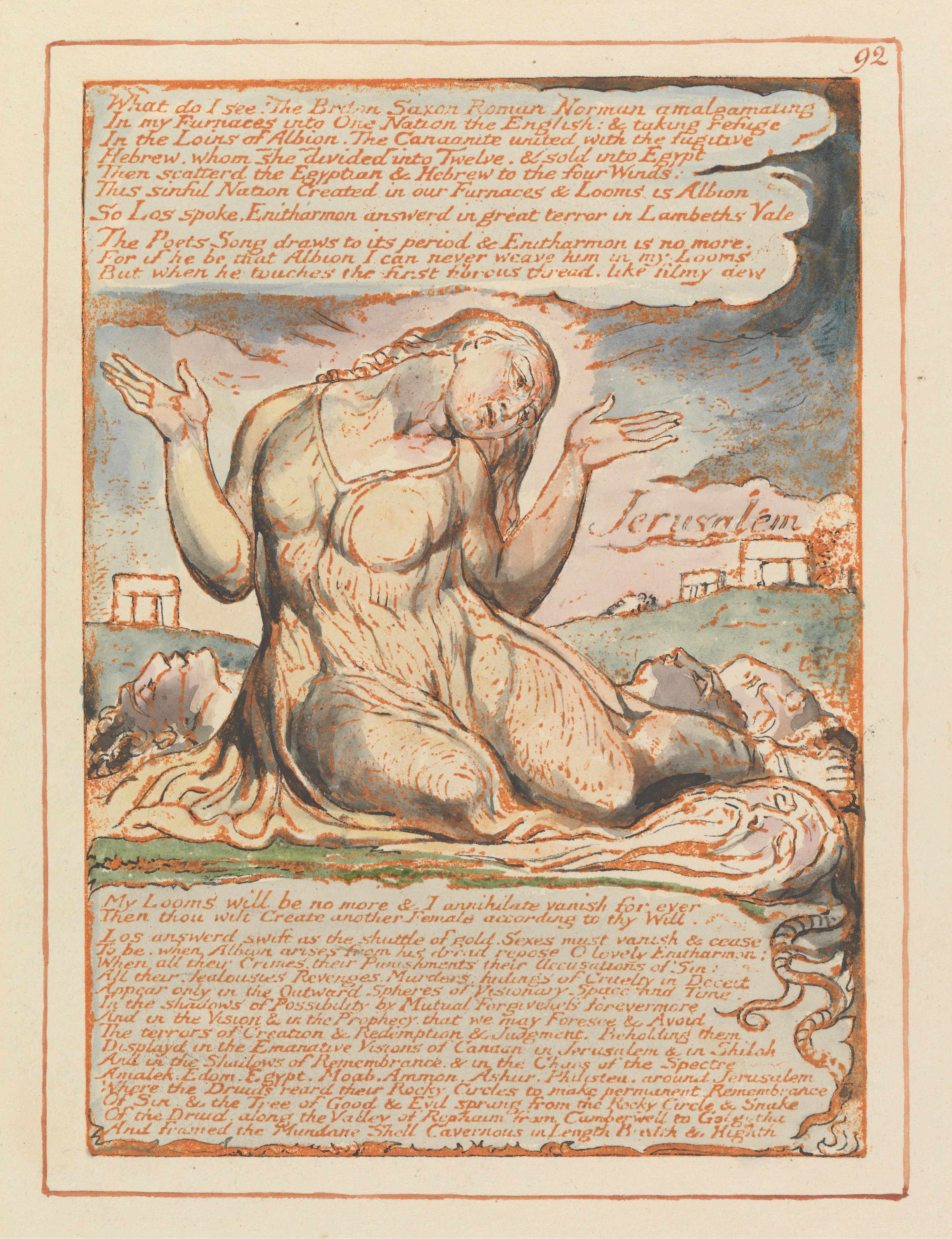
Yale Center for British Art
Jerusalem
Plate 92
  

Tuesday, December 6, 2022

Sex as Symbol

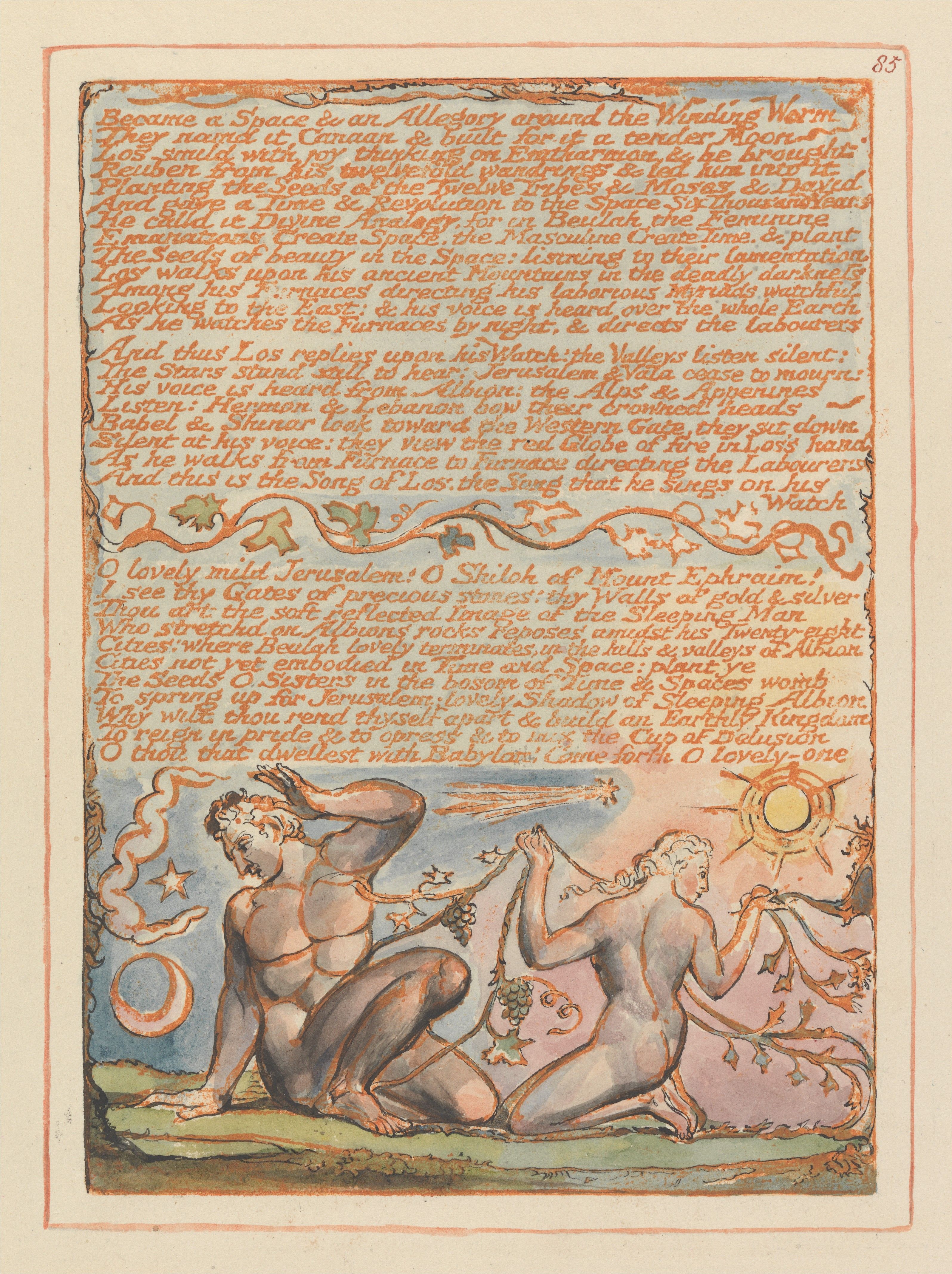
Yale Center for British Art
Jerusalem
Plate 85

Chapter 8, Blake Primer 

 Sex as Symbol

       Blake used the female as the basic symbol for the material and for the materialistic viewpoint. The history of this concept goes as far back as the beginning of time. The Sun represents a masculine God, the Moon, a Goddess, such as Diana, the great goddess of Ephesus, whose priests raised a riot against the apostle Paul, reported at Acts 19.

       Long after MHH he wrote Jerusalem where the "female will" approaches identity with Satan. Both terms connote a preoccupation with the material, putting it first and only. Thus when we read a passage like:

spoken by Vala, the personification of the "female will", we understand that Blake is not talking about what we know as the sex economy, but rather making a hard nosed statement of the nature of fallenness: the dominance of the material over the spiritual, a dominance all too evident in his age as in ours. This sad situation was always Blake's major concern, and the basic symbol with which he expressed it was that of sex. When we remember to translate male/female into spiritual/material or eternal/temporal, we make a great gain in our understanding of Blake.

       Milton's theory of sex influenced Blake as much as any other literary source. Paradise Lost provides a definitive model for much of the sexual imagery that Blake used. Professor Frye calls our attention to a line in Book iv of P . L. describing Adam and Eve: "Hee for God only, shee for God in him" Frye reminds us that this applies only to the unfallen pair; it assigns to Adam a purely spiritual authority. The male dominance of material history Frye calls a "fallen analogy" of that spiritual relationship.

       All this enriches our understanding of the meaning of Astarte in her many forms and of the priests' reactions to her which color virtually every word of the Old Testament and its literary descendants: God is male, the Creator; Nature is female, the Creation. The soul (of man and woman) is female in relation to her Creator. Christ is the bridegroom; in union with him we all (of both sexes) become part of the bride. The modern man can accept this only as an imperfect metaphor for spiritual reality.

iii

Generation

 According to Blake's myth sexes begin in the moony night of Beulah where the Eternals came to rest from the arduous wars of intellect that have filled their sunny days in Eden:

       Beulah, one of Blake's most ambiguous images, is a way station between Eden and Ulro. The Eternal, sleeping in Beulah, may rise from his sexual dreams and return to the activity of Eden, or he may fall further into Death Eternal, which is exactly what happened to Albion. Unable to find his way back to Heaven he lapsed into a deeper form of sleep where the female develops a will of her own and lures the male into the "torments of love and Jealousy". Late in Jerusalem the warrior, speaking for Albion, gives a glimpse of his true (fallen) situation and laments"

______________________________________________________________

       ( There are four worlds in Blake's psychic universe:
       Eternity
       Beulah
       Ulro

       Generation)

       Man in Eternity is androgynous. In Beulah, which means Married, the sexes are divided into loving and restful contraries. With the Fall the Female Will becomes dominant; the Human Form deteriorates to the sexual in which male and female, spirit and matter, exist in a state of constant warfare. Man has fallen into the fourth world of Ulro. But whatever falls may rise again.

       The third world, Generation, is the world of Los, fallen man's imaginative faculty. Los generates or brings forth artistic creations, structures of thought, myths of meaning, much as a woman brings forth children. These creations always turn bad (or perhaps just moldy) and are broken up and cast into Los's furnace for renewal. The process of generation and destruction would go on indefinitely, like the cycle of Nature, but the Moment of Grace breaks in upon it. Los learns to forgive. His emanation, Enitharmon, now joins him as an instrument of a regeneration offering redemptive promise. Blake proclaims, "0 holy generation, image of regeneration".

       The change in Los and Enitharmon, who together make up fallen man's imaginative faculty, prepares the ground for the generation of Jesus. The Sons of Eden announce this event in Night viii of Four Zoas with a paean of praise. Careful study of the entire song will cast more light on the meaning of Blake's symbolism of sex and generation; here are the final seven lines:

       What Blake reports next should be a welcome change for the by now outraged feminist. With his usual consistency he follows the divine annunciation with the appearance of Satan, and the worst thing he can say about Satan is to call him a "male without a female":

Sunday, November 20, 2022

VISION OF ST JOHN

The book of Revelation was important to Blake for multiple reasons. Primarily as a book of visions which Blake himself experienced as communications from God. Furthermore John of Patmos was giving an account of the new world which would replace the world of sin and death in which we live. Blake used the sleep of Albion as a symbol for the "passage through Eternal Death" until the breath Divine begins the process of restoration of the unity of all things. 

John of Patmos and William Blake both used symbolic language to convey spiritual truth.

Jerusalem, Plate 4, (E 146)
"Of the Sleep of Ulro! and of the passage through
Eternal Death! and of the awaking to Eternal Life.

This theme calls me in sleep night after night, & ev'ry morn
Awakes me at sun-rise, then I see the Saviour over me
Spreading his beams of love, & dictating the words of this mild song.  

Awake! awake O sleeper of the land of shadows, wake! expand!
I am in you and you in me, mutual in love divine:
Fibres of love from man to man thro Albions pleasant land.
In all the dark Atlantic vale down from the hills of Surrey
A black water accumulates, return Albion! return!                
Thy brethren call thee, and thy fathers, and thy sons,
Thy nurses and thy mothers, thy sisters and thy daughters
Weep at thy souls disease, and the Divine Vision is darkend:"
Four Zoas, Night VII, Page 87, (E 369)
"But This Union
Was not to be Effected without Cares & Sorrows & Troubles
Of six thousand Years of self denial and of bitter Contrition

Revelation 21

[22] And I saw no temple therein: for the Lord God Almighty and the Lamb are the temple of it.
[23] And the city had no need of the sun, neither of the moon, to shine in it: for the glory of God did lighten it, and the Lamb is the light thereof.
[24] And the nations of them which are saved shall walk in the light of it: and the kings of the earth do bring their glory and honour into it.
[25] And the gates of it shall not be shut at all by day: for there shall be no night there.
[26] And they shall bring the glory and honour of the nations into it.

British Museum
St John the Evangelist before a vision of Christ

This is the passage illustrated by the image:

Revelation 1

[9] I John, who also am your brother, and companion in tribulation, and in the kingdom and patience of Jesus Christ, was in the isle that is called Patmos, for the word of God, and for the testimony of Jesus Christ.
[10] I was in the Spirit on the Lord's day, and heard behind me a great voice, as of a trumpet,
[11] Saying, I am Alpha and Omega, the first and the last: and, What thou seest, write in a book, and send it unto the seven churches which are in Asia; unto Ephesus, and unto Smyrna, and unto Pergamos, and unto Thyatira, and unto Sardis, and unto Philadelphia, and unto Laodicea.
[12] And I turned to see the voice that spake with me. And being turned, I saw seven golden candlesticks;
[13] And in the midst of the seven candlesticks one like unto the Son of man, clothed with a garment down to the foot, and girt about the paps with a golden girdle.
[14] His head and his hairs were white like wool, as white as snow; and his eyes were as a flame of fire;
[15] And his feet like unto fine brass, as if they burned in a furnace; and his voice as the sound of many waters.
[16] And he had in his right hand seven stars: and out of his mouth went a sharp twoedged sword: and his countenance was as the sun shineth in his strength.
[17] And when I saw him, I fell at his feet as dead. And he laid his right hand upon me, saying unto me, Fear not; I am the first and the last:
[18] I am he that liveth, and was dead; and, behold, I am alive for evermore, Amen; and have the keys of hell and of death.
[19] Write the things which thou hast seen, and the things which are, and the things which shall be hereafter;
[20] The mystery of the seven stars which thou sawest in my right hand, and the seven golden candlesticks. The seven stars are the angels of the seven churches: and the seven candlesticks which thou sawest are the seven churches.

Hebrews 4

[12] For the word of God is quick, and powerful, and sharper than any twoedged sword, piercing even to the dividing asunder of soul and spirit, and of the joints and marrow, and is a discerner of the thoughts and intents of the heart.

In Ego and Archetype, Edward F Edinger wrote this about signs and symbols on page 109:

"Man needs a world of symbols as well as a world of signs. Both sign and symbol are necessary but should not be confused with one another. A sign is a token of meaning that stands for a known entity. By this definition, language is a system of signs, not symbols. A symbol on the other hand, is an image or representation which points to something essentially unknown, a mystery. A sign conveys abstract,objective meaning whereas a symbol conveys living, subjective meaning. A symbol has a subjective dynamism which exerts a powerful attraction and fascination on the individual. It is a living, organic entity which acts as a releaser and transformer of psychic energy. We may say that a sign is dead, but a symbol is alive.
...
The archetypal psyche is constantly creating a steady stream of living symbolic imagery. Ordinarily this stream of images is not consciously perceived except through dreams or through waking fantasy when the conscious level of attention has been lowered. However, there is reason to believe that even in the full waking state this system of symbols charged with effective energy continues to flow beyond the notice of the ego."  

These are the passages in which Blake mentioned Patmos or Revelations:

 Milton, Plate 40 [46], (E 141) 
"No sooner she had spoke but Rahab Babylon appeard
Eastward upon the Paved work across Europe & Asia
Glorious as the midday Sun in Satans bosom glowing:
A Female hidden in a Male, Religion hidden in War        
Namd Moral Virtue; cruel two-fold Monster shining bright
A Dragon red & hidden Harlot which John in Patmos saw

And all beneath the Nations innumerable of Ulro
Appeard, the Seven Kingdoms of Canaan & Five Baalim
Of Philistea. into Twelve divided, calld after the Names      
Of Israel: as they are in Eden. Mountain. River & Plain
City & sandy Desart intermingled beyond mortal ken

But turning toward Ololon in terrible majesty Milton
Replied. Obey thou the Words of the Inspired Man
All that can be annihilated must be annihilated

That the Children of Jerusalem may be saved from slavery"
Four Zoas, Night VIII, Page 114, (E 385) 
"And Los & Enitharmon took the Body of the Lamb 
Down from the Cross & placd it in a Sepulcher which Los had hewn
For himself in the Rock of Eternity trembling & in despair 
Jerusalem wept over the Sepulcher two thousand Years
PAGE 115 [111] 
Rahab triumphs over all she took Jerusalem
Captive A Willing Captive by delusive arts impelld
To worship Urizens Dragon form to offer her own Children
Upon the bloody Altar. John Saw these things Reveald in Heaven
On Patmos Isle & heard the Souls cry out to be deliverd 
He saw the Harlot of the Kings of Earth & saw her Cup
Of fornication food of Orc & Satan pressd from the fruit of Mystery
But when she saw the form of Ahania weeping on the Void
And heard Enions voice sound from the caverns of the Grave
No more spirit remained in her She secretly left the Synagogue of Satan" 
Jerusalem, Plate 48, (E 196)
"In silence the Divine Lord builded with immortal labour,         
Of gold & jewels a sublime Ornament, a Couch of repose,
With Sixteen pillars: canopied with emblems & written verse.
Spiritual Verse, order'd & measur'd, from whence, time shall reveal.
The Five books of the Decologue, the books of Joshua & Judges,
Samuel, a double book & Kings, a double book, the Psalms & Prophets 
The Four-fold Gospel, and the Revelations everlasting" 
Vision of Last Judgment, Page 80, (E 558) 
"Four Angels descend headlong  with four trumpets to
awake the Dead. beneath these is the Seat of the Harlot <namd>
Mystery in the Revelations.  She is [bound] siezed by
Two Beings each with three heads they Represent Vegetative
Existence. <as> it is written in Revelations they strip her naked
& burn her with fire <it represents the Eternal Consummation of
Vegetable Life & Death with its Lusts  The wreathed Torches in
their hands represents Eternal Fire which is the fire of
Generation or Vegetation it is an Eternal Consummation Those who
are blessed with Imaginative Vision see This Eternal Female &
tremble at what others fear not while they <despise &> laugh at
what others fear> <Her Kings & Councellors & Warriors descend in
Flames Lamenting & looking upon her in astonishment & Terror. &
Hell is opend beneath her Seat on the Left hand>. beneath her
feet is a flaming Cavern in which is seen the Great Red Dragon
with Seven heads & ten Horns [who] <he has Satans book
of Accusations lying on the rock open before him> <he> is bound
in chains by Two strong demons they are Gog & Magog" 
Vision of Last Judgment, Page 83, (E 561)
 "The Cloud that opens rolling apart before the throne &
before the New Heaven & the New Earth is Composed of Various
Groupes of Figures particularly the Four Living Creatures
mentiond in Revelations as Surrounding the Throne these I suppose
to have the chief agency in removing the 
old heavens & the old Earth to make way for the New Heaven & the
New Earth to descend from the throne of God & of the Lamb. that
Living Creature on the Left of the Throne Gives to the Seven
Angels the Seven Vials of the wrath of God <with> which they
hovering over the Deeps beneath pour out upon the wicked their
Plagues the Other Living Creatures are descending with a Shout &
with the Sound of the Trumpet Directing the Combats in the upper
Elements" 


Thursday, June 24, 2021

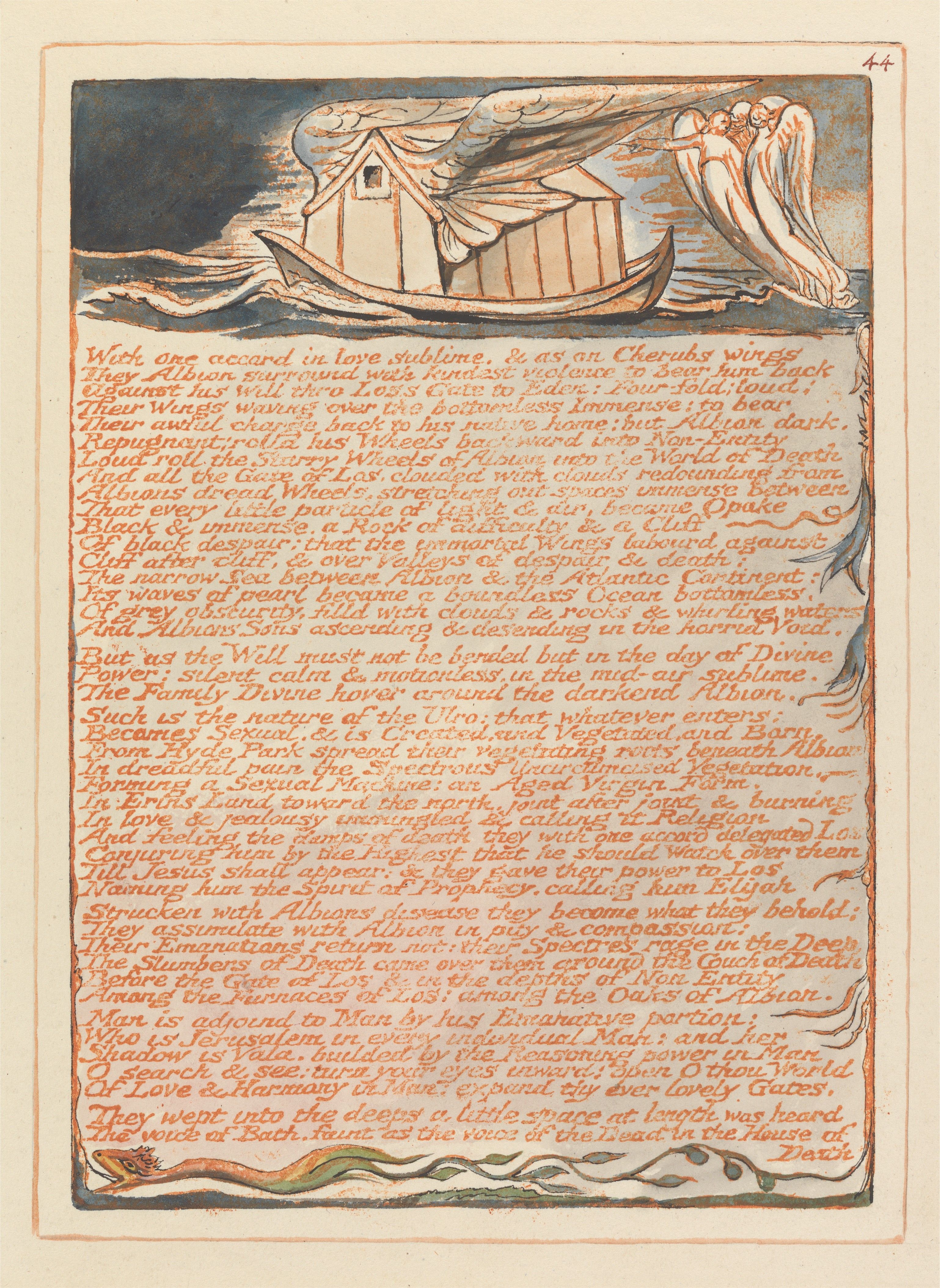
FLOOD & ARK

First posted Feb 2012

Quotes are from S. Foster Damon, A Blake Dictionary: The Ideas and Symbols of William Blake.

The Old Testament flood for which Noah built his ark is a pivotal development in history. Man is portrayed as ending one phase of his existence and beginning again with a clean slate. The ark made by Noah from God's instructions was the means through which humanity was preserved instead of being annihilated. An event which comes close to exterminating a population and altering a landscape made an imprint on the psyche. A complex of images developed around the story of the flood which kept the memory of it alive as a continually developing symbol.

Elements of the multifaceted symbol which developed around the 40 day rain and subsequent inundation include: the ark, the flood, the preservation of the species, the dove, the olive branch, the rainbow. As an event which incorporated negative aspects (such as punishment for sins, and destruction of the environment and its inhabitants), and positive aspects (such as saving of a remnant of the living things on the planet, and resulting in a promise that such an event of destruction would not recur), it offers itself for a symbol encompassing both destruction and reconstruction.

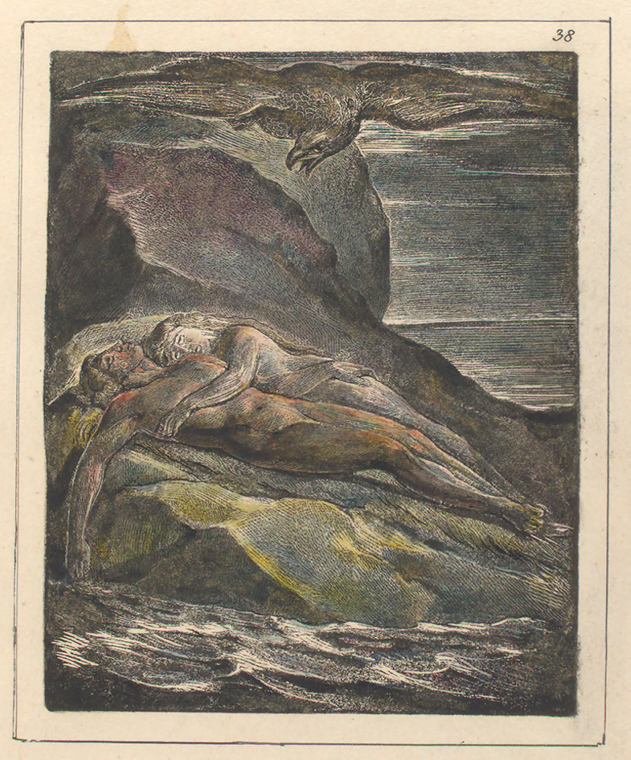
To focus on a single facet of the multifaceted image we look at the ark as Blake incorporated it. The ark is a safe feminine place of refuge as is Beulah.

Yale Center for British Art 

Jerusalem 

Plate 44

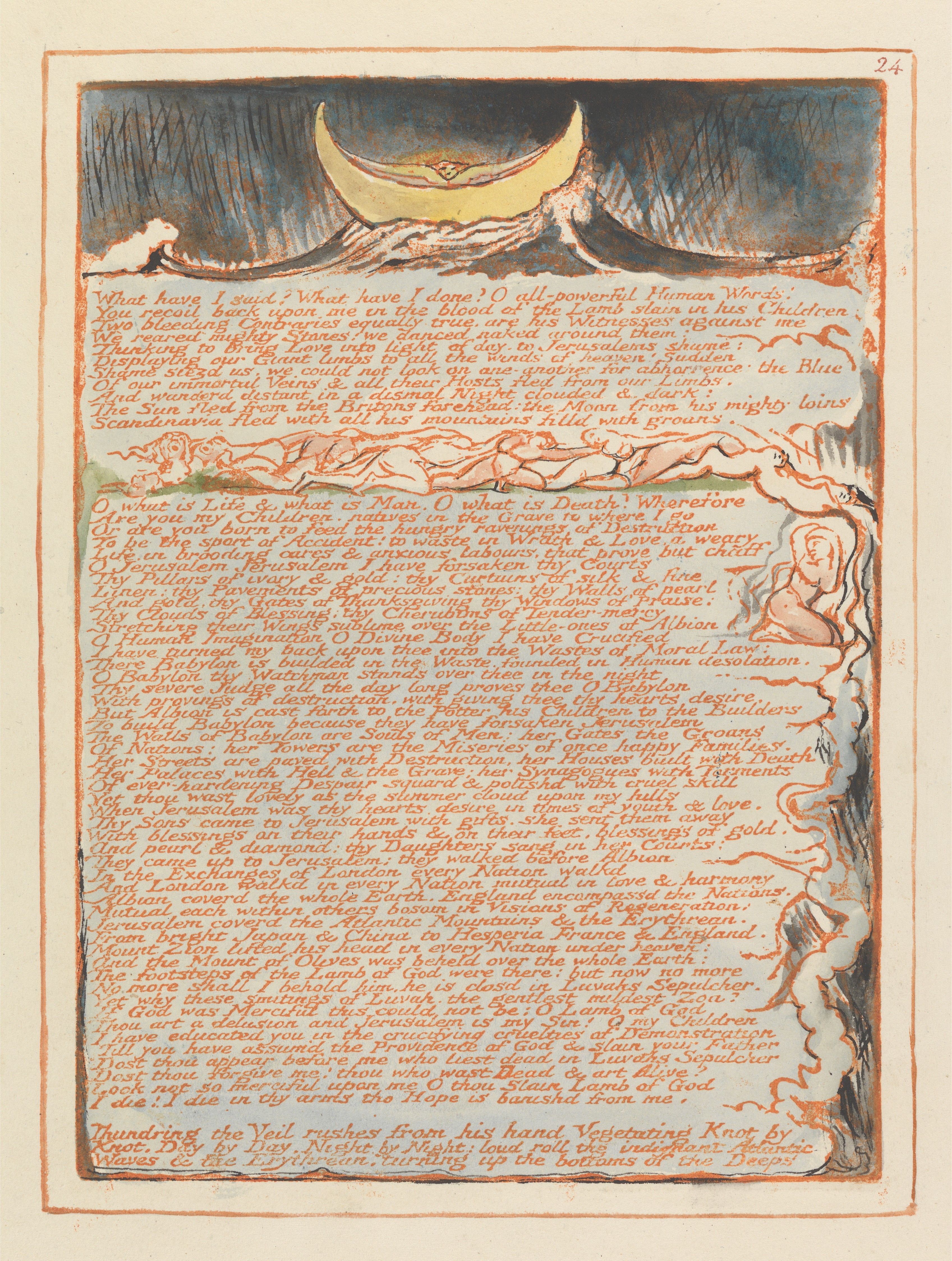
Yale Center for British Art 

Jerusalem 

Plate 24

Damon, Page 286
"It is the function of the female to provide a moony space of refuge and rest for the male."

Jerusalem, Plate 69, (E 223)
"& not like Beulah
Where every Female delights to give her maiden to her husband
The Female searches sea & land for gratification to the
Male Genius: who in return clothes her in gems & gold
And feeds her with the food of Eden. hence all her beauty beams
She Creates at her will a little moony night & silence
With Spaces of sweet gardens & a tent of elegant beauty:
Closed in by a sandy desart & a night of stars shining.
And a little tender moon & hovering angels on the wing.
And the Male gives a Time & Revolution to her Space
Till the time of love is passed in ever varying delights
For All Things Exist in the Human Imagination
And thence in Beulah they are stolen by secret amorous theft,"

Damon, Page 300
"As all forms of water signify matter, the flood was the overwhelming of mankind with Matter, which separated them from Eternity. This is the Sea of Time and Space in which we are all submerged. ...
The Ark, which preserved Noah and his family, symbolizes Love: consequently Blake depicted it as a crescent moon."

The achievement of the flood is the separation of intellect and love that each may be differentiated and defined. A tension must develop between the two so that the roles of each may be clarified. They are not meant to be enemies but friends who will be reunited when they have learned the lessons of misguided independence. Interdependence reunites them through the incarnation.

One of the forms Ololon assumes as Blake's Milton is concluding is that of an ark.


Damon, Page 308
"Then as a Moony Ark Ololon descended...into the Fires of Intellect" (42:7-9): love and intellect combined. The Starry Eight become Jesus; Ololon's clouds are his wedding garment; and Jesus becomes one with mankind (42:19). The mystical union has been achieved, and Blake falls fainting on his garden path."

Milton, Plate 42 [49], (E 143)
"So saying, the Virgin divided Six-fold & with a shriek
Dolorous that ran thro all Creation a Double Six-fold Wonder!
Away from Ololon she divided & fled into the depths
Of Miltons Shadow as a Dove upon the stormy Sea.

Then as a Moony Ark Ololon descended to Felphams Vale
In clouds of blood, in streams of gore, with dreadful thunderings
Into the Fires of Intellect that rejoic'd in Felphams Vale
Around the Starry Eight: with one accord the Starry Eight became
One Man Jesus the Saviour. wonderful! round his limbs
The Clouds of Ololon folded as a Garment dipped in blood
Written within & without in woven letters: & the Writing
Is the Divine Revelation in the Litteral expression:
A Garment of War, I heard it namd the Woof of Six Thousand Years"

In the development of the human psyche a major transition occurs when the mind attains an ability to focus on specific things rather than being immersed in an undifferentiated consciousness over which it has no control. When this happens the mind separates individual objects, events and experiences from one another. This may be described as being flooded with the world of materiality because what was experienced as a unity becomes many. A consciousness of the material, the world outside the mind, washes away the previous diffuse awareness.

Blake's ark is the safety net provided by Eternity in the time of the flood. The focused consciousness (the flood of the material) becomes the masculine side of the psyche and the unifying consciousness (of love, rest and repose) becomes the feminine side.

Four Zoas, PAGE 104 (SECOND PORTION), (E 377)
"Come Lord Jesus come quickly
So sang they in Eternity looking down into Beulah.
The war roard round Jerusalems Gates it took a hideous form
Seen in the aggregate a Vast Hermaphroditic form
Heavd like an Earthquake labring with convulsive groans
Intolerable at length an awful wonder burst
From the Hermaphroditic bosom Satan he was namd
Son of Perdition terrible his form dishumanizd monstrous
A male without a female counterpart a howling fiend
Fo[r]lorn of Eden & repugnant to the forms of life
Yet hiding the shadowy female Vala as in an ark & Curtains
Abhorrd accursed ever dying an Eternal death
Being multitudes of tyrant Men in union blasphemous
Against the divine image. Congregated Assemblies of wicked men."
 

For more about masculine and feminine consciousness read Sukie Colgrave's Uniting Heaven and Earth: A Jungian and Taoist Exploration of the Masculine and Feminine in Human Consciousness.