Blake seeks to provide the Golden String which can lead us through the labyrinth of our experience or his own poetry.

Showing posts with label Job. Show all posts

Wednesday, September 18, 2024

BLAKE & DREAMS 6


Wikipedia Commons
Paradise Regained
Christ's troubled sleep


Paradise Regained, Book 4
John Milton

"The Kingdoms of the world to thee I give;
For giv'n to me, I give to whom I please,
No trifle; yet with this reserve, not else, [ 165 ]
On this condition, if thou wilt fall down,
And worship me as thy superior Lord,
Easily done, and hold them all of me;
For what can less so great a gift deserve?
Whom thus our Saviour answer'd with disdain. [ 170 ]
I never lik'd thy talk, thy offers less,
Now both abhor, since thou hast dar'd to utter
The abominable terms, impious condition;
But I endure the time, till which expir'd,
Thou hast permission on me. It is written [ 175 ]
The first of all Commandments, Thou shalt worship
The Lord thy God, and only him shalt serve;
And dar'st thou to the Son of God propound
To worship thee accurst, now more accurst
For this attempt bolder then that on Eve, [ 180 ]
And more blasphemous? which expect to rue
...
So saying, he took (for still he knew his power
Not yet expir'd) and to the Wilderness [ 395 ] 
Brought back the Son of God, and left him there,
Feigning to disappear. Darkness now rose,
As day-light sunk, and brought in lowring night
Her shadowy off-spring, unsubstantial both,
Privation meer of light and absent day. [ 400 ]
Our Saviour meek and with untroubl'd mind
After his aerie jaunt, though hurried sore,
Hungry and cold betook him to his rest,
Wherever, under some concourse of shades
Whose branching arms thick intertwin'd might shield [ 405 ]
From dews and damps of night his shelter'd head,
But shelter'd slept in vain, for at his head
The Tempter watch'd, and soon with ugly dreams
Disturb'd his sleep; and either Tropic now
'Gan thunder; and both ends of Heav'n, the Clouds [ 410 ]
From many a horrid rift abortive pour'd
Fierce rain with lightning mixt, water with fire
In ruine reconcil'd: nor slept the winds
Within thir stony caves, but rush'd abroad
From the four hinges of the world, and fell [ 415 ]
On the vext Wilderness, whose tallest Pines,
Though rooted deep as high, and sturdiest Oaks
Bow'd thir Stiff necks, loaden with stormy blasts,
Or torn up sheer: ill wast thou shrouded then,
O patient Son of God, yet only stood'st [ 420 ]
Unshaken; nor yet staid the terror there,
Infernal Ghosts, and Hellish Furies, round
Environ'd thee, some howl'd, some yell'd, some shriek'd,
Some bent at thee their fiery darts, while thou
Sat'st unappall'd in calm and sinless peace." [ 425 ]


It seems that Milton knew that Satan would not approach Jesus only through his ego - through his conscious mind - but would access the unconscious where fears, failures, and hidden secrets might be stored. In Paradise Regained through troubled dreams Jesus was exposed to disturbing events which threatened his calm. Although Milton wrote of natural events of storms, terrors, furries, and fiery darts, Blake pictured a dream of a dark, demented God releasing monstrous serpents.

Blake showed a terrifying aspect of God being encountered in the dream. Later when Blake made illustrations for the book of Job, he pictured on page 11 the frightening event of seeing God as an evil, angry being entwined by a serpent, and surrounded by the elements being released in all their power. When Blake portrayed the 'troubled sleep' of Jesus he showed a weak God who appeared to be more a victim than a victimizer. The ugly God was no threat to Jesus who knew himself to be under the protection of a loving God who is wise, and kind and good and who shielded him from the dark forces such as those which welled up from Job's unconscious.

Jerusalem Bible
Job 33: 14-30
God speaks first in one way, and then in another, but not one notices. He speaks by dreams, and visions that come in the night, when slumber comes on mankind, and men are all asleep in bed. Then it is he whispers in the ear of man, or may frighten him with fearful sights, to turn him away from evil-doing, and make an end of his pride; to save his soul from the pit and his life from the pathway to Sheol. With suffering, too, he corrects man on his sickbed, when his bones keep trembling with palsy; when his whole self is revolted by food, and his appetite spurns dainties; when his flesh rots as you watch it, and his bare bones begin to show; when his soul is drawing near to the pit, and his life to the dwelling of the dead. Then there is an Angel by his side, a Mediator, chosen out of thousands, to remind a man where his duty lies, to take pity on him and to say, "Release him from descent into the pit, for I have found a ransom for his life"; his flesh recovers the bloom of its youth, he lives again as he did when he was young. He prays to God who has restored him to favor, and comes, in happiness, to see his face. He publishes far and wide the news of his vindication, singing before his fellow men this hymn of praise, "I sinned and left the path of right, but God has not punished me as my sin deserved. He has spared my soul from going down into the pit, and is allowing my life to continue in the light." All this God does again and yet again for man, rescuing his soul from the pit, and letting the light of life shine bright on him.
Songs of Innocence and of Experience, Song 5, (E 7)  
"The Shepherd.
How sweet is the Shepherds sweet lot,
From the morn to the evening he strays:
He shall follow his sheep all the day
And his tongue shall be filled with praise.

For he hears the lambs innocent call,
And he hears the ewes tender reply,
He is watchful while they are in peace,
For they know when their Shepherd is nigh."

Songs of Experience, Song 34, (E 20)
"The Little Girl Lost
...
Sweet sleep come to me
Underneath this tree;
Do father, mother weep.--
Where can Lyca sleep.

Lost in desart wild
Is your little child.
How can Lyca sleep,
If her mother weep.

If her heart does ake, 
Then let Lyca wake;
If my mother sleep,
Lyca shall not weep.

Frowning frowning night,
O'er this desart bright,
Let thy moon arise,
While I close my eyes.

Sleeping Lyca lay;
While the beasts of prey,

Come from caverns deep, 
View'd the maid asleep

The kingly lion stood
And the virgin view'd,
Then he gambold round
O'er the hallowd ground;

SONGS 35
Leopards, tygers play,
Round her as she lay;
While the lion old,
Bow'd his mane of gold.

And her bosom lick,
And upon her neck,
From his eyes of flame,
Ruby tears there came;

While the lioness,
Loos'd her slender dress,
And naked they convey'd
To caves the sleeping maid."  

Look closely at the lower right hand corner of this image for Paradise Regained and you will see that Blake included the head of a lion. Blake was indicating that the protection of the lion would be manifest when fearful, threating dark forces make their appearance.

Marriage of Heaven and Hell, Plate 8, (E 36)

"The roaring of lions, the howling of wolves, the raging of the
    stormy sea,    and the destructive sword. are portions of
    eternity too great for the eye of man."    

How Firm a Foundation
1
How firm a foundation, ye saints of the Lord,
Is laid for your faith in His excellent word!
What more can He say than to you He hath said,
To you who for refuge to Jesus have fled?
2
“Fear not, I am with thee, O be not dismayed,
For I am thy God, and will still give thee aid;
I’ll strengthen thee, help thee, and cause thee to stand,
Upheld by My righteous, omnipotent hand.”
3
“When through the deep waters I call thee to go,
The rivers of sorrow shall not overflow;
For I will be with thee, thy troubles to bless,
And sanctify to thee thy deepest distress.”
4
“When through fiery trials thy pathway shall lie,
My grace, all sufficient, shall be thy supply;
The flame shall not hurt thee; I only design
Thy dross to consume, and thy gold to refine.”
5
“E’en down to old age all My people shall prove
My sovereign, eternal, unchangeable love;
And then, when grey hairs shall their temples adorn,
Like lambs they shall still in My bosom be borne.”
6
“The soul that on Jesus hath leaned for repose,
I will not, I will not desert to his foes;
That soul, though all hell should endeavor to shake,
I’ll never, no, never, no, never forsake!”

Monday, July 15, 2024

MORNING STARS

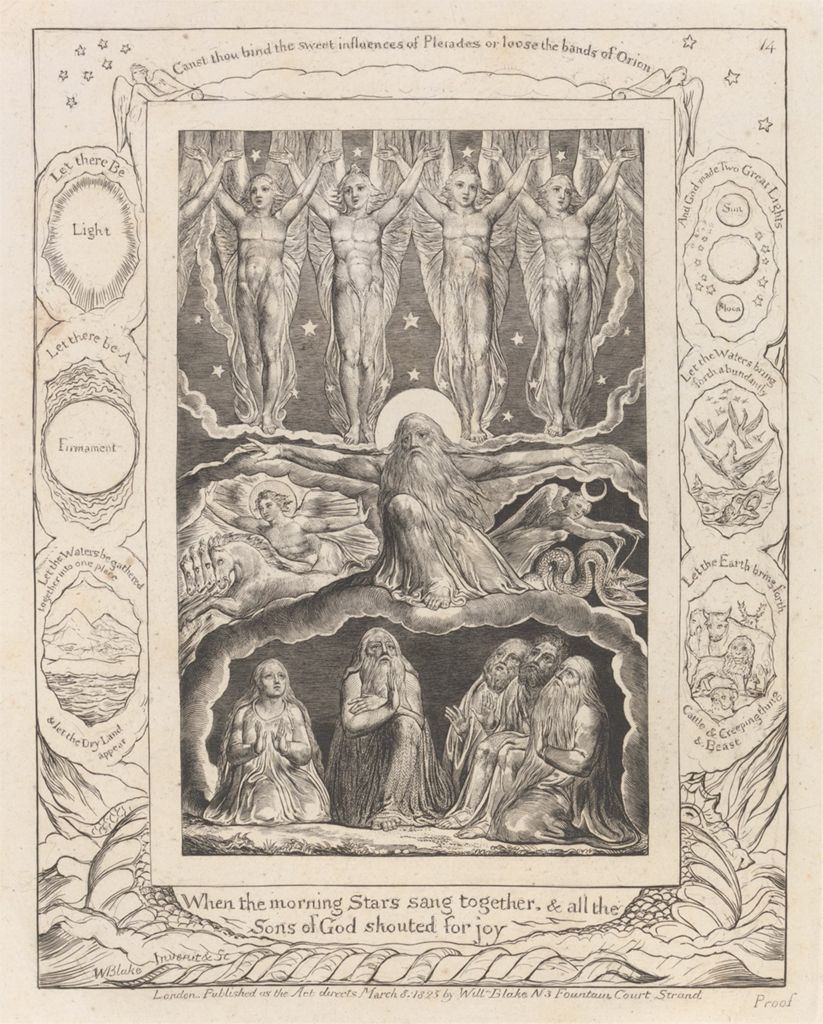
 In commenting on William Blake's Illustrations of the Book of Job in The Art of William Blake, Anthony Blunt wrote on page 86: 

"For once he reduced his visions to terms which are readily intelligible to all, and they gained not lost in the process...

In technique the engravings are masterly. As we know from Gilchrist, Blake had refreshed his mind and his hand by a renewed study of the engravings of Marcantonio and Durer, which he loved since childhood, and his graver takes on a new subtlety and produces a great variety of effects which he had hardly ever achieved in the earlier dry manner of his master Basire. The outline remains as firm as ever, but the modelling is fuller, the effects of light more varied, the texture richer, so that the absence of color is more than made up for; and the engravings have a concentration and force lacking in the preliminary water-colours. The variety of mood is as great as in earlier works but is achieved by moderate means...Ecstasy is given its most splendid expression in the famous plate When the Morning Stars Sang Together (Plate 14).

Yale Center for British Art
Illustrations of the Book of Job
Plate 14

"This last plate was Blake's final statement of a formal theme on which he had many variations and which derived ultimately from a crude engraving of a relief from Persepolis in Bryant's New system of ancient Mythology, published in 1776, the row of figures standing with their arms stretched upwards and overlapping. This device had appeared in one of the illustrations to Young's Night Thoughts, where the figures are cherubim with six wings, four of which cover their bodies and legs. The Job water-colours show four figures with one pair of wings each, clad in short skirts and flanked by two wisps of a cloud. In the engravings the group is made more coherent and more lively by the introduction of flowing gauze-like dresses which cover the figures right down to their feet and link with the line of the clouds, integrating them into the design. But Blake's most effective change at this stage is to add, at each end of the row of figures, an extra arm cut off by the edge of the plate, which suggests with striking effect that the row is continued indefinitely beyond the frame of the engraving and ads mystery to the whole conception."

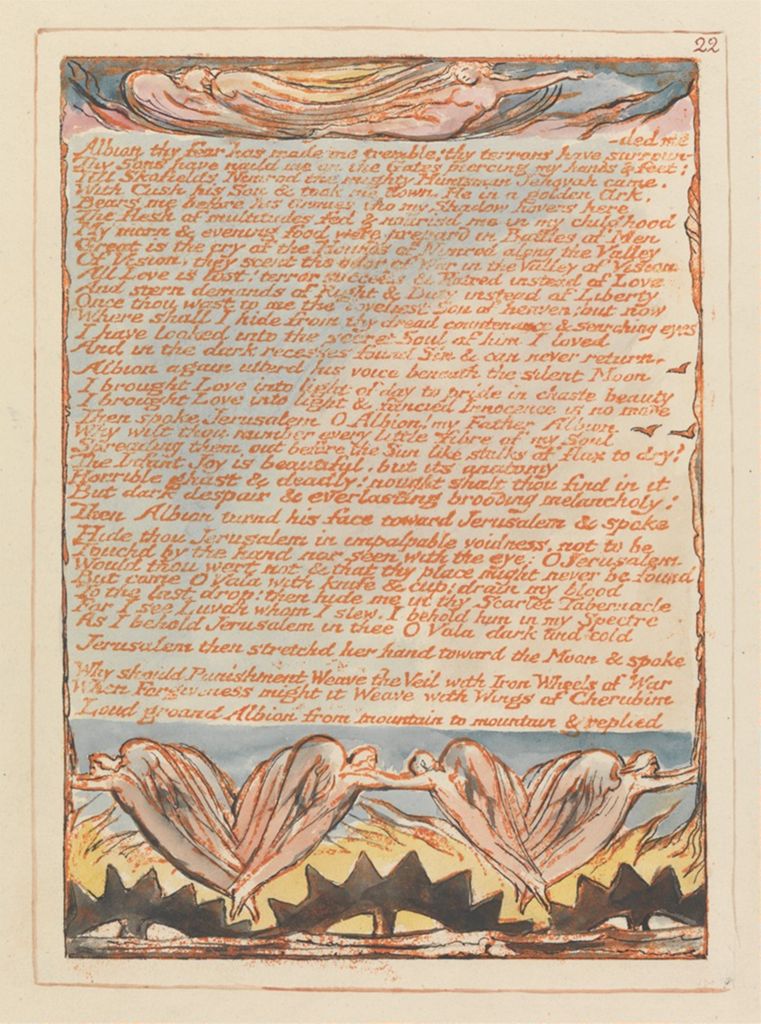
Blake made at least two additional images of this motif. In his illustrations to Milton's On the Morning of Christ's Nativity he pictured five angels is a row, enclosed in a circle of angels. At the bottom of plate 22 of Jerusalem Blake contrasted the Wings of Cheribim with Iron Wheels of war. The angels once again reach out to each other with the implication that an infinite pattern continues.

"Why should Punishment Weave the Veil with Iron Wheels of War
When Forgiveness might it Weave with Wings of Cherubim" 

This image of interlocked angels singing their praise and gratitude was Blake's response to the following verses in the Book of Job:

Job 38

[4] Where wast thou when I laid the foundations of the earth? declare, if thou hast understanding.
[5] Who hath laid the measures thereof, if thou knowest? or who hath stretched the line upon it?
[6] Whereupon are the foundations thereof fastened? or who laid the corner stone thereof;
[7] When the morning stars sang together, and all the sons of God shouted for joy?

The words Morning Star appear also in the Book of Revelation.

Revelation 22

[16] I Jesus have sent mine angel to testify unto you these things in the churches. I am the root and the offspring of David, and the bright and morning star.
[17] And the Spirit and the bride say, Come. And let him that heareth say, Come. And let him that is athirst come. And whosoever will, let him take the water of life freely.


In the Four Zoas Urizen and his obedient sons came not. The turned away.

Four Zoas, Night III, Page 37, (E 326)         

"Now sat the King of Light on high upon his starry throne
And bright Ahania bow'd herself before his splendid feet

O Urizen look on Me. like a mournful stream  
I Embrace round thy knees & wet My bright hair with my tears: 
Why sighs my Lord! are not the morning stars thy obedient Sons   
Do they not bow their bright heads at thy voice? at thy command
Do they not fly into their stations & return their light to thee
The immortal Atmospheres are thine, there thou art seen in glory
Surrounded by the ever changing Daughters of the Light
Why wilt thou look upon futurity darkning present joy"
Four Zoas, Night V, Page 64, (E 343)
"I well remember for I heard the mild & holy voice
Saying O light spring up & shine & I sprang up from the deep  
He gave to me a silver scepter & crownd me with a golden crown
& said Go forth & guide my Son who wanders on the ocean  

I went not forth. I hid myself in black clouds of my wrath       
I calld the stars around my feet in the night of councils dark
The stars threw down their spears & fled naked away
We fell. I siezd thee dark Urthona In my left hand falling
I siezd thee beauteous Luvah thou art faded like a flower"  

Songs of Innocence and of Experience, Song 30, (E 18) 

"O Earth O Earth return!
Arise from out the dewy grass;
Night is worn,
And the morn
Rises from the slumberous mass, 
 
Turn away no more
Why wilt thou turn away
The starry floor
The watry shore
Is giv'n thee till the break of day."

Wednesday, October 11, 2023

LAW & GRACE

Illustrations of the Book of Job
Plate 13
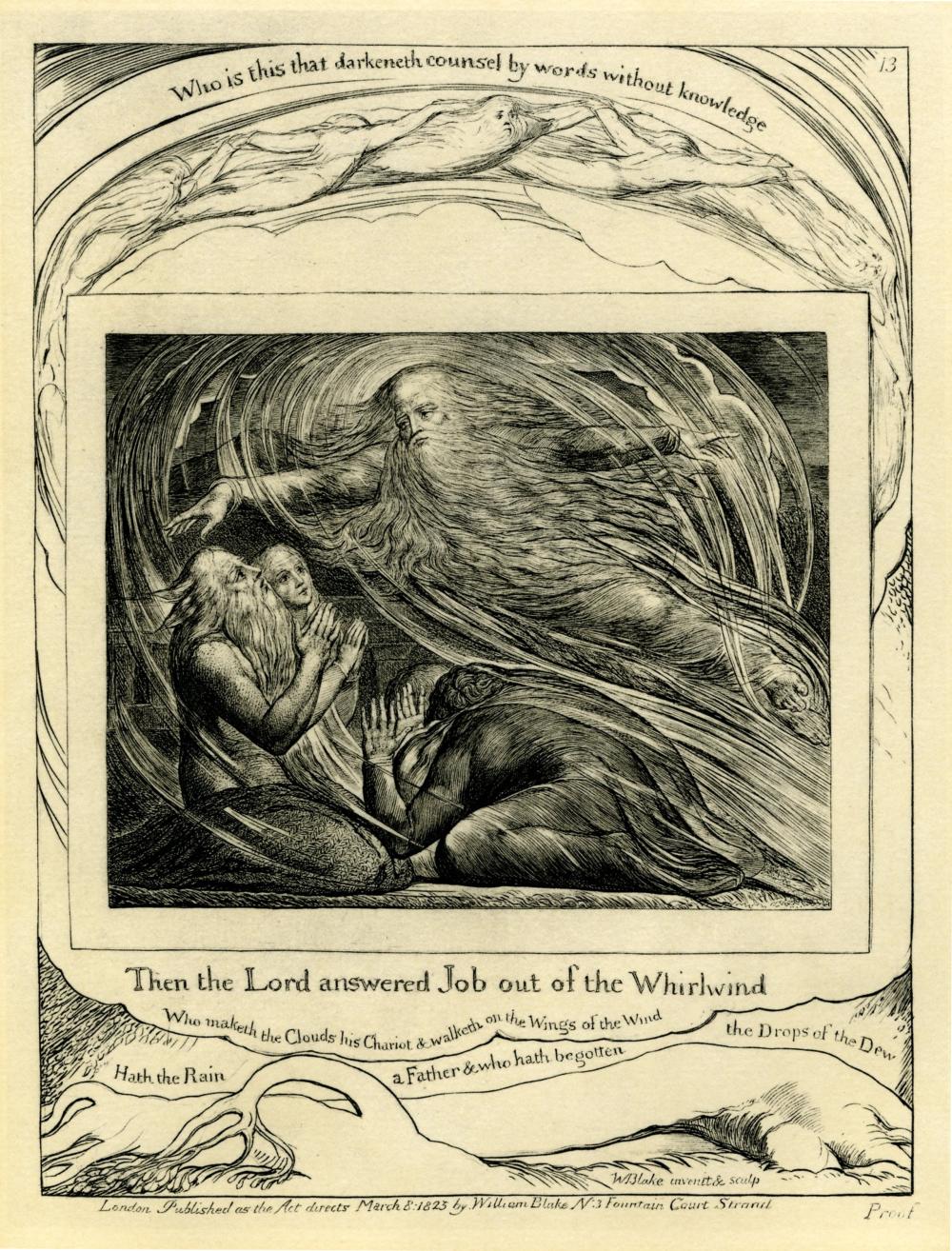
"Then the Lord answered Job out of the Whirlwind"
Everlasting Gospel, Textural Notes, (E 876) 
     "It was when Jesus said to Me
     Thy Sins are all forgiven thee
     The Christian trumpets loud proclaim
     Thro all the World in Jesus name
     Mutual forgiveness of each Vice
     And oped the Gates of Paradise
     The Moral Virtues in Great fear
     Formed the Cross & Nails & Spear
     And the Accuser standing by
     Cried out Crucify Crucify
     Our Moral Virtues neer can be
     Nor Warlike pomp & Majesty
     For Moral Virtues all begin
     In the Accusations of Sin" 
Jerusalem, Plate 25, (E 170)
"And there was heard a great lamenting in Beulah: all the Regions
Of Beulah were moved as the tender bowels are moved: & they said:

Why did you take Vengeance O ye Sons of the mighty Albion?
Planting these Oaken Groves: Erecting these Dragon Temples
Injury the Lord heals but Vengeance cannot be healed:            
As the Sons of Albion have done to Luvah: so they have in him
Done to the Divine Lord & Saviour, who suffers with those that Suffer:
For not one sparrow can suffer, & the whole Universe not suffer also,
In all its Regions, & its Father & Saviour not pity and weep.
But Vengeance is the destroyer of Grace & Repentance in the bosom
Of the Injurer: in which the Divine Lamb is cruelly slain:
Descend O Lamb of God & take away the imputation of Sin
By the Creation of States & the deliverance of Individuals Evermore Amen

Thus wept they in Beulah over the Four Regions of Albion
But many doubted & despaird & imputed Sin & Righteousness       
To Individuals & not to States, and these Slept in Ulro."

Jerusalem, Plate 86, (E 245)

"And Enitharmon like a faint rainbow waved before him         
Filling with Fibres from his loins which reddend with desire
Into a Globe of blood beneath his bosom trembling in darkness
Of Albions clouds. he fed it, with his tears & bitter groans
Hiding his Spectre in invisibility from the timorous Shade
Till it became a separated cloud of beauty grace & love       
Among the darkness of his Furnaces dividing asunder till
She separated stood before him a lovely Female weeping
Even Enitharmon separated outside, & his Loins closed
And heal'd after the separation: his pains he soon forgot:
Lured by her beauty outside of himself in shadowy grief.      
Two Wills they had; Two Intellects: & not as in times of old."

Letters, To Thomas Butts, (E 728)
"I know that you see certain merits
in me which by Gods Grace shall be made fully apparent & perfect
in Eternity. in the mean time I must not bury the Talents in the
Earth but do my endeavour to live to the Glory of our Lord &
Saviour & I am also grateful to the kind hand that endeavours to
lift me out of despondency even if it lifts me too high-"
John 1 
[14] And the Word was made flesh, and dwelt among us, (and we 
beheld his glory, the glory as of the only begotten of the Father,) full
of grace and truth.
[15] John bare witness of him, and cried, saying, This was he of whom I spake, He that cometh after me is preferred before me: for he was before me.
[16] And of his fulness have all we received, and grace for grace.
[17] For the law was given by Moses, but grace and truth came by Jesus Christ.

Romans 3
[20] Therefore by the deeds of the law there shall no flesh be justified in his sight: for by the law is the knowledge of sin.
[21] But now the righteousness of God without the law is manifested, being witnessed by the law and the prophets;
[22] Even the righteousness of God which is by faith of Jesus Christ unto all and upon all them that believe: for there is no difference:
[23] For all have sinned, and come short of the glory of God;
[24] Being justified freely by his grace through the redemption that is in Christ Jesus 

2 Corinthians 12

[9] And he said unto me, My grace is sufficient for thee: for my strength is made perfect in weakness. Most gladly therefore will I rather glory in my infirmities, that the power of Christ may rest upon me.
[10] Therefore I take pleasure in infirmities, in reproaches, in necessities, in persecutions, in distresses for Christ's sake: for when I am weak, then am I strong.

Robert Essick's article titled Blake’s Job: Some Unrecorded Proofs and Their Inscriptions, appeared in the Blake: An Illustrated Quarterly in 1986.In he included the following two statements:

"Charles Eliot Norton was the first to suggest that Blake pictures Job in a fallen state of consciousness at the beginning of the series. As Norton wrote in 1875, 'Job’s prayers and burnt-offerings, in the days of his prosperity, were, after all, but the propitiatory and selfish sacrifices of the law.'”

"Blake come to realize that the 'perfect and upright' man of 'the land of Uz' (Job 1:1) was not an archetype of the prayerful student of the arts but one who had already fallen in thrall to the dead letter of the law."  

Norton's and  Essick's insights revised the understanding of Blake's intentions when illustrating the Book of Job. Blake was communicating his perception of Job's spiritual journey which revised his image of God.

The law is a meant to be a means by which one achieves virtue and acceptance. Grace is the gift that is bestowed through the generosity of the giver. Under the law inclusion is earned through obedience. Under grace inclusion is the byproduct of accepting with gratitude the gift that has been offered.

Judging from Blake's Illustrations of the Book of Job, he understood that Job originally lived under the law. Job felt that the blessings that he received were repayment for his obedience and righteousness. His understanding of God was limited by his failure to comprehend the ways of God which were beyond natural and reasonable means.

When Job had a direct encounter with the wisdom and power of God he realized that he lived by grace rather than by law. His prosperity had not been of his own doing. When he encountered the loss of his goods, and family and health, he began to see that 'all these things' were not his own but were the bounty provided by the beneficence of God's grace.

The inner change which Job underwent when he was overwhelmed by the Almighty led to a transformation of his mind and spirit. He no longer expected to understand God because the unfathomable depth of God had been revealed to him. He knew thenceforth that he lived under grace and not law.

Romans 3

[8] And not rather, (as we be slanderously reported, and as some affirm that we say,) Let us do evil, that good may come? whose damnation is just.
[9] What then? are we better than they? No, in no wise: for we have before proved both Jews and Gentiles, that they are all under sin;
[10] As it is written, There is none righteous, no, not one:
[11] There is none that understandeth, there is none that seeketh after God.
[12] They are all gone out of the way, they are together become unprofitable; there is none that doeth good, no, not one.

Job 38

[1] Then the LORD answered Job out of the whirlwind, and said,
[2] Who is this that darkeneth counsel by words without knowledge?
[3] Gird up now thy loins like a man; for I will demand of thee, and answer thou me.
[4] Where wast thou when I laid the foundations of the earth? declare, if thou hast understanding.
[5] Who hath laid the measures thereof, if thou knowest? or who hath stretched the line upon it?
[6] Whereupon are the foundations thereof fastened? or who laid the corner stone thereof;
[7] When the morning stars sang together, and all the sons of God shouted for joy?
[8] Or who shut up the sea with doors, when it brake forth, as if it had issued out of the womb?
[9] When I made the cloud the garment thereof, and thick darkness a swaddlingband for it,
[10] And brake up for it my decreed place, and set bars and doors,
[11] And said, Hitherto shalt thou come, but no further: and here shall thy proud waves be stayed?
[12] Hast thou commanded the morning since thy days; and caused the dayspring to know his place;
[13] That it might take hold of the ends of the earth, that the wicked might be shaken out of it?
[14] It is turned as clay to the seal; and they stand as a garment.
[15] And from the wicked their light is withholden, and the high arm shall be broken.
[16] Hast thou entered into the springs of the sea? or hast thou walked in the search of the depth?
[17] Have the gates of death been opened unto thee? or hast thou seen the doors of the shadow of death?
[18] Hast thou perceived the breadth of the earth? declare if thou knowest it all.
[19] Where is the way where light dwelleth? and as for darkness, where is the place thereof,
[20] That thou shouldest take it to the bound thereof, and that thou shouldest know the paths to the house thereof?
[21] Knowest thou it, because thou wast then born? or because the number of thy days is great?
[22] Hast thou entered into the treasures of the snow? or hast thou seen the treasures of the hail,
[23] Which I have reserved against the time of trouble, against the day of battle and war?
[24] By what way is the light parted, which scattereth the east wind upon the earth?
[25] Who hath divided a watercourse for the overflowing of waters, or a way for the lightning of thunder;
[26] To cause it to rain on the earth, where no man is; on the wilderness, wherein there is no man;
[27] To satisfy the desolate and waste ground; and to cause the bud of the tender herb to spring forth?
[28] Hath the rain a father? or who hath begotten the drops of dew?
[29] Out of whose womb came the ice? and the hoary frost of heaven, who hath gendered it?
[30] The waters are hid as with a stone, and the face of the deep is frozen.
[31] Canst thou bind the sweet influences of Pleiades, or loose the bands of Orion?
[32] Canst thou bring forth Mazzaroth in his season? or canst thou guide Arcturus with his sons?
[33] Knowest thou the ordinances of heaven? canst thou set the dominion thereof in the earth?
[34] Canst thou lift up thy voice to the clouds, that abundance of waters may cover thee?
[35] Canst thou send lightnings, that they may go, and say unto thee, Here we are?
[36] Who hath put wisdom in the inward parts? or who hath given understanding to the heart?
[37] Who can number the clouds in wisdom? or who can stay the bottles of heaven,
[38] When the dust groweth into hardness, and the clods cleave fast together?
[39] Wilt thou hunt the prey for the lion? or fill the appetite of the young lions,
[40] When they couch in their dens, and abide in the covert to lie in wait?
[41] Who provideth for the raven his food? when his young ones cry unto God, they wander for lack of meat.

Job 42

[1] Then Job answered the LORD, and said,
[2] I know that thou canst do every thing, and that no thought can be withholden from thee.
[3] Who is he that hideth counsel without knowledge? therefore have I uttered that I understood not; things too wonderful for me, which I knew not.
[4] Hear, I beseech thee, and I will speak: I will demand of thee, and declare thou unto me.
[5] I have heard of thee by the hearing of the ear: but now mine eye seeth thee.
[6] Wherefore I abhor myself, and repent in dust and ashes.

[7] And it was so, that after the LORD had spoken these words unto Job, the LORD said to Eliphaz the Temanite, My wrath is kindled against thee, and against thy two friends: for ye have not spoken of me the thing that is right, as my servant Job hath.

Blake's Illustrations of The Book of Job begins with achievement by strictly following tenets of the law. It ends with acknowledging that the grace of God provides all that we are and have.


Friday, September 29, 2023

JOB PLATE 18

Wikipedia Commons
Illustrations of the Book of Job
Plate18

This is the location of verses of scripture on Plate 18.

. . . and the Lord also accepted Job (Job 42:9)

. . . and my servant Job shall pray for you (Job 42:8)
 
And the Lord turned the captivity of Job, when he prayed for his friends (Job 42: 10)
 
But I say unto you, Love your enemies, bless them at curse you, do good to them that hate you, and pray for them which despitefully use you, and persecute you (Matthew 5:44)
 
That ye may be the children of your Father which is in heaven: for he maketh his sun to rise on the evil and on the good, and sendeth rain on the just and on the unjust (Matthew 5: 45)

Blake discerned that the inner changes that Job experienced through his encounter with the living God brought about corresponding changes in Job's outer attitudes. Since Plate 17 represents the spiritual rebirth of Job, Plate 18 presents outward signs of the inner changes. We read in the Book of Job that when Job was accepted by God be became able to pray for his those who had been the enemies of his spiritual development. Job was no longer captive to his former attitudes when he prayed for his would-be friends.

On the pages of the 'book' are quotations from the New Testament. Jesus' message to his followers is of loving, blessing and doing good to those who are against you. If one is to be like the Heavenly Father one must treat the just and unjust equally.

On the borders of the plate Blake created image of the fulfillment of the changes which had taken place in Job. There are six angels facing outward, perhaps Angels of Providence. There are stalks of ripened wheat showing that the fruits of change are ready for harvest. The images of the tools of art indicate that the imagination has been released for creative expression.

Milton,Plate 36 [40], (E 136)

"When on the highest lift of his light pinions he arrives
At that bright Gate, another Lark meets him & back to back
They touch their pinions tip tip: and each descend
To their respective Earths & there all night consult with Angels
Of Providence & with the Eyes of God all night in slumbers       
Inspired: & at the dawn of day send out another Lark
Into another Heaven to carry news upon his wings"

Matthew 5 

 [44] But I say unto you, Love your enemies, bless them that curse you, do good to them that hate you, and pray for them which despitefully use you, and persecute you;
[45] That ye may be the children of your Father which is in heaven: for he maketh his sun to rise on the evil and on the good, and sendeth rain on the just and on the unjust.
[46] For if ye love them which love you, what reward have ye? do not even the publicans the same?
[47] And if ye salute your brethren only, what do ye more than others? do not even the publicans so?
[48] Be ye therefore perfect, even as your Father which is in heaven is perfect.

Additional post on Job Plate 18. 


Saturday, September 23, 2023

JOB PLATE 17


This is the location of verses of scripture on Plate 17.
 
1Samuel 2
[6] he bringeth down to the grave, and bringeth up.
 
1John 3
[2] we know that, when he shall appear, we shall be like him; for we shall see him as he is.


Psalms 8
[3] When I consider thy heavens, the work of thy fingers, the moon and the stars, which thou hast ordained;
[4] What is man, that thou art mindful of him? and the son of man, that thou visitest him?

Job 42
[5] I have heard of thee by the hearing of the ear: but now mine eye seeth thee.

John 14
[9] he that hath seen me hath seen the Father

John 10
[30] I and my Father are one.

John 14
[20] At that day ye shall know that I am in my Father, and ye in me, and I in you.

John 14
[28] If ye loved me, ye would rejoice, because I said, I go unto the Father


From the pages of the 'books' at the bottom of the plate:

John 14
[7] If ye had known me, ye should have known my Father also: and from henceforth ye know him, and have seen him 

*******

John 14
[11] Believe me that I am in the Father, and the Father in me: 

John 14
[21] he that loveth me shall be loved of my Father
[17] for he dwelleth with you, and shall be in you.

*******

John 14
[21] he that loveth me shall be loved of my Father, and I will love him, and will manifest myself to him.
[23] my Father will love him, and we will come unto him, and make our abode with him.

********

John 14
[16] And I will pray the Father, and he shall give you another Comforter, that he may abide with you for ever;
[17] Even the Spirit of truth; whom the world cannot receive


The rebirth of Job follows his trial by Satan, his encounter with the wisdom and power of Jehovah, and his recognition of the impotence of Behemoth and Leviathan. He is freed from exposure to Satan's dark dominion as he sees Satan fall from Heaven and lose his ability to mentally harass him. Having been released from the forces which kept him in bondage, he is opened to an encounter with a new vision of God. This can be seen as the revelation which comes through Jesus, the Seventh Eye of God. 

Job and his female counterpart are seen in Plate 17 receiving the blessing of a God who relates to him as Man to Man. The scripture on the plate delineates the experiential relationship which is introduced by the coming of Jesus. God becomes known because Man shall see 'him as he is' through seeing his son whom he loves. The theme of the quotes on the plate is love: the Fathers love for Jesus, the son's love for the Father, Man's love for Jesus and for his Father, and the love through which Man dwells within God himself. Through the Oneness of God and Jesus, Man loves and is loved. 

This plate is about transformations. Man has been transformed from a supplicant of a unknown God whom he fears and manipulates, to becoming a member of God's family who pleases God by loving him and Jesus. He is promised a comforter to be with him always as the Spirit of Truth.

By using New Testament scripture Blake presents this as God being transformed to a new revelation or Eye of God. He will not be a god who is distant or hidden. Through the revelation of Jesus, Man may know that God lives within his Soul. If Man believes that Jesus is in God, and that God is in Jesus, Man will know that he is beloved of God who abides with him.     

Job 42

[1] Then Job answered the LORD, and said,
[2] I know that thou canst do every thing, and that no thought can be withholden from thee.
[3] Who is he that hideth counsel without knowledge? therefore have I uttered that I understood not; things too wonderful for me, which I knew not.
[4] Hear, I beseech thee, and I will speak: I will demand of thee, and declare thou unto me.
[5] I have heard of thee by the hearing of the ear: but now mine eye seeth thee.
[6] Wherefore I abhor myself, and repent in dust and ashes.
[7] And it was so, that after the LORD had spoken these words unto Job, the LORD said to Eliphaz the Temanite, My wrath is kindled against thee, and against thy two friends: for ye have not spoken of me the thing that is right, as my servant Job hath.
[8] Therefore take unto you now seven bullocks and seven rams, and go to my servant Job, and offer up for yourselves a burnt offering; and my servant Job shall pray for you: for him will I accept: lest I deal with you after your folly, in that ye have not spoken of me the thing which is right, like my servant Job

From a sermon at St Andrews Church Cobourg CA:

"Job’s faith has been transformed. He cannot go back to being the individual he once was. His journey will not allow it, his new understanding of God will not allow it. So Job does the only thing he can do and that is to ask forgiveness for the simplicity of his former thoughts."


Friday, July 7, 2023

SATAN

Wikimedia Commons
Illustrations of the Book of Job
Satan Before the Throne of God

The work that is done in the psyche is not all easy and pleasant. It involves tearing down as well as building up. It includes dividing as well as uniting. In the Book of Job, Satan was given the task of testing God's servant Job who was though to be perfect. It turned out that there was a lot of internal work that he needed to do before he knew his own defects and failing. Satan was the instrument through which Job was able to evolve into self-knowledge and a right relationship with God.

Blake describes Satan as having a unique place in the scheme of things. He has no permanent existence as either body or spirit. He exists only as a function and is created when his function needs to be performed. Satan is a state which man passes through along his journey through Eternal Death or life as it is known in this world. He is called the Miller of Eternity because he breaks down the hardened routines we accept as our personalities or who we are. If one's psyche is under the control of a mistaken but pervasive behavior, Satan may intervene to reveal the destructiveness of that arrangement. 

Something has to play the role of showing us what changes will make it possible for an individual to be freed from the chains that bind him to the status quo. Psychological development is a process which is never complete. Satan is a miller; he grinds the hard grains until the are fit to make bread to feed the soul of man. Along with Rintrah, the plowman, he breaks hardened surfaces so that the work of Palamabron, Los and Blake may be accomplished. 

Perhaps we encounter Satan in our dreams when we enter a dark place where we see chaos and destruction. The unconscious mind is signaling us that change is imminent. We have the option of making the necessary changes of becoming their victim. Albion resisted change and suffered the consequences.  

Milton, Plate 3, (E 97)

"At last Enitharmon brought forth Satan Refusing Form, in vain
The Miller of Eternity made subservient to the Great Harvest
That he may go to his own Place Prince of the Starry Wheels

Plate 4 
Beneath the Plow of Rintrah & the harrow of the Almighty
In the hands of Palamabron. Where the Starry Mills of Satan
Are built beneath the Earth & Waters of the Mundane Shell
Here the Three Classes of Men take their Sexual texture Woven
The Sexual is Threefold: the Human is Fourfold              
If you account it Wisdom when you are angry to be silent, and
Not to shew it: I do not account that Wisdom but Folly.
Every Mans Wisdom is peculiar to his own Individ[u]ality
O Satan my youngest born, art thou not Prince of the Starry Hosts
And of the Wheels of Heaven, to turn the Mills day & night?  
Art thou not Newtons Pantocrator weaving the Woof of Locke
To Mortals thy Mills seem every thing & the Harrow of Shaddai
A scheme of Human conduct invisible & incomprehensible
Get to thy Labours at the Mills & leave me to my wrath,

Satan was going to reply, but Los roll'd his loud thunders.   

Anger me not! thou canst not drive the Harrow in pitys paths.
Thy Work is Eternal Death, with Mills & Ovens & Cauldrons.
Trouble me no more. thou canst not have Eternal Life

So Los spoke! Satan trembling obeyd weeping along the way.
Mark well my words, they are of your eternal Salvation"        
Jerusalem, Plate 35  [39], (E 181)
"By Satans Watch-fiends tho' they search numbering every grain
Of sand on Earth every night, they never find this Gate.
It is the Gate of Los. Withoutside is the Mill, intricate, dreadful
And fill'd with cruel tortures; but no mortal man can find the Mill
Of Satan, in his mortal pilgrimage of seventy years              

For Human beauty knows it not: nor can Mercy find it! But 
In the Fourth region of Humanity, Urthona namd[,]
Mortality begins to roll the billows of Eternal Death
Before the Gate of Los. Urthona here is named Los." 
Descriptive Catalogue, Chaucer's Canterbury Pilgrims, (E 535)
"Thus the reader will observe, that
Chaucer makes every one of his characters perfect in his kind,
every one is an Antique Statue; the image of a class, and not of
an imperfect individual.
  This groupe also would furnish substantial matter, on which
volumes might be written.  The Franklin is one who keeps open
table, who is the genius of eating and drinking, the Bacchus; as
the Doctor of Physic is the Esculapius, the Host is the Silenus,
the Squire is the Apollo, the Miller is the Hercules, &c.
Chaucer's characters are a description of the eternal Principles
that exist in all ages.  The Franklin is voluptuousness itself
most nobly pourtrayed:
Page 21
              "It snewed in his house of meat and drink."
  The Plowman is simplicity itself, with wisdom and strength
for its stamina.  Chaucer has divided the ancient character of
Hercules between his Miller and his Plowman.  Benevolence is the
plowman's great characteristic, he is thin with excessive labour,
and not with old age, as some have supposed.
               "He would thresh and thereto dike and delve
               For Christe's sake, for every poore wight,
               Withouten hire, if it lay in his might."
Visions of these eternal principles or characters of human
life appear to poets, in all ages; the Grecian gods were the
ancient Cherubim of Phoenicia; but the Greeks, and since them the
Moderns, have neglected to subdue the gods of Priam.  These Gods
are visions of the eternal attributes, or divine names, which,
when [P 22] erected into gods, become destructive to humanity.
They ought to be the servants, and not the masters of man, or of
society.  They ought to be made to sacrifice to Man, and not man
compelled to sacrifice to them; for when separated from man or
humanity, who is Jesus the Saviour, the vine of eternity, they
are thieves and rebels, they are destroyers.
  The Plowman of Chaucer is Hercules in his supreme eternal
state, divested of his spectrous shadow; which is the Miller, a
terrible fellow, such as exists in all times and places, for the
trial of men, to astonish every neighbourhood, with brutal
strength and courage, to get rich and powerful to curb the pride
of Man.
Jerusalem, Plate 31 [35], (E 177)
"Then the Divine hand found the Two Limits, Satan and Adam,
... 
"Albion goes to Eternal Death: In Me all Eternity.
Must pass thro' condemnation, and awake beyond the Grave!
No individual can keep these Laws, for they are death
To every energy of man, and forbid the springs of life;
Albion hath enterd the State Satan! Be permanent O State!
And be thou for ever accursed! that Albion may arise again:
And be thou created into a State! I go forth to Create           
States: to deliver Individuals evermore! Amen.

So spoke the voice from the Furnaces, descending into Non-Entity
 [To Govern the Evil by Good: and States abolish Systems.]" 
Romans 8 - Phillips Translation 
Verses 38-39 
        I have become absolutely convinced that neither death nor
        life, neither messenger of Heaven nor monarch of earth,
        neither what happens today nor what may happen tomorrow,
        neither a power from on high nor a power from below, nor
        anything else in God's whole world has any power to
        separate us from the love of God in Jesus Christ our
        Lord! 

Monday, December 12, 2022

JOB, BLAKE & JUNG

First posted Sept 2009.

William Blake, Carl Jung and the author of the Book of Job, seem to agree that the experience of Job represented a change in the relationship of man and God. Job struggles against the perceived injustice of God and the suffering it brings upon him. Job receives a direct intervention from God in the shape of God speaking to him from the whirlwind. Because Job was truthful with God and confronted God with the human point of view, he received an answer demonstrating God's power, wisdom and mystery. 

After his trials Job's fortunes are restored and he receives God's favor. The role that Satan (the personification of evil) plays in the story is pivotal. Satan is allowed by God to test Job because of Job's reputation for righteousness. This perhaps is the hinge of the story because Satan, not God is in charge of testing Job. In the end Job's demands convince God to relate to him directly.  

Wikipedia Commons
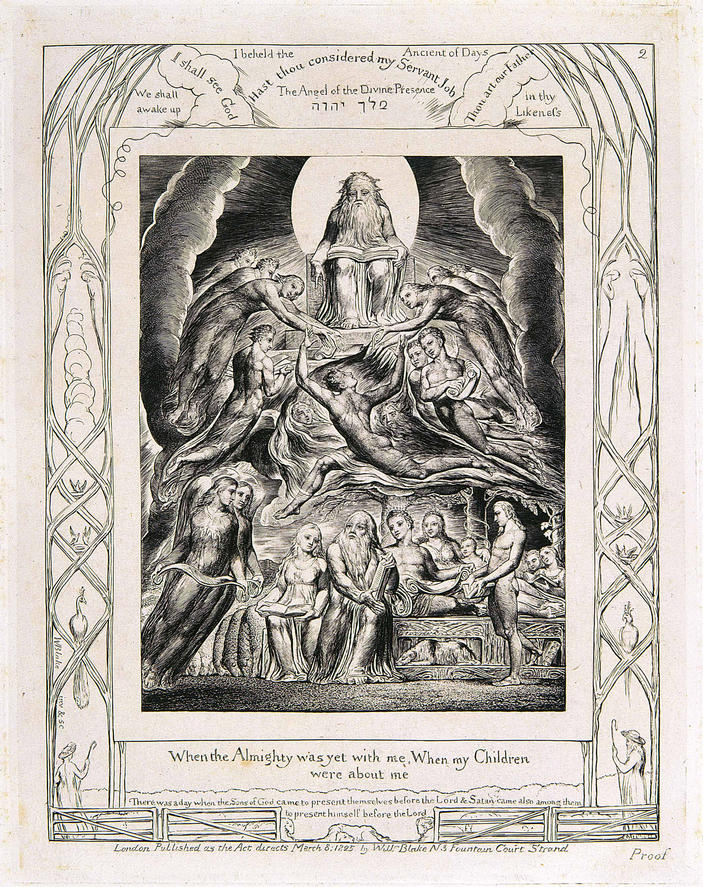
Satan before the Throne of God 
Illustrations to the Book of Job (Linnell Set)

Here is a quote from Jung in a letter to Morton Kelsey (from Carl Jung: Wounded Healer of the Soul by Claire Dunne): 

 "This is what happens in Job: The creator sees himself through the eyes of man's consciousness and this is the reason why God has to become man, and why man is progressively gifted with the dangerous prerogative of the divine 'mind.' You have it in Christ's saying: 'Ye are gods' and man has not even begun to know himself." 

Edward Edinger, in Encounter with the Self: A Jungian Commentary on William Blake's Illustrations of the Book of Job describes the encounter of Job with God as "a divine encounter by which the ego is rewarded with some insight into the transpersonal psyche." And he further says "The ego, by holding fast to its integrity, is granted a realization of the Self." 

Blake's book, Illustrations of the Book of Job, consists of 21 plates which tell Job's story in a few words and in highly symbolic pictures. Plate 13 represents the encounter of Job with God in the whirlwind which is the intimate experience of a man directly with the numinous. The next plate, number 14, depicts a rebirth of consciousness. The central picture is surrounded with images and words from the creation story in Genesis. The text includes "When the morning Stars sang together & all the sons of God shouted for joy." (Job 38:7) The central image depicts at the top four angels among the stars rejoicing. In the center is kneeling God with outstretched arms and a bright sun-like halo. Beside him are Apollo with the sun, and Artemis with the moon. At the lowest level are Job his wife and the three comforters, who are allowed to witness the celebration of the this new stage of creation. The next seven plates illustrate the changed relationship between Job and God. 

Damon in A Blake Dictionary explains the process Job underwent in terms to going through stages represented by the Seven Eyes of God. In the end "His manhood purged of all error, is now complete." Each one of us is searching for images to represent indescribable experience. 

For links to Blake's illustrations consult the post: Blake's Pictures for Job.


Sunday, December 4, 2022

Posts for Book of Job

Metropolitan Museum
Illustrations of the Book of Job
Title page

This post provides a convenient way to follow comments on each of the twenty-one plates of Blake's Illustrations of the Book of Job. As you can see from the url's they were posted in 2010. Larry is the author of these posts.

links

1. https://ramhornd.blogspot.com/2010/06/job-picture-1.html

2. https://ramhornd.blogspot.com/2010/06/job-picture-2.html

3. https://ramhornd.blogspot.com/2010/06/job-picture-3.html

4. https://ramhornd.blogspot.com/2010/06/job-picture-4.html

5. https://ramhornd.blogspot.com/2010/06/job-picture-5.html

6. https://ramhornd.blogspot.com/2010/06/job-picture-6.html

7. https://ramhornd.blogspot.com/2010/06/job-picture-7.html

8. https://ramhornd.blogspot.com/2010/06/job-picture-8.html

9. https://ramhornd.blogspot.com/2010/06/job-picture-9.html

10. https://ramhornd.blogspot.com/2010/06/job-picture-10.html

11. https://ramhornd.blogspot.com/2017/02/job-page-10.html

12. https://ramhornd.blogspot.com/2010/06/job-picture-12.html

13. https://ramhornd.blogspot.com/2010/07/job-picture-13.html

14. https://ramhornd.blogspot.com/2010/07/job-picture-14.html

15. https://ramhornd.blogspot.com/2017/03/job-page-14.html

16. https://ramhornd.blogspot.com/2010/07/job-picture-16.html

17. https://ramhornd.blogspot.com/2010/07/job-picture-17.html

18. https://ramhornd.blogspot.com/2010/07/job-picture-18.html

19. https://ramhornd.blogspot.com/2010/07/job-picture-19.html

20. https://ramhornd.blogspot.com/2010/07/job-picture-20.html

21. https://ramhornd.blogspot.com/2010/07/job-picture-21.html 


Saturday, December 3, 2022

JOB LABELS

The plates:


My labels for the plates:
 
1. Innocence 
2. Doubt
3. Wrath
4. Disasters
5. Temptation
6. Shame
7. Experience
8. Anger
9. Disillusionment
10. Rejection
11. Insight
12. New Birth
13. Vision
14. Synthesis
15. Encounter with Unconscious
16. Reversal
17. God of Love
18. Forgiveness
19. Humility
20. Self-giving

21. Wholeness
 
 INNOCENCE - one that feared God
DOUBT - when the Almighty was yet with me

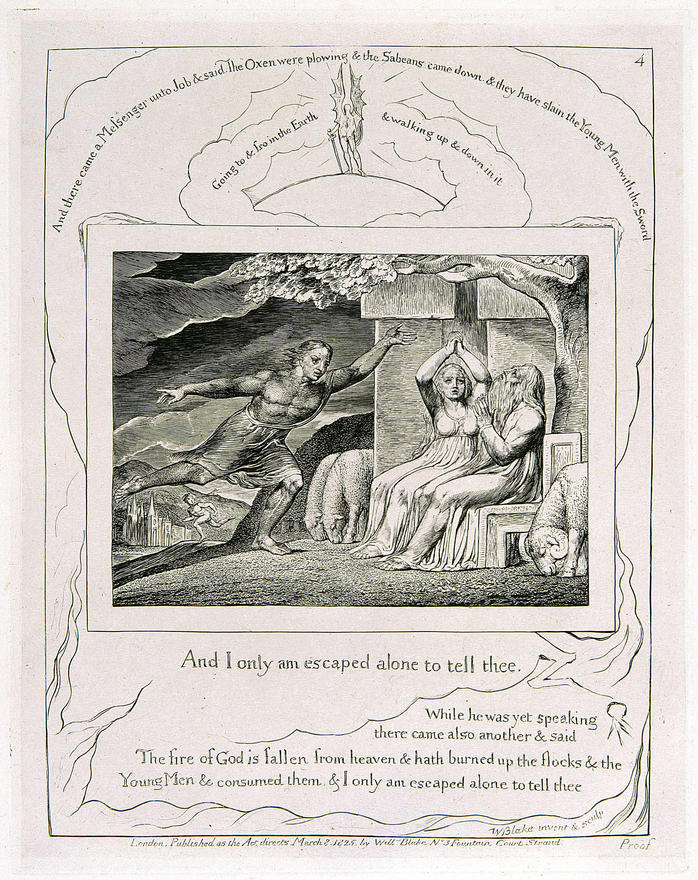
WRATH - The fire of god is fallen form heaven
 
DISASTERS - I only am escaped
https://upload.wikimedia.org/wikipedia/commons/a/a5/Blake_Job_4.jpg  
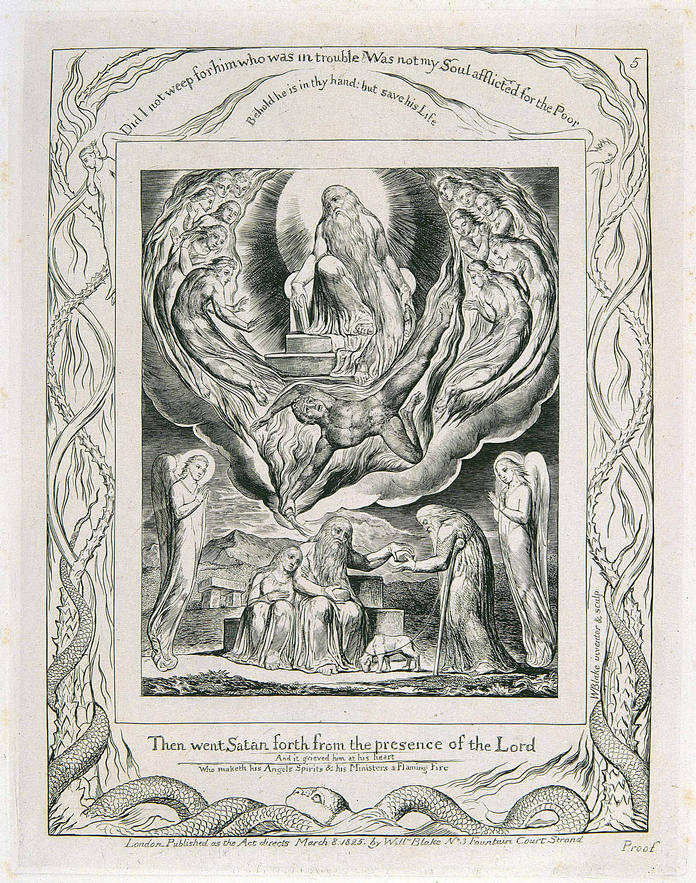
TEMPTATION - satan went froth from the presence
SHAME - smote Job with boils
 
EXPERIENCE - shall we receive good and not also evil
 
ANGER - let the day perish wherein I was born

 DISILLUSIONMENT - the spirit passed before my face
 
REJECTION - laughed to scorn
 
INSIGHT - dreams & visions
NEW BIRTH - these things worketh God
SYNTHESIS - the Lord answereth Job 
VISION - morning stars sang together

ENCOUNTER WITH UNCONSCIOUS - behold now
 
REVERSAL - I saw Satan fall from heaven
GOD OF LOVE - my eye seeth thee
FORGIVENESS - I & my Father are one
HUMILITY - Mercy endureth forever
 
SELF-GIVING - precious are thy thoughts
 
WHOLENESS - just & true are thy ways