Blake seeks to provide the Golden String which can lead us through the labyrinth of our experience or his own poetry.

Showing posts with label Prophet. Show all posts

Wednesday, January 28, 2026

SANITY

First posted July 2022

Wikipedia Commons
Frontispiece
Songs of Experience

Here is a section of An Interview Conducted with Kathleen Raine on July 12, 1993 by Donald E. Stanford:

Interview 

"Stanford: One critic has said recently that Blake was not mad, but he understood and described the mental suffering of madness in a profound way. Do concepts of madness such as schizophrenia, hallucination, and so on have a useful place in Blake criticism and will you comment on the direct question, “was Blake mad?”


Raine: No, of course he wasn’t mad. He was a sane man in a mad world, roughly speaking. Great genius has a wider field of consciousness. That is what genius is: seeing rather more than other men do, perhaps being in advance of his time. Certainly the nature of genius is to not accept current opinion, and Blake certainly did not accept current opinion. I don’t think that words like “schizophrenia” and “paranoia” add much to human discussion of whatever these words mean. Blake himself says, “Plato says that poets do not know what they write and utter. In that case, why is a lesser kind to be called knowing?” In other words, a poet is an inspired man. Blake believed in inspiration. This must be especially remembered with Blake, but all poets have believed in inspiration, that in an inspired state there is a widening of the field of consciousness. Yeats describes genius as bringing together at certain moments the waking and the sleeping mind. The available knowledge is greater in states of inspiration. Blake certainly had this. 


There is much suffering, as your critic says, in the writings of Blake: the turmoil, the anguish of Jerusalem. But this was not a personal thing; he was talking about the nation. He was a spiritual patriot, and he was speaking of the suffering of the giant Albion, as he calls the English nation. He was a prophet in the sense of the Old Testament prophets in the Jewish Bible, who also were speaking for their nation. They were not speaking of their individual suffering; they were speaking of the national psyche, if you like, into which Blake had certainly a remarkably clear insight. He speaks of living. He says, 'in South Molton Street I see and hear' what is going on in the soul of Albion, which is, of course, the soul of England. In other words, here in South Moulton Street I both see and hear the sufferings of the military, or the war against France that broke out after the French Revolution, of the conscription of soldiers, and the suffering of child labor, the endless sufferings of his people at that time, the hangings of boys at Tyburn for the theft of a yard of cloth, the injustices, the national crimes against which Blake spoke out. You may say these were descriptions of deep, deep suffering, the psychological sufferings of various kinds of mental and physical and spiritual tyrannies in his nation at the time. I wonder what he would have been writing about had he lived now. Certainly many things would have been the same — perhaps not all — but when he writes of London and marking, 'in every face marks of weakness, marks of woe,' he felt the collective suffering: that was the nature of his inspiration. He was not a personal poet expressing himself. He was a national prophet, calling to his nation to awake from their 'deadly sleep,' which is unconsciousness of what is going on, and to awake to the truths of the imagination and to reform many things. This is not madness."


Laocoon, (E 274)
 "There are States in which all Visionary Men are accounted Mad 
   Men   such are Greece & Rome"
 Poetical Sketches, (E 415)
"   MAD SONG.
The wild winds weep,
  And the night is a-cold;
Come hither, Sleep,
  And my griefs infold:   
But lo! the morning peeps          
  Over the eastern steeps,
And the rustling birds of dawn 
The earth do scorn.

Lo! to the vault
  Of paved heaven,              
With sorrow fraught
  My notes are driven:
They strike the ear of night,
  Make weep the eyes of day;
They make mad the roaring winds,      
  And with tempests play.

Like a fiend in a cloud
  With howling woe,
After night I do croud,
  And with night will go;         
I turn my back to the east,

From whence comforts have increas'd;
For light doth seize my brain
With frantic pain."

Annotations to Spurzheim's Observations on Insanity, (E 663) 
 "Cowper came to me & said. O that I
were insane always I will never rest.  Can you not make me truly
insane.  I will never rest till I am so. O that in the bosom of
God I was hid.  You retain health & yet are as mad as any of us
all--over us all--mad as a refuge from unbelief--from Bacon
Newton & Locke"
Letters, to Butts Jany 10 180(3), (E 724) 
"The Thing I
have most at Heart! more than life or all that seems to make life
comfortable without.  Is the Interest of True Religion & Science
& whenever any thing appears to affect that Interest. (Especially
if I myself omit any duty to my [self] <Station> as a
Soldier of Christ) It gives me the greatest of torments, I am not
ashamed afraid or averse to tell You what Ought to be Told.  That
I am under the direction of Messengers from Heaven Daily &
Nightly but the nature of such things is not as some suppose.
without trouble or care.  Temptations are on the right hand &
left behind the sea of time & space roars & follows swiftly he
who keeps not right onward is lost & if our footsteps slide in
clay how can we do otherwise than fear & tremble. but I should
not have troubled You with this account of my spiritual state
unless it had been necessary in explaining the actual cause of my
uneasiness into which you are so kind as to Enquire for I never
obtrude such things on others unless questiond & then I never
disguise the truth--But if we fear to do the dictates of our
Angels & tremble at the Tasks set before us. if we refuse to do
Spiritual Acts. because of Natural Fears or Natural Desires!  Who
can describe the dismal torments of such a state!--I too well
remember the Threats I heard!--If you who are organized by Divine
Providence for Spiritual communion.  Refuse & bury your Talent in
the Earth even tho you should want Natural Bread. Sorrow & Desperation 
pursues you thro life! & after death shame & confusion of face to
eternity--Every one in Eternity will leave you aghast at the Man
who was crownd with glory & honour by his brethren & betrayd
their cause to their enemies.  You will be calld the base Judas
who betrayd his Friend!--Such words would make any Stout man
tremble & how then could I be at ease? But I am now no longer in
That State & now go on again with my Task Fearless. and tho my
path is difficult.  I have no fear of stumbling while I keep it" 
Letters, April 25: 1803, To Butts, (E 728)
"Now I may say to you what perhaps I should not dare to say
to any one else.  That I can alone carry on my visionary studies
in London unannoyd & that I may converse with my friends in
Eternity.  See Visions, Dream Dreams, & prophecy & speak Parables
unobserv'd & at liberty from the Doubts of other Mortals. perhaps
Doubts proceeding from Kindness. but Doubts are always pernicious
Especially when we Doubt our Friends Christ is very decided on
this Point.  'He who is Not With Me is Against Me' There is no
Medium or Middle state & if a Man is the Enemy of my Spiritual
Life while he pretends to be the Friend of my Corporeal. he is a
Real Enemy--but the Man may be the friend of my Spiritual Life
while he seems the Enemy of my Corporeal but Not Vice Versa" 
                                                                                                                         

Thursday, August 3, 2023

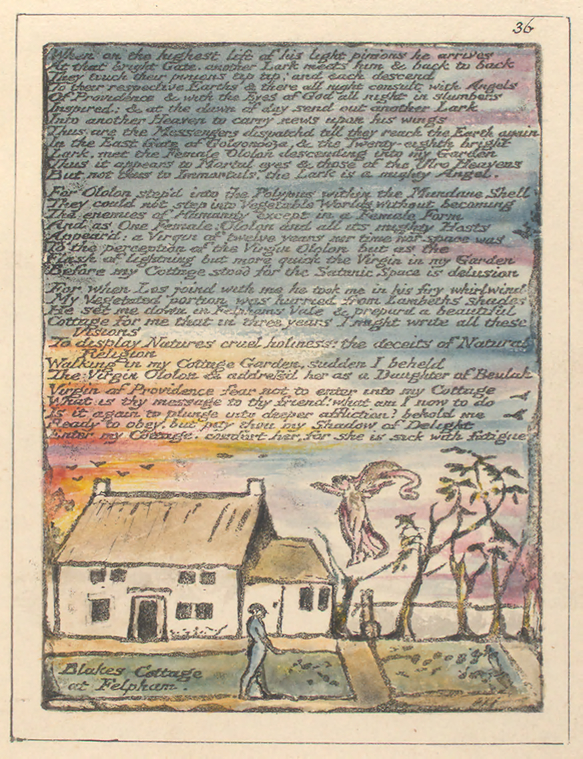
William Blake and His Reader

New York Public Library
Milton
Plate 36

First posted by Larry in Nov 2009

Inspired primarily by Blake's Sublime Allegory (Roger
Easson, p. 313) :

In 1800, when he was 33, Blake went to Felpham (on the
sea) under the sponsorship of a wealthy man who pretended
an interest in his welfare (Blake was well nigh starving
about that time).

In his Preface to Jerusalem he spoke of returning from the
sea. He was disillusioned because he had hoped for a
spiritual friend, but found a corporeal one.

"Corporeal Friends are Spiritual Enemies" (in Milton,
4.26; E98 and again in Jerusalem, 44.10; E193)

Blake was disillusioned with the public; they had failed
to show him any interest or respect.

Easson tells us that in Jerusalem the disillusioned poet
attempted to promote a dialogue with his readers (that's
us). With a typical prophetic attitude he expected a
response-- . Prophets don't say things to please their
listeners but to arouse them, provoke them, above all
awaken them
. Like Ezekiel Blake had "the desire of
raising other men to a perception of the Infinite"
(MHH13; Erdman 39).

In Jerusalem Blake is deliberately illusive (every Plate
might be thought of as a detective story or a crossword
puzzle). He means us to read it-- and consider! Like his
Vision of Christ in The Everlasting Gospel "he spoke in
parables to the blind".

Blake had been well received by a (very!) few from whom
their "love and friendship" was the highest reward. In
the preface he asks for our love and friendship; it can
only be reached through "the severe contentions of [true!]
friendship."

Blake took the freedom to contend with us, and whether or
to what degree we can respond creatively depends upon us.

Has anyone ever fully understood Blake? Ah! that's the
challenge. 


Tuesday, July 12, 2022

SANITY

Wikipedia Commons
Frontispiece
Songs of Experience

Here is a section of An Interview Conducted with Kathleen Raine on July 12, 1993 by Donald E. Stanford:

interview 

"Stanford: One critic has said recently that Blake was not mad, but he understood and described the mental suffering of madness in a profound way. Do concepts of madness such as schizophrenia, hallucination, and so on have a useful place in Blake criticism and will you comment on the direct question, “was Blake mad?”


Raine: No, of course he wasn’t mad. He was a sane man in a mad world, roughly speaking. Great genius has a wider field of consciousness. That is what genius is: seeing rather more than other men do, perhaps being in advance of his time. Certainly the nature of genius is to not accept current opinion, and Blake certainly did not accept current opinion. I don’t think that words like “schizophrenia” and “paranoia” add much to human discussion of whatever these words mean. Blake himself says, “Plato says that poets do not know what they write and utter. In that case, why is a lesser kind to be called knowing?” In other words, a poet is an inspired man. Blake believed in inspiration. This must be especially remembered with Blake, but all poets have believed in inspiration, that in an inspired state there is a widening of the field of consciousness. Yeats describes genius as bringing together at certain moments the waking and the sleeping mind. The available knowledge is greater in states of inspiration. Blake certainly had this. 


There is much suffering, as your critic says, in the writings of Blake: the turmoil, the anguish of Jerusalem. But this was not a personal thing; he was talking about the nation. He was a spiritual patriot, and he was speaking of the suffering of the giant Albion, as he calls the English nation. He was a prophet in the sense of the Old Testament prophets in the Jewish Bible, who also were speaking for their nation. They were not speaking of their individual suffering; they were speaking of the national psyche, if you like, into which Blake had certainly a remarkably clear insight. He speaks of living. He says, 'in South Molton Street I see and hear' what is going on in the soul of Albion, which is, of course, the soul of England. In other words, here in South Moulton Street I both see and hear the sufferings of the military, or the war against France that broke out after the French Revolution, of the conscription of soldiers, and the suffering of child labor, the endless sufferings of his people at that time, the hangings of boys at Tyburn for the theft of a yard of cloth, the injustices, the national crimes against which Blake spoke out. You may say these were descriptions of deep, deep suffering, the psychological sufferings of various kinds of mental and physical and spiritual tyrannies in his nation at the time. I wonder what he would have been writing about had he lived now. Certainly many things would have been the same — perhaps not all — but when he writes of London and marking, 'in every face marks of weakness, marks of woe,' he felt the collective suffering: that was the nature of his inspiration. He was not a personal poet expressing himself. He was a national prophet, calling to his nation to awake from their 'deadly sleep,' which is unconsciousness of what is going on, and to awake to the truths of the imagination and to reform many things. This is not madness."


Laocoon, (E 274)
 "There are States in which all Visionary Men are accounted Mad 
   Men   such are Greece & Rome"
 Poetical Sketches, (E 415)
"   MAD SONG.
The wild winds weep,
  And the night is a-cold;
Come hither, Sleep,
  And my griefs infold:   
But lo! the morning peeps          
  Over the eastern steeps,
And the rustling birds of dawn 
The earth do scorn.

Lo! to the vault
  Of paved heaven,              
With sorrow fraught
  My notes are driven:
They strike the ear of night,
  Make weep the eyes of day;
They make mad the roaring winds,      
  And with tempests play.

Like a fiend in a cloud
  With howling woe,
After night I do croud,
  And with night will go;         
I turn my back to the east,

From whence comforts have increas'd;
For light doth seize my brain
With frantic pain."

Annotations to Spurzheim's Observations on Insanity, (E 663) 
 "Cowper came to me & said. O that I
were insane always I will never rest.  Can you not make me truly
insane.  I will never rest till I am so. O that in the bosom of
God I was hid.  You retain health & yet are as mad as any of us
all--over us all--mad as a refuge from unbelief--from Bacon
Newton & Locke"
Letters, to Butts Jany 10 180(3), (E 724) 
"The Thing I
have most at Heart! more than life or all that seems to make life
comfortable without.  Is the Interest of True Religion & Science
& whenever any thing appears to affect that Interest. (Especially
if I myself omit any duty to my [self] <Station> as a
Soldier of Christ) It gives me the greatest of torments, I am not
ashamed afraid or averse to tell You what Ought to be Told.  That
I am under the direction of Messengers from Heaven Daily &
Nightly but the nature of such things is not as some suppose.
without trouble or care.  Temptations are on the right hand &
left behind the sea of time & space roars & follows swiftly he
who keeps not right onward is lost & if our footsteps slide in
clay how can we do otherwise than fear & tremble. but I should
not have troubled You with this account of my spiritual state
unless it had been necessary in explaining the actual cause of my
uneasiness into which you are so kind as to Enquire for I never
obtrude such things on others unless questiond & then I never
disguise the truth--But if we fear to do the dictates of our
Angels & tremble at the Tasks set before us. if we refuse to do
Spiritual Acts. because of Natural Fears or Natural Desires!  Who
can describe the dismal torments of such a state!--I too well
remember the Threats I heard!--If you who are organized by Divine
Providence for Spiritual communion.  Refuse & bury your Talent in
the Earth even tho you should want Natural Bread. Sorrow & Desperation 
pursues you thro life! & after death shame & confusion of face to
eternity--Every one in Eternity will leave you aghast at the Man
who was crownd with glory & honour by his brethren & betrayd
their cause to their enemies.  You will be calld the base Judas
who betrayd his Friend!--Such words would make any Stout man
tremble & how then could I be at ease? But I am now no longer in
That State & now go on again with my Task Fearless. and tho my
path is difficult.  I have no fear of stumbling while I keep it" 
Letters, April 25: 1803, To Butts, (E 728)
"Now I may say to you what perhaps I should not dare to say
to any one else.  That I can alone carry on my visionary studies
in London unannoyd & that I may converse with my friends in
Eternity.  See Visions, Dream Dreams, & prophecy & speak Parables
unobserv'd & at liberty from the Doubts of other Mortals. perhaps
Doubts proceeding from Kindness. but Doubts are always pernicious
Especially when we Doubt our Friends Christ is very decided on
this Point.  'He who is Not With Me is Against Me' There is no
Medium or Middle state & if a Man is the Enemy of my Spiritual
Life while he pretends to be the Friend of my Corporeal. he is a
Real Enemy--but the Man may be the friend of my Spiritual Life
while he seems the Enemy of my Corporeal but Not Vice Versa" 
  

Sunday, April 24, 2022

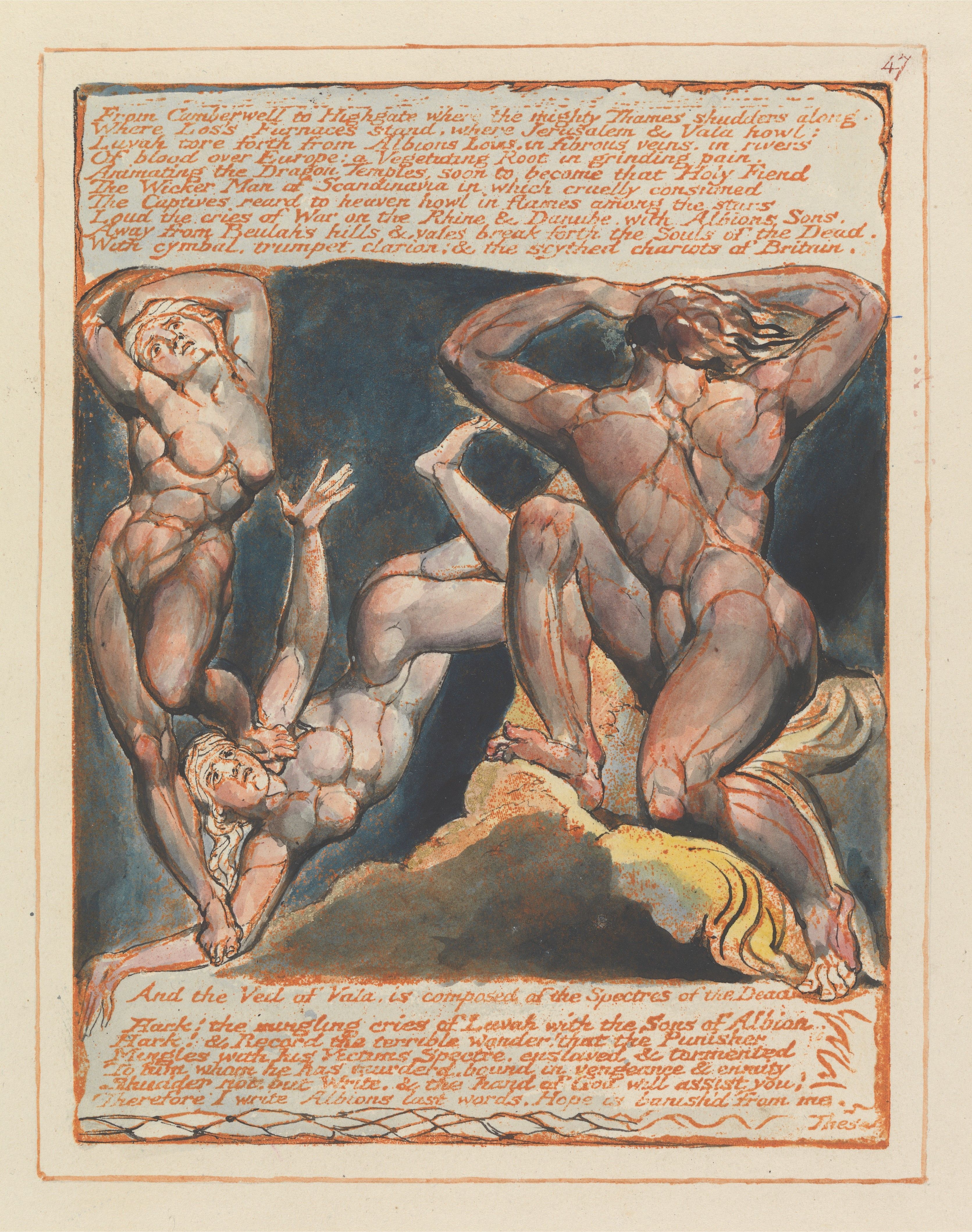
HOPE IS BANISHED

Yale Center for British Art
Jerusalem
Plate 47
 
  Dylan's life is one of the strangest odysseys, the details of which are not known to me, and may never be told. Dylan has always been at one level a very private person. Nevertheless the outline of his spiritual journey (up to now) belongs to the public and is sufficiently clear to relate it to the Blakean circle of destiny which we have studied in this book. 
 
In Blake and in Dylan we see two men who "call no man father", who fundamentally reject all forms of outward authority. Each communes with his own spirit, and this communion leads to the same end, to the encounter with Christ the King. The passage of 200 years has obscured the drama in Blake's case, so much so that his secular students almost completely lost sight of it. But Dylan's conversion is too new to be anything less than a collective trauma. His secular fans were sheerly appalled, confronted with a reality which they had systematically ignored. But Dylan's Christian audience by and large have failed to note the significance of the event, largely through the minuteness of their vision. In the history of Christianity it bears comparison to the Damascus Road, or to the strange warming of John Wesley's heart. 
 
Any number of pages could be devoted to relating Blake and Dylan, but one significant point deserves special emphasis: both men spent their pre-Christian decade celebrating fallenness. Hopefully by now the reader will have some grasp of what I mean by Blake's celebration of fallenness. Examples of this motif in Dylan's work are too numerous to do more than sample. Speaking in general the celebration of fallenness is the acme of the prophet's function. He points out to us what's wrong with our society, and he does this with the kind of language designed to raise things forcibly into our consciousness. 
 
Ezekiel had told Blake that his bizarre pantomimes were aimed at "raising other men into a perception of the infinite". Blake became pretty bizarre in his language at times, and so did Dylan, both for the purpose stated by Ezekiel. A review of Dylan's 1965 album, "Highway 61, Revisited", indicates that the denizens of Desolation Row are about as fouled up as any of Blake's giant forms. 

Here's verse 8 of the song of that name:
"Now at midnight all the agents
And the superhuman crew
Come out and round up everyone
That knows more than they do
Then they bring them to the factory ~
Where the heart attack machine Is strapped across their shoulders
And then the kerosene Is brought down from the castles
By insurance men who go
Check to see that nobody is escaping
To Desolation Row"
 
Jerusalem, Plate 47, (E 196)
[When Albion utterd his last words Hope is banishd from me]                                                   t
From Camberwell to Highgate where the mighty Thames shudders along,
Where Los's Furnaces stand, where Jerusalem & Vala howl:
Luvah tore forth from Albions Loins, in fibrous veins, in rivers
Of blood over Europe: a Vegetating Root in grinding pain.
Animating the Dragon Temples, soon to become that Holy Fiend
The Wicker Man of Scandinavia in which cruelly consumed
The Captives reard to heaven howl in flames among the stars
Loud the cries of War on the Rhine & Danube, with Albions Sons,
Away from Beulahs hills & vales break forth the Souls of the Dead,   
With cymbal, trumpet, clarion; & the scythed chariots of Britain.

And the Veil of Vala, is composed of the Spectres of the Dead

Hark! the mingling cries of Luvah with the Sons of Albion
Hark! & Record the terrible wonder! that the Punisher
Mingles with his Victims Spectre, enslaved and tormented         
To him whom he has murderd, bound in vengeance & enmity
Shudder not, but Write, & the hand of God will assist you!
Therefore I write Albions last words. Hope is banish'd from me."


Thursday, February 24, 2022

MORAVIAN MOTHER 5

Wikipedia Commons
Joseph of Arimathea preaching to the inhabitants of Britain
 
 Luke 24 (Phillips Translation) 
45-47 - Then he opened their minds so that they could understand the scriptures, and added, "That is how it was written, and that is why it was inevitable that Christ should suffer, and rise from the dead on the third day. So must the change of heart which leads to the forgiveness of sins be proclaimed in his name to all nations, beginning at Jerusalem."


Blake's mother was surely aware of the missionary activities of the Moravians who aimed to bring the Gospel to people in far flung locations. They experienced the joy and satisfaction of living in community under the guidance of the spirit and wanted to share it.

"They sent out the first missionaries when there were only 300 inhabitants in Herrnhut. Within 30 years, the church sent hundreds of Christian missionaries to many parts of the world, including the Caribbean, North and South America , the Arctic, Africa, and the Far East."

Arthur Freeman wrote this for the Center for Moravian Studies:

"A third mark of the Gemeine was mission. Christ had given his church a mission. Each one of the Gospels concludes with some equivalent of a commissioning of his disciples. In John Jesus sends his disciples as his Father had sent him (e.g. John 17:18). Both the life and activity of the Gemeine carry out this mission.Its life expresses the very relationship which Christ calls the church to facilitate for others and which gives those exploring the Gospel an experiential referent. In I John 1:3 others were invited into the fellowship with the Father and the Son which constitutes the life and fellowship of the community.

Hence for Moravians a crucial step in mission was always the planting of a Gemeine where the life with Christ was lived out and could be experienced by others. The mission as action was going where Christ would have the Gemeine go, keeping in mind that mission and evangelism was God’s business. One had to discern, follow, and participate in what God was doing. What then began as preaching excursions into areas surrounding Herrnhut, following the spiritual experience of 1727, in a few years brought Moravians to the West Indies and North America and then to many other parts of the world to “win souls for the Lamb.” Within ten years Moravians had gone also to Greenland, Surinam, South Africa, the Gold Coast, Algeria, Arctic Russia, and Ceylon."

From the beginning to the end of his career Blake saw that the nations of the world were one people joined by one spirit which spoke to all according to their various means of reception. Albion was Blake's symbol for undivided mankind. All nations were contained and expressed by Albion or by the 'Poetic Genius' as stated in Blake's earliest Illuminated Book. 

ALL RELIGIONS are ONE (E 1)

"PRINCIPLE. 5. The Religions of all Nations are derived from
each Nations different reception of the Poetic Genius which is
every where call'd the Spirit of Prophecy."

Blake's prophetic message was taken from the book of Numbers and quoted on the first plate of Milton. Damon tells us that prophets do not predict the future but reveal Eternal Truths. To spread such truth to all nations Blake accepted as his mission 'awaking to Eternal Life' all those who sleep in the 'land of shadows.'

Milton, Plate 1, (E 95)
 "I will not cease from Mental Fight,
     Nor shall my Sword sleep in my hand:
     Till we have built Jerusalem,                     
     In Englands green & pleasant Land.

Would to God that all the Lords people were Prophets.
                                        Numbers XI. ch 29 v."

Jerusalem, Plate 4, (E 146)
"Of the Sleep of Ulro! and of the passage through
Eternal Death! and of the awaking to Eternal Life.

This theme calls me in sleep night after night, & ev'ry morn
Awakes me at sun-rise, then I see the Saviour over me
Spreading his beams of love, & dictating the words of this mild song.  

Awake! awake O sleeper of the land of shadows, wake! expand!
I am in you and you in me, mutual in love divine:"

Blake is specific in naming nations to make it clear that Albion is inclusive and that his prophetic words are appropriate for everyone, everywhere.

Milton, Plate 31 [34],(E130)
"And all Nations wept in affliction Family by Family
Germany wept towards France & Italy: England wept & trembled
Towards America: India rose up from his golden bed:
As one awakend in the night: they saw the Lord coming            
In the Clouds of Ololon with Power & Great Glory!"

Jerusalem, Plate 24, (E 170)
"Thy Sons came to Jerusalem with gifts, she sent them away
With blessings on their hands & on their feet, blessings of gold,
And pearl & diamond: thy Daughters sang in her Courts:           
They came up to Jerusalem; they walked before Albion
In the Exchanges of London every Nation walkd
And London walkd in every Nation mutual in love & harmony
Albion coverd the whole Earth, England encompassd the Nations,
Mutual each within others bosom in Visions of Regeneration;      
Jerusalem coverd the Atlantic Mountains & the Erythrean,
From bright Japan & China to Hesperia France & England.
Mount Zion lifted his head in every Nation under heaven:
And the Mount of Olives was beheld over the whole Earth:
The footsteps of the Lamb of God were there: but now no more     
No more shall I behold him, he is closd in Luvahs Sepulcher."

Jerusalem, Plate 72, (E 227)
"These are the Land of Erin

All these Center in London & in Golgonooza. from whence
They are Created continually East & West & North & South
And from them are Created all the Nations of the Earth           
Europe & Asia & Africa & America, in fury Fourfold! 
[Legend on image] 
Continually Building. Continually Decaying because of
Love & Jealousy

And Thirty-two the Nations: to dwell in Jerusalems Gates
O Come ye Nations Come ye People Come up to Jerusalem
Return Jerusalem & dwell together as of old! Return
Return! O Albion let Jerusalem overspread all Nations            
As in the times of old! O Albion awake! Reuben wanders
The Nations wait for Jerusalem. they look up for the Bride

France Spain Italy Germany Poland Russia Sweden Turkey
Arabia Palestine Persia Hindostan China Tartary Siberia
Egypt Lybia Ethiopia Guinea Caffraria Negroland Morocco          
Congo Zaara Canada Greenland Carolina Mexico
Peru Patagonia Amazonia Brazil. Thirty-two Nations
And under these Thirty-two Classes of Islands in the Ocean
All the Nations Peoples & Tongues throughout all the Earth

And the Four Gates of Los surround the Universe Within and       
Without; & whatever is visible in the Vegetable Earth, the same
Is visible in the Mundane Shell; reversd in mountain & vale"

Jerusalem, Plate 97, (E 256)
"Awake! Awake Jerusalem! O lovely Emanation of Albion
Awake and overspread all Nations as in Ancient Time
For lo! the Night of Death is past and the Eternal Day
Appears upon our Hills: Awake Jerusalem, and come away

So spake the Vision of Albion & in him so spake in my hearing   
The Universal Father. Then Albion stretchd his hand into Infinitude."

Inscriptions, (E 671)                  
     "Albion rose from where he labourd at the Mill with Slaves
     Giving himself for the Nations he danc'd the dance of Eternal Death"

Revelation 22
[1] And he shewed me a pure river of water of life, clear as crystal, proceeding out of the throne of God and of the Lamb.
[2] In the midst of the street of it, and on either side of the river, was there the tree of life, which bare twelve manner of fruits, and yielded her fruit every month: and the leaves of the tree were for the healing of the nations.
[3] And there shall be no more curse: but the throne of God and of the Lamb shall be in it; and his servants shall serve him:
[4] And they shall see his face; and his name shall be in their foreheads.
[5] And there shall be no night there; and they need no candle, neither light of the sun; for the Lord God giveth them light: and they shall reign for ever and ever. 


Wednesday, May 6, 2020

BLAKE IN 1820

Wikipedia Commons Mrs Q 1820

Description from British Museum:

"Mrs.Q is probably the best known decorative print executed by William Blake, primarily due to the large number of facsimile reproduction impressions which were printed of this image in 1806. William Blake’s engraving is based upon a portrait by Francois Huet Villiers. The subject of Mrs.Q is Harriet Quentin, the wife of colonel Quentin and mistress to George IV when Prince Regent. The view in the background is thought to be the Thames at Eton, with the college chapel beyond. The miniature portraitist Villiers had died in 1813, thus this portrait must have had been drawn or painted at least seven years prior to the publication of this plate."

Blake was dependent on commercial engraving for earning a living. There was too little market for his output of creative books to sustain him economically. In 1821 he and Catherine moved to smaller and cheaper flat and he was forced to sell his collection of prints which he had been accumulating since his childhood.

A welcome source of income was the commission in 1820 to engrave a painting which had been created by a popular court painter Francois Villers-Huet. The subject of the portrait was Mrs Q, Harriet Quentin, who had been mistress of George IV when he was Prince Regent. The painter had died seven years previously and George IV had ascended to the throne in 1820 on his father's death.

The publication and circulation of this print was part of the campaign of radical dissent focused on the new king because of his reputation for extravagance and dissolution.

From The Stranger from Paradise: A biography of William Blake By G. E. Bentley Jr:
"One of the ways to plague the Prince Regent was to publicize his infidelities. Another of his mistresses was Mrs Harriet Quentin, often referred to as 'Mrs Q'. The radical print-seller Isaac Barrow commissioned Blake to engrave a portrait by H Villiers of the pretty Mrs Q, and his print was published on 1 June 1820 at the height of the agitation concerning Caroline' attempts (vain, as it turned out) to attend the coronation and assume her title as Queen. Blake was on the fringe of the sensational event and acting as the agent of a notoriously radical print-seller." (Page 365)

In Blake, Politics, and History, edited by Jackie DiSalvo, G. A. Rosso, Christopher Z. Hobson we read:
"While Blake has often been pictured as mellowing as he grew older, the context of his Mrs Q plate suggests that the sixty-two year old artist was caught up, willy-nilly, in the latest phase of English radical activism." 

Jerusalem, Plate 9, (E 152) 
"His hammer of gold he siezd; and his anvil of adamant.
He siez'd the bars of condens'd thoughts, to forge them:
Into the sword of war: into the bow and arrow:                   
Into the thundering cannon and into the murdering gun
I saw the limbs form'd for exercise, contemn'd: & the beauty of
Eternity, look'd upon as deformity & loveliness as a dry tree:
I saw disease forming a Body of Death around the Lamb
Of God, to destroy Jerusalem, & to devour the body of Albion     
By war and stratagem to win the labour of the husbandman:
Awkwardness arm'd in steel: folly in a helmet of gold:
Weakness with horns & talons: ignorance with a rav'ning beak!
Every Emanative joy forbidden as a Crime:
And the Emanations buried alive in the earth with pomp of religion:          
Inspiration deny'd; Genius forbidden by laws of punishment:
I saw terrified; I took the sighs & tears, & bitter groans:
I lifted them into my Furnaces; to form the spiritual sword.
That lays open the hidden heart: I drew forth the pang
Of sorrow red hot: I workd it on my resolute anvil:              
I heated it in the flames of Hand, & Hyle, & Coban
Nine times; Gwendolen & Cambel & Gwineverra
Are melted into the gold, the silver, the liquid ruby,
The crysolite, the topaz, the jacinth, & every precious stone,
Loud roar my Furnaces and loud my hammer is heard:               
I labour day and night, I behold the soft affections
Condense beneath my hammer into forms of cruelty
But still I labour in hope, tho' still my tears flow down.
That he who will not defend Truth, may be compelld to defend
A Lie: that he may be snared and caught and snared and taken     
That Enthusiasm and Life may not cease: arise Spectre arise!"

Saturday, November 11, 2017

LOS: POET & PROPHET

Los is the hero of Blake's myth as developed in the prophetic books. Among his many names are Eternal Poet and Eternal Prophet. As Blake's alter-ego he was the Creative Imagination, always expanding into new projects and endeavors. As a blacksmith he uses his furnaces to shape humanity through fire and the blows of his hammer. He holds the vision in times of trouble. He takes the materials at hand and puts them to the service of Jerusalem, the image of Divine Inspiration.

In describing this picture Erdman says: "The poet /blacksmith Los, naked with his steel hammer in a firm cushion of cloud, rests "wearied" from his intellectual labors, and regards the completed song/sun with anxious compassion."
British Museum
Song of Los
Plate 8, Copy A
Los as Time, together with Enitharmon as Space brings change. He represents evolution, not in the sense of progress but of opportunity. The information, structures, and insights developed by one generation are available for use by succeeding generations to build upon. Urizen sought fixed structure and predictability. Not so Los. Nothing for him would be more deadly than restating repeatedly the same ideas in different words or applying the same rules to every situation.

The huge advances in scientific thought have come not by using a template but by creating new ways of thinking, new avenues of questioning, new fields of research. Psychology itself had a burst of development when scientific techniques were applied to understand the mysteries of human behavior which had baffled the human mind from the time man became self-reflective. We are following Los when we seek new paths and expand the horizons of our pursuits.

As William Blake said in two of his early works:

All Religions Are One
"PRINCIPLE 4.
As none by traveling over known lands can find out
the unknown. So from already acquired knowledge Man could not
acquire more. therefore an universal Poetic Genius exists"

There is No Natural Religion (b)
"I Mans perceptions are not bounded by organs of perception. he
percieves more than sense (tho' ever so acute) can discover.
II Reason or the ratio of all we have already known. is not
the same that it shall be when we know more.
IV The bounded is loathed by its possessor. The same dull round
even of a univer[s]e would soon become a mill with complicated
wheels."

Blake spoke of dark Satanic Mills.
.
.

Friday, July 25, 2014

CHARIOT OF FIRE

The familiar lines of Blake's best known poem continue to yield stimulation to our imaginations.
Milton Plate 1,(E 95)
     "Bring me my Bow of burning gold:
     Bring me my Arrows of desire:                     
     Bring me my Spear: O clouds unfold!
     Bring me my Chariot of fire!

     I will not cease from Mental Fight,
     Nor shall my Sword sleep in my hand:
     Till we have built Jerusalem,                     
     In Englands green & pleasant Land."

Focusing on 'my Chariot of fire' we can have a look at Blake's use of the term in another context.

Vision of the Last Judgment, (E 560)
 "If the Spectator could Enter into these Images in his
Imagination approaching them on the Fiery Chariot of his
Contemplative Thought if he could Enter into Noahs Rainbow or
into his bosom or could make a Friend & Companion of one of these
Images of wonder which always intreats him to leave mortal things
as he must know then would he arise from his Grave then would he
meet the Lord in the Air & then he would be happy   General
Knowledge is Remote Knowledge it is in Particulars that Wisdom
consists & Happiness too.  Both in Art & in Life General Masses
are as Much Art as a Pasteboard Man is Human Every Man has Eyes
Nose & Mouth this Every Idiot knows but he who enters into &
discriminates most minutely the Manners & Intentions [P 83] the
[Expression] Characters in all their branches is the
alone Wise or Sensible Man & on this discrimination All Art is
founded.  I intreat then that the Spectator will attend to the
Hands & Feet to the Lineaments of the Countenances they are all 
descriptive of Character & not a line is drawn without intention
& that most discriminate & particular  much less an
Insignificant Blur or Mark> 
...
    By the side of Seth is Elijah he comprehends all the
Prophetic Characters he is seen on his fiery Chariot bowing
before the throne of the Saviour." 

Blake has derived his image of the chariot of fire from the character of Elijah in the Old Testament. Blake considers Elijah to be the prophet who best represents the prophetic character. The prophets acted as intermediaries between God and man. Through their intuitive visionary connection, the word of God was perceived through contemplation. The imagination of Blake was inspired by the account in the book of Second Kings of Elijah ascending to heaven in the whirlwind riding his chariot of fire. 

Victoria and Albert Museum
Transfiguration


2nd Kings 2
[7] Fifty men of the sons of the prophets also went, and stood at some distance from them, as they both were standing by the Jordan.
[8] Then Eli'jah took his mantle, and rolled it up, and struck the water, and the water was parted to the one side and to the other, till the two of them could go over on dry ground.
[9] When they had crossed, Eli'jah said to Eli'sha, "Ask what I shall do for you, before I am taken from you." And Eli'sha said, "I pray you, let me inherit a double share of your spirit."
[10] And he said, "You have asked a hard thing; yet, if you see me as I am being taken from you, it shall be so for you; but if you do not see me, it shall not be so."
[11] And as they still went on and talked, behold, a chariot of fire and horses of fire separated the two of them. And Eli'jah went up by a whirlwind into heaven.
[12] And Eli'sha saw it and he cried, "My father, my father! the chariots of Israel and its horsemen!" And he saw him no more.Then he took hold of his own clothes and rent them in two pieces.
[13] And he took up the mantle of Eli'jah that had fallen from him, and went back and stood on the bank of the Jordan.
[14] Then he took the mantle of Eli'jah that had fallen from him, and struck the water, saying, "Where is the LORD, the God of Eli'jah?" And when he had struck the water, the water was parted to the one side and to the other; and Eli'sha went over. 

Jesus, too, experienced Elijah as representative of the prophetic character when he was joined by Moses (who brought the law) and Elijah (the prophet) on the mount of transfiguration. The continuity of the prophetic function, of listening to the inner voice through which God speaks and delivering the message to those with ears to hear, is passed down through the generations. Blake accepted the function of a prophet and echoed the desire of Moses that 'all the Lord's people were Prophets'.

Milton, Plate 1, (E 96) 
"Would to God that all the Lords people were Prophets. Numbers XI. ch 29 v." 

Numbers 11 
[29] But Moses said to him, "Are you jealous for my sake? Would that all the LORD's people were prophets, that the LORD would put his spirit upon them!"

Matthew 17
[1] And after six days Jesus took with him Peter and James and John his brother, and led them up a high mountain apart.
[2] And he was transfigured before them, and his face shone like the sun, and his garments became white as light.
[3] And behold, there appeared to them Moses and Eli'jah, talking with him.
[4] And Peter said to Jesus, "Lord, it is well that we are here; if you wish, I will make three booths here, one for you and one for Moses and one for Eli'jah."
[5] He was still speaking, when lo, a bright cloud overshadowed them, and a voice from the cloud said, "This is my beloved Son, with whom I am well pleased; listen to him."
[6] When the disciples heard this, they fell on their faces, and were filled with awe.   

Blake's appeal to the Lord was 'Bring me my Chariot of fire!' 

.

Thursday, November 15, 2012

BLAKE'S MESSAGE V

Wikimedia Commons  Ezekiel's Vision

Bloom puts Blake's prophetic message in the context of the Old Testament prophets, whose imagery is repeated in the New Testament Book of Revelation. Bloom sees Blake recreating for his own time and in his own terms the message delivered by Isaiah, Ezekiel and the prophetic voice passed down through John of Patmos and Milton.

The prophet presents the eternal choice between turning toward God or continuing to follow the enemies of God. Blake utilises a multitude of images in an attempt to communicate with men in whatever state they were to be found. Blake was following the lead of Paul in First Corinthians:


First Corinthians 9

[19] For though I be free from all men, yet have I made myself servant unto all, that I might gain the more.
[20] And unto the Jews I became as a Jew, that I might gain the Jews; to them that are under the law, as under the law, that I might gain them that are under the law;
[21] To them that are without law, as without law, (being not without law to God, but under the law to Christ,) that I might gain them that are without law.
[22] To the weak became I as weak, that I might gain the weak: I am made all things to all men, that I might by all means save some.
[23] And this I do for the gospel's sake, that I might be partaker thereof with you.

Harold Bloom, speaking of
Jerusalem, states in Blake's Apocalypse on Page 366:

"From this opposition there emerges, in the fourth and last chapter, a clarifying confrontation of error and truth, which causes a Last Judgment to begin.


As a general principle of organization, a series of gradually sharpening antitheses leading to a necessity for moral choice, this resembles the pattern of the major prophetic books of the Bible...The books of Ezekiel and the other prophets are essentially collections of public oratory, poems of admonition delivered to a wavering people. The poems are interspersed in chronicles that deliberately mix history and vision, the way events were and the way the prophet fears they will turn out to be if they continue as they are going, or hopes hopes they will emerge if the people will realize that they are at the turning and can control events by a change of spirit.

Like Isaiah and Ezekiel, Blake believed that he had the decisive power of the eternal moment of human choice as a direct gift and trust from the Divine, and he seems to have imitated the organization of their books even as he believed his election as a prophet was in direct succession of their own. Isaiah and Ezekiel, like Amos before them renewed the vision of Elijah. Blake himself had see himself as renewing the vision of the English Elijah or Rintrah, Milton. With Milton firmly within him, Blake turns in
Jerusalem to the re-creation in English terms of the work of Hebraic prophecy...The principles which form and guide Blake, which he develops with enormous skill, are the literary principles implicit in Ezekiel and the other prophetic books of the Bible. Jerusalem will seem much less of a poetic sport if read in their company."

Marriage of Heaven & Hell, Plate 12,  (E 39)
 "Then Ezekiel said. The philosophy of the east taught the first 
principles of human perception     some nations held one
principle for  the origin & some another, we of Israel taught
that the Poetic Genius (as  you now call it) was the first
principle and all the others merely  derivative, which was the
cause of our despising the Priests & Philosophers  of other
countries, and prophecying that all Gods would at last be
proved. to originate in ours & to be the tributaries of the
Poetic  Genius, it was this. that our great poet King David
desired so fervently  & invokes so patheticly, saying by this he
conquers enemies & governs kingdoms; and we so loved our God.
that we cursed in his name all  the deities of surrounding
nations, and asserted that they had rebelled; from these opinions
the vulgar came to think that all nations would at last be
subject to the jews.
   This said he, like all firm perswasions, is come to pass, for all 
nations believe the jews code and worship the jews god, and what
greater subjection can be"

Jerusalem, Plate 12, (E 156)
"And the Four Points are thus beheld in Great Eternity
West, the Circumference: South, the Zenith: North,               
The Nadir: East, the Center, unapproachable for ever.
These are the four Faces towards the Four Worlds of Humanity
In every Man. Ezekiel saw them by Chebars flood.
And the Eyes are the South, and the Nostrils are the East.
And the Tongue is the West, and the Ear is the North."    

Vision of Last Judgment, (E 558)
"Hell is opend beneath her Seat on the Left hand. beneath her
feet is a flaming Cavern in which is seen the Great Red Dragon
with Seven heads & ten Horns [who] he has Satans book
of Accusations lying on the rock open before him  he is bound
in chains by Two strong demons they are Gog & Magog who have
been compelld to subdue their Master Ezekiel XXXVIIIc 8v with
their Hammer & Tongs about to new Create the Seven Headed
Kingdoms."  

Ezekiel 38
[8] After many days thou shalt be visited: in the latter years thou shalt come into the land that is brought back from the sword, and is gathered out of many people, against the mountains of Israel, which have been always waste: but it is brought forth out of the nations, and they shall dwell safely all of them.   

Ezekiel 38

[2] Son of man, set thy face against Gog, the land of Magog, the chief prince of Meshech and Tubal, and prophesy against him,
[3] And say, Thus saith the Lord GOD; Behold I am against thee, O Gog, the chief prince of Meshech and Tubal:
[14] Therefore, son of man, prophesy and say unto Gog, Thus saith the Lord GOD; In that day when my people of Israel dwelleth safely, shalt thou not know it?
[16] And thou shalt come up against my people of Israel, as a cloud to cover the land; it shall be in the latter days, and I will bring thee against my land, that the heathen may know me, when I shall be sanctified in thee, O Gog, before their eyes.
[18] And it shall come to pass at the same time when Gog shall come against the land of Israel, saith the Lord GOD, that my fury shall come up in my face.
 

Revelation 20
[8] And shall go out to deceive the nations which are in the four quarters of the earth, Gog and Magog, to gather them together to battle: the number of whom is as the sand of the sea. 

 
 Wikipedia:
  "Ezekiel's Gog from Magog was a symbol of the evil darkness of the north and the powers hostile to God, but in Revelation, Gog and Magog have no geographic location, and instead represent the nations of the world, banded together for the final assault on Christ and those who follow him." 
.

Tuesday, November 13, 2012

BLAKE'S MESSAGE IV

Roger and Kay Easson, writing in Milton A Poem by William Blake, view Blake's message as a reflection of the prophetic role he assumed. Blake quotes the Book of Numbers in saying "Would to God that all the Lords people were Prophets." Underlying Blake's writing is his response to the Lord's call for prophets.  

Page 18
"Milton
is a prophetic narrative since with it Blake exposes perceptual errors and renovates perception by teaching visionary truth. This prophetic narrative is conveyed both by words and by designs; Blake weaves together the linear orientation of words and the spatial dimensions of the graphic arts. However, in neither words nor designs does Blake adhere 
  to orthodox sequences or patterns. that is we cannot read Milton 'in time,' from a first event to a final event. Nor can we read Milton 'in space,' from a first place to a final place. Blake structures his words and designs in intricate patterns of parallelism and inversion that lead toward the unity of all word and designs within his prophetic vision. For Blake, prophecy teaches that spiritual travel must renovate each moment of each day. The narrative in Milton asserts that a spiritual journey is made in time and space, but that it simultaneously renovates our perceptions of time and space. The journey that the character Milton undertakes is necessarily individual, but since it shares in the archetypal pattern of such paths, it is, as Blake confirms, mutual. Moreover, for Blake, all spiritual journeys begin and end in the love and mercy of Jesus, the Saviour, and the Saviour's love and mercy are present not at one time and place or in one miraculous event, as a time-bound Natural Religion would have it, but present for all times and in all places as the ever-present potential for regeneration."  
Wikimedia Commons
Book of Urizen
Plate 2


Page 170
"The prophet, therefore, may sing songs, tell stories, and write poems. He presents the divine vision, but he must always defend it, explain it, and teach his audience how to perceive it. Los, Milton and the Starry Eight are the teachers within the Brotherhood of Prophets. Ultimately, it is William Blake who unites both the 'Divine Revelation' of the Bard and the 'Litteral expression' of prophecy within his poem Milton, that all his readers may become prophets."  


Milton, Plate 2, (E 96)
 "Come into my hand    
By your mild power; descending down the Nerves of my right arm
From out the Portals of my Brain, where by your ministry
The Eternal Great Humanity Divine. planted his Paradise,
And in it caus'd the Spectres of the Dead to take sweet forms
In likeness of himself. Tell also of the False Tongue! vegetated
Beneath your land of shadows: of its sacrifices. and
Its offerings; even till Jesus, the image of the Invisible God
Became its prey; a curec, an offering, and an atonement,
For Death Eternal in the heavens of Albion, & before the Gates
Of Jerusalem his Emanation, in the heavens beneath Beulah        

Say first! what mov'd Milton, who walkd about in Eternity
One hundred years, pondring the intricate mazes of Providence
Unhappy tho in heav'n, he obey'd, he murmur'd not. he was silent
Viewing his Sixfold Emanation scatter'd thro' the deep
In torment! To go into the deep her to redeem & himself perish?  
What cause at length mov'd Milton to this unexampled deed[?]   
A Bards prophetic Song!"