Blake seeks to provide the Golden String which can lead us through the labyrinth of our experience or his own poetry.

Showing posts with label Erdman. Show all posts

Wednesday, April 29, 2026

NELSON HILTON

 First posed August 2023

Title - Blake An Illustrated Quarterly - 1999

Article - www.english.uga.edu/wblake

"The 'Blake Digital Text Project' (http://www.english.uga.edu/wblake) originated in 1994 with the desire to create an electronic, online, interactive, enhanced version of the long out-of-print 1967 Concordance to the Writings of William Blake, edited by David V. Erdman."

[ An online Concordance to Blake is available now at:

http://victorian-studies.net/concordance/blake/         ]

When Nelson Hilton was Professor of English at the University of Georgia he worked at making Erdman's The Complete Poetry and Prose of William Blake accessible in digitized form. He indexed Blake's works and linked each item with the file containing the contents. Unlike Erdman's book he included line numbers for easy referencing. Page numbers from the book were on each line.

When Hilton left the University of Georgia, the Blake digitizing project migrated to the University of Arizona with which Hilton became associated. 

Each section of Erdman's book is easily located in this listing of the contents. It is convenient to click on any listing and read the selection that interests you. 

ContentsThe Complete Poetry and Prose of William Blake

https://blake.lib.asu.edu/html/home.html

In Hilton's CONTENTS here is text from America:

America, Plate 3, (E 51)

Am1.1; E51    "The shadowy daughter of Urthona stood before red Orc.
Am1.2; E51    When fourteen suns had faintly journey'd o'er his dark abode;
Am1.3; E51    His food she brought in iron baskets, his drink in cups of iron;
Am1.4; E51    Crown'd with a helmet & dark hair the nameless female stood;
Am1.5; E51    A quiver with its burning stores, a bow like that of night,
Am1.6; E51    When pestilence is shot from heaven; no other arms she need:
Am1.7; E51    Invulnerable tho' naked, save where clouds roll round her loins,
Am1.8; E51    Their awful folds in the dark air; silent she stood as night;
Am1.9; E51    For never from her iron tongue could voice or sound arise;
Am1.10; E51  But dumb till that dread day when Orc assay'd his fierce                                    embrace.   

Am1.11; E51  Dark virgin; said the hairy youth, thy father stern abhorr'd;
Am1.12; E51  Rivets my tenfold chains while still on high my spirit soars;
Am1.13; E51  Sometimes an eagle screaming in the sky, sometimes a lion,
Am1.14; E51  Stalking upon the mountains, & sometimes a whale I lash
Am1.15; E51  The raging fathomless abyss, anon a serpent folding

Am1.16; E51  Around the pillars of Urthona, and round thy dark limbs,
Am1.17; E51  On the Canadian wilds I fold, feeble my spirit folds.
Am1.18; E51  For chaind beneath rend these caverns; when thou bringest food
Am1.19; E51  I howl my joy! and my red eyes seek to behold thy face
Am1.20; E51  In vain! these clouds roll to & fro, & hide thee from my sight."
Wikipedia Commons
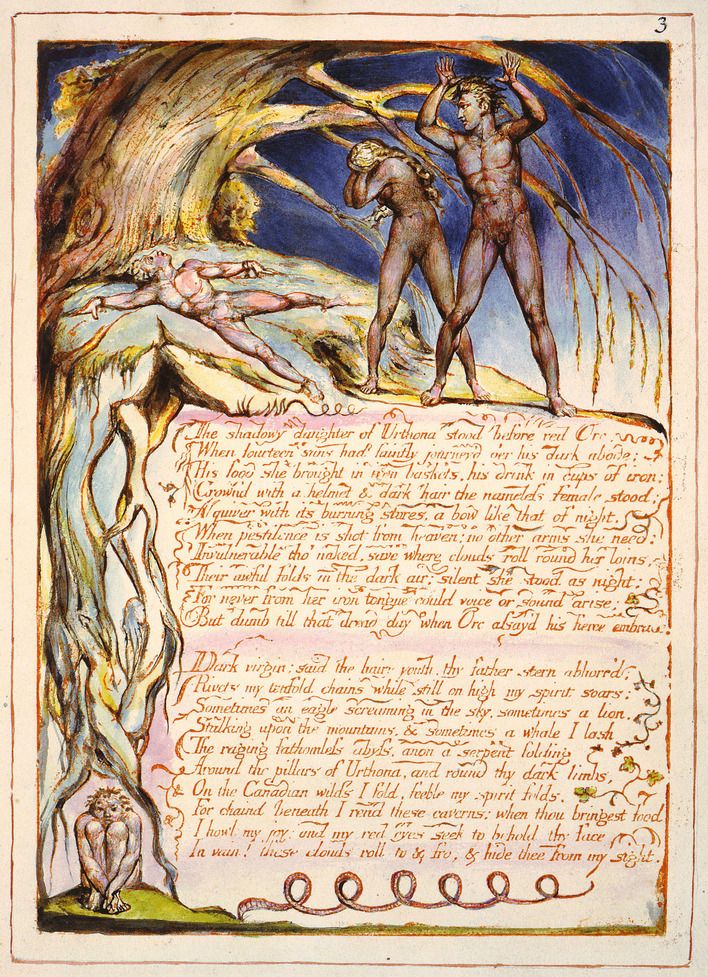
America
Plate 3
 
Los (Time) and Enitharmon (Space) children of Enion and Urthona (Nature and Spirit) become themselves the parents of Orc (the spirit of change or revolution.)  

So Blake announces that he will write about things happening in the natural word but clothed in symbols which will hide and reveal reality as befits his myth of  creation, fall, redemption and apocalypse.

We find the daughter of Urthona - a manifestation of Urthona in the Natural World - providing the food of dissension to Orc who is approaching maturity. She is armed with a supply of ideas and the means to direct them, but it takes the awakening of the revolutionary spirit to give them voice. Incidents that demand change repeatedly occur but a clear view of a way forward is not in sight.

Four Zoas, Night VII, Page 79, (E 355)

"Urizen answerd Read my books explore my Constellations 
Enquire of my Sons & they shall teach thee how to War
Enquire of my Daughters who accursd in the dark depths
Knead bread of Sorrow by my stern command for I am God
Of all this dreadful ruin   Rise O daughters at my Stern command

Rending the Rocks Eleth & Uveth rose & Ona rose       
Terrific with their iron vessels driving them across
In the dim air they took the book of iron & placd above
On clouds of death & sang their songs Kneading the bread of Orc
Orc listend to the song compelld hungring on the cold wind
That swaggd heavy with the accursed dough. the hoar frost ragd   
Thro Onas sieve   the torrent rain pourd from the iron pail
Of Eleth & the icy hands of Uveth kneaded the bread
The heavens bow with terror underneath their iron hands
Singing at their dire work the words of Urizens book of iron
While the enormous scrolls rolld dreadful in the heavens above   
And still the burden of their song in tears was poured forth
The bread is Kneaded let us rest O cruel father of children
But Urizen remitted not their labours upon his rock" 


Thursday, May 9, 2024

ERDMAN


Wikipedia Commons
America
Plate 12

David V Erdman, in Prophet Against Empire, demonstrated how the contraries reason and energy work together to accomplish what neither could accomplish alone.  The opportunity was there for Urizen to cooperate with the Lord of Day and use the Steeds of Light to bring about an accomadation with the energy of those seeking Liberty. He listened instead, however, to Reason and found that Wrath of the oppressed had seized the reins of government in the Age of Revolution. 

Page 194

“The creeping Urizen is supplied with a long soliloquy in a passage of Night Five of The Four Zoas  which is worth taking up here for the light it casts back upon The Marriage of Heaven and Hell and A Song of Liberty and The Tyger The fatal error of the jealous king is that his fixing of the horizon ultimately limits himself more than it does the energy of the people.  Royalty can keep its crimson robes, Orleans warned, only if it stops trying to measure of each man 'the circle that he shall run'. (French Revolution, P 91) Soliloquizing as he crawls in the den or narrow circle of his own ideas, the fallen Urizen of Night Five laments too late his imperial mistakes: his choice of war instead of peace, his failure to accept the opportunity to be an enlightened despot when the "mild & holy voice" of divine freedom said, "O light, spring up & shine" and "gave to me a silver sceptre & crownd me with a golden crown" to 'Go forth & guide' the people. 'I went not forth,' he laments, 'I hid myself in black clouds of my wrath, I called the stars around my feet in the night of councils dark'. (FZ's) Thus George assembled his council in 1774; thus Louis the King of France, prepared his ‘starry hosts’ in 1789 and let the spark of humanity in his bosom be 'quench’d in clouds' by 'the Nobles of France, and dark mists.' Each time, in the event, at Yorktown and again at Valmy, ‘The stars threw down their spears & fled naked away'. We fell.  Too late Urizen is sorry he refused to use his ‘Steeds of Light’.  

The language of the soliloquy is doubly revealing.  On the level of practice it is clear that ‘The stars threw down their spears’ means : the armies of counterrevolution were defeated. On the level of theory it is clear that Reason, when it refuses to assist but attempts to hinder Energy, is overthrown.  Denied the peaceful accommodation of the Steeds of Light, the just man seizes the Tigers of Wrath. Vetoed by a stubborn monarch, the French people became, as the London Times of January 7, 1792, put it, 'loose from all restraints, and, in many instances, more ferocious than wolves and tigers'. As Blake put it in Fayette, the French grew bloodthirsty and would 'not submit to the gibbet & halter.' 

If we take the tiger and horse as symbols of untamed Energy and domesticated Reason then it is obvious which of these contraries is more vital in days of revolution. In Hell is a proverbial that 'the tygers of wrath are wiser than the horses of instruction.'
...
Page 196 
The creator must have smiled at Yorktown and at Valmy, not because his people were warlike, but because they seemed ready to coexist with the Lamb, the wrath of the Tiger having done its work. The question, 'Did he smile his work to see?' is perhaps as rhetorical as the corresponding query of Orleans: 'And can Nobles be bound when the people are free, or God weep when his children are happy?'"

Four Zoas, Night V, Page 64, (E 343)
"But now my land is darkend & my wise men are departed

My songs are turned to cries of Lamentation           
Heard on my Mountains & deep sighs under my palace roofs         
Because the Steeds of Urizen once swifter than the light
Were kept back from my Lord & from his chariot of mercies

O did I keep the horses of the day in silver pastures
O I refusd the Lord of day the horses of his prince
O did I close my treasuries with roofs of solid stone            
And darken all my Palace walls with envyings & hate

O Fool to think that I could hide from his all piercing eyes
The gold & silver & costly stones his holy workmanship
O Fool could I forget the light that filled my bright spheres
Was a reflection of his face who calld me from the deep          

I well remember for I heard the mild & holy voice
Saying O light spring up & shine & I sprang up from the deep  
He gave to me a silver scepter & crownd me with a golden crown
& said Go forth & guide my Son who wanders on the ocean  

I went not forth. I hid myself in black clouds of my wrath       
I calld the stars around my feet in the night of councils dark
The stars threw down their spears & fled naked away
We fell. I siezd thee dark Urthona In my left hand falling

I siezd thee beauteous Luvah thou art faded like a flower"
America, Plate 2, (E 52)
"Silent as despairing love, and strong as jealousy,
The hairy shoulders rend the links, free are the wrists of fire;
Round the terrific loins he siez'd the panting struggling womb;
It joy'd: she put aside her clouds & smiled her first-born smile;
As when a black cloud shews its lightnings to the silent deep.   
Soon as she saw the terrible boy then burst the virgin cry.
I know thee, I have found thee, & I will not let thee go;
Thou art the image of God who dwells in darkness of Africa;
And thou art fall'n to give me life in regions of dark death.
On my American plains I feel the struggling afflictions          
Endur'd by roots that writhe their arms into the nether deep:
I see a serpent in Canada, who courts me to his love;
In Mexico an Eagle, and a Lion in Peru;
I see a Whale in the South-sea, drinking my soul away.
O what limb rending pains I feel. thy fire & my frost            
Mingle in howling pains, in furrows by thy lightnings rent;
This is eternal death; and this the torment long foretold."
French Revolution, Page 10(E 294)
"Fear not dreams, fear not visions, nor be you dismay'd with
     sorrows which flee at the morning;
Can the fires of Nobility ever be quench'd, or the stars by a
     stormy night?
Is the body diseas'd when the members are healthful? can the man
     be bound in sorrow
Whose ev'ry func,tion is fill'd with its fiery desire? can the
     soul whose brain and heart
Cast their rivers in equal tides thro' the great Paradise,
     languish because the feet
Hands, head, bosom, and parts of love, follow their high
     breathing joy?
And can Nobles be bound when the people are free, or God weep
     when his children are happy?
Have you never seen Fayette's forehead, or Mirabeau's eyes, or
     the shoulders of Target,
Or Bailly the strong foot of France, or Clermont the terrible
     voice, and your robes
Still retain their own crimson? mine never yet faded, for fire
     delights in its form.
But go, merciless man! enter into the infinite labyrinth of
     another's brain
Ere thou measure the circle that he shall run. Go, thou cold
     recluse,into the fires
Of another's high flaming rich bosom, and return unconsum'd, and
     write laws.
If thou canst not do this, doubt thy theories, learn to consider
     all men as thy equals,
Thy brethren, and not as thy foot or thy hand, unless thou first
     fearest to hurt them."

Thursday, August 10, 2023

NELSON HILTON

Title - Blake An Illustrated Quarterly - 1999
Article - www.english.uga.edu/wblake

"The 'Blake Digital Text Project' (http://www.english.uga.edu/wblake) originated in 1994 with the desire to create an electronic, online, interactive, enhanced version of the long out-of-print 1967 Concordance to the Writings of William Blake, edited by David V. Erdman."

[ An online Concordance to Blake is available now at:

http://victorian-studies.net/concordance/blake/         ]

When Nelson Hilton was Professor of English at the University of Georgia he worked at making Erdman's The Complete Poetry and Prose of William Blake accessible in digitized form. He indexed Blake's works and linked each item with the file containing the contents. Unlike Erdman's book he included line numbers for easy referencing. Page numbers from the book were on each line.

When Hilton left the University of Georgia, the Blake digitizing project migrated to the University of Arizona with which Hilton became associated. 

Each section of Erdman's book is easily located in this listing of the contents. It is convenient to click on any listing and read the selection that interests you. 

Contents, The Complete Poetry and Prose of William Blake

https://blake.lib.asu.edu/html/home.html

In Hilton's CONTENTS here is text from America:

America, Plate 3, (E 51)

Am1.1; E51    "The shadowy daughter of Urthona stood before red Orc.
Am1.2; E51    When fourteen suns had faintly journey'd o'er his dark abode;
Am1.3; E51    His food she brought in iron baskets, his drink in cups of iron;
Am1.4; E51    Crown'd with a helmet & dark hair the nameless female stood;
Am1.5; E51    A quiver with its burning stores, a bow like that of night,
Am1.6; E51    When pestilence is shot from heaven; no other arms she need:
Am1.7; E51    Invulnerable tho' naked, save where clouds roll round her loins,
Am1.8; E51    Their awful folds in the dark air; silent she stood as night;
Am1.9; E51    For never from her iron tongue could voice or sound arise;
Am1.10; E51  But dumb till that dread day when Orc assay'd his fierce    embrace.    

Am1.11; E51  Dark virgin; said the hairy youth, thy father stern abhorr'd;
Am1.12; E51  Rivets my tenfold chains while still on high my spirit soars;
Am1.13; E51  Sometimes an eagle screaming in the sky, sometimes a lion,
Am1.14; E51  Stalking upon the mountains, & sometimes a whale I lash
Am1.15; E51  The raging fathomless abyss, anon a serpent folding

Am1.16; E51  Around the pillars of Urthona, and round thy dark limbs,
Am1.17; E51  On the Canadian wilds I fold, feeble my spirit folds.
Am1.18; E51  For chaind beneath I rend these caverns; when thou bringest food
Am1.19; E51  I howl my joy! and my red eyes seek to behold thy face
Am1.20; E51  In vain! these clouds roll to & fro, & hide thee from my sight."

Wikipedia Commons
America
Plate 3
 
Los (Time) and Enitharmon (Space) children of Enion and Urthona (Nature and Spirit) become themselves the parents of Orc (the spirit of change or revolution.)  

So Blake announces that he will write about things happening in the natural word but clothed in symbols which will hide and reveal reality as befits his myth of  creation, fall, redemption and apocalypse.

We find the daughter of Urthona - a manifestation of Urthona in the Natural World - providing the food of dissension to Orc who is approaching maturity. She is armed with a supply of ideas and the means to direct them but it take the awakening of the revolutionary spirit to give them voice. Incidents that demand change repeatedly occur but a clear view of a way forward is not in sight.

Four Zoas, Night VII, Page 79, (E 355)

"Urizen answerd Read my books explore my Constellations 
Enquire of my Sons & they shall teach thee how to War
Enquire of my Daughters who accursd in the dark depths
Knead bread of Sorrow by my stern command for I am God
Of all this dreadful ruin   Rise O daughters at my Stern command

Rending the Rocks Eleth & Uveth rose & Ona rose       
Terrific with their iron vessels driving them across
In the dim air they took the book of iron & placd above
On clouds of death & sang their songs Kneading the bread of Orc
Orc listend to the song compelld hungring on the cold wind
That swaggd heavy with the accursed dough. the hoar frost ragd   
Thro Onas sieve   the torrent rain pourd from the iron pail
Of Eleth & the icy hands of Uveth kneaded the bread
The heavens bow with terror underneath their iron hands
Singing at their dire work the words of Urizens book of iron
While the enormous scrolls rolld dreadful in the heavens above   
And still the burden of their song in tears was poured forth
The bread is Kneaded let us rest O cruel father of children
But Urizen remitted not their labours upon his rock" 
Tuesday, August 1, 2023

WAR

Wikipedia Commons
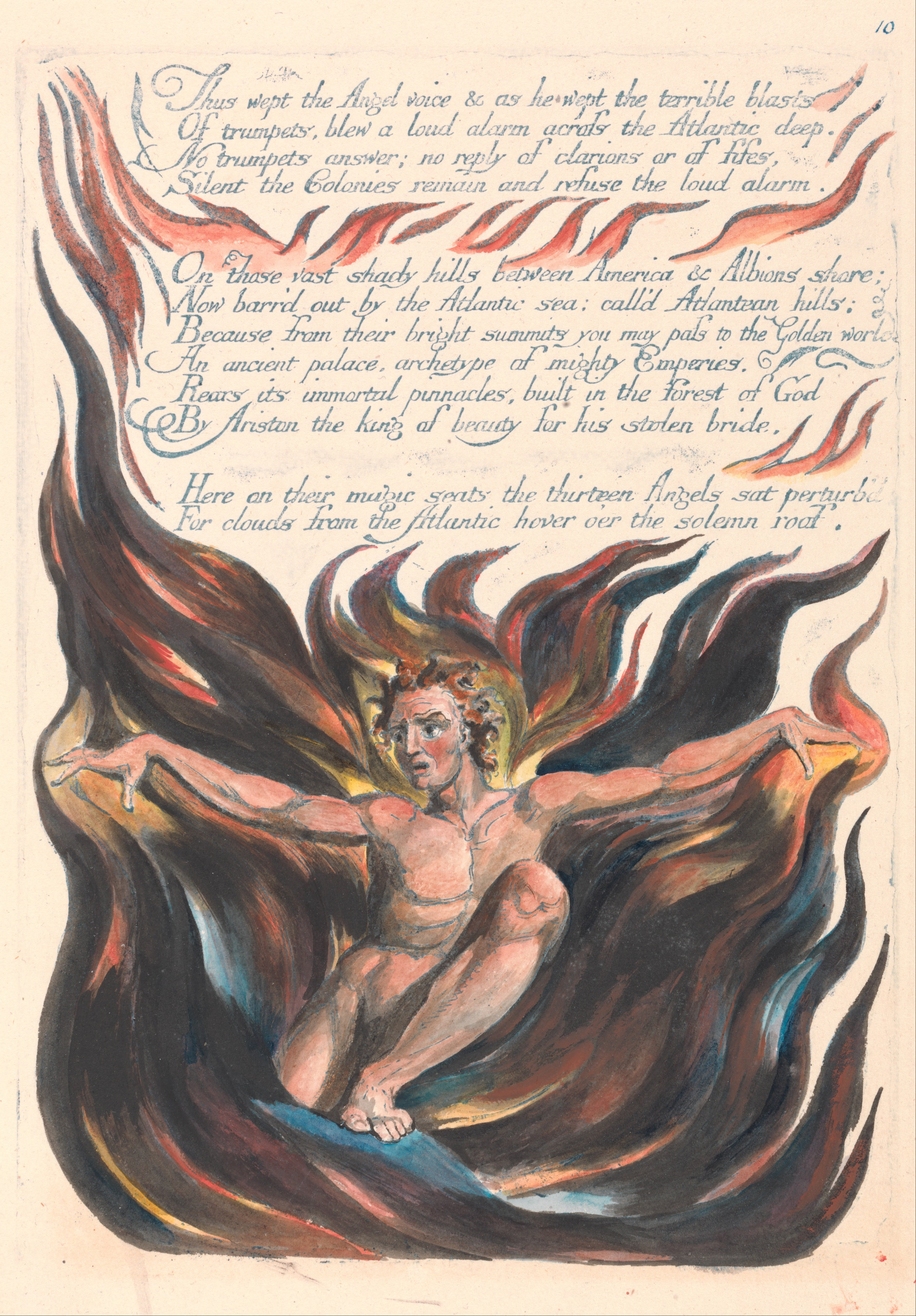
America 
Plate 6, Copy a

War is Blake's method of separating Truth from Error. The condition of War in Eternity is the clash of ideas or as David Erdman writes in Prophet Against Empire on Page 356, the separation of 'wheat from chaff.'

Blake distinguishes between the Wars of Man which in Eternity are experienced as visionary, and the violent conflicts with which we are familiar. Ololon looking down into our world sees that War has become the vehicle of decay & death. Ideas are meant to be expressions of the Divine Vision and not cause for bitterness and terror.

Milton, Plate 34 [38], (E 134) 
"And Ololon looked down into the Heavens of Ulro in fear
They said. How are the Wars of Man which in Great Eternity       
Appear around, in the External Spheres of Visionary Life
Here renderd Deadly within the Life & Interior Vision
How are the Beasts & Birds & Fishes, & Plants & Minerals
Here fixd into a frozen bulk subject to decay & death?
Those Visions of Human Life & Shadows of Wisdom & Knowledge      
Plate 35 [39]
Are here frozen to unexpansive deadly destroying terrors[.]
And War & Hunting: the Two Fountains of the River of Life
Are become Fountains of bitter Death & of corroding Hell
Till Brotherhood is changd into a Curse & a Flattery
By Differences between Ideas, that Ideas themselves, (which are  
The Divine Members) may be slain in offerings for sin"

Blake writes of the transition from corporeal war to mental war as The Four Zoas is brought to a close "as an extended song of harvest." Erdman furnishes the details. "Enion and Tharmas are at last united, appearing in Eden as innocent boy and girl in Eternal Childhood, he the rivers and seas, she the moon that woos them. ...The clouds of war dissipate and sink into the Seas of Tharmas. "... 

"Urizen combines the drying and cutting operations, and the winnowing is done by Tharmas as Tongue making the honest man's ultimate separation of wheat from chaff, exulting over the downfall of the great Whore and and all her "Kings & Councellors & Giant Warriors":

Four Zoas, Night IX, Page 134, (E 402)
"O Mystery Fierce Tharmas cries Behold thy end is come Art thou she that made the nations drunk with the cup of Religion Go down ye Kings & Councellors & Giant Warriors Go down into the depths go down & hide yourselves beneath Go down with horse & Chariots & Trumpets of hoarse war Lo how the Pomp of Mystery goes down into the Caves Her great men howl & throw the dust & rend their hoary hair Her delicate women & children shriek upon the bitter wind Spoild of their beauty their hair rent & their skin shriveld up Lo darkness covers the long pomp of banners on the wind And black horses & armed men & miserable bound captives Where shall the graves recieve them all & where shall be their place And who shall mourn for Mystery who never loosd her Captives Let the slave grinding at the mill run out into the field Let him look up into the heavens & laugh in the bright air Let the inchaind soul shut up in darkness & in sighing Whose face has never seen a smile in thirty weary years Rise & look out his chains are loose his dungeon doors are open And let his wife & children return from the opressors scourge They look behind at every step & believe it is a dream Are these the Slaves that groand along the streets of Mystery Where are your bonds & task masters are these the prisoners Where are your chains where are your tears why do you look around If you are thirsty there is the river go bathe your parched limbs The good of all the Land is before you for Mystery is no more Then All the Slaves from every Earth in the wide Universe Sing a New Song drowning confusion in its happy notes While the flail of Urizen sounded loud & the winnowing wind of Tharmas So loud so clear in the wide heavens & the song that they sung was this Composed by an African Black from the little Earth of Sotha"

After referring to the above passage near the end of the Four Zoas, Erdman continues: 

"This is the end so long foretold, and now Tharmas recites the beginning foretold in America, repeating Blake' paraphrase of the second and third demands of the Declaration of Independence, Life having been attained. The slaves and prisoners attaining Liberty are urged to pursue their Happiness as earth-owners, free of religion's tithes: The good of all the Land is before you for Mystery is no more"

Declaration of Independence

"all men are created equal, that they are endowed by their Creator with certain unalienable Rights, that among these are Life, Liberty and the pursuit of Happiness."

America, Plate 6, (E 53)

"The morning comes, the night decays, the watchmen leave their stations;
The grave is burst, the spices shed, the linen wrapped up;
The bones of death, the cov'ring clay, the sinews shrunk & dry'd.
Reviving shake, inspiring move, breathing! awakening!
Spring like redeemed captives when their bonds & bars are burst; 

Let the slave grinding at the mill, run out into the field:
Let him look up into the heavens & laugh in the bright air;
Let the inchained soul shut up in darkness and in sighing,
Whose face has never seen a smile in thirty weary years;
Rise and look out, his chains are loose, his dungeon doors are open.     
And let his wife and children return from the opressors scourge;
They look behind at every step & believe it is a dream.
Singing. The Sun has left his blackness, & has found a fresher morning
And the fair Moon rejoices in the clear & cloudless night;
For Empire is no more, and now the Lion & Wolf shall cease." 
Matthew 3
[11] I indeed baptize you with water unto repentance: but he that
 cometh after me is mightier than I, whose shoes I am not worthy to 
bear: he shall baptize you with the Holy Ghost, and with fire:
[12] Whose fan is in his hand, and he will throughly purge his floor, and gather his wheat into the garner; but he will burn up the chaff with unquenchable fire.

[13] Then cometh Jesus from Galilee to Jordan unto John, to be baptized of him. 
 

Friday, October 14, 2022

IDENTITY IN JERUSALEM

First posted March 2011

Karl Kroeber's chapter in Blake's Sublime Allegory, Essays on The Four Zoas, Milton, & Jerusalem, Edited by Stuart Curran & Joseph Anthony Wittreich, Jr. is titled Delivering Jerusalem. As have many before and after him, he is conveying his understanding of Jerusalem in order to make it more accessible to the reader. His idea is that Blake attempts to lead us on a journey inward in order to recover our 'identity' which is hidden from us by the fall into multiplicity.

Quotes from Kroeber on Blake's Jerusalem:

"It's 'plot' is the commonplace act of falling into sleep and awakening. Sleep is our chief means of natural regeneration. Falling asleep is a process of detaching oneself from one's ordinary 'identity,' what Blake calls 'selfhood,' what today we call one's sense of one's role. In this respect, at least, sleep is a temporary 'death' containing within it the potentiality of new life." (Page 354)

"From the opening of the prophecy, Albion's death is presented as part of a process of potential regeneration, because his salvation lies within himself:..." (Page 354)

"Jerusalem records a journey, a passage from disintegration to integration. But it is a journey inward...
"The first and most important 'figure' to be separated after the original division of Albion and Jesus is Los, the artificer, the impulse of divine energy toward Regeneration which prevents Albion from slipping into annihilation, nonentity. But Los exists as a separate entity only because of Albion's fall; and all that Los does, in one sense, is the reverse of true nobility and divinity. ...what he creates is the consolidation of error. Los is creative spirit struggling in a fallen cosmos, therefore admirable; but his creativity - 'Striving with Systems to deliver Individuals from those Systems' - is almost a parody of Christ's creativity, which makes reality out of 'nothing,' truth out of delusion." (Page 355)

So the difficulty of living in this world is first the illusion that this world (which we construct) is the true world and not a mask of the Eternal world which underlies, encloses, supersedes, and permeates it. Next is the illusion that what we know as 'ourselves' is our true identity and is able to perceive what we are, what the world is and what reality is. Further we work under the illusion that we can 'fix' things by continuing to do the same things that have contributed to creating the illusions.

" Blake's limits are not impassable boundaries...but critical points, equivalent to thirty-two degrees Fahrenheit for water. Contracted to Adam, mankind attains the possibility of the redeeming Christ. Reaching the limit of 'Opakeness' which is Satan, man attains the possibility of total luminescence, Lucifer, complete emanative power, the power of giving forth light instead of casting shadows, making spectres...Only then are we freed from the inhibiting pressure of those 'systems' external to us which contract and darken individuality into Selfhood." (Page 358)

"To fall is to enslave oneself to seemings, to have one' individual identity devoured by a multiplex, illusory Selfhood." (Page 359)

"...imagination, the awakened intellect, passes beyond the limits of seeming to what truly is." (Page 363)
...
"The total movement of Jerusalem from division through death and sexuality to civil integration is the process of 'identifying' Albion's Emanation, Jerusalem. What the process confirms is that we CAN re-establish our true identity, attain true livingness. 'Identity' means primarily, being oneself and not another." (Page 365)

Although Kroeber never mentions psychological processes or Jungian Analysis, one may see strong parallels to the process of Indivuation (which results in the formation of the Self) in the process described by Kroeber. The liberation of the identity as in Blake, or of the Self as in Jung may be seen as the life work of each individual striving for entry into Eternity.

Jerusalem, Plate 60, (E 209)
"within the Furnaces the Divine Vision appeard

On Albions hills: often walking from the Furnaces in clouds
And flames among the Druid Temples & the Starry Wheels
Gatherd Jerusalems Children in his arms & bore them like
A Shepherd in the night of Albion which overspread all the Earth

I gave thee liberty and life O lovely Jerusalem
And thou hast bound me down upon the Stems of Vegetation"


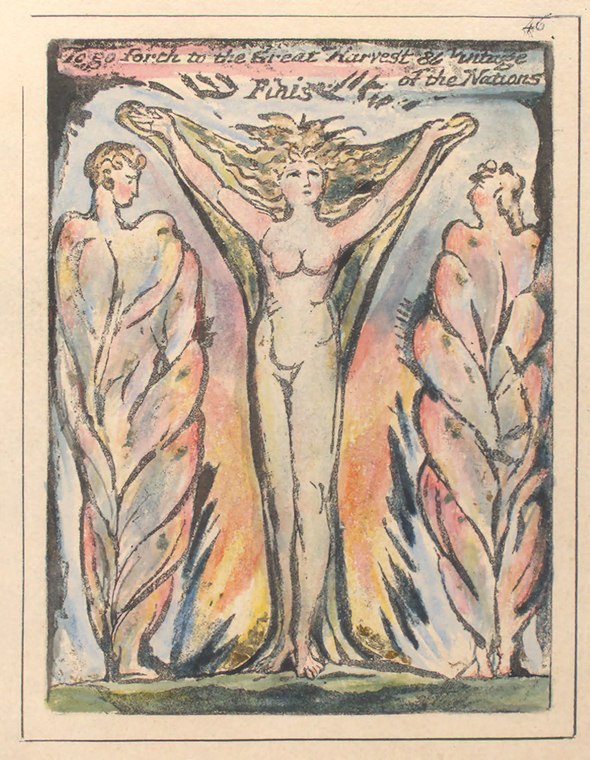
Pictured on the final plate of Milton with the words 'To go forth to the Great Harvest & Vintage of Nations', is the image of the liberated female shedding the dark garment of Selfhood (Erdman). The 'Stems of Vegetation' on either side draw us to a culminating point in Jerusalem where the Divine Vision has appeared in the Furnace of Los, gathered Jerusalem's children, and announced that he has given 'liberty and life' which have been bound down on 'stems of vegetation.' But the 'Great Harvest & Vintage' will be accomplished.


As Karl Kroeber says, "we CAN re-establish our true identity, attain true livingness."

Blake's Sublime Allegory, Essays on The Four Zoas, Milton, & Jerusalem

Thursday, November 1, 2018

SLAVERY 4

Wikimedia Commons
IIllustration to Stedman's Five Years Expedition 
Europe Supported By Africa and America
 Stedman's comments on Europe Supported By Africa and America:
"Going now to take my leave of Surinam, after all the horrors and
    cruelties with which I have hurt both the eye and heart of the
    feeling reader, I will close the scene with an emblematical picture
    of Europe supported by Africa and America, accompanied by an ardent
    wish that the friendly manner as they are represented, they may
    henceforth and to all eternity be the props of each other. I might
    have included Asia, but this I omitted, as having no connection with
    the present narrative:  we only differ in colour but are certainly
    all created by the same Hand. Thus, if it has not pleased fortune to
    make us equal in rank, let us at least use the superiority we
    possess with moderation, and not only proffer that happiness which
    we have to bestow on our equals, but let us extend it with
    cheerfulness to our deserving dependents." 
The final picture in Stedman's book, created by Stedman and engraved by Blake, is of three lovely young women. In spite of the requirements of his profession that he quell a slave rebellion and brutally punish disobedience, Stedman married a slave woman himself and with her had a child whom he later took to Europe. Although he realized that he had participated in injustices, he recognized the essential human value of all races. His hope was that the three races may learn that their differences were assets which might be shared with one another to increase the happiness of all. 

Blake did not try to reconcile Stedman's ideas with his own. As I read Blake's poetic statements, I see this as something of what he was saying in his illustrations to The Narrative of a Five Years Expedition against the Revolted Negroes of Surinam and his own poem Vision of the Daughters of Albion :
The African bears the burden of slavehood, of loss of liberty and of cruel punishment.
The European is under the hegemony of marriage laws which rob women of autonomy.
The American is suffering the destruction of the land and culture.

Africa loses her population and labor.
Europe loses the contribution which her women could make to life and liberty.
America loses the diversity and creativity of her native people.

Erdman in Prophet against Empire drew together the complexities of Blake's insights into the issues of diverse human beings living together for mutual benefit. Oothoon from Visions of Daughters of Albion, Europe Supported By Africa and America, from Blake's illustrations to Stedman's book, and the lessons learned in Little Black Boy, all contributed to understanding the difficulties of pursuing brotherhood.

Exerts from Page 239-40 - read the section :
"The argument of Oothoon is triplex, as she herself is. Stedman's emblematic picture treats Europe, Africa and America as three separate women: Blake treats them as one. He can do this because Oothoon is not a person but a 'soul.' Pictured in chains she is the female slave, but she does not have the black skin and tight ringlets of the emblem...Oothoon is the American Indian of the emblem wirh the same loose black hair, sad mouth and angular limbs.
...
To avoid a chauvinistic interpretation Blake explained that any skin color is a cloud that cannot obscure the essential brotherhood of man in a fully enlightened society, such as Heaven.
...
If the Negro is to be free of his black cloud, the little English boy must be free of his 'white cloud' which is equally opaque.
...
  As Africa she is urging the London citizens to ignore color differences. As America she is urging British law-makers to rescue her from the muddy feet of the slaver. As a woman enslaved by the Marriage Act morality, she is imploring her lover to rise above accusations of adultery" 

Marriage of Heaven and Hell, Plate 25, (E 44)
A song of Liberty
"12. Look up! look up! O citizen of London. enlarge thy
countenance; O Jew, leave counting gold! return to thy oil and
wine; O African! black African! (go. winged thought widen his forehead.)"
Marriage of Heaven and Hell, Plate 13, (E 39)
 "I then asked Ezekiel. why he eat dung, & lay so long on his
right  & left side? he answerd. the desire of raising other men
into a  perception of the infinite this the North American tribes
practise." 

Jerusalem, Plate 72, (E 227)
"All these Center in London & in Golgonooza. from whence
They are Created continually East & West & North & South
And from them are Created all the Nations of the Earth           
Europe & Asia & Africa & America, in fury Fourfold!

And Thirty-two the Nations: to dwell in Jerusalems Gates
O Come ye Nations Come ye People Come up to Jerusalem
Return Jerusalem & dwell together as of old! Return
Return! O Albion let Jerusalem overspread all Nations            
As in the times of old! O Albion awake! Reuben wanders
The Nations wait for Jerusalem. they look up for the Bride

France Spain Italy Germany Poland Russia Sweden Turkey
Arabia Palestine Persia Hindostan China Tartary Siberia
Egypt Lybia Ethiopia Guinea Caffraria Negroland Morocco          
Congo Zaara Canada Greenland Carolina Mexico
Peru Patagonia Amazonia Brazil. Thirty-two Nations
And under these Thirty-two Classes of Islands in the Ocean
All the Nations Peoples & Tongues throughout all the Earth"

Jerusalem, Plate 97, (E 256)
"Awake! Awake Jerusalem! O lovely Emanation of Albion
Awake and overspread all Nations as in Ancient Time
For lo! the Night of Death is past and the Eternal Day
Appears upon our Hills: Awake Jerusalem, and come away

So spake the Vision of Albion & in him so spake in my hearing   
The Universal Father."

Vision of Last Judgment, (E 556)
"it ought to be understood that the Persons
Moses & Abraham are not here meant but the States Signified by
those Names the Individuals being representatives or Visions of
those States as they were reveald to Mortal Man in the Series of
Divine Revelations. as they are written in the Bible these
various States I have seen in my Imagination when distant they
appear as One Man but as you approach they appear
Multitudes of Nations."

Monday, October 29, 2018

SLAVERY 3

British Museum
Visions of the Daughters of Albion
Copy A, Plate 11
Perhaps political situations are never simple, as Larry and I frequently commiserated there were too many variables.

During Blake's lifetime there were innumerable variables (rebellion, war, slavery, republicanism, liberation, etc.), each of which was influenced by multiple forces. Caution was called for in manipulating a single variable which would have a rippling effect. When Blake wrote Visions of the Daughters of Albion he attempted to affect the treatment of women and the treatment of slaves simultaneously. By allowing the work to be interpreted in multiple ways he avoided suggesting dramatic change in any single variable.

Two problems addressed in Visions of the Daughters of Albion were marriage laws which resulted in oppression of women, and failure of the law to prevent the use of British ships to transport slaves. David Erdman in Prophet Against Empire directed our attention to the subtle ways Blake referenced the slave trade when writing of the sexual triangle among Oothoon, Bromian and Theotormon. Before the lovers Oothoon and Theotormon could be married she was violated by Bromian. Oothoon was rejected by both men but she knew herself to be pure and undefiled. Shift to the situation regarding slavery - Oothoon is the African slave as the pawn being manipulated by outside forces; Bromian in the slave trader who makes it possible for slavery to increase; Theotormon is the Parliament who refuses to act against the power of the economic system sustained by slavery. 

The tensions which existed in either of the triangles is expressed in this way by Erdman on page 241 of his book:

"In her effort to prod him across the threshold of indecision - 'I cry O Theotormon for the village dog Barks at the breaking day'- Oothoon insists that the revolutionary dawn is at hand and overdue and the corn is ripe. But the 'citizen of London' does not look up... he fears the new philosophy may carry his thought to a 'remote land' (America) or may bring 'poison from the desert wilds' rather that 'dews and honey and balm.' And he grows silent when Bromian shakes the cavern with rhetorical question, just as the Abolitionists were silenced in 1793 by the clamor of Antijacobinism."

Visions of the Daughters of Albion, Plate 2, (E 46) 
"The Daughters of Albion hear her woes. & eccho back her sighs.
Why does my Theotormon sit weeping upon the threshold;
And Oothoon hovers by his side, perswading him in vain:
I cry arise O Theotormon for the village dog
Barks at the breaking day. the nightingale has done lamenting.
The lark does rustle in the ripe corn, and the Eagle returns     
From nightly prey, and lifts his golden beak to the pure east;
Shaking the dust from his immortal pinions to awake
The sun that sleeps too long. Arise my Theotormon I am pure.
Because the night is gone that clos'd me in its deadly black.
They told me that the night & day were all that I could see;     
They told me that I had five senses to inclose me up.
And they inclos'd my infinite brain into a narrow circle,
And sunk my heart into the Abyss, a red round globe hot burning
Till all from life I was obliterated and erased.
Instead of morn arises a bright shadow, like an eye              
In the eastern cloud: instead of night a sickly charnel house;
That Theotormon hears me not! to him the night and morn
Are both alike: a night of sighs, a morning of fresh tears;
Plate 3
And none but Bromion can hear my lamentations."
. 

Saturday, July 2, 2016

FOLLOW THE LINKS

Reposted from August 26, 2013.
 
A spiritual friend whom we met on the internet commented on Larry's recent post Blake's Main Chance. His comment was about people who lead ordinary lives as William Blake did, and accomplish extraordinary things. Larry replied by commenting that he, like Whitman, had written his book on government time. I followed that hint by searching for a connection between Blake and Whitman. I found a few literary and historical associations which led to Whitman's grave in New Jersey which was patterned after Death's Door in Blake's image for Blair's The Grave. Through a video on YouTube I was able to make a visit to Whitman's home in Camden NJ and his grave which is recognizable as Blake's portrayal of the door through which one passes to reach another dimension. I passed through that door and saw in Camden all the agony in Blake's London which led him to call it Babylon, a place of captivity and oppression. The woe of perceiving the deteriorated city was followed by the joy of hearing the background music and reading that the lyrics were by Woody Guthrie. I wound up hearing the voices and guitar music of my two sons back in the day when we were under the same roof, singing and playing Woody Guthrie, Bob Dylan, Arlo Guthrie, John Lennon, etc. .
Morgan Library
America
Plate 14, Copy A 
 
When the mind is open (or opened) to receiving multiple intimations of images of truth, the connections with the brotherhood of man and with the cosmos are achieved. The wall is breached. We become members of the one body which to Blake is Albion animated by Jesus.
 
David Erdman on Page 587 of Blake's Poetry and Designs is attempting to convey a similar idea:
 
"In other words, when we wind up the thread of  the illuminated poem into the golden ball of a single, dynamic, visualizable orb, we are ready to enter into new expanses, through heaven's gate, built in Jerusalem's wall - or in this instance, through the 'breach in the city ... after the battle.' It may be as Frye says, that Blake 'hardly seems to have noticed that he had perfected a radically new form of mixed art.' He hardly seem to have  cared, any more than he cared to question a window concerning his sight. It mattered little to him whether picture penetrated poem or poem penetrated picture, if only their  human, apocalyptic meaning would penetrate our hearts and minds."
Auguries of Innocence, (E 491)
"It is right it should be so 
Man was made for Joy & Woe
And when this we rightly know
Thro the World we safely go
Joy & Woe are woven fine
A Clothing for the soul divine"
Marriage of Heaven & Hell, Plate 8, (E 37)
"Every thing possible to be believ'd is an image of truth."
Jerusalem, Plate 88, (E 246)
"How then can I ever again be united as Man with Man
While thou my Emanation refusest my Fibres of dominion.
When Souls mingle & join thro all the Fibres of Brotherhood
Can there be any secret joy on Earth greater than this?" 
Jerusalem, Plate 96, (E 255)
"Jesus replied Fear not Albion unless I die thou canst not live
But if I die I shall arise again & thou with me            
This is Friendship & Brotherhood without it Man Is Not"
Jerusalem, Plate 77, (E 231)
"I give you the end of a golden string,
Only wind it into a ball:
It will lead you in at Heavens gate,
Built in Jerusalems wall."
Vision of Last Judgment, (E 565)
"I assert for My self that I do
not behold the Outward Creation & that to me it is hindrance &
not Action it is as the Dirt upon my feet No part of Me. What it
will be Questiond When the Sun rises  do  you  not  see  a  round 
Disk of fire somewhat like a Guinea O no no I see an Innumerable
company of the Heavenly host crying Holy Holy Holy is the Lord
God Almighty I question not my Corporeal or Vegetative Eye any
more than I would Question a Window concerning a Sight I look
thro it & not with it." 
. 

Wednesday, November 12, 2014

EUROPE PLATE 14

British Museum
Europe
Plate 14, Copy D
Perhaps we should take our first clue as to the meaning of Plate 14 of Europe from the inscriptions. What Blake intends to describe can be symbolized by being imprisoned in a dungeon. The images on the of webs and spiders, insects flying and crawling everywhere, give the impression of a dark, damp dungeon. Doubly trapped is the woman enclosed in a net asking for help from above. Above the image is the word "Dungeon." Below the image Cumberland has written lines from Dryden's opera libretto King Arthur. The passage can be found in Bysshe's The art of English Poetry.
 
"Them to a Dungeons depth I sent, fast bound, Where stow'd with snakes and adders now they lodge, 
The rats brush oer their faces with their tails, And croaking Paddocks [frogs or toads] crawl upon thier limbs. 
Dryden."

With the help of David Erdman's Blake: Prophet Against Empire, the imagery of Plate 14 becomes clearer. Much of this information is found in Chapter 9, Seeking the Trump of Doom, particularly pages 212-218.

On Plate 14 Blake has used historical data to provide the framework for his commentary on the human condition. A proclamation was issued by England's George III in cooperation with his prime minister William Pitt in 1792 against 'divers wicked and seditious writings.' Pitt was able to force the Chancellor Thurlow from his position because of his mild criticism of this proclamation. 

Blake both concealed and revealed his reaction to the Proclamation on Plate 14 of Europe. Erdman tells us that when Blake wrote the following lines he was referring to the dismissal of Chancellor Thurlow by Pitt from his position which included Keeper of the Seal and Guardian of the King's Conscience.

"Above the rest the howl was heard from Westminster louder & louder:
The Guardian of the secret codes forsook his ancient mansion,"  
Blake also is referring to Thurlow when he mentions 'furr'd robes & false locks' which were removed before 'he fled Groveling along Great George Street thro' the Park gate.'

Erdman tells us that, "Historians agree with Blake that this Proclamation began England's 'black era of reaction and coercion'" (Page 216). The Proclamation was issued a second time in 1794 linking it to a formal calling out of the militia . Blake's allusion to these circumstances is contained in these words:

"The youth of England hid in gloom curse the paind heavens; compell'd         
Into the deadly night to see the form of Albions Angel
Their parents brought them forth & aged ignorance preaches canting,
On a vast rock, perciev'd by those senses that are clos'd from thought:"
Blake considered that the combination of suppression of speech, and the dedication of troops and weaponry to an undeclared war, represented the intention of the government to restrict liberty and confine England in an unpleasant dungeon not of her choosing.     

The restrictions and deprivations which the people endured were reflected back upon the government which decreed them. The king was caught between the false rationality of Urizen's fearfulness and the demand for change from fiery Orc. His refuge was retreat into the despair of his own periodic mental illness.

Europe, Plate 12, (E 64)
"And the clouds & fires pale rolld round in the night of Enitharmon
Round Albions cliffs & Londons walls; still Enitharmon slept!
Rolling volumes of grey mist involve Churches, Palaces, Towers:
For Urizen unclaspd his Book: feeding his soul with pity
The youth of England hid in gloom curse the paind heavens; compell'd         
Into the deadly night to see the form of Albions Angel
Their parents brought them forth & aged ignorance preaches canting,
On a vast rock, perciev'd by those senses that are clos'd from thought:
Bleak, dark, abrupt, it stands & overshadows London city
They saw his boney feet on the rock, the flesh consum'd in flames:        
They saw the Serpent temple lifted above, shadowing the Island white:
They heard the voice of Albions Angel howling in flames of Orc,
Seeking the trump of the last doom

Above the rest the howl was heard from Westminster louder & louder:
The Guardian of the secret codes forsook his ancient mansion,    
Driven out by the flames of Orc; his furr'd robes & false locks
Adhered and grew one with his flesh, and nerves & veins shot thro' them
With dismal torment sick hanging upon the wind: he fled
Groveling along Great George Street thro' the Park gate; all the soldiers
Fled from his sight; he drag'd his torments to the wilderness.   

Thus was the howl thro Europe!
For Orc rejoic'd to hear the howling shadows
But Palamabron shot his lightnings trenching down his wide back
And Rintrah hung with all his legions in the nether deep

Enitharmon laugh'd in her sleep to see (O womans triumph)        
Every house a den, every man bound; the shadows are filld
With spectres, and the windows wove over with curses of iron:
Over the doors Thou shalt not; & over the chimneys Fear is written:
With bands of iron round their necks fasten'd into the walls
The citizens: in leaden gyves the inhabitants of suburbs         
Walk heavy: soft and bent are the bones of villagers

Between the clouds of Urizen the flames of Orc roll heavy
Around the limbs of Albions Guardian, his flesh consuming.
Howlings & hissings, shrieks & groans, & voices of despair
Arise around him in the cloudy   
Heavens of Albion, Furious"
Blake returnd to the incident of Thurlow's dismissal in Milton:


Milton, Plate 8, (E 102)
"Michael contended against Satan in the rolling thunder
Thulloh the friend of Satan also reprovd him; faint their reproof.

But Rintrah who is of the reprobate: of those form'd to destruction
In indignation. for Satans soft dissimulation of friendship!  
Flam'd above all the plowed furrows, angry red and furious,
Till Michael sat down in the furrow weary  dissolv'd in tears
Satan who drave the team beside him, stood angry & red
He smote Thulloh & slew him, & he stood terrible over Michael
Urging him to arise: he wept! Enitharmon saw his tears         
But Los hid Thulloh from her sight, lest she should die of grief
She wept: she trembled! she kissed Satan; she wept over Michael
She form'd a Space for Satan & Michael & for the poor infected[.]
Trembling she wept over the Space, & clos'd it with a tender Moon

Los secret buried Thulloh, weeping disconsolate over the moony Space     

But Palamabron called down a Great Solemn Assembly,
That he who will not defend Truth, may be compelled to
Defend a Lie, that he may be snared & caught & taken"
. 

Thursday, July 17, 2014

BLAKE & SOCRATES III

An extremely painful episode in Blake's life made him profoundly aware of the pressures suffered by Socrates, Jesus, early Christians, and dissenters from established religions. The means through which Blake personally encountered the accusation, trial and acquittal by the authorities of the King was a altercation with a soldier quartered a short distance from Blake's home in Felpham.
Blake included an account of the incident in a letter to his friend Thomas Butts:  

Letters, (E 732)
[To] Mr Butts, Gr Marlborough St, London
Felpham August 16. 1803
...
 I am at Present in a Bustle to defend myself against a
very unwarrantable warrant from a justice of Peace in
Chichester. which was taken out against me by a Private in Captn
Leathes's troop of 1st or Royal Dragoons for an assault &
Seditious words.  The wretched Man has terribly Perjurd himself
as has his Comrade for as to Sedition not one Word relating to
the King or Government was spoken by either him or me.  His
Enmity arises from my having turned him out of my Garden into
which he was invited as an assistant by a Gardener at work
therein, without my knowledge that he was so invited.  I desired
him as politely as was possible to go out of the Garden, he made
me an impertinent answer I insisted on his leaving the Garden he
refused I still persisted in desiring his departure he then
threatend to knock out my Eyes with many abominable imprecations
& with some contempt for my Person it affronted my foolish Pride
I therefore took him by the Elbows & pushed him before me till I
had got him out. there I intended to have left him. but he
turning about put himself into a Posture of Defiance threatening
& swearing at me.  I perhaps foolishly & perhaps not, stepped out
at the Gate & putting aside his blows took him again by the
Elbows & keeping his back to me pushed him forwards down the road
about fifty yards he all the while endeavouring to turn round &
strike me & raging & cursing which drew out several
neighbours. at length when I had got him to where he was
Quarterd. which was very quickly done. we were met at the Gate by
the Master of the house.  The Fox Inn, (who is [my] the
proprietor of my Cottage) & his wife & Daughter. & the Mans
Comrade. & several other people My Landlord compelld the Soldiers
to go in doors after many abusive threats [from the]
against me & my wife from the two Soldiers but not one word of
threat on account of Sedition was utterd at that time.  This
method of Revenge was Plann'd between them after they had got
together into the Stable.  This is the whole outline.  I have for
witnesses. The Gardener who is Hostler at the Fox & who Evidences
that to his knowledge no word of the remotest tendency to
Government or Sedition was utterd,--Our next door Neighbour a
Millers wife who saw me turn him before me down the road & saw &
heard all that happend at the Gate of the Inn who Evidences that
no Expression of threatening on account of Sedition was utterd in
the heat of their fury by either of the Dragoons. this was the
womans own remark & does high honour to her good sense as she
observes that whenever a quarrel happens the offence is always
repeated.  The Landlord of the Inn & His Wife & daughter will
Evidence the Same & will evidently prove the Comrade perjurd who
swore that he heard me  at the Gate utter Seditious words
& D--- the K--- without which perjury I could not have been
committed & I had no witness with me before the Justices who
could combat his assertion as the Gardener remaind in my Garden
all the while & he was the only person I thought necessary to
take with me.  I have been before a Bench of Justices at
Chichester this morning. but they as the Lawyer who
wrote down the Accusation told me in private are compelld by the
Military to suffer a prosecution to be enterd into altho they
must know & it is manifest that the whole is a Fabricated
Perjury.  I have been forced to find Bail.  Mr Hayley was kind
enough to come forwards & Mr Seagrave Printer at Chichester.
Mr H. in 100L & Mr S. in 50L & myself am bound in 100L for
my appearance at the Quarter Sessions which is after Michaelmass.
...
Every one here is my Evidence for Peace & Good Neighbourhood &
yet such is the present state of things this foolish accusation
must be tried in Public.
...
 This is but too just a Picture of my Present state I pray
God to keep you & all men from it & to deliver me in his own good
time.
... 
Affectionately Yours
WILLIAM BLAKE" 
Sedition, the crime of which Blake stood accused, was punishable by imprisonment or death. Blake was brought to trial in January 1804. Through the testimony of neighbors who had witnessed the incident he was found not guilty by a jury of having said 'Damn the King.'

David Erdman in Prophet Against Empire devotes several pages to examining the particulars of Blake's encounter with the law. The least that can be said about it is that it was traumatic for William and Catherine Blake:
Page 410
"Whatever we make of the coincidence of some of the dragoon's charges with some of Blake's prophetic opinions, however, the trial was an ordeal for Blake."
Page 411
"Yet the wounds made by the accusation and the inarticulate trial never completely healed."

On Plate 93 of Jerusalem Blake pictured three accusers and labeled them 'Anytus Melitus & Lycon', the names of three men who were involved in the proceedings against Socrates which led to the guilty verdict and his subsequent death. Blake connects the condemnation of Socrates to that of Jesus by pointing out that the accusers of both men thought their victims 'Pernicious' men. Blake puts himself in the category with Socrates and Jesus by picturing in the image an imaginative representation not of men involved in his trial, but the three Hunt brothers, who destroyed his reputation as an artist and imputed insanity to him through their published criticism in the Examiner. The pointing hand, seen six times in the image, was associated with the Hunts, whom Blake personified as 'Hand' in Jerusalem.

Jerusalem, Plate 93, (E 253)
"Anytus Melitus & Lycon thought Socrates a
Very Pernicious Man   So Caiphas thought Jesus"

Wikimedia Commons Jerusalem, Plate 93
Detail from top of Plate
The trial of Jesus:
Matthew 26
[57]Then those who had seized Jesus led him to Ca'iaphas the high priest, where the scribes and the elders had gathered.
[58] But Peter followed him at a distance, as far as the courtyard of the high priest, and going inside he sat with the guards to see the end.
[59] Now the chief priests and the whole council sought false testimony against Jesus that they might put him to death,
[60] but they found none, though many false witnesses came forward. At last two came forward
[61] and said, "This fellow said, `I am able to destroy the temple of God, and to build it in three days.'"
[62] And the high priest stood up and said, "Have you no answer to make? What is it that these men testify against you?"
[63] But Jesus was silent. And the high priest said to him, "I adjure you by the living God, tell us if you are the Christ, the Son of God."
[64] Jesus said to him, "You have said so. But I tell you, hereafter you will see the Son of man seated at the right hand of Power, and coming on the clouds of heaven."
[65] Then the high priest tore his robes, and said, "He has uttered blasphemy. Why do we still need witnesses? You have now heard his blasphemy.
[66] What is your judgment?" They answered, "He deserves death."

The trial of Socrates:
"The accusers of Socrates proposed the punishment of death.  In proposing death, the accusers might well have expected to counter with a proposal for exile--a punishment that probably would have satisfied both them and the jury.  Instead, Socrates audaciously proposes to the jury that he be rewarded, not punished.  According to Plato, Socrates asks the jury for free meals in the Prytaneum, a public dining hall in the center of Athens.  Socrates must have known that his proposed "punishment" would infuriate the jury.  I. F. Stone noted that "Socrates acts more like a picador trying to enrage a bull than a defendant trying to mollify a jury."  Why, then, propose a punishment guaranteed to be rejected?  The only answer, Stone and others conclude, is that Socrates was ready to die."

Read more about Blake's trial in A New Kind of Man by Michael Davis.

.