Blake seeks to provide the Golden String which can lead us through the labyrinth of our experience or his own poetry.

Showing posts with label Marriage of Heaven and Hell. Show all posts

Tuesday, September 1, 2026

Becoming Himself

 From Chapter One of Larry's Blake Primer
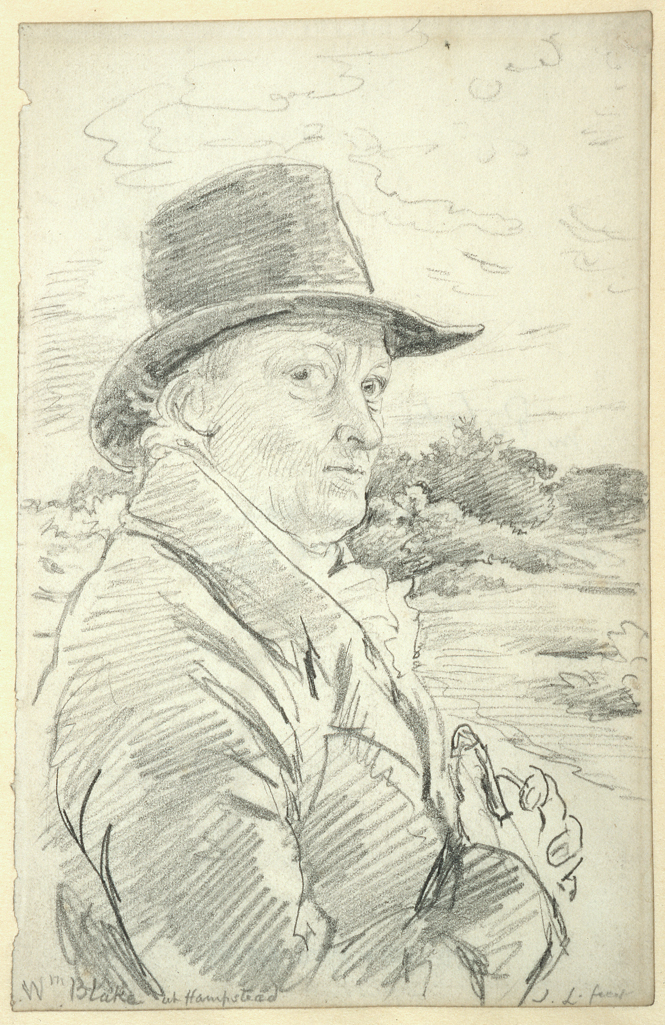
Fitzwilliam Museum
William Blake by John Linnell
c. 1825

  Blake knew a secret. He was possessed by realities foreign to the general mind. He knew that trees were full of angels. He knew and vividly experienced an inner world so real that it made the external world by comparison a thing of shadows. He even had some support for his ideas. He discovered that the Gnostics, Plotinus, Paracelsus, Boehme, and a host of others had reported on those realities, not to mention Elijah, John, Stephen, and a few other such types. To the conditioned mind of his day (and ours) all these reports were just stories, but to Blake they were imaginative realities. Imagination was more real to him than any cold blooded materiality.

With such a psyche how could he possibly trust himself to the sense deadening compromises by which most of us make our way in the world? When the chips were down, he always chose principle, conviction, imagination, and never mind the cost. The surprising thing is not that he failed to make his way, but that he managed to survive in this world for almost seventy years. He did have a strong instinct for survival.

So Blake lived in the world without beoming a worldling, and he learned to fight back. His defense mechanism was telling about his own world. In fact he turned it into a counteroffensive, which he launched with a bang in 1789. He wrote a strange document called The Marriage of Heaven and Hell in which he stood the dominant consciousness on its head. (This work probably contains more famous Blake quotes than any other.)

"The Marriage of Heaven and Hell' embodies new communicative skills which Blake used to raise consciousness, not among his contemporaries, few of whom ever saw it, but among later generations. In MHH and in subsequent prophecies he describes a world of thought, imagination and reality foreign to the socially conditioned mind. He deconditions us and reprograms us, or in his language he attempts to raise us "into a perception of the infinite." (Cf Blake's conversation with Ezekiel in MHH: in the first of the Memorable Fancies)

MHH celebrates Blake's discovery of his identity as a prophet and of the use of irony, which he likely learned from Isaiah. He called himself a devil, but that does not have the satanic implications that simpletons have ascribed to it; all his life Blake showed implacable enmity to Satan. Still perhaps his greatest weapon was the ability to turn conventional ideas upside down and let us see another reality beside the prevailing group-think. "Without Contraries is no progression". (MHH Plate 3; Erdman p. 34)

For example laws are for the protection of society--or sometimes for the advantage of those who make them. Wealth is virtue--or sometimes thievery. Worship is life giving--unless it's idolatrous. War is terrible--but also profitable. These are called antinomies. Blake called them contraries, and the Proverbs of Hell in MHH express his realization that much of the world's thinking is illegitimately one sided. In a strange way Blake's vision showed him the other side of the coin. This is what he shared in the decades when he fought back.

In a letter written to William Hayley Blake indicated that he had lost his vision about 1783 and regained it exactly twenty years later. From this we may surmise that Blake had chosen the world (or attempted to) when vision left him, but he apparently had a large reservoir of visionary capital which he lived on during his twenty years in the wilderness.

He also had a Christian friend, Thomas Butts, a minor civil servant who saw something in Blake that most people had missed. (In this letter Blake explained to Butts, with great poetic brilliance his experience "on the sands at Felpham"). Though Butts probably had no unusual visionary gifts himself, he did recognize them in his friend Blake. To encourage him he occasionally purchased Blake's pictures. As Butts became more aware of Blake's poverty, he commissioned him to paint fifty pictures at a guinea each and gave him complete freedom to choose his subjects. Butts' financial generosity made it possible for Blake and his wife to survive; in all likelihood his spiritual support was even more decisive.

A series of letters which Blake wrote Butts suggest a relationship of mutual warmth. Major Butts affirmed Blake in such a way that in these letters Blake dropped the cryptic and enigmatic style which had become almost a part of him and reverted to the limpid clarity seen in the 'Songs of Innocence'. Blake made every effort to explain himself to Butts, and we are rewarded in the Butts correspondence with some of the most revealing glimpses of his mind and being.

Blake tried to repay Butts for his kindness by offering him spiritual direction. However it seems likely that the relationship was the reverse, at least until the moment when Blake became confirmed in the Lordship of Christ. If Blake had a spiritual midwife, it must have been the humble customs officer.

As the century drew to a close, in spite of his friendship with Butts Blake's spirits began to sink. Cash and work were scarce. He began to suffer from melancholy, avoid his friends and shrink from social scenes.

Then in 1800 he received an invitation from a wealthy popular poetaster named William Hayley to move to Felpham, a village by the sea, and to collaborate in some artistic projects. Hayley in fact took Blake under his wing and set out to make a success of him. In particular he set him to painting miniature portraits and secured numbers of commissions for him. At the same time he strongly discouraged Blake's interest in writing.

This proved to be Blake's last temptation. Naturally he felt grateful for Hayley's interest and sponsorship, but as time went on it became increasingly clear that Hayley meant for him to become a man of the world (painting portraits) and to turn his back on the eternal (stop writing poetry). It was the climactic struggle between the two principles for possession of the artist's soul. We find the struggle aptly expressed in the extravagant words of a spiritual report which Blake wrote to Butts on January 10, 1803. (For the pertinent portion of this letter see Erdman at the bottom of 724 and top of 725.)

A more reasoned explanation of this archetypal problem came in a letter to George Cumberland in July 1800:

"I myself remember when I thought my pursuits of Art a kind of Criminal Dissipation and neglect of the main chance which I hid my face for not being able to abandon as a Passion which is forbidden by Law & Religion."

By the main chance he meant of course seeking conventional success.

After three years at Felpham it appears that Butt's support helped Blake to make the right final decision. An unpleasant altercation with a drunken soldier leading to a trial for sedition also helped. In 1803 he returned to London, richer only in experience, but confirmed in his determination to give his spiritual visions priority in his life.

Thursday, August 6, 2026

WOODLAND ENCOUNTER

Previously posted June 2020

Harry Ransom Center
The University of Texas at Austin
Woodland Encounter
Since I am always searching for things I have not seen before, I come across unexpected things in unexpected places. Such is this image from the University of Texas Harry Ransom Center. Images of the drawings of Blake are less available on the internet than are images from the Illuminated Books, Watercolors or Temperas. Perhaps this is because they are more likely to be held by individual collectors than by universities or museums. 

A watercolor wash drawing such as this, has a sense of immediacy not felt in a more finished painting or engraving. It seems to come to us directly from Blake's vision through his pencil and brush. The name that is attached to this picture, Woodland Encounter, did not likely come from Blake, but it suggests the significant features of the drawing. It takes place in the woods where confrontations with the other begin. We see the male as active offering direction, the female as receptive signaling acceptance. There is a prayerful attitude in the countenance of both figures as if they may be joined in spirit. 

If we look at this image from a psychological perspective, we can see an acknowledgment of the contrary states within the individual. We can see the figures as aspects on the psyche instead of a picture of a man and a woman. Blake sought to unite the contrary states. He did not see the marriage of heaven and hell as a failure but as a successful reconciliation of divisions which result from the inability to accept what is unlike one's self-image. To the extent we can accept that law (or wrath) and grace (or pity) are both necessary components of our own nature, we can begin to acknowledge that in society there will be expressions of law and grace constantly resurfacing in apparent opposition to each other.  Blake never tired of presenting the contraries in new guises. In the passage from The Marriage of Heaven and Hell Blake tells us that contraries: "Attraction and Repulsion, Reason and Energy, Love and Hate, are necessary to Human existence." Not necessary in the sense of being permanent but in the sense of being essential, as is time itself, if there is to be "progress" or movement toward wholeness.
 
Marriage of Heaven and Hell, Plate 3, (E 34) 
 " As a new heaven is begun, and it is now thirty-three years
since its advent: the Eternal Hell revives. And lo! Swedenborg is
the Angel sitting at the tomb; his writings are the linen clothes
folded up. Now is the dominion of Edom, & the return of Adam into
Paradise; see Isaiah XXXIV & XXXV Chap:
  Without Contraries is no progression.  Attraction and
Repulsion, Reason and Energy, Love and Hate, are necessary to
Human existence.
  From these contraries spring what the religious call Good &
Evil. Good is the passive that obeys Reason[.] Evil is the active
springing from Energy.
  Good is Heaven. Evil is Hell."

Isaiah 34
[12] They shall call the nobles thereof to the kingdom, but none shall be there, and all her princes shall be nothing.
[13] And thorns shall come up in her palaces, nettles and brambles in the fortresses thereof: and it shall be an habitation of dragons, and a court for owls.
[14] The wild beasts of the desert shall also meet with the wild beasts of the island, and the satyr shall cry to his fellow; the screech owl also shall rest there, and find for herself a place of rest.
[15] There shall the great owl make her nest, and lay, and hatch, and gather under her shadow: there shall the vultures also be gathered, every one with her mate.
[16] Seek ye out of the book of the LORD, and read: no one of these shall fail, none shall want her mate: for my mouth it hath commanded, and his spirit it hath gathered them.
[17] And he hath cast the lot for them, and his hand hath divided it unto them by line: they shall possess it for ever, from generation to generation shall they dwell therein.

Isaiah 35
[1] The wilderness and the solitary place shall be glad for them; and the desert shall rejoice, and blossom as the rose.
[2] It shall blossom abundantly, and rejoice even with joy and singing: the glory of Lebanon shall be given unto it, the excellency of Carmel and Sharon, they shall see the glory of the LORD, and the excellency of our God.
[3] Strengthen ye the weak hands, and confirm the feeble knees.
[4] Say to them that are of a fearful heart, Be strong, fear not: behold, your God will come with vengeance, even God with a recompence; he will come and save you.
[5] Then the eyes of the blind shall be opened, and the ears of the deaf shall be unstopped.
[6] Then shall the lame man leap as an hart, and the tongue of the dumb sing: for in the wilderness shall waters break out, and streams in the desert.
[7] And the parched ground shall become a pool, and the thirsty land springs of water: in the habitation of dragons, where each lay, shall be grass with reeds and rushes.
[8] And an highway shall be there, and a way, and it shall be called The way of holiness; the unclean shall not pass over it; but it shall be for those: the wayfaring men, though fools, shall not err therein.
[9] No lion shall be there, nor any ravenous beast shall go up thereon, it shall not be found there; but the redeemed shall walk there:
[10] And the ransomed of the LORD shall return, and come to Zion with songs and everlasting joy upon their heads: they shall obtain joy and gladness, and sorrow and sighing shall flee away.
. 

4 comments:

Ian V Mulder said...

It's a most attractive drawing, I don't generally like his representations of the human formm, but this one is more realistic. The woman finished in detail, the man sketched lightly. I've no idea what Blake intended, but form an impression that this simple man of the woods finds himself confronted by an apparition, in the form of a beautiful woman who's more real to him in this moment than his own mundane life. Yet less physical!

ellie Clayton said...

Thanks for seeing the image with different eyes. Perhaps the definition of a successful work of art is that it brings forth the inner truth which the conscious mind is prepared to receive.

If one can see the woman as more real but less physical, one has bridged the gap between the two worlds.

I am glad that you act as my bridge to the other side of the big pond. ellie

Susan J. said...

wow. Ellie. this image really captured me, and I loved your commentary. I guess I've told you about my sure-seemed-to-be-real experience of Jesus at the edge of a forest clearing, beckoning to me & saying "follow me" -- I love what you wrote about the essential necessity of opposites... thanks so much!!! oh - and the allusion to male and female as essential parts of each individual human seems quite timely as well -- THANK YOU, dear friend!

-- Susan J

ellie Clayton said...

Larry and I used to remark on how we 'played tapes', retelling the same memories. However I don't remember your 'tape' about Jesus beckoning to you from the edge of the forest clearing. I would like to hear it played repeatedly.

I know I repeat myself in my posts but then aren't there only a few things that need to be said. All we can hope is to state the old truth in fresh ways.

I'm glad I found WOODLAND ENCOUNTER for many reasons including that we meet in the woods for worship since the meeting house is closed.

Have a Blessed Day, ellie


Tuesday, February 24, 2026

CAVE


Fitzwilliam Museum
Visions of Daughters of Albion
Plate 1

In Part 2 of Words with Power, Frye devotes the four chapters to four metaphoric topics: the Mountain, the Garden, the Cave and the Furnace. He calls these chapters "essays on comparative mythology, organized around four primary concerns: the concern to make and create, the concern to love, the concern to sustain oneself and assimilate the environment, with its metaphorical kernal of food, and the concern to escape from slavery and restraint." (Page 139)  

Cave

The study of the Cave or the lower world begins with where we left off. In the post titled Mountain,  Jacob's ladder stretched between two levels of consciousness, 'planted in Jacob's dreaming brain.' The cave signifies the sub-conscious or supressed energies which are nearer the surface in the dreaming state. To reach the deeper levels of the lower world we are required to make a descent.

Frye

"the concern to sustain oneself and assimilate the environment, with its metaphorical kernal of food" (Page 139)

"We have now to consider the relation this world to a lower world. Here again we shall find both an enlarging and expanding of consciousness, corresponding to Jacob's ladder, ideological adaptations of it like the chain of being, and demonic parodies of it, corresponding to the Tower of Babel." (Page 229)

"The waking consciousness is considerably more docile than the more repressed forms of awareness, and consequently most structures of authority tend to focus on it and try to make sure that repressed impulses remain repressed. As usual there are resistance movements among poets...They drew also on a largley repressed oral tradition, repressed because the art of writing was controlled  mainly by more official authority." (Page 236)   

"The original descent is complemented by a creative assent, in the form of a revolutionary release of repressed elements, whether political of psychological...In the Old Testament the central image of this emancipating revolt is the Exodus; in the New Testament it is the Resurrection, Christ's escape from death as well as hell." (Page 238)

Blake was "the first person in the modern world to see the events of his day in their mythical and imaginative context. He realized the old mythical universe, in its ideological form as a rationalizing of traditional authority, was dead, and that it was time for a new emphasis in mythology that would accomodate the revolutionary movements he saw rising all around him. Being a poet and not a dialecticion, Blake also understood better than most others the metaphorical shape that the new construct would have...Blake saw that as long a man lives within a hierarchical myth without really knowing it, his whole behavior will be conditioned beyond the point of resistance: a rebellion against one hierarchy will mearly set up another one." (Page 243)

The work of the Printing house in Hell takes place not in the conscious mind of the ego but in the deeper recesses of the brain where supressed memories have been hidden. Blake is suggesting that before he has anything to transmit through words and images he must search through the contents of the brain which resides within the cave of his skull where Dragons do the word of clearing away 'All that can be annihilated' for it 'must be annihilated.' The internal process will continue in stages until the contents which germinate within his psyche find a receptive audience in the external world.
Marriage of Heaven and Hell, Plate 15, (E 39)
                            "A Memorable Fancy
   I was in a Printing house in Hell & saw the method in which
knowledge is transmitted from generation to generation.
   In the first chamber was a Dragon-Man, clearing away the
rubbish from a caves mouth; within, a number of Dragons were
hollowing the  cave, 
   In the second chamber was a Viper folding round the rock & the 
cave, and others adorning it with gold silver and precious
stones.
   In the third chamber was an Eagle with wings and feathers of
air, 
he caused the inside of the cave to be infinite, around were
numbers  of Eagle like men, who built palaces in the immense
cliffs.
   In the fourth chamber were Lions of flaming fire raging around
&  melting the metals into living fluids.
   In the fifth chamber were Unnam'd forms, which cast the metals 
into the expanse.
   There they were reciev'd by Men who occupied the sixth
chamber,  and took the forms of books & were arranged in
libraries."
The following passage indicates that it is Vala, the exterior world, that brings forth the Imaginative Human Form from her secret Cave. As the emanation of Luvah she is an expression of human emotions which are as likely to be destructive as constructive.
Jerusalem, Plate 29 [33], (E 176)
"The Imaginative Human Form is but a breathing of Vala
I breathe him forth into the Heaven from my secret Cave          
Born of the Woman to obey the Woman O Albion the mighty
For the Divine appearance is Brotherhood, but I am Love"
Four Zoas, Night VI, Page 74, (E 351)
"Four Caverns rooting downwards their foundations thrusting forth
The metal rock & stone in ever painful throes of vegetation
The Cave of Orc stood to the South a furnace of dire flames
Quenchless unceasing. In the west the Cave of Urizen             
For Urizen fell as the Midday sun falls down into the West
North stood Urthonas stedfast throne a World of Solid darkness
Shut up in stifling obstruction rooted in dumb despair
The East was Void. But Tharmas rolld his billows in ceaseless eddies
Void pathless beat with Snows eternal & iron hail & rain     
All thro the caverns of fire & air & Earth, Seeking
For Enions limbs nought finding but the black sea weed & sickning slime
Flying away from Urizen that he might not give him food
Above beneath on all sides round in the vast deep of immensity
That he might starve the sons & daughters of Urizen on the winds 
Making between horrible chasms into the vast unknown
All these around the world of Los cast forth their monstrous births
But in Eternal times the Seat of Urizen is in the South  
Urthona in the North Luvah in East Tharmas in West"
The emptiness of the void is not unproductive. It has the potential of becoming a womb in which the spirit may be nutured and grow into a fully developed fourfold human.
Milton, Plate 41[48], (E 143)
"Hence arose all our terrors in Eternity! & now remembrance
Returns upon us! are we Contraries O Milton, Thou & I            
O Immortal! how were we led to War the Wars of Death
Is this the Void Outside of Existence, which if enterd into
PLATE 42 [49]                  
Becomes a Womb? & is this the Death Couch of Albion
Thou goest to Eternal Death & all must go with thee
Jerusalem Frontispiece

Friday, October 31, 2025

BODY & SOUL


Blake Archive
Marriage of Heaven and Hell
Plate 14, Copy D
Original in Library of Congress

Marriage of Heaven and Hell, Plate 14, (E 39) 

   "But first the notion that man has a body distinct from his
soul, is to  be expunged; this I shall do, by printing in the
infernal method, by corrosives, which in Hell are salutary and
medicinal, melting apparent surfaces away, and displaying the
infinite which was hid.
   If the doors of perception were cleansed every thing would
appear  to man as it is: infinite.
   For man has closed himself up, till he sees all things thro'
narrow chinks of his cavern.
Plate 15
                            A Memorable Fancy
   I was in a Printing house in Hell & saw the method in which
knowledge is transmitted from generation to generation.
   In the first chamber was a Dragon-Man, clearing away the
rubbish from a caves mouth; within, a number of Dragons were
hollowing the  cave, 
   In the second chamber was a Viper folding round the rock & the 
cave, and others adorning it with gold silver and precious
stones.
   In the third chamber was an Eagle with wings and feathers of
air, 
he caused the inside of the cave to be infinite, around were
numbers  of Eagle like men, who built palaces in the immense
cliffs.
   In the fourth chamber were Lions of flaming fire raging around
&  melting the metals into living fluids.
   In the fifth chamber were Unnam'd forms, which cast the metals 
into the expanse.
   There they were reciev'd by Men who occupied the sixth
chamber,  and took the forms of books & were arranged in
libraries.     
Plate 16
   The Giants who formed this world into its sensual existence
and  now seem to live in it in chains; are in truth. the causes
of its life & the sources of all activity, but the chains are,
the cunning of weak  and tame minds. which have power to resist
energy. according to the proverb, the weak in courage is strong
in cunning.
   Thus one portion of being, is the Prolific. the other, the
Devouring:  to the devourer it seems as if the producer was in
his chains, but it is not so, he only takes portions of existence
and fancies that the whole.
   But the Prolific would cease to be Prolific unless the
Devourer as a sea recieved the excess of his delights.
   Some will say, Is not God alone the Prolific? I answer, God
only   Acts & Is, in existing beings or Men.
   These two classes of men are always upon earth, & they should
be enemies; whoever tries [PL 17] to reconcile them seeks to
destroy existence.   
   Religion is an endeavour to reconcile the two.
   Note.  Jesus Christ did not wish to unite but to seperate
them, as in  the Parable of sheep and goats! & he says I came not
to send Peace  but a Sword.
   Messiah or Satan or Tempter was formerly thought to be one of
the  Antediluvians who are our Energies."


Given to man are two means or doors of perception; his physical senses and his spiritual senses. The doors though which his body perceives are eyes, ears, nose, tongue and touch. Through intuition, imagination, intimation, and revelation the spirit receives and disseminates spiritual truth. Since physical sensation is of the body it dies with bodily death. The spiritual senses, like the Soul, are eternal and continue to operate in the Eternal World. Blake, like the Apostle Paul, recognized the Spiritual Body.

We live in both worlds, the physical and Eternal, although through our senses we may become more accustomed to the physical world of time and space. Nevertheless our Spiritual Senses are accessible to our bodies as well as our Spirits. Blake could say that "notion that man has a body distinct from his soul, is to be expunged", because the body and soul are interconnected serving one another and being served by the other. The Apostle Paul and William Blake agree that at death the Physical Body is left behind in the physical world, being replaced by a spiritual body as the spirit leaves time for Eternity. 

First Corinthians 2
[
13] Which things also we speak, not in the words which man's wisdom teacheth, but which the Holy Ghost teacheth; comparing spiritual things with spiritual.
[14] But the natural man receiveth not the things of the Spirit of God: for they are foolishness unto him: neither can he know them, because they are spiritually discerned.
[15] But he that is spiritual judgeth all things, yet he himself is judged of no man.

[16] For who hath known the mind of the Lord, that he may instruct him? But we have the mind of Christ.

First Corinthians 15

[41] There is one glory of the sun, and another glory of the moon, and another glory
of the stars: for one star differeth from another star in glory.
[42] So also is the resurrection of the dead. It is sown in corruption; it is raised in
incorruption:
[43] It is sown in dishonour; it is raised in glory: it is sown in weakness; it is
raised in power:
[44] It is sown a natural body; it is raised a spiritual body. There is a natural body,
and there is a spiritual body.

Songs of Innocense and of Experience, Plate 51, (E 30)
To Tirzah
"Thou Mother of my Mortal part. With cruelty didst mould my Heart. And with false self-decieving tears, Didst bind my Nostrils Eyes & Ears.
Didst close my Tongue in senseless clay
And me to Mortal Life betray:
The Death of Jesus set me free, 
Then what have I to do with thee?"

[text on illustration: It is Raised a Spiritual Body]
Four Zoas, Page 104 (Second Section), (E 378)
"Los said to Enitbarmon Pitying I saw
Pitying the Lamb of God Descended thro Jerusalems gates
To put off Mystery time after time & as a Man
Is born on Earth so was he born of Fair Jerusalem
In mysterys woven mantle & in the Robes of Luvah 

He stood in fair Jerusalem to awake up into Eden
The fallen Man but first to Give his vegetated body    
To be cut off & separated that the Spiritual body may be Reveald"
Annotations to Berkeley's Siris, (E 663)
"They [Plato and Aristotle] so considerd God as abstracted or distinct from the
Imaginative World but Jesus as also Abraham & David considerd God
as a Man in the Spiritual or Imaginative Vision
     Jesus considerd Imagination to be the Real Man & says I will
not leave you Orphanned and I will manifest myself to you   he
says also the Spiritual Body or Angel as little Children always
behold the Face of the Heavenly Father  
Marriage of Heaven and Hell, Plate 14, (E 39)
"For the cherub with his flaming sword is hereby commanded to 
leave his guard at the tree of life, and when he does, the whole 
creation will be consumed, and appear infinite. and holy whereas
it now  appears finite & corrupt.
   This will come to pass by an improvement of sensual enjoyment.
   But first the notion that man has a body distinct from his
soul, is to  be expunged;" 

Sunday, September 7, 2025

BLAKE & DIOGENES

First posted Sept 2016

 Isaiah 20

[1] In the year that Tartan came unto Ashdod, (when Sargon the king of Assyria sent him,) and fought against Ashdod, and took it;
[2] At the same time spake the LORD by Isaiah the son of Amoz, saying, Go and loose the sackcloth from off thy loins, and put off thy shoe from thy foot. And he did so, walking naked and barefoot.
[3] And the LORD said, Like as my servant Isaiah hath walked naked and barefoot three years for a sign and wonder upon Egypt and upon Ethiopia;
[4] So shall the king of Assyria lead away the Egyptians prisoners, and the Ethiopians captives, young and old, naked and barefoot, even with their buttocks uncovered, to the shame of Egypt.
[5] And they shall be afraid and ashamed of Ethiopia their expectation, and of Egypt their glory.
[6] And the inhabitant of this isle shall say in that day, Behold, such is our expectation, whither we flee for help to be delivered from the king of Assyria: and how shall we escape?

 Marriage of Heaven and Hell
"I also asked Isaiah what made him go naked and barefoot three
years? he answerd, the same that made our friend Diogenes the
Grecian."

 Blake's Memorable Fancy on Plates 12 and 13 of Marriage of Heaven and Hell uses the Hebrew prophets Isaiah and Ezekiel to emphasize the point that a conventional mindset that follows the popular mores fails to understand the voice of prophecy. Isaiah and Ezekiel developed their ability to listen to the voice that spoke from within. To convey the message they received, they occasionally behaved in ways which startled their contemporaries. They sought to change their societies by demonstrating what were the consequences of continuing in behaviors which were leading to destruction. Blake further emphasized the technique of shocking people out of habitual nonproductive attitudes by indicating that Isaiah attributed his going naked and barefoot for three years to the influence of Diogenes who had practiced the same kinds of outrageous stunts to his Greek contemporaries.

Blake was not averse to looking to the Greek philosophy of Diogenes to reinforce his principle that man could not depend upon only data from his senses to interpret his environment and experience. Isaiah, Ezekiel and Diogenes risked being outcast from their societies in order to encourage men to have their intellect and courage opened to perceiving the limitations of conventional thinking. In writing Marriage of Heaven and Hell Blake was engaging in similar strategies to those used by his heroes. He was presenting his ideas in forms and statements which were unacceptable to his public. He risked the ridicule of the critics and the indifference of potential readers by writing poetry which seemed ridiculous on the surface, and making images which appeared unpolished and obscure to current taste.

Fitzwilliam Museum
Marriage of Heaven and Hell
Plate 21

We can judge that Blake had an affinity toward Diogenes from the label cynic which is often attached to the name of the fourth century BC philosopher. As a young man Blake wrote An Island in the Moon: satirical observations on the set of people with whom he was acquainted. He gave himself the name Quid the Cynic. The Greek word cynic was derived from a word meaning dog-like, and Diogenes was thought of as a dog by his critics. Perhaps the unexpected pictures of dogs in Blake's images is meant to point out his viewing whatever situation was being illustrated from a cynical perspective which he shared with Diogenes.
Marriage of Heaven and Hell, PLATE 12, (E 38)
                    "A Memorable Fancy.                            
   The Prophets Isaiah and Ezekiel dined with me, and I asked
them how they dared so roundly to assert. that God spake to them; 
and  whether they did not think at the time, that they would be 
misunderstood, & so be the cause of imposition.
   Isaiah answer'd. I saw no God. nor heard any, in a finite
organical perception; but my senses discover'd the infinite in
every thing, and as  I was then perswaded. & remain confirm'd;
that the voice of honest indignation is the voice of God, I cared
not for consequences but  wrote.
   Then I asked: does a firm perswasion that a thing is so, make it so?
   He replied.  All poets believe that it does, & in ages of imagination
this firm perswasion removed mountains; but many are not capable
of a firm perswasion of any thing.
   Then Ezekiel said. The philosophy of the east taught the first 
principles of human perception     some nations held one
principle for  the origin & some another, we of Israel taught
that the Poetic Genius (as  you now call it) was the first
principle and all the others merely  derivative, which was the
cause of our despising the Priests & Philosophers  of other
countries, and prophecying that all Gods [PL 13] would at last be
proved. to originate in ours & to be the tributaries of the
Poetic  Genius, it was this. that our great poet King David
desired so fervently  & invokes so patheticly, saying by this he
conquers enemies & governs kingdoms; and we so loved our God.
that we cursed in his name all  the deities of surrounding
nations, and asserted that they had rebelled; from these opinions
the vulgar came to think that all nations would at last be
subject to the jews.
   This said he, like all firm perswasions, is come to pass, for all 
nations believe the jews code and worship the jews god, and what
greater subjection can be
   I heard this with some wonder, & must confess my own
conviction.  After dinner I ask'd Isaiah to favour the world with
his lost works, he said none of equal value was lost.  Ezekiel
said the same of his.
   I also asked Isaiah what made him go naked and barefoot three
years? he answerd, the same that made our friend Diogenes the
Grecian.
   I then asked Ezekiel. why he eat dung, & lay so long on his
right  & left side? he answerd. the desire of raising other men
into a  perception of the infinite this the North American tribes
practise. & is he honest who resists his genius or conscience.
only for the sake of present  ease or gratification?"

Saturday, August 23, 2025

LIMITED & ETERNAL


British Museum
Illustrations to Young's Night Thoughts

First posted Jan 2019

Near the end of his final book, Jung reached some conclusions on the ultimate questions facing man.

From C. G. Jung's Memories, Dreams, Reflections, Page 325:
"The decisive question for man is this: Is he related to something infinite or not?
...
The more a man lays stress on false possessions, the less sensitivity he has for what is essential, the less satisfying is his life. He feels limited because he has limited aims, and the result is envy and jealousy. If we understand and feel that there is in this life a link with the infinite, desires and attitudes change.
...
Only consciousness of our narrow confinement in the self forms the link to the limitlessness of the unconscious. In such awareness we experience ourselves concurrently as limited and eternal, as both the one and the other."

Perhaps Blake would have quibbled if he had heard Jung's statement that man breaks through to awareness of the unity of the limited and the eternal, through consciousness of his constraints. But both men were struggling to reconcile the poles of a paradox. Man experiences himself as divided, as living in two worlds - the sordid world of the survival of the fittest, and the divine world of innocence where 'all things work together for good.' One which imprisons him in time and space and one which invites him to soar in his imagination.

Reconciling the opposite poles of the dilemma may have come more naturally to Blake because he spoke the language of poetry whereas Jung spoke the language of science. Blake provided us with first hand images in metaphor and pictures to facilitate the experience of reconciliation. Jung analyzed dreams and myths for the material that supported ideas and concepts which he formulated intellectually.   


All Religions are One, (E 1)
 "The Religions of all Nations are derived from
each Nations different reception of the Poetic Genius which is
every where call'd the Spirit of Prophecy."
All Religions are One, (E 1)
  As all men are alike (tho' infinitely various) So
all Religions & as all similars have one source 
  The true Man is the source he being the Poetic Genius

There is No Natural Religion, (E 2)
  The desire of Man being Infinite the possession is Infinite
& himself Infinite
     Conclusion,   If it were not for the Poetic or Prophetic
character. the Philosophic & Experimental would soon be at the
ratio of all things & stand still, unable to do other than repeat
the same dull round over again
     Application.   He who sees the Infinite in all things sees
God.  He who sees the Ratio only sees himself only.
 Therefore God becomes as we are, that we may be as he is"

Marriage of Heaven and Hell,Plate 13, (E 39)
 "I then asked Ezekiel. why he eat dung, & lay so long on his
right  & left side? he answerd. the desire of raising other men
into a  perception of the infinite" 
Marriage of Heaven and Hell, Plate 14, (E 39)
 "If the doors of perception were cleansed every thing would
appear  to man as it is: infinite.
   For man has closed himself up, till he sees all things thro'
narrow chinks of his cavern."

Marriage of Heaven and Hell, Plate 18, (E 41)
"By degrees we beheld the infinite Abyss, fiery as the smoke 
of a burning city; beneath us at an immense distance was the sun,
black but shining[;] round it were fiery tracks on which revolv'd
vast spiders, crawling after their prey; which flew or rather
swum in the infinite deep, in the most terrific shapes of animals
sprung from corruption. & the air was full of them, & seemd
composed of them; these are Devils. and are called Powers of the
air, I now asked my companion which was my eternal lot? he said,
between the black & white spiders 
  But now, from between the black & white spiders a cloud and
fire burst and rolled thro the deep blackning all beneath, so
that the nether deep grew black as a sea & rolled with a terrible
noise: beneath us was nothing now to be seen but a black tempest,
till looking east between the clouds & the waves, we saw a
cataract of blood mixed with fire and not many stones throw from
us appeard and sunk again the scaly fold of a monstrous serpent.
at last to the east, distant about three degrees appeard a fiery
crest above the waves slowly it reared like a ridge of golden
rocks till we discoverd two globes of crimson fire. from which
the sea fled away in clouds of smoke, and now we saw, it was the
head of Leviathan. his forehead was divided into streaks of green
& purple like those on a tygers forehead: soon we saw his mouth &
red gills hang just above the raging foam tinging the black deep
with beams of blood, advancing toward [PL 19] us with all the
fury of a spiritual existence.
  My friend the Angel climb'd up from his station into the mill;
I remain'd alone, & then this appearance was no more, but I found
myself sitting on a pleasant bank beside a river by moon light
hearing a harper who sung to the harp. & his theme was, The man
who never alters his opinion is like standing water, & breeds
reptiles of the mind." 

Saturday, August 16, 2025

SONG OF LIBERTY

Blake Archive
Original in Fitzwilliam Museum
Copy H, Plate 24

 Thanks to Geoffrey Keynes for his introduction and commentary in William Blake: The Marriage of Heaven and Hell

Introduction - commentary by Keynes

 "On the third plate he had stated the doctrine of contraries - Attraction and Repulsion, Reason and Energy, Love and Hate. Without these contraries there could be no progression, that is, human thought and life need the stimulus of active and opposing ofrces to give them creative movement. In the light of this principle Blake gave the qualities, Good and Evil, meanings opposite to their their usual acceptation, and in the fourth plate announced in plain terms how the wrong interpretation had arisen, stemming from conventional moral codes. To him passive acceptance was evil, active opposition was good. This is the key to the paradoxes and inversions of which the whole work consists. Angels and Devils change places. Good is Evil. Heaven is Hell. Through freely using satire and paradox, Blake gives this book some of the most explicit statements of his mental attitudes, which he elaborated in the later Prophetic Books and restated more clearly in the phrases of the Laocoon plate in 1820. Page xi

"It is important to remember while reading the book that there are two primary features throughout - satire and personal philosophy. Blake is neither being flippant no too serious; the Marriage has much wit and good humor mingled with the expression of deeply felt personal convictions." Page xi

Marriage of Heaven and Hell, Plate 24, (E  44)

"One Law for the Lion & Ox is Oppression

Plate 25

Song of Liberty

1.  The Eternal Female groand! it was heard over all the Earth:
2.  Albions coast is sick silent; the American meadows faint!
3  Shadows of Prophecy shiver along by the lakes and the rivers
and mutter across the ocean! France rend down thy dungeon;  
4.  Golden Spain burst the barriers of old Rome;
5.  Cast thy keys O Rome into the deep down falling, even to
eternity down falling, 
6.  And weep! 
7.  In her trembling hands she took the new, born terror howling;
8.  On those infinite mountains of light now barr'd out by the
atlantic sea, the new born fire stood before the starry king! 
9.  Flag'd with grey brow'd snows and thunderous visages the
jealous wings wav'd over the deep.
10. The speary hand burned aloft, unbuckled was the shield,
forth went the hand of jealousy among the flaming hair, and 
[PL 26] hurl'd the new born wonder thro' the starry night.
11. The fire, the fire, is falling!
12. Look up! look up! O citizen of London. enlarge thy
countenance; O Jew, leave counting gold! return to thy oil and
wine; O African! black African! (go. winged thought widen his
forehead.) 
13. The fiery limbs, the flaming hair, shot like the sinking sun
into the western sea.
14. Wak'd from his eternal sleep, the hoary, element roaring
fled away:
15. Down rushd beating his wings in vain the jealous king: his
grey brow'd councellors, thunderous warriors, curl'd veterans,
among helms, and shields, and chariots horses, elephants:
banners, castles, slings and rocks,
16. Falling, rushing, ruining! buried in the ruins, on Urthona's
dens.
17. All night beneath the ruins, then their sullen flames faded
emerge round the gloomy king,
18. With thunder and fire: leading his starry hosts thro' the
waste wilderness [PL 27] he promulgates his ten commands,
glancing his beamy eyelids over the deep in dark dismay,
19. Where the son of fire in his eastern cloud, while the
morning plumes her golden breast,
20. Spurning the clouds written with curses, stamps the stony
law to dust, loosing the eternal horses from the dens of night,
crying

  Empire is no more! and now the lion & wolf shall cease.

          Chorus

  Let the Priests of the Raven of dawn, no longer in deadly
black, with hoarse note curse the sons of joy.  Nor his accepted
brethren whom, tyrant, he calls free; lay the bound or build the
roof.  Nor pale religious letchery call that virginity, that
wishes but acts not!
  For every thing that lives is Holy"
 ____________________
Chorus - Paraphrase
Liberty requires the removal of restraints which prevent the expression of joy. Accepting the designation of free when the tryrant is restricting freedom with political and religious restraints would set limits to liberty. Pretense which hides desire behind deceit destroys liberty no matter what the name.

It is life expressed through physical action and mental imagination that impart the divine to all creation. 
________________

Out of the destruction of the old system came the new. Song of Liberty began with a birth whose cry was 'heard over all the Earth.' It ended with the commandments being stomped to dust by the revolutionary force which released the energy of a new age. Liberty was not to be attained until the opposition to it had been removed. Blake systematically enumerated, in poetic language, aspects of the society in which he lived which kept him and his contempories in chains.
_____________

A Song of Liberty - Plates 25-27, commentary by Keynes

"In the sixteeenth sentence of the Song Blake added to the Rintrah of 'The Argument' one more of his personifications of abstract ideas by the name 'Urthona'. This is one of the 'Four Zoas' of Blake's conception of  Man's nature: Tharmas, his body; Urizen, his reason; Luvah, his emotions; Urthona, his imagination, All of these are explained only in later writings, yet Blake was content to throw in one of the Zoas, unexplained, among the consequences of Revolution, perhaps because it must have been the most important result of all. Urthona concerned Art and the Divinity of Man and worked darkly in the 'dens' of the subconscious mind, but would be liberated by the collapse of Tyranny."