First posed August 2023
Title - Blake An Illustrated Quarterly - 1999
Article - www.english.uga.edu/wblake
by Nelson Hilton
"The 'Blake Digital Text Project' (http://www.english.uga.edu/wblake) originated in 1994 with the desire to create an electronic, online, interactive, enhanced version of the long out-of-print 1967 Concordance to the Writings of William Blake, edited by David V. Erdman."
[ An online Concordance to Blake is available now at:
http://victorian-studies.net/concordance/blake/ ]
When Nelson Hilton was Professor of English at the University of Georgia he worked at making Erdman's The Complete Poetry and Prose of William Blake accessible in digitized form. He indexed Blake's works and linked each item with the file containing the contents. Unlike Erdman's book he included line numbers for easy referencing. Page numbers from the book were on each line.
When Hilton left the University of Georgia, the Blake digitizing project migrated to the University of Arizona with which Hilton became associated.
Each section of Erdman's book is easily located in this listing of the contents. It is convenient to click on any listing and read the selection that interests you.
https://blake.lib.asu.edu/html/home.html
In Hilton's CONTENTS here is text from America:
America, Plate 3, (E 51)
Am1.1; E51 "The shadowy daughter of Urthona stood before red Orc.
Am1.2; E51 When fourteen suns had faintly journey'd o'er his dark abode;
Am1.3; E51 His food she brought in iron baskets, his drink in cups of iron;
Am1.4; E51 Crown'd with a helmet & dark hair the nameless female stood;
Am1.5; E51 A quiver with its burning stores, a bow like that of night,
Am1.6; E51 When pestilence is shot from heaven; no other arms she need:
Am1.7; E51 Invulnerable tho' naked, save where clouds roll round her loins,
Am1.8; E51 Their awful folds in the dark air; silent she stood as night;
Am1.9; E51 For never from her iron tongue could voice or sound arise;
Am1.10; E51 But dumb till that dread day when Orc assay'd his fierce embrace.
Am1.11; E51 Dark virgin; said the hairy youth, thy father stern abhorr'd;
Am1.12; E51 Rivets my tenfold chains while still on high my spirit soars;
Am1.13; E51 Sometimes an eagle screaming in the sky, sometimes a lion,
Am1.14; E51 Stalking upon the mountains, & sometimes a whale I lash
Am1.15; E51 The raging fathomless abyss, anon a serpent folding
Am1.16; E51 Around the pillars of Urthona, and round thy dark limbs,
Am1.17; E51 On the Canadian wilds I fold, feeble my spirit folds.
Am1.18; E51 For chaind beneath I rend these caverns; when thou bringest food
Am1.19; E51 I howl my joy! and my red eyes seek to behold thy face
Am1.20; E51 In vain! these clouds roll to & fro, & hide thee from my sight."
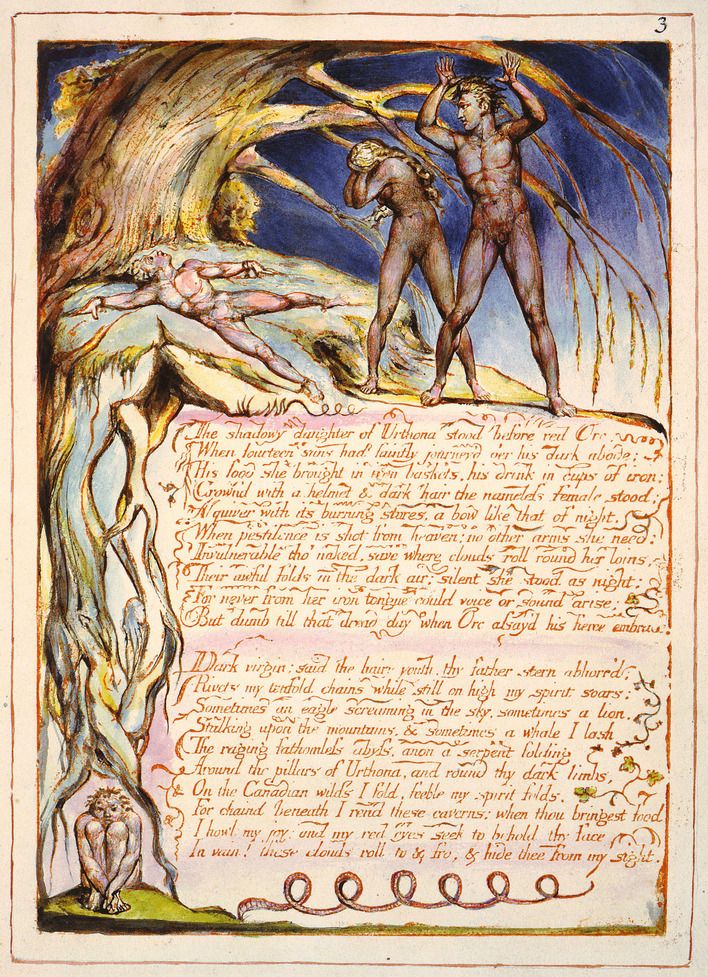 |
Wikipedia Commons America Plate 3 |
So Blake announces that he will write about things happening in the natural word but clothed in symbols which will hide and reveal reality as befits his myth of creation, fall, redemption and apocalypse.
We find the daughter of Urthona - a manifestation of Urthona in the Natural World - providing the food of dissension to Orc who is approaching maturity. She is armed with a supply of ideas and the means to direct them, but it takes the awakening of the revolutionary spirit to give them voice. Incidents that demand change repeatedly occur but a clear view of a way forward is not in sight.
Four Zoas, Night VII, Page 79, (E 355)

"Urizen answerd Read my books explore my Constellations
Enquire of my Sons & they shall teach thee how to War
Enquire of my Daughters who accursd in the dark depths
Knead bread of Sorrow by my stern command for I am God
Of all this dreadful ruin   Rise O daughters at my Stern command

Rending the Rocks Eleth & Uveth rose & Ona rose
Terrific with their iron vessels driving them across
In the dim air they took the book of iron & placd above
On clouds of death & sang their songs Kneading the bread of Orc
Orc listend to the song compelld hungring on the cold wind
That swaggd heavy with the accursed dough. the hoar frost ragd
Thro Onas sieve   the torrent rain pourd from the iron pail
Of Eleth & the icy hands of Uveth kneaded the bread
The heavens bow with terror underneath their iron hands
Singing at their dire work the words of Urizens book of iron
While the enormous scrolls rolld dreadful in the heavens above
And still the burden of their song in tears was poured forth
The bread is Kneaded let us rest O cruel father of children
But Urizen remitted not their labours upon his rock"