Blake seeks to provide the Golden String which can lead us through the labyrinth of our experience or his own poetry.

Showing posts with label Damon. Show all posts

Tuesday, April 15, 2025

BLAKE & SHELLEY


Yale Center for British Art
Jerusalem
Plate 40

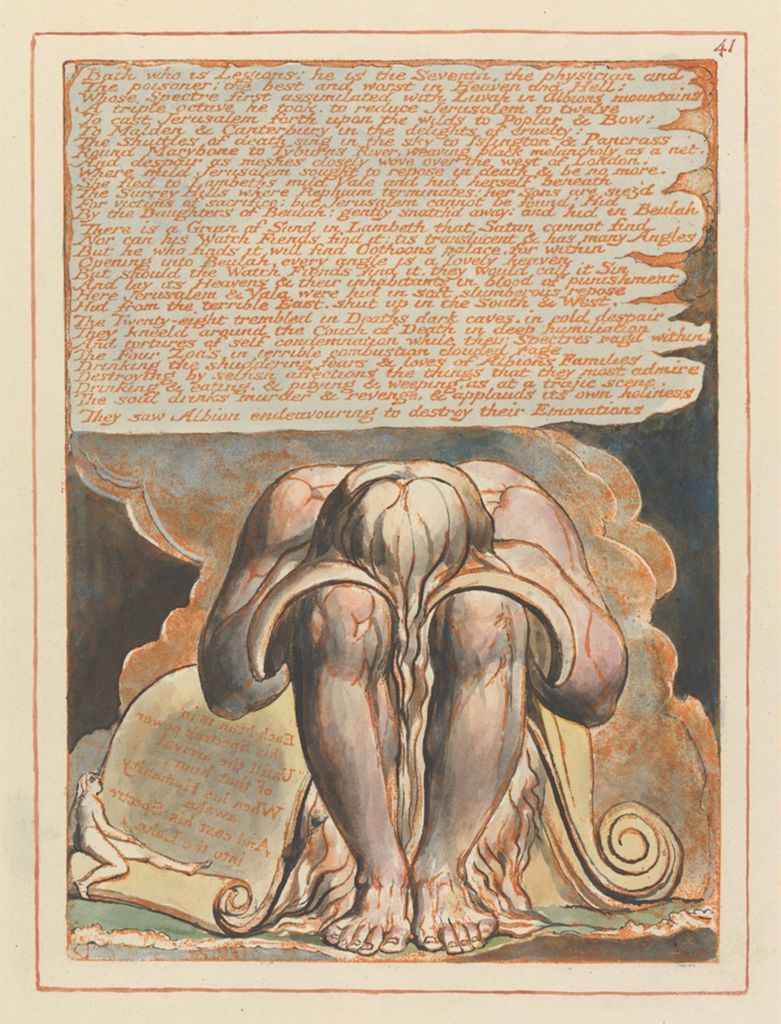
Jerusalem, Plate 41 [46], (E 188)
"And Ely, Scribe of Los, whose pen no other hand
Dare touch! Oxford, immortal Bard! with eloquence Divine,
Divine, he wept over Albion: speaking the words of God
In mild perswasion: bringing leaves of the Tree of Life."

Jerusalem, Plate 40 [45], (E 188)

"O God descend! gather our brethren, deliver Jerusalem
But that we may omit no office of the friendly spirit
Oxford take thou these leaves of the Tree of Life: with eloquence
That thy immortal tongue inspires; present them to Albion:
Perhaps he may recieve them, offerd from thy loved hands.
So spoke, unheard by Albion, the merciful Son of Heaven
To those whose Western Gates were open, as they stood weeping
Around Albion: but Albion heard him not; obdurate! hard!
He frown'd on all his Friends, counting them enemies in his sorrow"

Blake never mentioned Shelley by name although "he must have known of the son-in-law of his friends William Godwin and Mary Wollstoncraft" and of Godwin's disapproval of his sixteen year old daughter's involvement with a man already married. 

It seems likely that Blake must have been troubled by the life Shelley was living as young man. Shelley married a young woman and then left her to elope with the daughter of William Godwin and Mary Wollstonecraft. Until Shelley's wife died by suicide the couple were unable to marry. Shelley's wealthy father cut off his son's financial support leading him to an accumulation of debts and an unorthodox style of living. Shelley's life was short but filled with writing poetry, cultivating friendships and accumilating experience through study and travel. He lived on an emotional razor's edge. Perhaps Blake sumised that Shelley burned too much of his creative energy before reaching his inate potential. 

Since Blake showed an avid interest in reading the poetry of his contemporaries, we may assume that he read the published work of Shelley and admired his talent and many of his sentiments. Foster Damon, in A Blake Dictionary, introduced the idea that Blake was referring to Shelley when he wrote in Jerusalem of the Bard of Oxford.

Damon wrote on Page 314: "The Bard of Oxford. Oxford, the Cathedral City, is also 'an imortal bard,' whose divine eloquence fails to cure Albion. This episode is evidently a tribute to Shelley. Of all the contemporary poets, none was closer to Blake in revolutionary fervor, poetic rapture, intense visualizing, and daring thought. He denounced the tyrant God, and called himself an athiest, although only Blake surpassed him in religious feeling and insight. Shelley not only preached free love but he practiced it, yet without being a libertine. He attacked the oppressors of the poor, the coruption the government. He was an overt fighting Reprobate."

Page 71: "Ely is the cathedral citys of Cambridgeshire; its university, where the clergy are trained, is Cambridge; the greatest man produced by Cambridge was the anticlerical Milton, 'Scribe of Los, whose pen no other hand dare touch' (J 46:6).  With parallel irony, Blake (in my opinion there was no alternative) identified Oxford with the poet expelled from Oxford for his atheism, the anticlerical Shelley, 'immortal Bard; with eloquence divine he wept over Albion, speaking the words of God in mild perswasion, bringing leaves of the Tree of Life.'"

Twice Blake used the word eloquence in writing of the Bard of Oxford. He used it also in his early poem In Imitation of Spenser to intimate that with eloquence the consciousness of negative conditions can be altered: specifically that hate and envy can be dispelled.

Poetical Sketches, (E 421)

"AN IMITATION OF SPEN[S]ER
And thou, Mercurius, that with winged brow
Dost mount aloft into the yielding sky,
And thro' Heav'n's halls thy airy flight dost throw,
Entering with holy feet to where on high
Jove weighs the counsel of futurity;
Then, laden with eternal fate, dost go
Down, like a falling star, from autumn sky,
And o'er the surface of the silent deep dost fly.

If thou arrivest at the sandy shore,
Where nought but envious hissing adders dwell,
Thy golden rod, thrown on the dusty floor,
Can charm to harmony with potent spell;
Such is sweet Eloquence, that does dispel
Envy and Hate, that thirst for human gore
:
And cause in sweet society to dwell
Vile savage minds that lurk in lonely cell."


Saturday, April 5, 2025

FRIENDS OF ALBION

A Blake Dictionary
S Foster Damon
Cathedral Cities

William Blake’s drawings of Westminster Abbey
                            Countess Aveline tomb

In Jerusalem Blake intoduced the 28 catherdal cities when Albion had turned away from the Divine Vision. Albion was the symbol Blake used to represent Britain, his beloved homeland which was enduring multiple threats including war and famine. Within Britain were her Cathedral Cities, remnats of her past attempts at providing spiritual sustenance to sustain her when threats arose. Each City was associated with individuals and events from current or past history.

Jerusalem, Plate 35 [39], (E 181)
"Los was the friend of Albion who most lov'd him. In Cambridgeshire
His eternal station, he is the twenty-eighth, & is four-fold.
Seeing Albion had turn'd his back against the Divine Vision,
Los said to Albion, Whither fleest thou? Albion reply'd.         

I die! I go to Eternal Death! the shades of death
Hover within me & beneath, and spreading themselves outside
Like rocky clouds, build me a gloomy monument of woe:
Will none accompany me in my death? or be a Ransom for me
In that dark Valley? I have girded round my cloke, and on my feet

Bound these black shoes of death, & on my hands, death's iron gloves:
God hath forsaken me, & my friends are become a burden
A weariness to me, & the human footstep is a terror to me.

Los answerd, troubled: and his soul was rent in twain:
Must the Wise die for an Atonement? does Mercy endure Atonement? 
No! It is Moral Severity, & destroys Mercy in its Victim.
So speaking, not yet infected with the Error & Illusion,

Jerusalem, Plate 36 [40], (E 181)
"Los shudder'd at beholding Albion, for his disease
Arose upon him pale and ghastly: and he call'd around
The Friends of Albion: trembling at the sight of Eternal Death
The four appear'd with their Emanations in fiery
Chariots: black their fires roll beholding Albions house of Eternity               
Damp couch the flames beneath and silent, sick, stand shuddering
Before the Porch of sixteen pillars: weeping every one
Descended and fell down upon their knees round Albions knees,
Swearing the Oath of God! with awful voice of thunders round
Upon the hills & valleys, and the cloudy Oath roll'd far and wide

Albion is sick! said every Valley, every mournful Hill 

And every River: our brother Albion is sick to death." 

Jerusalem, Plate 44 [30], (E 193)

"And Los prayed and said. O Divine Saviour arise
Upon the Mountains of Albion as in ancient time. Behold!
The Cities of Albion seek thy face, London groans in pain
From Hill to Hill & the Thames laments along the Valleys
The little Villages of Middlesex & Surrey hunger & thirst        
The Twenty-eight Cities of Albion stretch their hands to thee:
Because of the Opressors of Albion in every City & Village:
They mock at the Labourers limbs!"
From Larry's post Church 8:
"Bear in mind that 27 is a super sinister number; Frye described it as "the cube of thee, the supreme aggravation of three". A happier constellation of 28 (a composite of the complete numbers four and seven) occurs in Jerusalem where England's cathedral cities are called the Friends of Albion. With this image Blake  recognized that in spite of all its sins the church had exercised a beneficent influence upon the course of history. Blake habitually picked one of these cities to be represented an important historical personage.

       For example Ely, the cathedral city of Cambridgeshire, stands for Milton, the greatest man produced by Cambridge. Verulam, an ancient name for Canterbury, represents Francis Bacon , one of Blake's chief devils. Professor Erdman informed us that Bath represents Rev. Richard Warner, a courageous minister who preached against war in 1804, when to do such a thing bordered on sedition. Blake's admiration for Warner led to the prominence which he gave Bath in the second chapter of Jerusalem."
 

Thursday, August 24, 2023

BLAKE & PLATO

BLAKE & PLATO

First posted 2011

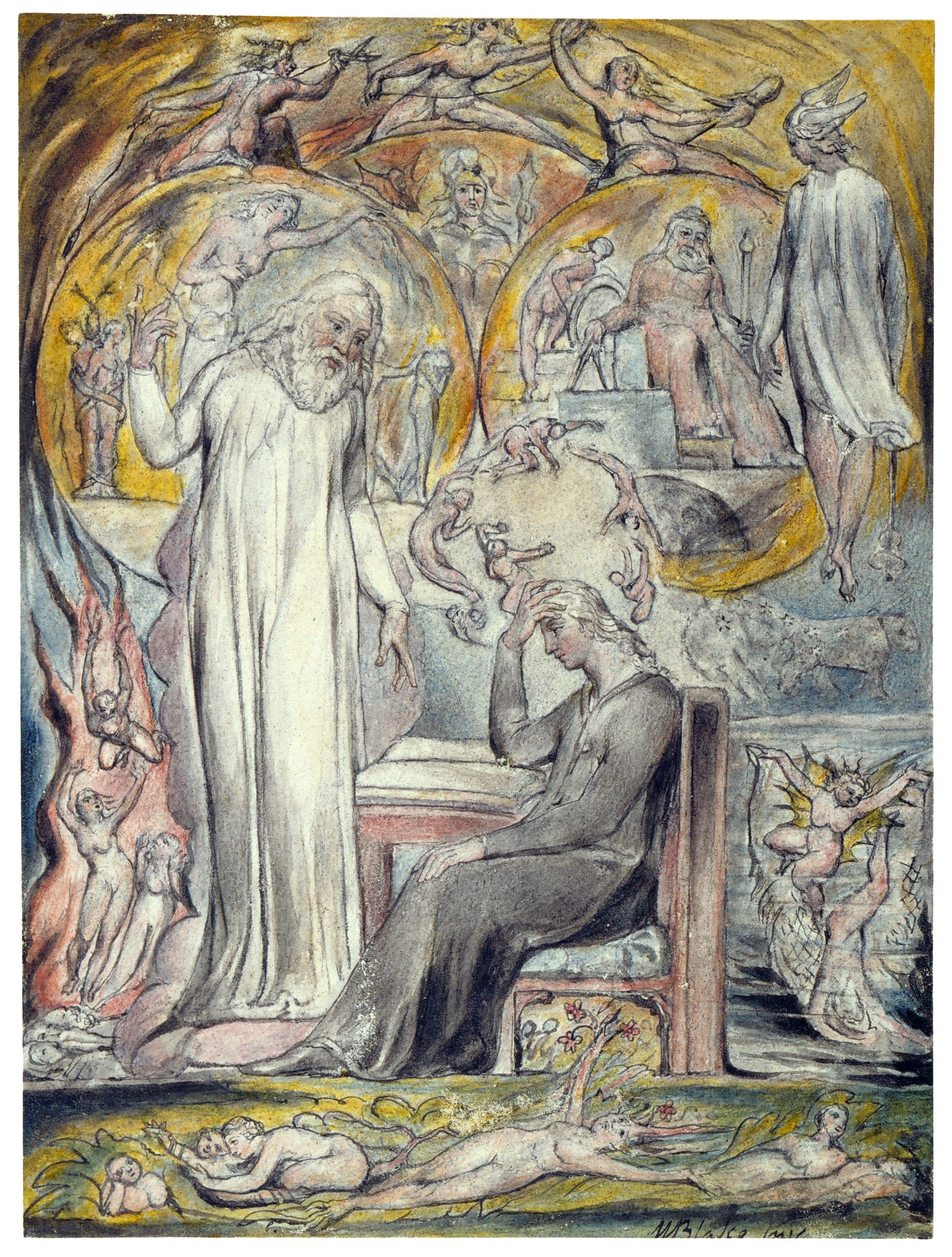
Commentary on Blake's six illustrations to Milton's Il Penseroso is found in Bette Charlene Werner's book Blake's vision of the poetry of Milton: illustrations to six poems. Blake 'invented', (he signed images WBlake inv), the third illustration The Spirit of Plato as a means of presenting a number of Plato's ideas as Milton contemplated them.

Il Penseroso

"Or let my lamp, at midnight hour,
Be seen in some high lonely tower,
Where I may oft outwatch the Bear,
With thrice great Hermes, or unsphere
The spirit of Plato, to unfold
What worlds or what vast regions hold
The immortal mind that hath forsook
Her mansion in this fleshly nook;
And of those demons that are found
In fire, air, flood, or underground,"
(lines 85-95)

In the picture we see how Plato divided the soul between the three worlds of Venus, Jupiter, Mars - senses, reason and energy. The Great Bear is the constellation around which the constellations revolve; it never sets - symbolizing an ever circling round.

Blake added a few lines of descriptive material to each of his illustrations to Il Penseroso.
Blake's description: "The Spirit of Plato unfolds his Worlds to Milton in Contemplation. The three destinies sit on the Circles of Plato's Heavens weaving their Thread of Mortal Life; these Heavens are Venus Jupiter and Mars. Hermes flies before as attending on the Heaven of Jupiter, the Great Bear is seen in the Sky beneath Hermes & The Spirits of Fire, Air, Water & Earth Surround Milton's Chair."

In this the third illustration to Il Penseroso illustrating lines 85-95 of Milton's poem, Blake goes to pains to include the import of the lines of the poem but adds details to indicate the ideas of Plato to which he objected.

Damon enumerates the points at which Plato's thought differed from Blake's:
"Thus it is that although Plato banished poets from his Republic, made God a geometrician, preached morality, was a fatalist when he accepted the Three Fates, debased love to homosexuality, admitted war to his ideal state, and considered Art an imitation of Nature (hence second rate), Blake was indebted to him." Blake knew that there was much to be admired in Plato's thought although he said that "What Jesus came to remove was the Heathen or Platonic Philosophy, which blinds the eye to Imagination, The real Man." (E 664 ). Blake portrays the Greek learned and wise among the saved in the Last Judgment.

The prominence in the illustration of Hermes perhaps in his role of as the guide for souls in the underworld, may be Blake's assertion that both Plato and Milton are still in need of guidance in matters of the soul. None of the Platonic images contemplated by Milton seems to show the positive outcome for Man's plight for which Blake is working.

Blake's ambivalence to Plato and Greek thought can be seen in these 2 short passages:

Songs and Ballads,(E 479)
"Twas the Greeks love of war
Turnd Love into a Boy
And Woman into a Statue of Stone
And away fled every joy"

Letter to Trusler, (E 702)
"The wisest of the Ancients considerd what is not
too Explicit as the fittest for Instruction because it rouzes the
faculties to act. I name Moses Solomon Esop Homer Plato"


Friday, August 12, 2022

SYMBOLISM

Wikipedia Commons
Book of Urizen
Plate 4, Copy A

Northrop Frye and Foster Damon each included in his definitive Blake book a helpful chart showing associations of symbols with the individual Zoas. Frye used The Four Zoas as his reference point whereas Damon used Jerusalem. Below are selected associations from their charts.

Fearful Symmetry, Frye, page 277:

In Four Zoas

1. Eternal Name    Luvah              Urizen            Tharmas            Urthona

2. Time Name        Orc                  Satan                C. Cherub            Fancy

3. Sense                 Nose                Eye                  Tongue                 Ear

4. Position              Center              Zenith              Circumference      Nadir

5. Nature                Stars                 Sun                 Moon                Mountains

6. Element              Fire                   Air                   Water                    Earth

7. Place                  Soil                   City                 Garden             Underground

8. Virtue                 Love                  Faith                Hope                   Vision 

9. Vice                    Hatred              Doubt               Despair             Dullness


A Blake Dictionary by Damon, page 212:

In Jerusalem - Fourfold Correspondence

1. Name             Urthona                 Luvah              Urizen               Tharmas 

2. Meanings       Imagination            Emotions            Reason            Senses         

3. Places             Nadir                     Center                Zenith              Circumference

4. Desires            Friendship             Love                   Hunger            Lust  

5. Worlds             Eternity                  Beulah                Ulro                 Generation

6. Sense               Ears                      Nostrils               Eyes                Tongue

7. Elements          Earth                      Fire                    Air                    Water

8. Symbols            Sun                        Moon                 Stars                Earth


Jerusalem, Plate 97, (E 256) 
 "Then Albion stretchd his hand into Infinitude.
And took his Bow. Fourfold the Vision for bright beaming Urizen
Layd his hand on the South & took a breathing Bow of carved Gold
Luvah his hand stretch'd to the East & bore a Silver Bow bright shining
Tharmas Westward a Bow of Brass pure flaming richly wrought   
Urthona Northward in thick storms a Bow of Iron terrible thundering.

And the Bow is a Male & Female & the Quiver of the Arrows of Love,
Are the Children of this Bow: a Bow of Mercy & Loving-kindness: laying
Open the hidden Heart in Wars of mutual Benevolence Wars of Love"
 

Thursday, August 11, 2022

CIRCUMFERENCE

Wikipedia Commons
Europe a Prophecy
Frontispiece

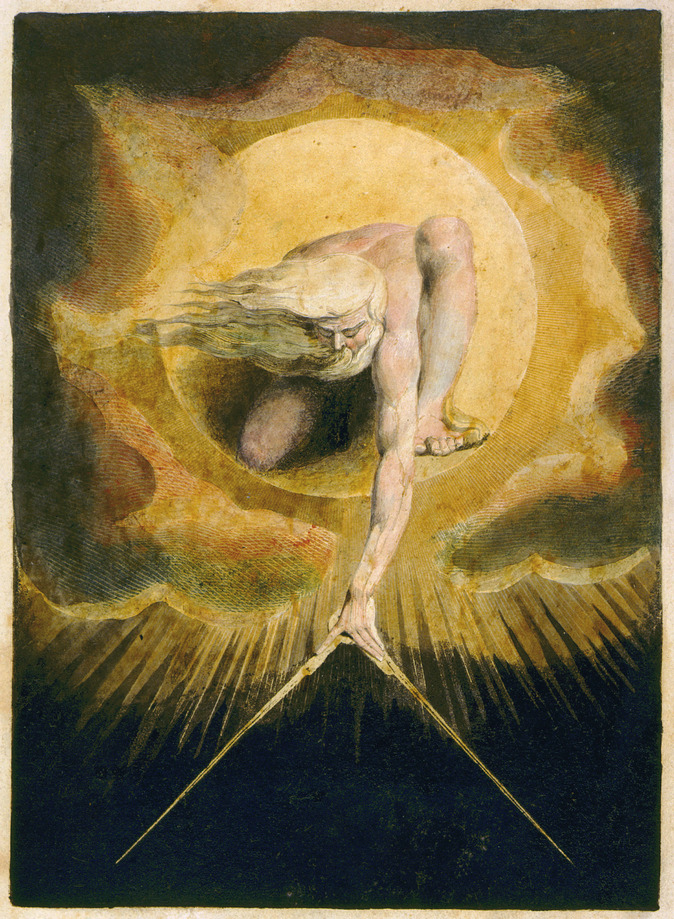
Energy is from the body - Tharmas. The outward circumference of Energy is reason - Urizen.

Marriage of Heaven and Hell, Plate 4, (E 34) 
"2. Energy is the only life and is from the Body and Reason is
the bound or outward circumference of Energy."

In The Blake Dictionary Damon tells us that in Great Eternity the West or the Circumference is the outward body - Tharmas; the Zenith is the Head - Urizen; the Nadir is the depths within - Urthona: and the Center is the heart - Luvah.

Jerusalem, Plate 12, (E 156)
"And the Four Points are thus beheld in Great Eternity
West, the Circumference: South, the Zenith: North,               
The Nadir: East, the Center, unapproachable for ever.
These are the four Faces towards the Four Worlds of Humanity
In every Man. Ezekiel saw them by Chebars flood.
And the Eyes are the South, and the Nostrils are the East.
And the Tongue is the West, and the Ear is the North." 

The Four Zoas exist in each human. The complexity in each Zoa gives rise to dual perspectives for viewing our world. Externally events have one meaning, whereas Internally the meaning is different. Seen from the perspective of Vala all is material; from the perspective of Jerusalem all is spiritual.  

Jerusalem, Plate 18,(E 162)
"From every-one of the Four Regions of Human Majesty,
There is an Outside spread Without, & an Outside spread Within
Beyond the Outline of Identity both ways, which meet in One:
An orbed Void of doubt, despair, hunger, & thirst & sorrow.
Here the Twelve Sons of Albion, join'd in dark Assembly,         
Jealous of Jerusalems children, asham'd of her little-ones
(For Vala produc'd the Bodies. Jerusalem gave the Souls)" 

The process of closing the circumference darkens the center. When the individual loses the cohesiveness which the body provides he becomes subject to the whims of the emotions. Love and jealousy begin to dominate, making wholeness difficult to maintain.

Jerusalem, Plate 19,(E 164)
"Willing the Friends endur'd, for Albions sake, and for
Jerusalem his Emanation shut within his bosom;
Which hardend against them more and more; as he builded onwards  
On the Gulph of Death in self-righteousness, that roll'd
Before his awful feet, in pride of virtue for victory:
And Los was roofd in from Eternity in Albions Cliffs
Which stand upon the ends of Beulah, and withoutside, all
Appear'd a rocky form against the Divine Humanity. 
Albions Circumference was clos'd: his Center began darkning
Into the Night of Beulah, and the Moon of Beulah rose
Clouded with storms: Los his strong Guard walkd round beneath the Moon
And Albion fled inward among the currents of his rivers."

Within man is his sanctuary, his inner life, which is uncovered when Jesus rends the veil of dominance by moral law.  

Jerusalem, Plate 69, (E 223) 
"Hence the Infernal Veil grows in the disobedient Female:
Which Jesus rends & the whole Druid Law removes away
From the Inner Sanctuary: a False Holiness hid within the Center,
For the Sanctuary of Eden. is in the Camp: in the Outline,
In the Circumference: & every Minute Particular is Holy:
Embraces are Cominglings: from the Head even to the Feet;
And not a pompous High Priest entering by a Secret Place.

Jerusalem pined in her inmost soul over Wandering Reuben         
As she slept in Beulahs Night hid by the Daughters of Beulah" 

When Albion turns away from the Divine Vision, he turns outward to his selfish center, his emanative life. Damon calls Albion's Sons his affections or the States of his Center.

Jerusalem , Plate 71, (E 224) 
"As the Soul is to the Body, so Jerusalems Sons,
Are to the Sons of Albion: and Jerusalem is Albions Emanation    

What is Above is Within, for every-thing in Eternity is translucent:
The Circumference is Within: Without, is formed the Selfish Center
And the Circumference still expands going forward to Eternity.
And the Center has Eternal States! these States we now explore."

Unity within the lineaments of man is achieved when the four senses are joined within the circumference to experience forgiveness of sins and self annihilation.  

Jerusalem, Plate 98,(E 257)
"South stood the Nerves of the Eye. East in Rivers of bliss the Nerves of the
Expansive Nostrils West, flowd the Parent Sense the Tongue. North stood
The labyrinthine Ear. Circumscribing & Circumcising the excrementitious
Husk & Covering into Vacuum evaporating revealing the lineaments of Man
Driving outward the Body of Death in an Eternal Death & Resurrection   
Awaking it to Life among the Flowers of Beulah rejoicing in Unity
In the Four Senses in the Outline the Circumference & Form, for ever
In Forgiveness of Sins which is Self Annihilation. it is the Covenant of Jehovah"


Annotations to Swedenborg, (E 604)
"Swedenborg - ... But he who knows how to elevate his Mind above
the Ideas of Thought which are derived from Space and Time, such
a Man passes from Darkness to Light, and becomes wise in Things
spiritual and Divine . . . and then by Virtue of that Light he
shakes off the Darkness of natural Light, and removes its
Fallacies from the Center to the Circumference. 
Blake - When the fallacies of darkness are in the circumference they
cast a bound about the infinite" 

READING SYMBOLS


Saturday, July 30, 2022

BLAKE'S INFINITY

Yale Center for British Art
America A Prophecy
Plate 14

In The Blake Dictionary on Page 31 S. Foster Damon states:

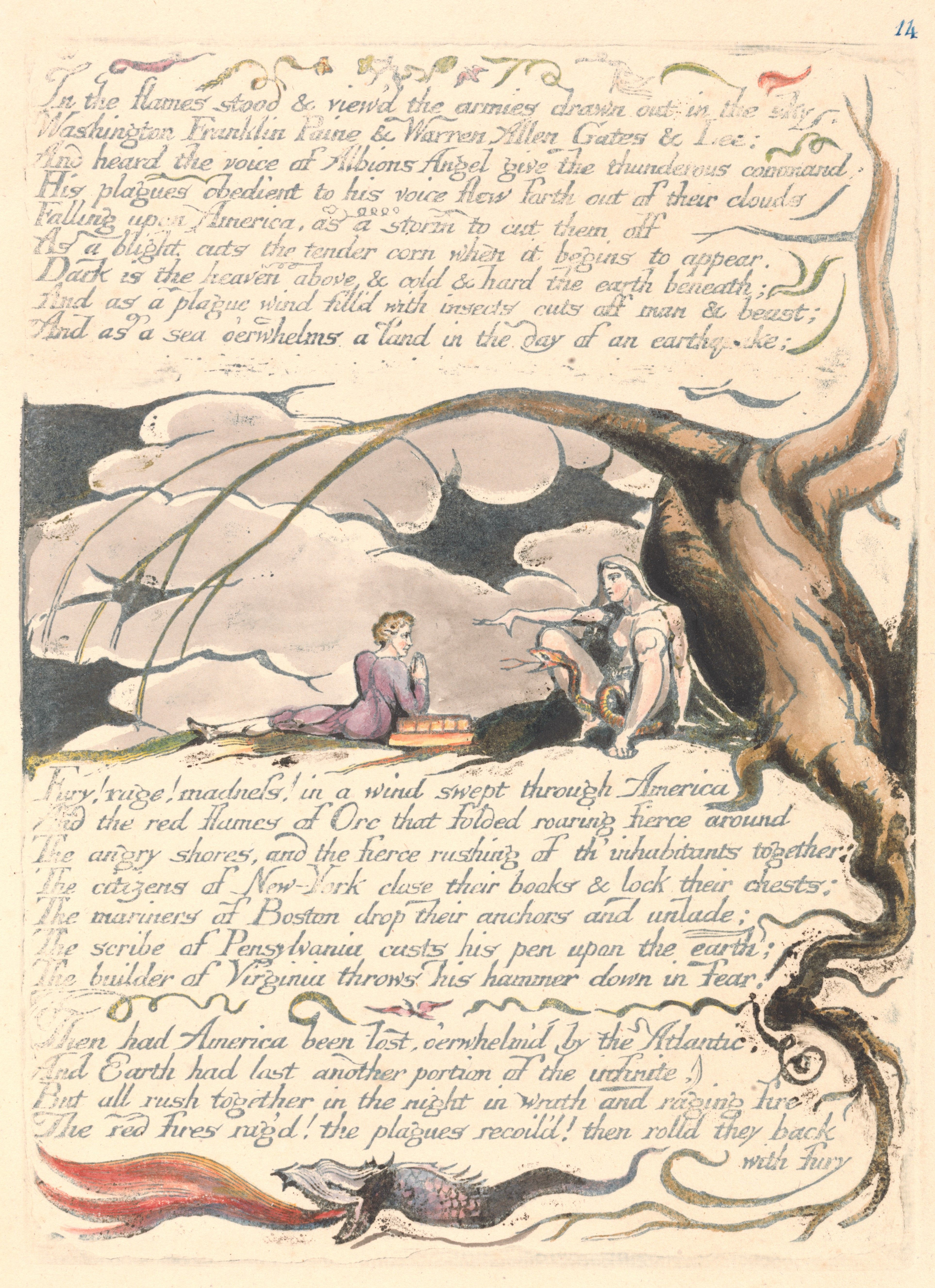
"To Blake, the Atlantic Continent symbolized the spiritual and intellectual unity of the two countries [America and the British Isles], but the deluge submerged most of it; indeed the American idea was the logical development of English libertarian thought. These ideas were lofty, therefore the Atlantic Continent is mountainous."

Blake's used the Atlantic Continent as a symbol for qualities of Infinity. Parallel to Eternity as a dimension beyond time, Infinity is a dimension beyond space. It is reached through the 'void outside of existence.'  Imagination can take you there.

In this statement infinite space in which all matter is contained is capable of being small enough  to be held in one's hand. Although infinity has no bounds, to the world of vision it contracts or expands to the perception of the individual.

Auguries of Innocence, (E 490)               

"To see a World in a Grain of Sand
And a Heaven in a Wild Flower
Hold Infinity in the palm of your hand
And Eternity in an hour"
America, Plate 14, (E 56)
 "Fury! rage! madness! in a wind swept through America             
And the red flames of Orc that folded roaring fierce around
The angry shores, and the fierce rushing of th'inhabitants together:
The citizens of New-York close their books & lock their chests;
The mariners of Boston drop their anchors and unlade;
The scribe of Pensylvania casts his pen upon the earth;          
The builder of Virginia throws his hammer down in fear.

Then had America been lost, o'erwhelm'd by the Atlantic,
And Earth had lost another portion of the infinite,
But all rush together in the night in wrath and raging fire
The red fires rag'd! the plagues recoil'd! then rolld they back with fury"

America was not lost to the Infinite although it was lost to Great Britain. It remained to be seen if Orc - the spirit of revolution - would gain a permanent foot hold for liberty or if America would slide back into the 'mind forged manacles' which prevent the perception of the infinite.   


Saturday, October 2, 2021

LARGE COLOR PRINTS 3

First posted Feb 2014

Genesis 2
[21] So the LORD God caused a deep sleep to fall upon the man, and while he slept took one of his ribs and closed up its place with flesh;
[22] and the rib which the LORD God had taken from the man he made into a woman and brought her to the man.
[23] Then the man said, "This at last is bone of my bones ad flesh of my flesh; she shall be called Woman, because she was taken out of Man."

 
Genesis 3
[2] And the woman said to the serpent, "We may eat of the fruit of the trees of the garden;
[3] but God said, `You shall not eat of the fruit of the tree which is in the midst of the garden, neither shall you touch it, lest you die.'"
[4] But the serpent said to the woman, "You will not die.
[5] For God knows that when you eat of it your eyes will be opened, and you will be like God, knowing good and evil."
[6] So when the woman saw that the tree was good for food, and that it was a delight to the eyes, and that the tree was to be desired to make one wise, she took of its fruit and ate; and she also gave some to her husband, and he ate. 

Wikipedia Commons
Large Color Printed Paintings
Satan Exaulting Over Eve

The name Satan does not appear in the book of Genesis. Eve's tempter is the serpent. We owe to Milton's Paradise Lost much of the imagery involving Satan in the Fall. Satan is rarely mentioned in the Old Testament outside of the book of Job where he is assigned by God the role of testing Job.
 
In Blake's picture Satan Exaulting Over Eve we see Eve lying prone with Satan in the air above her. Satan is the active figure, armed with spear and shield, held aloft by powerful wings, surrounded by energetic flames. Eve lies sleeping with the fruit in her hand and the serpent twining her body.

 
To Blake the two phases of man's consciousness, the active and passive, are balanced in the unified man. When man, through Creation, is divided from the unifying principle which is God, he undergoes a further division which can be expressed as various contraries, one of which is active and passive. The passive becomes the female or emanation or outer expression. The creation of Eve implies that the Fall has already been initiated because man has been divided from his emanation.

 
Although we may have been taught that the Fall was an event in which Eve ate the forbidden fruit, Blake sees the Fall as the accumulation of actions which draw man farther from the unity which he experienced in Eternity. 

 
Damon states in A Blake Dictionary that: "the division of the Emanation from the Individual is a split in the personality, a stage in the Fall of Man, symbolized in Genesis by the extraction of Eve from the side of sleeping Adam...
The separated Emanation takes the female form, an event which horrifies the Eternals. Man is left 'a dark Spectre', of perhaps only in his Spectre's power. Worse yet, the Emanation acquires a will of her own, which by definition is turned against her consort." (Page 121)  

 
Spectre of Urthona speaks to Shade of Enitharmon: 
 
Four Zoas, Night VII, Page 84, (E 359)
"This thou well rememberest listen I will tell
What thou forgettest. They in us & we in them alternate Livd
Drinking the joys of Universal Manhood. One dread morn
Listen O vision of Delight One dread morn of goary blood
The manhood was divided for the gentle passions making way
Thro the infinite labyrinths of the heart & thro the nostrils issuing
In odorous stupefaction stood before the Eyes of Man
A female bright. I stood beside my anvil dark a mass
Of iron glowd bright prepard for spades & plowshares. sudden down
I sunk with cries of blood issuing downward in the veins
Which now my rivers were become rolling in tubelike forms
Shut up within themselves descending down I sunk along,
The goary tide even to the place of seed & there dividing
I was divided in darkness & oblivion thou an infant woe
And I an infant terror in the womb of Enion
My masculine spirit scorning the frail body issud forth
From Enions brain In this deformed form leaving thee there
Till times passd over thee but still my spirit returning hoverd
And formd a Male to be a counterpart to thee O Love
Darkend & Lost In due time issuing forth from Enions womb
Thou & that demon Los wert born Ah jealousy & woe
Ah poor divided dark Urthona now a Spectre wandering
The deeps of Los the Slave of that Creation I created

I labour night & day for Los but listen thou my vision
I view futurity in thee I will bring down soft Vala
To the embraces of this terror & I will destroy
That body I created then shall we unite again in bliss"
 

.


Monday, April 26, 2021

BLAKE & DANTE

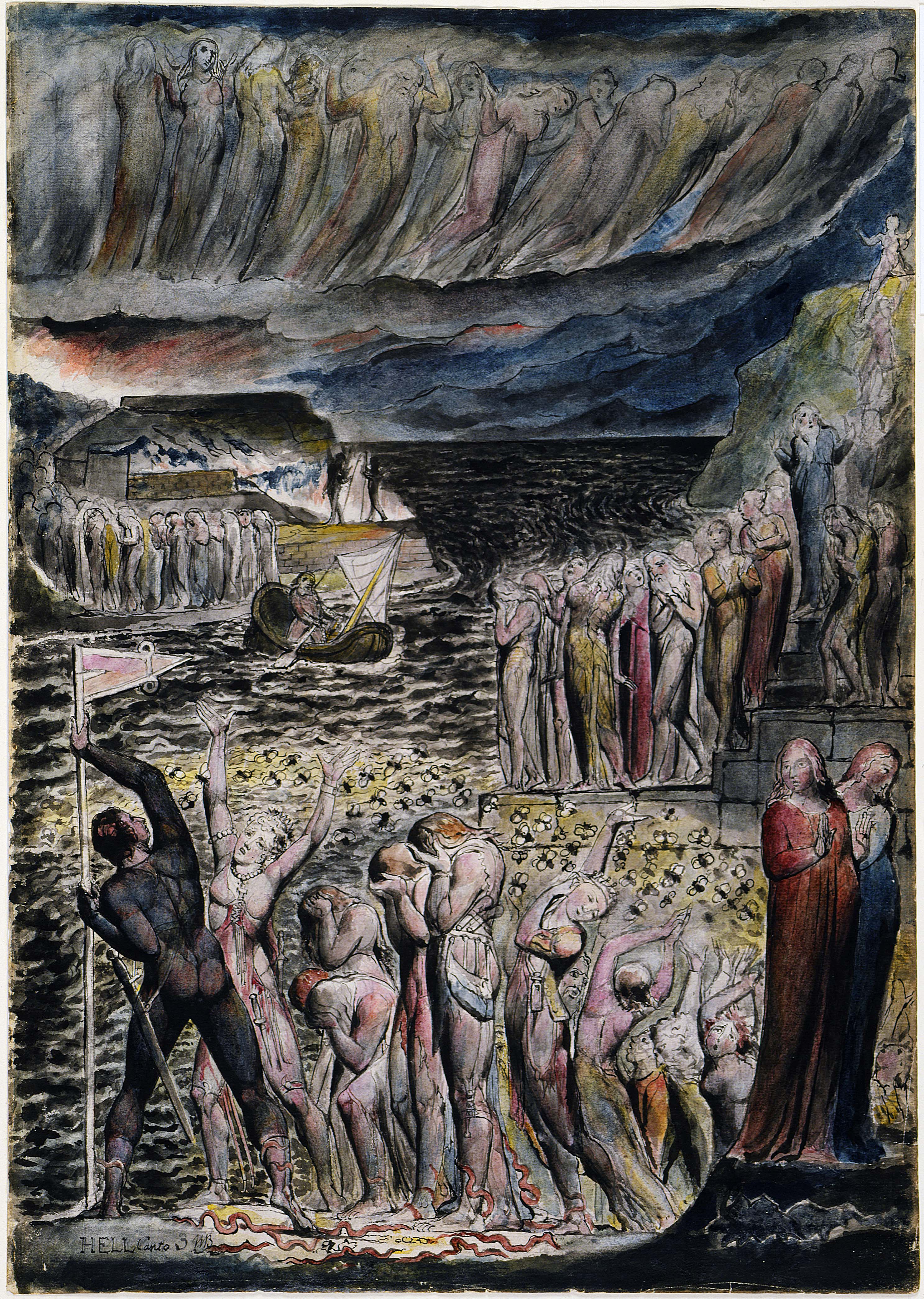
"The Vestibule of Hell and the Souls Mustering to Cross the Acheron"
Plate 5
Dante, Cato III
To enlarge image, right click on picture, select open in a new window, move cursor around picture to show detail. Close window to return.
 

Blake and Dante were at opposite poles in regard to their understanding of the nature of God. Blake reached the conclusion that God's love could reconcile the world to himself. Dante perceived of a God of vengeance who related to humanity by devising punishments for man's transgressions. Although Blake recognized Dante as a  gifted poet who was capable of receiving visions, he objected to the way Dante understood God. When Blake was commissioned to illustrate the Divine Comedy, he undertook it with enthusiasm but with reservations. Blake used his illustrations to show the punishments that Dante had imagined for his enemies and for those who had broken the rules of their society. He also showed how perverse were the tortures which Dante devised.

Blake's illustration for Canto III which he created with a high degree of skill and thought, illustrates the classical final step of the entry into Hell of those who deserve to experience the torments of Hell - the crossing of the river Acheron . Those who have not received the grace of Baptism remain in the limbo of neither enduring Hell of being received in Heaven.

Across the top of the picture are the angels who had not joined either side in the war in Heaven which Milton described in Paradise Lost. On the right side are the individuals who have not aligned themselves with either good of evil in their journey through life, either through not being Baptized by the Church or by being indecisive. Those in the foreground are those whom Dante places in the category of individuals whose sinfulness makes them unfit for Heaven until punishment (torture) induces repentance.

Blake knew that struggles took place within individuals, between the forces of good and evil, between life and death, between Eternity and the fallen world. Blake pursued the theme that mankind was capable of regeneration through casting off error and assimilating truth: that Truth when revealed in the depth of the soul is irresistible.

However, like Dante, Blake saw the danger of being wishy-washy of being immersed in the lake of Udan-Adan which he called a "Lake not of Waters but of Spaces Perturbd black & deadly." Blake took great stock in the definite. To be defined and organized and articulated is the condition of men who are aware of their own Eternal being and that of their fellow men.

S. Foster Damon, A Blake Dictionary
"Udan-Adan
The condition of formlessness, of the indefinite."

Milton Klonsky, Blake's Dante, Page 138
"Drifting aimlessly across the sky are the feckless and pusillanimous angels who refused to take sides in the civil war in Heaven between God and Satan."

Descriptive Catalogue, (E 541)
"A Spirit and a Vision are not, as the modern philosophy supposes, a cloudy vapour or a nothing: they are organized and minutely articulated beyond all that the mortal and perishing nature can produce. He who does not imagine in stronger and better lineaments, and in stronger and better light than his perishing mortal eye can see does not imagine at all. The painter of this work asserts that all his imaginations appear to him infinitely more perfect and more minutely organized than any thing seen by his mortal eye. Spirits are organized men."

Annotations to Watson
, (E 613) "The Man who pretends to be a modest enquirer into the truth of a self evident thing is a Knave The truth & certainty of Virtue & Honesty i.e Inspiration needs no one to prove it it is Evident as the Sun & Moon He who stands doubting of what he intends whether it is Virtuous or Vicious knows not what Virtue means. no man can do a Vicious action & think it to be Virtuous. no man can take darkness for light. he may pretend to do so & may pretend to be a modest Enquirer. but is a Knave" Jerusalem, Plate 5 (E 148) "But all within is open'd into the deeps of Entuthon Benython A dark and unknown night, indefinite, unmeasurable, without end. Abstract Philosophy warring in enmity against Imagination (Which is the Divine Body of the Lord Jesus. blessed for ever)."
Jerusalem, Plate 7, (E 149)
"They put forth their spectrous cloudy sails; which drive their 
Constellations over the deadly deeps of indefinite Udan-Adan
Kox is the Father of Shem & Ham & Japheth, he is the Noah
Of the Flood of Udan-Adan".

Jerusalem, Plate 55, (E 205)
"And the voices of the Living Creatures were heard in the clouds of heaven
Crying: Compell the Reasoner to Demonstrate with unhewn Demonstrations
Let the Indefinite be explored. and let every Man be judged
By his own Works, Let all Indefinites be thrown into Demonstrations
To be pounded to dust & melted in the Furnaces of Affliction:
He who would do good to another, must do it in Minute Particulars 
General Good is the plea of the scoundrel hypocrite & flatterer:
For Art & Science cannot exist but in minutely organized Particulars
And not in generalizing Demonstrations of the Rational Power.
The Infinite alone resides in Definite & Determinate Identity
Establishment of Truth depends on destruction of Falshood continually    
On Circumcision: not on Virginity, O Reasoners of Albion

So cried they at the Plow. Albions Rock frowned above
And the Great Voice of Eternity rolled above terrible in clouds
Saying Who will go forth for us! & Who shall we send before our face?"

Jerusalem, Plate 80, (E 237)
"And Rahab like a dismal and indefinite hovering Cloud
Refusd to take a definite form. she hoverd over all the Earth
Calling the definite, sin: defacing every definite form;"

Letters, to Cumberland, (E 783)
"For a Line or Lineament is not formed by Chance a Line is a Line in its
Minutest Subdivision[s] Strait or Crooked It is Itself & Not
Intermeasurable with or by any Thing Else Such is Job but since
the French Revolution Englishmen are all Intermeasurable One by
Another Certainly a happy state of Agreement to which I for One
do not Agree.  God keep me from the Divinity of Yes & No too The
Yea Nay Creeping Jesus from supposing Up & Down to be the same
Thing as all Experimentalists must suppose"

Four Zoas, Night IV, PAGE 52, (E 334) "I will compell thee to rebuild by these my furious waves Death choose or life thou strugglest in my waters, now choose life And all the Elements shall serve thee to their soothing flutes"

Revelation 3
[15] I know thy works, that thou art neither cold nor hot: I would thou wert cold or hot.
[16] So then because thou art lukewarm, and neither cold nor hot, I will spue thee out of my mouth.
[17] Because thou sayest, I am rich, and increased with goods, and have need of nothing; and knowest not that thou art wretched, and miserable, and poor, and blind,
and naked:


2nd Corinthians 5
[18] And all things are of God, who hath reconciled us to himself by Jesus Christ, and hath given to us the ministry of reconciliation;
[19] To wit, that God was in Christ, reconciling the world unto himself, not imputing their trespasses unto them; and hath committed unto us the word of reconciliation.

Divine Comedy
Inferno
Cato III
"Then looking farther onwards I beheld
A throng upon the shore of a great stream:
Whereat I thus: "Sir! grant me now to know
Whom here we view, and whence impell'd they seem
So eager to pass o'er, as I discern
Through the blear light?"  He thus to me in few:
"This shalt thou know, soon as our steps arrive
Beside the woeful tide of Acheron."
...
Then with eyes downward cast and fill'd with shame,
Fearing my words offensive to his ear,
Till we had reach'd the river, I from speech
Abstain'd.  And lo! toward us in a bark
Comes on an old man hoary white with eld,
...
Then all together sorely wailing drew To the curs'd strand, that every man must pass Who fears not God. Charon, demoniac form, With eyes of burning coal, collects them all, ...
Thus go they over through the umber'd wave, And ever they on the opposing bank Be landed, on this side another throng Still gathers. "Son," thus spake the courteous guide, "Those, who die subject to the wrath of God, All here together come from every clime, And to o'erpass the river are not loth: For so heaven's justice goads them on, that fear Is turn'd into desire. Hence ne'er hath past Good spirit. If of thee Charon complain, Now mayst thou know the import of his words." ...
Then to me The gentle guide: "Inquir'st thou not what spirits Are these, which thou beholdest? Ere thou pass Farther, I would thou know, that these of sin Were blameless; and if aught they merited, It profits not, since baptism was not theirs, The portal to thy faith. If they before The Gospel liv'd, they serv'd not God aright; And among such am I. For these defects, And for no other evil, we are lost;"


Tuesday, August 11, 2020

DESIGN 7 - THIRALATHA

For each of the eight images in the Large Book of Designs, I will republish an earlier post to shed light on how the picture fits into Blake's overall myth of Creation, Fall and Apocalypse.

7) Thiralatha
____________

2010/07

THIRALATHA

I enjoy locating Blake images which are rarely seen. Last week I came across an image in the British Museum collection which I had not seen before. It is from A Large Book of Designs which Blake was commissioned to make for Ozias Humphry (a painter of miniatures) in 1794.

The images from the book include:

Plate 1: "Albion rose from where he laboured at the Mill with Slaves
Giving himself for the Nations he danc'd the dance of Eternal Death"
Plate 2: The Accusers of Theft Adultery Murder, used as frontispiece of copy B of The Marriage of Heaven and Hell
Plate 3: Plate 21 of Book of Urizen - Los, Enitharmon, Orc
Plate 4: Plate 4 of Visions of the Daughters of Albion
Plate 5: Frontispiece to Visions of the Daughters of Albion
Plate 6: Joseph of Arimathea Preaching to the Inhabitants of Britain
Plate 7: Plate 8 of Book of Urizen
Plate 8: A Dream of Thiralatha from a canceled plate for America

Most of the images in A Large Book of Designs are familiar from other sources but this one was new to me: A Dream of Thiralatha. To see images from the Small and Large books of designs in the British Museum click on link.
These are two mentions of Thiralatha in Blake's early works.
 

America (E 59) [Fragment] [d]
"As when a dream of Thiralatha flies the midnight hour:
In vain the dreamer grasps the joyful images, they fly
Seen in obscured traces in the Vale of Leutha, So
The British Colonies beneath the woful Princes fade.


And so the Princes fade from earth, scarce seen by souls of men
But tho' obscur'd, this is the form of the Angelic land."

Europe, Plate 14, (E 66)
"Sotha & Thiralatha, secret dwellers of dreamful caves,
Arise and please the horrent fiend with your melodious songs.
Still all your thunders golden hoofd, & bind your horses black.
Orc! smile upon my children!
Smile son of my afflictions.
Arise O Orc and give our mountains joy of thy red light."

_________________________

In Fearful Symmetry, Northrop Frye describes the progressive decline of the children of Los and Enitharmon when the Divine Vision is lost:
"All of these sons (of Los) may under the wrong conditions be perverted and in fact are usually so portrayed. Rintrah may become fanatical bigotry, Palamabron lazy dilettantism, Bromion dogmatic prejudice, Sotha a berserk lust for fighting, Antamon sensuality, and so on. But there is a particular reason why they become perverted. Los is the spiritual form of time, and his 'emanation' is the spiritual form of space, Enitharmon. But until Los completes his task, Enitharmon will remain elusive and remote, and will be the tyranny which the idea of unbounded space exerts on the mind. (Page 261)
... 
"In human life Enitharmon is one of the presiding spirits of war, Blake calls war enslaved energy, and the energy he means is the organic energy of Orc. Organic energy, which exists in the world of generation, is primarily sexual energy, hence war is a perversion of the sexual impulse." (Page 262)


In A Blake Dictionary, S Foster Damon, provides a diagram of The Repression of Sex under Enitharmon on page 124.

Moving in a counterclockwise direction Ethinthus (body), leads to Leutha (guilt), followed by Oothoon (frustration) and ends with Thiralatha (erotic dreams). Thus the divisions of Enitharmon who was meant to embody Love and Imagination has become instead the source of sexual frustration and war (Sotha).
 
Song of Los, Plate 3, (E 67) 
"Times rolled on o'er all the sons of Har, time after time
Orc on Mount Atlas howld, chain'd down with the Chain of Jealousy
Then Oothoon hoverd over Judah & Jerusalem
And Jesus heard her voice (a man of sorrows) he recievd
A Gospel from wretched Theotormon.

The human race began to wither, for the healthy built            
Secluded places, fearing the joys of Love
And the disease'd only propagated:
So Antamon call'd up Leutha from her valleys of delight:
And to Mahomet a loose Bible gave.
But in the North, to Odin, Sotha gave a Code of War,             
Because of Diralada thinking to reclaim his joy." 

Although Damon calls Thiralatha "the last overt expression of thwarted sex," something of the Imagination remained in her as seen in the dream image of a lovely woman with a child falling into her arms .

. 

Monday, November 25, 2019

WEAVING 5

Victoria and Albert Museum
Theotormon Woven

Woven into the psyche of man is a consciousness of sin. It arises from love and jealousy which are the result of the split of the psyche into male and female, essence and emanation, the observer and the observed. Without being explicit Blake indicates that Theotormon, one of the four ungenerated Sons of Los, is the origin of this thread of dissension which finds its way into life as we experience it.  

Theotormon's Gospel is not the Gospel of Jesus which reveals the God Within. It focuses on an external God in the sky who dictates laws, pits man against man, and man against woman. In A Blake Dictionary, Damon states: 'Theotormon is Desire, when suppressed, he becomes Jealousy.' Without frequent mentions of Theotormon Blake indicates his presence in 'nets & gins & traps to catch the joys of Eternity.'

Visions of the Daughters of Albion, Plate ii, (E 45)              
  "The Eye sees more than the Heart knows.
      Printed by Will:m Blake: 1793.

PLATE ii, i
The Argument

I loved Theotormon
And I was not ashamed
I trembled in my virgin fears
And I hid in Leutha's vale!

I plucked Leutha's flower,                          
And I rose up from the vale;
But the terrible thunders tore
My virgin mantle in twain."

Visions of Daughtersn of Albion, Plate 2, (E 47), 
"Arise my Theotormon I am pure.
Because the night is gone that clos'd me in its deadly black.
They told me that the night & day were all that I could see;     
They told me that I had five senses to inclose me up.
And they inclos'd my infinite brain into a narrow circle,
And sunk my heart into the Abyss, a red round globe hot burning
Till all from life I was obliterated and erased."
Song of Los, Plate 3, (E 67)
"Then Oothoon hoverd over Judah & Jerusalem
And Jesus heard her voice (a man of sorrows) he recievd
A Gospel from wretched Theotormon.

The human race began to wither, for the healthy built            
Secluded places, fearing the joys of Love
And the disease'd only propagated:
So Antamon call'd up Leutha from her valleys of delight:
And to Mahomet a loose Bible gave.
But in the North, to Odin, Sotha gave a Code of War,             
Because of Diralada thinking to reclaim his joy."
Plate 4
These were the Churches: Hospitals: Castles: Palaces:
Like nets & gins & traps to catch the joys of Eternity
     And all the rest a desart;
Till like a dream Eternity was obliterated & erased."

Milton, Plate 22 [24], (E 117)
"Rintrah and Palamabron met us at the Gate of Golgonooza
Clouded with discontent. & brooding in their minds terrible things

They said. O Father most beloved! O merciful Parent!
Pitying and permitting evil, tho strong &  mighty to destroy.  
Whence is this Shadow terrible? wherefore dost thou refuse
To throw him into the Furnaces! knowest  thou not that he
Will unchain Orc? & let loose  Satan, Og, Sihon  &  Anak,
Upon the Body of Albion? for this he is come! behold it written
Upon his fibrous left Foot black! most dismal to our eyes  
The Shadowy Female shudders thro' heaven in torment inexpressible!
And all the Daughters of Los prophetic wail: yet in deceit,
They weave a new Religion from new Jealousy of Theotormon!
Miltons Religion is the cause: there is no end to destruction!"

Milton, Plate 28 [38], (E 126)
"The little weeping Spectre stands on the threshold of Death      
Eternal; and sometimes two Spectres like lamps quivering
And often malignant they combat (heart-breaking sorrowful & piteous)
Antamon takes them into his beautiful flexible hands,
As the Sower takes the seed, or as the Artist his clay
Or fine wax, to mould artful a model for golden ornaments,      
The soft hands of Antamon draw the indelible line:
Form immortal with golden pen; such as the Spectre admiring
Puts on the sweet form; then smiles Antamon bright thro his windows
The Daughters of beauty look up from their Loom & prepare.
The integument soft for its clothing with joy & delight.        

But Theotormon & Sotha stand in the Gate of Luban anxious
Their numbers are seven million & seven thousand & seven hundred
They contend with the weak Spectres, they fabricate soothing forms
The Spectre refuses. he seeks cruelty. they create the crested Cock
Terrified the Spectre screams & rushes in fear into their Net    
Of kindness & compassion & is born a weeping terror.
Or they create the Lion & Tyger in compassionate thunderings
Howling the Spectres flee: they take refuge in Human lineaments."

Jerusalem, Plate 72, (E 226)
"For Albion in Eternity has Sixteen Gates among his Pillars    
But the Four towards the West were Walled up & the Twelve
That front the Four other Points were turned Four Square
By Los for Jerusalems sake & called the Gates of Jerusalem
Because Twelve Sons of Jerusalem fled successive thro the Gates
But the Four Sons of Jerusalem who fled not but remaind     
Are Rintrah & Palamabron & Theotormon & Bromion
The Four that remain with Los to guard the Western Wall"

Europe, Plate 5, (E 62)
"Now comes the night of Enitharmons joy!                          
Who shall I call? Who shall I send?
That Woman, lovely Woman! may have dominion?
Arise O Rintrah thee I call! & Palamabron thee!
Go! tell the human race that Womans love is Sin!                 
That an Eternal life awaits the worms of sixty winters
In an allegorical abode where existence hath never come:
Forbid all joy, & from her childhood shall the little female
Spread nets in every secret path."