Blake seeks to provide the Golden String which can lead us through the labyrinth of our experience or his own poetry.

Showing posts with label Vala. Show all posts

Sunday, June 16, 2024

Blake's Sex


Yale Center for British Art
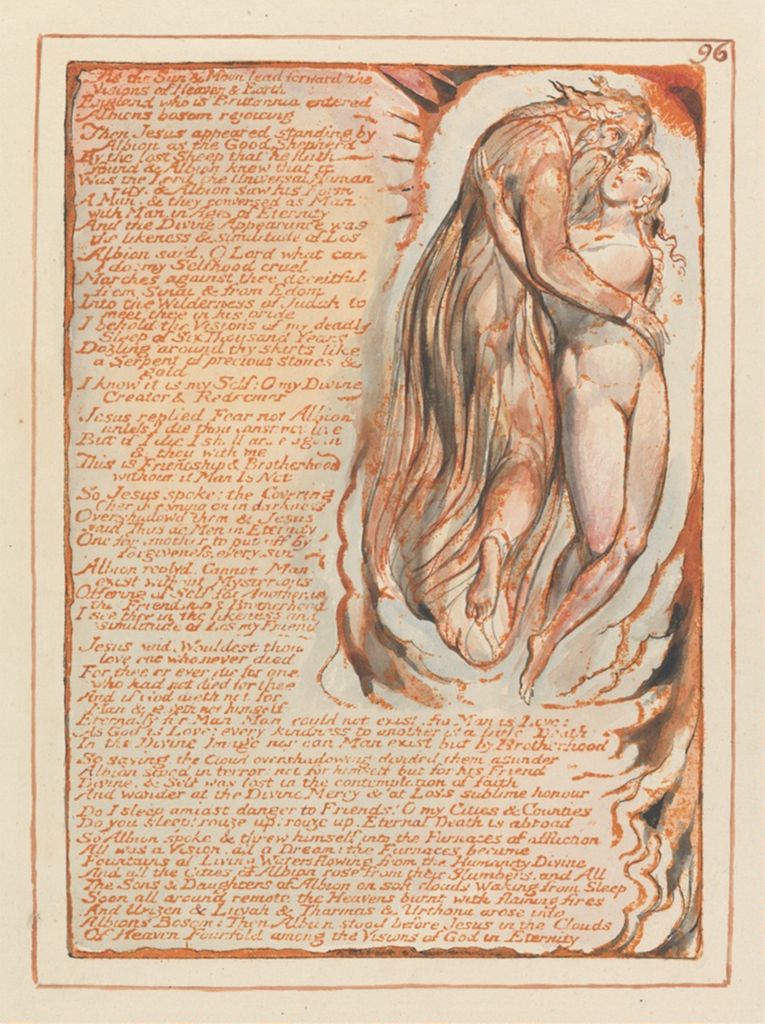
Jerusalem
Plate 96
All was a Vision, all a Dream:


In 2011 Larry posted seven times on Blake's sexual concepts, their sources, and their expression in his poetry.  

Sex I 

Sex II

Sex III

Sex IV

Sex V

Sex VI

Sex VII


BLAKE PRIMER - SEXUALITY

Summary

After all this detail We can begin our summary of Blake's theory of sex with Jesus' reply to the Sadducee's mocking question about the woman married to seven husbands: "for when they shall rise from the dead, they neither marry nor are given in marriage, but are as the angels which are in heaven."

Blake begins here, with the assumption that sexual division relates to this world, but not to Eternity. Sex appears in Beulah, a moony rest from the arduous creative activity of Eden. The "Female Will" condemns Man to the loss of Eternity, which Blake calls "the Sleep of Ulro".

Sex signifies fallenness, and the jealous and proudly chaste female symbolizes the active principle of evil, also identified with a materialistic viewpoint whose values are coercion and love of power.

Blake's vision of Jesus humanized his theory of sex. He began to use the biblical image of Jerusalem as the bride of Christ, named his last and greatest epic 'Jerusalem', and ultimately was able to rationalize the heterodox doctrine of sex with the glorified female as the emanation of the Eternal Man. Blake's female thus joined all the rest of his personal images in traveling the Circle of Destiny, materializing in the Fall and etherealizing in the Return.

Through all his journey Blake had a characteristically liberal and enlightened view of womankind, an entirely different matter from the sexual symbolism that filled his pages. His true and abiding feelings about the relation between men and women appear early in his works in his "Annotations to Lavater": "Let the men do their duty and the women will be such wonders; the female life lives from the light of the male: see a man's female dependants, you know the man." Admittedly short of the high standards of present day feminism, Blake's vision of womanhood considerably surpassed that of most of his contemporaries-- and perhaps most of ours.

End of Chapter Eight 


Monday, March 22, 2021

BLAKE & STRINGS


Yale Center for British Art
Jerusalem
Plate 30

The symbolism of the Bow String is not obvious. It has both a positive and a negative function. The bow is an instrument which is capable of setting in motion the arrow which is designed to produce results. In the thought of our poet the release of the arrow from the string of the bow sets in motion consequential activity. In the Four Zoas the release of the arrow from the bow starts the process through which the natural world is created.

Sung at the Feast of Los & Enitharmon

Four Zoas, Night I, Page 15, E 309
"The Horse is of more value than the Man. The Tyger fierce
Laughs at the Human form. the Lion mocks & thirsts for blood
They cry O Spider spread thy web! Enlarge thy bones & fill'd
With marrow. sinews & flesh Exalt thyself attain a voice

Call to thy dark armd hosts, for all the sons of Men muster together       
To desolate their cities! Man shall be no more! Awake O Hosts
The bow string sang upon the hills! Luvah & Vala ride
Triumphant in the bloody sky. & the Human form is no more   

The listning Stars heard, & the first beam of the morning started back
He cried out to his Father, depart! depart! but sudden Siez'd   
And clad in steel. & his Horse proudly neighd; he smelt the battle 
Afar off, Rushing back, reddning with rage the Mighty Father  

Siezd his bright Sheephook studded with gems & gold, he Swung it round
His head shrill sounding in the sky, down rushd the Sun with noise
Of war, The Mountains fled away they sought a place beneath      
Vala remaind in desarts of dark solitude. nor Sun nor Moon

By night nor day to comfort her, she labourd in thick smoke  
Tharmas endurd not, he fled howling. then a barren waste sunk down
Conglobing in the dark confusion, Mean time Los was born
And Thou O Enitharmon! Hark I hear the hammers of Los"   

Los and Enitharmon have the potential for providing experience in the natural world which will keep the mind open to the eternal world.

Jerusalem, Plate 97, (E 256) 
"Urthona Northward in thick storms a Bow of Iron terrible thundering.
And the Bow is a Male & Female & the Quiver of the Arrows of Love,
Are the Children of this Bow: a Bow of Mercy & Loving-kindness: laying
Open the hidden Heart in Wars of mutual Benevolence Wars of Love"

The bow in the hands of Vala is a Black Bow and it delivers arrows which initiate division.

Vala's black bow
 
Four Zoas, Night V, Page 59, (E 340) "Where is Sweet Vala gloomy prophet where the lovely form That drew the body of Man from heaven into this dark Abyss Shew thy soul Vala shew thy bow & quiver of secret fires Draw thy bow Vala from the depths of hell thy black bow draw And twang the bow string to our howlings let thine arrows black Sing in the Sky as once they sang upon the hills of Light When dark Urthona wept in torment of the secret pain He wept & he divided & he laid his gloomy head Down on the Rock of Eternity on darkness of the deep Torn by black storms & ceaseless torrents of consuming fire Within his breast his fiery sons chaind down & filld with cursings"

With the arrival of Orc the Black Bow releases the violence of war and Vala suffers the consequences.

Four Zoas, Night V, Page 92, (E 364)
"Stop we the rising of the glorious King. spur spur your clouds 

Of death O northern drum awake O hand of iron sound
The northern drum. Now give the charge! bravely obscurd!
With darts of wintry hail. Again the black bow draw
Again the Elemental Strings to your right breasts draw
And let the thundring drum speed on the arrows black  

The arrows flew from cloudy bow all day. till blood
From east to west flowd like the human veins in rivers
Of life upon the plains of death & valleys of despair
Now sound the clarions of Victory now strip the slain
clothe yourselves in golden arms brothers of war      
They sound the clarions strong they chain the howling captives
they give the Oath of blood They cast the lots into the helmet, 
They vote the death of Luvah & they naild him to the tree
They piercd him with a spear & laid him in a sepulcher
To die a death of Six thousand years bound round with desolation 
The sun was black & the moon rolld a useless globe thro heaven

Then left the Sons of Urizen the plow & harrow the loom
The hammer & the Chisel & the rule & compasses
They forgd the sword the chariot of war the battle ax
The trumpet fitted to the battle & the flute of summer 
And all the arts of life they changd into the arts of death
The hour glass contemnd because its simple workmanship
Was as the workmanship of the plowman & the water wheel
That raises water into Cisterns broken & burnd in fire
Because its workmanship was like the workmanship of the Shepherd 
And in their stead intricate wheels invented Wheel without wheel
To perplex youth in their outgoings & to bind to labours
Of day & night the myriads of Eternity. that they might file
And polish brass & iron hour after hour laborious workmanship
Kept ignorant of the use that they might spend the days of wisdom
In sorrowful drudgery to obtain a scanty pittance of bread
In ignorance to view a small portion & think that All
And call it Demonstration blind to all the simple rules of life

Now now the Battle rages round thy tender limbs O Vala" 

Thursday, April 12, 2018

Myths 2

Reposted from April 2013
Cupid and Psyche
     
  Blake had read Taylors' translation of Apuleius' Marriage of Cupid and Psyche. (Blake could not have read Bullfinch's version, but that may be easier for us to begin on.)

       In her discussion of Blake's use of Cupid and Psyche Raine refers us to a passage in Night II of The Four Zoas:
Four Zoas, Night II, PAGE 27, (E 317) 
"And I commanded the Great deep to hide her in his hand
Till she became a little weeping Infant a span long
I carried her in my bosom as a man carries a lamb
I loved her I gave her all my soul & my delight
I hid her in soft gardens & in secret bowers of Summer           
Weaving mazes of delight along the sunny Paradise
Inextricable labyrinths, She bore me sons & daughters
And they have taken her away & hid her from my sight"
       This is a "paradise of shadows" as Raine indicated. Blake described here the coming of an eternal soul into generation, which in Blake's myth is always a misfortune. (However in this (long!) poem Blake provided a creative rational for 'generation' (the descent of the soul).
       In this passage Luvah has (more or less) created Vala, and then (for an unknown reason here) found himself shut off from her and she from him.

       Cupid provides a magnificent house for Psyche, and Luvah does the same thing for Vala, just as Solomon had done (your house is traditionally a symbol of your body). Cupid, Luvah, Solomon build houses for Psyche, Vala, and the Shulamite respectively. They made a house for them, just as God makes a house for each of us.

Psyche's House
From Apuleius
    "And when she had refreshed her selfe sufficiently with sleepe, she rose with a more quiet and pacified minde, and fortuned to espy a pleasant wood invironed with great and mighty trees. Shee espied likewise a running river as cleare as crystall : in the midst of the wood well nigh at the fall of the river was a princely Edifice, wrought and builded not by the art or hand of man, but by the mighty power of God : and you would judge at the first entry therin, that it were some pleasant and worthy mansion for the powers of heaven. For the embowings above were of Citron and Ivory, propped and undermined with pillars of gold, the walls covered and seeled with silver, divers sorts of beasts were graven and carved, that seemed to encounter with such as entered in. All things were so curiously and finely wrought, that it seemed either to be the worke of some Demy god, or of God himselfe. The pavement was all of pretious stones, divided and cut one from another, whereon was carved divers kindes of pictures, in such sort that blessed and thrice blessed were they that might goe upon such a pavement : Every part and angle of the house was so well adorned, that by reason of the pretious stones and inestimable treasure there, it glittered and shone in such sort, that the chambers, porches, and doores gave light as it had beene the Sunne."
       Words of Vala:
    Four Zoas, Night IX, Page 128, (E 397)
    "My Luvah here hath placd me in a Sweet & pleasant Land
    And given me fruits & pleasant waters & warm hills & cool valleys
    Here will I build myself a house & here Ill call on his name
    Here Ill return when I am weary & take my pleasant rest
    So spoke the Sinless Soul and laid her head on the downy fleece
    Of a curld Ram who stretchd himself in sleep beside his mistress
    And soft sleep fell upon her eyelids in the silent noon of day
    Then Luvah passed by & saw the sinless Soul
    And said Let a pleasant house arise to be the dwelling place
    Of this immortal Spirit growing in lower Paradise
    He spoke & pillars were builded & walls as white as ivory
    The grass she slept upon was pavd with pavement as of pearl.
     
    Beneath her rose a downy bed & a cieling coverd all"

       The pleasant house has the symbolic meaning of the Beloved's (that's us!) body. In the Song of Solomon we have this duet:
    Solomon: If she is a wall, we will build towers of silver on her. If she is a door, we will enclose her with panels of cedar.
    Shulamite: I am a wall, and my breasts are like towers. Thus I have become in his eyes like one bringing contentment. Song of Solomon 8:9-10

Yale Center for British Art
Jerusalem
Plate 2,Copy E
Each of these three ladies (Psyche, Vala, and the Shulamite) mourns the absence of her husband. Each lady's husband acts as a surrogate for God. Descending into mortal life is a downer that stays with us until the mortal ends.

       With a rhapsodic verse from Solomon re his "beloved" in Blake and Tradition (but not Blake and Antiquity) Raine makes for us an extremely significant revelation: 

Song of Solomon 6
[4] Thou art beautiful, O my love, as Tirzah, comely as Jerusalem, terrible as an army with banners.

       As you read The Four Zoas it becomes more and more apparent that Tirzah is the type of Vala fallen. Jerusalem represents Vala redeemed.

(The Four Zoas is a notebook; Jerusalem is a magnificent (and very long!) poem.)


Saturday, May 21, 2016

Jerusalem & Vala

This material is from Chapter 8, section VI of Larry Clayton's book, A Blake Primer.
 
In the extended passage from Jerusalem which follows, Blake gives a colloquy with the fainting, confused Albion and the two females competing for his heart - Vala and Jerusalem. It's actually a recreation of the earlier colloquy in Visions of the Daughters of Albion, and infinitely richer and fuller. Albion wavers exactly like Theotormon; Vala, like Bromion, is implacably blind; and Jerusalem has the eloquence of the earlier heroine, Oothoon. In this scene, like the earlier one, Blake describes the eternal battle between faith and worldliness.
Jerusalem, Plate 20, (E 165)
"But when they saw Albion fall'n upon mild Lambeths vale:
Astonish'd! Terrified! they hover'd over his Giant limbs.
Then thus Jerusalem spoke, while Vala wove the veil of tears:
Weeping in pleadings of Love, in the web of despair.

Wherefore hast thou shut me into the winter of human life   
And clos'd up the sweet regions of youth and virgin innocence:
Where we live, forgetting error, not pondering on evil:
Among my lambs & brooks of water, among my warbling birds:
Where we delight in innocence before the face of the Lamb:
Going in and out before him in his love and sweet affection. 

Vala replied weeping & trembling, hiding in her veil.

When winter rends the hungry family and the snow falls:
Upon the ways of men hiding the paths of man and beast,
Then mourns the wanderer: then he repents his wanderings & eyes
The distant forest; then the slave groans in the dungeon of stone.    
The captive in the mill of the stranger, sold for scanty hire.
They view their former life: they number moments over and over;
Stringing them on their remembrance as on a thread of sorrow.
Thou art my sister and my daughter! thy shame is mine also!
Ask me not of my griefs! thou knowest all my griefs.             

Jerusalem answer'd with soft tears over the valleys.

O Vala what is Sin? that thou shudderest and weepest
At sight of thy once lov'd Jerusalem! What is Sin but a little
Error & fault that is soon forgiven; but mercy is not a Sin
Nor pity nor love nor kind forgiveness! O! if I have Sinned      
Forgive & pity me! O! unfold thy Veil in mercy & love!
Slay not my little ones, beloved Virgin daughter of Babylon
Slay not my infant loves & graces, beautiful daughter of Moab
I cannot put off the human form I strive but strive in vain
When Albion rent thy beautiful net of gold and silver twine;
Thou hadst woven it with art, thou hadst caught me in the bands
Of love; thou refusedst to let me go: Albion beheld thy beauty
Beautiful thro' our Love's comeliness, beautiful thro' pity.
The Veil shone with thy brightness in the eyes of Albion,
Because it inclosd pity & love; because we lov'd one-another!
Albion lov'd thee! he rent thy Veil! he embrac'd thee! he lov'd thee!
Astonish'd at his beauty & perfection, thou forgavest his furious love:
I redounded from Albions bosom in my virgin loveliness.
The Lamb of God reciev'd me in his arms he smil'd upon us:

He made me his Bride & Wife: he gave thee to Albion.             
Then was a time of love: O why is it passed away!"
Look also at the passage on Plate 31 and remember that Albion, Vala and Los each speaks from his own viewpoint. To understand Blake's vision the reader must imaginatively enter the psychic state of each of the three characters. Los most often speaks from the poet's true standpoint, and the following lines put his position about as plainly as it can be put:

Jerusalem, Plate 30 [34], (E 176)
"What may Man be? who can tell! but what may Woman be
To have power over Man from Cradle to corruptible Grave?
There is a Throne in every Man, it is the Throne of God:
This, Woman has claim'd as her own, and Man is no more!
Albion is the Tabernacle of Vala and her Temple,
And not the Tabernacle and Temple of the Most High.
0 Albion, why wilt thou Create a Female Will?
...
Is this the Female Will, 0 ye lovely Daughters of Albion, To
Converse concerning Weight & Distance in the Wilds of Newton & Locke?"

As the epic progresses, Blake continues to define the two women:

Jerusalem, Plate 39 [44], (E 187)
"Man is adjoin'd to Man by his Emanative portion
Who is Jerusalem in every individual Man, and her
Shadow is Vala, builded by the Reasoning power in Man."
 
British Museum Jerusalem Copy A, Plate 46
 
Omitting further detail we can begin our summary of Blake's theory of sex with Jesus' reply to the Sadducee's mocking question about the woman married to seven husbands: "for when they shall rise from the dead, they neither marry nor are given in marriage, but are as the angels which are in heaven."

Blake begins here, with the assumption that sexual division relates to this world, but not to Eternity. Sex appears in Beulah, a moony rest from the arduous creative activity of Eden. The "Female Will" condemns Man to the loss of Eternity, which Blake calls "the Sleep of Ulro". Sex signifies fallenness, and the jealous and proudly chaste female symbolizes the active principle of evil, also identified with a materialistic viewpoint whose values are coercion and love of power.

Blake's vision of Jesus humanized his theory of sex. He began to use the biblical image of Jerusalem as the bride of Christ, named his last and greatest epic Jerusalem, and ultimately was able to rationalize the heterodox doctrine of sex with the glorified female as the emanation of the Eternal Man. Blake's female thus joined all the rest of his personal images in traveling the Circle of Destiny, materializing in the Fall and etherealizing in the Return.

Through all his journey Blake had a characteristically liberal and enlightened view of womankind, an entirely different matter from the sexual symbolism that filled his pages. His true and abiding feelings about the relation between men and women appear early in his works in his "Annotations to Lavater": "Let the men do their duty and the women will be such wonders; the female life lives from the light of the male: see a man's female dependents, you know the man." Admittedly short of the high standards of present day feminism, Blake's vision of womanhood considerably surpassed that of most of his contemporaries-- and perhaps most of ours.

Luke 20
[27] Then came to him certain of the Sadducees, which deny that there is any resurrection; and they asked him,
[28] Saying, Master, Moses wrote unto us, If any man's brother die, having a wife, and he die without children, that his brother should take his wife, and raise up seed unto his brother.
[29] There were therefore seven brethren: and the first took a wife, and died without children.
[30] And the second took her to wife, and he died childless.
[31] And the third took her; and in like manner the seven also: and they left no children, and died.
[32] Last of all the woman died also.
[33] Therefore in the resurrection whose wife of them is she? for seven had her to wife.
[34] And Jesus answering said unto them, The children of this world marry, and are given in marriage:
[35] But they which shall be accounted worthy to obtain that world, and the resurrection from the dead, neither marry, nor are given in marriage:
[36] Neither can they die any more: for they are equal unto the angels; and are the children of God, being the children of the resurrection.
[37] Now that the dead are raised, even Moses shewed at the bush, when he calleth the Lord the God of Abraham, and the God of Isaac, and the God of Jacob.
[38] For he is not a God of the dead, but of the living: for all live unto him.
[39] Then certain of the scribes answering said, Master, thou hast well said.
[40] And after that they durst not ask him any question at all. 
.

Tuesday, February 24, 2015

BLAKE & NATURAL RELIGION

Without a perception of the infinite Deism became associated with Natural Religion through which the workings of nature replace the workings of God. Man became dependent on nature to provide an object of worship and a system of ethics. Newtonian science became the primary tool to understand reality. The outer material world absorbed his attention and commanded loyalty. In as much as man finds all of his enjoyment in material pleasures and his ethics are directed by the desire for accumulating material goods, he is an adherent of Natural Religion.

These activities which dominate our contemporary culture may be manifestations of our devotion to Natural Religion:
preoccupation with appearance of one's body,
acquisitiveness,
desire to exploit the resources of nature,
egocentricity,  
fear of dying,
willingness to exploit the weak for the benefit of the strong.

 
Yale Center for British Art  
Jerusalem
Copy E, Plate 25

On Plate 25 of Jerusalem we see Albion, the Universal Man, being tortured by Rahab, Vala and Tirzah, three aspects of Natural Religion. All three are manifestations in the fallen world of Eternal realities which have been debased. Rahab as Moral Virture imputes sin or righteousness to individuals rather than to the states through they pass. Vala spreads her veil to prevent man from perceiving the Eternal through the world in which he lives. Tirzah provides man with a physical body to lure him from consciousness of his spiritual body.

Blake saw the danger of replacing revealed religion with the worship of the material world, and spoke out with great force against Natural Religion.

Four Zoas, Night VIII, Page 115, (E 386)
"The Synagogue of Satan therefore uniting against Mystery
Satan divided against Satan resolvd in open Sanhedrim
To burn Mystery with fire & form another from her ashes 
For God put it into their heart to fulfill all his will

The Ashes of Mystery began to animate they calld it Deism
And Natural Religion as of old so now anew began
Babylon again in Infancy Calld Natural Religion"
Jerusalem, Plate 90, (E 250)
"So Los spoke. And the Giants of Albion terrified & ashamed  
With Los's thunderous Words, began to build trembling rocking Stones
For his Words roll in thunders & lightnings among the Temples   
Terrified rocking to & fro upon the earth, & sometimes
Resting in a Circle in Maiden or in Strathness or Dura.
Plotting to devour Albion & Los the friend of Albion
Denying in private: mocking God & Eternal Life: & in Public
Collusion, calling themselves Deists, Worshipping the Maternal  
Humanity; calling it Nature, and Natural Religion 
But still the thunder of Los peals loud & thus the thunder's cry 

These beautiful Witchcrafts of Albion, are gratifyd by Cruelty" 
Milton, Plate 40 [46], (E 141)
"Before Ololon Milton stood & percievd the Eternal Form
Of that mild Vision; wondrous were their acts by me unknown
Except remotely; and I heard Ololon say to Milton

I see thee strive upon the Brooks of Arnon. there a dread
And awful Man I see, oercoverd with the mantle of years.   
I behold Los & Urizen. I behold Orc & Tharmas;
The Four Zoa's of Albion & thy Spirit with them striving
In Self annihilation giving thy life to thy enemies
Are those who contemn Religion & seek to annihilate it
Become in their Femin[in]e portions the causes & promoters       
Of these Religions, how is this thing? this Newtonian Phantasm
This Voltaire & Rousseau: this Hume & Gibbon & Bolingbroke
This Natural Religion! this impossible absurdity
Is Ololon the cause of this? O where shall I hide my face
These tears fall for the little-ones: the Children of Jerusalem  
Lest they be annihilated in thy annihilation.

No sooner she had spoke but Rahab Babylon appeard
Eastward upon the Paved work across Europe & Asia
Glorious as the midday Sun in Satans bosom glowing:
A Female hidden in a Male, Religion hidden in War  

Namd Moral Virtue; cruel two-fold Monster shining bright
A Dragon red & hidden Harlot which John in Patmos saw
...
But turning toward Ololon in terrible majesty Milton
Replied. Obey thou the Words of the Inspired Man
All that can be annihilated must be annihilated   

That the Children of Jerusalem may be saved from slavery"

If we are inclined to think that it is science that upholds the notion that the world is matter only, we should note what Max Planck had to say:
"As a man who has devoted his whole life to the most clear headed science, to the study of matter, I can tell you as a result of my research about atoms this much: There is no matter as such. All matter originates and exists only by virtue of a force which brings the particle of an atom to vibration and holds this most minute solar system of the atom together. We must assume behind this force the existence of a conscious and intelligent Mind. This Mind is the matrix of all matter."
Max Planck, Das Wesen der Materie, 1944 

.

Thursday, May 8, 2014

UNVEILED

A dissertation, Revolution & Revelation: William Blake and the Moral Law, by Michael Farrell of the University of Oxford clarifies Blake's use of the Bible in developing the style and content of his writing. In this paragraph it becomes clear that Blake's use of Vala's veil had antecedents in Biblical accounts:

 "2 Corinthians 3 is instructive in analysing Blake’s conception of the revolutionary Christ. The oppressive Law of the Old Testament is essentially abolished by Christ and the new Law which he establishes 'consists not of a written law but of the Spirit' (2 Cor. 3: 6). The Law of Elohim the comminatory God of Judgement is supplanted by the Law of the Spirit the merciful Law of Jehovah which operates not in an external and abstract system of moral codes but internally in and through the Spirit. The old covenant is effectively a veil separating the individual from the Spirit: 'The veil is moved only when the person is joined to Christ' (2 Cor. 3: 14). For Blake the epiphany of the Christ at the apocalypse is the ultimate revelation or unveiling of Error: the word 'revelation', etymologically, derives from the Old French reveler or Latin revelare, from re, meaning 'again', in the sense of a reversal, and velum, meaning 'veil'. The word revelation has etymological links with the word 'apocalypse', which, deriving from the Greek apokaluptein , also means to unveil or reveal. Thus in Blake’s secular apocalypse the individual must necessarily undergo a Last Judgement in casting off Error, or the old Law, and embracing Truth, the covenant or law of the Spirit." (Page 7) Creative Commons License 3.0
 
RSV
2 Corinthians 3
[2] You yourselves are our letter of recommendation, written on your hearts, to be known and read by all men;
[3] and you show that you are a letter from Christ delivered by us, written not with ink but with the Spirit of the living God, not on tablets of stone but on tablets of human hearts.
[4] Such is the confidence that we have through Christ toward God.
[5] Not that we are competent of ourselves to claim anything as coming from us; our competence is from God,
[6] who has made us competent to be ministers of a new covenant, not in a written code but in the Spirit; for the written code kills, but the Spirit gives life.
[7] Now if the dispensation of death, carved in letters on stone, came with such splendor that the Israelites could not look at Moses' face because of its brightness, fading as this was,
[8] will not the dispensation of the Spirit be attended with greater splendor?
[9] For if there was splendor in the dispensation of condemnation, the dispensation of righteousness must far exceed it in splendor.
[10] Indeed, in this case, what once had splendor has come to have no splendor at all, because of the splendor that surpasses it.
[11] For if what faded away came with splendor, what is permanent must have much more splendor.
[12] Since we have such a hope, we are very bold,
[13] not like Moses, who put a veil over his face so that the Israelites might not see the end of the fading splendor.
[14] But their minds were hardened; for to this day, when they read the old covenant, that same veil remains unlifted, because only through Christ is it taken away.
[15] Yes, to this day whenever Moses is read a veil lies over their minds;
[16] but when a man turns to the Lord the veil is removed.
[17] Now the Lord is the Spirit, and where the Spirit of the Lord is, there is freedom.
[18] And we all, with unveiled face, beholding the glory of the Lord, are being changed into his likeness from one degree of glory to another; for this comes from the Lord who is the Spirit.

Yale Center for British Art 
Blake's Watercolours for the
Poems of Thomas Gray
With the help of Michael Farrell's explanation of Blake's use of the old and new covenants, and the passage he cites in Second Corinthians we can see more of Blake meaning in the following passage. Jerusalem represents the new covenant in which the law is expressed through the indwelling spirit. Albion has not been able to separate himself from dependance on the letter of the law as an external code which hides the face of God behind a veil of separation. Although the veil was removed by Christ, Albion has not freed himself from the guilt which causes him to use the veil as a 'law, a curse and a terror' against his children.
 
In his bitterness, Albion's dying curse is that Jerusalem, his own spiritual nature, be drawn 'down into this Abyss of sorrow and torture.'    


 Jerusalem, Plate 23, (E 168)
"Jerusalem! Jerusalem! deluding shadow of Albion!
Daughter of my phantasy! unlawful pleasure! Albions curse!
I came here with intention to annihilate thee! But
My soul is melted away, inwoven within the Veil
Hast thou again knitted the Veil of Vala, which I for thee       
Pitying rent in ancient times. I see it whole and more
Perfect, and shining with beauty! But thou! O wretched Father!

Jerusalem reply'd, like a voice heard from a sepulcher:
Father! once piteous! Is Pity. a Sin? Embalm'd in Vala's bosom
In an Eternal Death for. Albions sake, our best beloved.         
Thou art my Father & my Brother: Why hast thou hidden me,
Remote from the divine Vision: my Lord and Saviour.

Trembling stood Albion at her words in jealous dark despair:
He felt that Love and Pity are the same; a soft repose! 
Inward complacency of Soul: a Self-annihilation!                 

I have erred! I am ashamed! and will never return more:
I have taught my children sacrifices of cruelty: what shall I answer?
I will hide it from Eternals! I will give myself for my Children!
Which way soever I turn, I behold Humanity and Pity!

He recoil'd: he rush'd outwards; he bore the Veil whole away     
His fires redound from his Dragon Altars in Errors returning.
He drew the Veil of Moral Virtue, woven for Cruel Laws,
And cast it into the Atlantic Deep, to catch the Souls of the Dead.
He stood between the Palm tree & the Oak of weeping
Which stand upon the edge of Beulah; and there Albion sunk       
Down in sick pallid languor! These were his last words, relapsing!
Hoarse from his rocks, from caverns of Derbyshire & Wales
And Scotland, utter'd from the Circumference into Eternity.

Blasphemous Sons of Feminine delusion! God in the dreary Void
Dwells from Eternity, wide separated from the Human Soul         

But thou deluding Image by whom imbu'd the Veil I rent
Lo here is Valas Veil whole, for a Law, a Terror  & a Curse!
And therefore God takes vengeance on me: from my clay-cold bosom
My children wander trembling victims of his Moral justice.

His snows fall on me and cover me, while in the Veil I fold    
My dying limbs. Therefore O Manhood, if thou art aught
But a meer Phantasy, hear dying Albions Curse!
May God who dwells in this dark Ulro & voidness, vengeance take,
And draw thee down into this Abyss of sorrow and torture,
Like me thy Victim. O that Death & Annihilation were the same!"    
. 

Tuesday, May 6, 2014

WORLD OF SHADOW

Yale Center for British Art Book of Urizen
Plate 4, copy C
In Blake and Tradition, Kathleen Raine's chapter The Shadowy Female traced similarities of Blake's Vala and traditional representations of the shadowy or veiled female from Isis to Boehme's Aurora. Raine demonstrates that Blake was in the mainstream of literature which conveys eternal truth through symbolic language. Blake like Raine immersed himself in the esoteric tradition which built, over aeons, a language of symbols to covey the meaning for which the soul hungers. 


These quotes from Raine and the passages she cited in Blake give a flavor of Blake's use of the traditional images in his poetry:
 
Blake and Tradition, Vol 2, Page 181
"Vala likewise, becomes the object of the love of the Eternal Man when he sinks into the sleep, or death, from eternity. He falls in love with phenomenal appearances, the 'delusions of Vala,' and from this follows every evil of the Fall and Urizen's immense and fruitless labors to order a world which is essentially unreal."

Jerusalem, Plate 83, (E 241)
"According as they weave the little embryon nerves & veins     
The Eye, the little Nostrils, & the delicate Tongue & Ears
Of labyrinthine intricacy: so shall they fold the World
That whatever is seen upon the Mundane Shell, the same
Be seen upon the Fluctuating Earth woven by the Sisters.

And sometimes the Earth shall roll in the Abyss & sometimes 
Stand in the Center & sometimes stretch flat in the Expanse,
According to the will of the lovely Daughters of Albion.
Sometimes it shall assimilate with mighty Golgonooza:
Touching its summits: & sometimes divided roll apart.
As a beautiful Veil so these Females shall fold & unfold      
According to their will the outside surface of the Earth
An outside shadowy Surface superadded to the real Surface;
Which is unchangeable for ever & ever Amen: so be it!
Page 183
"As the veil deludes the fallen man, so he takes a hand in the weaving of it, realizing the horrible nightmare he creates - profane cities:

Jerusalem, Plate 42, (E 191)
"Till Norwood & Finchley & Blackheath & Hounslow, coverd the whole Earth.
This is the Net & Veil of Vala, among the Souls of the Dead."
Page 184
"The veil is also a net that catches the souls that have sunk into the waters of materialism; for it is these who are ensnared by the seeming substantiality of appearances:

Jerusalem, Plate 59, (E 208) 
"For the Veil of Vala which Albion cast into the Atlantic Deep
To catch the Souls of the Dead: began to Vegetate & Petrify
Around the Earth of Albion. among the Roots of his Tree"
Page 184
"We are here reminded of the genesis of the veil of Enion's 'filmy woof' in the sea of matter; but this passage continues:

Jerusalem, Plate 59, (E 208) 
"Thus in process of time it became the beautiful Mundane Shell,
The Habitation of the Spectres of the Dead & the Place
Of Redemption & of awaking again into Eternity"
Page 185
"Frozen, the 'fluctuating' veil of appearance become solid and substantial, until release comes when 'I rent the Veil where the Dead dwell.' The dead dwell in the 'Veil,' because thy dwell in the illusory world of phenomenal appearances. This rending has something of the awful significance of the rending of the veil of the Temple on the day of the Crucifixion, when Mystery was at an end in the triumph of Christ.

      
THE GATES of PARADISE, For The Sexes, The Keys, (E 268 )
"6    I rent the Veil where the Dead dwell   
     When weary Man enters his Cave
     He meets his Saviour in the Grave"


The veil which we weave is the outer world of experience which is assigned to be the substantial or real world. It replaces the mind or soul from which it is derived. Our eternal nature falls in love with the productions of time. The veil assumes an independent existence uncontrolled by the mind which was its origin. The mind allows the veil to perpetuate itself, leading to consequences which seem alien to the mind. The veil becomes more distant from its origin in the mind until it assumes the title of objective reality. Each stage if its development tightens the snare of the materialistic outlook. The situation is not resolved until the grip of the phenomenal world on the Eternal Man is relaxed.

Four Zoas, Night IX, Page 137, (E 405)
"Urthona calld his Sons around him Tharmas calld his sons
Numrous. they took the wine they separated the Lees
And Luvah was put for dung on the ground by the Sons of Tharmas & Urthona
They formed heavens of sweetest wo[o]d[s] of gold & silver & ivory 
Of glass & precious stones They loaded all the waggons of heaven
And took away the wine of ages with solemn songs & joy

Luvah & Vala woke & all the sons & daughters of Luvah
Awoke they wept to one another & they reascended
To the Eternal Man in woe he cast them wailing into              
The world of shadows thro the air till winter is over & gone

But the Human Wine stood wondering in all their delightful Expanses
The Elements subside the heavens rolld on with vocal harmony

Then Los who is Urthona rose in all his regenerate power"
. 

Sunday, May 4, 2014

LAMBETH

British Museum
Jerusalem
Plate 46, Copy a 
William and Catherine Blake lived in the London suburb of Lambeth for the decade of the 1790's. During those years Blake was inventing the techniques he used to produce his unique art. He had acquired a small printing press when he and an associate had operated a print shop on Broad Street. The press enabled the Blakes to combine the poetry which William was writing with his own illustrations on individual engraved plates which they printed in the workshop in their home. 
 
Their creative endeavors which they enjoyed in Lambeth became a metaphor for bringing together disparate elements. The pleasant tasks which they accomplished together were the physical side of building a structure in which ideas, emotional attachments and imagination could live. 
 
When Blake later wrote Jerusalem he used Lambeth as the image which brought Vala and Jerusalem together. Blake developed the character Vala to represent the physical world in all its physical beauty, and Jerusalem to represents the spiritual world in all its spiritual beauty. Although the two women may at times pull in opposite directions, in Lambeth they found a haven where they could work together. The work in the exterior world was supplemented by inner work: efforts to be helpful, loving, forgiving, kind, merciful and compassionate.
 
Jerusalem and Vala rightfully play complementary roles because Vala is Jerusalem's shadow. When Vala is not externalized into an entity independent of Jerusalem,  she displays all the loveliness of the substance she reflects. When Blake wanted to call attention to the interrelated roles which Vala and Jerusalem play he used Lambeth as the symbol which encompassed all he wanted his image to embody.

Jerusalem, Plate 11, (E 154)
"Vala is but thy Shadow, O thou lovliest among women!
A shadow animated by thy tears O mournful Jerusalem!    
Plate 12
Why wilt thou give to her a Body whose life is but a Shade?.
Her joy and love, a shade: a shade of sweet repose:
But animated and vegetated, she is a devouring worm:
What shall we do for thee O lovely mild Jerusalem?" 
 
Jerusalem, Plate 12 (E 155)
"And they builded Golgonooza: terrible eternal labour!

What are those golden builders doing? where was the burying-place
Of soft Ethinthus? near Tyburns fatal Tree? is that
Mild Zions hills most ancient promontory; near mournful
Ever weeping Paddington? is that Calvary and Golgotha?
Becoming a building of pity and compassion? Lo!
The stones are pity, and the bricks, well wrought affections:    
Enameld with love & kindness, & the tiles engraven gold
Labour of merciful hands: the beams & rafters are forgiveness:
The mortar & cement of the work, tears of honesty: the nails,
And the screws & iron braces, are well wrought blandishments,
And well contrived words, firm fixing, never forgotten,         
Always comforting the remembrance: the floors, humility,
The cielings, devotion: the hearths, thanksgiving:
Prepare the furniture O Lambeth in thy pitying looms!
The curtains, woven tears & sighs, wrought into lovely forms
For comfort. there the secret furniture of Jerusalems chamber    
Is wrought: Lambeth! the Bride the Lambs Wife loveth thee:
Thou art one with her & knowest not of self in thy supreme joy.

Go on, builders in hope: tho Jerusalem wanders far away,
Without the gate of Los: among the dark Satanic wheels."

Jerusalem, Plate 19, (E 164)
"And Albion fled inward among the currents of his rivers.

He found Jerusalem upon the River of his City soft repos'd       
In the arms of Vala, assimilating in one with Vala
The Lilly of Havilah: and they sang soft thro' Lambeths vales,
In a sweet moony night & silence that they had created
With a blue sky spread over with wings and a mild moon,
Dividing & uniting into many female forms: Jerusalem             
Trembling! then in one comingling in eternal tears,
Sighing to melt his Giant beauty, on the moony river.
Plate 20 
But when they saw Albion fall'n upon mild Lambeths vale:
Astonish'd! Terrified! they hover'd over his Giant limbs.
Then thus Jerusalem spoke, while Vala wove the veil of tears:
Weeping in pleadings of Love, in the web of despair.

Wherefore hast thou shut me into the winter of human life   
And clos'd up the sweet regions of youth and virgin innocence:
Where we live, forgetting error, not pondering on evil:
Among my lambs & brooks of water, among my warbling birds:
Where we delight in innocence before the face of the Lamb:
Going in and out before him in his love and sweet affection. 

Vala replied weeping & trembling, hiding in her veil.

When winter rends the hungry family and the snow falls:
Upon the ways of men hiding the paths of man and beast,
Then mourns the wanderer: then he repents his wanderings & eyes
The distant forest; then the slave groans in the dungeon of
     stone.    
The captive in the mill of the stranger, sold for scanty hire.
They view their former life: they number moments over and over;
Stringing them on their remembrance as on a thread of sorrow.
Thou art my sister and my daughter! thy shame is mine also!
Ask me not of my griefs! thou knowest all my griefs.             

Jerusalem answer'd with soft tears over the valleys.

O Vala what is Sin? that thou shudderest and weepest
At sight of thy once lov'd Jerusalem! What is Sin but a little
Error & fault that is soon forgiven; but mercy is not a Sin
Nor pity nor love nor kind forgiveness! O! if I have Sinned      
Forgive & pity me! O! unfold thy Veil in mercy & love!
Slay not my little ones, beloved Virgin daughter of Babylon
Slay not my infant loves & graces, beautiful daughter of Moab
I cannot put off the human form I strive but strive in vain
When Albion rent thy beautiful net of gold and silver twine;
Thou hadst woven it with art, thou hadst caught me in the bands
Of love; thou refusedst to let me go: Albion beheld thy beauty
Beautiful thro' our Love's comeliness, beautiful thro' pity.
The Veil shone with thy brightness in the eyes of Albion,
Because it inclosd pity & love; because we lov'd one-another!
Albion lov'd thee! he rent thy Veil! he embrac'd thee! he lov'd thee!
Astonish'd at his beauty & perfection, thou forgavest his furious love:
I redounded from Albions bosom in my virgin loveliness.
The Lamb of God reciev'd me in his arms he smil'd upon us:
He made me his Bride & Wife: he gave thee to Albion.             
Then was a time of love: O why is it passed away!"

Jerusalem, Plate 37 [41], (E 183)
"The Shuttles of death sing in the sky to Islington & Pancrass
Round Marybone to Tyburns River, weaving black melancholy as a net,
And despair as meshes closely wove over the west of London,
Where mild Jerusalem sought to repose in death & be no more.   
She fled to Lambeths mild Vale and hid herself beneath
The Surrey Hills where Rephaim terminates: her Sons are siez'd
For victims of sacrifice; but Jerusalem cannot be found! Hid
By the Daughters of Beulah: gently snatch'd away: and hid in Beulah

There is a Grain of Sand in Lambeth that Satan cannot find     
Nor can his Watch Fiends find it: tis translucent & has many Angles
But he who finds it will find Oothoons palace, for within
Opening into Beulah every angle is a lovely heaven
But should the Watch Fiends find it, they would call it Sin
And lay its Heavens & their inhabitants in blood of punishment  
Here Jerusalem & Vala were hid in soft slumberous repose
Hid from the terrible East, shut up in the South & West."

Jerusalem, Plate 84, (E 243)
"We builded Jerusalem as a City & a Temple; from Lambeth
We began our Foundations; lovely Lambeth! O lovely Hills
Of Camberwell, we shall behold you no more in glory & pride    
For Jerusalem lies in ruins & the Furnaces of Los are builded there"

Sunday, March 24, 2013

GOLDEN NET


Yale Center for British Art
Jerusalem
Plate 25, Copy E
Blake's little poem, The Golden Net, from his notebook (which came to be called The Pickering Manuscript) comments on the circumstances of man fallen from Eternity into the world of time and space. The outward, feminine world of matter is represented by the 'Three Virgins': chaste and cruel but presenting an appealing, exciting exterior.  They hold the very Golden String which may lead man through 'Heavens Gate built in Jerusalem's wall', but it has been woven into a net for entrapment. The Soul of our young man is 'melted away'; that is his ability to perceive the Eternal (the Fourfold) has been lost in his focus on the illusions of 'love & beauty' which have been materialized in the Threefold sexual world of these three virgins. 
The process through which the three beautiful virgins have become visible as reflections in the water of materiality rather than as mental images created by the imagination or reasoning is stated, then it is repeated as the young man turns away from the perception of the infinite. This is imaged as the young man straying underneath the net. By involving himself emotionally with the illusions which appear to him, he creates a world exterior to his mind and assigns to it the substance which belongs to the infinite, eternal existence of imagination.  
The three virgins appear in Blake mythopoeic system under the names of Vala, Rahab, and the Shadowy Female. Vala's daughter Tirzah is part of the family too. They exist as long as the mind cedes primary reality to the images it creates instead of the ability to create images.
The Pickering Manuscript, (E 483)
"     The Golden Net    
Three Virgins at the break of day
Whither young Man whither away
Alas for woe! alas for woe!
They cry & tears for ever flow
The one was Clothd in flames of fire    
The other Clothd in iron wire           
The other Clothd in tears & sighs       
Dazling bright before my Eyes
They bore a Net of Golden twine
To hang upon the Branches fine    
Pitying I wept to see the woe           
That Love & Beauty undergo
To be consumd in burning Fires
And in ungratified Desires
And in tears clothd Night & day    
Melted all my Soul away
When they saw my Tears a Smile
That did Heaven itself beguile
Bore the Golden Net aloft
As on downy Pinions soft                
Over the Morning of my Day              
Underneath the Net I stray
Now intreating Burning Fire             
Now intreating Iron Wire  
Now intreating Tears & Sighs   
O when will the morning rise"    
. 

Friday, March 22, 2013

SOFT SEXUAL DELUSIONS

Visions of Daughters of Albion
British Museum
Plate 2, Copy O


All of Blake imaging of the fall is away from unity into division; none more so than Vala's fall into love expressed through "the opposite sexes". The characteristics of the generated world are dualistic. What were easily reconciled contraries in Beulah become warring factions in Generation.


Milton, Plate 2, (E 96)
"Daughters of Beulah! Muses who inspire the Poets Song
Record the journey of immortal Milton thro' your Realms
Of terror & mild moony lustre, in soft sexual delusions
Of varied beauty, to delight the wanderer and repose
His burning thirst & freezing hunger! Come into my hand    
By your mild power; descending down the Nerves of my right arm
From out the Portals of my Brain, where by your ministry
The Eternal Great Humanity Divine. planted his Paradise,
And in it caus'd the Spectres of the Dead to take sweet forms
In likeness of himself. Tell also of the False Tongue! vegetated
Beneath your land of shadows: of its sacrifices. and
Its offerings; even till Jesus, the image of the Invisible God
Became its prey; a curec, an offering, and an atonement,
For Death Eternal in the heavens of Albion, & before the Gates
Of Jerusalem his Emanation, in the heavens beneath Beulah" 

Milton, Plate 4, (E 97)
"Beneath the Plow of Rintrah & the harrow of the Almighty
In the hands of Palamabron. Where the Starry Mills of Satan
Are built beneath the Earth & Waters of the Mundane Shell
Here the Three Classes of Men take their Sexual texture Woven
The Sexual is Threefold: the Human is Fourfold"        

Milton, Plate 35 [39], (E 135)
"but they
Could not behold Golgonooza without passing the Polypus
A wondrous journey not passable by Immortal feet, & none         
But the Divine Saviour can pass it without annihilation.
For Golgonooza cannot be seen till having passd the Polypus
It is viewed on all sides round by a Four-fold Vision
Or till you become Mortal & Vegetable in Sexuality
Then you behold its mighty Spires & Domes of ivory & gold        

And Ololon examined all the Couches of the Dead.
Even of Los & Enitharmon & all the Sons of Albion
And his Four Zoas terrified & on the verge of Death"

Milton, Plate 41 [48], (E 143)
Altho' our Human Power can sustain the severe contentions
Of Friendship, our Sexual cannot: but flies into the Ulro.

Jerusalem, Plate 29 [33], (E 175)
"And this is the cause of the appearance in the frowning Chaos[.] 
Albions Emanation which he had hidden in jealousy
Appeard now in the frowning Chaos prolific upon the Chaos
Reflecting back to Albion in Sexual Reasoning Hermaphroditic"

Quoting from Blake's Visionary Forms Dramatic, edited by Erdman and Grant; chapter by W. J. T. Mitchell, Page 62:
"In Blake's myth, the sexes do no exist as part of the ultimate reality, but are the product of pride and egotism: 'When the Individual appropriates Universality / He divides into Male & Female' (J 90:51-52). The danger is, according to Blake, that this sexual polarity will be mistaken for the final nature of things: 'when the Male & Female / Appropriate Individuality, they become Eternal Death' (J 90:52-53). That is, in terms of space and time, when space becomes an individual, an end in itself, it becomes a prison-house, the 'Mundane Shell' of matter which is mistakenly supposed to be independent of consciousness. In like manner, time becomes a nonhuman phenomena, an endless Heraclitean flux or the 'dull round' of a fatal, mechanistic determinism."
.

Wednesday, March 20, 2013

VALA'S LOVE

British Museum
Illustrations to Young's Night Thoughts
The prevailing emotion of Eternity is love: love of God and love of one another. The universal love of Eternity is not preferential or limited. We are unfamiliar with this kind of love in our world of generation. We offer and receive a degree of love according to closeness of relationships. We seek a mate with whom the highest degree of love will be exchanged. In Eternity such an exclusive bonding would destroy our ability to practice universal love.

The Zoa of emotion Luvah and his Emanative portion Vala, in Eternity were the expression of this universal, comprehensive love. The love of Eternity is called by Blake 'Brotherhood.' Blake was following Jesus in recognizing that there would be no marrying or giving in marriage in Eternity. Everyone loves all others completely eliminating the need for spouses or the sexual differentiation of the generative world.  

Luke 20 
[34] And Jesus answering said unto them, The children of this world marry, and are given in marriage: 
[35] But they which shall be accounted worthy to obtain that world, and the resurrection from the dead, neither marry, nor are given in marriage: 
[36] Neither can they die any more: for they are equal unto the angels; and are the children of God, being the children of the resurrection.


When Vala begins to function as an aspect of matter or nature, love loses its Eternal characteristics and becomes selfish, jealous and cruel. It becomes 'a pretence of love to destroy love.'

Jerusalem, Plate 17, (E 161)
"Vala would never have sought & loved Albion
If she had not sought to destroy Jerusalem; such is that false   
And Generating Love: a pretence of love to destroy love:
Cruel hipocrisy unlike the lovely delusions of Beulah:
And cruel forms, unlike the merciful  forms of Beulahs Night

They know not why they love nor wherefore they sicken & die
Calling that Holy Love: which is Envy Revenge & Cruelty           
Which separated the stars from the mountains: the mountains from Man
And left Man, a little grovelling Root, outside of Himself."
The relationship of sexual beings is the love which Vala has 'created'. Vala claiming for herself all that exists in the natural world of generation assumes power to replace Brotherhood with sexual love.

Jerusalem, Plate 29 [33], (E 176) 
"I emanated from Luvah over the Towers of Jerusalem
And in her Courts among her little Children offering up
The Sacrifice of fanatic love! why loved I Jerusalem!
Why was I one with her embracing in the Vision of Jesus
Wherefore did I loving create love, which never yet              
Immingled God & Man, when thou & I, hid the Divine Vision
In cloud of secret gloom which behold involve me round about
Know me now Albion: look upon me I alone am Beauty
The Imaginative Human Form is but a breathing of Vala
I breathe him forth into the Heaven from my secret Cave          
Born of the Woman to obey the Woman O Albion the mighty
For the Divine appearance is Brotherhood, but I am Love
PLATE 30 [34]
Elevate into the Region of Brotherhood with my red fires

Jerusalem, Plate 54, (E  204)
"Then Albion drew England into his bosom in groans & tears
But she stretchd out her starry Night in Spaces against him. like
A long Serpent, in the Abyss of the Spectre which augmented
The Night with Dragon wings coverd with stars & in the Wings     
Jerusalem & Vala appeard: & above between the Wings magnificent
The Divine Vision dimly appeard in clouds of blood weeping.
PLATE 55
When those who disregard all Mortal Things, saw a Mighty-One
Among the Flowers of Beulah still retain his awful strength
They wonderd; checking their wild flames & Many gathering
Together into an Assembly; they said, let us go down
And see these changes! Others said, If you do so prepare         
For being drived from our fields, what have we to do with the Dead?
To be their inferiors or superiors we equally abhor;
Superior, none we know: inferior none: all equal share
Divine Benevolence & joy, for the Eternal Man
Walketh among us, calling us his Brothers & his Friends:         
Forbidding us that Veil which Satan puts between Eve & Adam
By which the Princes of the Dead enslave their Votaries
Teaching them to form the Serpent of precious stones & gold
To sieze the Sons of Jerusalem & plant them in One Mans Loins
To make One Family of Contraries: that Joseph may be sold        
Into Egypt: for Negation; a Veil the Saviour born & dying rends.

But others said: Let us to him who only Is, & who
Walketh among us, give decision. bring forth all your fires!

So saying, an eternal deed was done: in fiery flames
The Universal Conc[l]ave raged, such thunderous sounds as never
Were sounded from a mortal cloud, nor on Mount Sinai old
Nor in Havilah where the Cherub rolld his redounding flame.

Loud! loud! the Mountains lifted up their voices, loud the Forests
Rivers thunderd against their banks, loud Winds furious fought
Cities & Nations contended in fires & clouds & tempests.         
The Seas raisd up their voices & lifted their hands on high
The Stars in their courses fought. the Sun! Moon! Heaven! Earth.
Contending for Albion & for Jerusalem his Emanation
And for Shiloh, the Emanation of France & for lovely Vala.

Then far the greatest number were about to make a Separation     
And they Elected Seven, calld the Seven Eyes of God;
Lucifer, Molech, Elohim, Shaddai, Pahad, Jehovah, Jesus.
They namd the Eighth. he came not, he hid in Albions Forests
But first they said: (& their Words stood in Chariots in array
Curbing their Tygers with golden bits & bridles of silver & ivory)   
Let the Human Organs be kept in their perfect Integrity
At will Contracting into Worms, or Expanding into Gods"
, 

Monday, March 18, 2013

VALA FALLS


Yale Center for British Art
 Jerusalem
Plate 23

From Page 172 of Kathleen Raine's Blake and Tradition:
"Here we must return, yet again, to the figure of Vala. We have seen her mythological antecedents as the soul Psyche; and we have see how in Jerusalem she became an independent figure, the material shadow of the soul who has become 'animated' with a life of her own. This animation of 'nature' as an externalized shadow of the soul we can more perfectly understand in its  relation to the sensible world. Blake in entitling his poem Vala, was indicating his central theme: man's lapse into a mistaken belief in the substantiality of the phenomena."

In the following account of the fall, told by the Spectre of Urthona, Albion succumbs to the appeal of Vala. From his union with her Urizen is born as the first to be born to the generated world - opening up the expression of the soul in material form. Albion perceives Vala now as half of split being: Luvah the Zoa, and Vala the Natural World which is the Zoa's reflection. Vala is given power to turn the emotions into destructive forces when she is seen as a function of matter and not of soul or spirit. Blake make it clear that what we see as Vala - natural phenomena - is a 'sweet delusion', covering and hiding from sight the real and Eternal world.


Four Zoas, Night VII, Page 82, (E 358)  
[Spectre of Urthona to Shadow of Enitharmon]
"But the next joy of thine shall be in sweet delusion  
And its birth in fainting & sleep & Sweet delusions of Vala  

The Shadow of Enitharmon answerd Art thou terrible Shade
Set over this sweet boy of mine to guard him lest he rend
PAGE 83 
His mother to the winds of heaven Intoxicated with
The fruit of this delightful tree. I cannot flee away
From thy embrace else be assurd so horrible a form
Should never in my arms repose. now listen I will tell
Thee Secrets of Eternity which neer before unlockd 
My golden lips nor took the bar from Enitharmons breast
Among the Flowers of Beulah walkd the Eternal Man & Saw
Vala the lilly of the desart. melting in high noon
Upon her bosom in sweet bliss he fainted   Wonder siezd
All heaven they saw him dark. they built a golden wall  
Round Beulah   There he reveld in delight among the Flowers
Vala was pregnant & brought forth Urizen Prince of Light
First born of Generation. Then behold a wonder to the Eyes
Of the now fallen Man a double form Vala appeard. A Male
And female shuddring pale the Fallen Man recoild    
From the Enormity & calld them Luvah & Vala. turning down
The vales to find his way back into Heaven but found none
For his frail eyes were faded & his ears heavy & dull

Urizen grew up in the plains of Beulah   Many Sons
And many daughters flourishd round the holy Tent of Man     
Till he forgot Eternity delighted in his sweet joy
Among his family his flocks & herds & tents & pastures

But Luvah close conferrd with Urizen in darksom night
To bind the father & enslave the brethren Nought he knew
Of sweet Eternity the blood flowd round the holy tent & rivn   
From its hinges uttering its final groan all Beulah fell
In dark confusion mean time Los was born & Enitharmon
But how I know not then forgetfulness quite wrapd me up
A period nor do I more remember till I stood
Beside Los in the Cavern dark enslavd to vegetative forms    
According to the Will of Luvah who assumed the Place
Of the Eternal Man & smote him."
.