Blake seeks to provide the Golden String which can lead us through the labyrinth of our experience or his own poetry.

Showing posts with label Urizen. Show all posts

Sunday, July 26, 2026

Blake's Religion

 Previously posted April 2023.

Wikipedia Commons
Jerusalem
Plate 26, Copy A

 Ram Horn'd with Gold

Edited by Larry Clayton

CHAPTER FOUR

Faith

iii

Sin and Forgiveness

"Whosoever of you are justified by the law: ye are fallen from grace"
Galatians 5:4

If the primary moral wrong is hindering, the primary grace is forgiveness. Redemption came for Blake when forgiveness first entered the horizon of his vision; it increasingly came to dominate it. Prior to 1800 with all his denunciations of Urizen, the Restrainer, and of morality Blake was growing more and more into the role of judge. He was becoming in fact a judge of judges. The later Lambeth books witness the resultant decrease in vitality; in the language of Zion he suffered a loss of faith. It coincided with a slowly dawning realization that Urizen had infested his own mind all the while he was denouncing him in others. There awakened in his mind a new awareness of sin, a sin more basic than hindering others, or rather an awareness of the inner cause of hindering. He called it the Selfhood, the Spectre, Satan. As many of us have since that day, Blake realized that he saw the God-playing in others because he was so good at it himself. This new vision of his Selfhood led to the Moment of Grace.

At Felpham, in the major crisis of his life, he faced the need to forgive both the impositions of his corporeal friend, Hayley, and the resentful thunderer, William Blake, as well. The appearance of his 'first Vision of Light' marks the coming of Christ into his life with the power of this forgiveness; henceforth he called him Jesus, the Forgiveness.

The old urizenic monstrosity that had haunted him, first in the outer world and increasingly as a component of his own psyche, was recognized, accepted, subdued, and forgiven. It was undoubtedly the greatest event of his life, a new birth of hope at the age of 43. He shared with us the psychic unfolding of this experience in Night vii of 'The Four Zoas' where Los embraces his Spectre (equivalent to Jung's acceptance of the shadow) and soon thereafter finds Urizen miraculously changed:

"Startled was Los; he found his Enemy Urizen now In his hands; he wonder'd that he felt love & not hate. His whole soul loved him; he beheld him an infant Lovely...."

Has anyone better portrayed the psychodynamics of forgiveness? In order to forgive you first withdraw the projection, then you forgive yourself. It's your baby!

We can't say that's the end of the story; in Night viii Urizen continues to afflict life with his judgments, hostility and violence; Satan comes forth from his War. The Saviour dies for him, and we are still waiting for the ultimate victory. Nor was Blake himself fully delivered from the resentments and self justifications of the old man. Hard times ahead, the deceitfulness and opprobrium of others continued to afflict and to warp his psyche and caused him to participate in sin (mostly by suffering through the sins of others against him), but now he knew the answer: through recurring awareness and Self-annihilation he could forgive again and again. The wheat and tares continued to grow together.

Blake had a deep grasp of what students of the Bible have called the kenosis. At his Moment of Grace it became for him an existential reality. He rewrote 4Z to show Jesus throughout the drama coming from above, hovering over Mankind, descending into mortal flesh to join us and to take on our burdens, our sorrow and pain and travail. Blake referred to this as the "dark Satanic body". This is the body we all wear until Jesus glorifies it in us.

According to Blake's faith this coming of Jesus is the ultimate act of forgiveness for what we have become in our brokenness. It empowers us to become through a new birth what we were originally and what we are called to be again. The new birth is an alteration of consciousness. Blake had an inkling of this as early as 'The Marriage of Heaven and Hell', where he referred to it as "an improvement of sensual enjoyment." In the same plate he referred to it as a cleansing of the "doors of perception" and likened the former state to life in Plato's cave.

In the lovely "first Light" poem quoted below he used the thoroughly biblical figure of Jesus purging away "all my mire and my clay". Forgiveness is not a temporal event, but an eternal one. The Lamb of God was slain from the foundation of the world. We must forgive not once, but seventy times seven times. Blake deals with sin and forgiveness as ultimates in his notebook poem, "My Spectre around me night and day". The poem speaks primarily to the advanced student, but with crystal clarity stanza 14 bears on the primary grace:

"& Throughout all Eternity  
I forgive you you forgive me
As our dear Redeemer said                                   
This the Wine & this the Bread"

The unforgiving, accusing, egocentric, spectrous Selfhood is the stuff of Ulro, the life that is Eternal Death. Forgiveness through Self-annihilation is the stuff of that life which is life indeed. In the eternal realm Good and Evil, Virtue and Sin, all are forgiven and replaced by Truth and Error, which constitute the matter of the eternal wars of love. We fight these with Blake's weapons (the burning arrows of thought, etc.) or with Paul's "whole armor of God". Error meets an eternal consummation as we grow closer and closer to the Perfect Man. The apocalypse in Blake's structure of faith comes as an alteration of consciousness by which "this world" fades out (is consumed) and is replaced by the Eternal. Albion awakes. "Whenever any Individual Rejects Error and Embraces Truth, a Last Judgment passes upon that Individual".

This was Blake's religion; unfortunately he does not seem to have found it in any of the churches which he knew. Instead many of his deepest convictions directly contravened the prevailing theology. He discovered that he "must create a system, or be enslated by another mans". The pages that follow trace some of the contrarieties between Blake's vision of eternal reality and the mainstream of Christian orthodoxy.

Letters, To Thomas Butts, (E 712) 
To my Friend Butts I write
     My first Vision of Light
     On the yellow sands sitting
     The Sun was Emitting
     His Glorious beams
     From Heavens high Streams
     Over Sea over Land
     My Eyes did Expand
     Into regions of air
     Away from all Care
     Into regions of fire
     Remote from Desire
     The Light of the Morning
     Heavens Mountains adorning
     In particles bright
     The jewels of Light
     Distinct shone & clear--
     Amazd & in fear
     I each particle gazed
     Astonishd Amazed
     For each was a Man
     Human formd.  Swift I ran
     For they beckond to me
     Remote by the Sea
     Saying.  Each grain of Sand
     Every Stone on the Land
     Each rock & each hill
     Each fountain & rill
     Each herb & each tree
     Mountain hill Earth & Sea
     Cloud Meteor & Star
     Are Men Seen Afar
     I stood in the Streams
     Of Heavens bright beams
     And Saw Felpham sweet
     Beneath my bright feet
     In soft Female charms
     And in her fair arms
     My Shadow I knew
     And my wifes shadow too
     And My Sister & Friend.
     We like Infants descend
     In our Shadows on Earth
     Like a weak mortal birth
     My Eyes more & more
     Like a Sea without shore
     Continue Expanding
     The Heavens commanding
     Till the jewels of Light
     Heavenly Men beaming bright
     Appeard as One Man
     Who Complacent began
     My limbs to infold
     In his beams of bright gold
     Like dross purgd away
     All my mire & my clay
     Soft consumd in delight
     In his bosom sun bright
     I remaind.  Soft he smild
     And I heard his voice Mild
     Saying This is My Fold
     O thou Ram hornd with gold
     Who awakest from sleep
     On the sides of the Deep
     On the Mountains around
     The roarings resound
     Of the lion & wolf
     The loud sea & deep gulf
     These are guards of My Fold
     O thou Ram hornd with gold
     And the voice faded mild
     I remaind as a Child
     All I ever had known
     Before me bright Shone
     I saw you & your wife
     By the fountains of Life
     Such the Vision to me 

     Appeard on the Sea" 


Friday, June 13, 2025

AHANIA AS PERSOPHONE

 First posted May 2011

Gospel of John, Chapter 12

[20] And there were certain Greeks among them that came up to worship at the feast:
[21] The same came therefore to Philip, which was of Bethsaida of Galilee, and desired him, saying, Sir, we would see Jesus
[22] Philip cometh and telleth Andrew: and again Andrew and Philip tell Jesus.
[23] And Jesus answered them, saying, The hour is come, that the Son of man should be glorified.
[24] Verily, verily, I say unto you, Except a corn of wheat fall into the ground and die, it abideth alone: but if it die, it bringeth forth much fruit.
[25] He that loveth his life shall lose it; and he that hateth his life in this world shall keep it unto life eternal.


Careful attention to the passages posted in 
Ahania Regenerate leads into the roots of some of Blake's symbols for regeneration including the above passage.

From Greek mythology Blake drew on the tale of 
Persephone which was the basis for the Eleusian mysteries reenacting the periods of the year when the goddess was bringing her life to the vegetative world and the time when she was hidden underground in the dark world of Hades. These corresponded to the periods when the crops were actively producing their fruits and those when the seed was buried in the ground awaiting the condition for growth. The periodic cycle of birth and death, of growth and rest, of activity and renewal was one of the phenomena represented by Urizen and Ahania in Blake's myth.

Four Zoas, Night ix, Page 122, (E 391)
"The spring. the summer to be thine then Sleep the wintry days
In silken garments spun by her own hands against her funeral
The winter thou shalt plow & lay thy stores into thy barns
Expecting to recieve Ahania in the spring with joy
Immortal thou. Regenerate She & all the lovely Sex
From her shall learn obedience & prepare for a wintry grave
That spring may see them rise in tenfold joy & sweet delight
Thus shall the male & female live the life of Eternity"

Blake's recurrent theme of weaving has an undercurrent to the cocooned being which is one phase in the life cycle of butterfly. The two periods of visible activity of the butterfly are first, the larval or caterpillar stage of devouring food, and second, the adult butterfly stage of mating and laying eggs. In the stages of the cocoon and egg, are the appearance of dormancy. Blake uses the garments woven by the emanations as 'bodies of death': clothing in the generative world of matter and death. The hidden activity of the world of generation, like that of the cocooned pupa, is transformation. The egg phase of the butterfly is likewise a period of transformation in which the egg acts as a womb leading to the birth of another outwardly active stage.

Four Zoas, Night ix, Page 125, (E 394)
"Then Urizen sits down to rest & all his wearied Sons
Take their repose on beds they drink they sing they view the flames
Of Orc in joy they view the human harvest springing up
A time they give to sweet repose till all the harvest is ripe"

The annual agricultural cycle demands periods of intense activity and periods of preparation and waiting. Urizen and his sons have completed a period of activity and they rest while they watch and wait. Ahania represented that period of restful watching and waiting in which Urizen relinquished his restless pursuit of making a world in his own image. With Ahania's return he could sit down and rest with his wearied sons.

The need for the mind to engage in varied activities is clarified in the characters of Urizen and Ahania. As the intellect or rational mind Urizen assumes that dominance is his due. But forces exist which are not controllable by rationality. Much of the mind is devoted to unconscious activities of which the reasoning mind is unaware. Ahania, as Persephone, has access to the underworld, or as psychology would call it, the unconscious. Urizen without Ahania could not rest nor could he listen to the inner, underlying motivations of his own actions.

Four Zoas, Night ix, Page 125, (E 394)
"And Lo like the harvest Moon Ahania cast off her death clothes
She folded them up in care in silence & her brightning limbs
Bathd in the clear spring of the rock then from her darksom cave
Issud in majesty divine Urizen rose up from his couch
On wings of tenfold joy clapping his hands his feet his radiant wings
In the immense as when the Sun dances upon the mountains"


The moon is fully reflecting the light of the sun, the shroud has been carefully removed, the spiritual body has emerged from the clear waters of rebirth. The Eternal Ahania exits the cave of separation to the life of reunion.


"The Reunion of Soul and Body"
Illustration to Robert Blair's The Grave


Monday, July 22, 2024

SENSES SHRINK

First posted May 2011 

An image that Blake uses for the Fall of Man (the division into duality or multiplicity), is presented as the limitation of man's sensory acuity. The senses of Eternity are flexible, expanding and contracting at will: their perceptions are infinite.

The Book of Urizen dramatizes the process of the infinite senses becoming the senses five that we recognize and enjoy today. It is not a happy sight to see the powers of Eternity being defined and limited into the narrow range of sight, sound, smell, and taste and touch to which we have access.

Wikipedia Commons
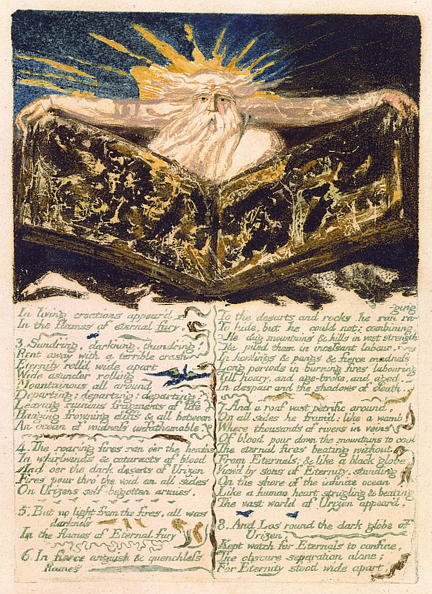
Book of Urizen
Copy G,  Plate 13

Book of Urizen, Plate 12, (E 76) 
"8. In harrowing fear rolling round;
His nervous brain shot branches
Round the branches of his heart.
On high into two little orbs
And fixed in two little eaves
Hiding carefully from the wind,
His Eyes beheld the deep,
And a third Age passed over:
And a state of dismal woe.

9. The pangs of hope began,
In heavy pain striving, struggling.
Two Ears in close volutions.
From beneath his orbs of vision
Shot spiring out and petrified
As they grew. And a fourth Age passed
And a state of dismal woe.

PLATE 13
10. In ghastly torment sick;
Hanging upon the wind;
Two Nostrils bent down to the deep.
And a fifth Age passed over;
And a state of dismal woe.

11. In ghastly torment sick;
Within his ribs bloated round,
A craving Hungry Cavern;
Thence arose his channeld Throat,
And like a red flame a Tongue
Of thirst & of hunger appeard.
And a sixth Age passed over:
And a state of dismal woe.
...
PLATE 25, (E 82)
The Senses inward rush'd shrinking,
Beneath the dark net of infection.

2. Till the shrunken eyes clouded over
Discernd not the woven hipocrisy
But the streaky slime in their heavens
Brought together by narrowing perceptions
Appeard transparent air; for their eyes
Grew small like the eyes of a man
And in reptile forms shrinking together"

The inability to perceive reality shows itself in man's forgetting Eternity from which he originated. This limits his ability to discern the possibility of living as he is meant to live. His limited perceptions further cloud his mind to the distorted conditions which he becomes satisfied with living under in the world he has made for himself.

Letter to Truxler, (E 702)
"As a man is So he Sees.
As the Eye is formed such are its Powers"

We are limited in what we see by who we are; likewise we are limited in who we are by what we see. In our present circumstances the distortions of our perceptions cause us to accept war, imprisonment, impoverishment, exploitation, and destruction of the environment. Further we are diminished in our self-perception by what we see is happening around us. Cleansing the windows of perception is a way to alter the direction in which we are heading. Blake has the journey to regeneration begin by Los recognizing himself in his enemy Urizen. Our return journey can begin with a recognition that we are creating the self-destructing world in our own image. Healing ourselves can heal our world.

Marriage of Heaven and Hell, Plate 14, (E 39)
 "If the doors of perception were cleansed every thing would
appear to man as it is: infinite.
For man has closed himself up, till he sees all things thro'
narrow chinks of his cavern."

Monday, May 27, 2024

INSPIRATION


British Museum
Milton
Plate 15

To Annihilate the Selfhood of Deceit & False Forgiveness

Iain McGilchrist is the author of the book The Master and his Emissary. McGilchrist postulates the right side of the brain which functions as a whole has been preempted by the left side of the brain which process partially, primarily through reasoning.

McGilchrist portrays the romantic movement as a reaction against the enlightenment or age of reason. McGilchrist sees that left side of the brain, which processes thought in the way that Blake's Urizen did, has come to dominate man's psyche. Like Urizen the left side of the brain is rational, rigid, inflexible, and locked in the continuum of space and time - the 'here and now'. Blake's Los uses the right side of his brain by depending on imagination to see the infinite in all things, to integrate the opposites, and to act from inspiration.

There is No Natural Religion, (E 3)
"  VII The desire of Man being Infinite the possession is Infinite
& himself Infinite
     Conclusion,   If it were not for the Poetic or Prophetic
character. the Philosophic & Experimental would soon be at the
ratio of all things & stand still, unable to do other than repeat
the same dull round over again
     Application.   He who sees the Infinite in all things sees
God.  He who sees the Ratio only sees himself only.

Therefore God becomes as we are, that we may be as he is"

Marriage of Heaven and Hell, Plate 11, (E 38)
 "Isaiah answer'd. I saw no God. nor heard any, in a finite
organical perception; but my senses discover'd the infinite in
every thing, and as  I was then perswaded. & remain confirm'd;"

Milton, Plate 13, (E 108)
"The Bard replied. I am Inspired! I know it is Truth! for I Sing
Plate 14 [15]
According to the inspiration of the Poetic Genius
Who is the eternal all-protecting Divine Humanity
To whom be Glory & Power & Dominion Evermore Amen"

Milton, Plate 40 [46], (E 142)
"There is a Negation, & there is a Contrary
The Negation must be destroyd to redeem the Contraries
The Negation is the Spectre; the Reasoning Power in Man
This is a false Body: an Incrustation over my Immortal           
Spirit; a Selfhood, which must be put off & annihilated alway
To cleanse the Face of my Spirit by Self-examination.
Plate 41 [48]
To bathe in the Waters of Life; to wash off the Not Human
I come in Self-annihilation & the grandeur of Inspiration
To cast off Rational Demonstration by Faith in the Saviour
To cast off the rotten rags of Memory by Inspiration
To cast off Bacon, Locke & Newton from Albions covering          
To take off his filthy garments, & clothe him with Imagination
To cast aside from Poetry, all that is not Inspiration
That it no longer shall dare to mock with the aspersion of Madness
Cast on the Inspired,"

Tuesday, July 4, 2023

OPPOSER OF CHANGE

Blake Archive
Book of Urizen
Plate 5
The Greek philosopher Heraclitus is credited with the idea that
the only constant in life is change. Of the few fragments of his writings 
remain, there is one in which he says:

"Everything changes and nothing remains still; and you cannot step twice into the same stream."

From wikipedia we learn more:  

"Heraclitus’ quote is perhaps best known through its interpretation in the dialogue “Cratylus” by Plato.

Socrates: "Heraclitus, I believe, says that all things pass and nothing stays, and comparing existing things to the flow of a river, he says you could not step twice into the same river." (Plato Cratylus 402)

In popular parlance Heraiclitus' insight is often restated as "Change is the only constant."

Blake's Zoa Urizen was opposed to change. The portrait Blake gives us of Urizen shows an individual whose effort was directed toward controlling the future, limiting the actions of others, and producing rules which would prevent change from happening. We are told that Urizen was fond of writing books to supervise the behavior of others in various spheres.

Apparently Urizen devoted significant time to producing his Book of Brass which (as Damon tells us) contains laws for establishing an ideal society.

Book of Urizen, Plate 4, (E 71)

4: From the depths of dark solitude. From
The eternal abode in my holiness,
Hidden set apart in my stern counsels
Reserv'd for the days of futurity,
I have sought for a joy without pain,                            

For a solid without fluctuation"

The perfect society for Urizen would be static. It would not allow for any change because that would obviate the control of the future which Urizen required.

Four Zoas, Night VII,  Page 80, (E 355)
"And Urizen Read in his book of brass in sounding tones    

Listen O Daughters to my voice Listen to the Words of Wisdom
So shall [ye] govern over all let Moral Duty tune your tongue 
But be your hearts harder than the nether millstone
To bring the shadow of Enitharmon beneath our wondrous tree   
That Los may Evaporate like smoke & be no more
Draw down Enitharmon to the Spectre of Urthona
And let him have dominion over Los the terrible shade

Compell the poor to live upon a Crust of bread by soft mild arts
Smile when they frown frown when they smile & when a man looks pale
With labour & abstinence say he looks healthy & happy
And when his children Sicken let them die there are enough
Born even too many & our Earth will be overrun
Without these arts If you would make the poor live with temper
With pomp give every crust of bread you give with gracious cunning 
Magnify small gifts reduce the man to want a gift & then give with pomp 
Say he smiles if you hear him sigh If pale say he is ruddy
Preach temperance   say he is overgorgd & drowns his wit
In strong drink tho you know that bread & water are all
He can afford   Flatter his wife pity his children till we can   

Reduce all to our will as spaniels are taught with art"

Four Zoas, Night VI, Page 73, (E 350) 
"Here will I fix my foot & here rebuild
Her Mountains of Brass promise much riches in their dreadful bosoms

So he began to dig form[ing] of gold silver & iron   
And brass vast instruments to measure out the immense & fix
The whole into another world better suited to obey
His will where none should dare oppose his will himself being King
Of All & all futurity be bound in his vast chain" 

In implementing the perfect autocratic society under his own dominance Urizen found himself opposed by Orc the embodiment of revolution. Urizen  wrote the Book of Iron describing the ruin and sorrow which results from the conflict between established systems and the impetus of change.

Four Zoas, Night VII, Page 79, (E 355)

"Urizen answerd Read my books explore my Constellations 
Enquire of my Sons & they shall teach thee how to War
Enquire of my Daughters who accursd in the dark depths
Knead bread of Sorrow by my stern command for I am God
Of all this dreadful ruin   Rise O daughters at my Stern command

Rending the Rocks Eleth & Uveth rose & Ona rose       
Terrific with their iron vessels driving them across
In the dim air they took the book of iron & placd above
On clouds of death & sang their songs Kneading the bread of Orc
Orc listend to the song compelld hungring on the cold wind
That swaggd heavy with the accursed dough. the hoar frost ragd   
Thro Onas sieve   the torrent rain pourd from the iron pail
Of Eleth & the icy hands of Uveth kneaded the bread
The heavens bow with terror underneath their iron hands
Singing at their dire work the words of Urizens book of iron
While the enormous scrolls rolld dreadful in the heavens above   
And still the burden of their song in tears was poured forth
The bread is Kneaded let us rest O cruel father of children
But Urizen remitted not their labours upon his rock" 

Urizen's books are not to be taken lightly. What he writes has a life of its own. Even if it is discarded or replaced it continues to exert its influence. Man, through his inner Urizen, repeatedly writes of the conflicts resulting from the need to preserve the past and the need to enter the future.

Four Zoas, Night  VI, Page 71, (E 348) 
"But still his books he bore in his strong hands & his iron pen   
For when he died they lay beside his grave & when he rose   
He siezd them with a gloomy smile for wrapd in his death clothes  
He hid them when he slept in death when he revivd the clothes
Were rotted by the winds the books remaind still unconsumd

Still to be written & interleavd with brass & iron & gold 
Time after time for such a journey none but iron pens           
Can write And adamantine leaves recieve nor can the man who goes
Page 72 
The journey obstinate refuse to write time after time"  

Albion appealed to Urizen to put aside his anger but he clung to his books until he was trapped in a labyrinth of unsolvable Mystery. Although Urizen escaped, his book of Iron remained behind. Nothing could abide the wrath of Orc or the resolve of Urizen.

Four Zoas, Night VII, Page 78, (E 353) 
"For Urizen fixd in Envy sat brooding & coverd with snow
His book of iron on his knees he tracd the dreadful letters
While his snows fell & his storms beat to cool the flames of Orc
Age after Age till underneath his heel a deadly root
Struck thro the rock the root of Mystery accursed shooting up   
Branches into the heaven of Los they pipe formd bending down
Take root again whereever they touch again branching forth
In intricate labyrinths oerspreading many a grizly deep
 Amazd started Urizen when he found himself compassd round
And high roofed over with trees. he arose but the stems          
Stood so thick he with difficulty & great pain brought
His books out of the dismal shade. all but the book of iron
Again he took his seat & rangd his Books around
On a rock of iron frowning over the foaming fires of Orc

And Urizen hung over Orc & viewd his terrible wrath              
Sitting upon an iron Crag at length his words broke forth 
Four Zoas, Night IX, Page 120, (E 389) 
 "The Eternal Man sat on the Rocks & cried with awful voice

O Prince of Light where art thou   I behold thee not as once
In those Eternal fields in clouds of morning stepping forth 
With harps & songs where bright Ahania sang before thy face
And all thy sons & daughters gatherd round my ample table
See you not all this wracking furious confusion
Come forth from slumbers of thy cold abstraction come forth
Arise to Eternal births shake off thy cold repose 
Schoolmaster of souls great opposer of change arise
That the Eternal worlds may see thy face in peace & joy
That thou dread form of Certainty maist sit in town & village
While little children play around thy feet in gentle awe
Fearing thy frown loving thy smile O Urizen Prince of light

Image of dread whence art thou whence is this most woful place
Whence these fierce fires but from thyself No other living thing
In all this Chasm I behold. No other living thing
Dare thy most terrible wrath abide   Bound here to waste in pain" 

Blake resolved his conundrum in the final pages of The four Zoas. The various aspects of the Eternal Man were restored to their original positions and functions. Urizen was reunited with his emanation. Damon states that "Orc burns himself out, especially when Urizen stops trying to control him; and he becomes Luvah again." 

Four Zoas, Night IX, Page 125, (E  394)

"The seed is harrowd in while flames heat the black mould & cause
The human harvest to begin Towards the south first sprang 
The myriads & in silent fear they look out from their graves

Then Urizen sits down to rest & all his wearied Sons
Take their repose on beds they drink they sing they view the flames
Of Orc in joy they view the human harvest springing up
A time they give to sweet repose till all the harvest is ripe    

And Lo like the harvest Moon Ahania cast off her death clothes
She folded them up in care in silence & her brightning limbs
Bathd in the clear spring of the rock then from her darksom cave
Issud in majesty divine   Urizen rose up from his couch
On wings of tenfold joy clapping his hands his feet his radiant wings
In the immense as when the Sun dances upon the mountains
A shout of jubilee in lovely notes responding from daughter to daughter
From son to Son as if the Stars beaming innumerable
Thro night should sing soft warbling filling Earth & heaven
And bright Ahania took her seat by Urizen in songs & joy         

The Eternal Man also sat down upon the Couches of Beulah
Sorrowful that he could not put off his new risen body
In mental flames the flames refusd they drove him back to Beulah
His body was redeemd to be permanent thro Mercy Divine

Page 126 
And now fierce Orc had quite consumd himself in Mental flames
Expending all his energy against the fuel of fire
The Regenerate Man stoopd his head over the Universe & in   
His holy hands recievd the flaming Demon & Demoness of Smoke
And gave them to Urizens hands the Immortal frownd Saying        

Luvah & Vala henceforth you are Servants obey & live
You shall forget your former state return O Love in peace
Into your place the place of seed not in the brain or heart"

While writing Jerusalem later in his career Blake returned to the theme of conflict between Urizen's desire to preserve the status quo and Orc's inclination to foster change. While Golgonooza was being built contentions between Los and the Spectre continued. However the Spectre had been forced to see the consequences of his own actions.
Jerusalem, Plate 10, (E 154)
"So spoke the Spectre shuddring, & dark tears ran down his shadowy face Which Los wiped off, but comfort none could give! or beam of hope Yet ceasd he not from labouring at the roarings of his Forge With iron & brass Building Golgonooza in great contendings Till his Sons & Daughters came forth from the Furnaces At the sublime Labours for Los. compelld the invisible Spectre Plate 11 To labours mighty, with vast strength, with his mighty chains, In pulsations of time, & extensions of space, like Urns of Beulah With great labour upon his anvils, & in his ladles the Ore He lifted, pouring it into the clay ground prepar'd with art; Striving with Systems to deliver Individuals from those Systems; That whenever any Spectre began to devour the Dead, He might feel the pain as if a man gnawd his own tender nerves."


Tuesday, April 11, 2023

Blake's Religion

Wikipedia Commons
Jerusalem
Plate 26, Copy A

 Ram Horn'd with Gold

Edited by Larry Clayton

CHAPTER FOUR

Faith

iii

Sin and Forgiveness

"Whosoever of you are justified by the law: ye are fallen from grace"
Galatians 5:4

If the primary moral wrong is hindering, the primary grace is forgiveness. Redemption came for Blake when forgiveness first entered the horizon of his vision; it increasingly came to dominate it. Prior to 1800 with all his denunciations of Urizen, the Restrainer, and of morality Blake was growing more and more into the role of judge. He was becoming in fact a judge of judges. The later Lambeth books witness the resultant decrease in vitality; in the language of Zion he suffered a loss of faith. It coincided with a slowly dawning realization that Urizen had infested his own mind all the while he was denouncing him in others. There awakened in his mind a new awareness of sin, a sin more basic than hindering others, or rather an awareness of the inner cause of hindering. He called it the Selfhood, the Spectre, Satan. As many of us have since that day, Blake realized that he saw the God-playing in others because he was so good at it himself. This new vision of his Selfhood led to the Moment of Grace.

At Felpham, in the major crisis of his life, he faced the need to forgive both the impositions of his corporeal friend, Hayley, and the resentful thunderer, William Blake, as well. The appearance of his 'first Vision of Light' marks the coming of Christ into his life with the power of this forgiveness; henceforth he called him Jesus, the Forgiveness.

The old urizenic monstrosity that had haunted him, first in the outer world and increasingly as a component of his own psyche, was recognized, accepted, subdued, and forgiven. It was undoubtedly the greatest event of his life, a new birth of hope at the age of 43. He shared with us the psychic unfolding of this experience in Night vii of 'The Four Zoas' where Los embraces his Spectre (equivalent to Jung's acceptance of the shadow) and soon thereafter finds Urizen miraculously changed:

"Startled was Los; he found his Enemy Urizen now In his hands; he wonder'd that he felt love & not hate. His whole soul loved him; he beheld him an infant Lovely...."

Has anyone better portrayed the psychodynamics of forgiveness? In order to forgive you first withdraw the projection, then you forgive yourself. It's your baby!

We can't say that's the end of the story; in Night viii Urizen continues to afflict life with his judgments, hostility and violence; Satan comes forth from his War. The Saviour dies for him, and we are still waiting for the ultimate victory. Nor was Blake himself fully delivered from the resentments and self justifications of the old man. Hard times ahead, the deceitfulness and opprobrium of others continued to afflict and to warp his psyche and caused him to participate in sin (mostly by suffering through the sins of others against him), but now he knew the answer: through recurring awareness and Self-annihilation he could forgive again and again. The wheat and tares continued to grow together.

Blake had a deep grasp of what students of the Bible have called the kenosis. At his Moment of Grace it became for him an existential reality. He rewrote 4Z to show Jesus throughout the drama coming from above, hovering over Mankind, descending into mortal flesh to join us and to take on our burdens, our sorrow and pain and travail. Blake referred to this as the "dark Satanic body". This is the body we all wear until Jesus glorifies it in us.

According to Blake's faith this coming of Jesus is the ultimate act of forgiveness for what we have become in our brokenness. It empowers us to become through a new birth what we were originally and what we are called to be again. The new birth is an alteration of consciousness. Blake had an inkling of this as early as 'The Marriage of Heaven and Hell', where he referred to it as "an improvement of sensual enjoyment." In the same plate he referred to it as a cleansing of the "doors of perception" and likened the former state to life in Plato's cave.

In the lovely "first Light" poem quoted above he used the thoroughly biblical figure of Jesus purging away "all my mire and my clay". Forgiveness is not a temporal event, but an eternal one. The Lamb of God was slain from the foundation of the world. We must forgive not once, but seventy times seven times. Blake deals with sin and forgiveness as ultimates in his notebook poem, "My Spectre around me night and day". The poem speaks primarily to the advanced student, but with crystal clarity stanza 14 bears on the primary grace:

"& Throughout all Eternity  
I forgive you you forgive me
As our dear Redeemer said                                   
This the Wine & this the Bread"

The unforgiving, accusing, egocentric, spectrous Selfhood is the stuff of Ulro, the life that is Eternal Death. Forgiveness through Self-annihilation is the stuff of that life which is life indeed. In the eternal realm Good and Evil, Virtue and Sin, all are forgiven and replaced by Truth and Error, which constitute the matter of the eternal wars of love. We fight these with Blake's weapons (the burning arrows of thought, etc.) or with Paul's "whole armor of God". Error meets an eternal consummation as we grow closer and closer to the Perfect Man. The apocalypse in Blake's structure of faith comes as an alteration of consciousness by which "this world" fades out (is consumed) and is replaced by the Eternal. Albion awakes. "Whenever any Individual Rejects Error and Embraces Truth, a Last Judgment passes upon that Individual".

This was Blake's religion; unfortunately he does not seem to have found it in any of the churches which he knew. Instead many of his deepest convictions directly contravened the prevailing theology. He discovered that he "must create a system, or be enslated by another mans". The pages that follow trace some of the contrarieties between Blake's vision of eternal reality and the mainstream of Christian orthodoxy.

Letters, To Thomas Butts, (E 712) 
To my Friend Butts I write
     My first Vision of Light
     On the yellow sands sitting
     The Sun was Emitting
     His Glorious beams
     From Heavens high Streams
     Over Sea over Land
     My Eyes did Expand
     Into regions of air
     Away from all Care
     Into regions of fire
     Remote from Desire
     The Light of the Morning
     Heavens Mountains adorning
     In particles bright
     The jewels of Light
     Distinct shone & clear--
     Amazd & in fear
     I each particle gazed
     Astonishd Amazed
     For each was a Man
     Human formd.  Swift I ran
     For they beckond to me
     Remote by the Sea
     Saying.  Each grain of Sand
     Every Stone on the Land
     Each rock & each hill
     Each fountain & rill
     Each herb & each tree
     Mountain hill Earth & Sea
     Cloud Meteor & Star
     Are Men Seen Afar
     I stood in the Streams
     Of Heavens bright beams
     And Saw Felpham sweet
     Beneath my bright feet
     In soft Female charms
     And in her fair arms
     My Shadow I knew
     And my wifes shadow too
     And My Sister & Friend.
     We like Infants descend
     In our Shadows on Earth
     Like a weak mortal birth
     My Eyes more & more
     Like a Sea without shore
     Continue Expanding
     The Heavens commanding
     Till the jewels of Light
     Heavenly Men beaming bright
     Appeard as One Man
     Who Complacent began
     My limbs to infold
     In his beams of bright gold
     Like dross purgd away
     All my mire & my clay
     Soft consumd in delight
     In his bosom sun bright
     I remaind.  Soft he smild
     And I heard his voice Mild
     Saying This is My Fold
     O thou Ram hornd with gold
     Who awakest from sleep
     On the sides of the Deep
     On the Mountains around
     The roarings resound
     Of the lion & wolf
     The loud sea & deep gulf
     These are guards of My Fold
     O thou Ram hornd with gold
     And the voice faded mild
     I remaind as a Child
     All I ever had known
     Before me bright Shone
     I saw you & your wife
     By the fountains of Life
     Such the Vision to me
     Appeard on the Sea" 
 

Thursday, February 2, 2023

IMAGE OF GOD

Wikisource
Jerusalem
Plate 99

In the thought of C G Jung the dynamic of individuation involves the ego/self axis which connects the conscious and unconscious functioning of the psyche. The ego, or consciousness, arises from the original state of unconsciousness which is the undifferentiated psyche. Jung calls the total psyche the Self; Blake calls the total psyche Albion (or Jesus or the Imagination.)

Jung and Blake discern that when consciousness develops, the connection between conscious mental processing and the unconscious totality is fractured. This is imaged as the division into the four functions in Jung and into the Four Zoas in Blake. Both men directed their thoughts to the restoration of the psyche as a unified whole which would incorporate the sundered parts and express each without division or competition.

In Blake the Zoa which became dominant was Urizen, the reasoning power of man. In Jung the ego which acted as the executive of the psyche was the thinking function. Blake and Jung agree that thought - not emotion, sensation, or intuition - governed the conscious functioning of the psyche.

Blake portrays the aspects of the psyche which are not dominant as struggling to wrest control from the rational function. This represents a tug of war in the individual as the separate parts seek expression. Luvah, Tharmas and Los battle with Urizen until the Eternal form of Los - Urthona - brings all into a unity as it was in the unconscious before the psyche interacted with the external world.

The parallel process takes place in Jung's system. The divided psyche which is under control of the rational mind or ego reconnects with the unified unconscious called the Self. Through the process of individuation the ego experiences that the totality of the psyche is the Self and the ego is drawn back into the greater reality.   

Blake discerned that the ultimate reconciliation restored to man the ability to perceive the Infinite Eternal Divine. Jung expressed the resolution of the process of restoring wholeness to the psyche in terms of the ego gradually subordinating itself to the completeness of the Self which is as close to a God-image as Jung goes.

Four Zoas, Night IX, Page 191, (E 391) 
"And the Eternal Man Said Hear my words O Prince of Light 
PAGE 122 
Behold Jerusalem in whose bosom the Lamb of God
Is seen tho slain before her Gates he self renewd remains
Eternal & I thro him awake to life from deaths dark vale
The times revolve the time is coming when all these delights
Shall be renewd & all these Elements that now consume            
Shall reflourish. Then bright Ahania shall awake from death
A glorious Vision to thine Eyes a Self renewing Vision  
Jerusalem, Plate 27, (E 171)
You have a tradition, that Man anciently containd in his mighty
limbs all things in Heaven & Earth: this you recieved from the
Druids.
  "But now the Starry Heavens are fled from the mighty limbs of
Albion" 
Four Zoas, Night IX, Page 133, (E 402)
"Not for ourselves but for the Eternal family we live
Man liveth not by Self alone but in his brothers face            
Each shall behold the Eternal Father & love & joy abound

So spoke the Eternal at the Feast they embracd the New born Man
Calling him Brother image of the Eternal Father. they sat down
At the immortal tables sounding loud their instruments of joy
Calling the Morning into Beulah the Eternal Man rejoicd"   
Four Zoas, Night IX, Page 136), (E 404)
"This dreadful Non Existence is worse than pains of Eternal Birth
Eternal Death who can Endure. let us consume in fires
In waters stifling or in air corroding or in earth shut up
The Pangs of Eternal birth are better than the Pangs of Eternal Death"
Four Zoas, Night IX, Page 138, (E 406)
"Such are the works of Dark Urthona  Tharmas sifted the corn
Urthona made the Bread of Ages & he placed it
In golden & in silver baskets in heavens of precious stone
And then took his repose in Winter in the night of Time

The Sun has left his blackness & has found a fresher morning     
And the mild moon rejoices in the clear & cloudless night 
And Man walks forth from midst of the fires  the evil is all consumd"  
 

Thursday, January 26, 2023

PLOW


Four Zoas
Page 5 
 
In his thesis Lee Hamilton explored Blake's poem Four Zoas from the perspective of Jungian psychology. His paper is deserving of careful study.

The explanation of the use of the plow as the symbol for the work of Urizen relates to the relationship of consciousness to unconsciousness. If in the first half of life, the task of man is to develop consciousness as represented by his Ego, his thinking controlling function, the second half of life turns to reversing the process. The Ego or consciousness must begin to relinquish control to the aspects of the psyche which have been unconscious. Urizen must relinquish ascendancy to Urthona who represents man's spiritual nature, intuition or wholeness.

Thesis by Lee Hamilton, ENERGY AND ARCHETYPE: A JUNGIAN ANALYSIS OF THE FOUR ZOAS BY WILLIAM BLAKE, Page 49.

 "The furnace is opened, and the molten metal that is now Luvah is allowed to pour out into furrows cut by Urizen's plow of the ages. This act symbolizes the canalization of the Feeling function by the Thinking function. Urizen forces the remains of Luvah into a furrow or form of his own design, just as he forced the Bulls of Luvah by making them pull his plow and do his bidding. The plow symbolizes the mastery of the conscious forces over the unconscious. Wherever the plow goes, it wrests a portion of the soil from its primal, un-conscious state and gives it over to the use of man's conscious intellect (Jung, IX, pt. 2, 148)."

Aion, C G Jung, Page 148:

"Since olden times the plough has stood for man's mastery over the earth: wherever man ploughs, he has wrested a patch of soil from the primal state and put it to his own use. That is to say: the fishes will rule this world and subdue it by working astrologically through man and moulding his consciousness." 

In the first half of life Urizen's plow tills the field breaking the soil and creating the furrows. Through building a system the mind processes the data by which the senses connect the inner world of the mind with the outer material world. Consciousness is expanded at the expense of instinctive unconscious activity.   

A point is reached where there is a realization that there is more to life than life in the material. Recognizing that the body will die but that consciousness is more than the body, man becomes aware that the individual is connected to a greater consciousness. The second half of life can be used to explore and develop the inner life which never dies. Time and Space begin to lose their grip as man perceives the Eternal and Infinite.

In the final resolution of the Four Zoas Urizen plays a pivotal role.  

As expressed by Hamilton on Page 117:

Four Zoas, Night IX, Page 124, (E 393)

"The Sons of Urizen Shout Their father rose The Eternal horses
Harnessd They calld to Urizen the heavens moved at their call
The limbs of Urizen shone with ardor. He laid his hand on the Plow                                                       t
Thro dismal darkness drave the Plow of ages over Cities
And all their Villages over Mountains & all their Vallies
Over the graves & caverns of the dead   Over the Planets
And over the void Spaces over Sun & moon & star & constellation"

"As already mentioned, the plowing symbolizes the victory of consciousness over unconsciousness. In this final apocalypse the meaning is the same, but it is applied on a higher plane of consciousness. Urizen's plow passes not over the surface of the Earth but over the entire universe. This represents the victory of a higher level of consciousness, an awareness of the presence of God, the self, and a divine order in the Universe. In psychological terms, this represents an awareness of the self, the God within every man, and its harmonizing influence." 

__________________________________________________________  

Four Zoas, Night IX, Page 138, (E 406)
"The Sun has left his blackness & has found a fresher morning     
And the mild moon rejoices in the clear & cloudless night    
And Man walks forth from midst of the fires the evil is all consumd
His eyes behold the Angelic spheres arising night & day
The stars consumd like a lamp blown out & in their stead behold
The Expanding Eyes of Man behold the depths of wondrous worlds 
One Earth one sea beneath nor Erring Globes wander but Stars
Of fire rise up nightly from the Ocean & one Sun
Each morning like a New born Man issues with songs & Joy
Calling the Plowman to his Labour & the Shepherd to his rest
He walks upon the Eternal Mountains raising his heavenly voice   
Conversing with the Animal forms of wisdom night & day
That risen from the Sea of fire renewd walk oer the Earth

For Tharmas brought his flocks upon the hills & in the Vales
Around the Eternal Mans bright tent the little Children play
Among the wooly flocks The hammer of Urthona sounds              
In the deep caves beneath his limbs renewd his Lions roar
Around the Furnaces & in Evening sport upon the plains
They raise their faces from the Earth conversing with the Man

How is it we have walkd thro fires & yet are not consumd
How is it that all things are changd even as in ancient times"  
A Vision of the Last Judgment, (E 554)
"The Nature of Visionary Fancy or Imagination is very little
Known & the Eternal nature & permanence of its ever Existent
Images is considerd as less permanent than the things of
Vegetative & Generative Nature yet the Oak dies as well as the
Lettuce but Its Eternal Image & Individuality never dies. but
renews by its seed. just as the Imaginative Image
returns according to the seed of Contemplative
Thought   the Writings of the Prophets illustrate these conceptions
of the Visionary Fancy by their various sublime & Divine Images
as seen in the Worlds of Vision"