Blake seeks to provide the Golden String which can lead us through the labyrinth of our experience or his own poetry.

Sunday, January 9, 2022

GIANT ALBION

 First posted Sept 2017

Yale Center for British Art
Jerusalem
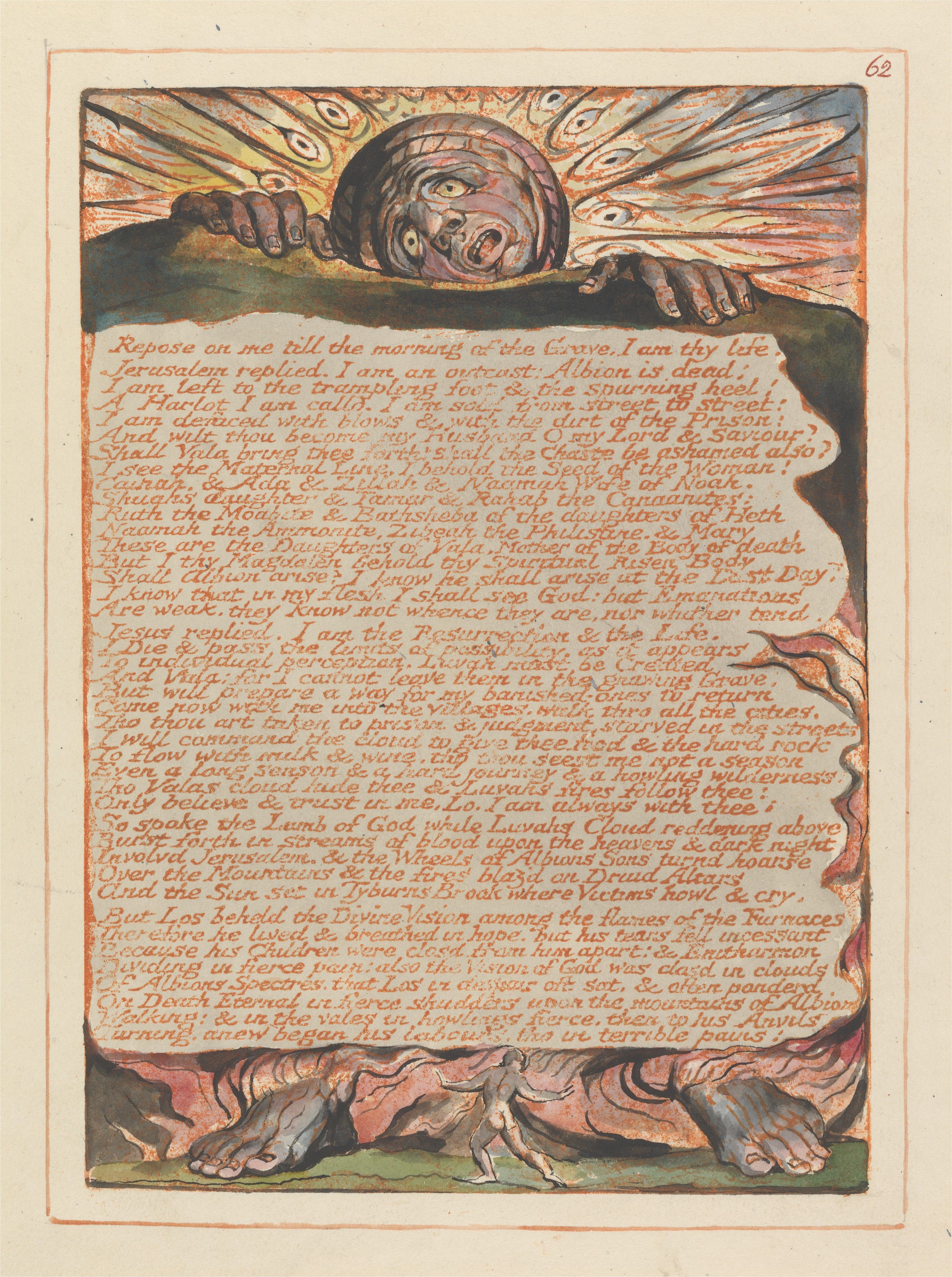
Plate 62

Damon writes in A Blake Dictionary that "Giants symbolize the great primeval powers within us..." the totality of which is symbolized by the giant Albion who is represented by all of Britain. More expansively Albion includes all of mankind in one body.

In this passage in Milton we read of Albion as a giant body stretching over the British landscape. He is attempting to rise from his dreadful sleep on the Couch of Death. The anguish he experienced is portrayed in the face of Albion on plate 62 of Jerusalem. Blake includes a small figure between Albion's feet to indicate the scale of the forces incorporated in Albion - his symbol of Man.

Milton, Plate 39 [44] (E 140)
"Awake Albion awake! reclaim thy Reasoning Spectre. Subdue        

Him to the Divine Mercy, Cast him down into the Lake
Of Los, that ever burneth with fire, ever & ever Amen!
Let the Four Zoa's awake from Slumbers of Six Thousand Years

Then loud the Furnaces of Los were heard! & seen as Seven heavens
Stretching from south to north over the mountains of Albion"     

Milton, Plate 39 [44]
"Then Albion rose up in the Night of Beulah on his Couch
Of dread repose seen by the visionary eye; his face is toward
The east, toward Jerusalems Gates: groaning he sat above
His rocks. London & Bath & Legions & Edinburgh                   
Are the four pillars of his Throne; his left foot near London
Covers the shades of Tyburn: his instep from Windsor
To Primrose Hill stretching to Highgate & Holloway
London is between his knees: its basements fourfold 
His right foot stretches to the sea on Dover cliffs, his heel  
On Canterburys ruins; his right hand covers lofty Wales
His left Scotland; his bosom girt with gold involves
York, Edinburgh, Durham & Carlisle & on the front
Bath, Oxford, Cambridge Norwich; his right elbow
Leans on the Rocks of Erins Land, Ireland ancient nation[,]      
His head bends over London: he sees his embodied Spectre
Trembling before him with exceeding great trembling & fear
He views Jerusalem & Babylon, his tears flow down
He movd his right foot to Cornwall, his left to the Rocks of Bognor
He strove to rise to walk into the Deep. but strength failing    
Forbad & down with dreadful groans he sunk upon his Couch
In moony Beulah. Los his strong Guard walks round beneath the Moon

Romans 12 
[4] For as we have many members in one body, and all members have not the same office: 
[5] So we, being many, are one body in Christ, and every one members one of another.
[6] Having then gifts differing according to the grace that is given to us, whether prophecy, let us prophesy according to the proportion of faith; 
[7] Or ministry, let us wait on our ministering: or he that teacheth, on teaching; 
[8] Or he that exhorteth, on exhortation: he that giveth, let him do it with simplicity; he that ruleth, with diligence; he that sheweth mercy, with cheerfulness.

 First Corinthians 12 
[12] For as the body is one, and hath many members, and all the members of that one body, being many, are one body: so also is Christ. 
[13] For by one Spirit are we all baptized into one body, whether we be Jews or Gentiles, whether we be bond or free; and have been all made to drink into one Spirit.

Saturday, January 8, 2022

ANCIENT BRITONS

First posted April 2010

When Blake moved back to London from Felpham he opened for a time an exhibit of his paintings in the shop of his brother James. He wrote an extended Descriptive Catalogue of the works he was exhibiting. The quotes about Albion and Arthur in a previous post were from that catalogue. A picture which has been lost was the subject of the comments Blake made about Albion and Arthur.

Blake's picture according to his description was of three ancient Britons who were the sole survivors of a battle against the Romans. 

Descriptive Catalogue, NUMBER 5, (E 542-5)

" THE ANCIENT BRITONS--Three Ancient Britons overthrowing the Army of armed Romans; the Figures full as
large as Life--From the Welch Triades.
In the last Battle that Arthur fought, the most Beautiful was one
That return'd, and the most Strong another: with them also return'd
The most Ugly, and no other beside return'd from the bloody Field.

The most Beautiful, the Roman Warriors trembled before and worshipped:
The most Strong, they melted before him and dissolved in his presence:
The most Ugly they fled with outcries and contortion of their Limbs."

To Blake:

"The Strong man represents the human sublime. The Beautiful man represents the human pathetic, which was
in the wars of Eden divided into male and female. The Ugly man represents the human reason. They were originally one man, who was fourfold; he was self-divided, and his real humanity slain on the stems of generation, and the form of the fourth was like the Son of God. How he became divided is a subject of great sublimity and pathos. The Artist has written it under inspiration, and will, if God please, publish it; it is voluminous, and contains the ancient history of Britain, and the world of Satan and of Adam. In the mean time he has painted this Picture,"
...
"It will be necessary for the Painter to say something concerning his ideas of Beauty, Strength and Ugliness.
The Beauty that is annexed and appended to folly, is a lamentable accident and error of the mortal and perishing life; it does but seldom happen; but with this unnatural mixture the sublime Artist can have nothing to do; it is fit for the burlesque. The Beauty proper for sublime art, is lineaments, or forms and features that are capable of being the receptacles of intellect; accordingly the Painter has given in his beautiful man, his own idea of intellectual Beauty. The face and limbs that deviates or alters least, from infancy to old age, is the face and limbs of greatest Beauty and perfection.
The Ugly likewise, when accompanied and annexed to imbecility and disease, is a subject for burlesque and not for historical grandeur; the Artist has imagined his Ugly man; one approaching to the beast in features and form, his forehead small, without frontals; his jaws large; his nose high on the ridge, and narrow; his chest and he stamina of his make, comparatively little, and his joints and his extremities large; his eyes with scarce any whites, narrow and cunning, and every thing tending toward what is truly Ugly; the incapability of intellect.
The Artist has considered his strong Man as a receptacle of Wisdom, a sublime energizer; his features and limbs do not spindle out into length, without strength, nor are they too large and unwieldy for his brain and bosom. Strength consists in accumulation of power to the principal seat, and from thence a regular gradation and subordination; strength is compactness, not extent nor bulk.
The strong Man acts from conscious superiority, and marches on in fearless dependance on the divine decrees, raging with the inspirations of a prophetic mind. The Beautiful Man acts from duty, and anxious solicitude for the fates of those for whom he combats. The Ugly Man acts from love of carnage, and delight in the savage barbarities of war, rushing with sportive precipitation into the very teeth of the affrighted enemy."

Although there is no exact correlation between the three survivors and the Four Zoas, it is worth looking for some resemblances. The Strong Man is most like Tharmas, the physical body and source of man's energy. The Beautiful Man resembles Luvah who incorporates all the emotions and in his Eternal form is referred to a 'beauteous'. The Ugly man is Urizen who has become ugly through his hate, cruelty, and vengeance. The fourth man is like to the Son of God as was the fourth man in Daniel's fiery furnace. Los plays that role in Blake's myth since he is the force that initiates reunification.

Since the original picture is lost, I have tried to find images which may resemble the three men Blake describes and the Son of God from Daniel's furnace.

Strong - 'inspirations of a prophetic mind'

 
Ugly - 'incapability of intellect'


Son of God - 'great sublimity and pathos'


 Beautiful - 'receptacles of intellect'

 
All Images are from the Book of Urizen.
 

Thursday, January 6, 2022

SLEEP OF ALBION

First posted April 2010

THE SLEEP OF ALBION is a chapter in Kathleen Raine's book, Golgoonoza: City of Imagination. In it Raine explores the relationship between King Arthur and Albion (the oldest name for Great Britain) in the mind of the British. She shows how Blake's Albion partakes of the legends surrounding King Arthur. As the legends of King Arthur end, he is entombed but not dead, sleeping until he is called to return to 'restore just rule to his kingdom and repel its enemies'. Blake writes: 

Descriptive Catalogue, Number V, (E 543)

 "The giant Albion, was Patriarch of the Atlantic, he is the Atlas of the Greeks, one of those the Greeks called Titans. The stories of Arthur are the acts of Albion, applied to a Prince of the fifth century, who conquered Europe, and held the Empire of the world in the dark age, which the Romans never again recovered." 

Quotes from Golgoonoza: City of Imagination:

 In Jerusalem, it is the Giant Albion who is "imagined in the similitude of Arthur". Albion's sleep is the sleep of Arthur. Raine says, "in recounting the 'acts of Albion' [Blake] considered himself to be recounting the sacred history - the inner history of the British nation from ancient times, with prophetic foresight of that future when Albion, like Arthur, is to wake from sleep." 

To Raine the 'sleep' of Albion "is conceived by Blake not as the mere passage of time but as a state of apathy, of lowering of consciousness, of forgetfulness of higher things...

"Blake tells the story of how the nation has come to lapse into spiritual ignorance and forgetfulness... 

"Blake is quite specific in his diagnosis of England's national disease: it is precisely that secular materialism ... upon which modern Western civilization is founded... 

"Our society is forever thinking in terms of changing our circumstances; Blake's revolution will come when we change ourselves. From inner awakenings outer changes will follow... 

"When Albion awakens he will find himself in his lost kingdom restored to its former glory; for the kingdom is ourselves... 

"Paradise is not a place but a state of being, the lost kingdom to which the sleepers of Albion must someday awake." 

Descriptive Catalogue, NUMBER V, (E 542) 

The Ancient Britons: 

"In the last Battle of King Arthur only Three Britons escaped, these were the Strongest Man, the Beautifullest Man, and the Ugliest Man; these three marched through the field unsubdued, as Gods, and the Sun of Britain s[e]t, but shall arise again with tenfold splendor when Arthur shall awake from sleep, and resume his dominion over earth and ocean."  

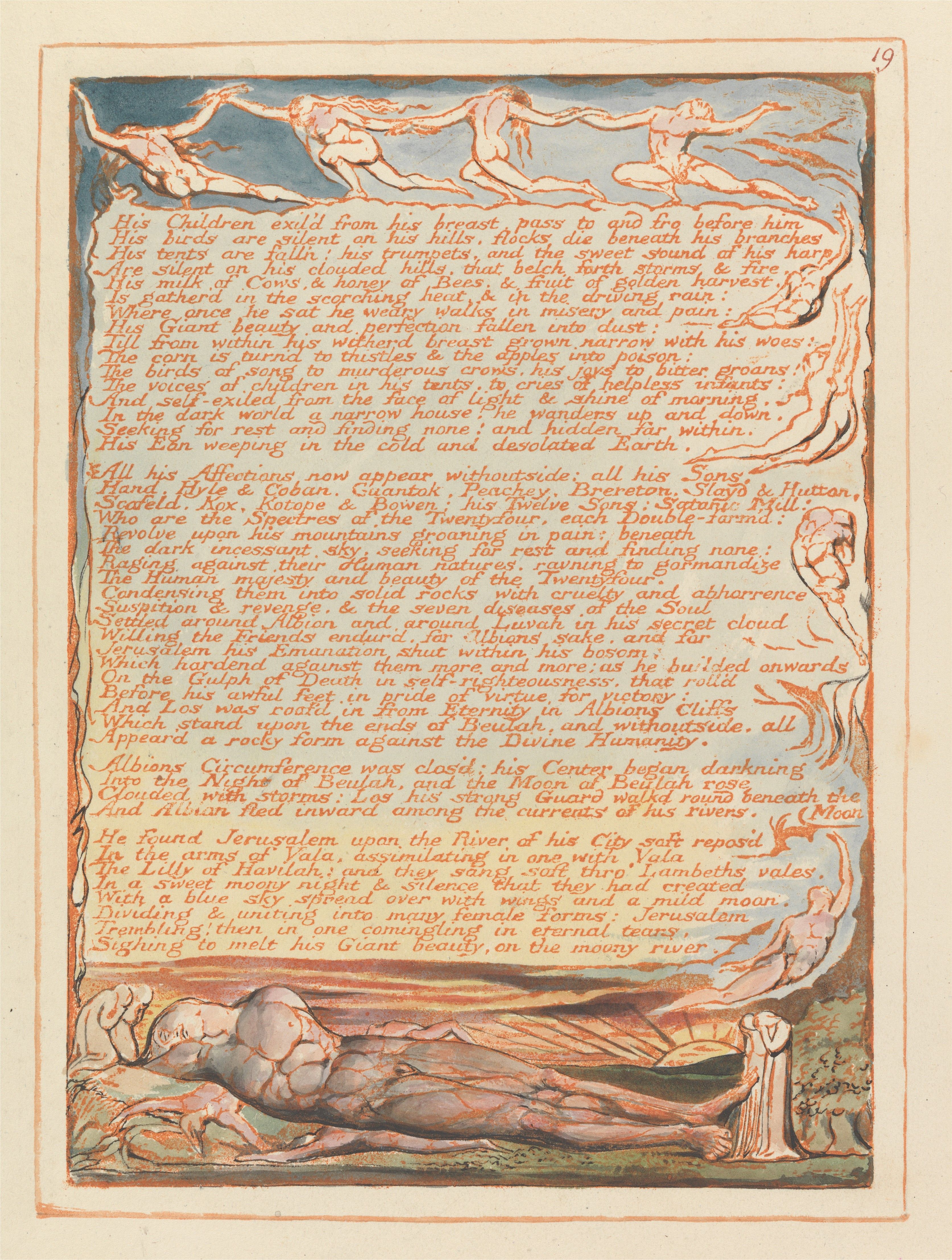
Jerusalem, Plate19, Albion 'in pain & tears'

Yale Center for British Art
Jerusalem
Plate 19

Thursday, October 14, 2021

LARGE COLOR PRINTS 13

First posted March 2014

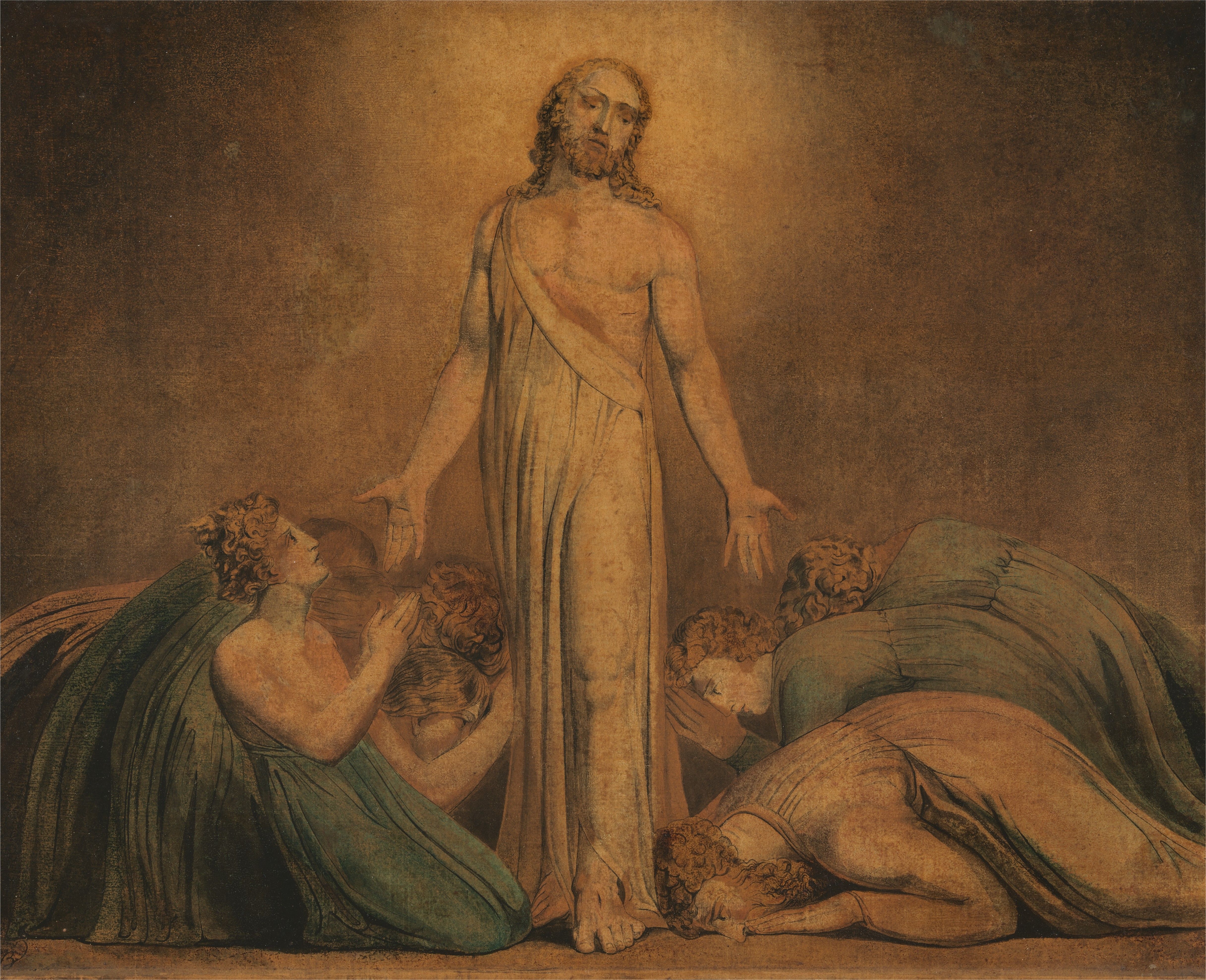
As a culmination of the process of having one's consciousness raised to the 'perception of the infinite', Blake produced Christ Appearing to the Apostles after the Resurrection as one of the designs for the Large Color Printed Drawings. When seen as the final picture of the series it parallels the final plates of the poetry in Jerusalem and reminds us of the end that John wrote for his Gospel.

If an individual had traversed a cycle in his psychological development from its inception of being introduced to a new level of truth, to the climax of assimilating that truth into his being, his new status could be represented by this image. The process had included a descent into the underground where he was sifted like wheat as was Nebuchadnezzar or Simon Peter, and who spent a period in the House of Death. The descent involved divisions; a breaking down of the unity of the vision of God as undifferentiated consciousness into man and God, man and woman, good and evil, reason and energy, body and soul.

The upward leg of the cycle was enacted by the reassembly of the divided parts by becoming aware of the value of each unit as half of a pair of contraries which comprise a whole. The return journey could also be described as recognizing the positive and negative dimensions of everything which had been discovered in the unconscious. Or looking at the return journey as related to outward experience it entails withdrawing the projections; seeing the outer world objectively rather than as one's own shadow side.
Yale Center for British Art
Large Color Printed Drawings 
Christ Appearing to the Apostles after the Resurrection

Luke 22
[27] For which is the greater, one who sits at table, or one who serves? Is it not the one who sits at table? But I am among you as one who serves.
[28] "You are those who have continued with me in my trials;
[29] and I assign to you, as my Father assigned to me, a kingdom,
[30] that you may eat and drink at my table in my kingdom, and sit on thrones judging the twelve tribes of Israel.
[31] "Simon, Simon, behold, Satan demanded to have you, that he might sift you like wheat,
[32] but I have prayed for you that your faith may not fail; and when you have turned again, strengthen your brethren." 


Matthew 18
[10] "See that you do not despise one of these little ones; for I tell you that in heaven their angels always behold the face of my Father who is in heaven.
[12] What do you think? If a man has a hundred sheep, and one of them has gone astray, does he not leave the ninety-nine on the mountains and go in search of the one that went astray?
[13] And if he finds it, truly, I say to you, he rejoices over it more than over the ninety-nine that never went astray.
[14] So it is not the will of my Father who is in heaven that one of these little ones should perish.

John 17
[1] When Jesus had spoken these words, he lifted up his eyes to heaven and said, "Father, the hour has come; glorify thy Son that the Son may glorify thee,
[2] since thou hast given him power over all flesh, to give eternal life to all whom thou hast given him.
[3] And this is eternal life, that they know thee the only true God, and Jesus Christ whom thou hast sent.
[4] I glorified thee on earth, having accomplished the work which thou gavest me to do;
[5] and now, Father, glorify thou me in thy own presence with the glory which I had with thee before the world was made.
...
[11] And now I am no more in the world, but they are in the world, and I am coming to thee. Holy Father, keep them in thy name, which thou hast given me, that they may be one, even as we are one.
...
[25] O righteous Father, the world has not known thee, but I have known thee; and these know that thou hast sent me.
[26] I made known to them thy name, and I will make it known, that the love with which thou hast loved me may be in them, and I in them." 

________________________ 
Jerusalem, Plate 96, (E 255) 
"Then Jesus appeared standing by Albion as the Good Shepherd
By the lost Sheep that he hath found & Albion knew that it
Was the Lord the Universal Humanity, & Albion saw his Form     
A Man. & they conversed as Man with Man, in Ages of Eternity
And the Divine Appearance was the likeness & similitude of Los"
_______________________________

There are three copies of this print: one in the Tate, one in the National Gallery, and one in the Yale Center for British Art. The copy in the Tate Museum, although in the poorest condition, shows the greatest emotional intensity in the compassionate expression of the Christ, and in the devoted response of the apostles.


Wednesday, October 13, 2021

LARGE COLOR PRINTS 12

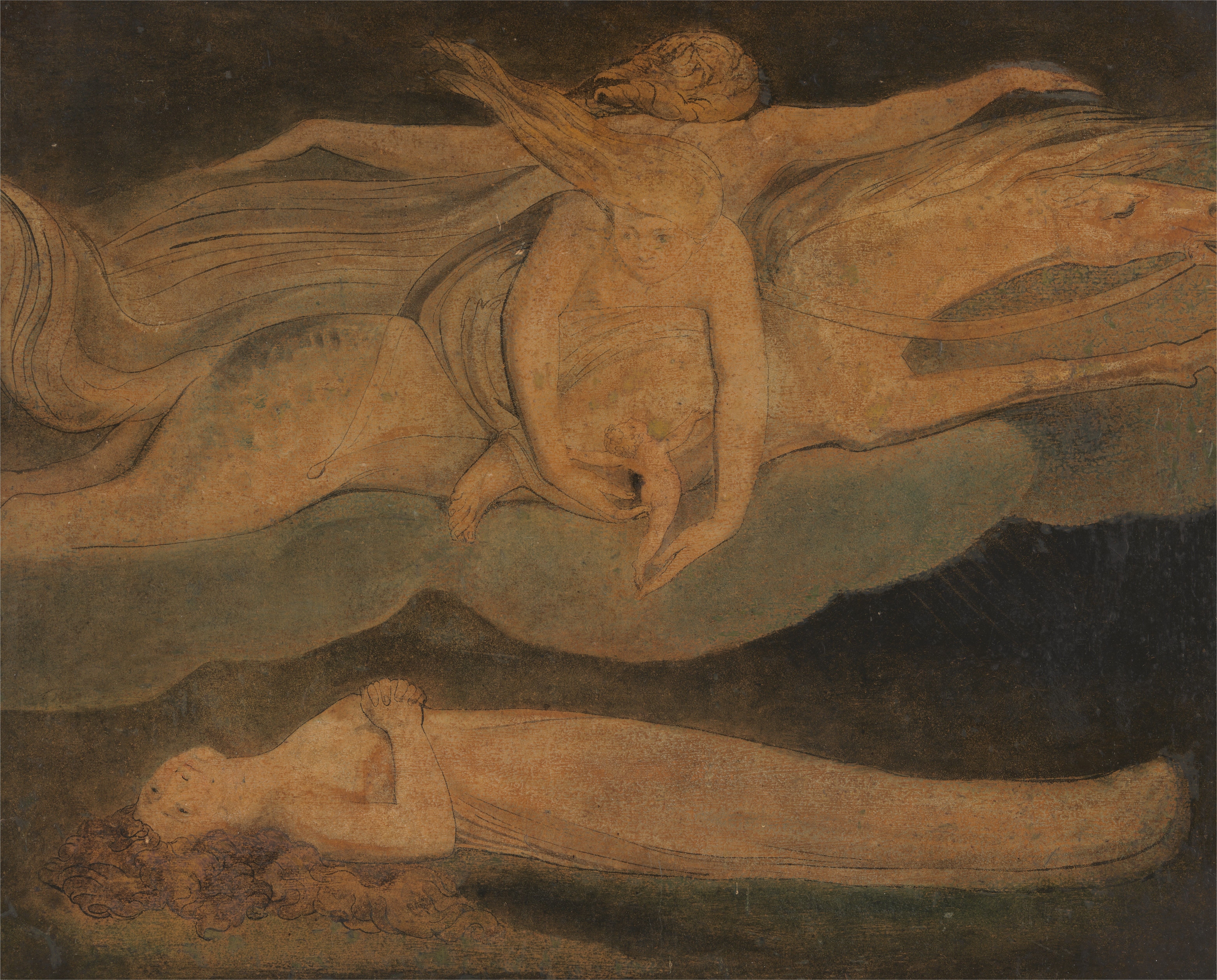
Yale Center for British Art
Large Color Printed Drawings
Pity

LARGE COLOR PRINTS 12

BLAKE'S PITY

IMAGE OF PITY

IMAGE OF PITY ii

Letters, To Flaxman, (E 707)
"Now my lot in the Heavens is this; Milton lovd me in childhood & shewd me his face Ezra came with Isaiah the Prophet, but Shakespeare in riper years gave me his hand"

It is not known if this vision which goes by the name Pity was stimulated by reading words in Act I, Scene 7 of Shakespeare's Macbeth but it may have been. Blake may have resonated to Shakespeare's description of pity without associating it in his image with 'the horrid deed' and 'vaulting ambition' described in Shakespeare's passage.

Macbeth , Act 1, Scene 7
"... He's here in double trust;
First, as I am his kinsman and his subject,
Strong both against the deed; then, as his host,
Who should against his murderer shut the door,
Not bear the knife myself. Besides, this Duncan
Hath borne his faculties so meek, hath been
So clear in his great office, that his virtues
Will plead like angels, trumpet-tongued, against
The deep damnation of his taking-off;
And pity, like a naked new-born babe,
Striding the blast, or heaven's cherubim, horsed
Upon the sightless couriers of the air,
Shall blow the horrid deed in every eye,
That tears shall drown the wind. I have no spur
To prick the sides of my intent, but only
Vaulting ambition, which o'erleaps itself
And falls on the other."

The idea of pity was a recurring theme in Blake's poetry. In the Book of Urizen Los first feels pity for Urizen's suffering. The dividing which follows is like the dividing which followed the initial dividing in Genesis when God divided Heaven from Earth.

Genesis 1

[3] And God said, Let there be light: and there was light.
[4] And God saw the light, that it was good: and God divided the light from the darkness.
[5] And God called the light Day, and the darkness he called Night. And the evening and the morning were the first day.
[6] And God said, Let there be a firmament in the midst of the waters, and let it divide the waters from the waters.
[7] And God made the firmament, and divided the waters which were under the firmament from the waters which were above the firmament: and it was so.
[8] And God called the firmament Heaven. And the evening and the morning were the second day.
[9] And God said, Let the waters under the heaven be gathered together unto one place, and let the dry land appear: and it was so.
[10] And God called the dry land Earth; and the gathering together of the waters called he Seas: and God saw that it was good.

Urizen, Plate 13, (E 77) 
6. Los wept obscur'd with mourning:
His bosom earthquak'd with sighs;
He saw Urizen deadly black,                     
In his chains bound, & Pity began,

7. In anguish dividing & dividing
For pity divides the soul
In pangs eternity on eternity
Life in cataracts pourd down his cliffs         
The void shrunk the lymph into Nerves
Wand'ring wide on the bosom of night
And left a round globe of blood
Trembling upon the Void"

In Milton pity is linked with love and compassion. The pity which is the 'garment of God' urges patience not wrath. God has provided Beulah as a protection from the stresses on Eden for the female. There she may learn to express the pity and compassion which is often lacking in her.

Milton, Plate 18 [20], (E 111)

"Orc answerd. Take not the Human Form O loveliest. Take not
Terror upon thee! Behold how I am & tremble lest thou also
Consume in my Consummation; but thou maist take a Form
Female & lovely, that cannot consume in Mans consummation
Wherefore dost thou Create & Weave this Satan for a Covering[?]  
When thou attemptest to put on the Human Form, my wrath  

Burns to the top of heaven against thee in Jealousy & Fear.
Then I rend thee asunder, then I howl over thy clay & ashes
When wilt thou put on the Female Form as in times of old
With a Garment of Pity & Compassion like the Garment of God      
His garments are long sufferings for the Children of Men
Jerusalem is his Garment & not thy Covering Cherub O lovely
Shadow of my delight who wanderest seeking for the prey."
Milton, Plate 25 [27], (E 122) 
"Go forth Reapers with rejoicing. you sowed in tears
But the time of your refreshing cometh, only a little moment     
Still abstain from pleasure & rest, in the labours of eternity
And you shall Reap the whole Earth, from Pole to Pole! from Sea to Sea
Begining at Jerusalems Inner Court, Lambeth ruin'd and given
To the detestable Gods of Priam, to Apollo: and at the Asylum
Given to Hercules, who labour in Tirzahs Looms for bread    
Who set Pleasure against Duty: who Create Olympic crowns
To make Learning a burden & the Work of the Holy Spirit: Strife.
T[o] Thor & cruel Odin who first reard the Polar Caves 
Lambeth mourns calling Jerusalem. she weeps & looks abroad
For the Lords coming, that Jerusalem may overspread all Nations  
Crave not for the mortal & perishing delights, but leave them
To the weak, and pity the weak as your infant care; Break not
Forth in your wrath lest you also are vegetated by Tirzah
Wait till the Judgement is past, till the Creation is consumed
And then rush forward with me into the glorious spiritual    
Vegetation; the Supper of the Lamb & his Bride; and the
Awaking of Albion our friend and ancient companion.

So Los spoke. But lightnings of discontent broke on all sides round
And murmurs of thunder rolling heavy long & loud over the mountains
While Los calld his Sons around him to the Harvest & the Vintage."

Milton, Plate 30 [33], (E 129
"Beulah is evermore Created around Eternity; appearing
To the Inhabitants of Eden, around them on all sides.
But Beulah to its Inhabitants appears within each district       
As the beloved infant in his mothers bosom round incircled
With arms of love & pity & sweet compassion. But to
The Sons of Eden the moony habitations of Beulah,
Are from Great Eternity a mild & pleasant Rest.

And it is thus Created. Lo the Eternal Great Humanity            
To whom be Glory & Dominion Evermore Amen
Walks among all his awful Family seen in every face
As the breath of the Almighty. such are the words of man to man
In the great Wars of Eternity, in fury of Poetic Inspiration,
To build the Universe stupendous: Mental forms Creating" 
_________________________
In William Blake's Circle of Destiny, Milton O Percival makes these comments:
"Los's feminine self is Enitharmon. She is the spiritual garment of man in the Generative world, being in this respect the counterpart of Jerusalem in Eden. Now the spiritual clothing which Los desires in a troubled world is pity. But true pity, as we have seen in the discussion of Luvah and Vala, is imaginative and spontaneous, not selfish and rational...She is in all things the outer aspect of the spiritual world of which he is the impelling spirit.  
...
For a short, resplendent period Los finds her tractable. In contrition for her selfish past she weaves the 'web of life' in the looms of Cathedron. This is the new Jerusalem toward which Los has aspired. Pity has been achieved. But this period of enlightenment soon declines, and Enitharmon sinks with Los into the lethargy of the eighteen Christian centuries. During these centuries Christianity ceases to be a thing of the spirit, retaining only its Christian name. This is the 'sleep' of Enitharmon - the triumph of the recalcitrant female emotions as they are personified in Vala-Rahab."
(Page 40,41)


Tuesday, October 12, 2021

LARGE COLOR PRINTS 11

First posted March 2014

Ruth 1
[11] But Na'omi said, "Turn back, my daughters, why will you go with me? Have I yet sons in my womb that they may become your husbands?
[12] Turn back, my daughters, go your way, for I am too old to have a husband. If I should say I have hope, even if I should have a husband this night and should bear sons,
[13] would you therefore wait till they were grown? Would you therefore refrain from marrying? No, my daughters, for it is exceedingly bitter to me for your sake that the hand of the LORD has gone forth against me."
[14] Then they lifted up their voices and wept again; and Orpah kissed her mother-in-law, but Ruth clung to her.
[15]And she said, "See, your sister-in-law has gone back to her people and to her gods; return after your sister-in-law."
[16] But Ruth said, "Entreat me not to leave you or to return from following you; for where you go I will go, and where you lodge I will lodge; your people shall be my people, and your God my God;
[17] where you die I will die, and there will I be buried. May the LORD do so to me and more also if even death parts me from you." 

Wikimedia
Large Color Prints
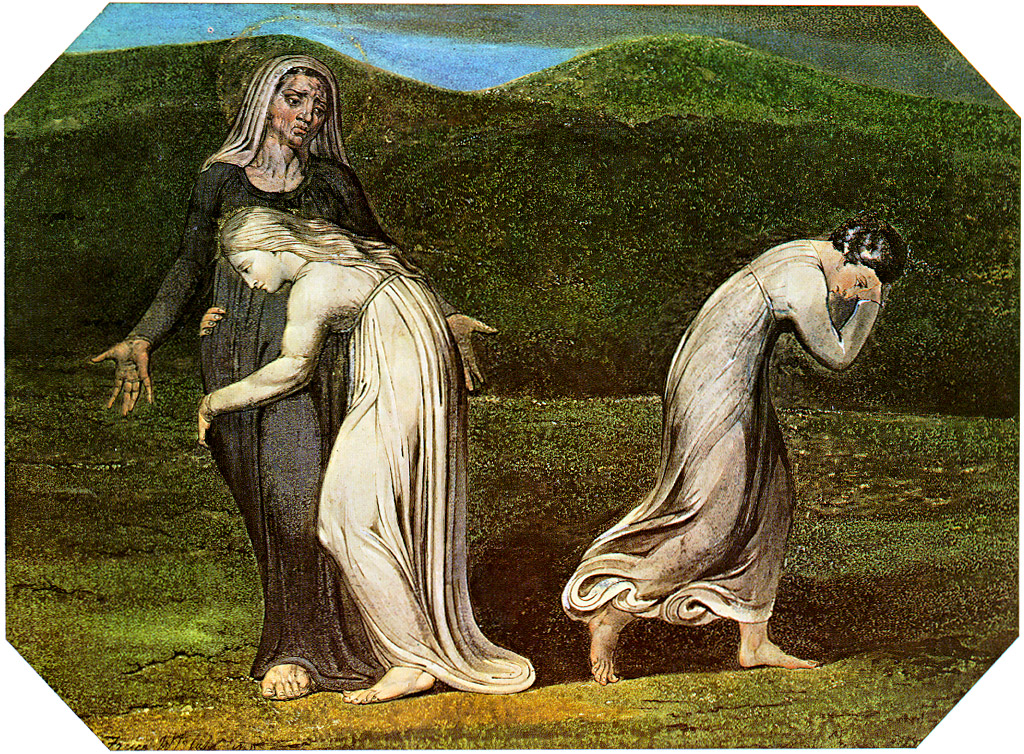
Naomi Entreating Ruth and Orpha

When you consider the import and implications of the Book of Ruth, you can understand Blake's inclusion on the picture Naomi in the series of Large Color Printed Drawings as a cycle of fall and return. First we take note of Ruth as an ancestor of Jesus. Second we observe that Naomi, Ruth and Orpha were all outsiders with experience of living in a foreign culture. Third we see that the three women suffered the experience of being widowed and left without sons or husbands to care for them. The emphasis on the return of Naomi to her hometown of Bethlehem adds another significant event that would have interested Blake.
 
Blake uses this image as an indication that the return involves a reintegration of the emanation into the complete man. Ruth exemplifies the willingness to forgo selfish interest as an expression of her love for her husband's family.  

Four Zoas, Night IX,  Page 133, (E 402)
"Not for ourselves but for the Eternal family we live
Man liveth not by Self alone but in his brothers face            
Each shall behold the Eternal Father & love & joy abound

So spoke the Eternal at the Feast they embracd the New born Man
Calling him Brother image of the Eternal Father." 
Jerusalem, Plate 96, (E 255)
"Jesus replied Fear not Albion unless I die thou canst not live
But if I die I shall arise again & thou with me            
This is Friendship & Brotherhood without it Man Is Not

So Jesus spoke! the Covering Cherub coming on in darkness
Overshadowd them & Jesus said Thus do Men in Eternity
One for another to put off by forgiveness, every sin

Albion replyd. Cannot Man exist without Mysterious          
Offering of Self for Another, is this Friendship & Brotherhood
I see thee in the likeness & similitude of Los my Friend

Jesus said. Wouldest thou love one who never died
For thee or ever die for one who had not died for thee
And if God dieth not for Man & giveth not himself           
Eternally for Man Man could not exist. for Man is Love:
As God is Love: every kindness to another is a little Death
In the Divine Image nor can Man exist but by Brotherhood"

Jerusalem, Plate 62, (E 212)
[Voice of the Lord]
"Repose on me till the morning of the Grave. I am thy life.

Jerusalem replied. I am an outcast: Albion is dead!
I am left to the trampling foot & the spurning heel!
A Harlot I am calld. I am sold from street to street!
I am defaced with blows & with the dirt of the Prison!   

And wilt thou become my Husband O my Lord & Saviour?
Shall Vala bring thee forth! shall the Chaste be ashamed also?
I see the Maternal Line, I behold the Seed of the Woman!
Cainah, & Ada & Zillah & Naamah Wife of Noah.
Shuahs daughter & Tamar & Rahab the Canaanites:                  
Ruth the Moabite & Bathsheba of the daughters of Heth
Naamah the Ammonite, Zibeah the Philistine, & Mary
These are the Daughters of Vala, Mother of the Body of death
But I thy Magdalen behold thy Spiritual Risen Body"
 

Sunday, October 10, 2021

LARGE COLOR PRINTS 10

First posted Feb 2014

The place that the picture Newton assumes in the series called the Large Color Prints is to emphasize the dual functions that science might play in the development of man's consciousness. Although Blake spoke of 'single vision' as 'Newton's sleep', he ends the Four Zoas with the beginning of the reign of 'sweet Science.'
Wikimedia
Large Color Printed Drawings
Newton
Along with Bacon and Locke, Newton became a symbol for Blake of the particular temptations faced by man in his own age. For Blake it was through the philosophies of these three men that the society had transitioned itself from orthodox Christianity to Deism, and from traditional agrarian organization to industrialization. Blake was not against change, but the change he desired was toward the development of the imagination to enable man to become more human. Blake saw changes brought about by the philosophies of Bacon, Locke and Newton chaining man to a materialistic, mechanistic and impoverished worldview.
 
To Blake who saw the holiness in everything, science, although of infinite value, was in his day being put to the wrong use. Meant to be a servant of man it was becoming his master.
Descriptive Catalogue, (E 536) 
"Visions of these eternal principles or characters of human
life appear to poets, in all ages; the Grecian gods were the
ancient Cherubim of Phoenicia; but the Greeks, and since them the
Moderns, have neglected to subdue the gods of Priam.  These Gods
are visions of the eternal attributes, or divine names, which,
when erected into gods, become destructive to humanity.
They ought to be the servants, and not the masters of man, or of
society.  They ought to be made to sacrifice to Man, and not man
compelled to sacrifice to them; for when separated from man or
humanity, who is Jesus the Saviour, the vine of eternity, they
are thieves and rebels, they are destroyers."

Four Zoas, Night III, Page 38, (E 326)
"O Prince the Eternal One hath set thee leader of his hosts
Page 39 
Leave all futurity to him Resume thy fields of Light  
Why didst thou listen to the voice of Luvah that dread morn
To give the immortal steeds of light to his deceitful hands
No longer now obedient to thy will thou art compell'd
To forge the curbs of iron & brass to build the iron mangers
To feed them with intoxication from the wine presses of Luvah
Till the Divine Vision & Fruition is quite obliterated
They call thy lions to the fields of blood, they rowze thy tygers
Out of the halls of justice, till these dens thy wisdom framd
Golden & beautiful but O how unlike those sweet fields of bliss  
Where liberty was justice & eternal science was mercy
Then O my dear lord listen to Ahania, listen to the vision
The vision of Ahania in the slumbers of Urizen
When Urizen slept in the porch & the Ancient Man was smitten 

The Darkning Man walkd on the steps of fire before his halls 
And Vala walkd with him in dreams of soft deluding slumber" 
Song of Los, Plate 4, (E 68)
"Thus the terrible race of Los & Enitharmon gave
Laws & Religions to the sons of Har binding them more
And more to Earth: closing and restraining:                      
Till a Philosophy of Five Senses was complete
Urizen wept & gave it into the hands of Newton & Locke"

Milton, Plate 27 [29], (E 125)
"But in Eternity the Four Arts: Poetry, Painting, Music,          
And Architecture which is Science: are the Four Faces of Man.
Not so in Time & Space: there Three are shut out, and only
Science remains thro Mercy: & by means of Science, the Three
Become apparent in time & space, in the Three Professions
Poetry in Religion: Music, Law: Painting, in Physic & Surgery: 
That Man may live upon Earth till the time of his awaking,
And from these Three, Science derives every Occupation of Men.
And Science is divided into Bowlahoola & Allamanda."

Four Zoas, Night IX, PAGE 139, (E 407) 
"The Sun arises from his dewy bed & the fresh airs
Play in his smiling beams giving the seeds of life to grow
And the fresh Earth beams forth ten thousand thousand springs of life
Urthona is arisen in his strength no longer now
Divided from Enitharmon no longer the Spectre Los                
Where is the Spectre of Prophecy where the delusive Phantom
Departed & Urthona rises from the ruinous walls
In all his ancient strength to form the golden armour of science
For intellectual War The war of swords departed now
The dark Religions are departed & sweet Science reigns           

                  End of The Dream"                
Reading this passage from Norhtrop Frye's Fearful Symmetry we can see that in the image Blake created of Newton, he intended to keep open the possibility that man's consciousness might evolve to the level of vision.
 
Fearful Symmetry, Page 259-60:
"Man stands at the level of conscious life: immediately in front of him is the power to visualize the eternal city and garden he is trying to regain; immediately behind him is an unconscious, involuntary and cyclic energy, much of which still goes on inside his own body. Man is therefor a Luvah or form of life subject to two impulses, one the prophetic impulse leading him forward to vision, the other the natural impulse which drags him back to unconsciousness and finally to death.
...
The imagination says that man is not chain-bound but muscle-bound; that he is born alive, and is everywhere dying in sleep; and that when the conscious imagination in man perfects the vision of the world of consciousness, at that point man's eyes will necessarily be open.
...
Every advance of truth forces error to consolidate itself in a  more obviously erroneous form, and every advance of freedom has the same effect on tyranny...The evolution comes in the fact that the opposition grows sharper each time, and will one day present a clear-cut alternative of eternal life or extermination."