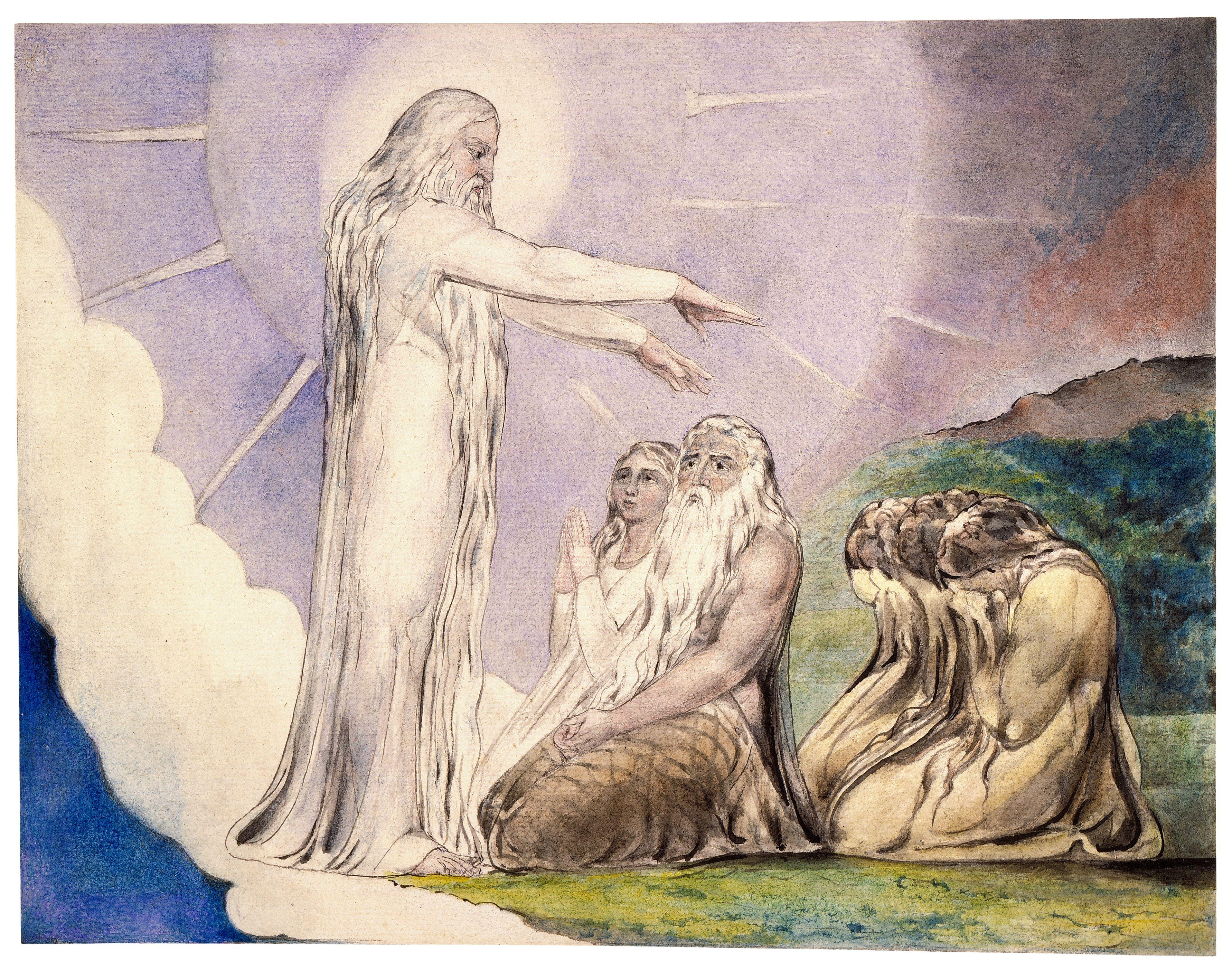
Blake seeks to provide the Golden String which can lead us through the labyrinth of our experience or his own poetry.

Thursday, April 7, 2011

LAMB OF INNOCENCE

Genesis 22
[1] And it came to pass after these things, that God did tempt Abraham, and said unto him, Abraham: and he said, Behold, here I am.
[2] And he said, Take now thy son, thine only son Isaac, whom thou lovest, and get thee into the land of Moriah; and offer him there for a burnt offering upon one of the mountains which I will tell thee of.
[3] And Abraham rose up early in the morning, and saddled his ass, and took two of his young men with him, and Isaac his son, and clave the wood for the burnt offering, and rose up, and went unto the place of which God had told him.
[4] Then on the third day Abraham lifted up his eyes, and saw the place afar off.
[5] And Abraham said unto his young men, Abide ye here with the ass; and I and the lad will go yonder and worship, and come again to you,
[6] And Abraham took the wood of the burnt offering, and laid it upon Isaac his son; and he took the fire in his hand, and a knife; and they went both of them together.
[7] And Isaac spake unto Abraham his father, and said, My father: and he said, Here am I, my son. And he said, Behold the fire and the wood: but where is the lamb for a burnt offering?
[8] And Abraham said, My son, God will provide himself a lamb for a burnt offering: so they went both of them together.
[9] And they came to the place which God had told him of; and Abraham built an altar there, and laid the wood in order, and bound Isaac his son, and laid him on the altar upon the wood.
[10] And Abraham stretched forth his hand, and took the knife to slay his son.
[11] And the angel of the LORD called unto him out of heaven, and said, Abraham, Abraham: and he said, Here am I.
[12] And he said, Lay not thine hand upon the lad, neither do thou any thing unto him: for now I know that thou fearest God, seeing thou hast not withheld thy son, thine only son from me.
[13] And Abraham lifted up his eyes, and looked, and behold behind him a ram caught in a thicket by his horns: and Abraham went and took the ram, and offered him up for a burnt offering in the stead of his son.

In Songs of Innocence Blake consistently uses the lamb as a symbol for the state of innocence. The lamb is cheerful, untroubled, well provided for, a source of comfort and joy. But the lamb, so gentle and innocent, implies a darker side. The lamb is typically the victim in the practice of sacrifice. Old Testament religious practice was built around the sacrifice of innocent victims to appease a demanding God. Abraham had been willing to sacrifice his son Isaac in response to God's command. The sacrifice of the innocent child was not required; a ram was substituted as an offering. The child who survived became Israel the father of a nation who continued to practice sacrifice. Later in Old Testament history the release of the Israelites from slavery in Egypt depended on the sacrifice of lambs to identify the sons who were to passed over by the Angel of Death.

When Blake uses the lamb as the symbol of innocence he is implying that the state of innocence is temporary. The lamb will not always be protected from harm. The innocents may become victims of circumstances which demand the sacrifice of the most helpless and harmless. The state of Innocence itself is the victim of the state of Experience which inevitably replaces it. Man is made for Joy and Woe. The lamb of innocence is the Joy which must be woven with the Woe of experience to travel safely through generation.

SONGS 4, (E 4)
Introduction
"Pipe a song about a Lamb;
So I piped with merry chear,
Piper pipe that song again--
So I piped, he wept to hear."

SONGS 5, (E 5)
The Shepherd.
"For he hears the lambs innocent call,
And he hears the ewes tender reply,
He is watchful while they are in peace,
For they know when their Shepherd is nigh."

SONGS 8, (E 8)
The Lamb
"Little Lamb who made thee
Dost thou know who made thee
Gave thee life & bid thee feed.
By the stream & o'er the mead;
Gave thee clothing of delight,
Softest clothing wooly bright;
Gave thee such a tender voice,
Making all the vales rejoice!
Little Lamb who made thee
Dost thou know who made thee

Little Lamb I'll tell thee,
Little Lamb I'll tell thee!
He is called by thy name,
For he calls himself a Lamb:
He is meek & he is mild,
He became a little child:
I a child & thou a lamb,
We are called by his name.
Little Lamb God bless thee.
Little Lamb God bless thee."

SONGS 10, (E 9)
The Little Black Boy.
"For when our souls have learn'd the heat to bear
The cloud will vanish we shall hear his voice.
Saying: come out from the grove my love & care,
And round my golden tent like lambs rejoice."

SONGS 12, (E 12)
The Chimney Sweeper
"Theres little Tom Dacre, who cried when his head
That curl'd like a lambs back, was shav'd, so I said.
Hush Tom never mind it, for when your head's bare,
You know that the soot cannot spoil your white hair."

SONGS 19, (E 19)
HOLY THURSDAY
"O what a multitude they seemd these flowers of London town
Seated in companies they sit with radiance all their own
The hum of multitudes was there but multitudes of lambs
Thousands of little boys & girls raising their innocent hands"

SONGS 20, (E 20)
Night
"Farewell green fields and happy groves,
Where flocks have took delight;
Where lambs have nibbled, silent moves
The feet of angels bright;
Unseen they pour blessing,
And joy without ceasing,"
SONGS 21
[Lion speaking]
"And now beside thee bleating lamb,
I can lie down and sleep;
Or think on him who bore thy name,
Graze after thee and weep.
For wash'd in lifes river,
My bright mane for ever,
Shall shine like the gold,
As I guard o'er the fold."

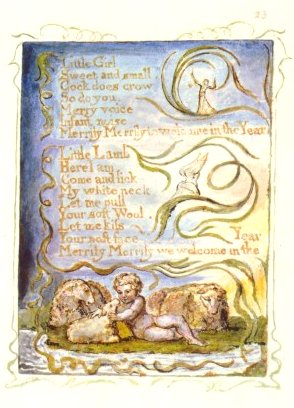
SONGS 23, (E 15)
"Little Girl
Little Lamb
Here I am,
Come and lick
My white neck.
Let me pull
Your soft Wool.
Let me kiss
Your soft face.
Merrily Merrily we welcome in the Year"

SONGS OF EXPERIENCE 42, (E 42)
The Tyger.
"Did he who made the Lamb make thee?"

The lamb is rarely used in the later poetry in the same sense as it is used in Songs of Innocence. One exception occurs in the Four Zoas as Luvah speaks of Vala:

Four Zoas, PAGE 27, (E 317)
"And I commanded the Great deep to hide her in his hand
Till she became a little weeping Infant a span long
I carried her in my bosom as a man carries a lamb
I loved her I gave her all my soul & my delight"
.

Wednesday, April 6, 2011

Blake's Joy

Count it all joy when ye fall into divers temptations; Knowing this, that the trying of your faith worketh patience. But let patience have her perfect work, that ye may be perfect and entire, wanting nothing. (James 1:2-4)

Th
e epigram says it all!

This little poem sets the natural scene:
"Man was made for Joy & Woe;
And when this we rightly know
Thro' the World we safely go.
Joy & Woe are woven fine,
A Clothing for the Soul divine;"
(From Auguries of Innocence; Erdman page 491)

We might wonder what meanings joy and woe had for Blake in the spiritual development of his life.

Blake must have been a joyous child to see a tree full of angels, but like all children he also knew woe at an early age; that is symbolized by the angry God at the window who left him screaming (I wonder how many of the small children of fundamentalist Christians have a similar experience.)

The angry God became Blake's chief source of woe and set him to writing feverishly over the years. It led to the system he created, the Myth, begun with a Fall. It led to a systematic study of human psychology with the division of the psyche into four fractions, namely Urizen, Luvah, Los, and Tharmas or in modern day parlance Thinking, Feeling, Intuition or Imagination, and Sensation.

Blake's Thinking became a bane to him; he identified Urizen with the Angry God, the Lawgiver, the
British Museum
Book of Urizen
Plate 4
Schoolmaster. He wrote thousands of words and produced a multitude of images dealing with Urizen.

He is first mentioned in 1793 in Visions of the Daughters of Albion: "O Urizen! Creator of men! mistaken Demon of heaven: Thy joys are tears! thy labour vain, to form men to thine image."(Erdman 48)

Also in 1793 Blake mentioned Urizen three times in America. (Erdman 54ff) Here's one of them:
"The fiery joy, that Urizen perverted to ten commands"; here he has identified Urizen with the God who directed Moses in the Exodus, but this Exodus was not to liberty, but from Eternity to a rule bound life .

In 1794 Blake began to describe Urizen's career with the Book of Urizen. The story is amplified in great detail. In The Four Zoas. (Put Urizen in the concordance if you want to know where it occurs.)

Blake hated the dominance of Urizen over his mind, but in the course of time he dealt creatively with Urizen. After many, many scenes showing Urizen making things worse and beginning to fear for Futurity he encountered and was confronted by Los. The contest was arduous-- between imagination and what had become fear. The enmity went on and on until finally Los subdued Urizen.

Then strangely enough Los found that he no longer hated Urizen; in fact he had come to love him. (He forgave one who had sinned against him!) Urizen was in his power. With the shivering Urizen subdued by Los, Blake laid to rest the Angry God.

For Blake the thump on the head was replaced by the healing balm of the Jesus he had come to love and worship. Facing God he said: "Throughout Eternity I forgive you; you forgive me." (Notebook, "MySpectre"54; E477) This is a powerful general statement about the consequences of grace. You is everyone of course, but Blake particularly addressed God in this statement. (We may not know it, but a host of us need to forgive God for the things that have appeared to us to be unjust.) Making that decision is infinitely liberating to the human soul.

For Blake having made it led to an immediate release of the visionary power he had lost twenty years before; like C.S.Lewis he was Surprised by Joy. He began to write and draw with power and vigor. In fact he became an evangelist. Unlike Francis of Assisi he used words by choice; words were his forte.

Milton, Jerusalem, Job (Illustrations): three of many ways of telling the old, old story.

Posted by Larry Clayton


Tuesday, April 5, 2011

BLAKE & DOUBT

Illustrations to the Book of Job
The Vision of Christ


Songs and Ballads
, Auguries of Innocence,(E 492)
"He who Doubts from what he sees
Will neer Believe do what you Please
If the Sun & Moon should Doubt
Theyd immediately Go out"

An Individual's loss of the ability to perceive the Divine Body may be called a loss of faith. Each individual psyche must rely upon a unifying principle to maintain a stable outlook. When this object of faith loses its ability to provide a cohesive scheme of organization the individual enters a state of doubt. Blake treats the experience of losing and regaining faith in his repeated accounts of fall and renewal. Milton in this passage willingly separates himself from his unifying principle and views instead the ' shades of Death & Ulro'. He strips himself of the protective garments and enters the state of doubt through which a reorganization may take place.

Milton, PLATE 14 [15], (E 108)
"Then there was great murmuring in the Heavens of Albion
Concerning Generation & the Vegetative power & concerning
The Lamb the Saviour: Albion trembled to Italy Greece & Egypt
To Tartary & Hindostan & China & to Great America
Shaking the roots & fast foundations of the Earth in doubtfulness
The loud voic'd Bard terrify'd took refuge in Miltons bosom

Then Milton rose up from the heavens of Albion ardorous!
The whole Assembly wept prophetic, seeing in Miltons face
And in his lineaments divine the shades of Death & Ulro
He took off the robe of the promise, & ungirded himself from the
oath of God

And Milton said, I go to Eternal Death!"

In these few lines Blake puts in more prosaic terms the process which is being undertaken in Milton's psyche.

Milton, PLATE 40 [46],(E 141)
"The Negation is the Spectre; the Reasoning Power in Man
This is a false Body: an Incrustation over my Immortal
Spirit; a Selfhood, which must be put off & annihilated alway
To cleanse the Face of my Spirit by Self-examination."

Milton is called upon to undergo these stages in this process of rebuilding:

Milton ,PLATE 41 [48], (E 142)
"To cast off Rational Demonstration by Faith in the Saviour
To cast off the rotten rags of Memory by Inspiration
To cast off Bacon, Locke & Newton from Albions covering
To take off his filthy garments, & clothe him with Imagination
To cast aside from Poetry, all that is not Inspiration"

Blake also describes the process as one in which external forces attempt to take away the ability of a individual to perceive the Divine Body.

Milton ,PLATE 41 [48], (E 142)
"These are the destroyers of Jerusalem, these are the murderers
Of Jesus, who deny the Faith & mock at Eternal Life:
Who pretend to Poetry that they may destroy Imagination;
By imitation of Natures Images drawn from Remembrance
These are the Sexual Garments, the Abomination of Desolation
Hiding the Human lineaments as with an Ark & Curtain
Which Jesus rent: & now shall wholly purge away with Fire"

The reorganization which may be called a recovery of faith is spoken of near the end of Jerusalem. The darkness has been integrated into the whole man who is Jesus. The 'Body of Doubt' has been deprived of independent existence.

Jerusalem, Plate 93,(E 253)
"Then Los again took up his speech as Enitharmon ceast

Fear not my Sons this Waking Death. he is become One with me
Behold him here! We shall not Die! we shall be united in Jesus.
Will you suffer this Satan this Body of Doubt that Seems but Is
Not
To occupy the very threshold of Eternal Life."

The robust faith that Blake had in the verities which he knew from internal experience is expressed in these lines.

Annotations to Watson, (E 613)
"The Man who pretends to be a modest enquirer into the truth of a self evident thing is a Knave The truth & certainty of Virtue & Honesty i.e Inspiration needs no one to prove it it is Evident as the Sun & Moon He who stands doubting of what he intends whether it is Virtuous or Vicious knows not what Virtue means. no man can do a Vicious action & think it to be Virtuous. no man can take darkness for light. he may pretend to do so & may pretend to be a modest Enquirer. but is a Knave"

Blake has the same confidence that man may draw near to God as does the author of Hebrews.

Hebrews
10:19-25 - So by virtue of the blood of Jesus, you and I, my brothers, may now have courage to enter the holy of holies by way of the one who died and is yet alive, who has made for us a holy means of entry by himself passing through the curtain, that is, his own human nature. Further, since we have a great High Priest set over the household of God, let us draw near with true hearts and fullest confidence, knowing that our inmost souls have been purified by the sprinkling of his blood just as our bodies are cleansed by the washing of clean water. In this confidence let us hold on to the hope that we profess without the slightest hesitation - for he is utterly dependable - and let us think of one another and how we can encourage each other to love and do good deeds. And let us not hold aloof from our church meetings, as some do. Let us do all we can to help one another's faith, and this the more earnestly as we see the final day drawing ever nearer.
.

Monday, April 4, 2011

GOLDEN STRING

Blake introduces Chapter 4 of Jerusalem, "To the Christians", with a
promise. He intends to lead us through 'heavens gate' if we follow the 'golden string' which he places in our hands.

Jerusalem, Plate 77, (E 231)
"I give you the end of a golden string,
Only wind it into a ball:
It will lead you in at Heavens gate,
Built in Jerusalems wall."

The 'golden string' used only once in Blake's poetry, is an image which is rich in associations. It recalls the string which Ariadne gave to Theseus to lead him out of the maze of the Minotaur. It reminds us of the thread which measures the length of life and is cut by the Fates. (Moirae - Wiki) It leads us to think of the path we travel through life with all its twists and turns.

But Blake's image goes beyond that. It postulates that the end of the golden string is given to us and we have more to do than follow it. We actively wind it into a ball. If we don't keep the string taut and keep winding it, we may lose our way and wander off into unknown territory. But by winding it and following, it will lead us to our to our destiny or destination.

We are headed toward Jerusalem:

Jerusalem, Plate 54, (E203)
"In Great Eternity, every particular Form gives forth or Emanates
Its own peculiar Light, & the Form is the Divine Vision
And the Light is his Garment This is Jerusalem in every Man
A Tent & Tabernacle of Mutual Forgiveness Male & Female
Clothings.
And Jerusalem is called Liberty among the Children of Albion"

River of Life


This image articulates the cutting of the thread, the flow of the stream, the guidance of Jesus, the tree of life, the rising sun, and company of angels and much more.


Four Zoas, Page 33, (E 322)
"Thus were the stars of heaven created like a golden chain
To bind the Body of Man to heaven from failing into the Abyss
Each took his station, & his course began with sorrow & care"
.

Sunday, April 3, 2011

CONSIDER THE LILIES

From Milton's L'Allegro
Night Startled by the Lark


Art and science have their origin in mental activity through which imagination gains expression. Preoccupation with physical activity depresses the intellect and the imagination which are vehicles for the spirit. Blake is in entire agreement with Jesus' instruction that our attention be given to seeking the kingdom not to providing for our physical needs. By devoting himself to outpourings of the imagination - art and science - he built the kingdom and found fulfillment in his inner life.

Jerusalem, Plate 77, (E 231)
O ye Religious discountenance every one among
you who shall pretend to despise Art & Science! I call upon you
in the Name of Jesus! What is the Life of Man but Art & Science?
is it Meat & Drink? is not the Body more than Raiment? What is
Mortality but the things relating to the Body, which Dies? What
is Immortality but the things relating to the Spirit, which Lives
Eternally! What is the joy of Heaven but Improvement in the
things of the Spirit? What are the Pains of Hell but Ignorance,
Bodily Lust, Idleness & devastation of the things of the Spirit[?]

Matthew 6
[28] And why take ye thought for raiment? Consider the lilies of the field, how they grow; they toil not, neither do they spin:
[29] And yet I say unto you, That even Solomon in all his glory was not arrayed like one of these.
[30] Wherefore, if God so clothe the grass of the field, which to day is, and to morrow is cast into the oven, shall he not much more clothe you, O ye of little faith?
[31] Therefore take no thought, saying, What shall we eat? or, What shall we drink? or, Wherewithal shall we be clothed?
[32] (For after all these things do the Gentiles seek:) for your heavenly Father knoweth that ye have need of all these things.
[33] But seek ye first the kingdom of God, and his righteousness; and all these things shall be added unto you.
[34] Take therefore no thought for the morrow: for the morrow shall take thought for the things of itself. Sufficient unto the day is the evil thereof.

Saturday, April 2, 2011

RECREATED

Blake's Sublime Allegory continues to be a fertile source for gaining understanding of Blake message. This is from the chapter, Blake's Radical Comedy, by W.J.T. Mitchell, page 305:

"The second thing we ought to notice is that the courage required for self-annihilation is not in itself sufficient to redeem either the self or the world. Milton's act would remain within the fruitless cycle of creation and destruction which continues to trap the male imagination, even after his descent, if it were not for Ololon's response, her renewal to life to balance his descent to death. Ololon's final transformation into an ark and a dove, the bearer and messenger of life amidst the annihilating flood, occurs when she casts off her false femininity. Her seeking out Milton reverses the traditional passive role of the virtuous heroine in epic and romance, but she does not escape this role by becoming a female warrior, a woman in the armor of a man. "A Female hidden in a Male, Religion hidden in War" (40:20). On the contrary, she sees that the stereotypes ruling the behavior of both sexes are the basis for the vicious cycle which entraps the best efforts of Milton and the sons of Los, and that these roles must be annihilated and recreated as human relationships before the cycle can be broken and transformed into the fruitful, liberating dialectic of contraries."

In this short passage and the pages surrounding it, we get help in understanding many of Blake's concepts.

1)First that annihilation is not the total solution for redemption. Annihilation is the 'bottom', the point where regeneration can begin in the individual and society.

2)The relationship of the male and female, the active and the receptive, are necessary ingredients in breaking the cyclical pattern called the Orc cycle (construction and destruction repeating itself.)

3)The female's role is not adopting the male's attitude of making the opposite sex into a 'commodity', but relinquishing the female attitude of jealousy of the males role as initiator.

4)The contribution of the female is to be the carrier of life and hope through which male and female can regenerate a relationship based on Human (unified), attitudes rather than Sexual (divided), attitudes.

5)Contraries are redeemed when the Negative of seeing them as being opposed to one another rather complementing one another, is annihilated.

Milton, Plate 35 [39], (E 135)
"O how the Starry Eight rejoic'd to see Ololon descended!
And now that a wide road was open to Eternity,"

Plate 40 [46] (E 142)
"But turning toward Ololon in terrible majesty Milton
Replied. Obey thou the Words of the Inspired Man
All that can be annihilated must be annihilated

That the Children of Jerusalem may be saved from slavery
There is a Negation, & there is a Contrary
The Negation must be destroyd to redeem the Contraries
The Negation is the Spectre; the Reasoning Power in Man
This is a false Body: an Incrustation over my Immortal
Spirit; a Selfhood, which must be put off & annihilated alway
To cleanse the Face of my Spirit by Self-examination.

PLATE 41 [48]
To bathe in the Waters of Life; to wash off the Not Human
I come in Self-annihilation & the grandeur of Inspiration
To cast off Rational Demonstration by Faith in the Saviour
To cast off the rotten rags of Memory by Inspiration
To cast off Bacon, Locke & Newton from Albions covering
To take off his filthy garments, & clothe him with Imagination
To cast aside from Poetry, all that is not Inspiration
Then trembled the Virgin Ololon & replyd in clouds of despair

Is this our Femin[in]e Portion the Six-fold Miltonic Female
Terribly this Portion trembles before thee O awful Man
Altho' our Human Power can sustain the severe contentions
Of Friendship, our Sexual cannot: but flies into the Ulro.
Hence arose all our terrors in Eternity! & now remembrance
Returns upon us! are we Contraries O Milton, Thou & I
O Immortal! how were we led to War the Wars of Death
Is this the Void Outside of Existence, which if enterd into

PLATE 42 [49]
Becomes a Womb? & is this the Death Couch of Albion
Thou goest to Eternal Death & all must go with thee

So saying, the Virgin divided Six-fold & with a shriek
Dolorous that ran thro all Creation a Double Six-fold Wonder!
Away from Ololon she divided & fled into the depths
Of Miltons Shadow as a Dove upon the stormy Sea.

Then as a Moony Ark Ololon descended to Felphams Vale
In clouds of blood, in streams of gore, with dreadful thunderings
Into the Fires of Intellect that rejoic'd in Felphams Vale
Around the Starry Eight: with one accord the Starry Eight became
One Man Jesus the Saviour. wonderful! round his limbs
The Clouds of Ololon folded as a Garment dipped in blood
Written within & without in woven letters: & the Writing
Is the Divine Revelation in the Litteral expression:
A Garment of War, I heard it namd the Woof of Six Thousand Years"

Jesus the Savior

Friday, April 1, 2011

VALA AS PSYCHE

Katherine Raine's Blake and Antiquity points out numerous ways in which the account of Vala and Luvah as they are sent into the 'vegetable' world follow the pattern of Cupid and Psyche in the myth of Apuleius. The house that Luvah provides for Vala is the 'body into which the soul enters when in "sleep she descends from Eternity."'

Four Zoas, Page 128, (E 397)
"My Luvah here hath placd me in a Sweet & pleasant Land
And given me fruits & pleasant waters & warm hills & cool valleys
Here will I build myself a house & here Ill call on his name
Here Ill return when I am weary & take my pleasant rest

So spoke the Sinless Soul & laid her head on the downy fleece
Of a curld Ram who stretchd himself in sleep beside his mistress
And soft sleep fell upon her eyelids in the silent noon of day

Then Luvah passed by & saw the sinless Soul
And said Let a pleasant house arise to be the dwelling place
Of this immortal Spirit growing in lower Paradise

He spoke & pillars were builded & walls as white as ivory
The grass she slept upon was pavd with pavement as of pearl
Beneath her rose a downy bed & a cieling coverd all

Vala awoke. When in the pleasant gates of sleep I enterd
I saw my Luvah like a spirit stand in the bright air
Round him stood spirits like me who reard me a bright house
And here I see thee house remain in my most pleasant world

PAGE 129
My Luvah smild I kneeled down he laid his hand on my head
And when he laid his hand upon me from the gates of sleep I came
Into this bodily house to tend my flocks in my pleasant garden

So saying she arose & walked round her beautiful house
And then from her white door she lookd to see her bleating lambs
But her flocks were gone up from beneath the trees into the hills

I see the hand that leadeth me doth also lead my flocks
She went up to her flocks & turned oft to see her shining house
She stopd to drink of the clear spring & eat the grapes & apples
She bore the fruits in her lap she gatherd flowers for her bosom
She called to her flocks saying follow me O my flocks

They followd her to the silent vall[e]y beneath the spreading
trees
And on the rivers margin she ungirded her golden girdle
She stood in the river & viewd herself within the watry glass
And her bright hair was wet with the waters She rose up from the
river
And as she rose her Eyes were opend to the world of waters
She saw Tharmas sitting upon the rocks beside the wavy sea
He strokd the water from his beard & mournd faint thro the summer
vales

And Vala stood on the rocks of Tharmas & heard his mournful voice"

From the Small Book of Designs
Thel Observing Lovers
From Raine, Page 23:
"We recognize the familiar theme of descent and return; Psyche's marriage, like the descent of soul in Porpyhry's myth, is described as a kind of death; ... Vala in the poem that bears her name makes the descent Thel refused; and her figure is enriched by attributes of Psyche."

In the introduction to Blake and Antiquity, Raine comments: "These lectures contain the essential theme of the larger book [Blake and Tradition] - a thesis more acceptable in 1977 than fifteen years ago, when I sought to establish, in detail which may now seem over-elaborate, Blake's indebtedness to Neo-Platonic and other sources within what may be called the canon of the Western esoteric tradition."
.