Blake seeks to provide the Golden String which can lead us through the labyrinth of our experience or his own poetry.

Sunday, October 2, 2011

ILLUSORY SPACES


New York Public Library

www.nypl.org
Milton
Copy c
Plate 10


We have posted in the past on Blake's worlds of Eden, Beulah and Golgonooza. With the help of Kay Parkhurst Easson and Roger Easson we will look at more of Blake's worlds. Perhaps they can reduce Blake's complex geography in Milton to more manageable proportions. The illusory spaces of Ulro, Entuthon Benython, and Udan-Adan are the focus of today's post.

Quotes from Milton: A Poem by William Blake:

Page 140 - "This [Blake's] geography is based upon Blake's rejection of two basic rationalistic premises: 1) that sensory data are the sole determinants in ascertaining the nature of the physical world and 2) that only the physical world exists. These assumptions derive from the physical sciences' rejection of the soul as focus for participation in this world and a concomitant rejection of the soul's eternal, infinite, and immortal point of awareness."

Page 142 - "This [Blake's] view of the physical world attests that Blake has returned the physical body of the individual, and the soul within it, to the center of the cosmos as the medieval world view had done before him."

Page 145 - "Thus we see nine regions in Blake's geography: the eternal spaces of Eden, Beulah, and Golgonooza; the created spaces of Allamanda, Bowlahoola, and Golgonooza; and the illusory spaces of Ulro, Entuthon Benython, and Udan-Adan."

Page 142 - "Blake names the chaos Ulro...
Ulro, then like the shell itself surrounds and underlies Eututhon Benython [which is] all the opaque surfaces we think we see, all the opaque surfaces a reasoning mind erects in its attempts know and hence control the universe: the surface of perceived objects, the surface of the body, the surfaces of the earth and the apparent surface of the sky. All the spaces between the surfaces we think we see beyond and the surface of our body, the empty space we feel we must control, Blake names Udan-Adan and he defines Udan-Adan as "a Lake not of Waters but of Spaces.""

The false assumptions we make by excluding the soul from the makeup of man and his ability to perceive, distort the world we see and present us with the world of illusion represented by Blake as Ulro, Entuthon Benython, and Udan-Adan: chaos, opacity, and emptiness.
In the Everlasting Gospel Blake warns that we 'Believe a Lie' when we trust 'the Eye' uninformed by the 'Soul & all its Gems.'

Everlasting Gospel, (E 520)
"And does the Sun & Moon blot out
Rooting over with thorns & stems
The buried Soul & all its Gems
This Lifes dim Windows of the Soul
Distorts the Heavens from Pole to Pole
And leads you to Believe a Lie
When you see with not thro the Eye
That was born in a night to perish in a night
When the Soul slept in the beams of Light."

Here is some of what Blake has to say about traveling in these illusory worlds in Milton.

Milton, PLATE I7 [19], (E 110)
"The Mundane Shell, is a vast Concave Earth: an immense
Hardend shadow of all things upon our Vegetated Earth
Enlarg'd into dimension & deform'd into indefinite space,
In Twenty-seven Heavens and all their Hells; with Chaos
And Ancient Night; & Purgatory. It is a cavernous Earth
Of labyrinthine intricacy, twenty-seven folds of opakeness
And finishes where the lark mounts; here Milton journeyed"

Milton,PLATE 26 [28], (E 123)
"And these the Labours of the Sons of Los in Allamanda:
And in the City of Golgonooza: & in Luban: & around
The Lake of Udan-Adan, in the Forests of Entuthon Benython
Where Souls incessant wail, being piteous Passions & Desires
With neither lineament nor form but like to watry clouds
The Passions & Desires descend upon the hungry winds
For such alone Sleepers remain meer passion & appetite;
The Sons of Los clothe them & feed & provide houses & fields"

Milton, PLATE 15 [17],(E 109)
"But to himself he seemd a wanderer lost in dreary night.

Onwards his Shadow kept its course among the Spectres; call'd
Satan, but swift as lightning passing them, startled the shades
Of Hell beheld him in a trail of light as of a comet
That travels into Chaos: so Milton went guarded within."

Milton, PLATE 21 [23], (E 116)
"And Ololon said, Let us descend also, and let us give
Ourselves to death in Ulro among the Transgressors."
.

Friday, September 30, 2011

MILTON'S JOURNEY

Kay Parkhurst Easson and Roger Easson wrote a remarkable commentary on Blake's Milton. The commentary along with the text of Milton and the images of the Plates from the Huntington Library and Art Gallery were published in 1978 as Milton: A Poem by William Blake. Blake's poem is viewed as a visionary account of engaging in a spiritual journey. "William Blake, the author in whom Milton's narrative originates, is one member of a Brotherhood of Prophets - the Bard, Milton, Los, Ololon, and Jesus - all of whom participate in the spiritual pilgrimage into the Ulro and, subsequently create Milton." (Page 170)
........
"Milton is a prophetic narrative since with it Blake exposes errors and renovates perception by teaching visionary truth. The prophetic narrative is conveyed both by words and by designs; Blake weaves together the linear orientation of words and the spatial dimensions of the graphic arts. However in neither words nor designs does Blake adhere to orthodox sequences of patterns. That is, we cannot read Milton 'in time,' from a first event to a final event. Nor can we read Milton 'in space,' from a first place to a final place. Blake structures his words and designs in intricate patterns of parallelism and inversion that lead toward the unity of all words and designs within prophetic narration. For Blake, prophecy teaches that spiritual travel must renovate each moment of each day. This narrative in Milton asserts that a spiritual journey is made in time and space, but it simultaneously renovates our perceptions of time and space. The journey that the character Milton undertakes is necessarily individual, but since it shares the archetypal pattern of such paths, it is, as Blake confirms mutual. Moreover, for Blake, all spiritual journeys begin and end in the love and mercy of Jesus, the Saviour, and the Saviour's love and mercy are present, not in one time and place or in one miraculous event, as a time-bound Natural Religion would have it, but present for all times and in all places as the ever-present potential for regeneration." (Page 158)


New York Public Library

Milton
Copy c


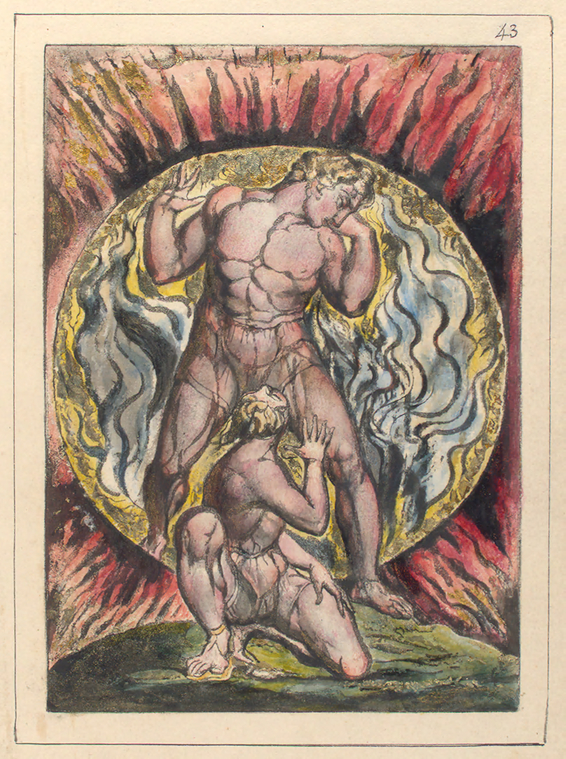
Plate 20 provides a verbal description of the Blake's participation in embarking on the journey. Plate 21 provides the complementary visual event. (In Copy b at the Huntington.)


Milton, PLATE 22 [20], (E 116)

"Tho driven away with the Seven Starry Ones into the Ulro
Yet the Divine Vision remains Every-where For-ever. Amen.
And Ololon lamented for Milton with a great lamentation.

While Los heard indistinct in fear, what time I bound my sandals
On; to walk forward thro' Eternity, Los descended to me:
And Los behind me stood; a terrible flaming Sun: just close
Behind my back; I turned round in terror, and behold.
Los stood in that fierce glowing fire; & he also stoop'd down
And bound my sandals on in Udan-Adan; trembling I stood
Exceedingly with fear & terror, standing in the Vale
Of Lambeth: but he kissed me and wishd me health.
And I became One Man with him arising in my strength:
Twas too late now to recede. Los had enterd into my soul:
His terrors now posses'd me whole! I arose in fury & strength.

I am that Shadowy Prophet who Six Thousand Years ago
Fell from my station in the Eternal bosom. Six Thousand Years
Are finishd. I return! both Time & Space obey my will.
I in Six Thousand Years walk up and down: for not one Moment
Of Time is lost, nor one Event of Space unpermanent
But all remain: every fabric of Six Thousand Years
Remains permanent: tho' on the Earth where Satan
Fell, and was cut off all things vanish & are seen no more
They vanish not from me & mine, we guard them first & last
The generations of men run on in the tide of Time
But leave their destind lineaments permanent for ever & ever.

So spoke Los as we went along to his supreme abode."
.

Thursday, September 29, 2011

PITY TO THE MYSTIC

In William Blake: Poet and Mystic, Pierre Berger writes of the universality of Blake's identification with 'minute particulars' of the created world:

"If, however, mysticism has the effect of destroying or attenuating this personal love and its selfish passions, it has the compensating result of increasing the sentiment of universal sympathy and the primitive feeling of fellowship with all created beings. Blake's work is full of this sympathy and this feeling.
His love has as its object, not only man, but all creatures, animals, even all plants and stones, beneath each of which he perceived a soul resembling his own. None of his predecessors had ever enjoyed such intimate communion with the world of animals and of inert nature. Others had regarded these as wonders of creation, as examples of God's goodness ; had admired them for their beauty, caressed and praised them as faithful servants or lovable companions. But no one had ever loved them as equals, as a brother or a sister might be loved. We must go back to the old Indian philosophers, or to mediaeval mystics like St. Francis of Assisi, to find this sentiment of brotherhood with animals, plants and inanimate things, this immense feeling of tenderness towards them, in which there is neither condescending pity nor any sense of man's superiority. To Blake, they were all spirits, like himself. He went farther even than most mystics : to him, the stone, the cloud, the clod of clay, were not merely each the abode of a spirit, but the spirits themselves, thus made visible to our eyes. He, who could " see a world in a grain of sand/' who found in the caterpillar on the leaf an image of the sorrows of motherhood, who heard the cherubim's song interrupted by the wounding of a lark, was able also to describe in touching words the emotions of the flower or the sparrow, the desire for love felt by the clod of clay, the sadness of the sick rose, or the infinite longings of the sunflower. To him, nothing is insignificant: all things are equal in the world of the eternal. What seems a trifle to others, fills "him full of smiles or tears." He represents himself as a sower who would cast his seed on the sand rather than tear up " some stinking weed." Of him, as of the Man of Sorrows, might it have been written that he would not break the bruised reed, nor quench the smoking flax. Blake would never have declared that he loved the spider and the nettle because other men hated them. That would have been the love that springs from pity. He loved them because they were his equals. Sterne's hero refused to kill a fly, since the world was large enough for it and him. Blake thought the same. But he went further, and saw the fly as a man, and himself as a fly. He ended by identifying himself with it." (Page 246)

 
Songs of Innocence and Experience, 40 (E 23)
THE FLY.

"Little Fly
Thy summers play,
My thoughtless hand
Has brush'd away.

Am not I
A fly like thee?
Or art not thou
A man like me?

For I dance
And drink & sing:
Till some blind hand
Shall brush my wing.

If thought is life
And strength & breath:
And the want
Of thought is death;

Then am I
A happy fly,
If I live,
Or if I die."

Berger: "His soul is one with the soul of all creatures : he feels with them and for them. His immense sympathy is like God's."

Songs of Innocence and Experience, 27, (E 17)
On Anothers Sorrow

"And can he who smiles on all
Hear the wren with sorrows small,
Hear the small bird's grief and care,
Hear the woes that infants bear,

And not sit beside the nest,
Pouring pity in their breast;
And not sit the cradle near,
Weeping tear on infant's tear ?"


The Divine form of Pity is recognition of the kinship of everything in the world which is our gift to inhabit.


Image is from:
Yale Center for British Art
Blake's Water-colours for the Poems of Thomas Gray
Ode on the Spring
No. 6
.

EVE TEMPTED

Blake wrote his Descriptive Catalogue in 1809 in conjunction with his exhibit of his works in his brother James' home. He explains here why he choose not to paint in oils but chose tempera or watercolor instead.

Descriptive Catalogue, (E 530)
"CLEARNESS and precision have been the chief objects in painting
these Pictures. Clear colours unmudded by oil, and firm and
determinate lineaments unbroken by shadows, which ought to
display and not to hide form, as is the practice of the latter

Schools of Italy and Flanders"

One of Blake's temperas, a dramatic scene from the Garden of Eden is in the collection of the Victoria and Albert Museum. Eve must have been as brave as she was beautiful and gullible to accept any gift from Blake's serpent. The sleeping Adam recalls to mind the sleeping Albion of Jerusalem. Look for symbols of the fall, materiality, dominon by the feminine and mystery.

Eve Tempted
Victoria and Albert MuseumGenesis 3
[1] Now the serpent was more subtil than any beast of the field which the LORD God had made. And he said unto the woman, Yea, hath God said, Ye shall not eat of every tree of the garden?
[2] And the woman said unto the serpent, We may eat of the fruit of the trees of the garden:
[3] But of the fruit of the tree which is in the midst of the garden, God hath said, Ye shall not eat of it, neither shall ye touch it, lest ye die.
[4] And the serpent said unto the woman, Ye shall not surely die:
[5] For God doth know that in the day ye eat thereof, then your eyes shall be opened, and ye shall be as gods, knowing good and evil.
[6] And when the woman saw that the tree was good for food, and that it was pleasant to the eyes, and a tree to be desired to make one wise, she took of the fruit thereof, and did eat, and gave also unto her husband with her; and he did eat.
[7] And the eyes of them both were opened, and they knew that they were naked; and they sewed fig leaves together, and made themselves aprons.

Tuesday, September 20, 2011

MENTAL TRAVELLER 1-3


Songs of Experience
, Song 48, (E 27)

INFANT SORROW
"My mother groand! my father wept.
Into the dangerous world I leapt:
Helpless, naked, piping loud;
Like a fiend hid in a cloud.

Struggling in my fathers bands:
Striving against my swadling bands:
Bound and weary I thought best
To sulk upon my mothers breast."


Readers of The Mental Traveller react in a wide variety of ways just as they do to The Tyger. The two poems both deal with contraries and contradictions which are mystifying to a superficial reading. Deeper thought about The Mental Traveller requires acquaintance with the concepts which Blake puts forth in his other work. Acquaintance with the bible, history, literature and psychology can contribute to understanding the metaphors and symbols which he uses. Even with a careful reading individuals can conclude the poem incorporates the whole esoteric import of Blake's work, or, in contrast, that it deals with ordinary relational or emotional experience in this world. We see it according their own gifts or needs.

You will develop your understanding as you work through the 26 verses of the poem. In my next several posts, I will share the thoughts I have as I look at it verse by verse. You may agree with some of what I say and disagree with other. I hope your final (or tentative) understanding will be your own. The title of the poem may mean little to you now; by the end its meaning may have expanded.

1)
"I travelled through a land of men,
A land of men and women too,
And heard and saw such dreadful things
As cold earth wanderers never knew."

Psychologically I think this first verse would indicate that becoming a traveler rather than a wanderer in the world of generation (men and women) requires a choice and a commitment. There are things to be learned but unless the eyes are opened, and steps are taken with deliberation, one remains within the group consciousness which prevents one from seeing things as they are. The idea that one must embark on a journey is a recurring theme in Blake. Gates of Paradise begins with the babe encased in the chrysalis with the potential for development. The Mental Traveller has started the journey and sees things that are not pretty or pleasing, but this is the price of pursuing the path of experience.

Dreadful is used as a subjective term; what one person fears another anticipates. The wanderer avoids letting these dreadful things into consciousness and so limits himself to the known, the comfortable and the dull.

All Religions are One, (E1)
"PRINCIPLE 4. As none by traveling over known lands can find out
the unknown. So from already acquired knowledge Man could not
acquire more. therefore an universal Poetic Genius exists"

The fearful symmetry is the contraries; what burns bright in the night
are the 'dreadful things'. By letting oneself see and hear these
'dreadful things' an opening is created for the appearance of the babe.

2)
"For there the babe is born in joy
That was begotten in dire woe,
Just as we reap in joy the fruit
Which we in bitter tears did sow;"

Blake introduces the contraries: joy and woe, reap and sow, begotten and born. We are entering a new phase. The period of joy begins with the birth of the babe. The period of tears and woe have produced a new beginning.

Auguries of Innocence (E 491)
"Man was made for Joy & Woe
And when this we rightly know
Thro the World we safely go
Joy & Woe are woven fine
A Clothing for the soul divine
Under every grief & pine
Runs a joy with silken twine
The Babe is more than swadling Bands
Throughout all these Human Lands"

3)
"And if the babe is born a boy
He’s given to a woman old,
Who nails him down upon a rock,
Catches his shrieks in cups of gold."

The babe who is born a boy, as male, represents the spiritual nature. So we will look at the situation from the perspective of spirit. Being bound to matter, to fallen nature, to Vala is agonizing. The boy is forced to forgo the expression of his energy and desire. But he was given to the old woman; he is born into materiality. (As in one of Blake's images, his Spectre has had a body woven for him by Enitharmon.) The woman is in need of what he can give, even his shrieks of pain. He is aware of receiving nothing in return.

In verses 1-3 the stage is set. Our Traveller is journeying through the land of men. He sees that a babe joyfully has been born out of the struggle and sorrow which preceded him. The babe is given to an old woman who deprives him of his freedom.

Here is another blog post which sheds light on The Mental Traveller.

Monday, September 19, 2011

MENTAL TRAVELLER 4-6


Complete text for Blake's The Mental Traveller.

As we continue to read through the poem we see the balance of power shifting.


4)

"She binds iron thorns around his head,
And pierces both his hands and feet,
And cuts his heart out of his side
To make it feel both cold & heat."

The image Blake creates is not limited to the situation he directly describes. He insists that we think of Jesus, Albion, Orc and Prometheus as well. In Jesus we see the crucifixion, and the lamb which is sacrificed to the demanding God. In Orc we see spirit of revolution which is ready to explode into conflagration. In Prometheus we see the thief of fire who suffered for his gift to humanity.

Blake uses symbols and images to suggest more than he says in words. The words suggest crucifixion to some. The word 'binds' suggests to me the situation when Los and Enitharmon bound Orc to the rock because of Los' jealousy. It is an easy jump from Orc to Prometheus and from there to the broader story of Prometheus stealing fire, being bound to a rock, suffering from heat and cold, having his liver eaten by the eagle, and being associated with Pandora.

It is with great difficulty that the old woman who is past her time of strength and influence can subdue the vigorous boy. In her weakness she asserts all the powers she has acquired through the ages.

For a time the energies that the boy represents can be suppressed through forceful measures. As long as her strength endures, the old woman keeps each of his abilities under her control.

5)
"Her fingers number every nerve
Just as a miser counts his gold;
She lives upon his shrieks and cries—
And she grows young as he grows old,"

Recently I was reading about the Mental Traveller in Raine's Blake and Antiquity. She includes it in a section called The Myth of the Great Year. She sees an alternation between the spirit and the material as an age is born and matures and dies.

What I picked up from Raine focused on the image of spiritual development and material development as being opposed movements, each of which follows the same path as the human body from birth and infancy through maturity to aging and death. However the culture that is old in spirit is young in material and visa versa. Each aspect nourishes the other and is nourished by the other, but they compete for resources and power and for 'air time'.

In these four lines of the poem, the aging civilization (conservative and materialistic) had depleted her own sources of energy. The babe is potential energy which she aims to tap into in order to replenish her own diminished supply of ideas and initiatives. Spiritual life in its infant stage may make a lot of noise and be disturbing in its exuberance. The old culture may be able to apply this to her own ends. (She may even be able to use it to start wars, or to get the other party elected.)

The infusion of energy enhances the old organization, but it diminishes the freshness and vitality of the new.

6)
"Till he becomes a bleeding youth
And she becomes a virgin bright;
Then he rends up his manacles
And pins her down for his delight."

The bleeding could be the red of torture, of passion, of fire, of wine, of war, or of
sacrifice.

To continue the civilization metaphor a point has been reached where the old and young each have something to give and something to receive. When a balance is reached the male, spiritual interest asserts itself and becomes dominant. This exchange of positions is no healthier than the previous one, because of the oppression and suffering which has taken place has left wounds and scars. (The child who grows up abused may not be healed by achieving his freedom.)

These three verses develop the idea of force and struggle. There is not any agreement between this male and female. Each uses whatever force is available to him/her to dominate the other. This demonstrates the paradigm that the use of force perpetuates itself and that force cannot be overcome by force. Other strategi
es can undermine the force in power.
.

Sunday, September 18, 2011

MENTAL TRAVELLER 7-9

The Mental Traveller

7)
"He plants himself in all her nerves
Just as a husbandman his mould,
And she bcomes his dwelling-place

And garden, frutiful seventyfold."

Note: judging from the context, 'mould' is the rich, loose workable soil which farmers are fond of.

Much to the surprise of the old woman (parhaps Vala), the boy (perhaps now Los) is able to use what she has unintentionally provided to him. His delight is to create a productive garden in which he can multiply the seed which he has received in order to produce a harvest of abundant fruit.

The boy is not separate from the medium through which he gains expression; he dwells in it as it dwells in him.

Annotations to Lavater,
(E 599)
"Whoso dwelleth in love dwelleth in God &
God in him. & such an one cannot judge of any but in love."

John 6: 56 "He that eateth my flesh, and drinketh my blood, dwelleth in me, and I in him."

Going back to the civilization metaphor, the young spiritual ideas can feed on the substance which has been produced by the older weakening material civilization. Think of the houses we live in, the buildings we occupy, the roads we drive on, the books we read as being a legacy from the civilization which may be replaced by a more vigorous one.

The phrase, "
plants himself in all her nerves", if a metaphor for an event in a culture, may be seen as merely descriptive or as something more sinister. The culture which is being invaded by alien ideas is likely to see it as 'wrong'. Western and Muslim cultures are presently struggling against invasions from the ideas of the contrary culture and neither likes it.

8)
"An aged shadow soon he fades,
Wandering round an earthly cot,
Full filled all with gems and gold
Which he by industry had got."

Our male child has grown through adolescence, and maturity and reached old age. He passed his zenith and is now on the decline. But his garden was planted and his crop harvested. His expansive purposeful traveling is now reduced to wandering and resting. But he is not destitute; his efforts have produced the things he values.

As the spiritual side of a civilization matures it produces arts and ideas. The cultural treasures accumulate. Think of the accumulation of treasures from the burst of intellectual and imaginative thought of Athens; or think of the manuscripts and music produced in the monasteries of the middle ages. These are the 'gems and gold' of the spirit.
Jerusalem, Plate 12, (E 154)
"What are those golden builders doing?...

Becoming a building of pity and compassion? Lo!
The stones are pity, and the bricks, well wrought affections:
Enameld with love & kindness, & the tiles engraven gold
Labour of merciful hands: the beams & rafters are forgiveness:
The mortar & cement of the work, tears of honesty: the nails,
And the screws & iron braces, are well wrought blandishments,
And well contrived words, firm fixing, never forgotten,
Always comforting the remembrance: the floors, humility,
The cielings, devotion: the hearths, thanksgiving:
Prepare the furniture O Lambeth in thy pitying looms!
The curtains, woven tears & sighs, wrought into lovely forms
For comfort. there the secret furniture of Jerusalems chamber
Is wrought: Lambeth! the Bride the Lambs Wife loveth thee:
Thou art one with her & knowest not of self in thy supreme joy.
Go on, builders in hope: tho Jerusalem wanders far away,
Without the gate of Los: among the dark Satanic wheels."


9)
"And these are the gems of the human soul:
The rubies and pearls of a lovesick eye,
The countless gold of an aching heart,
The martyr’s groan, and the lover’s sigh."

The gold and gems of the human soul are not acquired through power and success but through understanding, suffering, sacrifice and love. These are the lasting things of which Jesus spoke and of which Paul spoke in Corinthians and Philippians.

Matthew 6:19 "Lay not up for yourselves treasures upon earth, where moth and rust doth corrupt, and where thieves break through and steal
20 But lay up for yourselves treasures in heaven, where neither moth nor rust doth corrupt, and where thieves do not break through nor steal:"

1 Corinthians 13:13 "And now abideth faith, hope, charity, these three; but the greatest of these is charity."

Philippians 4:8 "Finally, brethren, whatsoever things are true, whatsoever things are honest, whatsoever things are just, whatsoever things are pure, whatsoever things are lovely, whatsoever things are of good report; if there be any virtue, and if there be any praise, think on these things."

Blake presented to us the idea of building Golgonooza a safe haven from the satanic activities of the fallen world. In Golgoonooza: City of Imagination, Kathleen Raine sees Golgonooza as an attempt to make visible the archetypal city of Eternity by those who remember Eternal things. Lovers of wisdom, poets, painters, architects - those with imagination - are the agents (Los and his sons) for building Golgonooza. Within London the the spiritual Four-fold eternal city is to take form as multiple pathways or gates into Great Eternity.

Verses 7-9 epitomize the productive aspects of the spiritual culture. Cooperation with the material rather than competition with it, allowed the accumulation of spiritual treasure even though the civilization created by a burst or spiritual insight was aging.
.