Blake seeks to provide the Golden String which can lead us through the labyrinth of our experience or his own poetry.

Sunday, September 16, 2012

MILTON'S L'ALLEGRO III

In his manuscript notes accompanying his watercolors Blake singles out these verses from Milton for his third illustratation to L'Allegro:
Descriptions of Illustrations to Milton's L'Allegro and Il Penseroso, (E 682)
"Sometime walking not unseen 
By hedgerow Elms on Hillocks green 
Right against the Eastern Gate 
When the Great Sun begins his state 
Robed in Flames & amber Light 
The Clouds in thousand Liveries dight 
While the Plowman near at hand 
Whistles o'er the Furrow'd Land 
And the Milkmaid singeth blithe 
And theMower whets his Scythe 
And every  Shepherd tells his Tale 
Under the  Hawthorn in the Dale" 

Blake states: 
"The Great Sun is represented clothed in Flames Surrounded by the Clouds in their Liveries, in their various Offices at the Eastern Gate. beneath in Small Figures Milton walking by Elms on Hillocks green The Plowman. The Milkmaid The Mower whetting his Scythe. & The Shepherd & his Lass under a Hawthorn in the Dale"
 
The Great Sun is the Spiritual Sun the source of light not measured in wavelengths and frequencies. The spiritual sun is the source of true existence which partakes of the eternal and infinite energy of life. It announces its presence by increased clarity of perception expressed in truth, mercy and grace.

Blake used the Lark as the symbol of the messenger of Los; he uses the symbol of the sun as Los himself as both the message and the source of the message.
In this picture Blake uses scale as one of the means to distinguish between the natural world and the Eternal world. In the third illustration to L'Allegro Blake follows the text he is illustrating but changes the emphasis by using most of the page to present the sun at his eastern gate. The occupants of the mundane world, including Milton, appear the bottom of the page as small easily overlooked figures. Four levels of existence can be distinguished in the image. The pastoral level of this earth is represented in the strip at the bottom of the page. Surrounding the sun is the level of Beulah as dominated by the feminine. Within the disc of the sun is the fiery transformative level. The primary figure which overlaps the other three layers is the Great Sun in his Human or Divine form. 

Marriage of Heaven & Hell, Plate 4, (E 34)
 "But the following Contraries to these are True
  1 Man has no Body distinct from his Soul for that calld Body is
a portion of Soul discernd by the five Senses. the chief inlets
of Soul in this age
  2. Energy is the only life and is from the Body and Reason is
the bound or outward circumference of Energy.
  3 Energy is Eternal Delight"

Vision of Last Judgment, (E 565)
"I assert for My self that I do
not behold the Outward Creation & that to me it is hindrance &
not Action it is as the Dirt upon my feet No part of Me. What it
will be Questiond When the Sun rises  do  you  not  see  a  round -  
Disk of fire somewhat like a Guinea O no no I see an Innumerable
company of the Heavenly host crying Holy Holy Holy is the Lord
God Almighty I question not my Corporeal or Vegetative Eye any
more than I would Question a Window concerning a Sight I look
thro it & not with it."  

Letters, To Trusler, (E 702)
"And I know that This World Is a
World of Imagination & Vision I see Every thing I paint In This
World, but Every body does not see alike.  To the Eyes of a Miser
a Guinea is more beautiful than the Sun & a bag worn with the use
of Money has more beautiful proportions than a Vine filled with
Grapes."  

Four Zoas, Night IX, Page 128, (E 396)
[Vala speaking]
"Rise up O Sun most glorious minister & light of day
Flow on ye gentle airs & bear the voice of my rejoicing 
Wave freshly clear waters flowing around the tender grass
And thou sweet smelling ground put forth thy life in fruits & flowers
Follow me O my flocks & hear me sing my rapturous Song
I will cause my voice to be heard on the clouds that glitter in the sun
I will call & who shall answer me   I will sing   who shall reply
For from my pleasant hills behold the living living springs
Running among my green pastures delighting among my trees"

Milton, Plate 21 [23],(E 116)
"He heard them call in prayer all the Divine Family;              
And he beheld the Cloud of Milton stretching over Europe.

But all the Family Divine collected as Four Suns
In the Four Points of heaven East, West & North & South
Enlarging and enlarging till their Disks approachd each other;
And when they touch'd closed together Southward in One Sun       
Over Ololon: and as One Man, who weeps over his brother,
In a dark tomb, so all the Family Divine. wept over Ololon."

Four Zoas, Night IX, Page 138, (E 406)
"Such are the works of Dark Urthona Tharmas sifted the corn
Urthona made the Bread of Ages & he placed it
In golden & in silver baskets in heavens of precious stone
And then took his repose in Winter in the night of Time

The Sun has left his blackness & has found a fresher morning     
And the mild moon rejoices in the clear & cloudless night  
And Man walks forth from midst of the fires the evil is all consumd
His eyes behold the Angelic spheres arising night & day
The stars consumd like a lamp blown out & in their stead behold
The Expanding Eyes of Man behold the depths of wondrous worlds
One Earth one sea beneath nor Erring Globes wander but Stars
Of fire rise up nightly from the Ocean & one Sun
Each morning like a New born Man issues with songs & Joy
Calling the Plowman to his Labour & the Shepherd to his rest
He walks upon the Eternal Mountains raising his heavenly voice   
Conversing with the Animal forms of wisdom night & day
That risen from the Sea of fire renewd walk oer the Earth"
.

Friday, September 14, 2012

MILTON'S L'ALLEGRO II

In his manuscript notes accompanying his watercolors Blake singles out these verses from Milton for his second illustratation to L'Allegro:


Descriptions of Illustrations to Milton's L'Allegro and Il Penseroso, (E 682)    


2        "To hear the Lark begin his flight
          From his Watch Tower in the Skies
          Till the dappled Dawn does rise"

 Blake states: 

 "The Lark is an Angel on the Wing Dull Night starts from his Watch Tower on a Cloud. The Dawn with her dappled Horses arises above the Earth The Earth beneath awakes at the Larks Voice"


Blake chose for his second illustration to L'Allegro to focus on a few lines which are apropos for describing his own perception of how messages are received from the Eternal world. He created a picture in which each object represents something other than what would be seen by the natural eye. He pictures the Lark as an Angel, the Night as a concerned old man watching in the cloudy sky, and the Dawn as a young woman arriving with her horses. He pictures the Earth as an eager young man gazing expectantly upward.

Mirth to Blake was an undifferentiated state with possibilities of going in multiple directions toward wantonness, or toward joy, or toward earthly satisfactions. On the contrary "To hear the Lark begin his flight" was a totally positive experience. It meant an invitation into a visionary world where ordinary things became carriers of messages of heaven. To hear the Lark is to become open to "an immense world of delight closed to [our] senses five." The common world is indeed dull and dark compared to that visited by Blake in his imagination.


Marriage of Heaven & Hell, Plate 5, (E 35)
"How do you know but ev'ry Bird that cuts the airy way,
Is an immense world of delight, clos'd by your senses five?"
 
Milton, Plate 35 [39], (E 136)

"Just at the place to where the Lark mounts, is a Crystal Gate
It is the enterance of the First Heaven named Luther: for
The Lark is Los's Messenger thro the Twenty-seven Churches
That the Seven Eyes of God who walk even to Satans Seat
Thro all the Twenty-seven Heavens may not slumber nor sleep      

But the Larks Nest is at the Gate of Los, at the eastern
Gate of wide Golgonooza & the Lark is Los's Messenger

PLATE 36 [40]
When on the highest lift of his light pinions he arrives
At that bright Gate, another Lark meets him & back to back
They touch their pinions tip tip: and each descend
To their respective Earths & there all night consult with Angels
Of Providence & with the Eyes of God all night in slumbers       
Inspired: & at the dawn of day send out another Lark
Into another Heaven to carry news upon his wings
Thus are the Messengers dispatchd till they reach the Earth again
In the East Gate of Golgonooza, & the Twenty-eighth bright
Lark. met the Female Ololon descending into my Garden            
Thus it appears to Mortal eyes & those of the Ulro Heavens
But not thus to Immortals, the Lark is a mighty Angel."
.

Wednesday, September 12, 2012

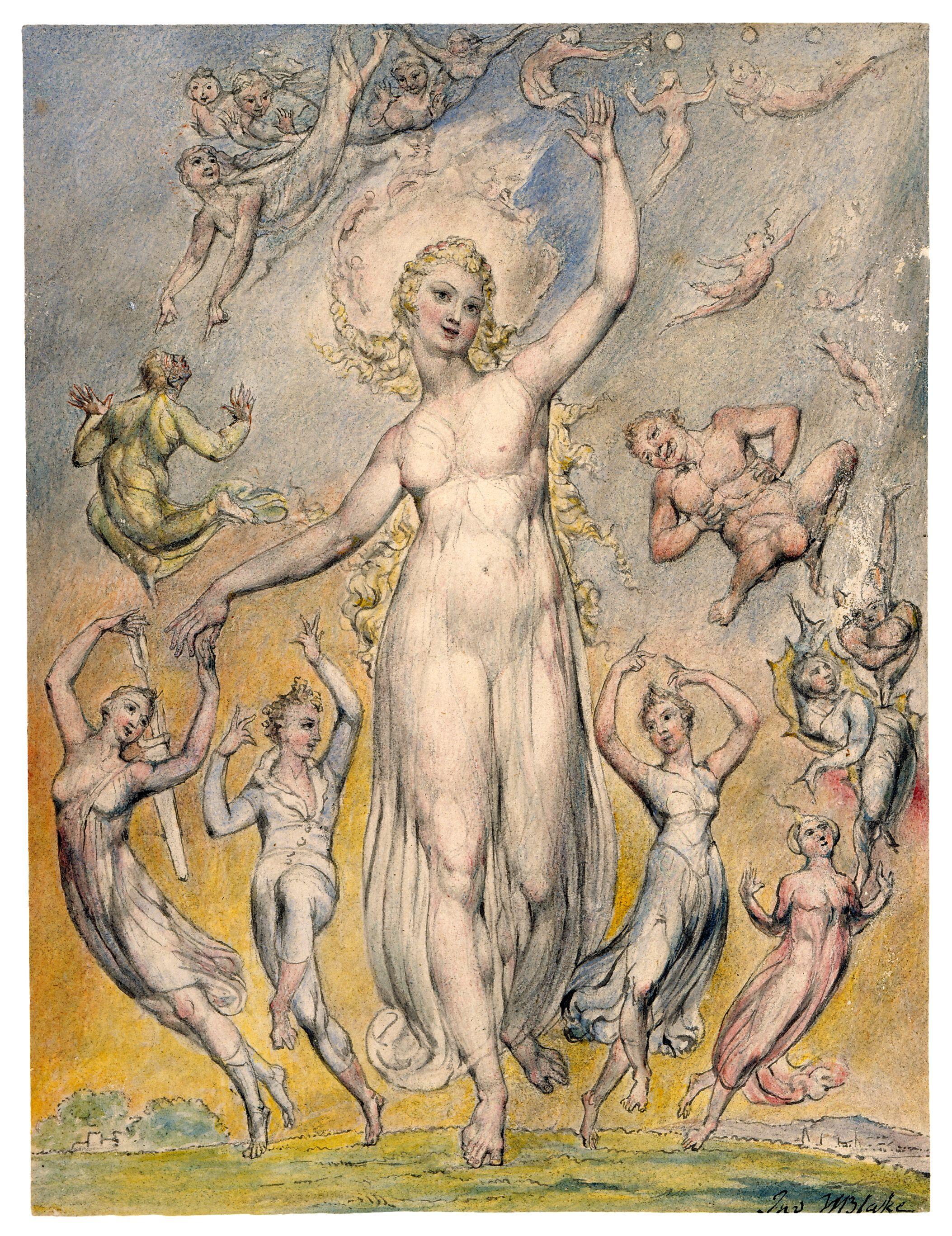
MILTON'S L'ALLEGRO

One series of Blake's illustrations to the poems of John Milton includes the unusual feature of commentary by Blake himself. Blake's watercolor illustration to L'Allegro and Il Penseroso created after 1816 for Thomas Butts is now in the collection of the Morgan Library & Museum. Martin Butlin in the Tate Publication William Blake, states that Blake used the series to 'illustrate the whole development of Milton's poetic life from the early state of Innocence inspired by mirth, through the Experience of Melancholy to the final maturity that produced Paradise Lost.'(Page 118) Perhaps as well as seeing Milton's life reflected in the images, one can find passages in Blake's writings to associate with the images created for L'Allegro and Il Penseroso.

In his manuscript notes accompanying his watercolors Blake singles out these verses from Milton to illustrate:
Descriptions of Illustrations to Milton's L'Allegro and Il Penseroso, (E 682)  
 
1         "Heart easing Mirth.
          Haste thee Nymph & bring with thee
          Jest & Youthful Jollity
          Quips & Cranks & Wanton Wiles
          Nods & Becks & wreathed smiles
          Sport that wrinkled Care derides
          And Laughter holding both his Sides
          Come & trip it as you go
          On the light phantastic toe
          And in thy right hand lead with thee
          The Mountain Nymph Sweet Liberty" 
 
 
Blake states:
"These Personifications are all brought together in the First
Design.  Surrounding the Principal Figure which is Mirth herself"
 
In his comment Blake makes it clear that his images in this illustration
are personification of states; each figure represents a state that 
Milton mentioned. 
 
Of particular interest is Liberty since Blake says:        
 "JERUSALEM IS NAMED LIBERTY 
       AMONG THE SONS OF ALBION" (Jerusalem, Plate 26, (E 171)) 

Miscellaneous Poems, Song, (E 414)
"I love the laughing vale,     
  I love the echoing hill,
Where mirth does never fail,
  And the jolly swain laughs his fill."

Satiric Verses and Epigrams, (E 502)
"The Angel that presided oer my birth
Said Little creature formd of Joy & Mirth    
Go love without the help of any King on Earth"

Letters, To Trusler,(E 702)
 "Fun I love
but too much Fun is of all things the most loathsom.  Mirth is
better than Fun & Happiness is better than Mirth--I feel that a
Man may be happy in This World." 
 
This image can be dramatically enlarged by right clicking and selecting open in a new window. The enlarged image will be highly detailed.
.

Monday, September 10, 2012

LIFE'S WORK X

Blake took the two tools he had at hand: the ability to write poetry and the ability to create images. These he applied to the task before him: 'the desire of raising other men into a perception of the infinite.' Accessing the visionary world which he sought to share with his brothers and sisters through his imagination required that his 'doors of  perception' be 'cleansed'. This he accomplished through annihilating his Selfhood by means of forgiving. This was his life's work.

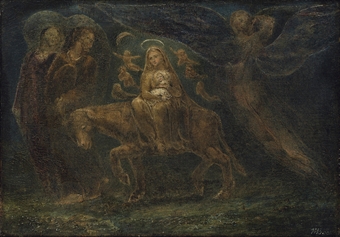
Roger Fry, in his article Three Pictures in Tempera by William Blake in the Burlington Magazine (1904), later reprinted in the book Vision and Design, paid tribute to Blake as an artist. Fry recognised art as the vehicle for conveying thought and spirit through symbolic language in both verbal and visual images. One of the three temperas commented on in the article was Flight into Egypt.

Flight into Egypt
1799
In the following passage from Fry the embedded quote is from Blake's Descriptive Catalogue (E 541).

"Blake's art indeed is a test case for our theories of aesthetics. It boldly makes the plea for art that it is a language for conveying impassioned thought and feeling, which takes up the objects of sense as a means to this end, owing them no allegiance and accepting from them only the service that they can render for that purpose. 'Poetry' says Blake, 'consists of bold, daring, and masterly conceptions; and shall painting be confined to the solid drudgery of facsimile representations of merely mortal and perishing substances, and not be, as poetry and music are, elevated into its own proper sphere of invention and visionary conception?' The theory that art appeals solely by the associated ideas of the natural object it imitates is easily refuted when we consider music and architecture; in those at least the appeal to the spirit is made directly in a language which has no other use than that of conveying its own proper ideas and feelings. But in pictorial art the fallacy that nature is the mistress instead of the servant seems almost ineradicable, and it is difficult to convince people the increased scientific investigation of phenomena, increased knowledge of how thing present themselves to our sight changes the mode, but does not necessarily increase the power, of pictorial expression...The essential power of pictorial as of all other arts lies in the use of a fundamental and universal symbolism, and whoever has the instinct for this can convey his ideas, though possessed of only the most rudimentary knowledge of the actual forms of nature; while he who has it not can by no accumulation of observed facts add anything to the spiritual treasure of mankind. Of this language of symbolic form in which the spirit communicates its most secret and indefinable impulses Blake was an eloquent and persuasive master. He could use it, too, to the most diverse ends; and though the sublimity which is based on dread came most readily to his mind,
...
To an artist like Blake, who wished to give visible form to profound and universal conceptions, a mythology was essential, and so intense was his imaginative grasp that he was able to recreate Christian and Hebrew mythology, giving them and essentially modern significance. He even attempted to invent a fresh and national mythology of which Albion was the protagonist. Whether he lacked the power, or whether the temper of his age was too contrary, the attempt was abortive. How different would have been the history of nineteenth-century art had Blake been able to impose on us a living mythology, held not necessarily as literally true, but as the only means of expressing in visible form our surmises about the eternal verities." Roger Fry - Page 144

Blake uses the inscriptions on the Laocoon engraving to expound his ideas about art and religion.
Laocoon, (E 273)
"Prayer is the Study of Art
Praise is the Practise of Art
Fasting &c. all relate to Art
The outward Ceremony is Antichrist
Without Unceasing Practise nothing can be done 

Practise is Art     If you leave off you are Lost

A Poet a Painter a Musician an Architect: the Man 
Or Woman who is not one of these is not a Christian 
You must leave Fathers & Mothers & Houses & Lands 
     if they stand in the way of ART

The unproductive Man is not a Christian"
. 

Saturday, September 8, 2012

LIFE'S WORK IX

Although Linnell was not a wealthy man when he knew Blake, his friend was much poorer. One way Linnell sought to improve Blake's finances was through the publication of Blake's series of images for the Book of Job. Linnell agreed to pay Blake to make engravings. The two men were to share the profit when the sets were sold. Blake was supported on a modest scale by the payments from Linnell but no significant profits were realised.

The series of engravings made through the close cooperation of the two men as fellow artists and business partners, are considered to be the apex of Blake's engraving career. Kathleen Raine feels that Blake also achieved his highest level of communicating his spiritual vision through this series of engraved plates. 

Illustrations of the Book of Job
Plate 5
1826

In Kathleen Raine's biography, William Blake, she describes the final phase of  Blake's Life's Work in Chapter eleven. Blake's production of Illustrations of the Book of Job was a fitting culmination to a life well spent.

Raine Wrote:

"Blake's Illustrations of the Book of Job are more than an illustration of the Bible; they are in themselves a prophetic vision, a spiritual revelation, at once a personal testimony and replete with Blake's knowledge of Christian Cabbala, Neoplatonism, and the mystical theology of the Western Esoteric tradition as a whole. They are a complete statement of Blake's vision of man's spiritual drama. The true God is the 'God within', enthroned in every human soul; the 'divine humanity' whose lineaments are  those of Job himself. 'Satan, the Selfhood' is permitted to tempt Job. It is this Selfhood who makes havoc of Job's world; and as Satan assumes power, so the interior vision darkens and the 'God within' falls into the 'deadly sleep' of spiritual amnesia (Plate 5). Satan's supreme deception (Blake has given expression to this in Milton) is his claim to be God; a god external to the soul, framer of the moral law based on the natural order of 'one law  for the lion and ox'. Job's three friends are clearly based on his own Zoas: Tharmas (the sensual man), Luvah (the man of feeling), and Urizen (the reasoner). The beautiful figure of Elihu, who, in Plate 12, ushering the first light of dawn among the fading stars, causes Job to look up in hope, is evidently Los, the poetic imagination, who 'kept the divine vision in time of trouble'." (Page 186 )
 
Jerusalem, Plate 15, (E 159)
"In every Nation of the Earth till the Twelve Sons of Albion
Enrooted into every Nation: a mighty Polypus growing
From Albion over the whole Earth: such is my awful Vision.   

I see the Four-fold Man. The Humanity in deadly sleep
And its fallen Emanation. The Spectre & its cruel Shadow.
I see the Past, Present & Future, existing all at once
Before me; O Divine Spirit sustain me on thy wings!
That I may awake Albion from His long & cold repose.             
For Bacon & Newton sheathd in dismal steel, their terrors hang
Like iron scourges over Albion, Reasonings like vast Serpents
Infold around my limbs, bruising my minute articulations

I turn my eyes to the Schools & Universities of Europe
And there behold the Loom of Locke whose Woof rages dire  
Washd by the Water-wheels of Newton. black the cloth
In heavy wreathes folds over every Nation; cruel Works
Of many Wheels I View, wheel without wheel, with cogs tyrannic
Moving by compulsion each other: not as those in Eden: which
Wheel within Wheel in freedom revolve in harmony & peace." 
. 

Thursday, September 6, 2012

LIFE'S WORK VIII

Not long after Blake and Linnell met they cooperated in engraving a commission which Linnell had for an image of a Baptist minister. Blake as a youth had been trained in traditional engraving techniques during his apprenticeship. He was resistant to some of the methods of engraving which were later introduced to save labor.  Linnell was less trained and less experience in engraving but had been introduced to techniques which Blake could see were valuable. Because the two men respected one another personally and acknowledged the artistic abilities of the other, they were able to work together as a team.

Linnell's journal includes references to several occasions when the two men attended exhibitions or visited museums. The pleasure that they had in viewing and critiquing artwork together would have been multiplied when they visited the home of Thomas Butts, Blake's primary patron. There Linnell would have seen for the first time hundreds of images which Blake had produced for Butts including the illustrations to Paradise Lost, dozens of illustrations to the Old Testament and to the New  Testament, illustrations to Milton's Comus and On the Morning of Christ's Nativity and more. The set of illustrations from 1805-6 to the Book of Job so impressed Linnell that he commissioned a copy be produced for him. 

In 1821 Linnell and Blake traced the outlines from the Butts images in order for Blake to make the copies. The Linnell set of Job images can be viewed in the Blake Archive, and compared to the Butts set. Here is the fourth image from the Linnell set as found on Wikimedia.

Illustrations to the Book of Job
Linnell Set, 1821
The Messengers Tell Job of His Misfortunes

We can be sure that Blake was conveying his ideas about visionary art to his friend during the time they spent together.

Vision of the Last Judgment, (E 554)
    " The Nature of Visionary Fancy or Imagination is very little
Known & the Eternal nature & permanence of its ever Existent
Images is considerd as less permanent than the things of
Vegetative & Generative Nature yet the Oak dies as well as the
Lettuce but Its Eternal Image & Individuality never dies. but
renews by its seed. just the Imaginative Image
returns the seed of Contemplative
Thought the Writings of the Prophets illustrate these conceptions
of the Visionary Fancy by their various sublime & Divine Images
as seen in the Worlds of Vision
...
  This world of Imagination is the World of
Eternity it is the Divine bosom into which we shall all go after
the death of the Vegetated body   This World is
Infinite & Eternal whereas the world of Generation or Vegetation
is Finite & Temporal    There Exist
in that Eternal World the Permanent Realities of Every Thing
which we see are reflected in this Vegetable Glass of Nature
     All Things are comprehended in their Eternal Forms in the
Divine body of the Saviour the True Vine of Eternity
The Human Imagination who appeard to Me as Coming to Judgment.
among his Saints & throwing off the Temporal that the Eternal
might be Establishd. around him were seen the Images of
Existences according to a
certain order suited to my Imaginative Eye"
 
From the Victorian web we find a quote from Linnell about Blake published in The Life of John Linnell by A. T. Story in 1892:
"I soon encountered Blake's peculiarities, and was sometimes taken aback by the boldness of some of his assertions. I never saw anything the least like madness. I never opposed him spitefully, as many did. But being really anxious to fathom, if possible, the amount of truth that there might be in his most startling assertions, I generally met with a sufficiently rational explanation in the most really friendly and conciliatory tone. Even to John Varley, to whom I had introduced Blake, and who readily devoured all the marvellous in Blake's most extravagant utterances — even to Varley Blake would occasionally explain, unasked, how he believed that both Varley and I could see the same visions as he saw — making it evident to me that Blake claimed the possession of some powers, only in a greater degree, that all men possessed, and which they undervalued in themselves, and lost through love of sordid pursuits, pride, vanity, and the unrighteous Mammon."  

. 

Tuesday, September 4, 2012

LIFE'S WORK VII


Drawings of William Blake
Selection, Introduction and Commentary by Geoffery Keynes
Head of Infant in a Bonnet


Rachel Campbell-Johnston's biography Mysterious wisdom: The Life and work of Samuel Palmer includes chapters on Blake and on Linnell who were Palmer's friends and mentors. Speaking of Blake and Linnell, Campbell-Johnston remarks:

"And yet the two men had much in common. They were both religious dissenters and political radicals; they shared a reverence for the scriptures and had both learned Hebrew and Greek; they admired the art of Michaelangelo, Durer and Van Eyck and; both the sons of tradesmen, they preferred simple manners to a smart social life. Their friendship was to span the last decade of Blake's life. They would visit each other's studios, go to plays together, dine with mutual acquaintances and gaze at pictures side by side. .."
(Page 65)   

Blake was a welcome visitor to Linnell's home at Cirencester Place and after the move in 1820 of Linnell's family to the country, at the Collins Farm in Hampstead. Linnell's first child Hannah was born in 1818; there would be 8 more to follow. Blake made a drawing on one of the Linnell children as an infant. In these letters is a discussion of the naming on one of the Linnell children, 'a fine boy', born in 1826. The four sons of the Linnells were named James, Thomas, William and John.
Letters, (E 778)

"[To] John Linnell Esqre Cirencester Place
5 July 1826
Dear Sir
     I thank you for the Receit of Five Pounds this Morning &
Congratulate you on the receit of another fine Boy am glad to
hear of Mrs Linnells health & safety
     I am getting better every hour my Plan is diet only & if the
Machine is capable of it shall make an old man yet: I go on Just
as If perfectly well which indeed I am except in those paroxysms
which I now believe will never more return Pray let your own
health & convenience put all solicitude concerning me at rest You
have a Family I have none there is no comparison between our
necessary avocations
Believe me to be Dr Sir
Yours Sincerely
WILLIAM BLAKE" 
 
 Letters,(E 779)
To John Linnell Esqre Circencester Place,
Fitzroy Square

Sunday Afternoon July 16--1826
[Postmark: Noon 17 Jy]
Dear Sir
     I have been ever since taking Dr Youngs Addition to Mr
Finchams Practise with me ([It] <The Addition> is
dandelion) In a Species of Delireum & in Pain too much for
Thought It is now passed as I hope But the moment I got ease of
Body. began Pain of Mind [word del.] & that not a small one It it
about The Name of the Child which Certainly ought to be
Thomas. after Mrs Linnells Father It will be brutal not to say
Worse for it is worse In my opinion <& on my Part>.  Pray
Reconsider it if it is not too late It very much troubles Me as a
Crime in which I shall [be] [a] <The> Principal.  Pray
Excuse this hasty Expostulation & believe me to be Yours
Sincerely
WILLIAM BLAKE
 
From the website for redhill-reigate-history we learn more to the child named after William Blake:
"William, the third son of John Linnell, is said to have been named after the painter William Blake. He became a prolific and talented painter in his own right and exhibited at the Royal Academy and at other art exhibitions. He probably worked and lived more in London and abroad than at Redhill, although he did have an art school in Redhill where he taught many people to draw and paint."
.