Blake seeks to provide the Golden String which can lead us through the labyrinth of our experience or his own poetry.

Wednesday, February 13, 2013

BLAKE'S FURNACES

To appreciate Blake's use of the furnace it is helpful to have observed some process of shaping metal through the use of heat and force. Seeing a blacksmith shaping horseshoes or hardware impresses one with a process which requires considerable energy and violence. Add to this the force required in extracting ores and the heat required to change a solid metal into liquid. With this in mind, the furnaces of Blake gain a added dimension which emphasizes the extreme measures to which he alludes.   
Perhaps the earliest reference to a furnace in Blake's poetry come in his poem in Songs of Experience named The Tyger. The fourth verse states:

"What the hammer? what the chain, 
In what furnace was thy brain?
What the anvil? what dread grasp,                    
Dare its deadly terrors clasp!"  
Songs of Innocence & Experience, Song 42, (E 24)

Hammer, chain, furnace, anvil: these words all direct our attention to the shaping of metal, a hard and resistant material, into some desired or useful form. That the process would induce terror if their use were suggested to be applied to a living thing is axiomatic. Yet Blake finds the furnace an appropriate metaphor for the measures which are required for altering the human brain which has through the ages produced societies which result in so much suffering and pain in their members. He returns to the symbol of the furnace often, especially in the hands of Los, as the tool to which he must resort in opposition to mental constructs which produce oppressive conditions.

The title page of The Book of Los shows Los situated in a confining enclosure surrounded on all sides by unyielding rock. This is the condition which requires the use of a refining, reshaping furnace.
Commentary introducing The Book of Los in Blake's Poetry and Design, Edited by Mary Lou Johnson and John E. Grant indicates that:
"It is evident in both [The Book of] Urizen and [The Book of] Los that the blacksmith Los is a s
killed craftsman; he has built his own tools and knows how to use them. But he is not yet the artist he is in Jerusalem or a  true prophet as he is in Milton; the product of his imaginings in Los is only the 'Human Illusion,' a conception of mankind as mind contained and confined in flesh.' (Page 169)
Book of Los, Plate 5, (E 94)
"2: Upfolding his Fibres together
To a Form of impregnable strength
Los astonish'd and terrified, built                 
Furnaces; he formed an Anvil
A  Hammer of adamant then began
The binding of Urizen day and night

3: Circling round the dark Demon, with howlings
Dismay & sharp blightings; the Prophet               
Of Eternity beat on his iron links

4: And first from those infinite fires
The light that flow'd down on the winds
lie siez'd; beating incessant, condensing
The subtil particles in an Orb.                    

5: Roaring indignant the bright sparks
Endur'd the vast Hammer; but unwearied
Los beat on the Anvil; till glorious
An immense Orb of fire be fram'd

6: Oft he quench'd it beneath in the Deeps        
Then surveyd the all bright mass. Again
Siezing fires from the terrific Orbs
He heated the round Globe, then beat[,]
While roaring his Furnaces endur'd
The chaind Orb in their infinite wombs"  
The work of the furnaces has begun and will continue until the return to Eden is accomplished.   

Monday, February 11, 2013

MEMORABLE LINES

There are as many ways to study Blake as there are to study any complex subject. To start a study of any subject an entry point must be found through something that is familiar and relatively simple. Many  people find that Songs of Innocence & Experience offers an introduction which stimulates their interest. Another point of entry may be to become  familiar with some of Blake's succinct and striking statements which represent the thought he develops and expands throughout his lifetime.

Metropolitan Museum of Art
www.metmuseum.org
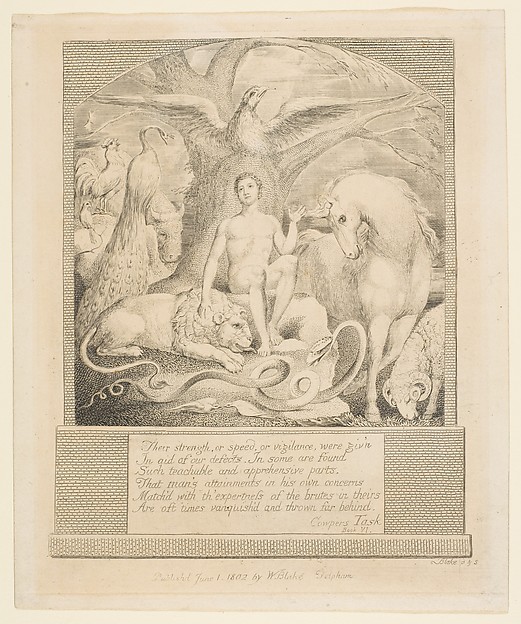
Adam and the Beasts, Illustration from Hayley's Ballads


Words and ideas may gradually  become familiar and find a lodging place in our minds. Then they may  begin their work of altering the ingrained habits of thought that prevent us from creating that new heaven of imagination which Blake so longed for and so worked for.  

  
Memorable Lines 
1.
"He who would see the Divinity must see him in his Children
One first, in friendship & love; then a Divine Family, & in the midst
Jesus will appear; so he who wishes to see a Vision; a perfect Whole        
Must see it in its Minute Particulars"

2.
"Friendship cannot exist without Forgiveness of Sins continually"

3.
"A Last Judgment is not for the purpose of making Bad
Men better but for the Purpose of hindering them from opressing
the Good with Poverty & Pain by means of Such Vile Arguments &
Insinuations"

4.
"What are all the Gifts of the
Spirit but Mental Gifts whenever any Individual Rejects Error &
Embraces Truth a Last Judgment passes upon that Individual" 

5.
"Error is
Created Truth is Eternal Error or Creation will be Burned Up &
then & not till then Truth or Eternity will appear It is Burnt up
the Moment Men cease to behold it"  

6.
"I care not whether a Man is Good or Evil; all that I care
Is whether he is a Wise Man or a Fool. Go! put off Holiness    
And put on Intellect:"

7.
"Holiness is not The Price of Enterance into Heaven Those
who are cast out Are All Those who having no Passions of their
own because No Intellect.  Have spent their lives in Curbing &
Governing other Peoples by the Various arts of Poverty & Cruelty
of all kinds" 
 
8.
"All Life consists of these Two Throwing off Error continually & recieving Truth Continually."

9.
"Man has no Body distinct from his Soul for that calld Body is
a portion of Soul discernd by the five Senses. the chief inlets
of Soul in this age"

10.
"These the Visions of Eternity 
But we see only as it were the hem of their garments
When with our vegetable eyes we view these wond'rous Visions"

11.
"For God himself enters Death's Door always with those that enter 
And lays down in the Grave with them, in Visions of Eternity
Till they awake & see Jesus & the Linen Clothes lying
That the Females had Woven for them, & the Gates of their Fathers House"

12.
"I pretend not to holiness! yet I pretend to love,
to see, to converse with daily, as man with man, & the more to
have an interest in the Friend of Sinners." 
, 

Saturday, February 9, 2013

INVENTOR

Satiric Verses and Epigrams, (E 514)
"Rafael Sublime Majestic Graceful Wise
His Executive Power must I despise  
Rubens Low Vulgar Stupid Ignorant
His power of Execution I must grant"

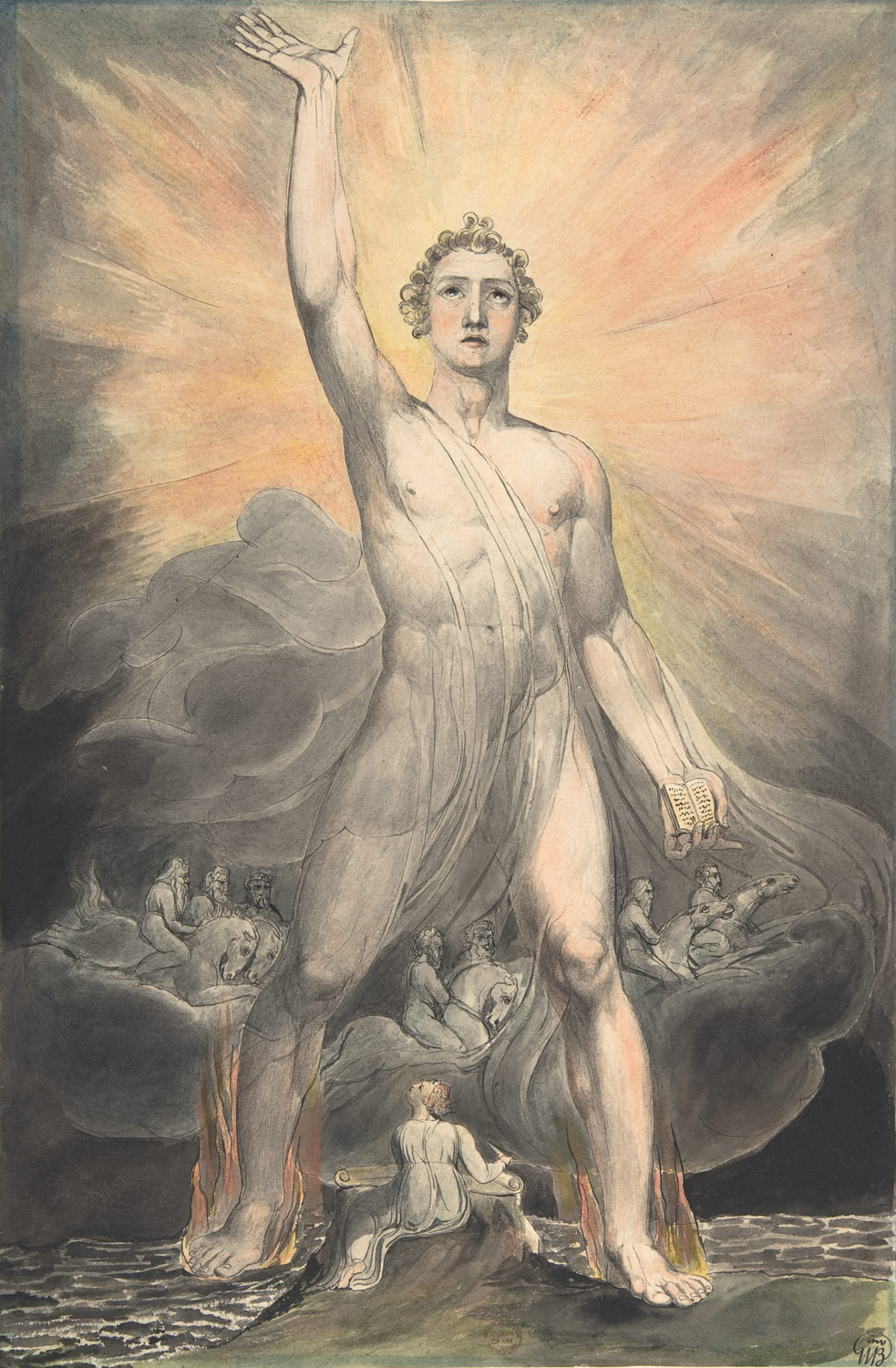
Metropolitan Museum of Art Angel of Revelation
1805
Signature bottom right
In his early career Blake was fond of signing his work WB inv. He recognized that the original conception of the work of art provided the essential foundation upon which the final product was built. Blake worked in various media including drawing, watercoloring, tempera, engraving, poetry and prose. Each depended on an 'Original Invention': an idea or mental image which existed only in his fertile imagination.
Blake's ability to invent was recognized by his contemporaries, but they sometimes denied his ability to execute which depended upon different skills. Blake would not concede that his ability to execute was any less than his ability to invent. 

Blake's training was as a reproductive engraver whose skill is faithfully reproducing images which have been conceived by others for printing in published form. Since his goal was to execute his own inventions, not just the inventions of others, he developed a broad set of skills encompassing disciplines which spanned visual and verbal communication. Engraving in the conventional practice became his vocation; his imaginative creations became his art which he considered to be the 'whole business of man.'
Blake's ability to execute was dependent on a two pronged method of learning: study of his predecessors and experimentation. He found in Michelangelo the finest ability to conceive and execute so he set him up as a model in art, as he did Milton in poetry. His experimentation led him into novel methods of printing, painting and writing. Learning through experiments was another facet of his inventiveness; gaining mastery of his new methods allowed him to execute his images in an individualistic manner. If his aim had been to follow current trends and appeal to popular tastes he would have applied different strategies.  
Invention and Execution became for Blake two of his contraries; two opposed but equally true expressions of the unity of his art. His work was in consolidating the inner dimension - the invention, with the outer expression - the execution. If they were not perfectly balanced, the work of art would be spoiled by failing to communicate Eternal truth.


Public Address, Page 60, (E 576)
 "No Man Can
Improve An Original Invention. [Since Hogarths time we have
had very few Efforts of Originality] but 
Drawn with a firm  
hand at once [with all its Spots & Blemishes which
are beauties & not faults] like Fuseli & Michael Angelo
Shakespeare & Milton>" 
 Public Address, PAGE 62, (E 576) 
     "I have heard many People say Give me the Ideas.  It is no
matter what Words you put them into & others say Give me the
Design it is no matter for the Execution.  These People know
Nothing Of Art.  Ideas cannot be Given
but in their minutely Appropriate Words nor Can a Design be made
without its minutely Appropriate Execution ... He who copies does
not Execute he only Imitates what is already Executed Execution
is only the result of Invention" 
 Public Address, Page 24, (E 582)
     "I know my Execution is not like Any Body Else I do not
intend it should be so 
...I defy any Man to Cut
Cleaner Strokes than I do or rougher when I please & assert that
he who thinks he can Engrave or Paint either without being a
Master of Drawing is a Fool  Painting is Drawing
on Canvas & Engraving is Drawing on Copper & nothing Else
[Drawing is Execution & nothing Else] & he who Draws best must be
the best Artist [&] to this I subscribe" 
 Annotations to Reynolds, P iii, (E 637)
     "Invention depends Altogether upon Execution or
Organization. as that is right or wrong so is the Invention
perfect or imperfect.  Whoever is set to Undermine the Execution
of Art is set to Destroy Art   Michael Angelos Art Depends on
Michael Angelos Execution Altogether" 
 Annotations to Reynolds, p 126, (E 654) 
    "Can any Man be such a fool as to believe that Rafael &
Michael Angelo were Incapable of the meer Language of Art & That
Such Idiots as Rubens. Correggio & Titian Knew how to Execute
what they could not Think or Invent" 
 Descriptive Catalogue, (E 528)
 "If Italy is enriched and
made great by RAPHAEL, if MICHAEL ANGELO is its supreme glory, if
Art is the glory of a Nation, if Genius and Inspiration are the
great Origin and Bond of Society, the distinction my Works have
obtained from those who best understand such things, calls for my
Exhibition as the greatest of Duties to my Country." 
 Descriptive Catalogue, (E 547)
"...when the Artist took his pencil, to execute his
ideas, his power of imagination weakened so much, and darkened,
that memory of nature and of Pictures of the various
Schools possessed his mind, instead of appropriate execution,
resulting from the inventions; like walking in another man's
style, or speaking or looking in another man's style and manner,
unappropriate and repugnant to your own individual character;
tormenting the true Artist, till he leaves the Florentine, and
adopts the Venetian practice, or does as Mr. B. has done, has the
courage to suffer poverty and disgrace, till he ultimately
conquers."

Thursday, February 7, 2013

LITTLE SWEEP

The children's opera The Little Sweep was composed in 1948 by Benjamin Britten with libretto by Eric Crozier. The subject for the composition was furnished by William Blake's two poems (both named The Chimney Sweeper) from Songs of Innocence and Songs of Experience. The plight of children in 18th and 19th century England forced into the dangerous occupation of cleaning chimneys provides the metaphor for children exploited, neglected or abused in any age and setting. Britten's opera incorporates a range of reactions to the little sweep who is mistreated  by his employer, misunderstood by the housekeeper, and sympathetically protected by the wealthy children.

Britten and Crozier do not attempt to follow the storyline of Blake's poems which focus most of the attention on the failure of religion and government to correct abuses in society by promising a compensating reward in the afterlife while enjoying the fruits of the labor of the underprivileged.

If you seek performances of The Little Sweep on youtube, you may be surprised to find that the one of the most complete ones available was produced in Vietnamese, another in Spanish. Here is a short segment from an English production with Maureen Forrester playing Miss Baggott the housekeeper.

Songs of Innocence, Song 12, (E 10)   
The Chimney Sweeper
"When my mother died I was very young,
And my father sold me while yet my tongue,
Could scarcely cry weep weep weep weep.              
So your chimneys I sweep & in soot I sleep,
 
Theres little Tom Dacre, who cried when his head        
That curl'd like a lambs back, was shav'd, so I said.
Hush Tom never mind it, for when your head's bare,
You know that the soot cannot spoil your white hair.
 
And so he was quiet, & that very night,
As Tom was a sleeping he had such a sight,    
That thousands of sweepers Dick, Joe, Ned & Jack
Were all of them lock'd up in coffins of black,

And by came an Angel who had a bright key,
And he open'd the coffins & set them all free.
Then down a green plain leaping laughing they run      
And wash in a river and shine in the Sun.
 
Then naked & white, all their bags left behind,
They rise upon clouds, and sport in the wind.
And the Angel told Tom if he'd be a good boy,
He'd have God for his father & never want joy.

And so Tom awoke and we rose in the dark
And got with our bags & our brushes to work.
Tho' the morning was cold, Tom was happy & warm,
So if all do their duty, they need not fear harm."
British Museum
Songs of Experience
Copy T

Songs of Experience, Song 37, (E 22) 
The Chimney Sweeper   
"A little black thing among the snow:
Crying weep, weep, in notes of woe!    
Where are thy father & mother? say?
They are both gone up to the church to pray.

Because I was happy upon the heath, 
And smil'd among the winter's snow:  
They clothed me in the clothes of death,
And taught me to sing the notes of woe.

And because I am happy, & dance & sing,
They think they have done me no injury:
And are gone to praise God & his Priest & King
Who make up a heaven of our misery." 

Tuesday, February 5, 2013

SONGS & PROVERBS

In 1965 Benjamin Britten composed a song cycle titled Songs and Proverbs of William Blake based entirely on Blake's poetry. The composition includes lines from Songs of Innocence & Experience, Marriage of Heaven & Hell and Auguries of Innocence. This performance by Benjamin Luxton, baritone, is available on youtube in two parts. The second half begins at Tyger.
Follow Blake's poetry printed below as you listen to the music.

1.Proverb I: The pride of the peacock
Marriage of Heaven & Hell, Plate 8, (E 36)
The pride of the peacock is the glory of God.
The lust of the goat is the bounty of God.
The wrath of the lion is the wisdom of God.
The nakedness of woman is the work of God.  
2.London Songs of Innocence & Experience, Song 46, (E 26) 
LONDON  
I wander thro' each charter'd street,
Near where the charter'd Thames does flow.  
And mark in every face I meet 
Marks of weakness, marks of woe.

In every cry of every Man, 
In every Infants cry of fear, 
In every voice: in every ban, 
The mind-forg'd manacles I hear

How the Chimney-sweepers cry
Every blackning Church appalls,
And the hapless Soldiers sigh
Runs in blood down Palace walls

But most thro' midnight streets I hear
How the youthful Harlots curse
Blasts the new-born Infants tear 
And blights with plagues the Marriage hearse
 
3.Proverb II: Prisons are built 

Marriage of Heaven & Hell, Plate 8, (E 36)
Prisons are built with stones of Law, 
Brothels with bricks of Religion.


4.The Chimney-Sweeper

Songs of Experience, Song 37, (E 22) 
THE CHIMNEY SWEEPER                                    
A little black thing among the snow:
Crying weep, weep, in notes of woe!                    
Where are thy father & mother? say?
They are both gone up to the church to pray.

Because I was happy upon the heath, 
And smil'd among the winter's snow: 
They clothed me in the clothes of death,
And taught me to sing the notes of woe.

And because I am happy, & dance & sing,
They think they have done me no injury:
And are gone to praise God & his Priest & King
Who make up a heaven of our misery.            

5.Proverb III: The bird a nest 
Marriage of Heaven & Hell
, Plate 8, (E 36)
The bird a nest, the spider a web, man friendship. 


6.A Poison Tree
Songs of Innocence & Experience, Song 49, (E 28) 
A POISON TREE.                              
I was angry with my friend;
I told my wrath, my wrath did end.
I was angry with my foe:
I told it not, my wrath did grow.

And I waterd it in fears,
Night & morning with my tears:
And I sunned it with smiles,
And with soft deceitful wiles.

And it grew both day and night.
Till it bore an apple bright.
And my foe beheld it shine,
And he knew that it was mine.

And into my garden stole,
When the night had veild the pole;
In the morning glad I see;
My foe outstretchd beneath the tree.

7.Proverb IV: Think in the morning  

Marriage of Heaven & Hell, Plate 9, (E 37) 
Think in the morning, Act in the noon, Eat in the evening, Sleep in the night. 


British Museum Small Book of Designs
From Marriage of Heaven & Hell
Plate 14
8.The Tyger  
Songs of Innocence & Experience, Song 42, (E 24) 
THE TYGER.                                                  
Tyger Tyger, burning bright,
In the forests of the night;
What immortal hand or eye,                                     
Could frame thy fearful symmetry?                              

In what distant deeps or skies.                                
Burnt the fire of thine eyes?                                  
On what wings dare he aspire?                        
What the hand, dare sieze the fire?

And what shoulder, & what art,
Could twist the sinews of thy heart?
And when thy heart began to beat,
What dread hand? & what dread feet?               
 
What the hammer? what the chain, 
In what furnace was thy brain?
What the anvil? what dread grasp,                     
Dare its deadly terrors clasp!                       

When the stars threw down their spears               
And water'd heaven with their tears:
Did he smile his work to see?                        
Did he who made the Lamb make thee?                  

Tyger Tyger burning bright,
In the forests of the night:                         
What immortal hand or eye,        
Dare frame thy fearful symmetry? 

9.Proverb V: The tygers of wrath  
Marriage of Heaven & Hell, Plate 9, (E 37)
The tygers of wrath are wiser than the horses of instruction
Plate 7, (E 35)
If the fool would persist in his folly he would become wise.
Plate 9 , (E 37)
If others had not been foolish, we should be so.
 
10.The Fly 
Songs of Innocence & Experience, Song 40, (E 23) 
THE FLY.                                    
Little Fly
Thy summers play,                           
My thoughtless hand                          
Has brush'd away.                           
 
Am not I 
A fly like thee?
Or art not thou
A man like me?

For I dance
And drink & sing: 
Till some blind hand
Shall brush my wing.

If thought is life                                
And strength & breath:
And the want                                       
Of thought is death;

Then am I
A happy fly,
If I live,
Or if I die. 
 
11.Proverb VI: The hours of folly  
Marriage of Heaven & Hell, Plate 7, (E 36)
Eternity is in love with the productions of time.             
The busy bee has no time for sorrow.
The hours of folly are measur'd by the clock, but of wisdom: no clock can measure.

12.Ah! Sun-flower!
Songs of Innocence & Experience, Song 43, (E 25)
AH! SUN-FLOWER
Ah Sun-flower! weary of time,
Who countest the steps of the Sun:
Seeking after that sweet golden clime
Where the travellers journey is done.

Where the Youth pined away with desire,
And the pale Virgin shrouded in snow:
Arise from their graves and aspire,
Where my Sun-flower wishes to go.

13.Proverb VII: To see a World 
Songs and Ballads, (E 490)
AUGURIES OF INNOCENCE   
To see a World in a Grain of Sand
And a Heaven in a Wild Flower
Hold Infinity in the palm of your hand
And Eternity in an hour

14.Every Night and Every Morn

Songs and Ballads, (E 492)
AUGURIES OF INNOCENCE
Every Night & every Morn
Some to Misery are Born 
Every Morn & every Night
Some are Born to sweet delight
Some are Born to Endless Night
We are led to Believe a Lie 
When we see not Thro the Eye   
Which was Born in a Night to perish in a Night
When the Soul Slept in Beams of Light
God Appears & God is Light
To those poor Souls who dwell in Night 
But does a Human Form Display
To those who Dwell in Realms of day

Sunday, February 3, 2013

BLAKE'S FAIRIES

Wikipedia Commons
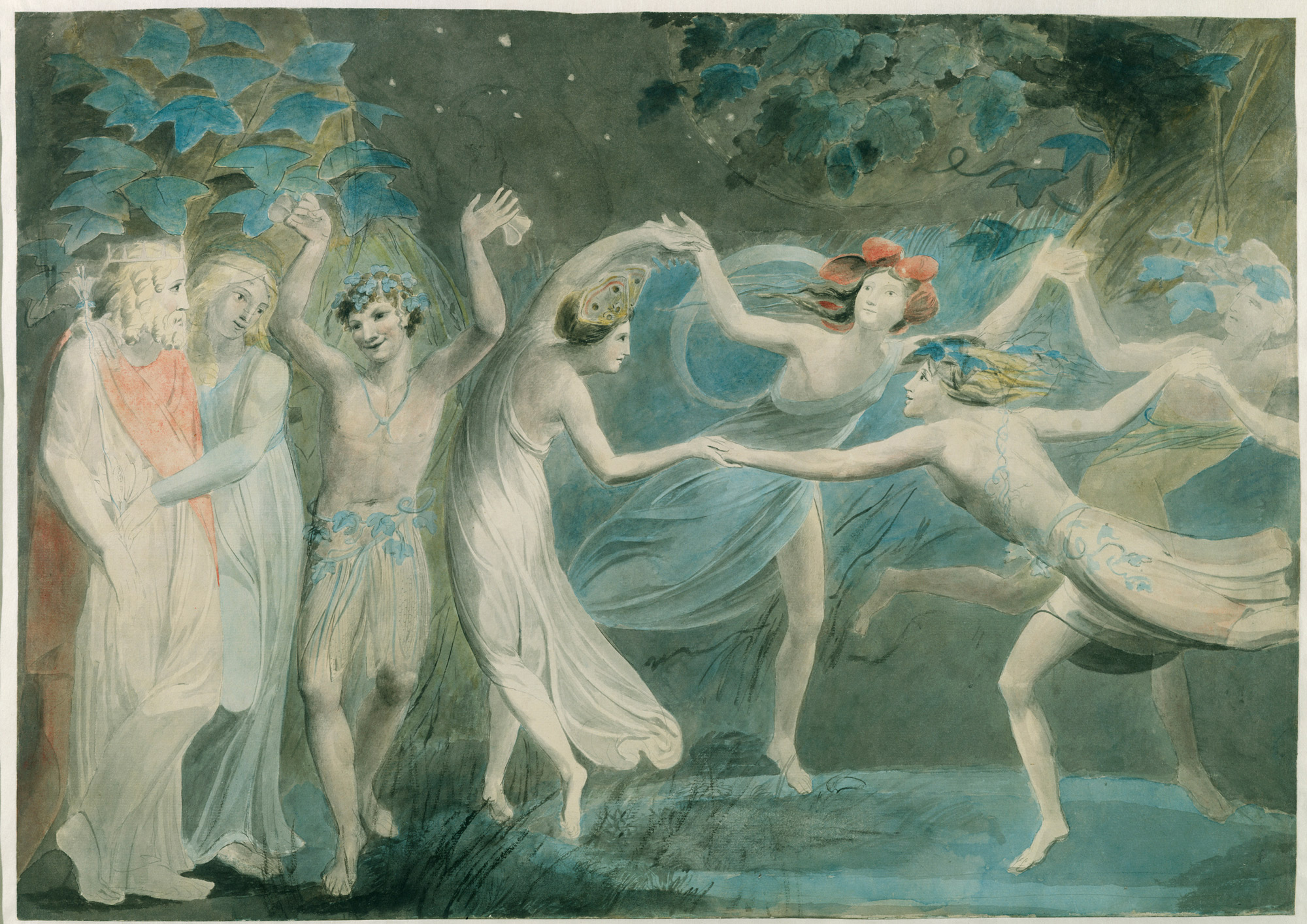
Oberon, Titania and Puck with Fairies Dancing
c. 1786
Blake let his imagination roam widely as had Shakespeare before him. They both wrote about fairies as if they had a first hand acquaintance. In Midsummer Night's Dream Shakespeare takes us into the world which awakes while we sleep and dream, ruled by the king and queen of fairies. Blake pictured a joyful image of fairies dancing before their king and queen with Puck who was given the power to alter how individuals perceived one another. Blake pictured the same pair, Oberon and Titania, on Plate 5 of Song of Los resting comfortably within two adjacent lilies. Titania sleeps while Oberon holds a sceptre.

In a very early biography of Blake (Life of Blake, By Allan Cunningham) there is reported a conversation of Blake with a lady at a dinner party:
"'Did you ever see a fairy's funeral, madam?' he once said to a lady, who happened to sit by him in company. 'Never, sir!' was the answer. 'I have,' said Blake, 'but not before last night. I was walking alone in my garden, there was great stillness among the branches and flowers and more than common sweetness in the air; I heard a low and pleasant sound, and I knew not whence it came. At last I saw the broad leaf of a flower move, and underneath I saw a procession of creatures of the size and colour of green and gray grasshoppers, bearing a body laid out on a rose leaf, which they buried with songs, and then disappeared. It was a fairy funeral.'"

In his Descriptive Catalogue, Blake introduces the idea that in Shakespeare and Chaucer fairies are rulers of the vegetable world, perhaps indicating that he uses them in the same way.

Descriptive Catalogue, (E 535)
"By way of illustration, I instance Shakspeare's Witches in
Macbeth.  Those who dress them for the stage, consider
them as wretched old women, and not as Shakspeare intended, the
Goddesses of Destiny; this shews how Chaucer has been
misunderstood in his sublime work.  Shakspeare's Fairies also
are the rulers of the vegetable world, and so are Chaucer's;
let them be so considered, and then the poet will be understood,
and not else."

Blake's best known passage about a fairy introduces his prophecy Europe which he published in 1794. In Blake's system fairies are associated with the Element air, and the Zoa Urizen.

Europe, Plate iii, (E 60)
"Five windows light the cavern'd Man; thro' one he breathes the air;
Thro' one, hears music of the spheres; thro' one, the eternal vine
Flourishes, that he may recieve the grapes; thro' one can look.
And see small portions of the eternal world that ever groweth;
Thro' one, himself pass out what time he please, but he will not;
For stolen joys are sweet, & bread eaten in secret pleasant.

So sang a Fairy mocking as he sat on a streak'd Tulip,
Thinking none saw him: when he ceas'd I started from the trees!
And caught him in my hat as boys knock down a butterfly.
How know you this said I small Sir? where did you learn this song? 
Seeing himself in my possession thus he answered me:
My master, I am yours. command me, for I must obey.

Then tell me, what is the material world, and is it dead?
He laughing answer'd: I will write a book on leaves of flowers,
If you will feed me on love-thoughts, & give me now and then   
A cup of sparkling poetic fancies; so when I am tipsie,
I'll sing to you to this soft lute; and shew you all alive
The world, when every particle of dust breathes forth its joy.

I took him home in my warm bosom: as we went along
Wild flowers I gatherd; & he shew'd me each eternal flower:     
He laugh'd aloud to see them whimper because they were pluck'd.
They hover'd round me like a cloud of incense: when I came
Into my parlour and sat down, and took my pen to write:
My Fairy sat upon the table, and dictated EUROPE."

The conversation of Blake about the fairy funeral which sent ripples out in the literary world may be pursued at this website about Lucy Hooper.

Friday, February 1, 2013

ENTHUSIASM

British Museum
Jerusalem, Plate 76
Copy A

William Blake and John Wesley were contemporaries in 18th century London. Although their paths may have crossed there is no record of a meeting between them. Wesley was a public figure whose sermons were well known. Although Blake may have been attracted to Wesley's religious zeal, the two would have found little in common in their approach to religious experience. Both men believed in a religion expressed though the heart as a result of direct personal experience. Where they differed was in the degree of spontaneous expression each valued. Blake's ideal was perfect liberty; Wesley's was the disciplined approach of using 'every means which either reason or Scripture recommends.'

Blake was willing to apply the term 'enthusiast' to himself even though some people of his day associated enthusiasm with madness. Wesley advised his followers that enthusiasm was of the world; that enthusiasm was not the mark of a Christian as holiness was.   

In John Wesley edited by Albert C Outler, Wesley's attitude to enthusiasm is explained in this way:
"When his doctrines of assurance and experience were labeled 'enthusiasm,' he carefully distinguished between 'enthusiasm proper' and that true ernestness based upon the Spirit's witness in our hearts. In these terms, he could insist, against all formalists, that until faith is deeply personal, it is not yet authentic." (Page 30)

Quotes from Wesley's sermon, The Nature Of Enthusiasm:
"such a disorder as greatly hinders the exercise of reason"
"immediately a superficial change"
"For Christians are holy; these are unholy: Christians love God; these love the world: Christians are humble; these are proud: Christians are gentle; these are passionate; Christians have the mind which was in Christ; these are at the utmost distance from it."
"imagine themselves to be influenced or directed by the Spirit when they are not"

Blake embraced the label of enthusiasm as descriptive of his heartfelt commitment to the Lord whom he knew and loved.     


Jerusalem, Plate 3, (E 145)
The Enthusiasm of the following Poem, the Author hopes
[no Reader will think presumptuousness or arroganc[e] when he
is reminded that the Ancients acknowledge their love to their
Deities, to the full as Enthusiastically as I have who
Acknowledge mine for my Saviour and Lord, for they were wholly
absorb'd in their Gods.] I also hope the Reader will
be with me, wholly One in Jesus our Lord, who is the God [of
Fire] and Lord [of Love] to whom the Ancients
look'd and saw his day afar off, with trembling & amazement."

Jerusalem, Plate 9, (E 152)
"Loud roar my Furnaces and loud my hammer is heard:               
I labour day and night, I behold the soft affections
Condense beneath my hammer into forms of cruelty
But still I labour in hope, tho' still my tears flow down.
That he who will not defend Truth, may be compelld to defend
A Lie: that he may be snared and caught and snared and taken     
That Enthusiasm and Life may not cease: arise Spectre arise!

Thus they contended among the Furnaces with groans & tears;
Groaning the Spectre heavd the bellows, obeying Los's frowns;
Till the Spaces of Erin were perfected in the furnaces
Of affliction, and Los drew them forth, compelling the harsh Spectre."         

Annotations to Reynolds, (E 645)
"Reynolds:But as mere enthusiasm will carry you but a little way. . .
Blake: [Damn The Fool] 
     Meer Enthusiasm is the All in All!-- Bacons Philosophy has
Ruind England " 

Annotations to Reynolds,(E 647)
"It is Evident that Reynolds Wishd none but Fools to be in
the Arts & in order to this, he calls all others Vague
Enthusiasts or Madmen"  

    
Letters, To Hayley, (E 705)
 "Thirteen years ago.  I lost a
brother & with his spirit I  converse daily & hourly in the
Spirit.  & See him in my remembrance in the  regions of my
Imagination.  I hear his advice & even now write from his
Dictate--Forgive me for expressing to you my Enthusiasm which I
wish all to  partake of Since it is to me a Source of Immortal
Joy even in this world by it  I am the companion of Angels."

Letters, To Butts, (E 720)
 "And now let me finish with assuring you that Tho I have been
very unhappy I am so no longer I am again Emerged into the light
of Day I still & shall to Eternity Embrace Christianity and Adore
him who is the Express image of God but I have traveld thro
Perils & Darkness not unlike a Champion I have Conquerd and shall
still Go on Conquering Nothing can withstand the fury of my
Course among the Stars of God & in the Abysses of the Accuser My
Enthusiasm is still what it was only Enlarged and confirmd" 
.