Blake seeks to provide the Golden String which can lead us through the labyrinth of our experience or his own poetry.

Monday, October 14, 2013

BLAKE, HAYLEY, ROSSETTI

When Blake died in 1827 he was little known outside of a small circle of friends and supporters. As a designer and engraver he was known through his illustrations of 1797 for Young's Night Thoughts and his designs for Blair's The Grave published in 1808. Artists such as the group of younger admirers who called themselves The Ancients were acquainted with his work in his later years and mentioned it in wider circles. Blake's legacy was in jeopardy after his death because his talents had not been recognized during his life. After his death Blake's Notebook passed from John Linnell to Samuel Palmer and then to Dante Gabriel Rossetti who contributed to the second volume of the 1880 Gilchrist biography of Blake.

Collectors preserved his books and pictures; devoted admirers wrote of his life and thought. The obscure, poverty stricken mystic became recognized as a cultural treasure whose voice lives and speaks for a more receptive audience.

In a letter to a friend Rossetti commented on Hayley's book of ballads illustrated by Blake.

DANTE GABRIEL ROSSETTI TO WILLIAM ALLINGHAM
8 Jan., 1856. 
A month and a half actually, dear A., since the 
last sheet, already long behindhand, yet which has 
lain in my drawer ever since, till it is too late now 
to wish you merry Christmas, too late to wish you 
happy New Year, only not too late to feel just 
the same towards you as if I were the best cor 
respondent in the world, and to know you feel the 
same towards me... 
Many thanks indeed for your new year's gift, 
a most delightful one. Old Blake is quite as 
loveable by his oddities as by his genius, and the 
drawings to the Ballads abound with both. The 
two nearly faultless are the Eagle and the Hermit's 
Dog. Ruskin's favourite (who has just been look 
ing at it) is the Horse ; but I can't myself quite 
get over the intensity of comic decorum in the 
brute's face. He seems absolutely snuffling with 
propriety. The Lion seems singing a comic song- 
with a pen behind his ear, but the glimpse of 
distant landscape below is lovely. The only draw 
ing where the comic element riots almost unre- 
buked is the one of the dog jumping down the 
crocodile. 

As regards engraving, these drawings, with the 
Job, present the only good medium between etching 
and formal line that I ever met with. I see that 
in coming to me the book returns home ; having 
set out from No. 6 Bridge St., Blackfriars, just 
50 years ago. Strange to think of it as then, new 
literature and art. Those ballads of Hayley some 
of the quaintest human bosh in the world picked 
their way, no doubt, in highly respectable quarters, 
where poor Blake's unadorned hero at Page i was 
probably often stared at, and sometimes torn out. 
___________
[Comment on website:]
The book that " returns home ; having set out 
from No. 6, Bridge Street, Blackfriars, just fifty 
years ago," was Ballads by William Hayley, founded 
on anecdotes relating to animals, with prints, de 
signed and engraved by William Blake. Chichester, 
printed by J. Seagrave for Richard Phillips, Bridge 
Street, Blackfriars, London, 1805."
British Museum
The Eagle. 
Ballad the Second in Hayley's "Designs to a Series of Ballads" (Chichester, 1802)

Saturday, October 12, 2013

LANGUAGE OF LIGHT & DARK

As Blake gained experience in producing illuminated books he learned to exploit the possibilities of white-line engraving to an impressive degree. Laurence Binyon in The Engraved Designs of William Blake speaks of the mastery of Blake in producing books in which his imagination controlled every aspect of conception and production. In the last of Blake's illuminated books, Jerusalem, he increased the use of white-line engraving to enhance his ability to communicate the stark contrasts available to man between life and death.

A quote from Binyon's book:

"The conception of a book as a complete unity, in which the lettering, the decoration, the illustrations, the proportions of the page, the choice of paper, should all be determined and carried out by a single mind and hand, surpassed even the conceptions of medieval scribes and miniaturists. For Blake combined not only the scribe and the illuminator, to whose arts be added the art of the  printer; but, unlike his medieval predecessors, he was the sole author of the text. In the history of book-production these works are unique.

"Blake's methods, it is true, did not lend themselves to the exquisite and finished delicacy of the miniature printers; nor could he rival their penmanship, though in the conditions of the age in which he lived we may wonder that his script is so good, and so successfully combined with decoration, as in the best of the books." (Page 23)
....
"Whatever may be thought of it as a  poem, however, Jerusalem is, with the Job, the grandest of Blake's works. His peculiar imagination is here at its most impressive. For what he had to say, the language of light and dark, was more expressive than any words could be...We may not know what some of the images mean; even when they are interpreted in the light of the mystic ideas, they remain much more eloquent than the interpretation. They are sometimes, no doubt, images that appeared to Blake in waking vision, and were transcribed in perfect condition that significance was in them, even if he could not himself explain it: for as he wrote on the title-page of The Daughters of Albion, 'The Eye sees more than the Heart knows.' "

(Page 33)


The following are some of the white-line etched plates of Jerusalem which are in the collection of the British Museum. Each is from Copy A, one of the four uncolored copies:

Plate 2
Plate 26

Plate 28

Plate 31

Plate 33
 
Plate 51

Plate 53

Jerusalem Jesus and Albion
Copy A, Plate 76
1804
Milton Klonsky speaking of Plate 76 of Jerusalem, states in William Blake The Seer and his Visions :

"With its spidery thin and mercurial white line on a black ground, like the afterimage of a vision, the plate is generally regarded as Blake's most superb realization of the technique he described as 'woodcut on copper'; 'instead of etching the blacks Etch the whites & bite it in.'" (Page 104)


Jerusalem, Plate 96, (E 255) 
"As the Sun & Moon lead forward the Visions of Heaven & Earth 
England who is Brittannia entered Albions bosom rejoicing 

Then Jesus appeared standing by Albion as the Good Shepherd 
By the lost Sheep that he hath found & Albion knew that it 
Was the Lord the Universal Humanity, & Albion saw his Form 
 A Man. & they conversed as Man with Man, in Ages of Eternity 
And the Divine Appearance was the likeness & similitude of Los"  

In a exuberant mood while writing his youthful satiric manuscript which has come to be called An Island in the Moon, Blake picks up in mid-sentence with some ideas on illuminating a Manuscript:

Island in the Moon, (E 465)
[Here a leaf or more is missing]
"PAGE X
them Illuminating the Manuscript--Ay said she that would be
excellent.  Then said he I would have all the writing Engraved
instead of Printed & at every other leaf a high finishd print all
in three Volumes folio, & sell them a hundred pounds a piece.
they would Print off two thousand   then said she whoever will
not have them will be ignorant fools & will not deserve to live" 
. 

Thursday, October 10, 2013

POWERS OF INVENTION

Much has been written about Blake's relief engraving methods which he developed to produce his 'illuminated books' which he first mentioned in his Prospectus  in 1793. He found that to produce fine printed detail in his engraved plates he could add intaglio techniques to supplement the relief etching. Of course the copper plates which Blake engraved have disappeared, leaving only the paper prints which were made from them. Scholars have studied the resulting prints in attempting to learn how the images were produced. The unique images which characterize Blake's work are the result of his experimenting with existing methods, combining techniques and trying things that hadn't been done before.
 
You may get some understanding of printing methods from observing your own hands. The fine lines in your hand enable you to make types of prints. If your hand is lightly covered with ink and pressed on paper you can make a relief printing of the raised surfaces. If you covered your hand heavily with ink and then wiped away the ink from the raised surfaces you may with heavier pressure make an impression in ink of the pattern of indented lines in your hand. 

 
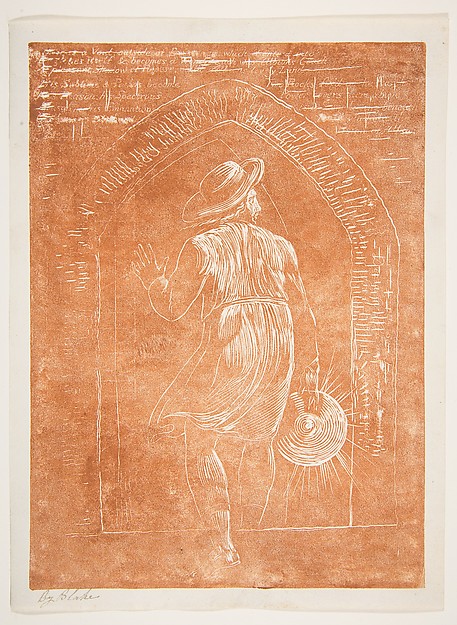
In the post Grain of Wheat, the image from 1804, depended solely on white-line engraving to produce the lighted image of Los entering the darkness of the void. In the post Woodcut on Pewter, the 1800 image on pewter was created by similar intaglio engraving which Blake himself described. The lettering was produced by relief etching supposedly on separate plates. Blake had used white line etching earlier in his book America. Erdman tells us that plates 2, 6, 8, 11, and 13 show the use of white-line as well as relief etching.


British Museum
America
Plate 11, Copy A
Yale Center for British Art
America
Plate 11, Copy M


Plate 11 is the most dramatic example of white-line etching in America. It is clear that the effect of individual stalks of wheat could not have been produced by Blake's relief method. In order to produce the cocoon-like enclosure structure around the child with its delicate threads, Blake was impelled to complicate his printing method by adding intaglio engraving. Blake added coloring to some copies of his white-line engravings producing striking results.


Miscellaneous Prose, Prospectus, (E 692)
     "TO THE PUBLIC         
October 10, 1793.

The Labours of the Artist, the Poet, the Musician, have been
proverbially attended by poverty and obscurity; this was never
the fault of the Public, but was owing to a neglect of means to
propagate such works as have wholly absorbed the Man of Genius. 
Even Milton and Shakespeare could not publish their own works.
     This difficulty has been obviated by the Author of the
following productions now presented to the Public; who has
invented a method of Printing both Letter-press and Engraving in
a style more ornamental, uniform, and grand, than any before
discovered, while it produces works at less than one fourth of
the expense.
     If a method of Printing which combines the Painter and the
Poet is a phenomenon worthy of public attention, provided that it
exceeds in elegance all former methods, the Author is sure of his
reward.
     Mr. Blake's powers of invention very early engaged the
attention of many persons of eminence and fortune; by whose means
he has been regularly enabled to bring before the Public works
(he is not afraid to say) of equal magnitude and consequence with
the productions of any age or country: among which are two large
highly finished engravings (and two more are nearly ready) which
will commence a Series of subjects from the Bible, and another
from the History of England.
     The following are the Subjects of the several Works now
published and on Sale at Mr. Blake's, No. 13, Hercules Buildings,
Lambeth.

     1.  Job, a Historical Engraving.  Size 1 ft.7 1/2 in. by 1
ft. 2 in.: price 12s.
     2.  Edward and Elinor, a Historical Engraving.  Size 1 ft. 6
1/2 in. by 1 ft.: price 10s. 6d.
     3.  America, a Prophecy, in Illuminated Printing.  Folio,
with 18 designs: price 10s. 6d.
     4.  Visions of the Daughters of Albion, in Illuminated
Printing.  Folio, with 8 designs, price 7s. 6d.
     5.  The Book of Thel, a Poem in Illuminated Printing. 
Quarto, with 6 designs, price 3s.
     6.  The Marriage of Heaven  and Hell, in Illuminated
Printing.  Quarto, with 14 designs, price 7s. 6d.
     7.  Songs of Innocence, in Illuminated Printing.  Octavo,
with 25 designs, price 5s.
     8.  Songs of Experience, in Illuminated Printing.  Octavo,
with 25 designs, price 5s.
     9.  The History of England, a small book of Engravings. 
Price 3s.
     10. The Gates of Paradise, a small book of Engravings. 
Price 3s.

     The Illuminated Books are Printed in Colours, and on the
most beautiful wove paper that
could be procured,
     No Subscriptions for the numerous great works now in hand
are asked, for none are wanted; but the Author will produce his
works, and offer them to sale at a fair price."

Other examples of images which utilize white-line engraving include: 
Approach of Doom after drawing by Robert Blake, 1788,
Death's Door for Blair's The Grave, 1805,
Man Sweeping the Interpreters Parlor, 1822.
.

Tuesday, October 8, 2013

BLAKE'S COTTAGE

Library of Congress Milton
Plate 40, Copy D
 

The reasons for Blake to leave London in 1800 were numerous, including personal, political and financial. We get an idea of the political pressures in this passage from a genealogical website by D.W. Martyn Bone.


Historical Summary - Great Britain 1790's
"The revolution in France sparks fierce debate over the freedoms and inherent rights of humanity, leading to thoughts of manhood suffrage, more effective governance, lower taxes and aid for aged and poor. France declares war on Britain, whose challenges are increased by a revolt in Ireland eventually put down through brutal violence, and a rebellion within the British navy which resulted in better conditions and continued sea defense plus a blockade of French ports. Economic depression caused by war leads to rioting at home among the disenfranchised workers. Smuggling is rampant. Government responses to internal upheavals include banning trade unions, censoring the press, and rounding up subversives. An attempt to abolish slavery across the empire fails. Canada is divided into an upper English half, and lower French half to maintain loyalty in this age of revolution." 


Rosetti Archive
 

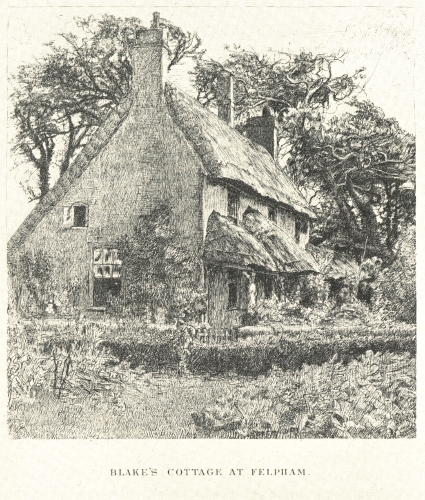
As William and Catherine were preparing for their move from London to Felphan, Blake wrote to his friend George Cumberland a letter mentioned in William Blake, published by the Tate, and edited by Peter Ackroyd, Marilyn Butler, Robin Hamlyn and Michael Phillips. The letter in the collection of Robert N Essick includes verses in a postscript which reveal Blake's perception of his previous decade in London and his expectations of new situation in Felpham. (Page 154)
"Dear Generous Cumberland nobly
solicitous for a Friend's welfare.
Behold me
Whom your Friendship has Magnified:
Rending the manacles of Londons
Dungeon dark
I have rent thee black net & escap'd. See My
Cottage at Felpham in joy.
Beams over the Sea, a bright light over
France, but the Web & the Veil I have left
Behind me at London resists every beam of
light;hanging from heaven to Earth
Dropping with human gore.Lo! I have left
it!I have torn it from my limbs
I shake my wings ready to take my flight!
Pale,Gastly pale:stands the City in fear" 
British Museum
Blake's Cottage
1915


After their arrival in their new home, Blake wrote ecstatically to John Flaxman about their journey and the cottage near the sea which they would occupy.  


Letters, (E 710) 

[To] Mr [John] Flaxman, Buckingham Street, Fitzroy Square, London 

Felpham Septr. 21. . 1800 Sunday Morning 

Dear Sculptor of Eternity
     We are safe arrived at our Cottage which is more beautiful
than I thought it. & more convenient.  It is a perfect Model for
Cottages & I think for Palaces of Magnificence only Enlarging not
altering its proportions & adding ornaments & not principals.
Nothing can be more Grand than its Simplicity & Usefulness.
Simple without Intricacy it seems to be the Spontaneous Effusion
of Humanity congenial to the wants of Man.  No other formed House
can ever please me so well nor shall I ever be perswaded I
believe that it can be improved either in Beauty or Use
     Mr Hayley recievd us with his usual brotherly affection.  I
have begun to work.  Felpham is a sweet place for Study. because
it is more Spiritual than London   Heaven opens here on all sides
her golden Gates   her windows are not obstructed by
vapours. . voices of Celestial inhabitants are more distinctly
heard & their forms more distinctly seen & my Cottage is also a
Shadow of their houses.  My Wife & Sister are both well. courting
Neptune for an Embrace
     Our journey was very pleasant & tho we had a great deal of
Luggage.  No Grumbling all was Chearfulness & Good Humour on the
Road & yet we could not arrive at our Cottage before half past
Eleven at night. owing to the necessary shifting of our Luggage
from one Chaise to another for we had Seven Different Chaises &
as many different drivers   We s[e]t out between Six & Seven in
the Morning of Thursday. with Sixteen heavy boxes & portfolios
full of prints.  And Now Begins a New life. because another
covering of Earth is shaken off.  I am more famed in Heaven for
my works than I could well concieve   In my Brain are studies &
Chambers filld with books & pictures of old which I wrote &
painted in ages of Eternity. before my mortal life & whose works
are the delight & Study of Archangels.  Why then should I be
anxious about the riches or fame of mortality.  The Lord our
father will do for us & with us according to his Divine will for
our Good
     You O Dear Flaxman are a Sublime Archangel My Friend &
Companion from Eternity in the Divine bosom is our Dwelling place
I look back into the regions of Reminiscence & behold our ancient
days before this Earth appeard in its vegetated mortality to my
mortal vegetated Eyes.  I see our houses of Eternity which can
never be separated tho our Mortal vehicles should stand at the
remotest corners of heaven from Each other
     Farewell My Best Friend Remember Me & My Wife in Love &
Friendship to our Dear Mr Flaxman whom we ardently desire to
Entertain beneath our thatched roof of rusted gold & believe me
for ever to remain
Your Grateful & Affectionate
WILLIAM BLAKE

from Stannings Bed and Breakfast
mid 20th century
We can conjecture that Blake was thinking of this Bible verse while writing the above letter:


Romans 8
[28] And we know that all things work together for good to them that love God, to them who are the called according to his purpose.


Blake didn't neglect to tell his friend and benefactor Thomas Butts of the ideal situation in which they found themselves just a few days after their arrival.


Letters, (E 711) 
[To] Mr [Thomas] Butts, Gt Marlborough Street
near Oxford Street, London

[Postmark: Sep 23 1800]
Dear Friend of My Angels
     We are safe arrived at our Cottage without accident or
hindrance tho it was between Eleven & Twelve OClock at night
before we could get home, owing to the necessary shifting of our
boxes & portfolios from one Chaise to another.  We had Seven
different Chaises & as many different drivers.  All upon the road
was chearfulness & welcome tho our luggage was very heavy there
was no grumbling at all.  We traveld thro a most beautiful
country on a most glorious day.  Our Cottage is more beautiful
than I thought it & also more convenient. for tho Small it is
well proportiond & if I should ever build a Palace it would be
only My Cottage Enlarged.  Please to tell Mr Butts that we have
dedicated a Chamber to her Service & that it has a very fine view
Of the Sea.  Mr Hayley recievd me with his usual brotherly
affection.  My Wife & Sister are both very well & courting
Neptune for an Embrace, whose terrors this morning made them
afraid but whose mildness is often Equal to his terrors The
Villagers of Felpham are not meer Rustics they are polite &
modest.  Meat is cheaper than in London but the sweet air & the
voices of winds trees & birds & the odours of the happy ground
makes it a dwelling for immortals.  Work will go on here with God
speed--.  A roller & two harrows lie before my window.  I met a
plow on my first going out at my gate the first morning after my
arrival & the Plowboy said to the Plowman.  "Father The Gate is
Open"--I have begun to Work & find that I can work with greater
pleasure than ever.  Hope soon to give you a proof that Felpham
is propitious to the Arts.
     God bless you.  I shall wish for you on Tuesday Evening as
usual.  Pray give My & My wife & sisters love & respects to Mr.
Butts, accept them yourself & believe me for ever
Your affectionate & obliged Friend
WILLIAM BLAKE

My Sister will be in town in a week & bring with her your account
& whatever else I can finish.  Direct to Mr Blake: Felpham
near Chichester, Sussex

An enhanced and improved Blake's Cottage is presently on the market for sale for the first time since 1928.
.

Sunday, October 6, 2013

WOODCUT ON PEWTER

British Museum
Little Tom the Sailor
1800

A greatly enlarged view of the image can be obtained by right clicking on picture, selecting view in new window, and clicking on image.

 An example of Blake's alternate engraving techniques is found in his broadside Little Tom the Sailor which was executed soon after his arrival in Felpham on September 18, 1800. Hayley had devised a project for providing financial support for the family of a boy who had been killed at sea. Hayley wrote a sentimental poem which would be illustrated and printed by the Blakes and sold for the benefit of the boy's family. Perhaps Hayley provided the pewter for the project which made it more complex than Blake's method of relief printing on copper which he had developed for his 'illuminated books'. Four separate sections comprise the single sheet.  

Quoting from Engravings of William Blake, Archibald G B Russell (1912):
Page 82
"The ballad was written by Hayley, 22nd September 1800, for the widowed mother of a Folkstone sailor lad, named Tom Spicer, who had been drowned at sea...Ballad and imprint are executed in the ordinary method of relief-etching employed by Blake in the engraved books. The pictorial designs are examples of what he called 'woodcuts on pewter'". 

In his notebook Blake wrote two undated memoranda on the use of pewter in engraving. Note the care required to avoid extraneous marks.

Blake's Notebook, (E 694)
 "Memorandum 
To Engrave on Pewter. Let there be first a drawing made correctly with black lead pencil, let nothing be to seek, then rub it off on the plate coverd with white wax. or perhaps pass it thro press. this will produce certain & determind forms on the plate & time will not be wasted in seeking them afterwards" 

"Memorandum 
To Woodcut on Pewter. lay a ground on the Plate & smoke it as for Etching, then trace your outlines & draw, them with a needle. and beginning with the spots of light on each object with an oval pointed needle scrape off the ground. [& instead of etching the shadowy strokes] as a direction for your graver then proceed to graving with the ground on the plate being as careful as possible not to hurt the ground because it being black will shew perfectly what is wanted"

Blake depended on Catherine to execute the more routine aspects of his productions including some printing and coloring. Her assistance was engaged in this project in spite of the distractions on her of settling into a new home and coming down with an illness. Hayley apparently had business in London which required his attention.

Letters, [To William Hayley], (E 714)
"Felpham 26th November, 1800
Dear Sir,
     Absorbed by the poets Milton, Homer, Camoens, Ercilla,
Ariosto, and Spenser, whose physiognomies have been my delightful
study, Little Tom has been of late unattended to, and my
wife's  illness not being quite gone off, she has not printed any
more  since you went to London.  But we can muster a few in
colours and  some in black which I hope will be no less favour'd
tho' they are  rough like rough sailors.  We mean to begin
printing again  to-morrow.  Time flies very fast and very
merrily.  I sometimes  try to be miserable that I may do more
work, but find it is a  foolish experiment.  Happinesses have
wings and wheels; miseries  are leaden legged and their whole
employment is to clip the wings  and to take off the wheels of
our chariots.  We determine,  therefore, to be happy and do all
that we can, tho' not all that  we would.  Our dear friend
Flaxman is the theme of my emulation  in this industry, as well
as in other virtues and merits.  Gladly  I hear of his full
health and spirits.  Happy son of the Immortal  Phidias, his lot
is truly glorious, and mine no less happy in his  friendship and
in that of his friends.  Our cottage is surrounded  by the same
guardians you left with us; they keep off every wind.  We hear
the west howl at a distance, the south bounds on high  over our
thatch, and smiling on our cottage says: "You lay too  low for my
anger to injure." As to the east and north I believe  they cannot
get past the turret.    
     My wife joins me in duty and affection to you.  Please to
remember us both in love to Mr. and Mrs. Flaxman, and believe me
to be your affectionate,
Enthusiastic, hope-fostered visionary,
WILLIAM BLAKE
[From the Gilchrist Life]

Russell on page 39 tells us that: "The lower of the two pictorial designs which accompany the ballad...is a beautiful example of Blake's quieter and often happier mood."

In another letter (E 724) to Hayley written after his return to London, Blake expresses this sentiment:

"Engraving is Eternal work
...
 I curse & bless Engraving
alternately because it takes so much time & is so untractable.
tho capable of such beauty & perfection"
. 

Friday, October 4, 2013

BORN LIKE A GARDEN

Jerusalem, Plate 5, (E 147)
"Trembling I sit day and night, my friends are astonish'd at me.
Yet they forgive my wanderings, I rest not from my great task!
To open the Eternal Worlds, to open the immortal Eyes
Of Man inwards into the Worlds of Thought: into Eternity
Ever expanding in the Bosom of God. the Human Imagination        
O Saviour pour upon me thy Spirit of meekness & love:
Annihilate the Selfhood in me, be thou all my life!
Guide thou my hand which trembles exceedingly upon the rock of ages,
While I write of the building of Golgonooza, & of the terrors of Entuthon:
Of Hand & Hyle & Coban, of Kwantok, Peachey, Brereton, Slayd & Hutton:
Of the terrible sons & daughters of Albion. and their Generations."
 
Metropolitan Museum of Art
Jerusalem Frontispiece
Blake involved himself in his 'great task' without ceasing. In the creation of the visual images through which he would complement the poetic images of his epics, he constantly explored methods of presenting the products of the Human Imagination. His experimentation with techniques of printing led him to 'white line' engraving which added another dimension to portraying the dynamics of light and dark. The image in my previous post is an example of this technique.

Much of Blake's engraving employed the relief method of printing in which the surface on which the ink would be applied was raised above the surrounding surface. He dissolved the copper which was unprotected by a resistant material to produce the elevated text and picture which would be printed. In the 'white line' engraving the surface which would be inked was protected by the resistant material which was then incised with the design. The application of acid ate only the lines leaving them lowered rather than elevated. Wax was removed, ink was lightly applied to the whole plate but did not penetrate the lines which remained white. A negative image was produced when the plate was printed.

Blake seems to have combined printing methods on individual plates in the same way that he combined water coloring and drawing with ink, charcoal or pencil along with his printing.

Annotations to Reynolds, (E 648)
 "Knowledge of Ideal Beauty. is Not to be Acquired It is Born
with us Innate Ideas. are in Every Man Born with him. they are
 Himself.  The Man who says that we have No Innate Ideas
must be a Fool & Knave.  Having No Con-Science " 
 Annotations to Reynolds, (E 656)
"Reynolds Thinks that Man Learns all that he Knows I say on
the Contrary That Man Brings All that he has or Can have Into the
World with him.  Man is Born Like a Garden ready Planted & Sown  
This World is too poor to produce one Seed"    
Jerusalem, Plate 91, (E 252) "I care not whether a Man is Good or Evil; all that I care Is whether he is a Wise Man or a Fool. Go! put off Holiness And put on Intellect: or my thundrous Hammer shall drive thee To wrath which thou condemnest: till thou obey my voice So Los terrified cries: trembling & weeping & howling! Beholding" 
. 

Wednesday, October 2, 2013

GRAIN OF WHEAT

British Museum
Jerusalem Frontispiece
Copy A
 
 Blake uses the grave as a symbol for this mortal, earthly life. Like John, the Gospel writer, Blake images the seed of life falling into the earth which is its grave. For Blake the element or Zoa of earth is Urthona through whom the imagination is expressed. Death becomes the entry point into the grave which we experience as life. The seed which was buried is molded into a visible form as though it acquired clothing appropriate to an earthly life. 
 
John 12
[24] Truly, truly, I say to you, unless a grain of wheat falls into the earth and dies, it remains alone; but if it dies, it bears much fruit.
[25] He who loves his life loses it, and he who hates his life in this world will keep it for eternal life.


Milton, Plate 26 [30], (E 126)
"Antamon takes them into his beautiful flexible hands,
As the Sower takes the seed, or as the Artist his clay
Or fine wax, to mould artful a model for golden ornaments,      
The soft hands of Antamon draw the indelible line:
Form immortal with golden pen; such as the Spectre admiring
Puts on the sweet form; then smiles Antamon bright thro his windows
The Daughters of beauty look up from their Loom & prepare.
The integument soft for its clothing with joy & delight."
 
It is this clothing which is susceptible to becoming the Selfhood which must be annihilated. As Blake says in the epilogue to Gates of Paradise:
"To The Accuser Who is
  The God of This World

Truly My Satan thou art but a Dunce
And dost not know the Garment from the Man" 

To keep one's life one must learn to love the seed planted within one more than the encrustation formed around it by worldly considerations. Then the individual will know what can be saved and what must be annihilated.
Jerusalem, Plate 49, (E 199)
"Learn therefore O Sisters to distinguish the Eternal Human
That walks about among the stones of fire in bliss & woe
Alternate! from those States or Worlds in which the Spirit travels"

Milton, Plate 14 [15], (E 108)
"And Milton said, I go to Eternal Death! The Nations still
Follow after the detestable Gods of Priam; in pomp               
Of warlike selfhood, contradicting and blaspheming.
When will the Resurrection come; to deliver the sleeping body
From corruptibility: O when Lord Jesus wilt thou come?
Tarry no longer; for my soul lies at the gates of death.
I will arise and look forth for the morning of the grave.       
I will go down to the sepulcher to see if morning breaks!
I will go down to self annihilation and eternal death,
Lest the Last Judgment come & find me unannihilate
And I be siez'd & giv'n into the hands of my own Selfhood
The Lamb of God is seen thro' mists & shadows, hov'ring          
Over the sepulchers in clouds of Jehovah & winds of Elohim
A disk of blood, distant; & heav'ns & earth's roll dark between
What do I here before the Judgment? without my Emanation?"

Milton, Plate 40 [46], (E 142) 
"There is a Negation, & there is a Contrary
The Negation must be destroyd to redeem the Contraries
The Negation is the Spectre; the Reasoning Power in Man
This is a false Body: an Incrustation over my Immortal           
Spirit; a Selfhood, which must be put off & annihilated alway
To cleanse the Face of my Spirit by Self-examination."

Milton, Plate 38 [43], (E 139)
"I come to discover before Heavn & Hell the Self righteousness
In all its Hypocritic turpitude, opening to every eye
These wonders of Satans holiness shewing to the Earth     
The Idol Virtues of the Natural Heart, & Satans Seat
Explore in all its Selfish Natural Virtue & put off
In Self annihilation all that is not of God alone:
To put off Self & all I have ever & ever Amen"

Jerusalem, Plate 21, (E 167)
 "O that Death & Annihilation were the same!"
.