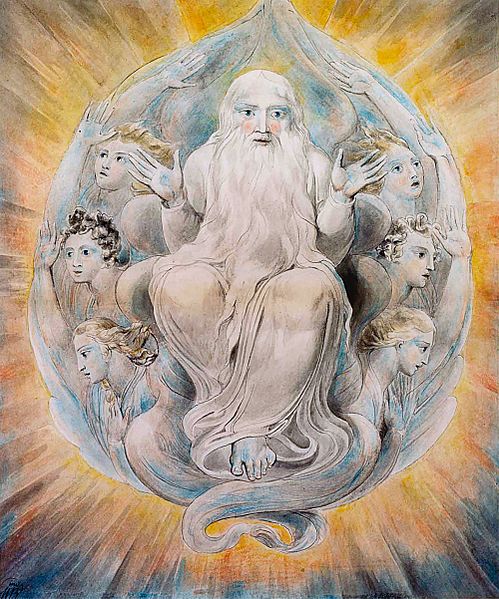
Blake seeks to provide the Golden String which can lead us through the labyrinth of our experience or his own poetry.

Wednesday, July 6, 2016

BATTLE RAGES


British Museum
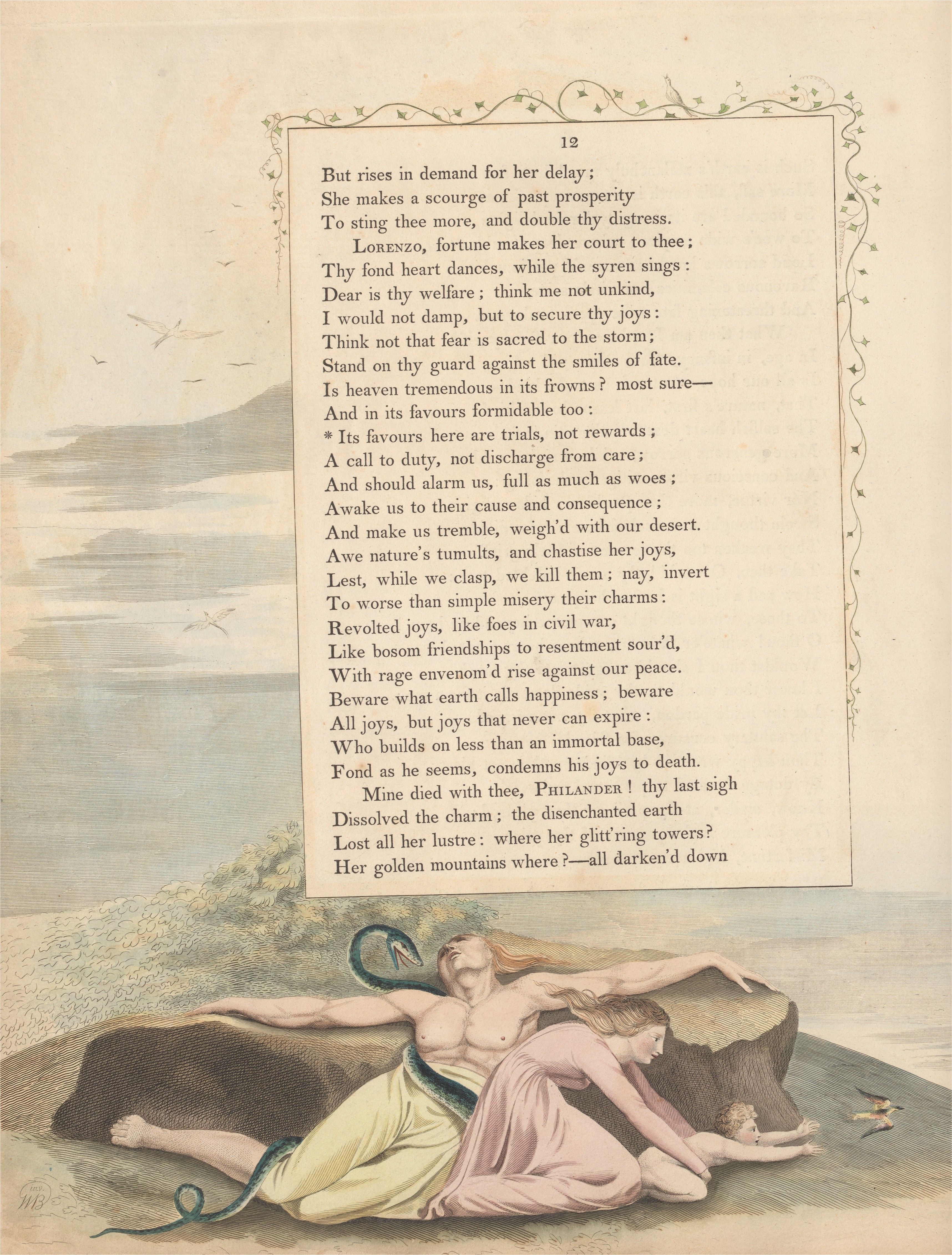
Illustrations to Young's Night Thoughts
Blake didn't have an aversion to Newton, Bacon and Locke; he was opposed to the ideas they represented to him. He used their names as a shorthand to express the positions and assumptions they professed. The Enlightenment was based on the assumptions these three men taught: Bacon that empirical data alone provided the foundation for judgement; Locke that the mind was a blank slate rather than an image of the Eternal; Newton that the only tool man required to make things right was his own reasoning power.
 
In Blake: A Collection of Critical Essays, edited by Northrop Frye, Jean Hagstrum made this scathing statement about Newton, Bacon and Locke as active functions of Urizen as he undermined humanity:
Page 154
"Urizen is also and active force. Dividing, partitioning, dropping the plummet line, applying Newton's compasses to the world, he creates abstract mathematical forms. Like Locke, he shrinks the senses, narrows the perceptions, binds man to natural fact. Like Bacon he creates the laws of prudence and crucifies passion. He is the man neoclassical psychology and ethics have delivered into our hands - a passivity, a receptacle, a 'soul-shuddering vacuum,' an abominable void,' an 'unknown, abstracted, brooding, secret' power of dark negation."

 
Bacon, Newton and Locke symbolized the principalities, and powers, the darkness of this world, and spiritual wickedness against which we wrestle.
Four Zoas, Night I, PAGE 3, (E 300)
4 lines of Greek text; Ephesians 6: 12

"For we wrestle not against flesh and blood, but
against principalities, against powers, against the rulers of the
darkness of this world, against spiritual wickedness in high
places." 
The battle that raged within man's brain was the effort to put aside these propositions which had come to dominate his culture and infected each individual with false assumptions which undermined his ability to sense the activity of his own Soul and to allow the Christ Within to be manifest in the way he chose to live. This could be accomplished:
not by rational demonstration but by faith,
not by memory but by inspiration,
not by concealing but by revealing,
not by doubting but by affirming.

 
Milton, PLATE 41 [48], (E 142) 
"To bathe in the Waters of Life; to wash off the Not Human
I come in Self-annihilation & the grandeur of Inspiration
To cast off Rational Demonstration by Faith in the Saviour
To cast off the rotten rags of Memory by Inspiration
To cast off Bacon, Locke & Newton from Albions covering          
To take off his filthy garments, & clothe him with Imagination
To cast aside from Poetry, all that is not Inspiration
That it no longer shall dare to mock with the aspersion of Madness
Cast on the Inspired, by the tame high finisher of paltry Blots,
Indefinite, or paltry Rhymes; or paltry Harmonies.               
Who creeps into State Government like a catterpiller to destroy
To cast off the idiot Questioner who is always questioning,
But never capable of answering; who sits with a sly grin
Silent plotting when to question, like a thief in a cave;
Who publishes doubt & calls it knowledge; whose Science is Despair   
Whose pretence to knowledge is Envy, whose whole Science is
To destroy the wisdom of ages to gratify ravenous Envy;
That rages round him like a Wolf day & night without rest
He smiles with condescension; he talks of Benevolence & Virtue
And those who act with Benevolence & Virtue, they murder time on time
These are the destroyers of Jerusalem, these are the murderers
Of Jesus, who deny the Faith & mock at Eternal Life:
Who pretend to Poetry that they may destroy Imagination;
By imitation of Natures Images drawn from Remembrance
These are the Sexual Garments, the Abomination of Desolation
Hiding the Human lineaments as with an Ark & Curtains

Which Jesus rent: & now shall wholly purge away with Fire
Till Generation is swallowd up in Regeneration."

Jerusalem, Plate 70, (E 224)
"And this the form of mighty Hand sitting on Albions cliffs
Before the face of Albion, a mighty threatning Form.

His bosom wide & shoulders huge overspreading wondrous
Bear Three strong sinewy Necks & Three awful & terrible Heads
Three Brains in contradictory council brooding incessantly.      
Neither daring to put in act its councils, fearing each-other,
Therefore rejecting Ideas as nothing & holding all Wisdom
To consist. in the agreements & disagree[me]nts of Ideas.
Plotting to devour Albions Body of Humanity & Love.

Such Form the aggregate of the Twelve Sons of Albion took; & such
Their appearance when combind: but often by birth-pangs & loud groans
They divide to Twelve: the key-bones & the chest dividing in pain
Disclose a hideous orifice; thence issuing the Giant-brood
Arise as the smoke of the furnace, shaking the rocks from sea to sea.
And there they combine into Three Forms, named Bacon & Newton & Locke,
In the Oak Groves of Albion which overspread all the Earth.

Imputing Sin & Righteousness to Individuals; Rahab
Sat deep within him hid: his Feminine Power unreveal'd
Brooding Abstract Philosophy. to destroy Imagination, the Divine-
-Humanity A Three-fold Wonder: feminine: most beautiful: Three-fold"

States and their alternatives:
NEWTON - trust your reasoning power OR trust your intuition (imagination,)
BACON - give the sense world exclusive control OR see the limitations of the world perceived by the senses,
LOCKE - deny existence of the Eternal OR turn to the realities which are imperishable.
.

Monday, July 4, 2016

REFLECTIONS


This was first posted by Larry on one of his other blogs.

REFLECTIONS OF A HAPPY OLD MAN

So What's so Good about Blake?

This post was inspired by encouragement from my friend Meredith who wrote: "I am eager to hear Larry speak more about Blake." Like most of my blogs they are more about me, and Blake's statement "I must create a system, or be enslaved by another man's," aptly described my life and became my credo. Reading those words did it for me! It's practically the story of my life.
 
Jerusalem, Plate 18, (E 152)
 "I must Create a System, or be enslav'd by another Mans
 I will not Reason & Compare: my business is to Create"
 
Raised in a parsonage, wedded to the church (with the usual adolescent rebellion included), I set out to serve mankind, via the Methodist parish ministry for eight years, and thereafter with a much larger mission, including ten years rehabilitating alcoholics (with the bishop's blessing). The sap was rising.
 
"But your flag decal won't get you Into Heaven any more.  
They're already overcrowded From your dirty little war.
Now Jesus don't like killin' No matter what the reason's for,
And your flag decal won't get you Into Heaven any more."
 
This little chorus by John Prine was dinned in my ears for months by my adolescent sons (ca 1972). It was a cute thought, but it meant little to me at the time. But God has a strange way of bringing little things like that together over a period of time for long range consequences.
British Museum   Illustrations to Young's Night Thoughts

 
Eight years after leaving North Carolina and moving to Washington DC, with an uncreative job I had to do (for groceries), I came across Northrup Frye's Fearful Symmetry. I read it five times and was hooked. Over the next five years I wrote my Blake book (A Blake Primer) while employed at a menial job at EPA in Washington DC.
 
Meanwhile Ellie and I were committed to a nationally famous small church in D.C. After serving it for ten years it was beginning to lose its charm for us (too much structure, too much discipline, too much being told what to believe).
 
We tried UU (they had too lavish a worship service). The next Sunday we walked into Langley Hill Friends Meeting: oh joy, no 'authority', just seek God in your own way, at your own pace. 
Looking back now (23 years later), and with Meredith's inducement to reflect on Blake it came to me how he had influenced our lives and our faith. Every other 'system' had fallen short; we must create our own. (Quakers believe the Light Within is what drives your life.) Blake spent his whole life looking at the light within-- and reporting to us what he had found.
 
Other men have been driven exclusively by that light within, Nietzsche, for example and Van Gogh, but they both went crazy. Blake of course was considered crazy by many or most people. The difference is while they got lost in their visions he came back from his, to sober rationality.
Blake and the Quakers set us free from the emotional ties of conventional theology and organized religion; they were all "another man's system". He proved that you could be set free from other men's systems and keep your sanity. Of course he and Catherine were as poor as church mice, materially!, but spiritually he was a prince.
 
He was 42 when he "met the Lord" (to use a hackneyed term). He spent many years excoriating the God of this world, Old Nobodaddy, as he called God (and he had a few other names for him, too). But all that negativity, like Isaiah's, had a happy outcome.
 
Songs & Ballads, Notebook, (E 471)
" To Nobodaddy
 Why art thou silent & invisible Father of jealousy
 Why dost thou hide thyself in clouds From every searching Eye
 Why darkness & obscurity In all thy words & laws
 That none dare eat the fruit but from The wily serpents jaws
 Or is it because Secresy gains females loud applause"
 
Early in his career he coined two important terms: innocence and experience. They represent two phases or stages of life, or perhaps two roads to take; some choose innocence; he chose experience. He described the first choice with Thel; his life is the second choice, a long and torturous road; but both end at the same place.
 
THE GHOST of ABEL, A Revelation In the Visions of Jehovah, (E 272)
 "The Elohim of the Heathen Swore Vengeance for Sin! Then Thou, stoodst
 Forth O Elohim Jehovah! in the midst of the darkness of the Oath! All Clothed
 In Thy Covenant of the Forgiveness of Sins: Death O Holy! Is this Brotherhood
 The Elohim saw their Oath Eternal Fire; they rolled apart trembling over The
 Mercy Seat: each in his station fixt in the Firmament by Peace Brotherhood and Love."
 
From his acquaintance with Jesus he referred to him as 'The forgiveness', and he considered forgiveness to be the greatest (and even the only) tenet of life (completely in accord with the Lord's Great Commandment). For me that substantially leaves all other theologies in the dust.
 
Further it completely discounts the support of war, of which practically all established churches through the years have been guilty. They are hard to forgive for that, and in polite society there is a strong taboo against mentioning it.
 
Luke 6 [37] Judge not, and ye shall not be judged: condemn not, and ye shall not be condemned: forgive, and ye shall be forgiven:
 
Matthew 6 [9] After this manner therefore pray ye: Our Father which art in heaven, Hallowed be thy name. [10] Thy kingdom come. Thy will be done in earth, as it is in heaven. [11] Give us this day our daily bread. [12] And forgive us our debts, as we forgive our debtors. [13] And lead us not into temptation, but deliver us from evil: For thine is the kingdom, and the power, and the glory, for ever. Amen. [14] For if ye forgive men their trespasses, your heavenly Father will also forgive you: [15] But if ye forgive not men their trespasses, neither will your Father forgive your trespasses.
Luke 10 [27] And he answering said, Thou shalt love the Lord thy God with all thy heart, and with all thy soul, and with all thy strength, and with all thy mind; and thy neighbour as thyself.
.

Saturday, July 2, 2016

FOLLOW THE LINKS

Reposted from August 26, 2013.
 
A spiritual friend whom we met on the internet commented on Larry's recent post Blake's Main Chance. His comment was about people who lead ordinary lives as William Blake did, and accomplish extraordinary things. Larry replied by commenting that he, like Whitman, had written his book on government time. I followed that hint by searching for a connection between Blake and Whitman. I found a few literary and historical associations which led to Whitman's grave in New Jersey which was patterned after Death's Door in Blake's image for Blair's The Grave. Through a video on YouTube I was able to make a visit to Whitman's home in Camden NJ and his grave which is recognizable as Blake's portrayal of the door through which one passes to reach another dimension. I passed through that door and saw in Camden all the agony in Blake's London which led him to call it Babylon, a place of captivity and oppression. The woe of perceiving the deteriorated city was followed by the joy of hearing the background music and reading that the lyrics were by Woody Guthrie. I wound up hearing the voices and guitar music of my two sons back in the day when we were under the same roof, singing and playing Woody Guthrie, Bob Dylan, Arlo Guthrie, John Lennon, etc. .
Morgan Library
America
Plate 14, Copy A 
 
When the mind is open (or opened) to receiving multiple intimations of images of truth, the connections with the brotherhood of man and with the cosmos are achieved. The wall is breached. We become members of the one body which to Blake is Albion animated by Jesus.
 
David Erdman on Page 587 of Blake's Poetry and Designs is attempting to convey a similar idea:
 
"In other words, when we wind up the thread of  the illuminated poem into the golden ball of a single, dynamic, visualizable orb, we are ready to enter into new expanses, through heaven's gate, built in Jerusalem's wall - or in this instance, through the 'breach in the city ... after the battle.' It may be as Frye says, that Blake 'hardly seems to have noticed that he had perfected a radically new form of mixed art.' He hardly seem to have  cared, any more than he cared to question a window concerning his sight. It mattered little to him whether picture penetrated poem or poem penetrated picture, if only their  human, apocalyptic meaning would penetrate our hearts and minds."
Auguries of Innocence, (E 491)
"It is right it should be so 
Man was made for Joy & Woe
And when this we rightly know
Thro the World we safely go
Joy & Woe are woven fine
A Clothing for the soul divine"
Marriage of Heaven & Hell, Plate 8, (E 37)
"Every thing possible to be believ'd is an image of truth."
Jerusalem, Plate 88, (E 246)
"How then can I ever again be united as Man with Man
While thou my Emanation refusest my Fibres of dominion.
When Souls mingle & join thro all the Fibres of Brotherhood
Can there be any secret joy on Earth greater than this?" 
Jerusalem, Plate 96, (E 255)
"Jesus replied Fear not Albion unless I die thou canst not live
But if I die I shall arise again & thou with me            
This is Friendship & Brotherhood without it Man Is Not"
Jerusalem, Plate 77, (E 231)
"I give you the end of a golden string,
Only wind it into a ball:
It will lead you in at Heavens gate,
Built in Jerusalems wall."
Vision of Last Judgment, (E 565)
"I assert for My self that I do
not behold the Outward Creation & that to me it is hindrance &
not Action it is as the Dirt upon my feet No part of Me. What it
will be Questiond When the Sun rises  do  you  not  see  a  round 
Disk of fire somewhat like a Guinea O no no I see an Innumerable
company of the Heavenly host crying Holy Holy Holy is the Lord
God Almighty I question not my Corporeal or Vegetative Eye any
more than I would Question a Window concerning a Sight I look
thro it & not with it." 
. 

Monday, June 27, 2016

The Universal Symbols

First posted by Larry on March 7, 2011, his 85TH birthday.

Yale Center for British Art
Illustrations for Young's Night Thoughts
 
Perhaps Blake's greatest gift to any of us may be the Faculty of perceiving the realities around us in terms of the Universal Symbols:
 
For example the character Jane in Jane Eyre may serve as a Christ Symbol (or in Blake's lexicon as Eternity). Rochester represents Everyman; the flossie, to whom he was considering marriage, is the Way of the World, the purely material.
 
The half cousin who wanted Jane to marry him and go to Africa with him represents Conventional Religion; his sisters are the Blakean Redeemed.

Rochester's wife is the victim of his accumulated moral failings, which led to spiritual blindness.
 
The happy ending is echoed by the ending of most Detective Stories. The crime is solved, the detective enjoys real life, the harm remains, but it no longer affects him. In the Sacred Story every tear has been wiped away.
 
In this post I've expressed the reality of the story in terms of the Blakean universal symbols. That's only one of many ways you might find universal meaning is a work of art.
 
IMO it was Northrup Frye who introduced the Blake community (in 1947) to an understanding of Blake's use of symbols, images, metaphor; armed with that knowledge understanding of his poetry, his myth, the import of his pictures proceeded apace. But that's appropriate for another post.
Four Zoas, Night IX, PAGE 121, (E 390) 
"Urizen wept in the dark deep anxious his Scaly form
To reassume the human & he wept in the dark deep

Saying O that I had never drank the wine nor eat the bread
Of dark mortality nor cast my view into futurity nor turnd  
My back darkning the present clouding with a cloud               
And building arches high & cities turrets & towers & domes  
Whose smoke destroyd the pleasant gardens & whose running Kennels
Chokd the bright rivers burdning with my Ships the angry deep
Thro Chaos seeking for delight & in spaces remote
Seeking the Eternal which is always present to the wise          
Seeking for pleasure which unsought falls round the infants path
And on the fleeces of mild flocks who neither care nor labour
But I the labourer of ages whose unwearied hands
Are thus deformd with hardness with the sword & with the spear
And with the Chisel & the mallet I whose labours vast            
Order the nations separating family by family
Alone enjoy not   I alone in misery supreme
Ungratified give all my joy unto this Luvah & Vala    
Then Go O dark futurity I will cast thee forth from these
Heavens of my brain nor will I look upon futurity more   
I cast futurity away & turn my back upon that void       
Which I have made for lo futurity is in this moment      
Let Orc consume let Tharmas rage let dark Urthona give
All strength to Los & Enitharmon & let Los self-cursd
Rend down this fabric as a wall ruind & family extinct           
Rage Orc Rage Tharmas Urizen no longer curbs your rage

So Urizen spoke he shook his snows from off his Shoulders & arose"
. 

Saturday, June 25, 2016

IN GOD'S PRESENCE

Matthew 6
[24] No man can serve two masters: for either he will hate the one, and love the other; or else he will hold to the one, and despise the other. Ye cannot serve God and mammon.

 
Luke 4
[5] And the devil, taking him up into an high mountain, shewed unto him all the kingdoms of the world in a moment of time.
[6] And the devil said unto him, All this power will I give thee, and the glory of them: for that is delivered unto me; and to whomsoever I will I give it.
[7] If thou therefore wilt worship me, all shall be thine.
[8] And Jesus answered and said unto him, Get thee behind me, Satan: for it is written, Thou shalt worship the Lord thy God, and him only shalt thou serve.

 
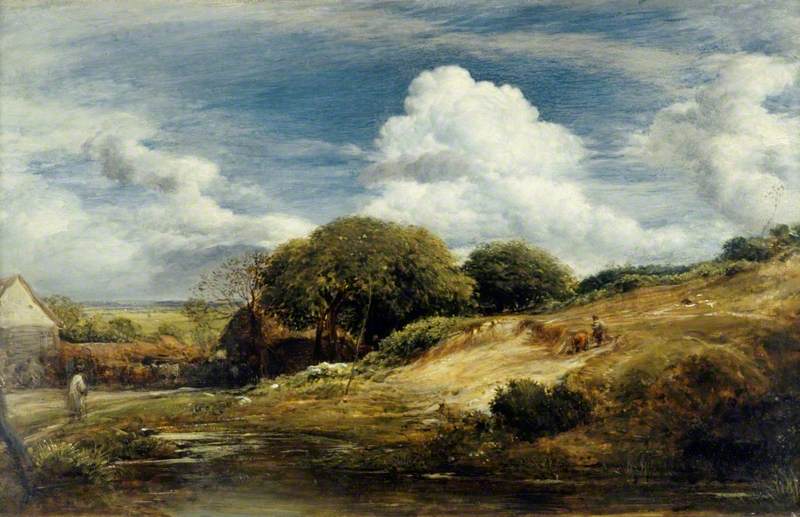
John Linnell appreciated William Blake for his artistic ability and for his spiritual perception, but he also appreciated him for his friendship. Linnell welcomed Blake into his home and into his family circle. When Linnell and his family moved from London proper to the countryside north of the city, Blake became a frequent visitor to their farm in Hampstead. On one of these visits Linnell prevailed on Blake to pose for this sketch. Linnell knew Blake well enough to capture a likeness showing alertness, perception and good humor.

The lighthearted Blake is apparent in this poem from Blake's Notebook.
William Blake  by John Linnell

Songs & Ballads, From Blake's Notebook, (E 481)
"I rose up at the dawn of day
Get thee away get thee away
Prayst thou for Riches away away
This is the Throne of Mammon grey

Said I this sure is very odd                                     
I took it to be the Throne of God
For every Thing besides I have
It is only for Riches that I can crave

I have Mental Joy & Mental Health
And Mental Friends & Mental wealth
Ive a Wife I love & that loves me
Ive all But Riches Bodily
                
I am in Gods presence night & day 
And he never turns his face away
The accuser of sins by my side does stand                      
And he holds my money bag in his hand

For my worldly things God makes him pay
And hed pay for more if to him I would pray
And so you may do the worst you can do
Be assurd Mr Devil I wont pray to you                         
                
Then If for Riches I must not Pray
God knows I little of Prayers need say
So as a Church is known by its Steeple 
If I pray it must be for other People 

He says if I do not worship him for a God                     
I shall eat coarser food & go worse shod
So as I dont value such things as these
You must do Mr Devil just as God please"

Blake's poor health in the last few years of his life prevented him from enjoying the company of Linnell as often as he would have liked. He relished his visits to Collins Farm until he was forced to curtail his activities.
 
Letters, To John Linnell Esqre, N 6 Cirencester Place, Fitzroy Square, (E 778)
[Postmark: 2 July 1826]
"My dearest Friend
     This sudden cold weather has cut .up all my hopes by the
roots.  Everyone who knows of our intended flight into your
delightful Country concur in saying: "Do not Venture till summer
appears again".  I also feel Myself weaker than I was aware,
being not able as yet to sit up longer than six hours at a
time. & also feel the Cold too much to dare venture beyond my
present precincts.  My heartiest Thanks for your care in my
accomodation & the trouble you will yet have with me.  But I get
better & stronger every day, tho weaker in muscle & bone than I
supposed. As to pleasantness of Prospect it is All pleasant
Prospect at North End.  Mrs Hurd's I should like as well as
any--But think of the Expense & how it may be spared & never mind
appearances
     I intend to bring with me besides our necessary change of
apparel Only My Book of Drawings from Dante & one Plate shut up
in the Book.  All will go very well in the Coach. which at
present would be a rumble I fear I could not go thro.  So that
I conclude another Week must pass before I dare Venture upon what
I ardently desire--the seeing you with your happy Family once
again & that for a longer Period than I had ever hoped in my
health full hours
I am dear Sir
Yours most gratefully
WILLIAM BLAKE"


          Collins's Farm, North End, Hampstead: 1831

          by John Linnell

Wednesday, June 22, 2016

MENTAL FIGHT

On page 26 of Fearful Symmetry, Frye writes:
"It appears then, then, that there are not only two worlds, but three: the world of vision, the world of sight and the world of memory: the world we create, the world we live in and the world we run away to. The world of memory is an unreal world of reflection and abstract ideas; the world of sight is the potentially real world of subjects and objects; the world of vision is the world of creators and creatures. In the world  of memory we see nothing; in the world of sight we see what we have to see; in the world of vision we see what we want to see. There are not three different worlds, as in the religions which speak of a heaven and hell in addition to ordinary life; they are the egocentric, the ordinary and the visionary ways of looking at the same world."  
British Museum
Illustrations to Young's Night Thoughts

The world of vision, of creator and creatures, is Blake's world of Imagination; Jung's of Intuition. This is the mental world of which Blake writes and in which he lives. He takes up the sword for mental fight and never puts it down.
 
Blake is the teacher par excellence who presents his subject, asks his students to incorporate an understanding of it into their own thinking and then gives them opportunities to practice the paradigm of acting which he hopes to teach. The student has not learned anything experientially until he incorporates an altered behavior into his range of options.  

An aspect to becoming aware of the imaginative dimension in what goes on in the world around us, is finding patterns which enable us to fit together diverse pieces of our experience. If we recognize similar patterns in, for example religion and science, we expand our ability to assimilate a cohesive view rather than multiple limited views. If we look through a different window of perception, if we alter our preconceived assumptions, or back away form emotional involvement, the whole picture may begin to become visible.
 
When I was trying to catch site of a comet in the sky, I simply couldn't see it although I knew its location and that it was visible to the naked eye. I was trying to focus my eyes as if I would when looking for detail in a picture. When I instead gave up on seeing the comet and looked at the whole sky, the faint light of the comet came into view. Our eyes are actually constructed with special receptors to see faint light as well as receptors for bright light. Until I 'turned off' the receptors for bright light, the receptors for dim light couldn't make the comet visible.
 
Frye and Blake are telling us that we have receptors for peering into the mental world of vision or imagination. But if our focus of attention is occupied with sensation, emotion or rationalization, we miss the fainter light of intuition.      

Milton, Plate 1, (E 95)
"I will not cease from Mental Fight,
Nor shall my Sword sleep in my hand:
Till we have built Jerusalem,
In Englands green & pleasant Land."

A Vision of The Last Judgment, (E 555)
                   For the Year 1810
        Additions to Blakes Catalogue of Pictures &c 
"This world of Imagination is the World of
Eternity it is the Divine bosom into which we shall all go after
the death of the Vegetated body   This World of Imagination is
Infinite & Eternal whereas the world of Generation or Vegetation
is Finite & Temporal    There Exist
in that Eternal World the Permanent Realities of Every Thing
which we see are reflected in this Vegetable Glass of Nature
     All Things are comprehended in their Eternal Forms in the
Divine body of the Saviour the True Vine of Eternity
The Human Imagination who appeard to Me as Coming to Judgment.
among his Saints & throwing off the Temporal that the Eternal
might be Establishd. around him were seen the Images of
Existences according to a certain order suited to my Imaginative Eye 
     Here follows the description of the Picture" 

Tuesday, June 21, 2016

HARVEST & VINTAGE

Revelations 14
[15] And another angel came out of the temple, crying with a loud voice to him that sat on the cloud, Thrust in thy sickle, and reap: for the time is come for thee to reap; for the harvest of the earth is ripe.
[16] And he that sat on the cloud thrust in his sickle on the earth; and the earth was reaped.
[17] And another angel came out of the temple which is in heaven, he also having a sharp sickle.
[18] And another angel came out from the altar, which had power over fire; and cried with a loud cry to him that had the sharp sickle, saying, Thrust in thy sharp sickle, and gather the clusters of the vine of the earth; for her grapes are fully ripe.
[19] And the angel thrust in his sickle into the earth, and gathered the vine of the earth, and cast it into the great winepress of the wrath of God.
[20] And the winepress was trodden without the city, and blood came out of the winepress, even unto the horse bridles, by the space of a thousand and six hundred furlongs.

S. Foster Damon, William Blake: Philosophy and Symbols, in commenting on the final scenes in the Four Zoas, says (Page 164):


Wikipedia Commons
AND GOD BLESSED THE SEVENTH DAY 
AND SANCTIFIED IT
"In six days heaven and earth had been created, according to Genesis, and on the seventh day the Lord rested. In six days, therefore, that work is to be reversed, before the Sabbath of the Millennium can arise. These six days are spent in a final Harvest and Vintage of the world, to make the Bread and Wine of Eternity. Urizen threshes the corn which Urthona bakes into the Bread of Philosophy, while Luvah presses the grapes into the Wine of Ecstacy; and all the chaff and refuse is cast into Non-Entity. This lovely festival in the spiritual world is the reality of what on earth seems to be the final catastrophes of the Apocalypse. During this time Orc burns himself out: Ahania and Enion rise to their former Glory; Luvah and Vala regain their original State of Innocence; while Los takes on his original form, Urthona. The terrific vision ends in a splendid peace:

[Four Zoas, PAGE 139, Night the Ninth, (E 406)]:
"How is it we have walkd thro fires & yet are not consumd
How is it that all things are changd even as in ancient times

The Sun arises from his dewy bed & the fresh airs
Play in his smiling beams giving the seeds of life to grow
And the fresh Earth beams forth ten thousand thousand springs of
life
Urthona is arisen in his strength no longer now
Divided from Enitharmon no longer the Spectre Los
Where is the Spectre of Prophecy where the delusive Phantom
Departed & Urthona rises from the ruinous walls
In all his ancient strength to form the golden armour of science
For intellectual War The war of swords departed now
The dark Religions are departed & sweet Science reigns

End of The Dream"

The image of the harvest and vintage appears in Milton as well:

Milton, PLATE 25 [27] (E 121)
"The Wine-press on the Rhine groans loud, but all its central beams
Act more terrific in the central Cities of the Nations
Where Human Thought is crushd beneath the iron hand of Power.
There Los puts all into the Press, the Opressor & the Opressed
Together, ripe for the Harvest & Vintage & ready for the Loom.

They sang at the Vintage. This is the Last Vintage! & Seed
Shall no more be sown upon Earth, till all the Vintage is over
And all gatherd in, till the Plow has passd over the Nations
And the Harrow & heavy thundering Roller upon the mountains

And loud the Souls howl round the Porches of Golgonooza

Crying O God deliver us to the Heavens or to the Earths,
That we may preach righteousness & punish the sinner with death
But Los refused, till all the Vintage of Earth was gatherd in.

And Los stood & cried to the Labourers of the Vintage in voice of
awe.

Fellow Labourers! The Great Vintage & Harvest is now upon Earth
The whole extent of the Globe is explored: Every scatterd Atom
Of Human Intellect now is flocking to the sound of the Trumpet
All the Wisdom which was hidden in caves & dens, from ancient
Time; is now sought out from Animal & Vegetable & Mineral

The Awakener is come. outstretchd over Europe! the Vision of God
is fulfilled
The Ancient Man upon the Rock of Albion Awakes,
He listens to the sounds of War astonishd & ashamed;"

Milton, PLATE 27 [29] (E 124)
"This Wine-press is call'd War on Earth, it is the Printing-Press
Of Los; and here he lays his words in order above the mortal
brain
As cogs are formd in a wheel to turn the cogs of the adverse
wheel."

Milton, PLATE 43 [50], (E 144)
"To go forth to the Great Harvest & Vintage of the Nations

Finis"
As Damon says, Blake wrote on multiple levels simultaneously. On the historical level the harvest and vintage appeared as the battles and wars which were taking place in his own times - the Napoleonic Wars ("Wine-press on the Rhine groans loud".) In Blake's personal experience the activities of his publishing work were his participation in the 'Great Harvest & Vintage' ("the Printing-Press Of Los; and here he lays his words in order above the mortal brain"). At the spiritual level they were the rewinding of the 'golden string' which had begun to be unwound with the material creation which Blake pictured in the Book of Urizen ("Every scatterd Atom Of Human Intellect now is flocking to the sound of the Trumpet").

Genesis 1
[5] And God called the light Day, and the darkness he called Night. And the evening and the morning were the first day.
[8] And God called the firmament Heaven. And the evening and the morning were the second day.
[12] And the earth brought forth grass, and herb yielding seed after his kind, and the tree yielding fruit, whose seed was in itself, after his kind: and God saw that it was good.
[13] And the evening and the morning were the third day.
[17] And God set them in the firmament of the heaven to give light upon the earth,
[18] And to rule over the day and over the night, and to divide the light from the darkness: and God saw that it was good.
[19] And the evening and the morning were the fourth day.
[22] And God blessed them, saying, Be fruitful, and multiply, and fill the waters in the seas, and let fowl multiply in the earth.
[23] And the evening and the morning were the fifth day.
[27] So God created man in his own image, in the image of God created he him; male and female created he them
[31] And God saw every thing that he had made, and, behold, it was very good. And the evening and the morning were the sixth day.