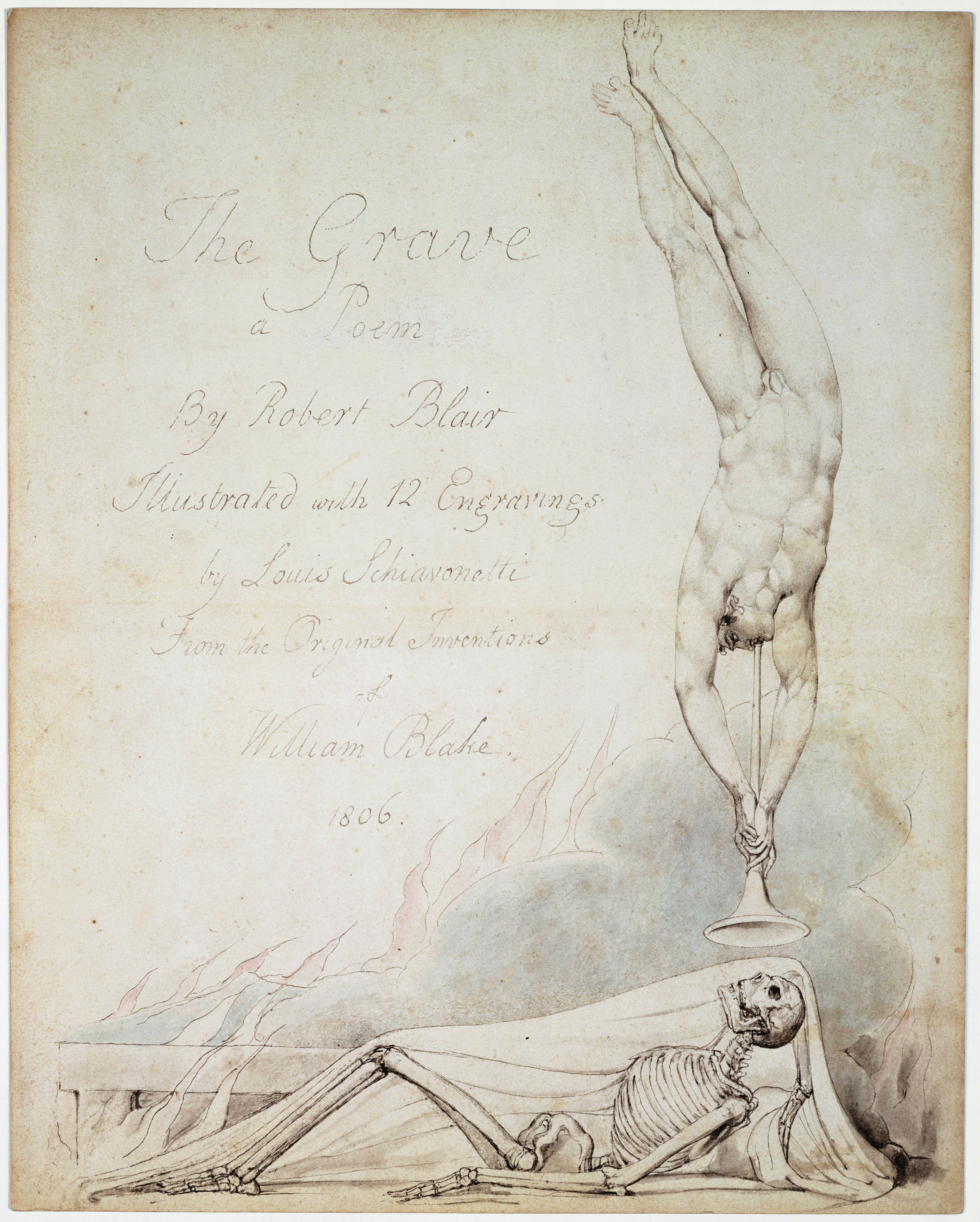
No committed Christian ever had a more antagonistic relationship to the church
than William Blake. This, probably more than anything else, has prevented wider
recognition
of his spiritual genius. Like Paul he became an apostle to the gentiles
and suffered the attacks of the orthodox. In his non-allegiance to the
organized church Blake is in good company: Milton, Emerson, Whitman,
Lincoln, and Gandhi all refused the church for essentially the same
reasons--it never was what it purported to be.
In these posts we examine in some detail Blake's relationship to the church:
In the first unit we survey church history from Blake's point of view, and we trace
some of the sources of his ideas and attitudes.
In the second
we take a closer look at the contemporary scene with sections on
the
State Church, the Society of Friends, the Methodists, and the Deists.
In the third we examine Blake's personal associations as they relate to religious
community, and we conclude with his statements about the church and the uses
which he made of the word in his poetry.
A Blakean View of Christianity
The immediate followers of Jesus were accused of turning the world upside
down. They followed him in challenging all forms of worldly power including death.
One can make a good case for the idea that the Christian by definition challenges the powers of the world that's certainly the meaning of 'radical Christian'.
Blake perceived the legacy that Jesus left behind in two ways. On one
hand the church as the mystical body of Christ consists of those who
continually challenge the authority or powers of the world. On the other
hand the Church as an institution becomes one of the powers of the
world. The tension between these two principles probably exists within
the breast of anyone seriously interested in Christ.
In the second century Ignatius of Antioch eloquently
embodied that tension with his life. Ignatius died a martyr to the
secular power of the Roman Empire. Before that happened, he had spent
much of his time as an eccleiastical authority rooting out dissenters,
whom he called heretics; he did this in the course of establishing the
institutional authority of what became the Roman Church.
With Constantine these two streams of authority came together. In 312 A.D. the
new emperor declared himself a Christian and assumed control of the Church. He
exercised that control through the simple device of naming his most trusted servant
as bishop. The Church became an arm of the political power of the empire.
From that day to this the Church has been primarily one of the powers of the
world. The power of the Church has been expressed through ecclesiastical
hierarchies and creeds, both imposed upon the rank and file by various coercive
techniques essentially identical with those of other worldly powers. This means that
the
spiritual reality of Christ vis-a-vis the Church is only actualized
through the same sort of dissent that Jesus made in the beginning.
These conclusions of course may be debated, but they represent the
basic and lifelong viewpoint underlying the radical protest which was
Blake's art.
The Early Church
After the departure of Christ converts to the new faith gathered
together in small groups awaiting the bodily return of Christ, which
they expected momentarily. Paul and the other missionaries organized
these brotherhoods throughout the Roman world. Paul's letters usually
contain two sections: poetic images created to encourage their faith as
they awaited the return of Christ at the end of the age and practical
advice for the Christians' life together.
He wrote for example to the Colossians that they were "buried with him in baptism [and] risen with him through the faith". No one could interpret that as a
statement
of material fact, but rather as a powerful poetic identification of the
faithful with Christ. In spite of Paul's encouragement the years went
by disappointing their hopes for the second coming and requiring
adjustment to changed expectations.
Two classes of leaders arose, whom we may call priests and poets. The priests
dedicated
their efforts to preserving the heritage of the apostles. They clearly
spelled out the facts and implications of the faith which they had
received from the first generation of believers. They claimed the
authority of their forebears, and they
required uniformity of belief and obedience as a condition of membership in the Church.
Paul's practical advice to struggling congregations became the rules of
order; his poetic images became dogma. The priests imposed their order
and dogma upon the majority of their followers and cast out the others.
The priests go by the name of the Church Fathers, and the institution
which they organized became the orthodox Church.
The other class of leaders we have called the poets. The earliest
Christian poets largely manifested themselves in a movement called Gnosticism
. While the Church Fathers transformed doctrine into dogma, these
Christian Gnostic poets moved in the opposite direction. Instead of
focusing on the letter they listened to the Spirit, and they heard a
wide variety of things. They believed in "letting a thousand flowers
bloom". Many of them enjoyed Greek or oriental learning, which they
combined with Christian thought, much to the dismay of the priests.
What did the Church Fathers find so threatening about the Gnostics?
First of all it was a matter of temperament; priests and poets are
temperamentally at opposite
poles; it has always been so. The priestly enterprise requires a conforming flock;
poets
simply don't conform. The Gnostic poets came up with all sorts of
radical ideas which severely threatened the emerging orthodoxy.
They became the first of a long line of non-conforming Christians, a line that
comes straight down to William Blake. Obviously a movement like Christian
Gnosticism,
creative as it may have been, didn't make for order. The Church Fathers
were much better organized, and they successfully cast out the
Gnostics, naming them heretics. Bowing to their conforming zeal the
Christian Gnostics went
underground but emerged periodically offering a radical alternative to the established way. The Bogomils, the Albigenses, the Waldensians and many other
groups through the ages experienced a grace that freed them both from the law and from much concern about this world.
Jerusalem, Plate 52, (E 201)
 " Those who Martyr others or who cause War are Deists, but never
can be Forgivers of Sin.  The Glory of Christianity is, To
Conquer by Forgiveness.  All the Destruction therefore, in
Christian Europe has arisen from Deism, which is Natural
Religion.
 |
| Wikimedia Commons
A Large Book of Designs
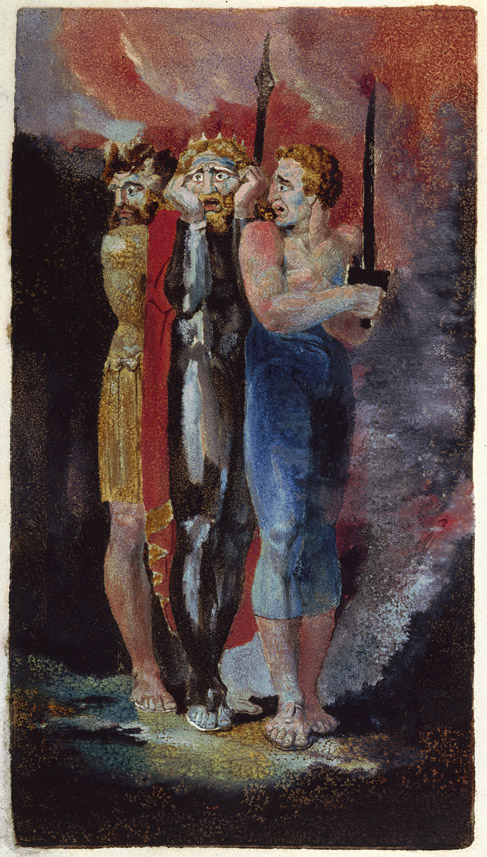
The Accusers |
I saw a Monk of Charlemaine
Arise before my sight
  I talkd with the Grey Monk as we stood
In beams of infernal light

  Gibbon arose with a lash of steel
And Voltaire with a wracking wheel
  The Schools in clouds of learning rolld
Arose with War in iron & gold.

  Thou lazy Monk they sound afar
In vain condemning glorious War
  And in your Cell you shall ever dwell
Rise War & bind him in his Cell.

  The blood. red ran from the Grey Monks side
His hands & feet were wounded wide
  His body bent, his arms & knees
Like to the roots of ancient trees

  When Satan first the black bow bent
And the Moral Law from the Gospel rent
  He forgd the Law into a Sword
And spilld the blood of mercys Lord.

  Titus! Constantine!  Charlemaine!
O Voltaire! Rousseau! Gibbon! Vain
  Your Grecian Mocks & Roman Sword
Against this image of his Lord!

  For a Tear is an Intellectual thing;
And a Sigh is the Sword of an Angel King
  And the bitter groan of a Martyrs woe
Is an Arrow from the Almighties Bow!"
The priestly party, who usually controlled the sword, assisted
thousands of them in their exit from this world. The Church through the
centuries combined a rigidly orthodox view of Christian theology with a
bloodthirsty reaction toward their
theological opponents.
Blake, like many other thoughtful people, discounted the orthodox theology on
the basis of the bloodthirsty spirit, which he perceived an obvious contradiction to
the spirit of Christ. "Though I speak with the tongue of men and angels and have not love". The Church had done that, and Blake knew it. He therefore listened to the tongues of other men and other angels.
.
.
 Blake's Illustrations to Bunyan's Pilgrims Progress