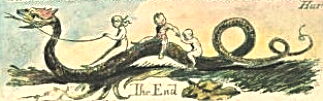
Blake seeks to provide the Golden String which can lead us through the labyrinth of our experience or his own poetry.

Monday, April 8, 2019

Image of God

 This is an extract (1) from Chapter Five (GOD) of Ram Horn'd With Gold by Larry Clayton.

British Museum

Small Book of Designs

Copy A, Plate 1


"Thinking as I do that the Creator
of this world is a cruel being, and
being a worshipper of Christ, I have to
say: "the Son! oh how unlike the Father":
First God Almighty comes with a thump on
the head; then J.C. comes with a balm
to heal it."
(Blake's Comments on A Vision of the Last Judgment, Erdman 565)


       To put it shortly the epigraph says it all. An esoteric alternative Protestantism nurtured Blake as a child. But what he said above aptly expresses the feelings of enormous numbers of people in our society today. "I don't care for the O.T. The N.T. suits me better": there is the understated strong consensus of many today, so extravagantly stated here by William Blake.

      It remains for us only to elaborate on the development of 'God-thought' in the thinker through the years of his spiritual growth. 
**************************************************
      The materialistic psychology dominant in Blake's age as well as our own portrays the real and the imaginative as opposites. But in truth there are only images of reality; all reality is mental, that is, mediated into consciousness by the mind. Our immediate experience is a chaos of sense perception from which we all create our own visions of reality. Like Blake "[we] must create our own system or be enslaved by another man's" (Jerusalem plate 10, line 20). An authentic person consciously creates his own vision of reality. He chooses to be who he is rather than to borrow his identity from a group or from a charismatic figure.
     
 Each person's ultimate reality is his God. There is no known objective God (the Russian cosmonauts assured us of that many years ago); there are only images of God. Some of the outstanding images of God that have shaped the life of the world came to us from Moses, Isaiah, Buddha, and Mohammed. Finally we have the vision of Jesus, whom Christians consider to be an incarnation of God. But perhaps equally influential upon the course of history have been the visions of Alexander, Napoleon, and Stalin. Their common vision of the dominion of power is near the opposite pole from that of the gentle Galilean.

       Blake was a total and confirmed visionary, and he evisioned all of the images of God listed above and quite a few others as well. He did this by pursuing his imaginative experience wherever it led. The uncanny freedom with which he followed "the wind where it listeth" led him on a strange and fascinating spiritual journey through some remarkable byways and paths, described in his poetry. At the end of his pilgrimage he came to a definite vision of God as Jesus, the Forgiveness. After almost two centuries it remains one of the highest and best visions of God that Christians have for their inspiration.

       Full understanding of Blake's vision of God depends upon a grasp of his concepts of time and eternity. For Blake the eternal is the realm of the real, while time is the dimension of Plato's mortal cave of phantasmal dreams. Although the eternal is immortal, it does not refer simply to the hereafter; that would be just a phantasmal portion of time stretched out indefinitely. The eternal is the Mental, the Imaginative, the world to which a man may awaken as soon as he realizes that the corporeal, temporal, materialistic framework of reality is an illusion.

       The rationalists of Blake's day with their radical materialism had closed themselves off from the eternal. They had imprisoned themselves in what he called the mundane shell (Milton plate 17 line 18ff). They were exclusively this worldly. Blake perceived that they worshiped the God of this World, no matter what they called him. They had most often called him Jehovah or Jesus. As a young man Blake renamed him Urizen . He spent half a lifetime studying this God of the timebound so he could cast him off and replace him with a more authentic image. Eventually he came to realize that this god's truest name is Satan. He also referred to him as the Selfhood (Jerusalem 5:21-23) and the Spectre.

       Blake tells us that radical materialism with its worship of the God of this World is a state of mind from which a man may awaken at any moment into a realization of the infinite and of his kinship with the Divine Man, Jesus. So these two Gods, the Satan of the World and the Jesus of Eternity remain in continuous opposition in men's minds, and they are best understood in contrast to one another.

       Jesus is the Lord of the Eternal realm, which is imaginative, creative, non-violent, gracious, and above all forgiving and uniting into life. Satan is God of this World, of power, might, law, man against man, separation, finally death. One is Lord of Life, the other the Lord of Death. Satan is actually not a person but a state and will eventually go to his own place, which is a way of saying that Jesus will eventually get him off our backs. This happens at the Last Judgment when all Error is burnt up.
The Journey
      We live in a secular age; the reality of God has been largely barred from the consciousness of most people. It is a significant experience for only a minority of the population. Of course many people understand that everyone has a God of some sort--his ultimate concern. But the biblical God, the God of Abraham, Issac, and Jacob, the God and Father of our Lord Jesus Christ, is not a live issue in the minds of very many people today. Our foremost modern psychologist, C.G.Jung, quite properly placed God in our unconscious and encouraged us to seek there for him. Jung understood very well Blake's statement that "all deities reside in the human breast" (end of Plate 11 of The Marriage of Heaven and Hell).

      The secular currents so powerful today were already flowing strongly in the late 18th Century in England. The prevalent deism put God back behind the present scene, a long way behind it. Strictly the Divine Architect, having made the world like a clock, he wound it up and left it to run on its own. He also left the deists to their own devices, and they were happy in this new freedom. They felt that they had learned to control their destinies without divine assistance.
Jerusalem, Plate 52, (E 201) 
"Man must & will have Some Religion; if he has not the Religion
of Jesus, he will have the Religion of Satan, & will erect the
Synagogue of Satan. calling the Prince of this World, God; and
destroying all who do not worship Satan under the Name of God. 
Will any one say: Where are those who worship Satan under the
Name of God! Where are they? Listen! Every Religion that Preaches
Vengeance for Sins the Religion of the Enemy & Avenger; and not
the Forgiver of Sin, and their God is Satan, Named by the Divine
Name   Your Religion O Deists: Deism, is the Worship of the God
of this World by the means of what you call Natural Religion and
Natural Philosophy, and of Natural Morality or
Self-Righteousness, the Selfish Virtues of the Natural Heart. 
This was the Religion of the Pharisees who murderd Jesus.  Deism
is the same & ends in the same."

     Blake lived in the midst of these currents, but he opposed them emphatically. Unlike the deists he experienced the immediate presence and pervasive reality of God in his life. He completely filled his poetry and pictures alike with metaphysical images because his mind dwelt almost exclusively upon spiritual themes. The material realm interested him only as a shadow of the eternal. He abhorred the materialism by which the deists lived. He might have been happier and more at home in the Middle Ages.

      But he was also a very modern man. He understood better than Jung that an external objective God is an unknown quantity, a projection of unsophisticated minds:
      "Mental things are alone Real....Where is the Existence Out of Mind or Thought? Where is it but in the mind of a Fool?" (Vision of the Last Judgment, page 565)

       The only God anyone can know is the image of God projected upon his mind or enclosed in his consciousness. Since time began, men have shared their visions of God with one another. All religions began in this way. The Bible makes most sense as an infinitely fascinating compendium of the visions of God shared by Moses, Isaiah, Paul and the other writers. This unfolding and composite vision has shaped western culture down to the present moment.

      Blake thoroughly surveyed this passing scene, not just the Bible, but every other religious document he could get his hands on, and related them all to his own direct and immediate visions. Over his lifetime he may have taken more liberties with God than any other systematic thinker ever did. He could do this because he so fully realized that all of these visions of God had come forth from human breasts like his own. Moses, Isaiah, and the others were his eternal brothers, and he joyously engaged with them in the eternal war, the intellectual war, which he called the "severe contentions of friendship" (Jerusalem 91:17).

.

Sunday, April 7, 2019

Blake's Search

Wikipedia Commons
Illustrations to Young's Night Thoughts
 Page 75

 This is an extract (2) from Chapter Five (GOD) of Ram Horn'd With Gold by Larry Clayton.

A Political God

        "The name of God is blasphemed among the Gentiles because of you" (Romans 2:24)
     
         From the beginning Blake realized the close and intimate relationship between a person's image of God and his political views. The authoritarian image in some form finds favor with establishment types, authority figures and all others who perceive their welfare as dependent upon the status quo. These people feel threatened by unrest in the social levels below their own; they look to God, their primary symbol of authority, to control it. They impose this vision of God upon society, and they use their power to control and discourage alternative visions.

       Liberal types in contrast more likely entertain an image of a benevolent God, a God of mercy whose basic activity is not to control the lower classes but to lift them up, nurture the needy, provide for the poor, and protect them from the rapacious powerful.

        Blake found both types of men among the authors of the Bible; they project the two basic images of God side by side. His simplified schema of interpretation assigned to the two types the designations of priest and prophet. The priest upholds the authority of the past, the authority of tradition. The prophet sees a burning bush and hears a new word which judges the authority and tradition of the priest and invokes a new scene, new ideas, new forms, new life.

        Rather obviously Jesus belonged to the prophetic type. He had as a fundamental aim raising our consciousness of the benevolence of God. He incarnated God, and he was supremely benevolent to all but the priestly party. They suppressed him in the flesh, and in his resurrected body they have always attempted to remake him in their image. As he warned, they have used his name to control, suppress, and even exterminate large numbers of people who would not do as they were told. Blake's real mission in life, both before and after his Moment of Grace , was to rescue the world's image of God from the preemption of the priestly party.

        The conventional understanding of God is that he will get you and put you in a dark hot place forever if you don't do exactly as you are told, by his priest of course. In 1741, sixteen years before Blake's birth, a New England divine named Jonathan Edwards wrote and delivered a sermon which he named, "Sinners in the Hands of an Angry God"; historians tell us that it scared literally thousands of people into the Christian church. A similar vision of God has haunted multitudes before and after Blake even down to the present day. Besides the superstitious fear it has aroused, this understanding of God has contributed to oceans of blood shed by well meaning Christians through the ages.

        Relating this conventional understanding to one of Blake's earliest experiences, his brief career in school yields a distinctive image of God as a Transcendental Schoolmaster. As soon as Blake reached the age of reason, he rejected such a God as radically and uniquivocally as he had rejected the flesh and blood schoolmaster . He saw such an image of God standing at the apex of a pyramid of human unhappiness, of exploitation, oppression, misery and hatred. He saw the divine right of kings and all those who derive their authority from the Crown. He saw their lackey priests extorting tithes from the people, collected by the 18th century equivalent of the IRS, and often giving little in return.


Four Zoas, Night II, Page 36, (E 325)
"It is an easy thing to laugh at wrathful elements 

To hear the dog howl at the wintry door, the ox in the slaughter house moan 
To see a god on every wind & a blessing on every blast 
To hear sounds of love in the thunder storm that destroys our enemies house 
To rejoice in the blight that covers his field, & the sickness that cuts off his children 
While our olive & vine sing & laugh round our door & our children bring fruits & flowers 
Then the groan & the dolor are quite forgotten & the slave grinding at the mill 
And the captive in chains & the poor in the prison, & the soldier in the field 
When the shatterd bone hath laid him groaning among the happier dead 
It is an easy thing to rejoice in the tents of prosperity 
Thus could I sing & thus rejoice, but it is not so with me!"

       He saw the emerging divine right of industrialists to work seven year old children fourteen hours a day at hard labor and reward them with a pittance. This image of God was most horrendously embodied in the judges and executioners who disposed of the child criminals. He saw the press gangs with royal authority to capture and drug anyone lacking upper class credentials; their poor victims woke up aboard ship in a state of virtual slavery, and following the brave Roman tradition they learned to fear their officers more than the enemy. Blake felt an intense mystic union with the suffering masses and even the suffering masters: he knew that a prison officer has to be just as sick as the men he guards.

       All these social programs were devised to teach poor devils to do what they were told, and behind them all stood the grim Transcendental Schoolmaster with the god sized birch rod. How could a self respecting person with any human sensitivity be other than an atheist! But Blake was never an atheist. Somehow he had to come to terms with God. If the above were a true representation of God, then he would rebel against God with his last breath. The young Blake identified with Milton's Satan in Paradise Lost: such a God is a sneaking serpent, and Blake would spend his life as the just man raging in the wilds. Schizophrenia might be the normal reaction to certain social conditions.


         The August Schoolmaster exists to enforce good and to prohibit or punish evil. The trouble with good and evil is that in this fallen world they are always defined by the man with the biggest stick. He of course sees himself as the likeness of God, God's earthly representative. So the most oppressive tyrant, the most colossal mass murderer, the most authentic Caesar becomes the Son of Heaven. The list is long and gruesome, and Blake knew his history.

Visions of Daughters of Albion, Plate 4, (E 48)
"Then Oothoon waited silent all the day. and all the night,
Plate 5
But when the morn arose, her lamentation renewd,
The Daughters of Albion hear her woes, & eccho back her sighs. 
O Urizen! Creator of men! Mistaken Demon of heaven:
Thy joys are tears! thy labour vain, to form men to thine image.
How can one joy absorb another? are not different joys  
Holy, eternal, infinite! and each joy is a Love.  
Does not the great mouth laugh at a gift? & the narrow eyelids mock
At the labour that is above payment, and wilt thou take the ape
For thy councellor? or the dog, for a schoolmaster to thy children?
Does he who contemns poverty, and he who turns with abhorrence  
From usury: feel the same passion or are they moved alike?
How can the giver of gifts experience the delights of the merchant?
How the industrious citizen the pains of the husbandman.
How different far the fat fed hireling with hollow drum;
Who buys whole corn fields into wastes, and sings upon the heath:
How different their eye and ear! how different the world to them!"
        Although he wouldn't dream of worshiping such a deity, Blake had no hesitancy about calling him God; he simply refused to call him a good God. Wide reading in Oriental, Greek, and Norse mythology had led him to an acquaintance with any number of malevolent gods. In his poetry he used these pagan images to flesh out the God of Wrath whom he found in the Old Testament. For perhaps fifteen years Blake's creative energies were largely expended in a conscious and deliberate overt rebellion against the conventional image of the Old Testament God. During those years he subjected that image to a searching and unique psychological analysis; it fills the pages of the Blake reader.
.

Friday, April 5, 2019

Beyond Innocence

Wikisource 
Book of Thel  
Image from Final Page

 This is an extract (3) from Chapter Five (GOD) of Ram Horn'd With Gold by Larry Clayton.


Early Images of God
        'Songs of Innocence' and 'The Book of Thel' both composed shortly before 
'The Marriage of Heaven and Hell', contain perhaps the most exquisite images of a 
benevolent God to be found in modern literature. Written by a man of 34, they vividly 
evoke the faith of a child like mind unsullied by the world. Writing them Blake performed 
the imaginative feat of a supreme artist able in vision to project his psyche back to the 
days before the Fall. Actually at this stage of his life Blake already had a 
keen awareness of the Fall, a mind deeply shadowed by it; but no trace 
of the shadows appears in these exquisite sacrifices of praise. It's as 
if with prescience that his art will shortly be submerged in visions of 
fallen man and a fallen God, he paused for one preliminary glimpse of 
the Golden Age.

Book of Thel, Plate 1, (E 3)
"The daughters of Mne Seraphim led round their sunny flocks.
All but the youngest; she in paleness sought the secret air. 
To fade away like morning beauty from her mortal day: 
Down by the river of Adona her soft voice is heard: 
And thus her gentle lamentation falls like morning dew. 
 O life of this our spring! why fades the lotus of the water? 
Why fade these children of the spring? born but to smile & fall. 
Ah! Thel is like a watry bow. and like a parting cloud. 
Like a reflection in a glass. like shadows in the water. 
Like dreams of infants. like a smile upon an infants face, 
Like the doves voice, like transient day, like music in the air; 
Ah! gentle may I lay me down, and gentle rest my head. 
And gentle sleep the sleep of death. and gentle hear the voice 
Of him that walketh in the garden in the evening time."
         That pause brought a precious gift to mankind. The faith of the Clod can hardly be improved upon. The God in "The Little Black Boy" not so much in the imagined father as in the spirit of the child, has been a candle in the life of many a hard pressed pilgrim tempted to curse the darkness.
        After 'Songs of Innocence' begin the curses. It may be worthwhile to curse the darkness if thereby we make someone aware of it. This was Blake's aim, like that of most social prophets. Dickens rubs our noses in the darkness over and over, and we're better men for having read him. Like Dickens' novels Blake's poems are full of darkness. From 1790 to 1800 he directed our thoughts to the fallen God whom we worship, who promotes the darkness and calls it light.
    
   Few or no specimens of humanity would stoop so low as to consign a fellow man to everlasting torment; any Being imagined to do such a thing must be at best subhuman. The worship of such a being is devil worship. In a poem on the French Revolution Blake descended to the crudest vulgarity in trying to put such a theological notion in its rightful place:
       
            Satiric Verses, From Blake's Notebook, (E 500)
"The King awoke on his couch of gold             As soon as he heard these tidings told             ...             Then he swore a great and solemn Oath:             "To kill the people I am loth,             "But if they rebel, they must go to hell:             "They shall have a Priest and a passing bell."             Then old Nobodaddy aloft             Farted and belch'd and cough'd,             And said, "I love hanging and drawing and quartering             "Every bit as well as war and slaughtering.             "Damn praying and singing             "Unless they will bring in             "The blood of ten thousand by fighting or swinging." 

.

Thursday, April 4, 2019

Battle with Urizen

Yale Center for British Art
America
Plate 10

This is an extract (4) from Chapter Five (GOD) of Ram Horn'd With Gold by Larry Clayton.

Urizen

With the conception of Urizen Blake began the most serious stage of his war with the conventional God. In fact his battle with God provided the creative energy for the development of his entire mythology, particularly the series of poems known as the Lambeth books and the first major attempt at an epic, 'The Four Zoas'. 'Milton' and 'Jerusalem' were written after the battle was won.

The 'Book of Urizen' is at one level a brutal burlesque of the Creation story found in Genesis. More properly it offers an alternative to the biblical story, based upon Neo-platonic metaphysics. Blake took the Gnostic demiurge, something much less than the Supreme Being, and merged it with the Old Testament God into a diabolic parody.

Tremendous meaning may doubtless be found in this book, the Genesis of Blake's Bible of Hell. Some knowledgeable interpreters see in it a superwise man offering supersubtle insight to the devotees and adepts who have pursued his truth. But a plain man's view suggests that 'Book of Urizen' comes from the pen of an angry young man. Most of us have shut out youthful anger. We pass our days having closed off our consciousness from the horror of life that surrounds us. In that way we can sleep at night and forget that we live in a filthy world, a place where ten year old children hang for trivial crimes and five year olds learn to climb the insides of tall back chimneys. Comparable things are happening in our town today, but we simply don't dwell on those sorts of things; we learn to be positive thinkers.

But men like Blake and Vincent van Gogh couldn't shut those images out. Van Gogh died in an insane asylum. Blake had a more creative solution; he wrote the 'Book of Urizen'. Someone is finally and ultimately responsible for the horror of the world. He blamed God or rather the image of God projected by his fellow men. Anyone gifted with a real relationship with God has had similar feelings.

At the deepest level 'Book of Urizen' comes through as a cry of pain: the God who made this black world in which we live in chains has to be a monster. And Blake offers some very imaginative ideas as to how he got that way. He fell from Eternity; he fell before Creation; and then he created an awful mess. Then he gave us laws to live by that shrink us up more and more from what we might be. William Blake is noted for the Divine Vision. But 'Book of Urizen' is the diabolic vision, the Bible of Hell. Before ecstasy there is agony. In 'Book of Urizen' Blake poignantly articulates the darkness before the dawn.

The really exciting thing about 'The Four Zoas' is the long incubation and eventual birth of Blake's new, positive image of God concurrent with the thorough and definite laying to rest of the old one. These realities become vivid once the reader gains sufficient familiarity with the material to see the underlying currents of spiritual movement. If you like poetry, 4Z contains many beautiful lines interspersed throughout the nine Nights amidst long, bleak desert passages describing fallenness. The beautiful passages mark stirrings of the Spirit. (It has great similarity in fact to the style of Isaiah, who wrote the most beautiful parts of the O.T. surrounded by unrelieved darkness.)

Follow the speeches of Enion , the primeval mother of Los and Enitharmon. In Night i her children's increasing depravity and her maternal love lead her down into the abyss of Non-entity, in her case an abyss of consciousness. She becomes a disembodied voice sounding a note of reality over the general fallenness as it progressively develops. Her comments throughout the action preserve the feeling of human oneness that will break forth at the darkest hour. In Enion Blake found a new voice expressing a passionate love that laments but doesn't excoriate, and a faith, evolved through suffering, that the Divine Image will come to redeem. These of course are the most creative themes of the Old Testament, slowly evolving out of its generally primitive theology. Enion's speeches at the conclusion of Nights i, ii, and viii are too long to quote here, but they contain some of the most sublime poetry Blake wrote and portend the emergence of the new God of compassion.

In 4Z Blake elaborated and analyzed the God, Urizen, in the fullest detail; this version contains less heat and more light than we found in 'Book of Urizen.' Urizen symbolizes man's thinking faculty; in the primary myth of the Fall he became estranged from his feelings. This story is told at least six times in 4Z. Blake devoted Night ii to Urizen's creation of a rocky, hard, opaque world of mathematical certainty and calculation. Anyone who has spent time on a college campus has met people highly developed intellectually and infantile emotionally. They lack the capacity to express any value more intense than "very interesting". Many of course have denied that value has any meaning. Imagine what kind of world they create, what spiritual climate they live in; there you have Urizen.

He is a God devoid of true feeling; he has feelings, but they're all false. He continually weeps, like the Old Testament God who wept as he punished people. He builds a world of law, devoid of feeling, devoid of compassion, devoid of humanity. His world is based upon fear of the future, and he attempts to secure himself against it at all costs. Fear defines his character and his actions until the very end of the fallen world. In Night viii Urizen is still fighting life and light. He sets out:

Four Zoas, Night VIII, Page 102, E 375
"to pervert all the faculties of sense
Into their own destruction, if perhaps he might avert
His own despair even at the cost of everything that breathes."

There you find a preview of the God of the superpowers. Their fear has become the guiding principle leading them toward the destruction of "everything that breathes".

Urizen's initial downfall comes in Night iii. His emanation (in this case wife), Ahania, has followed Enion, the Earth Mother, into the abyss of consciousness. She tries to share with Urizen a level of truth that he finds so unpleasant that he casts her out, and promptly falls himself like Humpty Dumpty. In Ahania's vision we have a psychologically acute and penetrating description of the incipience of a false God. It ranks with the Bible's eloquent pre-psychological denunciations of idolatry, as found for example in Isaiah 40. Blake re-used this passage in 'Jerusalem', attesting its authenticity even on the illumined side of the Divine Vision:
Four Zoas, Night III, Page 40, (E 327)
"Then Man ascended mourning into the splendors of his palace,
Above him rose a Shadow from his wearied intellect
Of living gold, pure, perfect, holy; in white linen he hover'd,
A sweet entrancing self delusion, a wat'ry vision of Man
Soft exulting in existence, all the Man absorbing.
Man fell upon his face prostrate before the wat'ry shadow,
Saying, "O Lord, whence is this change? thou knowest I am nothing."
... Idolatrous to his own Shadow, words of Eternity uttering:
"O I am nothing when I enter in judgment with thee.
"If thou withdraw thy breath I die and vanish into Hades;
"If thou dost lay thine hand upon me, behold I am silent;
"If thou withhold thine hand I perish like a fallen leaf.
"O I am nothing, and to nothing must return again.
"If thou withdraw thy breath, behold I am oblivion."

In this parody of the Psalmist Blake shows us a fundamental truth about man's image of the transcendental God. He doesn't deny the reality of a transcendental God as some of his interpreters have concluded. He denies the truth of man's image of the transcendental God, an entirely different matter.

He opposes the ascribing of qualities to the Wholly Other. According to Blake when that is done the result is something less than man. Worshiping this sub-human God the worshiper becomes something less than man himself. He represses a portion of his humanity, which Blake here calls Luvah, and that repressed portion falls upon him and afflicts him with boils from head to toe. The penalty for idolatry is brokenness and suffering, consciousness of sin, guilt, division, finitude, envy, the torments of love and jealousy, the whole bit of man's unfortunate fallen circumstances. It's all caused by the false God that man has chosen. Isaiah understood a part of this; he recognized some of the idols of others but not his own. Thomas Altizer, in his book on Blake, rightly took this passage as a critical revelation of the "death of God".

Man worships a shadow of his wearied intellect. No higher God is possible without the wholeness that Christ brings. Worship of a shadow of our wearied intellect leads to all the false and fatal evils that we visit upon one another from simple vanity to war.
.

Wednesday, April 3, 2019

Transition

Wikipedia Commons
For the Sexes: The Gates of Paradise
Plate 21, Epilogue

This is an extract (5) from Chapter Five (GOD) of Ram Horn'd With Gold by Larry Clayton.

Humanism

With idols no longer possible what's left to worship? The answer depends upon your experience. With all the idols gone the true God remains, for those who can meet him. For others the highest possible is the Human Form, and here Blake settled before he came to see Jesus as God. He began by worshiping the Human Form, the Highest and Best Imaginable, and in 1800 he recognized this Highest and Best in Jesus. In terms of conventional theology Blake was a humanist before he became a committed Christian. In "The Marriage of Heaven and Hell' he loudly proclaimed his humanism: "God only Acts and Is, in existing beings or Men". And a few pages later:

The worship of God is: "Honouring his gifts in other men, each according to his genius, and loving the greatest men best: those who envy or calumniate great men hate God; for there is no other God."

According to Kathleen Raine it was "the central doctrine of the Swedenborgian New Church that God can only be known in human form". Blake illustrated this with his quatrain at the end of "Auguries of Innocence":
"God Appears and God is Light
To those poor Souls who dwell in Night,
But does a Human Form Display
To those who Dwell in Realms of day."

Finally in his "Annotations to Berkeley's Siris", which he read about 1820, he wrote "God is Man and exists in us and we in him". He was still a humanist, but his humanism had gained a strong Christian dimension. Blake's argument against the conventional images of God, from beginning to end, hinged upon their sub-human nature. The biblical writers frequently ascribed to their God attitudes and behaviour beneath the moral level of any self respecting human. God cannot be less than man; therefore the appropriate response to such an image is derision, especially in the face of the common credulous awe.

The spiritually open person, free of the common credulous awe and capable of a clear eyed gaze at the Bible, no longer finds it possible to view all the biblical images as portraying a God worthy of worship. Furthermore when one looks freely at the actions of political and religious leaders of Christendom of the past 2000 years, it becomes clear that they were often worshipping something other than the true God. Finally the actions and attitudes of our contemporaries and even our own point to domination by a vision that is something less than the Highest and Best. In his poetry Blake documents these three observations with voluminous detail. They led to his ultimate evaluation of the universal false God. The name he settled upon is refreshingly biblical and authentic:

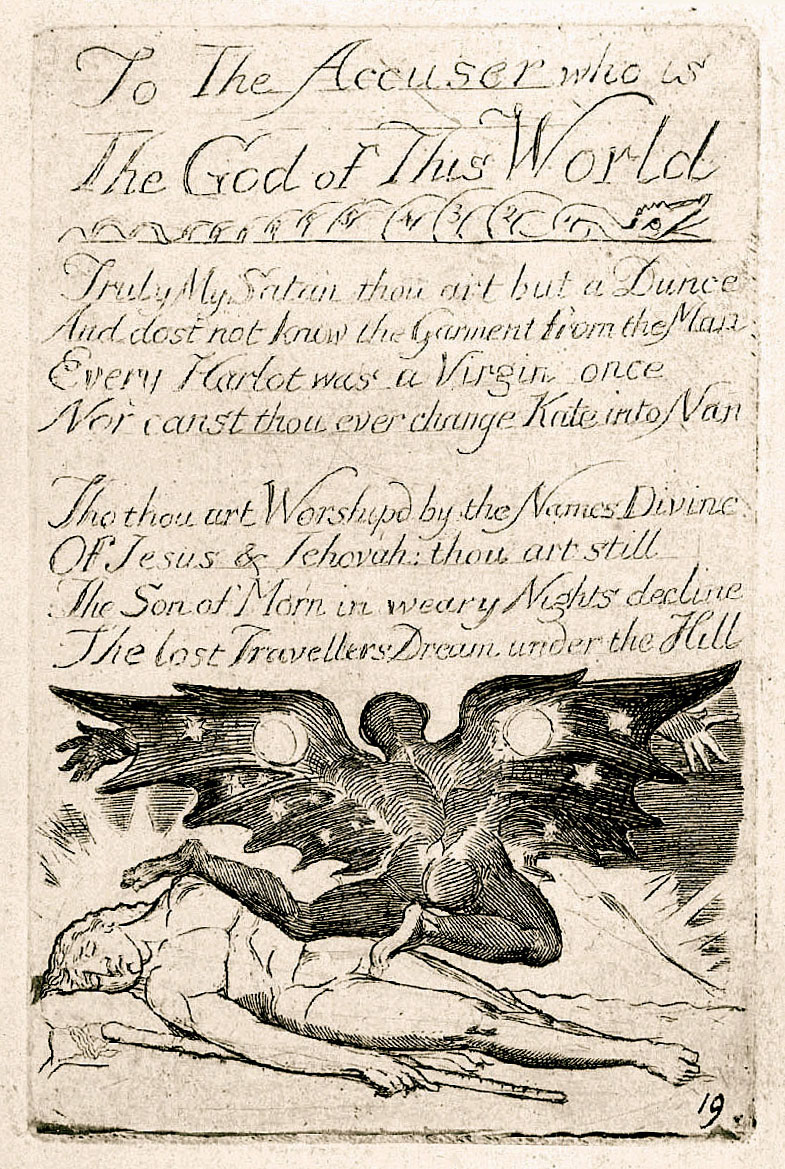
For the Sexes: The Gates of Paradise, Plate 21, (E 269)
"To the Accuser, who is
The God of this World
...
Tho' thou art Worship'd by the Names Divine
Of Jesus and Jehovah, thou art still
The Son of Morn1 in weary Night's decline,
The Lost Traveller's1 Dream under the Hill."

Jesus had said it a long time before: "Why call ye me Lord, Lord...." 

God of this World

Who is the God of this World? He is the God of those whose life is based upon the physical senses and centered in material existence, in this world. They provide for themselves now because there is no Other. They use law and power for their own advantage at the expense of others and consider that to be the nature of reality. These are the worshippers of the God of this World. In the end nothing could be more authentically biblical.

Once he began to focus upon the God of this World, Blake found in the Bible much positive information: he masquerades as an angel of light; he tempts; he accuses. "We do not find anywhere that Satan is accused of sin. He is only accused of Unbelief and thereby drawing man into sin that he may accuse him." Satan is particularly attached to the rulers of the world--economic, political, and ecclesiastical--and they to him. He is "Worshiped as God by the Mighty Ones of the Earth" (Jerusalem 29:18). They naturally regard him as God because their faithfulness to his values and methods has led them to great prosperity.

But in Satan's kingdom more basic than oppressive power is fear and timidity. Northrup Frye explains: "The morally good man tries to obey an external God instead of bringing out the God in himself. The external God [is] only the shadow of Caesar." Tyranny is only possible because men are willing victims. That's why the flaming rebel has such an important place in the renewal of life .

Interpreters have greatly misunderstood the role of Satan in Blake's structure of thought because he used the image of the devil to represent two different things. The Satan of 'Paradise Lost' was a flaming rebel against a ridiculous God, and in MHH Blake ironically identified himself with this devil and even claimed that Milton belonged to the devil's party without knowing it.

But the God of this World is an altogether sinister image. The devils of MHH represent fiery creativity. The God of this World opposes creativity of every sort in favor of rigid obedience to the powers that be. They are his powers. A lineal descendant of Urizen, he claims everything he can touch for Eternal Death.

Blake's reversal of symbols is admittedly confusing. But then everyone has or should take the freedom to change his values and symbols as he goes through life. Actually in the course of his development as a poet and thinker Blake used 'Satan' with a variety of meanings. The God of this World is a less ambiguous term. It connotes Deceiver, Tempter, Perverter, Accuser, Killer. The God of this World is the God of Eternal Death.

The third temptation of Jesus in the wilderness was to fall down and worship the God of this World. Had he succumbed, the Jews would have had their political messiah, and the spiritual history of the world would have been different. The story of this temptation is a critical element in Blake's system of thought. He doesn't apply it to the historical Jesus so much; he applies it to the members of Christ.

When a pilgrim sets out to pursue the narrow path, his primary problem remains the temptation to worship the God of this World. With great interest Blake watched the careers of his fellow men as they met and responded to that moment. 'The Four Zoas', as its biblical superscription suggests, is largely devoted to wrestling against the rulers of the darkness of this world. In CHAPTER ONE we saw how Blake's life may be interpreted in terms of this fundamental psychic and spiritual event.

The Felpham Moment represented the ultimate level of the problem posed to him. Blake knew that Hayley was his friend and wished him well. But at Felpham he came to realize that life offers us two kinds of friends. "Corporeal friends are spiritual enemies." A corporeal friend may offer you the world and take your soul. Hayley was Blake's corporeal friend; he wanted for him the best that he knew; he wanted to help him make his way in the world!

Hayley was a worldling; he knew nothing of the Realms of day. His corporeal friendship was eternally dangerous to his protege. As a matter of fact he had sponsored Godwin, before that spiritually oriented poet went crazy. It took Blake a while to work all this out, but when he did, the whole problem of God became clear. The God of this World was clarified, named, cast into the lake, and soon thereafter the Divine Vision came to him with power. We have already quoted Blake's eloquent poetic description of the event:

Jerusalem, Plate 37 [41], (E 184)
"Each man is in his Spectre's power
Until the arrival of that Hour
When his Humanity awake
And cast his Spectre into the lake."

In the circumstances of the Felpham visit Hayley incarnated to Blake the Spectre, the God of this World--not Hayley the man, but Hayley the spiritual principle who had acted upon Blake at his point of weakness to take his soul. Hayley the man was simply a fellow sufferer whom Blake continued to encourage through the years ahead, but what he had represented in Blake's mind, the smiling worldling, no longer had influence upon Blake's life. The Spectre was cast into the lake.

The Spectre is the individual internal form of Satan or the God of this World. Another name for him is the Selfhood. He is the internal egocentric principle that causes a man to see himself over against the rest of humanity. In his poem, 'Milton', Blake makes this identity clear with the words of Milton at the conclusion of the "Bard's Song", which has been devoted to an elaborate description of how Satan arises and acts in human life: "I in my Selfhood am that Satan: I am that Evil One!/ He is my Spectre!"

The Job series shows more eloquently than any words could how the conventional idea of God, a part of a man's psyche, eventually proves to be satanic. Job, a ruler of the world, comes to recognize that his God is satanic, passes through a spiritual death, and is reborn with a clarified vision. That's Job's story and Blake's story and everyman's story.

The gospel truth reveals that the satanic God of this World, our Spectre, our Selfhood, will die, and the Divine Image in us will rise to meet the true God in the Realms of day. The theology here is a composite of Job and Revelation. Blake's life and work both attest that the way in which the satanic God dies is through our becoming aware of him. Blake strove to do this consciously as an artist through what he called "building Golgonooza", but the Moment of Grace for him as always was not something that he did, but something that happened to him when he had made himself ready.


.

Tuesday, April 2, 2019

Destination

Yale Center for British Art
                            Illustrations to Young's Night Thoughts
This is an extract (6) from Chapter Five (GOD) of Ram Horn'd With Gold by Larry Clayton.

The Divine Vision

Throughout this chapter we have followed Blake as he encountered, faced, studied, named, and denounced the false God in the many guises in which he appears to man. This enterprise occupied the first half of his adult life. But during this time he was always aware of something real behind the shadow. As a child he had loved the Lamb:

Songs of Innocence, Song 8, (E 9)
"Little Lamb, who made thee?
Dost thou know who made thee?
Gave thee life, and bid thee feed
By the stream and o'er the mead;

Gave thee clothing of delight,
Softest clothing, wooly, bright;
Gave thee such a tender voice
Making all the vales rejoice?
Little Lamb, who made thee?
Dost thou know who made thee?

Little Lamb, I'll tell thee,
Little Lamb, I'll tell thee:
He is called by thy name,
For he calls himself a Lamb.
He is meek, and he is mild;
He became a little child.
I a child, and thou a lamb,
We are called by his name.
Little Lamb, God bless thee!
Little Lamb, God bless thee!"

As a youth Blake's mind came to be overshadowed by the Tyger. Some interpreters believe that at a certain point he began to see Jesus as misguided: in the 'Song of Los' he wrote that Jesus "received a Gospel from wretched Theotormon". Theotormon symbolizes the legalistic repression of impulse. If Blake did turn away from Jesus, it was by no means an uncommon stage of life for a young man.

Blake always put an ultimate trust in the imaginative power that gave him visions of infinite joy. But at the age of 24 through a failure of consciousness he had chosen a measure of satanic power with a consequent loss of spiritual perception; the Divine Vision faded. There followed the years of struggle with the God of this World, and as we have seen, his experience at Felpham (his "first Vision of Light") led to his definite rejection of the Tempter. In 1803 he returned to London, having prepared himself for an additional grace which shortly fell upon him. In a letter to Hayley dated Oct. 23, 1804 he gave an account of an awesome change that had come into his life:
Letters, To William Hayley, (E 756)
"Suddenly on the day after visiting the Truchsessian Gallery of pictures, I was again enlightened with the light I enjoyed in my youth, and which has for exactly twenty years been closed from me as by a door and by window-shutters."

It's doubtful that he expected Hayley to understand this fully, but we are eternally indebted to both of them for passing it down to us. It marks in a most objective way the return of the Divine Vision, who had been overshadowed by Blake's preoccupation with the God of this World.

The progression of Blake's poetry shows the eclipse of Christ through the long struggle of the nineties. Now he proceeded to introduce the Lamb into 4Z with a group of additional lines at strategic places. These images means relatively little to the secular reader, but cause great joy to the Christian.

The Destination

The healing of Los, described in Night vii of 'The Four Zoas', prepares the way for Christ's coming into history. Night viii tells the story of Jesus: the Incarnation, the Crucifixion, and the Resurrection of the spiritual body. It's important to remember that in Blake's mental world and in his poetry these are psychic rather than historical events.

Blake had always worshiped the Divine Vision. In his twenty years in the wilderness the Divine Vision dimmed and lost the immediacy which had informed the beautiful poems of Innocence. Kathleen Raine points to a few lines that describe with peculiar luminosity this dimming of the Divine Vision:

Jerusalem , Plate 66, (E 8)
"And as their eye & ear shrunk, the heavens shrunk away:
The Divine Vision became First a burning flame [Moses], then a column
Of fire [the Exodus],then an awful fiery wheel surrounding earth and heaven [Ezekiel],
And then a globe of blood wandering distant in an unknown night:" [false Christianity]
This describes Blake's personal experience and that of Mankind. But at or after Felpham he recovered the Divine Vision and realized that his name is Jesus.

He spent the rest of his life celebrating the momentous event and the Name and proclaiming its reality in a hundred ways. It had happened to him, and it would happen to the world.

With the ensuing works of art Blake gives us a portrait of Jesus in many ways original. It may prove to be the most vital portrait of Jesus for the present age. The quest for the historical Jesus long ago became a vain enterprise. Every worshiper has endowed the Divine Man with his own highest values, and Blake was no exception. His mature or final portrait of Jesus has four salient features. Three of them expressed convictions that he had held for a lifetime and repeatedly expressed poetically and pictorially. The fourth was a new experience, the touch of grace; it irradiated the first three with glory.

.

Monday, April 1, 2019

Reconciliation with Jesus

British Museum
Illustrations to Young's Night Thoughts

This is an extract (7) from Chapter Five (GOD) of Ram Horn'd With Gold by Larry Clayton.
i
 Perhaps the most basic feature of Blake's Jesus is the Oneness that he embodied. It's also the most orthodox. Blake was in many ways an unorthodox thinker and theologian, as the preceding pages have shown, but the Oneness of Jesus comes straight out of the New Testament. A wealth of texts demonstrate this; those of the Bible and those of Blake show a profound simultaneity of intention:

The Evangelist John quotes Jesus in his starkest statement of his identity: "I and my Father are One" John 10:30. And later he recorded Jesus' great prayer of intercession for us,

"That they all may be one, as thou Father, art in me, and I in thee, that they also may be one is us."

If any one verse in the Bible most clearly expresses Blake's fundamental faith, that's it. Look at Blake's first mention of Jesus in 4Z:

"Then those in Great Eternity met in the Council of God
...
As One Man all the Universal family; and that One Man
They call Jesus the Christ, and they in him and he in them
Live in Perfect harmony, in Eden the land of life."
(The Four Zoas [Nt 1], 21.1-6; E310)

In the total structure of his theological vision Blake has imaginatively answered thoroughly and completely the prayer of Jesus in the Garden of Gethsemane. According to his vision Jesus, the One, comprises the true nature of you and me when we are healed and whole. Once again nothing could be more biblical.

Long before his encounter with Jesus Blake's myth was thoroughly grounded in the Oneness of Man. Albion was One, the Universe. His division was the Fall, and his return to unity the ultimate good. Thus Blake describes Albion, the Universal Man at the very beginning of 4Z:

Four Zoas, Night I, Page 4, (E 310)
"Daughter of Beulah, Sing,
His fall into Division and his Resurrection to Unity:
His fall into the Generation of decay and death, and his
Regeneration by the Resurrection from the dead."

That was the shape of the original myth. After Felpham Jesus became the One and Albion became one of his members--and so did Blake. 'Jerusalem' begins with a plate headed by the stark phrase in Greek, "Jesus only", and Blake reports hearing these words from the Savior:

Jerusalem, Plate 4, (E 146)
"I am not a God afar off, I am a brother and friend;
Within your bosoms I reside, and you reside in me:
Lo! we are One, forgiving all Evil, Not seeking recompense.
Ye are my members...."

And near the end of 'Jerusalem':

Jerusalem, Plate 91, (E 251)
"He who would see the Divinity must see him in his Children,
One first, in friendship and love, then a Divine Family, and in midst
Jesus will appear....
But General Forms have their vitality in Particulars, and every
Particular is a Man, a Divine Member of the Divine Jesus."

Jesus claimed to be one with God and prayed that we might join him in the oneness. Blake's pilgrimage, with his successive visions of God, those he hated as well as those he loved, provides a fascinating example of how a man becomes one with God. To love the true God is to hate all false Gods.
ii
The philosophic garment with which Blake clothed Jesus was his Neo-platonic idealism. The Eternal Jesus whom Blake envisioned and worshiped is radically separated from the Hebrew peasant who lived in the first century. Blake understood that the worship of the historical Jesus had become an insidious form of idolatry, an advanced form of Satanism.

The priest claims the historical Jesus as his exclusive possession and as the ultimate sanction of his particular form of religious tyranny. He uses the figure first to cow and then to exploit his credulous followers. In this way he denies the indwelling Spirit in himself as well as in his flock. Blake's Jesus, in contrast to the priests', exists not in history but in heaven, which is not a far off never, never land, but a psychic reality.

The never, never land is a materialistic illusion. The reality of Jesus is eternal rather than material; preoccupation with the material Blake saw clearly as a rejection or refusal of the eternal. In 4Z Jerusalem, the embodiment of the church, responds materialistically to the death of Jesus: "let us build a Sepulcher and worship Death in fear while yet we live." What a powerful commentary on the response of the Church to the Christ event!

As long as our minds are centered in that particular century, Christ is dead for us. Preoccupied with the corporeal, we fail to discern the (spiritual) body. A few pages later we read that "Jerusalem wept over the Sepulcher two thousand years". Blake means that we Christians have done this under the influence of the established Church, dominated by the materialistic spirit of the age. While Jerusalem weeps over the corporeal body, like Mary Magdalen at the empty tomb, Jesus in his spiritual body stands beside her waiting to be recognized, but this won't happen until we (Jerusalem) awaken from our obsession with the material:

"And Los and Enitharmon builded Jerusalem, weeping
Over the Sepulcher and over the Crucified body
Which, to their Phantom Eyes, appear'd still in the Sepulcher;
But Jesus stood beside them in the spirit...."
(FZ9-117.1-4; E386|)

The Eternal Man, both First and Second Adam, had God (Spirit) for father and Earth (Clay, Matter) for mother. Blake's profound allegiance to this traditional symbolism led to what many have perceived as a savage attack on Jesus' mother. The attack was savage, but the object of Blake's savagery was not Mary herself but the veneration of Mary, which he could only see as a reversion to Nature Worship and the fertility cults. He understood the veneration of Mary as an alternative to the Living Christ, a direct rival in fact of true Christianity.

This background helps one to understand the psychic meaning of the "Visions of Elohim Jehovah" concerning Joseph and Mary found on Plate 61 of 'Jerusalem'. Too lengthy to quote here, it gives the clearest picture of Blake's feelings about the corporeal ancestry of Christ. A brief but cogent statement of the same thing appears in 'The Everlasting Gospel':
iii
As soon as people attempt to frame Christianity within rules and fit it into a prescribed law and order, it stops being Christianity. There is a general failure to understand that Christians are handed over to the Holy Ghost.... Where God's Spirit is, there freedom must be; there Moses must keep silent, all laws withdraw, and let no one be so bold as to prescribe law, rules, order, goals, and measures to the Holy Ghost, nor attempt to reach, govern, and lead those who belong to him.

All his life Blake had an implacable hatred of law, which he equated with coercion or hindering of others; to him that was the only sin. Consequently Blake's Jesus was a thorough going antinomian. Perhaps his most extreme expression of this occurs in MHH, written before his conversion:

Marriage of Heaven & Hell, Plate 21, (E 43)
"If Jesus Christ is the greatest man, you ought to
love him in the greatest degree; now hear how he has
given his sanction to the law of the ten
commandments: did he not mock at the sabbath, and so
mock the sabbath's God? murder those who were
murder'd because of him? turn away the law from the
woman taken in adultery? steal the labor of others
to support him? bear false witness when he omitted
making a defence before Pilate? covet when he pray'd
for his disciples, and when he bid them shake off
the dust of their feet against such as refused to
lodge them? I tell you, no virtue can exist without
breaking these ten commandments. Jesus was all
virtue, and acted from impulse, not from rules."

That's the proud, tongue in cheek, announcement of a young man not yet marked by the suffering of life. As he matured, his language became more moderate, but his attitude remained substantially the same. Blake hates the law, and his Jesus forgives the lawbreaker. The letter kills, but the Spirit gives life.

Law is an expression of authority. Life presents to us two kinds of authority: spiritual authority or God and political authority, his worldly shadow. Blake consumed his early years in rebellion against the shadow. Then at age 43 he met God and was able to submit to and affirm the true authority.

Some means of coercion characterizes all forms of political authority; ecclesiastical authority is no exception. Blake temperamentally renounced all forms of political authority; he felt that they were satanic, based on coercion and fear and earthly power. Political authority is the authority of this world, and he had no use for it.

In contrast, spiritual authority as Blake experienced it, is the exercise of the purest form of love with an absence of any sort of constraint. The release from constraint by the active goodwill calls forth the Divine Image from the dark sepulcher or cave of corporeal life. Blake had uniquely experienced this spiritual authority as a child; he rediscovered it in the experience which he understood as Self-annihilation or Forgiveness.

Henceforth for him this was the basic and intimate character and quality of Jesus. This was the good news. In 'Milton' the old antinomian made his commitment to the law of self giving love, referring to it as the "Universal Dictate". A free Blakean translation of John 3.16 with a touch of Philippians 2 added might read: God so forgave the world that he annihilated his transcendent Deity and united himself through a corporeal sepulcher with sinful, materialistic man to lift us up to Eternity. Here is the ultimate of spiritual authority, and those who meet Jesus begin to exercise it in the way that he did.

Although Blake did not often use the conventional Christian symbolism of the cross, after his conversion he did believe from the depths that by dying for one another we live eternally:

"Jesus said: "Wouldest thou love one who never died
For thee, or ever die for one who had not died for thee?
And if God dieth not for Man and giveth not himself
Eternally for Man, Man could not exist; for Man is Love
As God is Love; every kindness to another is a little Death
In the Divine Image, nor can Man exist but by Brotherhood."
(Jerusalem, 96.23ff; E256)

Freedom from materialism and from the law are the philosophic and moral coloring which Blake gave to his portrait of Jesus the One. In this way he accommodated his new vision of God to his existing value structure.
iv
But the fourth feature of Jesus came into Blake's consciousness as a new experience. It came from Beyond. That is to say it was not an inward expression of Blake's psyche; it came like the Son of God who had joined the three friends in Nebuchadnezzar's furnace. It wasn't something he thought of; it was something that happened to him.

It was the experience of forgiveness and self-annihilation, which are two sides of the same coin. No one forgives until he has found the grace to annihilate at least momentarily the law bound accusing spectre which is his Selfhood. And this is only possible as an act of the Imagination, which is eternal, which is Christ. Whenever you successfully annihilate your old self to the point of truly forgiving another, the eternal Christ is alive and at work in your soul. In fact it is he who does it. He is in you, and you are in him; that's eternal life.

Reduced to its barest essential that's what Jesus finally came to mean for Blake. The only unique thing about the man of Nazareth was that he taught forgiveness of one's enemies. In this sense he incarnated God. God is love, is forgiveness. "If Morality was Christianity, Socrates was the Saviour." Unlike Socrates Jesus was a man in whom God dwelt through his vision and his acts of forgiveness.

The significance of the resurrection lies in the coming to life of Forgiveness, Jesus, in you and me. In this way we defeat death.

Textual note for Everlasting Gospel, (E 875)
"There is not one Moral Virtue that Jesus Inculcated but Plato
and Cicero did Inculcate before him; what then did Christ
Inculcate? Forgiveness of Sins. This alone is the Gospel,
and this is the Life and Immortality brought to light by Jesus,
Even the Covenant of Jehovah, which is This: If you forgive
one another your Trespasses, so shall Jehovah forgive you,
That he himself may dwell among you; but if you Avenge, you
Murder the Divine Image, and he cannot dwell among you; because
you Murder him he arises again, and you deny that he is Arisen,
and are blind to Spirit."

Textual note for Everlasting Gospel, (E 875)

   "If Moral Virtue was Christianity
     Christs Pretensions were all Vanity
     And Caiphas & Pilate Men
     Praise Worthy & the Lions Den
     And not the Sheepfold Allegories
     Of God & Heaven & their Glories 
     The Moral Christian is the Cause 
     Of the Unbeliever & his Laws 
     Take Jesus & Jehovahs Name.
     For what is Antichrist but those
     Who against Sinners Heaven close
     With Iron bars in Virtuous State
     And Rhadamanthus at the Gate"
     ...
     It was when Jesus said to Me
     Thy Sins are all forgiven thee
     The Christian trumpets loud proclaim
     Thro all the World in Jesus name
     Mutual forgiveness of each Vice
     And oped the Gates of Paradise
     The Moral Virtues in Great fear
     Formed the Cross & Nails & Spear
     And the Accuser standing by
     Cried out Crucify Crucify
     Our Moral Virtues neer can be
     Nor Warlike pomp & Majesty
     For Moral Virtues all begin
     In the Accusations of Sin
     And all the Heroic Virtues End 
     In destroying the Sinners Friend" 
 
End of Chapter Five of Ram Horn'd With Gold.
.